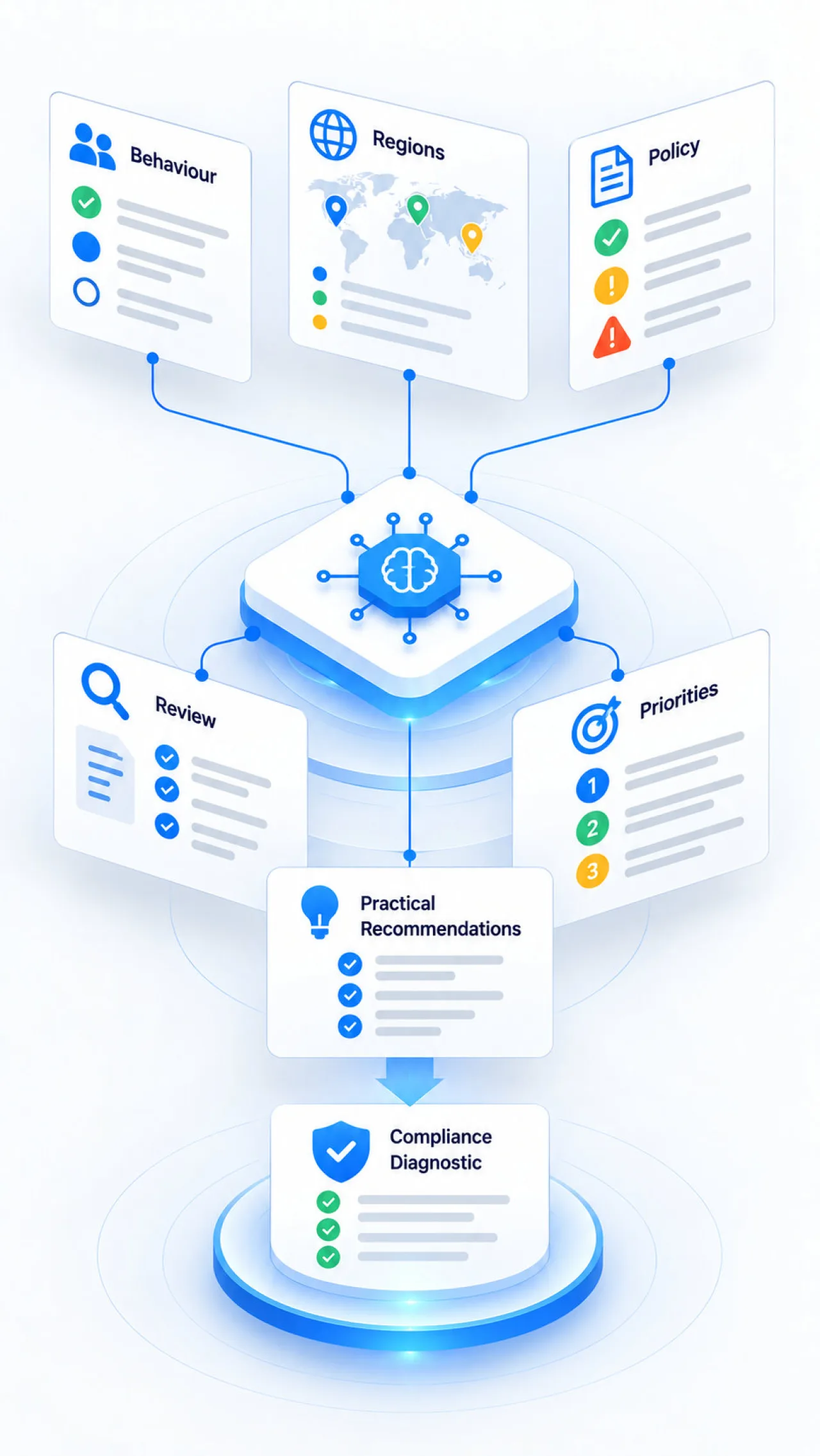
A banner can look convincing while its saved choices, tag settings and policy statements disagree. We investigate those connections: what your policy says should happen, what the implementation is expected to do, and what the permitted evidence actually shows. The result is a reviewed explanation of the discrepancies and their significance, rather than a single scanner score.
A person scopes the work and controls the AI-assisted investigation in a Desktop Workspace. Regional investigation remains part of the service where it is needed and authorised. Before checking a regional rule or exception, we agree the location method and restrictions. The report distinguishes an actual regional observation, a simulated routing condition and an unknown location, and records provider limits and untested cases. Where authorised residential-IP evidence is appropriate, its source and limitations are recorded; a simulated location is never presented as proof of real regional behaviour.
Selected scenarios can follow a visitor before choice, through acceptance, refusal or a partial choice, and back through a saved decision, withdrawal, expiry or navigation. We compare the visible controls with consent states, actual network and storage evidence, and the named recipients where access permits. A diagnostic indicator or dataLayer event supports investigation but does not prove every downstream system obeyed the choice. Unavailable server or vendor evidence stays pending with a reason, responsible owner and next step.
Policy alignment is substantive work: we compare declared purposes, vendors, exceptions and change or withdrawal instructions with behaviour. Missing approved text or unresolved legal applicability is a finding or limitation, not an invented pass. The responsible legal or policy decision maker resolves those questions; our technical report does not certify compliance. Basic and Advanced Consent Mode may produce different network behaviour, so denied storage alone is not treated as evidence of zero requests or lawful processing.
You receive expected and observed behaviour, conditions and evidence, priorities, uncertainty and proposed corrections with ways to verify them. Acceptance concerns the report and agreed coverage. Repairs and release are separate decisions, and existing useful findings can inform implementation without repeating the same investigation. Using AI here does not commission a customer AI product or authorise training on or publication of your materials.