
Published Jun 7, 2026
Google Tag Manager and the New Prefix Logic: GTM-, GT-, G-, AW- and DC- in 2026
Google’s 2026 tagging updates turn container prefixes into a runtime-governance issue. This review explains what GTM-, GT-, G-, AW-, DC-, and UA- mean, how Google tag and Google Tag Manager unification changes deployment assumptions, and what analytics teams should audit before restricted and full-capability modes drift out of sync.
Category: Analytics & Conversion Tracking · By Mikalai Sasau
This article reviews Google Tag Manager’s new prefix logic and the 2026 convergence of the Google tag and Google Tag Manager. It explains how GTM-, GT-, G-, AW-, DC-, and historical UA- identifiers affect runtime capabilities, Google-only modes, container governance, and conversion-tracking audits.
Practical default: treat the deployed identifier as a runtime capability switch, not only as an account label. Audit the ID actually loaded on every template, subdomain, and CMS integration before assuming that the tags configured inside a container can or cannot execute.
Executive summary
The June 30, 2026 notice many practitioners received should not be read as a minor implementation cleanup. Read together with Google’s container-ID behavior documentation and its May 20, 2026 announcement about Google tag and Google Tag Manager updates, it points to a larger architectural shift: Google is converging the Google tag and Google Tag Manager into a shared runtime, and the prefix in the deployed identifier is becoming a first-class switch for what that runtime is allowed to do. In plain English, the prefix is no longer just a naming convention. It is increasingly a capability flag.
Google’s own wording makes this explicit. The container ID “contains an alphabetic prefix and an alphanumeric suffix,” and “the prefix specifies the functionality that the container can execute.” Google says a GTM- prefix enables all tag types, including third-party scripts and custom HTML/JavaScript, while product-specific prefixes such as G- or AW- restrict execution to Google services only. That is the clearest public statement Google has made that the prefix is part of the runtime contract, not only an account label.
This also validates a pattern experienced analysts have been noticing for several years. Google first re-centered its web measurement stack around the Google tag in 2022, then made that tag compatible with Google Tag Manager in 2023, then started auto-loading Google tags for certain GTM event tags in 2025, and has now formally announced unification in 2026. The June 2026 notice is therefore not the beginning of the story. It is the point where the design becomes operationally visible.
The road to unification
Google telegraphed this direction as early as August 2022, when it renamed the global site tag as the Google tag and described it as “a single, reusable tag” that could be centrally managed across Google Ads and Google Analytics. In the same announcement, Google told GTM users to “stay tuned for future updates on tighter integration and upgrade paths between the Google tag and Google Tag Manager.” In hindsight, that line reads like a roadmap hint, not a throwaway sentence.
The next major step arrived on September 5, 2023. Google’s Tag Manager release notes say that the Google tag became compatible with Google Tag Manager, and that GA4 Configuration tags were automatically upgraded into Google tags. That matters because it moved GA4’s main setup object from a GA4-specific concept into a broader Google-wide tagging abstraction. From that point on, GA4 setup in GTM was already being folded into a common Google tag model.
Then, in March 2025, Google pushed the architecture further. GTM containers with Google Ads and Floodlight tags began automatically loading a Google tag first before sending events, specifically to unlock settings such as enhanced conversions, cross-domain tracking, auto-events, and user-provided data behavior from the Google tag layer. Google framed this as reliability and measurement improvement; Simo Ahava’s analysis made the practical implication clearer: Google was enforcing the dependency that Google event tags should not really operate without a Google tag context loaded first.
At the same time, Google expanded first-party delivery infrastructure through what was first called first-party mode and is now called Google tag gateway for advertisers. Release notes and setup guides show Google moving this workflow directly into GTM and Google tag settings, with Cloudflare, Google Cloud Platform, Akamai, Fastly, and Amazon CloudFront integrations. This is important because the unification is not only about the interface. It is also about the delivery path, the measurement path, and how the runtime is served from first-party infrastructure.
The formal announcement came on May 20, 2026. Google said it would soon introduce updates that “streamline your measurement setup, improve performance and management, and provide a more unified experience across Google’s tagging products.” The key sentence removes much of the ambiguity: “Your Google tags will be upgraded to fully capable Google Tag Manager containers.” That is not a cosmetic change. It is a product-line merger at the runtime level.
Unified tagging runtime flow: a page loads an identifier such as GTM-XXXXXX, GT-XXXXXX, G-XXXXXX, or AW-XXXXXX → Google’s servers return the relevant configuration → the identifier prefix determines which runtime capabilities are available → Google-only IDs send data only to Google services → GTM- mode can also execute third-party tags, Custom HTML, and custom JavaScript configured in the container.
How the runtime now works
The old mental model treated gtag.js and gtm.js as related but distinct implementations. Google’s current documentation points to a different model. The page snippet includes an ID, Google’s servers return the relevant configuration, and the prefix on that ID determines what the runtime can execute. In Google’s own help center, GTM- means the container can run all tag types, while G- and AW- are explicitly documented as Google-only modes.
This makes the prefix a security and governance boundary. If you load a GTM- identifier, the runtime is allowed to execute third-party scripts, Custom HTML, custom JavaScript, and Google-bound data transmission. If you load a Google-only identifier, the runtime is limited to sending data to Google services and will not execute other tag types. Google’s broader product distinction has existed for years: the Google tag sends data to Google services, while Tag Manager can deploy Google tags, third-party tags, and custom tags. The new prefix logic encodes that product distinction into the deployment ID itself.
There is another important layer beneath this: both systems already share core plumbing. Google’s developer documentation says that googletagmanager.com loads both Tag Manager and gtag.js functionality, and both GTM and the Google tag rely on the dataLayer object for passing events and variables. The industry intuition that Google had been collapsing these systems under one delivery domain and one event bus was correct. The public docs now say it more openly.
The 2026 optimization flow takes this one step further. Google says optimized GTM containers will be able to send data directly to Google destinations, whereas previously GTM loaded extra JavaScript, namely gtag.js, to send data to Google destinations. That means the new design is not simply “GTM plus Google tag,” but increasingly “one container runtime with destination-aware behavior,” where the old extra Google-tag layer can be collapsed away for performance.
Google has also changed the initialization model. For new deployments, Google says all snippets will be the same and will no longer include the legacy gtag('config', ...) command. Instead, initialization should be configured through a new gtm init trigger, which can optionally wait for the config command if a legacy setup must be preserved. That is another strong signal that Google is standardizing the loader and moving setup logic from page code into the container/runtime layer.
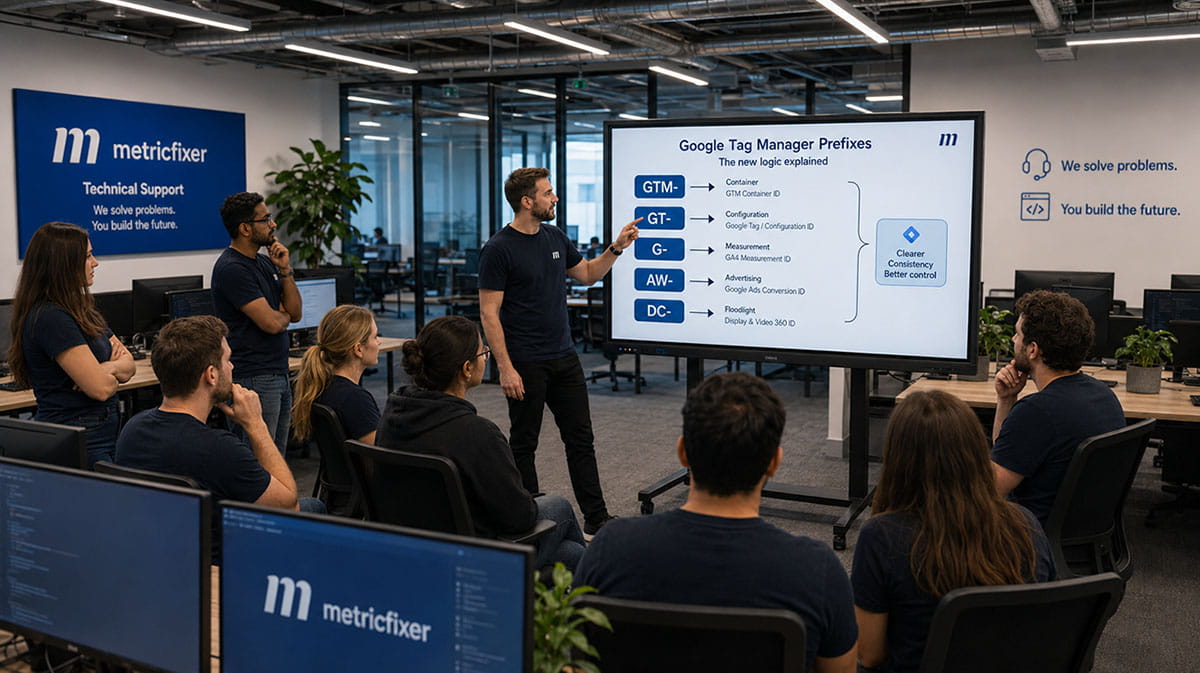
The prefix map practitioners should know
The safest way to discuss prefixes in 2026 is to separate what Google documents explicitly from what is strongly implied by the broader Google tag taxonomy.
| Prefix | What Google officially says it is | Practical meaning in 2026 |
|---|---|---|
GTM- | A Google Tag Manager container ID. | Full-capability container mode. Google explicitly says it can load third-party scripts, Custom HTML/JavaScript, and send data to Google services. |
GT- | A Google tag ID. Google says each newly created Google tag gets a GT- prefix. | The newer generic Google tag namespace. It belongs to the Google tag family and can be interchangeable with other IDs attached to the same Google tag, but Google has not published a separate GT- behavior matrix on the container-ID help page. |
G- | A Google tag legacy prefix used for GA4 tags. | Google explicitly says a container loaded with G- is limited to Google tags only. It is also a legacy-prefix alias in the Google tag family. |
AW- | A Google tag legacy prefix used for Google Ads tags. | Google explicitly says a container loaded with AW- is limited to Google tags only. In practice, Google Ads setups increasingly assume a Google tag exists before Ads event tags fire. |
DC- | A Google tag legacy prefix used for Floodlight tags. | Part of the same Google tag ID family. Floodlight documentation uses DC- in Google tag snippets, but Google’s new container-ID page does not separately enumerate DC- behavior; the Google-only interpretation is strongly implied, not separately spelled out there. |
UA- | A Universal Analytics tag/property ID. Google says Universal Analytics tags are not compatible with the Google tag. | Historical only. Relevant for audits, migrations, and old templates, not for current Google tag architecture. |
Two additional details matter in practice. First, Google says a single Google tag can have multiple tag IDs, and those IDs can be interchangeable when adding the Google tag to a website. Second, Google’s developer docs say the ID in the script source URL is the one that “controls” the Google tag, and that some features depend on that controlling product/account. Prefixes are therefore not only aliases; they also carry product lineage and control semantics.
What the June 30 change likely means
The public documentation does not reproduce the exact migration logic described in the account-specific email, so the safest interpretation is this: Google has identified accounts where a GTM container exists, but some pages are loading it in a more restrictive configuration that suppresses part of the container’s behavior. The public container-ID help page explains the mechanism behind that suppression. The May 2026 unification docs explain the strategic direction. Put together, the most plausible reading is that Google intends to reduce the mismatch between what the container contains and what the page-level deployment currently allows it to do.
For practitioners, the critical business consequence is simple. If a container includes non-Google tags that are currently dormant on some templates, subdomains, or CMS-managed pages because those pages are effectively running the container in a Google-only mode, then runtime normalization could cause those tags to begin executing where they were previously suppressed. That is why the email’s practical warning matters so much more than its polite wording: the issue is not just tracking fidelity, but unexpected tag activation.
There is precedent for Google enforcing dependencies in the loader rather than in the interface. The March 2025 change for Ads and Floodlight tags did precisely that: GTM auto-loaded a Google tag as a network action when one was missing, so event tags could inherit the full Google tag configuration. As Simo Ahava pointed out, nothing visibly changed in the container itself, but the runtime behavior changed materially. The June 2026 notice looks consistent with that same pattern of “runtime correction over interface warning.”
The one thing we should not overclaim is that Google has publicly said tagmanager.google.com will become the only tagging interface. It has not. What Google has said is more precise: Google tags are becoming fully capable GTM containers; optimized GTM containers will link to Google destination accounts; and those containers become directly visible and manageable within other Google product interfaces. That is convergence for sure, but a single permanent UI endpoint remains an informed inference, not an announced roadmap item.
Why this points to a unified control plane
The strongest evidence for convergence is not one announcement, but the way Google now exposes tagging across products. You can open Google tag settings from Google Ads, Google Analytics, Campaign Manager 360, and Google Tag Manager. Google Ads Data Manager also includes Google tag management directly in its interface. That is not a classic “separate products linked together” model anymore. It is a multi-entry control plane over the same tagging objects.
Google is reinforcing that control plane with visualization and governance features outside classic GTM as well. Data Manager’s map view now supports “Google tags,” including both Google Tag Manager and Google Tag containers, and shows how data sources connect to destinations. Meanwhile, the 2026 GTM update introduces a centralized Settings tab, a data flow map, simplified user access, and a visual tagging workflow in Tag Assistant for no-code conversion setup. All of these features make more sense if Google is thinking in terms of one measurement graph with multiple front ends, rather than several independent tagging products.
There is also a delivery-layer argument for the same conclusion. Google tag gateway for advertisers now sits directly inside GTM and Google tag settings, lets marketers serve Google scripts from their own domain, and explicitly affects how tags are requested and how measurement events travel to Google. Once script delivery, event routing, user access, consent controls, destination mapping, and debugging live in the same family of surfaces, the old distinction between “GTM” and “the Google tag” becomes less operationally meaningful.
That is why the prefix story matters. In the old world, a prefix mostly told you which product issued the identifier. In the new world, the prefix increasingly tells the runtime how much authority it has on the page. That is a deeper architectural role, and it explains why Google has spent several years normalizing IDs, destinations, settings inheritance, and UI entry points.
What teams should audit now
If you manage mature GTM estates, the immediate priority is not to rewrite everything. It is to find mismatches. Audit which identifier is actually deployed on each page group, template family, subdomain, and CMS integration, then compare that to what the underlying container contains. If you find a container with non-Google tags being loaded through a Google-only ID path on some pages, treat that as a live governance risk rather than a documentation oddity. Google’s own help center now says the deployed ID can change runtime capabilities.
The second priority is to make Google-bound event flows explicit. Google recommends implementing the Google tag in GTM for Ads products, and Tag Assistant / Tag Diagnostics warnings now reflect missing Google tag foundations for event tags. In practice, old “event-only” Google setups with no clear config/tag foundation are now a technical-debt category, not merely a stylistic preference.
The third priority is governance. If you truly want a container to remain Google-only, do not rely on habit or naming alone. Remove non-Google tags from that container, or separate them into a different deployment model. If, on the other hand, you need a full GTM container, standardize on the GTM- deployment path and document that choice. Google’s own examples now frame that switch as the way to move between restricted and fully capable modes.
Finally, remember that the prefix is not the only governance layer available. GTM still supports gtm.allowlist and gtm.blocklist in the data layer, which can override container configuration at page level and block specific tag types even if they are configured in the container. For enterprise teams, that remains a valuable backstop when legal, performance, or platform teams need harder controls than editorial process alone can provide.
A practical audit should include the following checks:
- Inventory deployed IDs. Crawl templates, page groups, subdomains, embedded checkout flows, CMS blocks, landing-page builders, and legacy microsites to see which ID is actually loaded in production.
- Compare deployed mode with container content. A container that includes third-party tags but is loaded through a Google-only identifier is a mismatch; a container that is meant to be Google-only but still contains Custom HTML or vendor tags is also a mismatch.
- Map Google-bound dependencies. Identify Google Ads, Floodlight, and GA4 event tags that depend on Google tag configuration for enhanced conversions, cross-domain settings, auto-events, user-provided data, or consent behavior.
- Decide the intended authority level. Document which properties should run full-capability
GTM-mode and which should remain restricted to Google services only. - Apply page-level backstops where needed. Use
gtm.allowlistandgtm.blocklistwhen compliance, security, or platform teams need hard controls beyond container review. - Retest with operational tools. Use Tag Assistant, Tag Diagnostics, browser network logs, and controlled preview environments to confirm which scripts execute after deployment changes.
Open questions and limitations
Some important details remain under-documented in public. Google has publicly documented the capability split for GTM- versus product-specific examples such as G- and AW-, but it has not published a full container-behavior matrix for every Google tag prefix on the new help page, especially GT- and DC-. Those prefixes are officially documented as Google tag IDs, but their exact deployment semantics in the new container-ID model are partly inferred from the broader Google tag taxonomy.
Likewise, Google’s May 20, 2026 announcement says optimization is opt-in and gives no fixed general rollout date for the optimization banner, while account-specific emails reference June 30, 2026 behavior changes. That suggests Google may be applying some runtime corrections to affected accounts separately from the opt-in container optimization flow, but the exact server-side migration logic has not been fully described in public documentation. That is the main technical ambiguity still left on the table.
The broader conclusion, however, is already solid. Google has spent several years turning prefixes, IDs, destinations, settings, and delivery paths into components of one unified tagging architecture. The 2026 notices did not invent that architecture. They simply made it impossible to ignore.
Methodology and sources
This article is based on a review of a source research document prepared for Metricfixer, Google’s public Google Tag Manager and Google tag documentation available on 6 June 2026, Google Tag Platform developer materials, Google Ads / Campaign Manager help pages, and Simo Ahava’s technical analysis of the 2025 auto-loading change. The exact account-specific June 30 email is treated as implementation context, not as a substitute for public Google documentation.
- Google Tag Manager Help: Manage tagging behavior using the container ID
- Google Tag Manager Help: Updates to Google tag and Google Tag Manager
- Google Blog: Simplifying measurement with the Google tag
- Google Tag Manager Help: Release notes
- Google Developers: Analyze existing tag configurations
- Google Developers: Configure Google products and send event data
- Google Developers: Google tag API reference
- Google Tag Manager Help: Google tag ID definition
- Campaign Manager 360 Help: Use the Google tag for Floodlight activities
- Google Ads Help: Configure your Google tag settings
- Google Ads Data Manager Help: Data manager map view and Google tags
- Google Tag Manager Help: Set up Google tag gateway for advertisers in Google Tag Manager with Cloudflare
- Google Developers: Set up Google tag gateway for advertisers
- Google Developers: Restrict tag deployment in Google Tag Manager
- Simo Ahava: Clarification on GTM auto-loading the Google tag for Ads and Floodlight
This article is for technical and operational information only. metricfixer is not affiliated with Google, Google Tag Manager, Google Ads, Campaign Manager 360, Google Analytics, Simo Ahava, or other third-party platforms and publishers mentioned in the article. Google documentation, tagging behavior, product interfaces, consent controls, diagnostics, and runtime capabilities may change after publication; production changes should be validated in the relevant account and deployment environment.