
Published Jun 3, 2026
Ringostat in Context: Call Tracking, GTM, dataLayer, and Conversion Analytics Compared
A practical comparison of Ringostat, Nimbata, CallRail, CallTrackingMetrics and Invoca for businesses that need reliable call tracking, GA4-ready attribution, GTM/dataLayer flexibility, CRM integrations, and better visibility into phone-call conversions.
Category: Analytics & Conversion Tracking · By Mikalai Sasau
This article compares Ringostat, Nimbata, CallRail, CallTrackingMetrics, and Invoca from an analytics and conversion-tracking perspective, with special attention to call attribution, Google Tag Manager, dataLayer event routing, CRM/ad integrations, pricing transparency, and practical fit for SMB, agency, mid-market, and enterprise tracking stacks.
Executive summary
Ringostat is not just a call-tracking tool; it is a broader
communications-and-attribution stack that combines cloud telephony,
dynamic call tracking, callback, AI-assisted call analysis, CRM/ad
integrations, reporting, and end-to-end analytics in one platform. Its
most unusual differentiator in this comparison is publicly
documented native support for pushing call events into
dataLayer for Google Tag Manager at multiple call
moments—before the call, at pickup, and after the call—using
custom JavaScript functions in the Ringostat UI. In the public
documentation I reviewed, Ringostat was the only vendor in this
group that explicitly documents browser-side
dataLayer.push(...) for call events rather
than using GTM mainly for tag deployment, server-side tracking, or
direct destination integrations.
In terms of service breadth, Ringostat is materially broader than a lightweight tracker such as Nimbata because it bundles business telephony features, IVR, recordings, callback, chat, CRM-linked workflows, and analytics/reporting alongside call tracking. However, it remains narrower than the most enterprise-heavy platforms in this set—especially Invoca, and in some operational areas CallTrackingMetrics—when you look at enterprise governance, contact-center depth, and the scale of premium integrations and AI workflows.
In terms of quality, the evidence is favorable but mixed in maturity and market footprint. Ringostat publicly claims 97% call-tracking accuracy and documents mechanisms such as highlighted dynamic pools, automatic pool sizing, and number-hiding logic to sustain attribution quality during traffic spikes. Reviews on G2 are very positive overall, but the external English-language review base is much smaller than for CallRail, CTM, or Invoca, and heavily concentrated in Europe. That means Ringostat looks strong, but the public signal is less statistically robust than for the larger North American vendors.
My bottom-line recommendation is this: choose Ringostat when
phone calls are a core revenue channel and you need both attribution and
operational telephony, especially if GTM/dataLayer flexibility
matters. Choose Nimbata when you mainly need
cost-efficient attribution, simpler setup, and lower upfront costs, and
you do not need Ringostat’s broader phone-system layer or
native dataLayer event pattern.
CallRail is the safer SMB default in North America; CTM is the stronger
choice for highly customized routing and workflow-heavy setups; Invoca
is the highest-end choice for enterprise marketing + contact-center
orchestration.
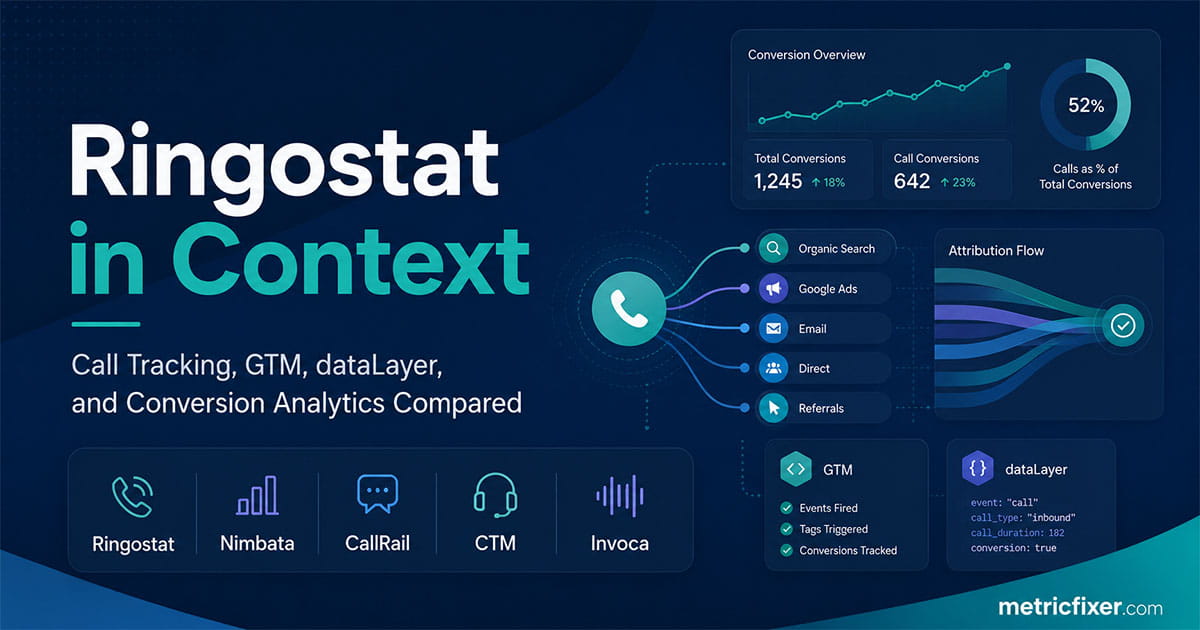
Ringostat feature inventory
Ringostat’s public product surface spans call tracking, cloud telephony, callback, online chat, call recordings, AI recommendations, call transcription, AI call quality assessment, business phone apps, integrations, and analytics. The pricing page presents seat-based telephony plans—Basic, Pro, and Corporate—with Basic positioned around cross-platform telephony and CRM integration, Pro adding call transcription, AI call quality assessment, online chat, callback, and advanced reporting, and Corporate adding power dialer, custom CRM integrations, automated missed-call handling, a dedicated account manager, and priority support. The public homepage and feature pages also highlight local and international numbers, IVR, call recording, click-to-call, call queuing, and business-hours controls.
On the call-tracking side, Ringostat documents a fairly mature attribution layer. It markets 97% accuracy, uses highlighted dynamic pools so each advertising channel can have its own number pool, automatically monitors traffic and recommends the number of tracking numbers required, and offers a “Call Us” button that hides the number until intent is high in order to preserve pool efficiency during spikes. It also supports call tagging/segmentation, custom reports with 30+ parameters, and centralized access to call recordings through the call log.
On the analytics and attribution side, Ringostat supports end-to-end analytics with ad-cost ingestion from Google Ads and Facebook and CRM revenue/deal connections via supported CRMs. Its end-to-end analytics page says it can use Ringostat’s own “Event-Driven” attribution model and can also support classic attribution models where that fits the business better. The integrations and knowledge-base pages show CRM support including Bitrix24, retailCRM, amoCRM, Pipedrive, Salesforce, Zoho CRM, and HubSpot, with additional analytics/ad integrations for Google Analytics, Facebook Pixel, OWOX BI, Google Ads, Facebook, and Instagram, plus API and webhooks. The integrations page markets 30+ integrations.
On the operational telephony side, Ringostat clearly goes beyond “just tracking.” Its business-phone positioning includes IVR, call recording, call queuing, local and international numbers, click-to-call, and a Smart Phone app; its security and utilities pages add backup destinations, access controls, spam protection, blacklists, callback anti-spam, and mobile/desktop usage. In practice, this places Ringostat closer to a hybrid of call tracking and a lightweight cloud phone system than to a narrow attribution-only tool.
On APIs, webhooks, support, and compliance, Ringostat’s documentation is solid for an SMB/mid-market platform. It exposes API/webhook routes, says webhook authorization supports Basic Authentication and OAuth 2.0, and markets GDPR compliance, SSL encryption, backups, TLS 1.2+ for the Smart Phone app, and ISO/IEC 27001:2022 compliance for that app. Its public feature pages also emphasize prompt technical support and proactive customer success; the Corporate plan adds dedicated account management and priority support. What it does not publicly match is the breadth of enterprise compliance language offered by Invoca or CallRail.
Public pricing is partly transparent and partly modular. Ringostat publicly lists seat-based plans at roughly €17 / €28 / €41 per user per month billed annually on the pricing page, with minimum user counts, while some page snippets render the same numerals with dollar symbols depending on region/rendering. The practical total cost for a call-tracking deployment is therefore not fully reducible to a single public number, because seats, tracking numbers, minutes, and optional modules affect the final price. That makes Ringostat less transparent than Nimbata and CTM, but more transparent than Invoca’s quote-only model.
dataLayer and GTM support
Ringostat’s clearest technical differentiator is its
documented custom-JS integration layer for GTM. In
Ringostat’s knowledge base, the platform explicitly says it can send
events to Google Tag Manager so that “almost any service that requires
script execution” can be triggered, and it explains
dataLayer specifically as the object used to pass call
events into GTM. Ringostat lets the user choose when to send the
event—before call, at pickup, or after call—and then
define a custom function. It also documents filtering logic based on
call and attribution parameters such as Insertion_type,
Type, Unique_call, Source,
Medium, Campaign, Keyword,
Last_Page, and Visitor_UUID (its GA Client ID
field).
A simplified implementation pattern, based on Ringostat’s documented flow, looks like this:
if (Insertion_type === 'callback') { dataLayer.push({ event: 'RingostatCallback' });
}
That event can then trigger any GTM tag you choose: GA4, Meta Pixel, DV360, Floodlight, custom HTML, Measurement Protocol relays, or a custom endpoint. Ringostat even documents adjacent examples for GA4 and Facebook Pixel that rely on this same GTM/custom-event pattern.
The key technical caveat is important: Ringostat explicitly warns
that GTM cannot track offline events, so these
browser-side events fire on the visitor side. If the visitor has already
closed the site when the call happens, the event will not be sent then;
Ringostat says it may be sent later if the visitor reopens the site on
the same device within 24 hours. In other words, the
dataLayer path is powerful but not a perfect mirror
of the telephony journal; it is a browser-mediated event
stream.
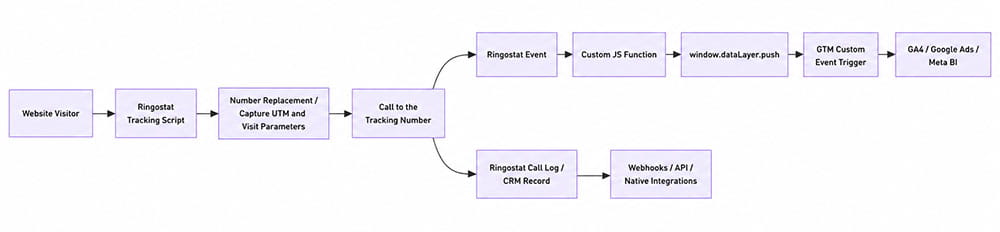
That architecture is the main reason Ringostat is unusually flexible
for advanced measurement stacks: it gives analysts a browser-side bridge
from call event → dataLayer → GTM
→ any compatible destination.
By comparison, the other vendors in this report look different:
| Vendor | Native browser-side call-event push to dataLayer for
GTM |
What the public docs show |
|---|---|---|
| Ringostat | Yes, explicitly documented. | Custom JS functions can call dataLayer.push(...);
supports event timing selection and filtering by attribution/call
parameters; GTM then triggers downstream tags. |
| Nimbata | Not publicly documented as a native call-event
dataLayer output. |
Public docs show a GTM template for installing the DNI script and
server-side GTM support; Nimbata also sends call events to GA4 as
nimbata_call or a custom event name, but I did not find
public docs showing a browser-side dataLayer.push for
completed calls. |
| CallRail | No public native dataLayer
call-event doc found. |
Official docs use GTM to install the JS/DNI snippet; CallRail’s GA4 integration sends calls, texts, chats, and forms directly to GA4 events. A community feature request asks for GTM custom-event firing, which suggests this is not the standard documented path. |
| CallTrackingMetrics | No public native dataLayer
call-event doc found. |
Official docs show GTM for installing the CTM tracking code, GA4
events sent via CTM triggers, and webhooks/API for custom plumbing.
Public docs emphasize direct actions and developer endpoints, not
browser-side dataLayer.push for call events. |
| Invoca | No public native post-call dataLayer
output doc found in accessible public pages. |
Public snippets show GTM/dataLayer being used to expose GA Session ID to Invoca and rerun the Invoca tag; public product docs emphasize direct GA4/ad-platform events, APIs, and webhooks. That suggests GTM/dataLayer is mainly used to enrich Invoca attribution rather than to have Invoca emit browser-side call events to GTM. |
The practical implication is straightforward: if your
measurement design specifically depends on call events entering
dataLayer first and then being routed through GTM
wherever you want, Ringostat is the strongest documented fit in this
comparison. The others can still reach many destinations, but
primarily through their own direct integrations, server-side workflows,
triggers, or APIs/webhooks rather than a public browser-side
dataLayer pattern.
Ringostat vs Nimbata, CallRail, CTM, and Invoca
| Platform | Service breadth and quality | GTM / dataLayer support |
Public pricing | Best fit | Main trade-offs |
|---|---|---|---|---|---|
| Ringostat | Broad SMB/mid-market stack: cloud phone, IVR, call recording, callback, chat, call tracking, end-to-end analytics, AI call QA/recommendations, 30+ integrations. Strong operational telephony layer for a tracker. | Best documented dataLayer
support in this set. Native custom JS can push call
events into GTM at chosen call moments, with parameter-based filtering.
|
Public seat-based plans roughly €17 / €28 / €41 per user/month billed annually, plus numbers/usage and modular deployment variables. Exact total call-tracking cost is partly usage-dependent. | SMBs, agencies, and mid-market businesses that need both attribution and telephony workflows, especially if GTM flexibility matters. | Smaller English review footprint; pricing is less transparent than Nimbata/CTM for a full deployment; less enterprise governance depth than Invoca/CallRail. |
| Nimbata | Leaner call-tracking-first platform with DNI, routing, recordings, IVR, workflows, AI tagging/scoring, CRM/ad integrations, and agency tooling. Strong value orientation. | GTM template for DNI install and sGTM setup are documented; no
public native browser-side call-event dataLayer push found.
|
Transparent and cheaper entry: $0 + usage, $35–39, $80–89, $120–149 plus usage, billed differences by term. Charges per answered call, not per minute. | Cost-conscious SMBs and agencies that mainly want attribution, routing, and integrations without a full phone-system layer. | Fewer telephony/communications-layer features than Ringostat or CTM; high-usage economics still depend on numbers and answered-call volume. |
| CallRail | Very mature SMB/agency lead-engagement platform for calls, texts, forms, conversation intelligence, and AI voice assist; strongest independent review volume in this group. | GTM is documented mainly for installing the JS/DNI snippet; GA4
receives direct events from CallRail. No public native
dataLayer call-event doc found. |
Public pricing around $50–55/month plus usage for entry call tracking; $95 and $150 tiers for richer tracking and conversation intelligence; Voice Assist starts at $95/month plus overage logic. | North American SMBs/agencies that want fast implementation, strong market proof, and good native lead-engagement tooling. | Less transparent/native GTM event flexibility than Ringostat; some users cite integration gaps and learning-curve/UI issues. |
| CallTrackingMetrics | Broadest mid-market customization layer here: attribution, IVR, routing, softphone, triggers, AskAI, outbound tech, agency subaccounts, API/webhooks. Very strong operational flexibility. | GTM install is documented, but public docs point to CTM triggers,
direct GA4 actions, webhooks, and API rather than native
dataLayer call-event output. |
Transparent tiering: $79/$65/$60 Marketing Lite, $179/$149/$135 Marketing Pro, $329/$274/$247 Sales Engage, $1999 Enterprise, plus usage. | Mid-market and advanced agencies needing high routing/workflow control or one platform for marketing + call-center ops. | More complexity and a steeper learning curve than Ringostat, Nimbata, or CallRail. |
| Invoca | Highest-end enterprise option here: dynamic numbers, custom/advanced IVR, custom Signals, AI QA, PreSense, rich ad/social integrations, SAML, sandbox, SIP, enterprise compliance. | Public docs point to GTM/dataLayer mainly for tag deployment and
exposing identifiers to Invoca; destinations are handled through direct
integrations, APIs, and webhooks. No public native post-call
dataLayer push found. |
Custom quote only. Public page exposes packaging and included number/Signal allowances but not prices. | Enterprise brands, regulated industries, multi-location businesses, and contact centers with large call volumes and sophisticated AI/routing needs. | Price opacity, heavier implementation, and likely too much platform for teams that only need basic call attribution. |
On “volume of services,” the ranking is roughly: Invoca and CTM at the top for breadth/depth in enterprise or workflow-heavy setups; Ringostat in the middle but unusually broad for its likely target market because it combines telephony and attribution; CallRail broad for SMB lead management but less telephony-operational than Ringostat/CTM; Nimbata intentionally leanest and most price-efficient. On “quality,” the safest public proof points are CallRail/CTM/Invoca because of their much larger verified review bases; Ringostat’s service quality looks good, but the body of English-language third-party evidence is much smaller.
Reviews and case-study evidence
Ringostat’s public review profile is positive but thinner than that of larger rivals. On G2 it has 4.9/5 from 48 reviews, with the review summary emphasizing call tracking, analytics, and responsive support; the same page also notes complaints around interface intuitiveness and dated UX. Importantly, 47 of the 48 G2 reviews are from Europe, so the English-language review signal is geographically concentrated. TrustRadius exposes only 3 reviews, where the visible downside comments include price sensitivity for smaller firms and incomplete end-to-end analytics support for some use cases. Trustpilot shows only 4 reviews, all 5-star at the time of the snippet—useful as a signal, but too small a sample to weigh heavily.
The clearest recurring praises for Ringostat are: accurate source attribution, useful call analytics, real-time CRM synchronization, call recordings, and support that helps shape setup around the business rather than just handing over software. G2’s synthesized summary emphasizes call tracking, analytics, and support; individual reviews mention recorded conversations, budget optimization, and business-specific recommendations. TrustRadius reviewers specifically mention being able to identify lead sources, avoid buying a separate virtual PBX, and eliminate missed-call problems.
The recurring complaints are narrower: the interface feels dated or less intuitive than newer SaaS products, some functions are buried in menus, and the value proposition becomes weaker when a business does not rely heavily on phone calls. One G2 reviewer also frames Ringostat’s end-to-end analytics as mainly suitable for businesses where phone communication is central, which is less a defect than a fit issue. TrustRadius also surfaces price sensitivity for smaller companies.
The best official case evidence I found is Ringostat’s 2024 Verseo case study. There, Verseo reports that Ringostat integrated well with HubSpot, Google Analytics 4, and Google Ads; call-source data and recordings were transferred into CRM entities in real time; and after using Ringostat’s data to optimize a specific group of call-oriented ads, the number of calls increased by 5%. Verseo’s Head of Marketing explicitly praised the integration configurability and real-time data transfer without interruptions. That is vendor-controlled evidence, so it should be treated as directional rather than impartial—but it is still a useful proof point of implementation quality.
When you compare public review scale across vendors, Ringostat is the clear outlier in smaller review volume: G2 lists 48 reviews for Ringostat versus 1,715 for CallRail, 758 for CTM, and 967 for Invoca. That does not prove Ringostat is worse; it does mean that the external reputation picture is less mature and should be interpreted with more caution. Nimbata’s public review base is also smaller than the big U.S. players, but Capterra shows 4.7/5 from 27 reviews and very positive sentiment around support, ease of use, and affordability.
For broader market sentiment, the larger vendors show familiar patterns. CallRail’s G2 summary centers on ease of use, reporting, and straightforward setup, with complaints around integration limitations and some UI/learning-curve issues. CTM’s reviews consistently praise customization, attribution, reporting, and support, but also warn about complexity and knowledge barriers. Invoca’s G2 summary is strongest on customer support, analytics, and attribution accuracy, but also surfaces learning curve and setup complexity. That context matters because it shows Ringostat’s biggest public weakness is not review negativity but review scarcity.
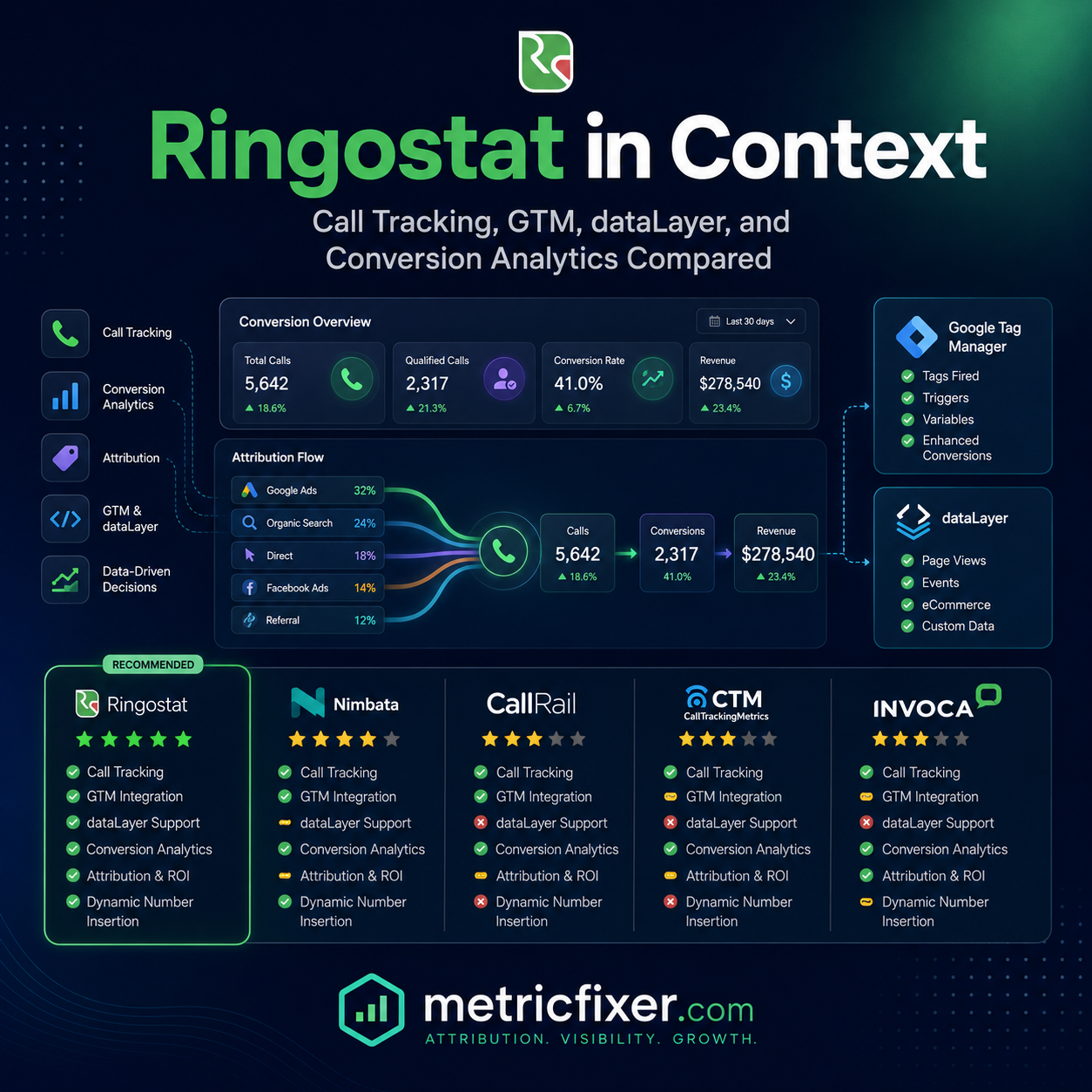
Recommendations by use case
Ringostat is the recommended choice for businesses
where phone calls are a serious revenue event, where marketers and
sales/ops both need the same system, and where GTM-centric measurement
architecture matters. That includes digital agencies, call-heavy
e-commerce categories, healthcare providers, real-estate teams,
education, automotive, and local multi-location services that need a
combination of attribution, IVR/routing, recordings, CRM workflows, and
reporting. The strongest fit is SMB to mid-market
rather than very small microbusinesses or very large contact-center
enterprises. The documented dataLayer/GTM path is
especially attractive if your analysts want to route call events into
custom tags, multiple ad platforms, or bespoke measurement endpoints
without waiting for a native integration roadmap.
Ringostat is also a good fit when one platform replacing several tools creates economic value. TrustRadius feedback specifically mentions not needing a separate virtual PBX, and Ringostat’s own stack includes telephony, tracking, callback, recordings, and AI features. If you would otherwise buy a call tracker plus a small cloud phone system plus some CRM glue, Ringostat’s broader bundle can be financially rational even if its sticker price is not the absolute lowest.
Nimbata is the better choice when you mainly need attribution and lead-quality visibility at a lower price point, especially for small agencies, single-brand SMBs, or lean in-house teams. Its pricing is more transparent, it starts lower, it charges per answered call rather than per minute, and reviewer sentiment is strongly positive on support and ease of setup. If your core requirement is “show me which campaigns/keywords/pages drive calls, get those outcomes into GA4/Ads/CRM, and don’t make this expensive,” Nimbata is very hard to ignore. The main reasons not to choose it over Ringostat are if you need a richer phone-system layer, more built-in call-center operations, or the explicit GTM/dataLayer event model.
CallRail is the safer default for North American
SMBs and agencies that want the largest body of market validation, easy
onboarding, mature lead tracking across calls/texts/forms, and
reasonable pricing transparency. If your measurement stack can live with
direct GA4 and ad-platform integrations rather than browser-side
dataLayer call events, CallRail is often the low-friction
choice. I would prefer Ringostat over CallRail only when telephony depth
or GTM/dataLayer flexibility is a deciding requirement.
CallTrackingMetrics should win when your business has more complex call flows, multiple subaccounts, heavier inbound/outbound processes, or stronger needs around workflow automation, softphone, advanced routing, and developer extensibility. It is the most obvious step up from Ringostat for organizations that are outgrowing a simpler call-tracking deployment and want one system spanning marketing attribution and more serious call-center/sales operations. The trade-off is complexity: CTM’s own review ecosystem repeatedly describes a learning curve and knowledge barrier.
Invoca should win when the business is enterprise-scale, highly regulated, multi-location, or contact-center intensive. Its public product and security pages are clearly oriented toward enterprise routing, Signal AI, QA at scale, SAML, premium integrations, and very strong compliance language. If you need contact-center orchestration plus marketing attribution plus enterprise governance, Invoca is the class leader here—but if you are asking whether Ringostat or Nimbata is the better fit, Invoca is probably unnecessary unless your scale and governance requirements are unusually high.
Open questions and limitations
Some pricing details remain partly unspecified or region-dependent. Ringostat’s public pricing is transparent at the seat-plan level, but the total cost of a live call-tracking deployment depends on numbers, minutes, and selected modules; the page also renders different currency symbols depending on region/context. Invoca is quote-based, so exact price comparisons are impossible from public materials alone.
For non-Ringostat GTM/dataLayer support, my
conclusion is intentionally narrow: I did not find public
documentation showing native browser-side call-event pushes
into dataLayer for Nimbata, CallRail, CTM, or Invoca. That
is not proof that custom or private implementations are impossible; it
is a statement about what is publicly and explicitly documented in the
sources reviewed.
Finally, Ringostat’s third-party English-language review corpus is much smaller than the major U.S. vendors’, so conclusions about long-run market reputation should be treated as positive but lower-confidence than equivalent conclusions for CallRail, CTM, or Invoca.
Methodology and sources
This article is based on a review of official product pages, pricing pages, help-center materials, integration documentation, marketplace/review pages, and publicly available case-study evidence for Ringostat, Nimbata, CallRail, CallTrackingMetrics, and Invoca. The goal is not to reproduce vendor marketing pages, but to summarize the operational consequences for analytics, conversion tracking, GTM/dataLayer workflows, call attribution, CRM integration, and platform selection.
- Ringostat official materials reviewed for call tracking, cloud telephony, pricing, GTM/dataLayer documentation, integrations, security, reviews, and case-study evidence.
- Nimbata official materials reviewed for call tracking features, pricing, GTM installation, server-side GTM support, and positioning against broader telephony platforms.
- CallRail Google Tag Manager documentation and CallRail pricing materials reviewed for GTM installation, GA4 event routing, pricing, and SMB/agency positioning.
- CallTrackingMetrics Google Tag Manager documentation and CTM pricing materials reviewed for GTM deployment, workflows, triggers, routing, and mid-market fit.
- Invoca GTM/dataLayer documentation and Invoca pricing materials reviewed for enterprise packaging, dataLayer usage, API/webhook positioning, and contact-center fit.
- G2 Ringostat reviews, TrustRadius Ringostat reviews, and comparable public review pages for CallRail, CTM, and Invoca reviewed as third-party reputation signals.
This article is for technical and operational information only. metricfixer is not affiliated with Ringostat, Nimbata, CallRail, CallTrackingMetrics, Invoca, Google, Meta, or other third-party platforms mentioned in the article. Platform capabilities, pricing, integrations, and documentation may change after publication.