
Published Aug 4, 2026
Server-Side GTM Benchmarked: What It Really Improves—and What It Does Not
Server-side GTM can reduce browser work, improve first-party data controls, and make some identifiers more durable—but it cannot recover events the server never receives or make tracking invisible. This controlled benchmark separates measurable gains from common sales claims.
Category: Analytics & Conversion Tracking · By metricfixer Expert Team
Server-side Google Tag Manager is often sold as a single answer to ad blockers, missing conversions, slow pages, short-lived cookies, weak attribution, and visible Google requests. This study tests those claims separately. It compares a conventional browser-heavy setup, a proxy-only server-side setup, and a consolidated server-side event flow on the same page, then checks the result against current browser privacy behavior, consent requirements, filter lists, Google Analytics opt-out behavior, and infrastructure costs.
Practical default: adopt server-side GTM when you have a defined need for first-party collection, payload validation, consent enforcement, data enrichment, or server-side fan-out. Do not deploy it only to replace a Google hostname with your own. A changed endpoint alone does not make tracking complete, compliant, fast, or unblockable.
Executive summary
Server-side Google Tag Manager can create real technical value, but the value is narrower and more conditional than many implementation pitches suggest. Its strongest benefits are control over the measurement pipeline, fewer browser-side vendor requests when the architecture is genuinely consolidated, server-side validation and redaction, and more durable first-party cookies in correctly configured same-origin deployments.
It is not a universal recovery layer. A server container can process only an event that reaches it, or an event independently generated by a backend system. It cannot reconstruct a click, form submission, consent state, referral source, or browser purchase event that was never generated and is unknown to the server. Moving an endpoint behind a first-party domain can improve delivery against simple hostname-based blocking, but current privacy lists already contain rules for server-side GTM hosts, paths, parameters, and common hosting patterns. A custom domain therefore reduces one class of blocking; it does not make the collection flow invisible.
The controlled benchmark produced two very different server-side outcomes:
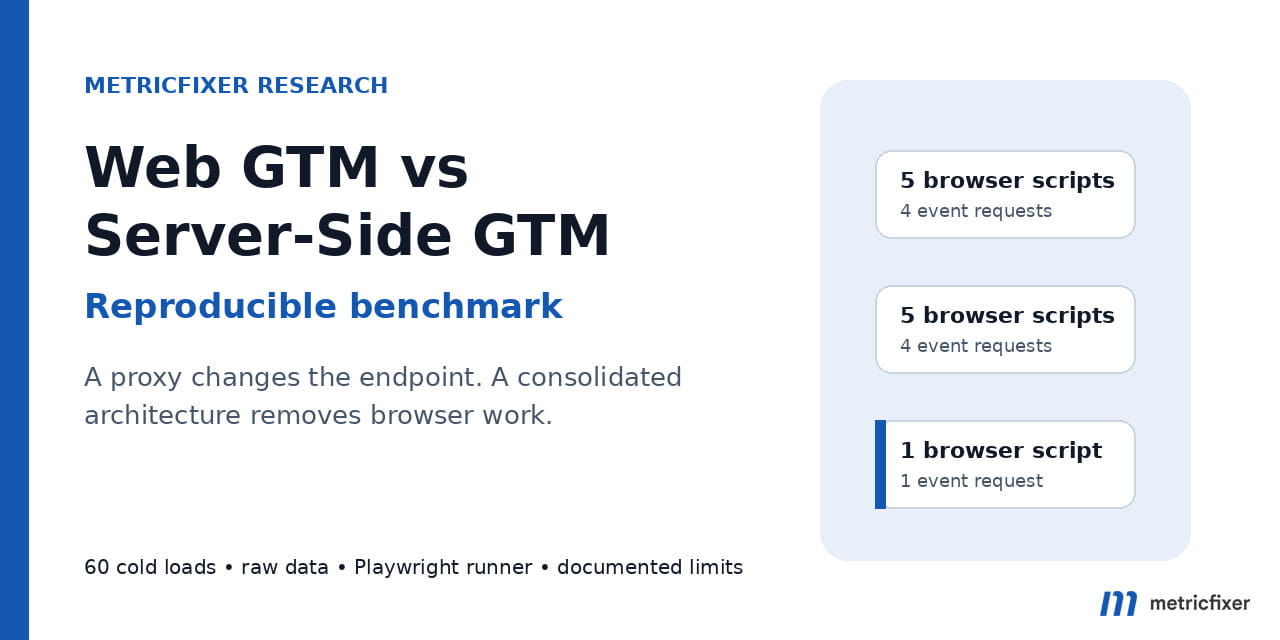
- Proxy-only sGTM: the browser still loaded the same five JavaScript resources and sent the same four measurement requests. Median request count, JavaScript bytes, page load time, Largest Contentful Paint, and Total Blocking Time were effectively unchanged from the web GTM-style setup.
- Consolidated sGTM: four browser vendor libraries and four outbound event requests were replaced by one small dispatcher and one first-party event request, while the server produced four logical downstream deliveries. In this fixture, browser requests fell by 63.6%, JavaScript transfer by 88.3%, median LCP by 29.4%, and median load time by 29.5%.
Those percentages are not a forecast for every website. They describe this controlled test page. The transferable finding is architectural: server-side tagging improves performance only when it removes browser work. Repointing the same browser tags to a new hostname does not do that.
The same conditional logic applies to cookies and attribution. A same-origin server endpoint can set an HttpOnly cookie that is not subject to WebKit's specific seven-day cap for cookies created through document.cookie. But Safari can still limit cookies associated with CNAME cloaking, users can clear storage, private browsing remains restrictive, consent can prohibit storage, and new anti-fingerprinting defenses continue to evolve. Attribution may improve when click identifiers, client identifiers, consent state, and transaction data are preserved and normalized. It may become worse when a migration creates duplicate events, mismatched client identifiers, missing session data, or incorrect server-container routing.
Claim-by-claim verdict
| Common claim | Verdict | What sGTM can genuinely improve | What it cannot guarantee |
|---|---|---|---|
| “It bypasses AdBlock” | Partly true, temporary, and audience-dependent | A first-party endpoint can pass simple rules that block known Google or vendor hostnames. First-party dependency serving can also remove a Google-hosted script as the first failure point. | Modern filters can block first-party hosts, recognizable paths, query parameters, scripts, CNAME patterns, and server-side GTM signatures. JavaScript disabled by the browser, CSP, consent, or an extension still prevents event generation. |
| “It restores lost conversions” | Only for specific losses | It can reduce losses between the browser and vendor, retry or validate some server-known events, and send purchases generated by a payment, order, booking, or CRM backend. | It cannot recover an event that neither the browser nor a backend system generated. It cannot invent missing click IDs, referral data, consent, or identity links. |
| “It speeds up the site” | True only after browser work is removed | One browser event stream can replace multiple vendor libraries and requests, with fan-out handled on the server. | A proxy-only migration leaves the same JavaScript, CPU work, and request count in the browser. It may add another network hop without any client-side saving. |
| “It extends cookie life” | Conditionally true | A same-origin server can set first-party HttpOnly cookies and avoid the specific WebKit cap applied to JavaScript-created cookies. | No cookie is permanent. CNAME defenses, link-decoration rules, private browsing, storage deletion, consent, and future browser protections still apply. |
| “It fixes attribution” | Sometimes | It can preserve identifiers, enrich server-known events, normalize campaign data, and enforce consistent payloads. | It cannot restore unknown acquisition data. Hybrid deployments can create duplicate purchases, identity splits, wrong session assignment, and more Direct or Unassigned traffic. |
| “It hides Google tracking behind our domain” | Technically incomplete and strategically weak | The browser can send to a first-party hostname while downstream vendor calls occur from the server. A tag gateway can also serve some dependencies from first-party infrastructure. | The purpose and structure of the endpoint can still be detected. A first-party label does not change the data recipient, consent obligation, or user choice. |
What is actually being compared
“Web GTM versus server-side GTM” sounds like a two-option comparison, but production implementations usually fall into at least four different architectures. Treating them as equivalent is the main reason performance and recovery claims become misleading.
| Architecture | Browser responsibility | Server responsibility | Expected effect |
|---|---|---|---|
| Conventional web GTM | Loads the web container, vendor libraries, reads browser context, and sends separate requests to destinations. | Destinations receive requests directly from the browser. | Simple to understand, but browser cost and blocking exposure grow with each destination. |
| sGTM as a proxy only | Loads substantially the same browser scripts and sends substantially the same number of events, but to a first-party endpoint. | Receives and forwards the requests. | More endpoint control and potentially better first-hop delivery, but little or no automatic speed improvement. |
| Consolidated sGTM | Loads one lean collection layer and sends a normalized event stream. | Validates, enriches, applies consent rules, and fans out to several destinations. | Can materially reduce browser requests and JavaScript if vendor libraries are genuinely removed. |
| Backend-generated events | May contribute identifiers during the session, but is not required to generate the final transaction event. | An order, payment, booking, subscription, or CRM system creates the event and sends it through sGTM or directly to an API. | Most reliable for server-known business outcomes, but requires identity, consent, deduplication, and attribution design. |
Google's own architecture documentation describes server-side tagging as an intermediary endpoint and continues to show a web container or Google tag collecting browser information before the server container processes it. In the usual deployment, therefore, “server-side” describes where tag processing and downstream delivery occur; it does not mean the browser has disappeared.
The real measurement chain: user action → browser or backend generates an event → the first-hop request is delivered → an sGTM Client claims and parses it → server-side rules validate, redact, enrich, and route it → a destination accepts it → the destination makes it eligible for reporting and attribution.
Completeness model: measured events = generated events × first-hop delivery × server acceptance × destination acceptance × reporting eligibility.
sGTM can improve the middle of this chain. It does not automatically improve every factor, and it cannot change a zero at the event-generation stage into a one.
Benchmark method
The laboratory test used one identical editorial-style landing page and changed only the measurement architecture. The page contained the same HTML, CSS, hero image, cards, and interaction target in every run.
- 60 cold page loads: 15 randomized runs for each of four variants.
- Browser: headless Chromium with a 1365 × 900 viewport and cache disabled.
- Network profile: 150 ms latency, 1.6 Mbps download, and 750 Kbps upload.
- CPU profile: 4× slowdown.
- Metrics: request count, total transfer, JavaScript request count and transfer, DOMContentLoaded, load time, LCP, layout shift, long tasks, Total Blocking Time, and logical downstream deliveries.
- Reporting: medians are shown because a single best run is not representative. P75 values and raw run data are retained in the reproducibility package.
The test used synthetic, deterministic browser bundles rather than live Google Analytics, Google Ads, Meta, affiliate, or CRM libraries. That choice isolates the architecture instead of measuring whatever production SDK version, account configuration, cache state, or external network condition happened to be available on one day. The result is a controlled comparison of browser work, not a claim that a specific vendor bundle always has the same weight or CPU cost.
The four variants were:
- Control: no measurement JavaScript.
- Web GTM-style: one browser container, four browser vendor libraries, and four direct event requests.
- sGTM proxy-only: the same browser container, the same four browser libraries, and the same four event requests, with only the collection endpoint changed.
- sGTM consolidated: one small browser dispatcher and one first-party request; the server recorded four logical destination deliveries.
Benchmark results
| Median metric | Control | Web GTM-style | sGTM proxy-only | sGTM consolidated |
|---|---|---|---|---|
| Browser requests | 2 | 11 | 11 | 4 |
| Total transfer | 224.9 KB | 365.8 KB | 365.8 KB | 241.5 KB |
| JavaScript requests | 0 | 5 | 5 | 1 |
| JavaScript transfer | 0 KB | 140.3 KB | 140.3 KB | 16.4 KB |
| Largest Contentful Paint | 1,480 ms | 2,232 ms | 2,236 ms | 1,576 ms |
| Load event | 1,470.5 ms | 2,222.4 ms | 2,222.5 ms | 1,567.2 ms |
| Long tasks | 0 | 4 | 4 | 0 |
| Total long-task duration | 0 ms | 453 ms | 465 ms | 0 ms |
| Total Blocking Time | 0 ms | 253 ms | 265 ms | 0 ms |
| Browser event requests | 0 | 4 | 4 | 1 |
| Logical destination deliveries | 0 | 4 | 4 | 4 |
Reproducibility package: the benchmark source code, raw data, processed results, environment notes, and interpretation limits are available in the public Metricfixer repository.
A proxy-only migration did not improve speed
Compared with the web GTM-style variant, proxy-only sGTM changed median browser request count by 0%, JavaScript transfer by approximately 0%, median LCP by +0.18%, and median load time by less than +0.01%. The small TBT difference was normal run-to-run variation in this fixture, not evidence of a systematic server-side penalty or benefit.
This result is important because many deployments described as a performance optimization do little more than change www.google-analytics.com or another vendor endpoint to a custom hostname. If the browser still downloads and executes the same code, a custom collection domain does not remove the cost.
Consolidation produced the measurable gain
Compared with the web GTM-style variant, the consolidated server-side flow reduced browser requests by 63.6% and JavaScript transfer by 88.3%. Median LCP was 656 ms faster, median load time was 655.2 ms faster, and the deterministic long tasks present in the four-library fixture disappeared.
The consolidated result remained slightly slower than the no-tags control because it still loaded one dispatcher and sent one measurement request. That is the realistic target: server-side tagging can make measurement lighter, but it does not make measurement free.
The magnitude of improvement will differ on a real website. A site with one lightweight analytics tag may see little performance change. A site that removes several heavy advertising, personalization, affiliate, and experimentation libraries may see a much larger benefit. The engineering question is therefore not “Do we have sGTM?” but “Which browser libraries and requests did the migration actually remove?”
Does sGTM bypass ad blockers?
A first-party collection endpoint can improve delivery against an older or simpler blocking model. A rule that blocks google-analytics.com, googletagmanager.com, or a known vendor collector may not automatically block metrics.example.com. This is a real advantage, especially where a browser extension relies mainly on hostname lists.
However, current filtering systems are not limited to third-party hostnames. The filter-list snapshot reviewed on 31 July 2026 shows that:
- EasyPrivacy contains an explicit Server-side GTM section with active rules targeting recognizable sGTM scripts, container identifiers, proxy paths, event parameters, and common hosted implementations.
- AdGuard's first-party tracking-server list contained 3,550 active blocking rules. Exact hostname-label counts included 43 rules beginning with
sgtm., 41 withgtm., 50 withmetrics., 232 withanalytics., 14 withcollect., 80 withtracking., and 56 withtagging.. - Browsers and blockers can also use CNAME uncloaking, aggressive first-party blocking, path and query matching, and behavioral or semantic classification rather than a fixed vendor domain.
A 2026 research preprint, SST-Guard, is especially relevant to the direction of travel. Its authors report that server-side Google Analytics can be detected from network behavior even when endpoints change. A preprint is not a browser standard and should not be treated as proof that every blocker already implements the method, but it demonstrates why “rename the endpoint and become invisible” is not a durable security assumption.
The browser script may still be blocked first
Another frequent implementation gap is routing event collection through sGTM while continuing to load gtm.js, gtag.js, or another critical dependency from a known Google hostname. If the blocker stops that script, no browser event is generated and the first-party collector receives nothing.
Google's tag gateway and dependency-serving patterns address this separate layer by serving supported Google tag dependencies through first-party infrastructure. That can improve resilience, but it remains subject to first-party filtering and does not override consent or opt-out choices. Collection routing and dependency serving should therefore be evaluated as two different controls.
The defensible conclusion
sGTM may increase delivered events for a specific audience, browser mix, endpoint pattern, and filter environment. There is no honest universal percentage. The only credible measurement is a controlled rollout that compares:
- browser-generated events before any network request;
- requests received by the first-party endpoint;
- events accepted and routed by the server container;
- requests accepted by each destination;
- events that finally appear in vendor reporting after deduplication and eligibility rules.
Calling every difference “recovered conversions” hides where the loss occurred and can turn a technical improvement into a misleading marketing claim.
Can sGTM restore lost conversions?
The answer depends on what “lost” means. There are at least five different loss points:
- The action happened, but no event was generated. A broken listener, JavaScript error, navigation race, inaccessible cross-origin iframe, or missing thank-you page can prevent the browser event from existing.
- The event was generated, but the first request was blocked or failed. A first-party endpoint can improve this layer.
- The server received the request, but rejected, misparsed, or misrouted it. Validation and observability can improve this layer, while incorrect Clients and priorities can make it worse.
- The destination received the request but rejected or deduplicated it. Invalid parameters, timestamps, identifiers, consent state, API secrets, or duplicate transaction IDs can cause this.
- The destination stored the event but did not report or attribute it as expected. Reporting identity, attribution windows, session requirements, privacy thresholds, modeling, and product-specific eligibility rules still apply.
sGTM is most useful at stages two and three. It can also support stage one when a backend system independently knows that a business event occurred. For example, a payment webhook can create a purchase event even when the customer closes the tab and never reaches a confirmation page.
But this is not the server container “recovering” a browser event. It is a different source of truth generating a new server-known event. The implementation still needs a stable transaction_id, identity mapping, original click or campaign identifiers where available, consent state, a timestamp, and a deduplication strategy across browser and backend sources.
Google Analytics Measurement Protocol makes the same architectural point: it is designed to augment normal tagging, not automatically replace all browser collection. A fully server-to-server event can be sent, but some reporting context may be incomplete. In addition, the Measurement Protocol endpoint can return an HTTP 2xx response when a request was received even if the payload is malformed or will not be processed as intended. A successful HTTP status is therefore not proof of a successful conversion.
Failure matrix: what survives and what does not
| Failure scenario | Conventional web tags | sGTM collection flow | Backend-generated event | Operational meaning |
|---|---|---|---|---|
| Known Google or vendor hostname blocked | Often fails at script or request level. | May pass if scripts and collection are genuinely first-party; may still be blocked by first-party rules. | Usually unaffected by the user's browser blocker. | sGTM can improve the first hop, but only if event generation still occurs. |
| First-party endpoint blocked | Direct destinations may still work independently. | The central collection path fails. | Can use a separate authenticated server path. | Consolidation creates a valuable control point and a potential single point of failure. |
| JavaScript disabled, broken, or blocked by CSP | Browser events fail. | Browser-originated events still fail before reaching sGTM. | Server-known outcomes can still be generated. | “Server-side” does not remove the browser dependency for browser interactions. |
| Basic Consent Mode denies analytics storage and blocks tags | No ordinary analytics request. | No browser event arrives for sGTM to process. | Must be governed by the same consent and purpose rules. | sGTM is not a consent bypass. |
| Advanced Consent Mode with denied storage | Limited cookieless pings may be sent by supported tags. | Can process the consent-aware, identifier-limited request. | Must preserve the relevant consent state. | A limited ping is not equivalent to a fully identified conversion. |
| sGTM outage or routing error | Direct browser destinations may continue if they do not depend on sGTM. | Centralized fan-out can fail for every destination. | Can queue and retry if the backend architecture supports it. | Health checks, redundancy, alerting, and replay design matter. |
Malformed payload returns HTTP 2xx | May look successful in the browser. | May look successful at the first hop while the destination rejects it. | Same risk when calling an API. | Validate payloads and reconcile destination reporting; do not monitor status codes alone. |
| User leaves an external payment flow and never returns | Thank-you-page purchase can be missing. | Still missing if sGTM depends on that browser event. | Payment or order webhook can create the purchase. | Reliability comes from the backend source, not merely from the server container. |
When sGTM really improves site speed
Google's rationale for server-side tagging correctly identifies a performance opportunity: the browser can send one event stream and load fewer vendor libraries. The benchmark supports that opportunity. But it also shows why server-side tagging is not itself a performance metric.
A useful migration inventory should classify every browser tag into one of four groups:
- Can be removed: the server can reproduce the necessary destination request from a common event schema.
- Can be reduced: a small browser component is still needed for page context, but a large vendor SDK can be removed.
- Must remain: the feature depends on browser APIs, DOM state, rendering, personalization, remarketing behavior, or a vendor requirement that the server template cannot reproduce.
- Should be removed regardless: the tag is obsolete, duplicated, unowned, or has no documented business use.
Only the first two groups create an sGTM-specific performance benefit. The fourth group is ordinary tag governance and would improve the page even without a server container.
Performance testing should compare equivalent business functionality and use field data where possible. Laboratory LCP and TBT are useful for detecting architectural differences, but Real User Monitoring should segment by device, browser, geography, consent state, cache state, and page template. A server-side migration that improves an average while worsening checkout errors or consent behavior is not a successful optimization.
Cookie life, Safari, and ITP
The cookie claim has a valid technical core. WebKit's ITP 2.1 introduced a seven-day cap for persistent cookies created through document.cookie. Cookies set in an HTTP response, including HttpOnly cookies, are not affected by that specific JavaScript-cookie cap. A correctly configured same-origin sGTM endpoint can therefore manage a first-party identifier in a more durable storage path than a browser script setting it directly.
That does not mean “sGTM makes cookies permanent.” The result depends on how the endpoint is deployed:
- Same-origin path: a route such as
https://www.example.com/metricsis the strongest first-party pattern because the browser sees the website's own origin. - First-party subdomain: a host such as
https://metrics.example.comcan support server-set first-party cookies, but the DNS and hosting design matter. - Third-party or provider default domain: a hosted endpoint on another party's domain does not provide the same first-party cookie benefit.
- CNAME-cloaked third-party service: WebKit can detect when a first-party-looking subdomain resolves to a third party and apply a seven-day cap to cookies set in those responses.
Safari 26 and related WebKit changes also continue to restrict fingerprinting scripts, link-decoration state, navigational tracking information, and private-browsing behavior. Users can clear cookies, block storage, or browse privately. Consent requirements can prohibit creating or using the identifier in the first place. The defensible claim is therefore: sGTM can improve first-party identifier durability in a same-origin, consent-aware design. “It defeats ITP” is not defensible.
Does sGTM improve attribution?
sGTM can improve the quality of inputs used for attribution. It can normalize campaign parameters, preserve a click identifier received by the website, enrich a purchase with server-known order data, apply consistent timestamps, and prevent some browser-to-vendor delivery loss. It can also use server-managed identifiers and controlled cookies where the legal and technical conditions are satisfied.
However, attribution is a chain, not a tag location. The server needs the relevant acquisition and identity data before it can use them. Common migration failures include:
- the landing page loses
gclid,gbraid,wbraid, or campaign parameters before they are stored; - the backend purchase has no trustworthy link to the browser's
client_id, user account, click identifier, or session; - the browser and server use different client identifiers;
- a server-managed client ID is enabled for only part of the traffic;
- browser and server purchases both arrive without reliable
transaction_iddeduplication; - Measurement Protocol events omit or misuse
session_id, engagement time, timestamps, or consent state; - the server container strips referral, page location, user agent, or campaign fields needed by the destination;
- events are backdated outside the destination's accepted window or attached to the wrong user.
A migration can therefore increase event count while reducing attribution quality. The correct benchmark is not “How many more purchases appeared?” It is:
- What percentage of orders reconcile to the commerce backend?
- What percentage carry a valid and expected transaction ID?
- What percentage are duplicates?
- What percentage retain the expected acquisition source?
- What percentage attach to the intended user and session?
- How do Direct, Unassigned, modeled, and unattributed shares change?
- How do reported revenue, refunds, and net revenue reconcile?
More data is not automatically better data. The best sGTM attribution outcome comes from a deliberate identity and transaction architecture, not from the proxy hostname.
Consent Mode is still a browser-and-server workflow
Server-side Consent Mode requires both the browser and server layers. A consent management platform or equivalent interface collects the user's choice in the browser. The web container or Google tag attaches consent state to the request, and the server container uses that state when deciding which tags may run and what data may be forwarded.
sGTM does not provide a consent banner and does not create lawful permission. It is useful because the server can enforce the choice centrally across multiple destinations. For example, it can prevent an advertising tag from firing when ad_storage or ad_user_data is denied, remove fields that a destination should not receive, or route an analytics event differently from an advertising event.
The difference between Basic and Advanced Consent Mode also remains important:
- Basic implementation: Google tags are blocked until consent. If consent is denied, the ordinary browser request does not exist, and sGTM cannot recreate it.
- Advanced implementation: supported tags load and can send limited, cookieless, consent-aware pings when storage is denied. The server may process those pings, but they do not contain the same identifier set as a consented event.
Server-side processing should never silently convert a denied or limited event into a fully identified advertising event. Consent state must survive parsing, enrichment, retries, queues, transformations, and fan-out.
Google Analytics Opt-out is not an implementation loophole
Google's Analytics Opt-out Browser Add-on is designed to prevent supported Google Analytics JavaScript from sharing visit activity with Google Analytics. It does not disable every form of analytics a website may operate, and it does not prevent the website from receiving its own network traffic for unrelated purposes.
For an sGTM architecture, the practical rule should be simple:
- when the supported browser tag honors the opt-out and does not generate an Analytics event, the server container has nothing to restore;
- if a custom first-party collector still receives an event, forwarding it to Google Analytics in order to defeat the expressed opt-out would contradict the purpose of the add-on;
- the opt-out state should be treated as a suppression signal in browser logic and, where technically available, in server-side routing and QA.
Designing sGTM to evade an explicit user choice is not a data-quality improvement. It is a governance failure.
What “hiding Google requests” really means
With a first-party endpoint, the browser may show a request to metrics.example.com or a same-origin path instead of a request to a Google collector. The sGTM server then sends downstream requests from its own infrastructure. This changes network topology in three useful ways:
- the browser discloses less directly to each downstream vendor;
- the server can validate, redact, or enrich data before forwarding;
- vendor endpoints see a request from the server rather than a direct browser connection.
It does not make the processing secret. Browser developer tools still show the first-party request. Filter lists can fingerprint the route. Consent notices and privacy disclosures must still describe the destinations and purposes. A user-facing first-party hostname does not make Google, Meta, or another downstream platform cease to be a recipient.
There is also a technical distinction between collection and dependency serving. A custom sGTM domain can route measurement requests through the server container. Serving supported Google scripts such as gtm.js from first-party infrastructure requires a tag gateway or dependency-serving configuration. An implementation that changes only the event endpoint still exposes the Google-hosted bootstrap as a separate blockable request.
Side effects and new failure modes
Bot traffic and endpoint abuse
A public first-party collection endpoint can receive monitoring traffic, crawlers, browser automation, malformed requests, replay attempts, and direct POST spam. Some of that traffic would never have reached a third-party analytics endpoint in the same form. sGTM provides a place to validate schemas, require expected headers or tokens where appropriate, reject impossible events, rate-limit abusive clients, and separate known monitoring from user traffic. None of those controls is automatic.
Bot traffic also has a direct cost in autoscaled infrastructure. A spike that is filtered after reaching the server may still consume requests, CPU, logging, and egress. Monitoring should therefore include rejected volume, not only accepted analytics events.
Server IP, location, and client context
Downstream requests originate from the tagging server, so a custom destination tag that relies on the network source IP can accidentally see the server's egress IP instead of the user's context. Built-in templates may derive and pass client context correctly, but custom templates, reverse proxies, CDNs, and load balancers need explicit review.
Common mistakes include trusting an unvalidated forwarding header, losing the user agent, using the server region as the user's location, or sending a full IP address to a destination that should receive a reduced or anonymized value. The server layer increases control, but it also makes the implementation team responsible for deciding what client context is legitimate and necessary.
Client claiming and routing errors
In an sGTM container, incoming requests are evaluated by Clients. The first eligible Client with the highest priority claims the request and determines how it is parsed. A broad custom Client, wrong priority, changed path, unexpected content type, or mismatched protocol can cause an event to be ignored or converted into the wrong event model.
This is one reason a healthy HTTP response from the endpoint is insufficient. Preview logs should show which Client claimed the request, which variables were produced, which consent state was attached, which transformations ran, which tags fired, and what each destination returned.
A new central point of failure
Consolidation simplifies the browser but concentrates operational risk. If the tagging endpoint, DNS, CDN, load balancer, server container, or shared transformation fails, several destinations may stop receiving data at once. A direct client-side architecture can fail destination by destination; a centralized architecture can fail as a group.
Production designs need health checks, at least two serving instances where the platform recommends redundancy, alerting on received and forwarded volume, regional planning, deployment rollback, and an explicit answer to whether critical backend events are queued and replayed after an outage.
Duplicates during hybrid migration
Google recommends parallel measurement until the server-side path reaches parity. Parallel measurement is sensible, but it creates a period in which direct browser tags and server tags can both send the same event. A purchase without stable transaction_id deduplication can double revenue. A page-view stream duplicated under different client IDs can inflate users and sessions while appearing superficially “more complete.”
The migration plan should define, per destination and event, which path is authoritative, how duplicates are identified, when the old path will be disabled, and what parity threshold must be met before cutover.
Logs can become a new sensitive-data store
Tagging servers, CDNs, load balancers, preview tools, and application logs may record URLs, request bodies, headers, IP-derived context, identifiers, and error payloads. Moving data into infrastructure controlled by the website can improve governance only if logging, access, retention, redaction, and regional processing are also governed.
Avoid placing email addresses, phone numbers, names, or other direct identifiers in URLs. Review whether request and error logs retain payloads. Restrict preview access. Apply data minimization before fan-out rather than assuming a server environment is private by default.
Infrastructure cost: the part omitted from many ROI claims
Google's current Cloud Run setup guidance estimates approximately $45 per configured server per month for the always-allocated baseline used in its example and recommends a minimum of two servers to reduce the risk of data loss. That puts the basic recommended serving layer at roughly $90 per month before traffic-dependent charges and operational tooling.
| Cost layer | Illustrative monthly baseline | What is often excluded |
|---|---|---|
| Single lab instance | Approximately $45 | Not highly available and not the recommended production minimum. |
| Two-instance production baseline | Approximately $90 | Additional traffic, egress, storage, logs, monitoring, CDN, load balancing, and support. |
| Three always-allocated instances | Approximately $135 | Same exclusions; actual cost varies by region and configuration. |
| Managed sGTM provider | Provider-specific | Request tiers, domain or container limits, log retention, regions, templates, support, and overage pricing. |
| Engineering and analytics operations | Usually larger than hosting | Architecture, consent mapping, templates, QA, reconciliation, monitoring, incident response, and ongoing vendor changes. |
The financial case should be based on incremental value, not event-count vanity metrics. Useful inputs include:
- reconciled incremental transactions or leads that were genuinely missing;
- revenue or media efficiency attributable to better data, after duplication and attribution checks;
- performance value from browser libraries actually removed;
- reduced manual work from centralized transformations and vendor fan-out;
- hosting, monitoring, engineering, compliance, and incident costs;
- the business impact of a centralized measurement outage.
A small site with one analytics destination may not justify the operational layer. A high-volume ecommerce, lead-generation, marketplace, or subscription business with several destinations, backend outcomes, strict data controls, and measurable browser loss may justify it quickly.
How to benchmark sGTM on your own site
A credible production test should use a staged rollout rather than a before-and-after comparison across unrelated dates. Seasonality, campaign mix, consent rates, browser distribution, promotions, and site releases can easily create a false uplift.
- Define the event source of truth. For purchases, use the commerce or payment backend. For leads, use a CRM state or validated submission record. Do not use the analytics platform being tested as its own denominator.
- Record event creation before transport. Count events generated in the browser and events independently generated by backend systems.
- Split equivalent traffic. Route comparable users or sessions through the existing and candidate paths while preserving consent and avoiding duplicate destination events.
- Log each pipeline stage. Track first-hop received, Client claimed, validation passed, tag fired, destination response, and reported event.
- Segment the result. Compare Safari, Chrome, Firefox, mobile, desktop, consented, denied, ad-blocked where detectable without fingerprinting, paid traffic, organic traffic, and key geographies.
- Reconcile identity and transactions. Check
client_id, user ID where applicable, session identifiers, click IDs,transaction_id, timestamps, currency, value, refunds, and duplicates. - Measure performance separately. Compare browser JavaScript bytes, main-thread time, requests, LCP, INP, and error rate with equivalent functionality.
- Run failure tests. Block the endpoint, block the bootstrap script, deny consent, break a Client route, return an upstream error, replay a transaction, and verify alerting.
- Calculate net value. Subtract infrastructure and operating cost from validated incremental business value.
Decision checklist
- [ ] We can name the exact loss point or governance problem sGTM is expected to solve.
- [ ] The new design removes or materially reduces at least one browser-side vendor library or request, if performance is a stated goal.
- [ ] Browser, backend, and destination events share a documented identity and transaction model.
- [ ] Consent state is collected in the browser and enforced through every server-side destination.
- [ ] Analytics opt-out and other explicit user choices are honored rather than routed around.
- [ ] The endpoint uses an intentional same-origin or first-party architecture, not only a provider default hostname.
- [ ] We have tested current filter lists and real browser configurations instead of assuming the custom hostname is unblockable.
- [ ] Each incoming request is claimed by the intended sGTM Client and schema validation rejects malformed or impossible events.
- [ ] Parallel browser and server events use stable deduplication keys.
- [ ] Monitoring distinguishes received, accepted, forwarded, destination-accepted, and reported events.
- [ ] The service is redundant, alertable, and recoverable; critical backend events have a queue or replay strategy where needed.
- [ ] Logging, data retention, access, IP handling, and direct identifiers have been reviewed.
- [ ] The validated business uplift exceeds hosting and ongoing operating cost.
Bottom line
Server-side GTM is most valuable when it changes the architecture, not merely the hostname. It can turn a collection endpoint into a controlled data boundary, reduce browser work through genuine consolidation, improve some first-party cookie mechanics, validate and normalize events, and distribute one event stream to multiple destinations.
Its limitations are equally important. It cannot recover an event the server never receives and does not independently know about. It does not make consent optional, defeat an Analytics opt-out, guarantee attribution, make cookies permanent, or make tracking invisible to modern blockers. It can also introduce bot costs, identity splits, routing failures, server-IP mistakes, duplicate events, sensitive logs, and a centralized outage domain.
The right business case is therefore not “server-side is better.” It is: this specific server-side design removes these browser costs, closes these measured delivery gaps, enforces these data rules, and produces this reconciled value at this operating cost. Anything less is a marketing promise, not a benchmark.
Open questions and limitations
The laboratory page deliberately isolates measurement architecture. It does not reproduce every feature of Google Analytics, Google Ads, Floodlight, Meta, TikTok, affiliate, experimentation, personalization, call-tracking, or consent-vendor libraries. A production template may require some browser SDKs to remain, and a vendor's server-side template may not provide feature parity with its browser implementation.
The benchmark measures cold-load browser cost under one network and CPU profile. It does not predict a universal Core Web Vitals improvement. Real User Monitoring and page-template-specific testing remain necessary.
The filter-list audit is a dated snapshot. Lists, extensions, browser defenses, and hosted sGTM signatures change continuously. The counts demonstrate that first-party and sGTM-specific blocking exists; they do not estimate the percentage of users who run each rule set or the exact uplift for any website.
Cookie behavior varies by browser, deployment topology, DNS, redirects, user actions, consent, and future privacy changes. The article distinguishes same-origin server-set cookies from JavaScript-created and CNAME-cloaked cookies, but implementation-specific testing is still required.
Infrastructure prices vary by cloud region, scaling model, traffic, logging, networking, and managed provider. The cost examples use Google's published server estimate as an orientation point, not a quote for a particular deployment.
Methodology and sources
This article combines a reproducible synthetic browser benchmark with a review of current primary documentation from Google Tag Platform, Google Analytics, Google Cloud, WebKit, Brave, EasyList/EasyPrivacy, and AdGuard. The benchmark ran 60 randomized cold loads on one identical page and retained raw and summarized output. The filter-list audit was performed on 31 July 2026. Claims based on the laboratory fixture are explicitly separated from browser, platform, and filter-list behavior documented by third parties.
- Google Tag Platform: Why and when to use server-side tagging
- Google Tag Manager: Client-side tagging versus server-side tagging
- Google Tag Platform: Send data to server-side Tag Manager
- Google Tag Platform: Configure a custom domain
- Google Tag Platform: Serve Google tag dependencies from first-party infrastructure
- Google Tag Platform: Consent Mode in server-side Tag Manager
- Google Tag Platform: Cloud Run setup and server cost guidance
- Google Cloud Run pricing
- Google Analytics Measurement Protocol overview
- Google Analytics Measurement Protocol reference
- Google Analytics Opt-out Browser Add-on documentation
- WebKit: Intelligent Tracking Prevention 2.1
- WebKit: CNAME cloaking and bounce tracking defense
- WebKit features in Safari 26
- EasyList and EasyPrivacy filter-list repository
- AdGuard first-party tracking-server filter list
- Brave: blocking CNAME-cloaked tracking
- SST-Guard: detecting server-side Google Analytics tracking, 2026 preprint
This article is for technical and operational information only and is not legal advice. metricfixer is not affiliated with Google, Google Tag Manager, Google Analytics, Google Cloud, WebKit, Apple, Brave, EasyList, AdGuard, or the authors of the research cited. Browser behavior, filter lists, platform features, consent requirements, and infrastructure prices may change after publication. Any production implementation should be tested against the website's actual consent design, data flows, vendor contracts, browser mix, and applicable law.