
Published Oct 15, 2026
How European Websites Should Configure Cookiebot and Google Consent Mode
A practical consent-first architecture for European websites: configure Cookiebot, Google Consent Mode, Basic or Advanced tag behavior, regional domain groups, consent records, withdrawal, and end-to-end testing.
Category: Consent Management · By metricfixer AI Studio
For a website built primarily for European customers, consent is not a regional exception added after the analytics stack is finished. It is part of the loading sequence itself. This guide explains how to configure Cookiebot and Google Consent Mode for traffic from the European Economic Area, the United Kingdom, and Switzerland, how to choose between Basic and Advanced Consent Mode, and how to preserve useful measurement without treating a technical signal as a substitute for a valid user choice.
Practical default: load the consent layer before Google Tag Manager or the Google tag; start ad_storage, analytics_storage, ad_user_data, and ad_personalization as denied; offer equally clear reject, customize, and accept choices; let Cookiebot send the consent update; retain the consent record; and keep a permanent, easy-to-find control for changing or withdrawing the choice. Use Basic Consent Mode when no pre-consent Google request is acceptable. Use Advanced Consent Mode only when cookieless pings and modeling have been deliberately approved as part of the site's privacy design.
Executive summary
A Europe-facing website should normally be designed around a consent-first lifecycle. The consent mechanism must appear before consent-dependent advertising and measurement processing begins, and the implementation must communicate the visitor's actual choice to Google. Google Consent Mode does not collect that choice. It is an API that receives the choice from a banner, CMP, or custom consent system and changes tag behavior accordingly.
Google's EU User Consent Policy names three geographic scopes: the EEA, the United Kingdom, and Switzerland. The EEA consists of the EU member states plus Iceland, Liechtenstein, and Norway. Google currently requires advertisers with EEA traffic to send validated consent signals when they use Google tags or SDKs for measurement, audiences, or personalization. Google does not currently state the same verified-signal expectation for advertiser traffic from the UK and Switzerland, but its policy still names those users and still requires the applicable disclosures and legally valid consent. A European project can therefore use one common configuration across all three scopes, while recognizing that the enforcement language is not identical.
For a typical ecommerce, lead-generation, SaaS, or service website, Cookiebot is a practical implementation layer because it can:
- display a configurable consent interface in the visitor's language;
- scan and classify cookies and trackers;
- block non-essential technologies automatically or by tag rules;
- send Google Consent Mode updates after the visitor chooses;
- maintain consent records;
- provide a Cookie Declaration and a persistent preference control;
- support multiple regional banner configurations when a site also serves non-European markets.
Cookiebot participation in Google's CMP Partner Program can reduce implementation work, but it is not a compliance certificate for the final website. Google explicitly says that using a partner CMP does not guarantee compliance because the result depends on the banner text, choices, tag order, category mapping, and the signals actually sent.
The most important technical distinction is between Basic and Advanced Consent Mode:
- In Basic Consent Mode, Google tags are held back until the required consent is granted. A user who does not consent does not generate the blocked Google requests.
- In Advanced Consent Mode, Google tags may load with denied defaults and send cookieless pings. The denied state changes what is stored and sent, but it does not mean that no Google request occurred.
For a European project, either architecture can be valid as a technical pattern, but neither should be selected only because it produces a more favorable dashboard. The choice should follow the site's legal assessment, disclosures, data flows, modeling requirements, and tolerance for pre-consent transmission.

What counts as European traffic in this setup?
The word "Europe" is often used too broadly in implementation tickets. Google does not define the scope as the entire continent. Its EU User Consent Policy applies to end users in the EEA, the UK, and Switzerland. Other European countries may have their own privacy, telecommunications, consumer, or platform requirements, but they are not automatically inside Google's named EU User Consent Policy scope merely because they are geographically European.
| Traffic group | Google policy position | Recommended implementation treatment |
|---|---|---|
| EU member states | Inside the EEA and inside the named policy scope | Use the full consent-first configuration and send validated consent signals. |
| Iceland, Liechtenstein, and Norway | EEA members, even though they are not EU member states | Include them explicitly in the EEA configuration and testing list. |
| United Kingdom | Named separately in Google's policy | Usually use the same practical banner and tag behavior unless the business has approved a distinct UK configuration. |
| Switzerland | Named separately in Google's policy since the 2024 update | Usually include it in the common European configuration or maintain a separate profile if the wording or behavior materially differs. |
| Other European markets outside the EEA, UK, and Switzerland | Not included solely by Google's named geographic scope | Assess the local market separately. Do not infer either that a GDPR-style banner is always required or that no privacy controls are needed. |
| Visitors whose location cannot be resolved reliably | No special exemption | Use a documented fallback. For a Europe-first site, the conservative fallback is normally the European consent path. |
This is also why a site should not rely on one vague preset labeled "EU" without checking its country list. The implementation team should verify that the actual region definition includes Iceland, Liechtenstein, Norway, the UK, and Switzerland where those territories are intended to receive the same configuration. The broader regional landscape is covered in metricfixer's website consent signals and cookie-banner requirements guide.
The target consent lifecycle
The correct sequence matters more than the number of settings screens. A website can have a polished banner and still fail if Google Tag Manager loads first, if the defaults are missing, or if the user's choice never produces an update.
There are three separate control layers in this flow:
- The consent interface explains the purposes and collects the visitor's choice.
- The tag-control layer blocks or adapts tags according to that choice.
- The platform signal layer tells Google whether advertising storage, analytics storage, advertising user data, and personalization are allowed.
A failure at any layer can produce misleading results. For example, the banner may record a rejection while a marketing tag still fires because it was not assigned to the correct category. Alternatively, the tag may be blocked correctly but Google Ads Data Manager may be configured to label missing website signals as consent granted. The first article in this pair focuses on the website layer. The companion GA4 and Google Ads audience setup guide for European traffic covers the linked-account and advertising-platform controls.
Recommended Cookiebot architecture for a European project
The ideal Cookiebot structure depends on whether the website is genuinely Europe-only or serves several legal and commercial regions. More domain groups are not automatically better. Each additional configuration creates another banner, language set, category map, geolocation rule, consent path, and QA surface.
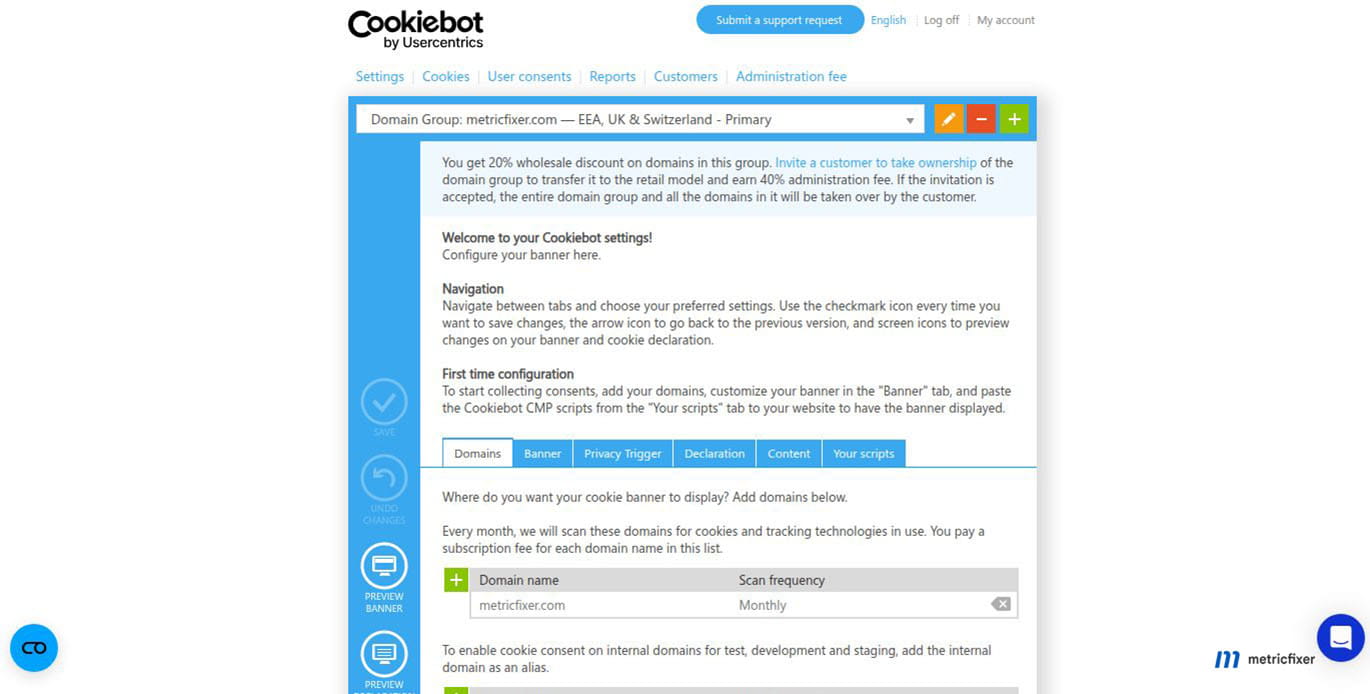
Option 1: one Europe-first primary domain group
This is the best default for a single-brand website whose meaningful traffic and sales are concentrated in the EEA, UK, and Switzerland.
- The actual domain sits in one primary Cookiebot domain group.
- The banner is displayed to all visitors or to the complete European target region.
- The same category model, vendor disclosures, languages, and Consent Mode mapping apply across the main market.
- The consent log, scans, cookie classifications, and reports remain centralized.
Displaying the same consent-first experience to every visitor can be operationally attractive when more than 90% of traffic is European. It avoids geolocation race conditions, cache variants, and the risk that an unresolved location receives a permissive path. The trade-off is unnecessary friction for visitors from markets where the business could lawfully and contractually use a different experience.
Option 2: one group with regional banner distribution
A site can maintain one primary group but display the banner only in selected regions. This is useful when the website is managed from Europe but also receives substantial traffic from markets that use a different privacy model.
The implementation team should document:
- the complete list of countries receiving the European banner;
- the behavior for countries outside that list;
- the fallback for an unknown or disputed location;
- whether CDN caching can serve the wrong HTML or script variant;
- how VPN, corporate proxy, bot, and preview traffic will be tested.
This option changes banner visibility, but it does not automatically create a different Google Consent Mode default for every other country. The CMP distribution rule, the Consent Mode default, and the tags' firing logic must agree.
Option 3: multiple domain groups for materially different regional experiences
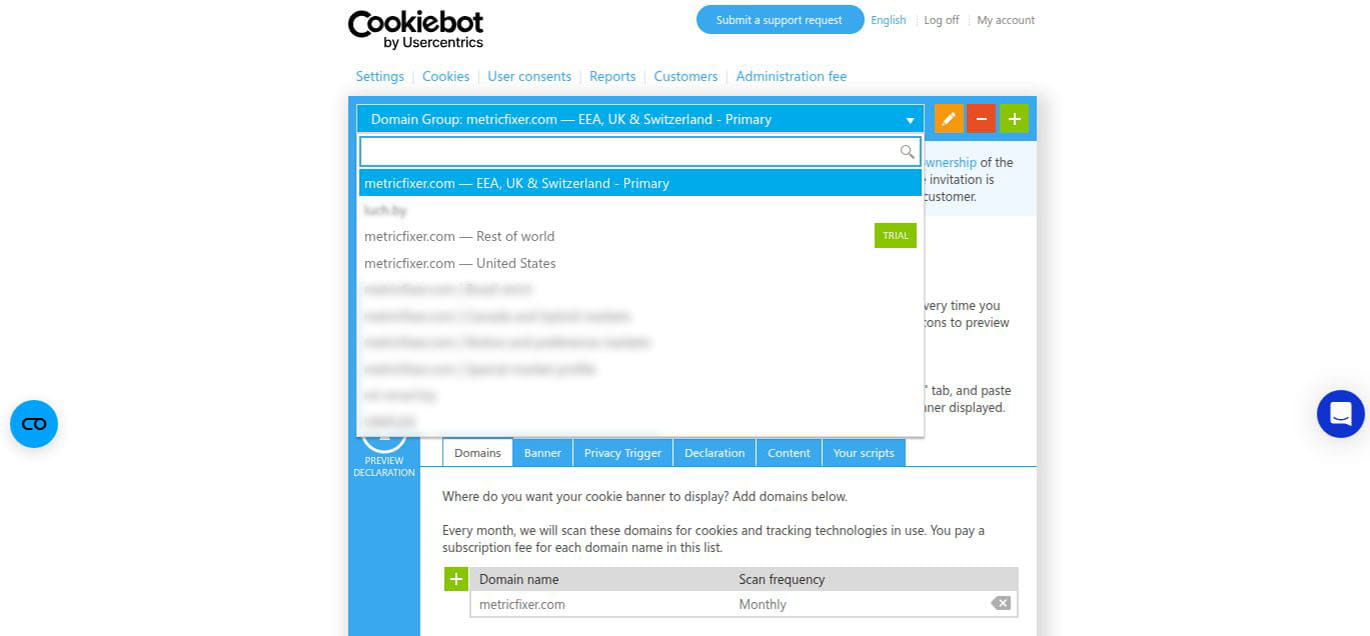
This is the most flexible architecture and the closest to the metricfixer example with separate domain groups for different geo-zones. A global business could use:
- Primary: EEA, UK, and Switzerland — the actual domain, scans, classifications, reports, consent log, and European banner.
- Alternative: United States — a notice-and-opt-out or state-specific configuration where appropriate.
- Alternative: Rest of world — a simpler preference interface or another approved regional design.
- Optional UK or Swiss profile — only when the text, purposes, legal basis, or behavior genuinely differs enough to justify another configuration.
Cookiebot's multiple-legislation documentation makes one operational rule especially important: only the primary domain group should contain the actual domain. Alternative groups are configuration profiles. Adding the same domain to each group can cause repeated scans and additional charges, and it fragments governance.
For direct script deployment, Cookiebot supports a data-georegions attribute that maps a region code to the alternative domain-group ID. A simplified example is shown below. Replace the placeholders with the exact region code and IDs from the live Cookiebot account.
<script
  id="Cookiebot"
  src="https://consent.cookiebot.com/uc.js"
  data-cbid="PRIMARY-DOMAIN-GROUP-ID"
  data-blockingmode="auto"
  data-georegions="{'region':'REGION_ID','cbid':'ALTERNATIVE-DOMAIN-GROUP-ID'}"
  type="text/javascript">
</script>
When Cookiebot is deployed through Google Tag Manager, the CMP template can map one or more region codes to a domain-group ID without editing the embed directly. In either implementation, the Cookie Declaration must use the matching regional configuration so the public list of cookies and purposes does not contradict the banner.
Option 4: a custom consent layer instead of a commercial CMP
Google does not require advertisers to use a CMP from its partner program. A custom banner or CMS consent module can be used if it performs the complete job:
- shows the correct disclosure before consent-dependent processing;
- provides a genuine and granular choice;
- does not preselect consent;
- blocks or adapts every relevant tag and SDK;
- sends the four required Google consent states;
- stores evidence of the choice and the text shown;
- allows easy withdrawal;
- handles regional routing, language, accessibility, and versioning;
- keeps working after template, GTM, plugin, or vendor changes.
This path can be appropriate for a large organization with an internal privacy platform. It is usually more expensive than it first appears because the banner UI is only a small part of the system. The difficult work is tag inventory, classification, signal ordering, record retention, preference synchronization, and regression testing.
Is there a reasonable no-banner path for a European project?
There is one technically coherent path: do not load consent-dependent advertising or analytics services for those users. If the site uses only strictly necessary technologies and does not send personal data to Google for ads measurement, personalization, audiences, or non-essential analytics, a Google-specific consent workflow may not be needed. This is not the same as loading GA4 and Google Ads with a permanent denied state and calling the site banner-free.
For a commercial European website that wants GA4 behavioral reports, Google Ads conversion measurement, remarketing, enhanced conversions, or Customer Match, the no-banner path is normally incompatible with those goals. A custom consent interface can replace Cookiebot; the need to collect and communicate the choice does not disappear.
Configure the banner as a decision interface, not a notice
A European banner should let the user make a decision. A notice that says "we use cookies" and provides only an accept button does not create the same evidence as an interface that supports refusal, purpose-level choice, and withdrawal.
First-layer controls
A practical first layer should provide:
- a clearly visible Reject all control;
- a Customize or Settings control;
- an Accept all control;
- plain-language purposes, including a direct reference to ads personalization where the site uses it;
- a visible route to the vendor and privacy information;
- no preselected non-essential categories;
- no design that makes refusal materially harder to find or use than acceptance.
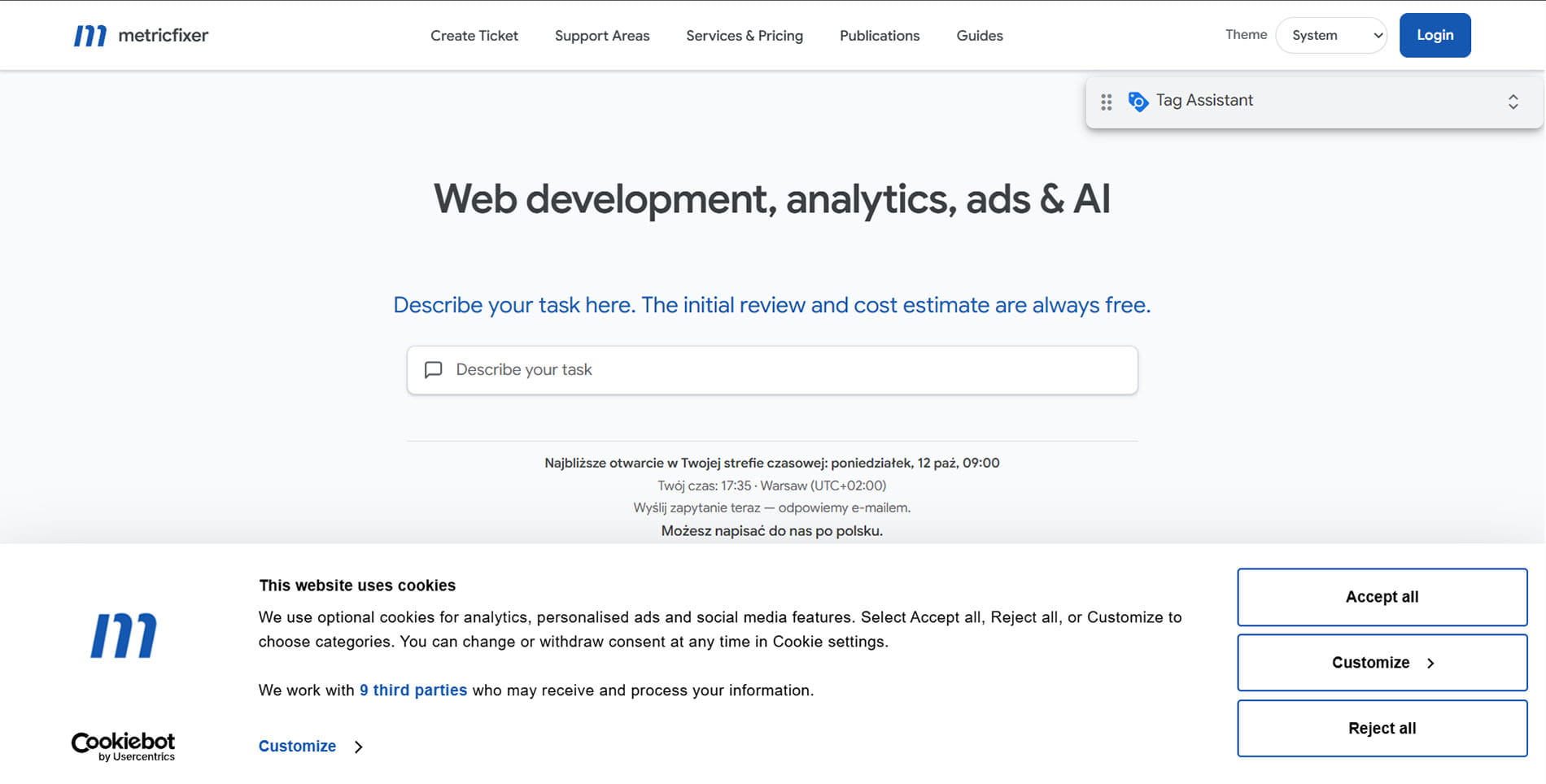
The European Data Protection Board's cookie-banner taskforce identified the absence of a reject control on the first layer as a recurring problematic practice, and the Court of Justice of the European Union has confirmed that a pre-ticked box does not constitute active consent. These sources do not prescribe one universal pixel-perfect banner design, but they strongly support an affirmative, unambiguous choice rather than implied acceptance.
Categories and Google Consent Mode mapping
Cookiebot's standard category model and Google's signal model are related but not identical. The implementation must map purposes deliberately.
| Cookiebot category or purpose | Typical Google consent effect | Important limitation |
|---|---|---|
| Necessary | security_storage may remain granted; strictly necessary site functions remain available. |
Do not place advertising or general analytics technologies in this category merely to avoid consent. |
| Preferences | May control functionality_storage and personalization_storage where the implementation uses them. |
Site-content personalization is not automatically the same as Google Ads personalization. |
| Statistics | Normally maps to analytics_storage. |
GA4 may still have advertising-related destinations and settings; category labels alone do not control all downstream use. |
| Marketing | Cookiebot maps ad_storage, ad_user_data, and ad_personalization to marketing consent. |
All three signals must be present and must reflect the actual user choice. Do not update only ad_storage. |
That mapping means a user can approve statistics while rejecting marketing. In that state, analytics storage may be granted while advertising storage, advertising user data, and advertising personalization remain denied. The network requests, cookies, GA4 behavior, and Google Ads audience eligibility should match that exact combination.
Disclosures, vendors, and languages
Google's policy expects the website to identify parties that may collect, receive, or use personal data as a result of Google products and to link to Google's business data responsibility information. The site should also disclose other marketing, analytics, chat, video, call-tracking, and experimentation vendors. A Google-only banner is incomplete if Meta, Microsoft, TikTok, Hotjar, a CRM form service, or an embedded video platform also receives data.
For a multilingual European site, banner language should follow the page or user language predictably. Do not translate only the buttons while leaving purposes, vendors, and the Cookie Declaration in another language. Legal and product teams should approve the actual text rather than relying on machine translation without review.
Withdrawal and consent records
Google requires consent records and clear instructions for revocation. Its help page says the record should include at least the text and choices shown and the date and time of affirmative consent. The EDPB's guidance also states that withdrawing consent must be as easy as giving it.
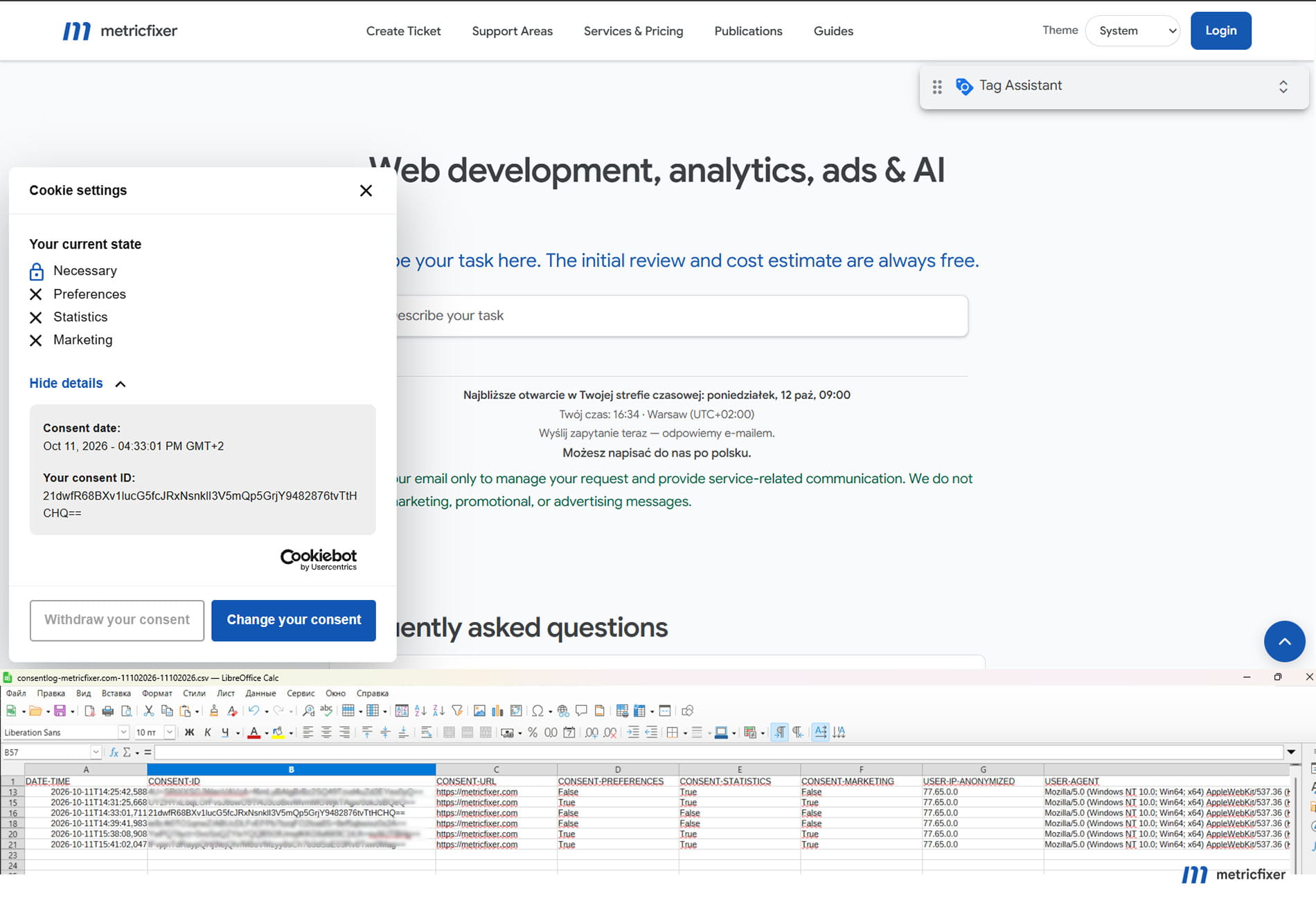
For Cookiebot, the production design should include:
- a permanent privacy trigger, floating icon, or clearly labeled footer link;
- a preference center that opens directly without requiring the user to search a policy document;
- a one-step reject-all or equivalent withdrawal route;
- consent-log retention and export procedures;
- a process for renewing consent after material changes to purposes, vendors, or categories;
- a version record for banner text and classifications.
Set the default consent state before Google tags
The default command must execute before gtag.js, Google Tag Manager, or another Google-tag delivery path can process data. Cookiebot's inline implementation documentation provides a conservative baseline in which the advertising, analytics, functionality, and personalization states are denied while security storage remains granted.
window.dataLayer = window.dataLayer || [];
function gtag() {
  dataLayer.push(arguments);
}

gtag('consent', 'default', {
  ad_personalization: 'denied',
  ad_storage: 'denied',
  ad_user_data: 'denied',
  analytics_storage: 'denied',
  functionality_storage: 'denied',
  personalization_storage: 'denied',
  security_storage: 'granted',
  wait_for_update: 500
});

gtag('set', 'ads_data_redaction', true);
gtag('set', 'url_passthrough', false);
In a direct deployment, this code belongs in an inline script marked so Cookiebot does not block it, and it must precede the Google tag or GTM snippet. In a GTM deployment, the preferred route is normally the current Cookiebot CMP template fired on Consent Initialization - All Pages, with the default states configured inside that tag.
Do not establish the same defaults independently in several places unless the ordering and precedence are documented. A common failure pattern is:
- an inline default sets all values to denied;
- a GTM custom tag sets another default later;
- a Google tag account-level override applies a third rule;
- the CMP sends an update;
- a later page event reinitializes the defaults and silently returns the user to denied or granted.
The implementation should have one authoritative default, one authoritative update, and a documented fallback. Google Tag Manager's Consent Overview and Tag Assistant can then show which tag set each state.
Basic vs Advanced Consent Mode for a European website
| Question | Basic Consent Mode | Advanced Consent Mode |
|---|---|---|
| Do Google tags load before the user chooses? | No, the relevant tags are blocked. | They may load with denied defaults. |
| Can pre-consent Google requests occur? | Not from the blocked tags. | Yes, limited cookieless pings can be sent. |
| What happens after consent is granted? | The allowed tags load and begin normal consented behavior. | The already loaded tags update to the granted behavior. |
| Modeling potential | Lower because Google receives less denied-state information. | Higher potential for consent-mode modeling, subject to thresholds and eligibility. |
| Implementation risk | Tags must be reliably blocked and unblocked. Incorrect additional-consent rules can suppress them permanently. | The defaults must be early and complete. A missing or late default can allow unintended storage or processing. |
| Best fit | Organizations that require no Google request before the relevant consent. | Organizations that have approved consent-aware cookieless pings and want modeling support. |
Cookiebot notes that Google tags have built-in consent checks. In Advanced mode, they should normally be allowed to load and adapt to the Consent Mode state rather than being given an additional GTM firing restriction that blocks them completely. In Basic mode, the tags require explicit consent gating. Mixing these patterns produces one of the most common implementation bugs: the team believes it has Advanced Consent Mode, but GTM blocks the tags like Basic mode, or it believes it has Basic mode while built-in consent allows cookieless requests.
Google's data-transmission controls add another layer. They can limit or prevent advertising data transmission when consent is denied, but they do not create a banner, do not record consent, and do not replace the four Consent Mode states. A site using server-side GTM must also apply equivalent restrictions in the server container, because a client-side UI setting does not automatically redact every server-side request.
Consent Mode, TCF, and the advertiser/publisher distinction
European teams frequently inherit publisher terminology even when they operate a normal advertiser website.
- Advertiser website: an ecommerce, SaaS, lead-generation, or service site that buys ads and uses Google tags. Google does not require it to use a CMP from the partner program, although Google requires EEA advertiser traffic to send validated consent choices through Consent Mode or TCF when the relevant features are used.
- Publisher website or app: a property monetized through products such as AdSense, Ad Manager, or AdMob. Google's certified-CMP and TCF requirements for publishers are a separate compliance track.
An advertiser can use Cookiebot's standard banner and direct Consent Mode integration without enabling IAB TCF. TCF becomes more relevant when a property participates in a broad advertising-vendor ecosystem and needs to pass a TC string to multiple vendors. Cookiebot supports a mode in which TCF data can inform ad_storage, ad_user_data, and ad_personalization, but Cookiebot still recommends setting the Consent Mode defaults manually to avoid a network-timing gap.
Do not enable TCF simply because the site is European. It adds vendors, purposes, special features, legal-basis choices, and another debugging surface. The right question is whether the website's vendor ecosystem and contracts require it.
The 2026 Google control changes that matter
Google has been consolidating how consent controls linked GA4 and Google Ads data. From 15 June 2026, Google states that ad_storage is the single control in Google Ads for Google Ads cookies and identifiers collected through the Google Analytics tag or Firebase SDK. Google Signals remains a Google Analytics control for data use inside Analytics, but turning Google Signals off no longer means that Google Ads will ignore consented advertising storage from the linked GA implementation.
For a European project, the practical conclusion is simple: do not rely on Google Signals being off as an advertising-consent control. The site's ad_storage default and update must be correct.
Google's EU User Consent Policy help page also states that, beginning in August 2026, Google is starting to launch IP-based ads measurement and personalization solutions in the EEA, UK, and Switzerland. Google reminds customers to provide appropriate transparency about IP-address use. This makes it unsafe to describe a denied-cookie implementation as "no data processing" without checking the actual tag behavior, transmission controls, and disclosures.
Metricfixer covers the wider platform transition in its review of GA4 consent changes and server-side GTM.
Validation plan before launch
Do not validate only the banner. Validate the full state machine.
| Test case | Expected consent state | Expected tag behavior |
|---|---|---|
| Fresh EEA visit before interaction | All four core states are denied. |
Basic: Google tags blocked. Advanced: consent-aware cookieless behavior only. |
| Reject all | ad_storage, analytics_storage, ad_user_data, and ad_personalization remain denied. |
No consent-dependent cookies; no remarketing eligibility; behavior matches selected mode. |
| Statistics only | analytics_storage granted; advertising states denied. |
Analytics behavior follows the approved statistics purpose; advertising storage and personalization remain unavailable. |
| Marketing accepted | The approved advertising and analytics states update to granted. |
Allowed tags fire or upgrade, and consented audience/measurement behavior becomes possible. |
| Consent withdrawn | The relevant states update back to denied. |
Future processing stops or adapts; consent-dependent cookies are removed where the CMP implementation supports removal. |
| Unknown location or geo failure | Documented fallback applies. | For a Europe-first property, the fallback should not silently become a permissive granted path. |
Use all of the following checks:
- Tag Assistant: inspect the earliest Consent event, the on-page defaults, the update after each banner action, and which tags fired or were blocked.
- Browser storage: clear the profile, run a fresh visit, and inspect cookies, local storage, and other identifiers before and after each choice.
- Network requests: filter requests to Google and every other vendor. Confirm that the payload and endpoint behavior match Basic or Advanced mode.
- Cookiebot Consent Mode Checker: use it to identify missing defaults, missing v2 parameters, or premature trackers.
- Cookiebot consent log: verify that the decision, timestamp, banner version, and category choice are recorded.
- GA4 Consent settings: review the detected signals after sufficient processing time.
- Regional tests: test at least one EEA country, Norway, the UK, Switzerland, and the site's principal non-European market.
- Withdrawal: repeat the visit after changing the choice and confirm that the update is effective without requiring a new account or device.
The Cookiebot checker is useful, but Cookiebot itself warns that a "no risk" result is not proof of full compliance. It reads browser and data-layer behavior and does not assess every GTM tag, backend request, server-side container, disclosure, or legal issue. Google Ads and GA4 diagnostics can also lag behind a live change. The fastest truth source is the actual default, update, storage, and network behavior observed in a clean session.
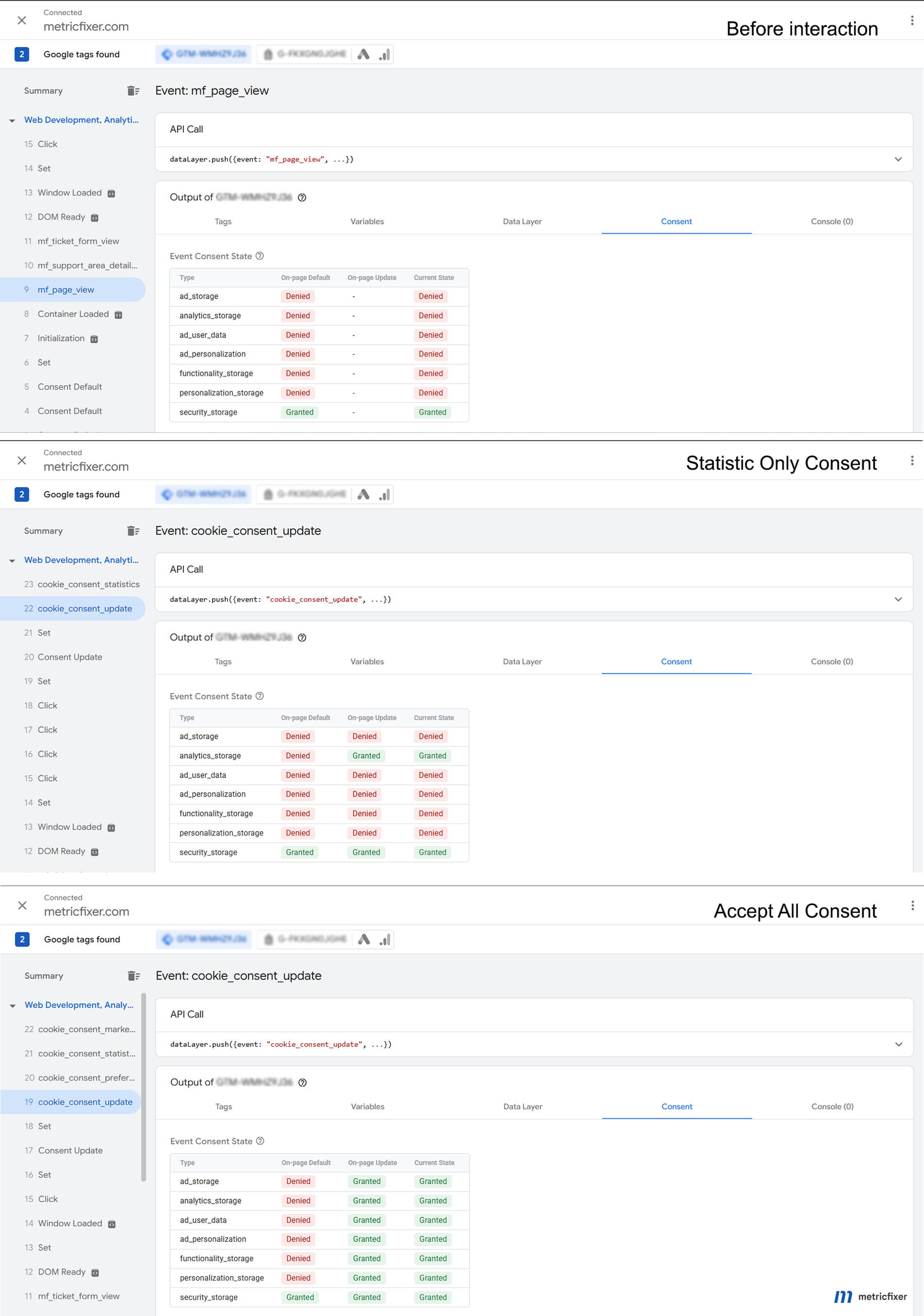
For a systematic approach to messages such as "Consent Mode is configured, but Google still says it is not," use metricfixer's Consent Mode diagnostic guide.
Common failure patterns
- Cookiebot loads after GTM. The page can send data before the default state exists.
- The default is globally granted. The banner appears, but the technical state assumes consent before the user acts.
- Only
ad_storageandanalytics_storageare implemented. The v2 signalsad_user_dataandad_personalizationare missing. - Reject is hidden in the second layer. The first layer functions as an accept prompt rather than an equal decision interface.
- Marketing tags are classified as necessary or statistics. The user rejects marketing, but the tags remain active.
- Advanced mode tags are also blocked by additional consent rules. The team expects cookieless modeling but has actually implemented Basic behavior.
- Basic mode tags rely only on built-in consent. Google tags load in denied mode even though the approved design required no pre-consent request.
- The CMP records a choice but does not send an update. Google remains at the default state for the whole visit.
- A later page event resets consent. SPA navigation or duplicate defaults overwrite the user's choice.
- The UK and Switzerland are omitted from the banner distribution. The team interprets "EU" literally and misses the broader Google policy scope.
- Consent withdrawal exists only inside a long privacy policy. Giving consent takes one click; withdrawing it takes several pages and settings.
- A partner-CMP badge is treated as a guarantee. The live banner, disclosures, tag order, and category mapping remain wrong.
- Only Google tags are reviewed. Other advertising, analytics, chat, video, and call-tracking vendors continue to process data outside the selected categories.
Architecture decision table
| Site profile | Recommended Cookiebot design | Recommended Consent Mode design |
|---|---|---|
| European-only or overwhelmingly European website | One primary Europe-first domain group; banner shown to all or nearly all traffic. | Global denied default; Basic or Advanced behavior selected deliberately. |
| European core market with meaningful U.S. traffic | Primary European group plus one U.S. alternative profile, or regional distribution from a single group. | Denied European default and a separately approved U.S. path; test geo and cache behavior. |
| Global site with several legal experiences | Multiple domain groups only for materially different configurations; actual domain in the primary group only. | Region-specific defaults and updates managed from one documented source of truth. |
| Large enterprise with internal privacy platform | Custom CMP can replace Cookiebot if it provides equivalent routing, records, withdrawal, and tag control. | Direct Consent Mode or TCF integration, with early defaults and validated updates. |
| European site that does not need analytics or advertising data | No CMP may be possible if no non-essential trackers or consent-dependent services load. | No Google advertising/analytics tags for those purposes; do not describe permanent denied Advanced mode as service removal. |
Implementation checklist
- [ ] The EEA list includes all EU member states plus Iceland, Liechtenstein, and Norway.
- [ ] The UK and Switzerland are included in the approved policy and banner scope.
- [ ] The CMP or custom consent layer loads before GTM and the Google tag.
- [ ]
ad_storage,analytics_storage,ad_user_data, andad_personalizationhave an explicit default. - [ ] The default is
deniedfor the European consent path. - [ ] The banner has visible reject, customize, and accept controls on the first layer.
- [ ] Non-essential purposes are not preselected.
- [ ] Ads personalization and third-party data recipients are disclosed clearly.
- [ ] Cookiebot categories and GTM consent requirements match the real tag purposes.
- [ ] The team has chosen Basic or Advanced Consent Mode intentionally.
- [ ] Data-transmission controls have been reviewed separately from Consent Mode.
- [ ] Consent records include the text, choices, date, and time.
- [ ] The visitor can reopen preferences and withdraw consent easily.
- [ ] Multiple Cookiebot groups do not contain duplicate domain registrations.
- [ ] The Cookie Declaration follows the same regional group as the banner.
- [ ] Tag Assistant, storage, network, Cookiebot, and GA4 diagnostics have all been tested.
- [ ] Server-side GTM and backend uploads have been reviewed separately from browser tags.
- [ ] The privacy team has reviewed Google's 2026 controls and IP-address transparency changes.
Methodology and sources
This article was prepared from a review of Google's EU User Consent Policy and policy help page, Google Consent Mode and data-transmission documentation, the 2026 Google Analytics data-control update, Google Tag Manager consent features, Cookiebot's Consent Mode, multiple-legislation, regional-distribution, consent-log, and verification documentation, and primary European consent guidance. The review was completed on 6 August 2026. Product labels, regional enforcement expectations, and interfaces can change after publication.
- Google EU User Consent Policy
- Google: Help with the EU User Consent Policy
- Google Consent Mode reference
- Google: Set up Consent Mode
- Google: Verify Consent Mode implementation
- Google tag data-transmission controls
- Google Analytics data-control changes for 2026
- Google Tag Manager Consent Mode support
- Cookiebot: Implementing Google Consent Mode
- Cookiebot: About Google Consent Mode
- Cookiebot: Supporting multiple legislations on one website
- Cookiebot: Supporting multiple legislations through GTM
- Cookiebot Google Consent Mode Checker
- European Data Protection Board Cookie Banner Taskforce report
- EDPB Guidelines 05/2020 on consent
- Court of Justice of the European Union: Planet49 consent summary
This article provides technical and operational information and is not legal advice. European consent requirements vary by country, technology, purpose, and the exact data flow. metricfixer is an official Cookiebot reseller, but a Cookiebot subscription or successful checker result does not by itself guarantee compliance. metricfixer is not affiliated with Google, Usercentrics, the European Data Protection Board, or the Court of Justice of the European Union. Platform policies, interfaces, laws, and regulatory guidance may change after publication.