
Published Sep 24, 2026
ChatGPT Ads View-Through Attribution: What Changed and How to Reconcile CRM Data
ChatGPT Ads can now combine click-through and view-through conversions. Learn what changed, why interface and API definitions may differ, and how to reconcile platform reporting with CRM outcomes without inventing an order-level match.
Category: Analytics & Conversion Tracking · By metricfixer Expert Team
ChatGPT Ads reporting can now include conversions after ad views, not just clicks. This review explains the change, the remaining documentation inconsistencies, and how to compare OpenAI's attributed results with CRM leads, orders, and revenue without pretending that every number has a one-to-one match.
Practical takeaway: keep platform attribution, traceable customer journeys, and verified business outcomes separate. Build an auditable click-to-CRM connection, report view-through credit explicitly, and do not treat a larger conversion total as evidence of additional sales.
Contents
Executive summary
The important change is not that an impression becomes a conversion. A business action still has to be reported. What changes is the interaction that may receive credit for it, and which attributed actions appear together in a report.
For advertisers, this creates two different reconciliation tasks. The first is operational: did the website or CRM record a genuine action, and did the measurement integration send it correctly? The second is interpretive: does OpenAI assign credit under the same rules that your business uses? A successful answer to the first does not guarantee agreement on the second.
Our recommendation is to maintain three views: OpenAI-attributed results, CRM outcomes with an observed ChatGPT ad-click connection, and business results under your cross-channel attribution policy. These are comparison layers, not numbers to add together.
This is a documentation-based review, checked on 24 September 2026. It does not present a metricfixer campaign experiment or claim access to client reports. The reconciliation architecture and numerical example below are editorial proposals, not observed account results.
What changed in ChatGPT Ads attribution
The public record shows a staged change rather than one clean switch from click-only measurement to a completely new attribution model.
| Date | Evidence | What it establishes |
|---|---|---|
| 18-19 August 2026 | PPC Land recorded updated OpenAI documentation. | One-day view-through reporting existed, initially described as supplemental and outside the main conversion total. |
| 14 September 2026 | IntentPeak reported an in-account attribution-change notice. | Its account showed a blended total, adjustable windows, and ad-event-time reporting. This is an account observation, not a universal rollout date. |
| 24 September 2026 review | OpenAI's Measure Results guide. | The current Help Center describes configurable click-plus-view reporting. |
The current reporting rules are:
| Setting | Documented behavior |
|---|---|
| Click window | 7, 14, or 30 days. |
| View window | 0 days disables view-through reporting; 1 day includes eligible view-through conversions in Conversions. |
| Competing interactions | A qualifying click takes precedence over an impression. |
| Separate reporting | Click-through and view-through columns are available separately, including in CSV exports. |
| Date basis | Conversions defaults to credited click/impression time. Conversions (by conv. time) uses the outcome's time. |
OpenAI describes this as last-touch logic, not multi-touch attribution, and allows 24-48 hours for processing. The guide does not establish one universal default window for every account.
Consider a hypothetical customer who sees an ad, does not click, and later purchases after searching for the brand. View-through attribution asks whether an eligible impression can receive credit. It does not establish that the customer read the ad carefully, changed their mind because of it, or would otherwise have abandoned the purchase.
The opportunity is to recognize influence that a click-only report could miss. The risk is to mistake a broader crediting rule for additional demand.
Why the interface and API can disagree
There is an important inconsistency in the public documentation. The Help Center describes the blended interface total above, while the published Insights API reference still defines conversions as equal to click_through_conversions, with view_through_conversions separate. Its example returns seven click-through conversions and three view-through conversions, while conversions remains seven.
This is evidence of inconsistent documented definitions, not a live test proving that every account or API response currently behaves differently. Neither silently overriding the API reference nor treating it as the definitive description of the newer interface is justified.
For a reporting pipeline, preserve the original field names and source. A column called "Conversions" in an interface export and a JSON field called conversions should not automatically become the same warehouse measure.
Define an import contract that records the endpoint or export type, conversion event, date basis, timezone, attribution settings, and extraction time. Where a setting is not exposed by that source, store it as unknown rather than borrowing it from another screen. Keep the raw download so that a later definition change can be investigated.
Also avoid adding a view-through column to a total that already contains it. Conversely, do not relabel a click-only API field as "all attributed conversions." An explicit combined measure is appropriate only after confirming that the components cover the same events, period, windows, and mutually exclusive attribution categories.
The developer reporting guide provides aggregate conversion reporting and says reporting applies going forward from campaign attachment. That is another reason not to expect a newly connected dashboard to reconstruct an entire historical CRM funnel automatically.
What the earlier tracking complaints show
There were public concerns before the September blended-total change. In a first-person LinkedIn post, Nicholas Verity reported 57 OpenAI ad clicks but fewer than 20 Google Analytics visits, despite applying UTMs to every link. He also reported no conversions and said he had paused the campaign.
MediaPost's report dated 28 August 2026 covered that complaint and Daniel Johnson's observation that click counts did not consistently align with Google Analytics, with differences in both directions. In the original LinkedIn discussion, another practitioner, Yoav Rubin, said he was not seeing a major discrepancy.
These are useful warning signals, but not an audited measurement study. The available accounts do not provide the request logs, consent states, precise analytics metric definitions, and raw exports needed to identify a cause. They do not establish a platform-wide error rate.
Most importantly, a click-to-visit discrepancy is not the same as a platform-to-CRM conversion discrepancy. A visit is not an order, and repeated interactions need not represent different people. Missing site measurement, genuinely lost visits, and different counting rules require different investigations.
The responsible conclusion is neither "OpenAI is inventing conversions" nor "the gap is normal, so ignore it." It is that discrepancies should be classified and investigated before performance claims are accepted. Adding view-through attribution does not resolve an earlier unexplained click-to-visit gap.
Why click-based results can differ from CRM
OpenAI's conversion measurement guidance identifies attribution rules, timestamps, storage and consent conditions, deduplication, configuration, and modeled reporting as possible sources of disagreement. The following diagnostic framework is our recommended way to separate them; it is not a diagnosis of the public complaints.
| Comparison | Question to resolve | Useful evidence |
|---|---|---|
| Ad clicks vs measured visits | Did a destination request occur, and did site measurement run? | Redirect and landing logs, analytics collection, consent state, preserved parameters. Requests alone are not unique people. |
| Visits vs CRM leads | Did the visitor actually submit a valid lead? | Form acceptance, spam filtering, contact creation, duplicate-contact rules. |
| CRM outcomes vs submitted events | Were the correct lifecycle actions exported once? | Business-event ledger, queue records, payload versions, delivery responses. |
| Received events vs attributed results | Were matching, campaign configuration, and attribution eligibility satisfied? | Data-source settings, event names, available matching context, report definitions. |
| Platform credit vs CRM source | Are both systems applying the same cross-channel rule? | Observed touch history and a written source-selection policy. |
| Attributed revenue vs finance | Are these created orders, paid orders, or net revenue? | Payment status, refunds, cancellations, tax treatment, currency and value units. |
For example, a person might click a ChatGPT ad, return through another channel, and buy. A CRM using the last observed marketing touch could assign that order elsewhere, while a platform-specific rule could still credit the earlier eligible ad click. No event needs to be missing for those reports to disagree.
Date alignment creates a second problem. If a click occurs on Monday and the order on Thursday, an interaction-date report and an order-date CRM export place the same journey in different daily buckets. Comparing a longer period helps only when its boundaries also include the relevant interactions and outcomes.
For your own reporting, maintain both an outcome-date view for CRM reconciliation and a click-cohort view for acquisition analysis. A cohort is simply the group of clicks that happened in a particular period, followed forward to see what happened next.
Processing delay and attribution maturity are different clocks. An interaction cohort can keep gaining outcomes while its allowed lookback relationship remains open. Therefore, "wait two days" is not a general rule for treating a recent, long-window acquisition cohort as final.
Build a first-party click-to-CRM connection
The most useful independent evidence is a chain that your business controls: an identifiable landing interaction, a customer or lead relationship established legitimately, and a later business outcome.
Keep campaign identity and click evidence separate
Use stable campaign and ad identifiers for reporting joins. Names are useful for humans but should not be the only keys: renaming a campaign should not rewrite its history. Metricfixer's OpenAI Ads dynamic-parameter guide covers the supported URL macros and tagging hierarchy.
A proposed destination template is shown below. It is an example, not a live URL or a complete implementation:
https://example.com/demo?utm_source=chatgpt&utm_medium=paid_ai&utm_campaign=crm_demo&utm_id={campaign_id}&utm_content={ad_id}&oai_ad_group_id={ad_group_id}Here, paid_ai and oai_ad_group_id are advertiser-chosen conventions. Define the corresponding analytics channel rules rather than assuming a custom medium is automatically classified as paid advertising. Keep paid campaign tagging distinct from ordinary referrals out of ChatGPT answers.
Campaign tags identify the campaign represented by a visit; they are not unique proof of an individual ad click. OpenAI separately supplies the opaque oppref reference. Its Pixel documentation says the browser integration captures that value and stores it in a first-party cookie. Do not invent a replacement value.
| Identifier | Purpose in the proposed architecture | What it does not prove |
|---|---|---|
| Campaign, ad-group and ad IDs | Join campaign metadata and aggregate media costs to tagged journeys. | That a particular customer saw an impression. |
oppref | Preserve the OpenAI-provided click context when available and permitted. | That OpenAI ultimately credited a particular CRM outcome. |
| Internal customer or lead ID | Connect legitimately recognized first-party records across the business funnel. | That one person has only one order or conversion. |
| Business-event ID | Identify one lifecycle action consistently across systems. | That the action was incremental or even eligible for platform attribution. |
Store touch history, not just one source field
At a permitted landing interaction, preserve the available campaign context and capture time. Associate it with the lead when the person submits a form, then retain the relationship through contact merges, opportunity creation, and payment.
Do not overwrite the original touch every time a visitor returns. Store subsequent touches separately and apply your chosen attribution policy when producing the report. Record whether the relationship came from a captured reference, campaign tags, or another explicit first-party association; these are different strengths of evidence.
For a long sales cycle, the contact-to-opportunity-to-order relationship matters as much as the first cookie. An agency can capture the landing page perfectly and still lose the sale if its CRM creates an unrelated contact record at checkout.
This design is feasible where the required relationships survive. It cannot reconstruct missing historic identifiers, observe a visit that was never recorded, or legitimately turn an uncertain cross-device guess into a deterministic match.
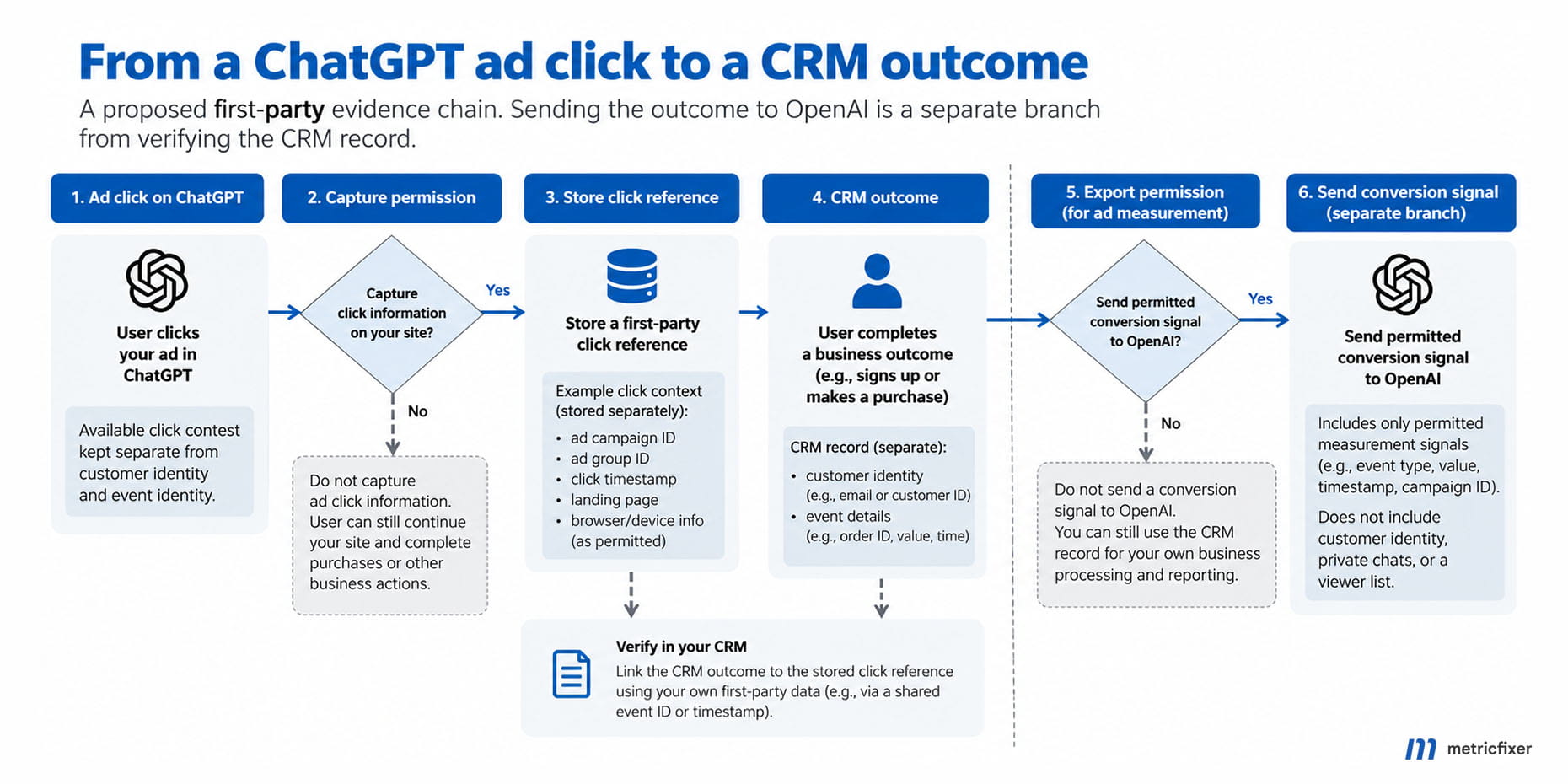
Text workflow: ad click → permitted landing-context capture → lead/customer association → CRM lifecycle outcome → internal reconciliation. A separate, permission-gated export sends the business event to OpenAI for matching and attribution.
Send CRM outcomes without creating duplicates
A CRM integration should transmit business events, not every change to a database row. Define the meaning of a conversion first: form accepted, trial started, order created, or another supported action. A corrected phone number is not another lead; a payment webhook retry is not another purchase.
Maintain an internal event ledger with the business record, event ID, actual occurrence time, value policy, permission reference, and delivery history. Keep sensitive matching information in a controlled store rather than copying it into routine reporting exports.
This illustrative record is an internal design, not an OpenAI API payload:
{
  "business_event_id": "order-created:ORD-1042",
  "business_record_id": "ORD-1042",
  "event_kind": "order_created",
  "occurred_at": "2026-09-20T10:15:00Z",
  "customer_record_id": "CUSTOMER-208",
  "touch_history_ref": "TOUCH-771",
  "value_minor": 12500,
  "currency": "USD",
  "measurement_permission_ref": "PERMISSION-52",
  "delivery_status": "pending",
  "mapping_version": "2026-09-24"
}
The permission reference must point to a real decision, not automatically mean "consent granted." A queue worker should check whether export is permitted before sending and again when retrying after a delay.
Reuse the identity of the action
The Conversions API uses id; the browser Pixel uses event_id. For the same action, align those values, Pixel ID, and event identity; custom names must also match. OpenAI documents first-received-event handling for matching duplicates.
In the proposed ledger, a retry retains the original ID. A genuinely different action gets a different ID. Do not use one contact ID for every purchase, and do not issue a new random event ID each time the same webhook is delivered.
First-received handling also means a later duplicate is not a safe general-purpose update mechanism. Keep refunds and net-revenue accounting in your business records unless a specifically supported correction workflow has been verified.
Preserve matching context without manufacturing it
Available matching data may include the original oppref, permitted customer identifiers, and the browser reference. The API documents user.obref as the unchanged value from the Pixel's __obref cookie. It is not a click reference or a list of people who saw ads. Follow the current schema and normalization instructions rather than assuming the browser and server fields are interchangeable.
Better delivery helps when a genuine outcome occurs in the backend or CRM. It does not guarantee that the platform can connect that outcome to an eligible ad interaction. Nor does hashing a customer identifier remove the need for a permitted data-sharing basis.
Do not confuse event age with time since the ad click
The API currently requires timestamp_ms to be within the last seven days and no more than ten minutes in the future. That is a submission constraint, not the click-attribution window.
For example, a sale happening today after a click twenty days ago is a new event, not a twenty-day-old event. Submit its real occurrence time promptly. Eligibility for ad credit is a separate question. Never rewrite an old sale's timestamp to make an otherwise late upload look recent.
For broader lifecycle design, see metricfixer's guide to CRM integration for offline conversion tracking.
How far view-through reconciliation can go
The missing link is exposure evidence. When someone sees an ad without clicking, your website receives no landing visit from that impression. Adding more URL parameters therefore cannot create an impression-to-CRM connection.
OpenAI's advertising privacy explanation describes aggregated, non-identifying performance reporting, not advertiser access to people's private chats or a named viewer list.
A technically plausible matching path is nevertheless straightforward: the advertiser sends a permitted outcome with supported identifiers; the platform evaluates it against its own eligible interaction records; the advertiser receives attributed reporting. The platform may have evidence that is unavailable in the advertiser's CRM. This is a conceptual explanation, not a claim that OpenAI publishes every matching rule or uses one identical method for every event.
Modeled attribution adds another boundary
OpenAI says modeled measurement can use aggregate patterns to estimate attribution for otherwise unattributed advertiser-reported events. Totals may include such estimates where available.
This is not the same as saying that OpenAI invents orders. It does mean that the attribution component may not correspond to a deterministic, inspectable person-to-impression join. Do not label every unmatched platform conversion as view-through, and do not assume that every view-through conversion is modeled: these are different dimensions.
| Level | What can be established | Boundary |
|---|---|---|
| First-party event and journey audit | A known business action, its delivery record, and any preserved click-to-customer relationship. | Does not independently reproduce all platform attribution decisions. |
| Aggregate comparison | Campaign-period outcomes compared under documented definitions, with gaps classified where evidence permits. | A total cannot identify which otherwise unlinked orders supplied its view-through component. |
| Platform-assisted event-level reconciliation | Potentially, an advertiser's own event ID returned with attribution type and campaign credit. | No public attribution-disposition interface of this kind was identified in the documentation reviewed. |
The third option is a theoretical product design, not an available feature promised here. It would require an explicitly supported, privacy-reviewed interface and a clear treatment of modeled results. A controlled data collaboration could instead return aggregate overlap, but only if the parties actually support the required data and permissions. Calling something a "clean room" does not create access to OpenAI's exposure records.
Without that additional interface, trying to distribute a reported view-through total across convenient CRM orders is fabricated precision. Matching people by a similar timestamp, approximate location, or shared IP address is not an acceptable substitute for reliable evidence.
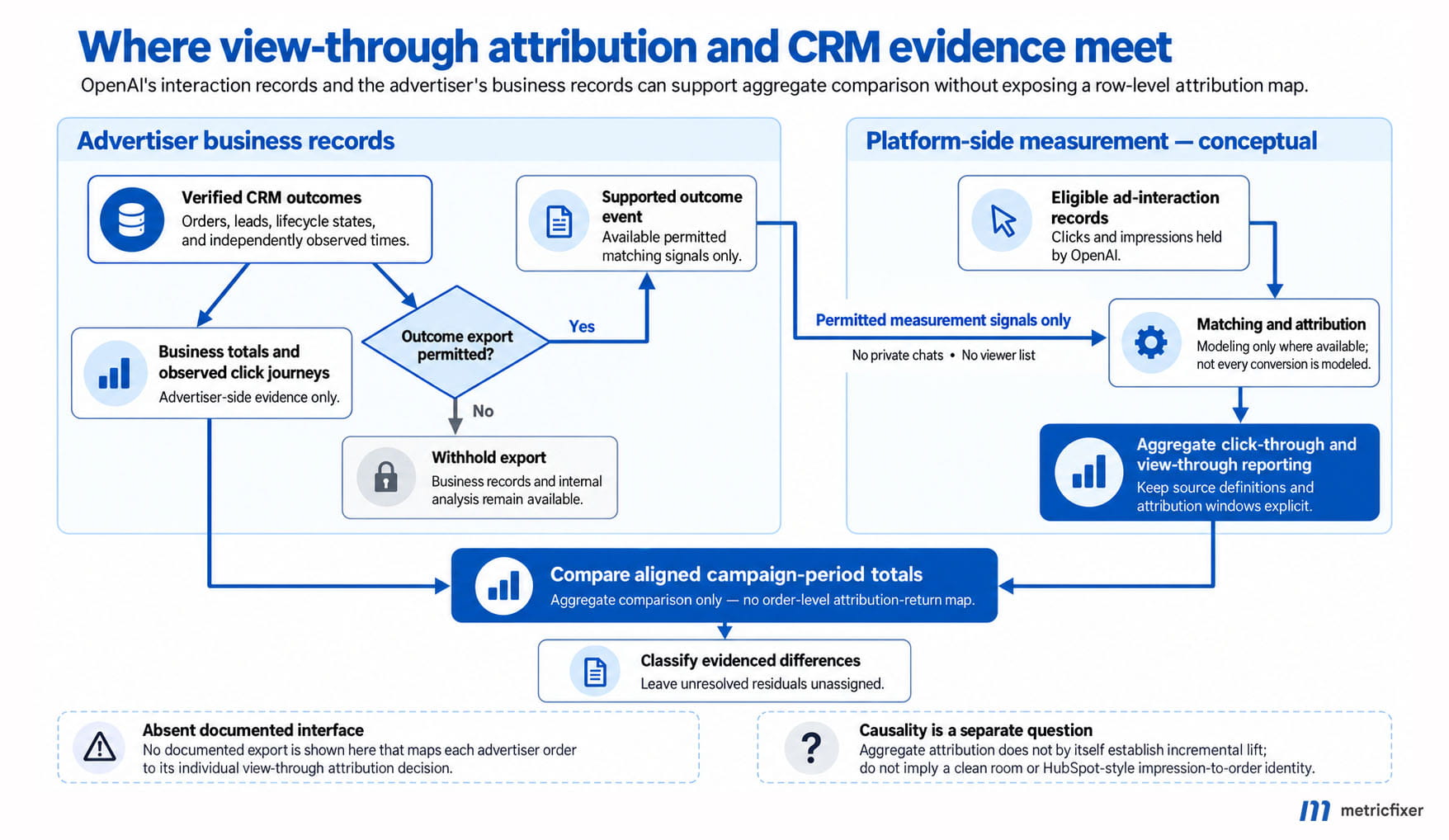
Text workflow: private eligible ad-interaction records + permitted advertiser outcome signals → platform matching/attribution → aggregate reporting. Separately, CRM records → verified business totals. Compare aligned totals; do not invent an order-level view-through join.
What HubSpot and measurement partners add
The CRM connection is no longer entirely theoretical. OpenAI's 16 September announcement introduced HubSpot as its first CRM partner and Shopify as its first ecommerce partner.
The HubSpot setup guide describes campaign creation, lead capture into the CRM, follow-up workflows, and performance reporting alongside other channels. Those capabilities can reduce the operational distance between an ad campaign and a customer record.
However, the reviewed guide does not promise an export identifying every CRM order credited to a non-clicked impression. "Connected to the CRM" and "independently auditable view-through attribution" remain different claims.
OpenAI also documents measurement partner integrations. Hightouch provides an event-data sync route; Triple Whale's instructions combine API connection with its own UTM-based journey measurement. The page explicitly says capabilities vary by partner.
Before adopting a connector, ask which direction data travels: media reports into your warehouse, outcomes into OpenAI, or both. Then ask which attribution model produces each displayed metric. A polished combined dashboard can still contain two incompatible conversion definitions.
There is also an important scope exception: OpenAI's current mobile measurement partner guide describes click-based attribution. Do not automatically extend the web view-through discussion to every app integration or event-sharing arrangement.
Worked example: one campaign, three answers
Illustrative scenario only: assume a campaign spends $1,000 and all relevant records are mature, deduplicated, and aligned to the same purchase definition. For this simplified example, exclude modeling and suppose the following relationships are known. This is not a claim that today's aggregate API reveals these relationships.
Ten orders have a preserved ChatGPT ad-click connection and qualify for platform click credit. For two of those orders, a later marketing touch means the business's cross-channel last-touch policy assigns the sale elsewhere. Five additional orders qualify for view-through credit without qualifying click credit.
| Question | Orders counted | Spend divided by that count |
|---|---|---|
| How many orders receive platform click credit? | 10 | $100.00 |
| How many receive click-or-view credit? | 15 | $66.67 |
| How many belong to ChatGPT under the business's cross-channel last-touch policy? | 8 | $125.00 |
Changing the reported denominator from ten to fifteen makes the calculated cost per attributed order one-third lower. It does not create five new orders in the business. Likewise, the difference between ten and eight is explained by the hypothetical attribution policy, not by two lost purchases.
In a real aggregate report, the same arithmetic would not prove that the extra five could be matched to five specific CRM orders. That conclusion would need separate evidence.
Use equally explicit revenue labels: "revenue from CRM orders with observed ChatGPT clicks," "revenue credited by the platform," and "net revenue allocated under our cross-channel policy." Do not describe any of them as incremental revenue without evidence about what would have happened without the advertising.
The same caution applies across platforms. One order may receive credit under more than one platform's rules. Summing those claims does not produce a deduplicated company-wide order total. Similarly, a blended conversion count divided by clicks is not a clean post-click conversion rate.
Separate reporting, optimization, and billing
OpenAI says changing the reporting windows does not change optimization, bidding, or billing. That does not mean views are irrelevant to every optimization product.
The current Conversion optimization guide distinguishes click billing, which optimizes toward post-click outcomes, from impression billing, which can optimize toward eligible outcomes after views and clicks. The latter is commonly described as oCPM; click-billed conversion optimization is oCPC. Neither is payment per conversion.
This newer product description does not align with the older, broad click-only optimization language still present in some developer measurement pages. Treat the campaign's objective and billing configuration as separate from the reporting preset; do not resolve the inconsistency by assuming one toggle controls everything.
In practical terms, hiding view-through results is not evidence that an impression-billed optimizer has stopped learning from view-related outcomes. Conversely, displaying more attributed outcomes does not prove that delivery has improved.
The guide also currently permits one standard optimization event per campaign, not custom conversion events. A business that defines a bespoke "sales-qualified lead" in its CRM should not assume that every event it can report is eligible as an optimization target.
For the wider release, see metricfixer's September OpenAI Ads update. This article's narrower recommendation is to evaluate buying configuration, report definitions, and verified customer quality as separate decisions.
Practical reconciliation checklist
Use the following as a reporting and implementation review, not as a requirement to run a new client experiment.
- Name the business action. Separate leads, qualified leads, created orders, paid orders, and customers. Record the value and refund policy.
- Freeze the comparison definition. Record account, campaign scope, event, source, raw columns, window settings, timezone, date basis, objective, billing option, and extraction time.
- Preserve the first-party chain. Keep campaign IDs, permitted click context, touch timestamps, customer associations, and one stable identity per business event.
- Audit delivery separately from attribution. Compare eligible business events with queued, sent, accepted, rejected, and retried records. Missing delivery and missing platform credit are different problems.
- Keep comparison series stable. Maintain an explicitly defined click-based series and a separately labeled broader attribution series. Annotate the definition change instead of splicing unlike totals into one trend.
- Revisit incomplete periods. Refresh data across the relevant attribution horizon and processing lag. Preserve successive extracts when investigating restatements.
- Explain only what the evidence explains. Label policy differences, implementation losses, duplicate events, and unresolved residuals separately. Do not force equality or apply an unsupported "normal discrepancy" percentage.
A useful distinction is already present in OpenAI's event-monitoring documentation: recent-event retrieval is a short-lived diagnostic sample, roughly covering fifteen minutes, while historical attributed results belong in Insights. An event appearing in a receipt view is not a row-level attribution confirmation.
Keep a small set of questions open for OpenAI or an integration provider: Does this export use the interface's reporting preset? Can observed and modeled attribution be separated? What exactly makes an impression eligible? Is advertiser-owned event-level attribution available through any supported interface? How are corrections and late outcomes handled?
The final standard should be simple: the CRM verifies the business outcome; preserved first-party evidence supports the journey; the ad platform reports its attribution claim; incrementality requires separate causal evidence. View-through reporting can be useful without collapsing those four roles into one number.
Methodology and sources
This desk review was prepared on 24 September 2026. Product behavior was checked against OpenAI's public Help Center and developer documentation for reporting, conversion measurement, Pixel and server events, Insights, conversion optimization, HubSpot, and measurement partners. Sources are linked beside the relevant claims rather than repeated in a technical bibliography.
Historical sequencing uses PPC Land's August reporting and IntentPeak's dated first-person account observation. The discrepancy discussion uses Nicholas Verity's public post and MediaPost's dated coverage. These sources establish what people reported, not an independently verified platform-wide failure or performance benchmark.
The current Help Center reporting description and published API definition are presented as inconsistent, not silently reconciled. Public pages and indexed versions can update at different times; this review does not substitute for an account-specific export contract.
No live advertiser account, client CRM, raw conversion export, or production campaign was accessed. No natural experiment or screenshot-based validation was performed. The proposed data architecture, classification framework, and numerical example are editorial analysis. They do not claim a measured conversion lift, a known attribution error rate, or a currently available event-level view-through export.
This article is for technical and operational information only and is not legal advice or a guarantee of advertising performance. metricfixer is not affiliated with OpenAI or the third-party platforms and publishers mentioned. Product availability, field definitions, matching rules, and reporting behavior may change. Collect and share customer data only when permitted under applicable requirements and platform terms. An attributed conversion is not, by itself, proof of an incremental business outcome.