
Published Jul 11, 2026
Dropshipping Advertising Strategies and Ad Formats That Work in 2026
A practical 2026 review of which advertising channels and ad formats fit different dropshipping models, from Google Search and Shopping to Meta, TikTok, Demand Gen, native, push, and affiliate traffic.
Category: Online advertising · By Mikalai Sasau
This review explains which advertising strategies and ad formats are still practical for dropshipping in 2026. It compares search, shopping, automated campaigns, short-form social video, native advertorials, push traffic, and affiliate channels across general, niche, print-on-demand, high-ticket, subscription, and B2B dropshipping models.
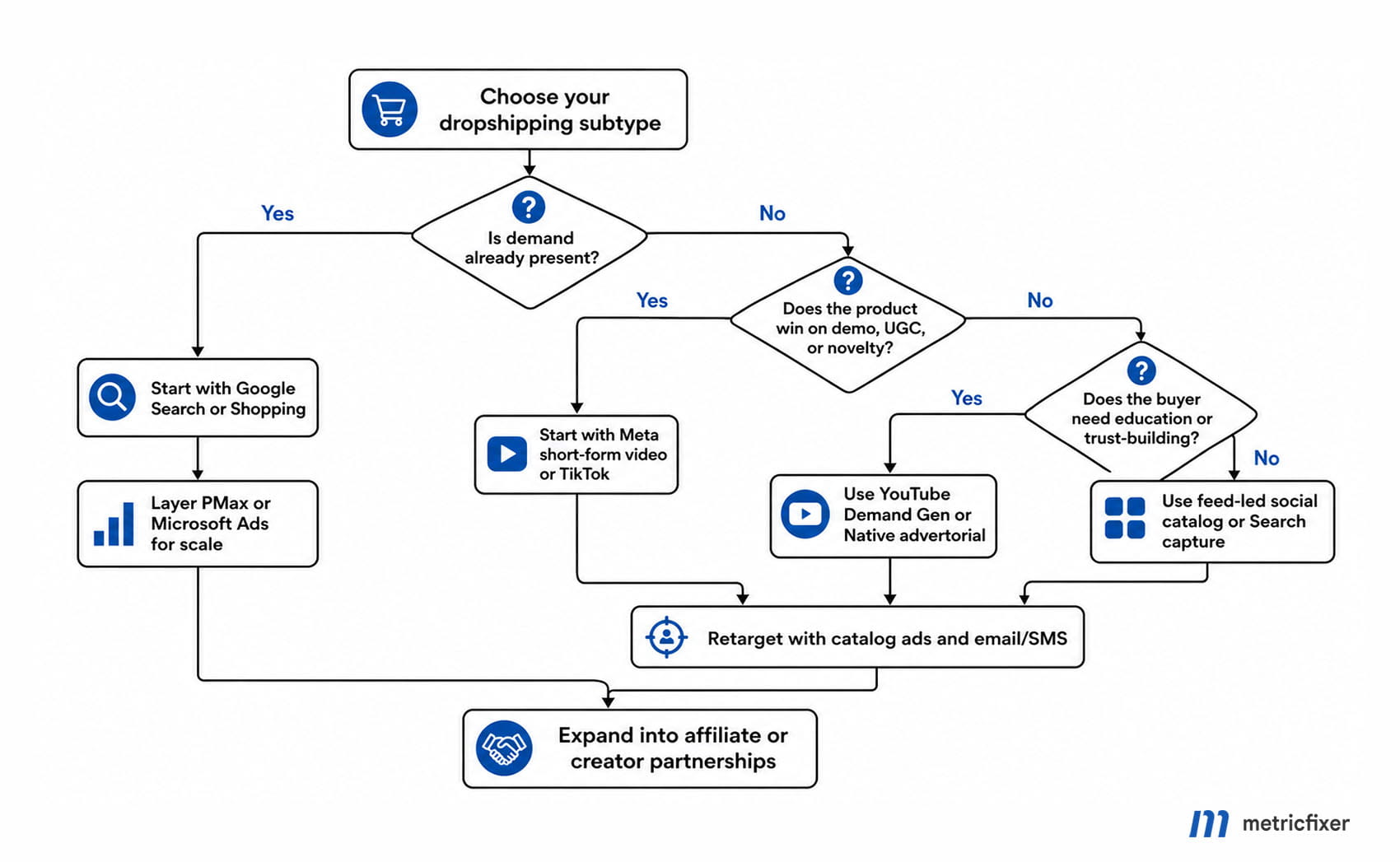
Practical default: do not choose a traffic source because it is popular in dropshipping forums. Choose it because it matches the product’s buying intent, margin, proof format, delivery reliability, and post-click trust. Use Google Search and Shopping when demand already exists, use Meta or TikTok when the product can be demonstrated visually, and use YouTube, Demand Gen, or native advertorials when buyers need education before they buy.
Executive summary
As of July 2026, the clearest pattern is that dropshipping works best when channel choice matches buying intent, margin structure, and fulfillment reliability. Google Search and Shopping remain the strongest first-acquisition channels for high-intent, high-ticket, niche, and B2B dropshipping. Meta and TikTok remain the strongest demand-creation channels for visually demonstrable, impulse-friendly, or creator-native products such as many POD and lifestyle offers. Google positions Performance Max as a default way to maximize online sales across Google inventory, and Google has reported that retailers switching from Standard Shopping to Performance Max saw an average 25% increase in conversion value at similar ROAS. Broader ecommerce benchmark data also tends to show stronger ecommerce ROAS on Google than on Meta or TikTok, even as CPCs and CPAs have risen.
The big shift is not that completely new channels appeared. The shift is that automation now needs more reliable data, more creative assets, and more patience. Google Performance Max, Google Demand Gen, Microsoft Performance Max, and TikTok Smart+ reward advertisers who bring clean conversion tracking, enough budget to escape learning-mode starvation, good product feeds, and a steady creative pipeline. Google recommends letting Demand Gen gather at least 50 conversions and keeping budget at least 10x target CPA. TikTok recommends Smart+ web campaigns run for at least seven days, with campaign budgets often around 10x–30x historical CPA and multiple creatives. Microsoft says Performance Max often needs 2–3x the budget of historical standalone campaigns and a 2–4 week learning period.
The main risk factor is still trust failure. Google can suspend advertisers for misrepresentation, including offering products that cannot be delivered or hiding relevant business information. Merchant Center requires shipping and landing-page consistency. TikTok’s deceptive-practices policy allows suspension or bans for misleading behavior, and Meta can impose advertising restrictions for severe or repeated violations. For dropshipping, thin margins, slow shipping, and aggressive creative claims are a dangerous combination because they increase chargebacks, Merchant Center disapprovals, and ad-account instability.
Forum evidence points in the same direction, but it should be treated as operator intelligence rather than controlled research. BlackHatWorld, Reddit, and Warrior Forum discussions often describe Google Shopping as high-intent but compliance-sensitive, while TikTok and Facebook are discussed as stronger options when creative can manufacture demand. The forum pattern is useful because it aligns with official platform guidance and ecommerce benchmark data, not because every forum post is reliable.
What changed in 2025 and 2026
The first change is that automation became the default operating model rather than an optional upgrade. Google steers retailers toward Performance Max for Shopping inventory and toward Demand Gen for YouTube and visual discovery. Microsoft says Performance Max reaches Search, audience, and Product Ads across the Microsoft Advertising Network while still allowing Search campaigns to take priority on matching queries. TikTok has moved toward Smart+ as a “best practices out of the box” option, with newer controls that let smaller advertisers choose fuller automation or more manual control.
The second change is that creative must be format-native. TikTok recommends TikTok-first assets: vertical 9:16 video, creator or customer faces, UGC-style production, a hook in the first 3–6 seconds, and continuous refresh to fight fatigue. Google’s Demand Gen guidance emphasizes mixed image and video assets, product feeds, and careful bidding control during the learning period. Meta’s ecommerce tooling centers on Advantage+ and catalog-driven ads, which makes the creative engine part of the media-buying system itself.
The third change is measurement discipline. Google stresses conversion tracking and cart data; TikTok recommends Pixel plus Events API and enough creative volume; Outbrain recommends using both lower-funnel and higher-volume intermediate events for native conversion bidding. Dropshipping teams often blame a channel when the real problem is creative mismatch, weak post-click trust, or attribution credit being taken by brand search, coupon partners, or remarketing.
The fourth change is harder enforcement around truthfulness and operational quality. For dropshipping in 2026, shipping times, return policies, pricing accuracy, product accuracy, and visible brand identity are not just operations details. They are media-buying dependencies because ad systems and merchant platforms increasingly penalize misleading claims and inconsistent fulfillment.
Channel selection workflow
Before building campaign structures, map the product to its demand pattern. This prevents the most common dropshipping mistake: sending a product that needs education into a pure shopping feed, or sending a high-intent product into entertainment-led cold social traffic without a margin cushion.
Channel playbook by platform and format
The table below summarizes the strongest practical fit for each platform and format. Where public dropshipping-specific CAC or ROAS benchmarks are not available, the economics are marked as unspecified rather than estimated too precisely.
| Platform / format | Typical ROI or CAC range |
Targeting tactics that work | Creative patterns that work | Bidding approach | Landing page best practices | Compliance and risk issues | Scalability |
|---|---|---|---|---|---|---|---|
| Google Search | Ecommerce CPC often $1.80–$3.00+; mature ecommerce often targets ~3–4x+ ROAS, but dropshipping-specific ROAS is unspecified. Paid-search ecommerce CVR benchmark cited by BigCommerce is 2.81%. |
High-intent exact/phrase themes, long-tail purchase terms, strong negatives, branded/non-branded segmentation, competitor conquest only when margins allow. | RSAs built around price, shipping speed, returns, trust badges, financing, and product-specific value props. For expensive products, add calls, reviews, and technical reassurance. |
Start with manual structure or Max Conversions/Max Conversion Value once tracking is stable; adjust slowly. |
Match ad promise exactly; fast load, visible price, fees, shipping, returns, social proof, contact info, and no bait-and-switch. | Lower ban risk than social if truthful, but very high suspension risk if business practices look deceptive. | High, but capped by search demand. |
| Google Shopping | Often one of the best direct-response ecommerce formats; lower CPC than text search is commonly reported, but dropshipping-specific CPA is unspecified. |
Feed optimization matters more than interest targeting: clean titles, GTINs, correct categories, custom labels, pricing, availability, shipping, review/feed hygiene. | Product image, price, promo clarity, trust, and SKU specificity do the work. Commodity-looking feeds usually lose. |
Standard Shopping still useful for control; Target ROAS common once volume exists. |
Direct-to-product pages, price parity with feed, clear delivery windows, returns, and visible store legitimacy. | Merchant Center suspensions are a major dropshipping risk; Google explicitly bans offers you cannot deliver and requires truthful pricing/shipping. Forum operators repeatedly mention misrepresentation suspensions. | High if feed quality and operations are strong. |
Google Performance Max |
Google reports retailers switching from Standard Shopping to PMax saw 25% higher conversion value at similar ROAS on average; broad ecommerce median ROAS is competitive, but dropshipping-specific CAC is unspecified. |
Feed-led plus audience signals. Best when paired with accurate conversion tracking, new-customer segmentation, clean brand exclusions where available, and stable budgets. | Strong feed images + additional text/image/video assets; creative breadth matters because PMax serves across Search, Shopping, YouTube, Display, Discover, and Maps. |
Maximize conversion value / tROAS is common. Google stresses flexible budgets and patience in learning. Microsoft makes a similar point for its own PMax. |
Same as Shopping, plus stronger brand and category pages because PMax can send mixed-intent traffic. |
Reduced control, learning-period volatility, and account-level negatives rather than full campaign-level control for Google PMax. Poor feeds amplify risk. |
Very high if you can feed it data and creative. |
| Microsoft Ads | Public dropshipping-specific ROI/CAC is unspecified. Industry commentary consistently treats it as a lower-volume, cheaper-click complement to Google. Microsoft positions PMax as ROI-oriented and cross-network. |
Import Google Search and Shopping, then refine with search themes, negatives, product filters, and audience signals. Exact-match and query-control matter more than broad automation in early stages. | Similar creative/funnel logic to Google; best for intent capture, less for impulse discovery. | For Shopping: CPS, Max Clicks, portfolio strategies, or tROAS. For PMax: allow 2–4 weeks learning, budget 2–3x historical standalone campaigns. |
Same LP rules as Google: exact offer match, price transparency, trust, delivery clarity. | Lower risk than social for creative-policy issues, but lower traffic ceiling. Review delays and learning periods still matter. | Medium to high as an incremental intent layer. |
| Meta formats | Triple Whale’s 2025 ecommerce median benchmarks for Meta were about $38.19 CPA and 1.86 ROAS overall; Meta says Advantage+ Shopping campaigns delivered on average 9% lower cost per conversion, and adding more placements has been shown to reduce cost per result in Meta testing. |
Broad / Advantage+ prospecting, catalog retargeting, first-party audiences, lookalikes where useful, exclusions for recent purchasers, lifecycle segmentation. | UGC video, founder/customer demos, Reels/Stories, collection ads, branded-but-not-overproduced static + motion, catalog overlays for retargeting. |
Advantage+ Sales / manual broad + dynamic catalog retargeting. Stable optimization events matter. |
Mobile-first PDPs, one-product focus, social proof, FAQs, fast checkout, and highly visible shipping/return terms. | Creative fatigue, attribution ambiguity, and account restrictions are the main issues. Meta says severe/repeated violations can lead to advertising restrictions; Reddit threads continue to show disabled accounts. | High, but only if creative production is constant. |
| TikTok | Triple Whale’s 2025 ecommerce median benchmarks for TikTok were about $32.74 CPA and 2.21 ROAS overall. |
Broad interest + creator-style hooks, Spark-like creator assets, product demos, catalog-backed Smart+ when available, paid-and-organic linkage. |
Vertical 9:16, faces on screen, DIY/UGC style, trend-native edits, hook in first 3–6 seconds, 3–5 creatives per ad group, frequent refresh. |
Smart+ is increasingly the default. TikTok recommends Pixel + Events API, at least six creative assets, seven-day stability, and budgets around 10x historical CPA, with 30x historical CPA preferred for some target-CPA/min-ROAS setups. |
Mobile PDPs with a single clear promise, visual proof, short copy, reviews, and quick checkout. If the product needs explanation, a pre-sell page or creator-led PDP works better than a generic catalog page. |
Deceptive-practices enforcement, creative fatigue, and fulfillment mismatches are the big risks. TikTok says misleading behavior may trigger suspension or bans; forum posts also show operational confusion around TikTok Shop fulfillment. | High for demo-friendly consumer goods; poor for products that do not “show” well. |
YouTube / Demand Gen |
Direct-response economics are highly variable. Google says YouTube delivers 2.3x higher long-term ROAS than paid social in a Nielsen analysis, and reports Demand Gen delivered 58% higher ROAS than legacy Video Action Campaigns on average in its own cited analysis; dropshipping-specific CAC is unspecified. |
Audience-first funneling, channel controls, custom segments, product feeds, creative layers by awareness and consideration stage, and cross-channel retargeting. | Mixed video + image assets, creator-style demos, comparisons, testimonials, Shorts-friendly verticals, and product-feed ads. | Use tCPA/tROAS for efficiency, start with max strategies when targets are unclear; Google recommends budget at least 10x tCPA and at least 50 conversions for learning. |
Often works best with either a highly persuasive PDP or a pre-sell landing page that educates before the click to product. |
Can underperform badly if used as cold traffic to weak PDPs; better when product needs explanation, trust, or demonstration. | High, especially for education-heavy or premium offers. |
| Native / teaser networks | Cold-sale purchase economics are usually unspecified publicly; Outbrain says lower-funnel native conversion events often sit around 0.5%–3% CVR, and case studies from Taboola show strong retargeting ROAS, including 679% average ROAS in one ecommerce case. |
Broad topical targeting, publisher filtering, creative-format segmentation, advertorial funnels, and retargeting. Outbrain advises not benchmarking native against Search because Search naturally converts better. | Problem-solution headlines, curiosity without deception, advertorial pre-sell, social proof, bundles, and a narrow linear funnel. Taboola explicitly says native ecommerce funnels should stay linear and educational first, promotional second. | Outbrain tCPA / tROAS works best with realistic targets; it recommends starting tCPA about 20% above ideal and budgets at least 3x desired CPA. |
Avoid homepages. Use advertorial → product page → checkout; too many choices kill conversion. | Clickbait risk, publisher quality variance, weak attribution, and fraud/poaching concerns if paired with bad partner sources. | Medium to high when the product needs education and margins can fund the funnel. |
| Push notification networks | Public ecommerce purchase CPA is mostly unspecified; the best public case evidence is anecdotal. PropellerAds case material reports 20%–30% ROI at scale for one ecommerce operation, but that should be treated as directional, not typical. |
Placement whitelists, device/GEO segmentation, simple offer angles, low-friction funnels, and dynamic CPA-style optimization. |
Short copy, icon + offer + urgency, simple visual cues. Works better for list growth, discounts, replenishment, or aggressive direct-response angles than for premium brand-building. | Dynamic CPA or target CPA-style buying when the network supports it. |
Minimalistic LPs, direct offer pages, or lead-capture pre-landers. Long, brand-heavy PDPs usually waste the click. | Traffic quality risk, weak brand safety, browser/platform restrictions, and high sensitivity to offer-market fit. | Medium, but unstable and rarely the best first channel for mainstream dropshipping. |
Affiliate / CPA networks |
Store-specific CAC is usually unspecified because economics depend on commission rates and fraud controls. Impact reports that 74% of brands generate 11%–30% of total revenue from affiliate marketing, not first-touch CPA. |
Best via content/review partners, creators, comparison sites, loyalty/coupon partners with rules, and creator-affiliate hybrids. Top programs diversify across 3–4 partner types. | Offer-led comparisons, creator reviews, editorial commerce, and post-purchase/referral mechanics tend to work better than generic incentive traffic. | Commission-based, often with approval windows, source-level quality filters, and delayed payouts tied to approved orders. | Product pages must be attribution-clean, with coupon governance and partner-specific exclusions where needed. | Main risks are coupon poaching, proxy traffic, click stuffing, and low-quality publishers. Everflow’s ecommerce fraud guide names coupon poaching and click stuffing as primary risks. | Medium to high as an incremental channel, not usually ideal as the first one for thin-margin consumer dropshipping. |
The table combines official platform documentation, 2025–2026 ecommerce benchmark publications, and operator evidence from forums and communities. The most important operational lesson is that a channel with strong intent can still fail if the store has poor feed data, unclear delivery terms, weak landing-page trust, or unstable conversion tracking.
Which formats fit each dropshipping subtype
Comparative fit matrix
The following scores are strategic-fit scores for first serious scaling in 2026. They are not profitability guarantees. A score of 5 means the channel is usually a strong first or second candidate for that subtype; a score of 1 means it should rarely be tested first unless the product has unusual economics or proof.
| Dropshipping subtype | Google Search | Google Shopping / PMax |
Microsoft Ads | Meta | TikTok | YouTube / Demand Gen |
Native / teaser | Push | Affiliate / CPA |
|---|---|---|---|---|---|---|---|---|---|
| General consumer goods | 4 | 5 | 3 | 4 | 3 | 2 | 2 | 1 | 2 |
| Print-on-demand | 2 | 2 | 1 | 5 | 5 | 3 | 2 | 1 | 3 |
| High-ticket dropshipping | 5 | 5 | 4 | 2 | 1 | 4 | 4 | 1 | 3 |
| Niche / vertical stores | 4 | 4 | 3 | 4 | 3 | 3 | 4 | 1 | 3 |
| Subscription-based dropshipping | 3 | 2 | 2 | 4 | 3 | 4 | 3 | 1 | 5 |
B2B dropshipping |
5 | 3 | 5 | 2 | 1 | 4 | 3 | 1 | 3 |
The logic is consistent across subtypes. Search captures explicit purchase intent. Meta and TikTok perform best when the product can win through creative demand generation. YouTube and native advertising work better when buyers need education. Push traffic is narrow and unstable for mainstream dropshipping. B2B behaves differently because search-led lead generation is structurally stronger than entertainment-led social traffic for business purchases.
What to use and what to avoid by subtype
General consumer goods
The best first stack is usually Google Shopping or Performance Max plus Meta catalog and video. General goods win when users already understand the product and can compare price, image, shipping speed, and reviews quickly. BigCommerce frames Google as a natural starting point for online stores because it captures active purchase intent, then suggests adding Meta and TikTok for visual, earlier-funnel demand. The formats to avoid first are push and teaser traffic, because generic consumer-goods margins are often too thin to absorb low-trust traffic and the policy risk increases quickly when stores overpromise delivery or product quality.
Print-on-demand
Print-on-demand is usually strongest on Meta and TikTok because the ad itself is often the product proof: design aesthetic, identity signal, humor, or creator endorsement. Printful margin guidance suggests many POD sellers target 20%–40% margins, with competitive basics lower and premium or niche products higher. That makes low-ROAS traffic dangerous unless the design and audience match are excellent. Google Shopping is weaker for generic POD unless the product is branded, seasonal, licensed, occasion-based, or already in demand. Push and most native/teaser cold traffic should usually be avoided at the start.
High-ticket dropshipping
High-ticket dropshipping is the strongest case for Google Search plus Shopping or PMax, with Microsoft Search and Shopping as a sensible second layer. High-ticket purchases reward commercial intent, detailed research, and product-specific landing pages. YouTube, Demand Gen, and native advertorials can work as assistive channels because premium products often need demonstration, comparison, financing reassurance, or trust-building. Avoid push, broad TikTok prospecting, and generic CPA traffic unless the product is unusually demonstrable and margins are exceptional.
Niche / vertical stores
Niche and vertical stores are the most flexible subtype. If the niche has search demand, Google Search and Shopping often win first. If the niche is community-driven or aesthetic-led, Meta can become equal or superior. If the niche requires belief change or education, native advertorials and YouTube become more viable than they are for general stores. Taboola’s native funnel guidance is especially relevant here: keep the funnel linear, educate before promoting, and do not send cold traffic to a generic homepage. Avoid push first, and be careful with overly broad PMax or social campaigns when the store lacks product depth or creative depth.
Subscription-based dropshipping
Subscription-based dropshipping behaves more like retention commerce than one-off retail. The best paid formats tend to be Meta short-form video, creator-led social, and affiliate or creator partnerships that can transfer trust over time. YouTube can also work when the subscription value proposition needs explanation. The main risk is not just platform policy but billing recognition and chargebacks: cancellation terms, billing descriptors, refund visibility, and proactive customer communication matter. Push traffic is usually a bad fit because low-recognition traffic can amplify subscription disputes.
B2B dropshipping
B2B dropshipping usually works best with Google Search and Microsoft Search first, then YouTube or Demand Gen for assisted education and remarketing. B2B buyers have longer cycles, more stakeholders, and higher informational needs. Shopping can work if pricing is public and buyers are comfortable with self-serve purchasing, but many B2B offers convert better through quote, call, or lead-generation pages. Avoid TikTok, push, and most teaser or CPA traffic as primary channels because signal quality is usually too low for multi-step business purchasing.
Decision matrix
The decision matrix below turns the subtype analysis into a practical media plan. It is designed for the first serious scaling attempt, not for mature brands that already have proven funnels in several channels.
| Subtype | Recommended top format | Recommended second format | Why these win in 2026 | Formats to avoid first |
|---|---|---|---|---|
| General consumer goods | Google Shopping / PMax |
Meta Advantage+ catalog + video |
Feed-led inventory plus retargeting works when products are understood quickly and trust signals are visible. | Push, teaser-native cold traffic, generic CPA buys. |
| Print-on-demand | Meta Reels / Stories / catalog | TikTok Smart+ / creator-style video |
POD usually sells on identity, humor, trend, or design story rather than existing search demand. |
Shopping-first, push, teaser-native unless the niche is already proven. |
| High-ticket | Google Search | Google Shopping / PMax |
Intent and research dominate; each sale can absorb meaningful CPC, and detailed PDPs convert better than entertainment-led traffic. |
Push, broad TikTok, generic CPA networks. |
| Niche / vertical | Google Search / Shopping | Native advertorial or Meta | Match the channel to how the niche buys: Search when intent exists, Native or Meta when education or identity storytelling is required. | Push and untargeted PMax. |
| Subscription-based | Meta short-form video | Affiliate / creator partnerships | Subscriptions need repeated recognition and trust; creator-led explanation and partner validation outperform low-trust traffic. | Push, low-quality CPA traffic, opaque billing funnels. |
B2B dropshipping |
Google Search | Microsoft Search | Business buyers search explicitly, compare terms, and often convert through quote/contact or account-based workflows. | TikTok, push, teaser-native cold traffic. |
The core logic is simple: use search when demand already exists, use social when the product needs creative demand generation, use YouTube or native advertising when the buyer needs education, and use affiliate or creator partnerships when trust transfer is more important than raw traffic volume.
Actionable playbook for an internet-marketing team
If you are launching or reworking a dropshipping brand in 2026, the safest operating model is to start with one primary acquisition channel and one retargeting or support channel, not eight channels at once. For general goods, niche stores, high-ticket stores, and B2B, that usually means Google first. For POD and other demo-native offers, that usually means Meta or TikTok first. Add the next channel only after first-channel economics and operational trust are stable.
The first non-negotiable is tracking. Install Google Ads conversion tracking and cart data where possible, Meta Pixel plus Conversions API, TikTok Pixel plus Events API, and a unified attribution view if several paid channels are active. Native optimization fails without enough conversion signal, and partner or affiliate traffic becomes dangerous without source-quality monitoring.
The second non-negotiable is operational credibility on the landing page. Every winning stack assumes fast mobile load, clear shipping estimates, accurate pricing, visible returns, recognizable contact information, reviews, and truthful product descriptions. Unclear operational information eventually becomes a media-cost problem because it increases failed checkouts, disputes, account reviews, and platform disapprovals.
The third non-negotiable is creative systemization, especially on Meta and TikTok. A dropshipping team needs a weekly creative pipeline: creator clips, customer clips, founder clips, problem-solution demos, comparison videos, objection-handling videos, and SKU-level catalog variants. Without that system, social scale usually stalls because fatigue arrives faster than campaign learning can stabilize.
The fourth non-negotiable is traffic-to-page fit. Native traffic should not land on a generic homepage. Search users usually deserve a product page or tightly matched collection page. High-ticket traffic needs financing, specs, shipping clarity, and a support path. Subscription traffic needs billing terms and cancellation clarity before purchase. Much of what practitioners call “bad traffic” is actually the wrong traffic sent to the wrong page.
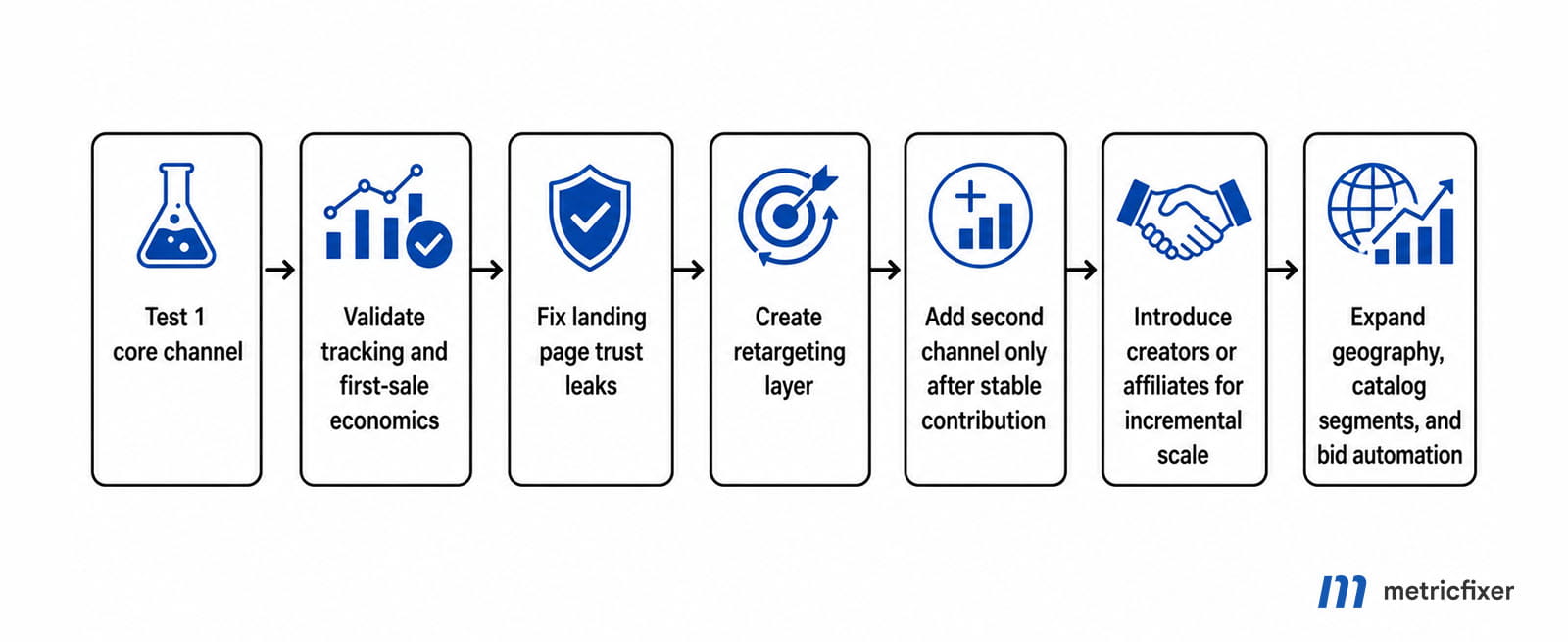
A practical rollout sequence can be kept simple. For general consumer and niche stores, launch Google Shopping, PMax, or Search, then add Meta retargeting and catalog campaigns, then test TikTok only if the product shows well on video. For POD, launch Meta or TikTok with creator-style creative, then add branded or occasion-based Google Search once demand exists, then layer affiliate creators. For high-ticket, launch Google Search and Shopping, add Microsoft imports, then test YouTube or native advertising for education. For subscription, launch Meta or creator-led social, add affiliate or content partners, and only then test YouTube. For B2B, launch Google Search and Microsoft Search first, then use YouTube or Demand Gen for remarketing and education.
Open questions and limitations
This review is strongest on channel fit, creative mechanics, platform rules, and broad ecommerce economics. It is weaker on hard dropshipping-only CAC and ROAS by subtype because most public datasets report ecommerce or DTC performance rather than pure dropshipping cohorts. Where reliable subtype-specific economics were unavailable, this article marks them as unspecified instead of manufacturing precision.
Forum evidence is useful but directional. BlackHatWorld, Warrior Forum, Reddit, and similar sources can reveal recurring operator problems such as account bans, Google Shopping compliance issues, or TikTok fulfillment confusion. They should not be read as controlled research. In this review, forum material is used mainly where it aligns with official platform documentation and reputable benchmark publications.
Public, archivable English-language Telegram channel material was not reliable enough to support load-bearing claims, so Telegram sources were not used as a primary evidence base.
Methodology and sources
This article is based on a review of official documentation from advertising platforms, ecommerce benchmark publications, merchant and policy documentation, and selected forum/operator discussions. Official platform materials were weighted highest for policy and campaign mechanics. Benchmark reports were used for broad ecommerce economics. Forum sources were used only as directional operator evidence, especially where they matched platform documentation or benchmark trends.
- Google Ads Help: Onboarding guide for Shopping ads
- Google Ads Help: Demand Gen campaign performance guide
- Google Ads policy: Misrepresentation
- BlackHatWorld discussion: dropshipping with Google Shopping
- TikTok Ads: Creative best practices for performance ads
- BigCommerce: Ecommerce PPC guide
- BigCommerce: Google Ads for ecommerce
- Google Ads Help: Bid strategy selection
- Microsoft Learn: Shopping campaigns
- Google Ads Help: Target ROAS bidding for Shopping campaigns
- Google Merchant Center: Checkout and landing page requirements
- Google Ads Help: Retailer best practices for AI-powered Performance Max campaigns
- Google Ads Help: About Target ROAS bidding
- WordStream: 2025 Google Ads benchmarks
- Microsoft Learn: About Performance Max campaigns
- Triple Whale: Facebook ad benchmarks
- Meta Business Help Center: Advantage+ catalog ads
- Meta Business Help Center: Collection ads
- Meta Business Help Center: Advantage+ Sales Campaigns
- Meta Business Help Center: Advertising restrictions
- Triple Whale: TikTok ad benchmarks
- TikTok Ads Manager: Smart+ campaigns
- TikTok Ads Manager: Smart+ web campaign best practices
- TikTok Advertising Policies: Deceptive practices
- Google Ads & Commerce Blog: Demand Gen performance updates
- Google Ads Help: Creative excellence guide for Demand Gen campaigns
- Outbrain: Conversion bid strategy setup
- Taboola: Building ecommerce funnels with native content
- PropellerAds: Ecommerce scaling case material
- Adsterra: Push notification advertising guide
- Adsterra: Web push notifications publisher guide
- impact.com: State of affiliate marketing research report
- Everflow partner marketing platform
- Everflow Helpdesk: Fraud detection for ecommerce
- Printful: Print-on-demand statistics and market data
- Shopify: High-ticket dropshipping
- Shopify Help Center: Chargeback monitoring
- HubSpot: CPL and CAC benchmarks
- Triple Whale: Google Ads benchmarks
This article is for informational and strategic planning purposes only. metricfixer is not affiliated with Google, Microsoft, Meta, TikTok, Outbrain, Taboola, PropellerAds, Adsterra, impact.com, Everflow, Shopify, Printful, HubSpot, Triple Whale, BigCommerce, BlackHatWorld, or other third-party platforms and publishers mentioned in the article. Advertising platform policies, campaign automation rules, benchmark data, and merchant requirements may change after publication. Always verify current platform documentation and test economics on your own store before scaling paid media.