
Published Sep 3, 2026
Google Ads Gambling Certification Changes 2026: What Operators, Affiliates, and Agencies Need to Know
Google tightened gambling ad certification in August 2026. This guide explains the new licence, domain, landing-page, account, geo and audience requirements—and the September policy-health change.
Category: Online advertising · By metricfixer Expert Team
Google has tightened the way gambling advertisers qualify for and maintain Google Ads certification. The August 26, 2026 update is not simply a new application form: it formalizes stronger checks around local licensing, the relationship between advertiser, licensee and domain, responsible-gambling disclosures, affiliate destinations, mobile apps, account structure and recertification. A second certification change is scheduled for September 14, 2026 and will extend Google’s “good policy health” requirements across all categories covered by the Gambling and games policy.
Practical default: treat Google Ads gambling certification as an ongoing compliance system, not a one-time approval. Before launching or expanding a campaign, verify the license for the exact market, the certified domain or app, the landing-page disclosures, account structure, location settings, audience settings and the policy history of the account and its manager account.
Executive summary
On August 26, 2026, Google changed its certification applications and standards for online gambling jurisdictions, online non-casino games that require certification and social casino games. All new applicants must use the revised process. The most important change is that Google now spells out a much more explicit chain of evidence between the local gambling licence, the advertising entity, the gambling operator and the destination domain. If that relationship is not obvious, the advertiser must document it.
The destination itself now matters more visibly in the certification process. Google says gambling landing sites must prominently show an age warning, addiction-help resources, terms and conditions, licensing information and a privacy policy that identifies the data controller. Operators must state their registered business name and licence number. Affiliates and aggregators that do not need their own licence must link only to gambling entities that are fully licensed and authorised for the geography being targeted, and the advertised site must state this clearly in its footer.
Mobile app promotion receives a specific two-way verification requirement: an operator’s licensed domain must link to the official App Store or Google Play listing, and the store listing must link back to the registered domain. This makes the website, app-store identity and regulatory identity part of one auditable chain.
Google also formalised structural limits. A separate certification application is required for each country. One Google Ads account cannot simultaneously hold an online gambling certification and a social casino games certification. Different social-casino certification groups may also require separate accounts. If material information from the application changes later, Google requires immediate recertification and warns that failure to do so may lead to suspension.
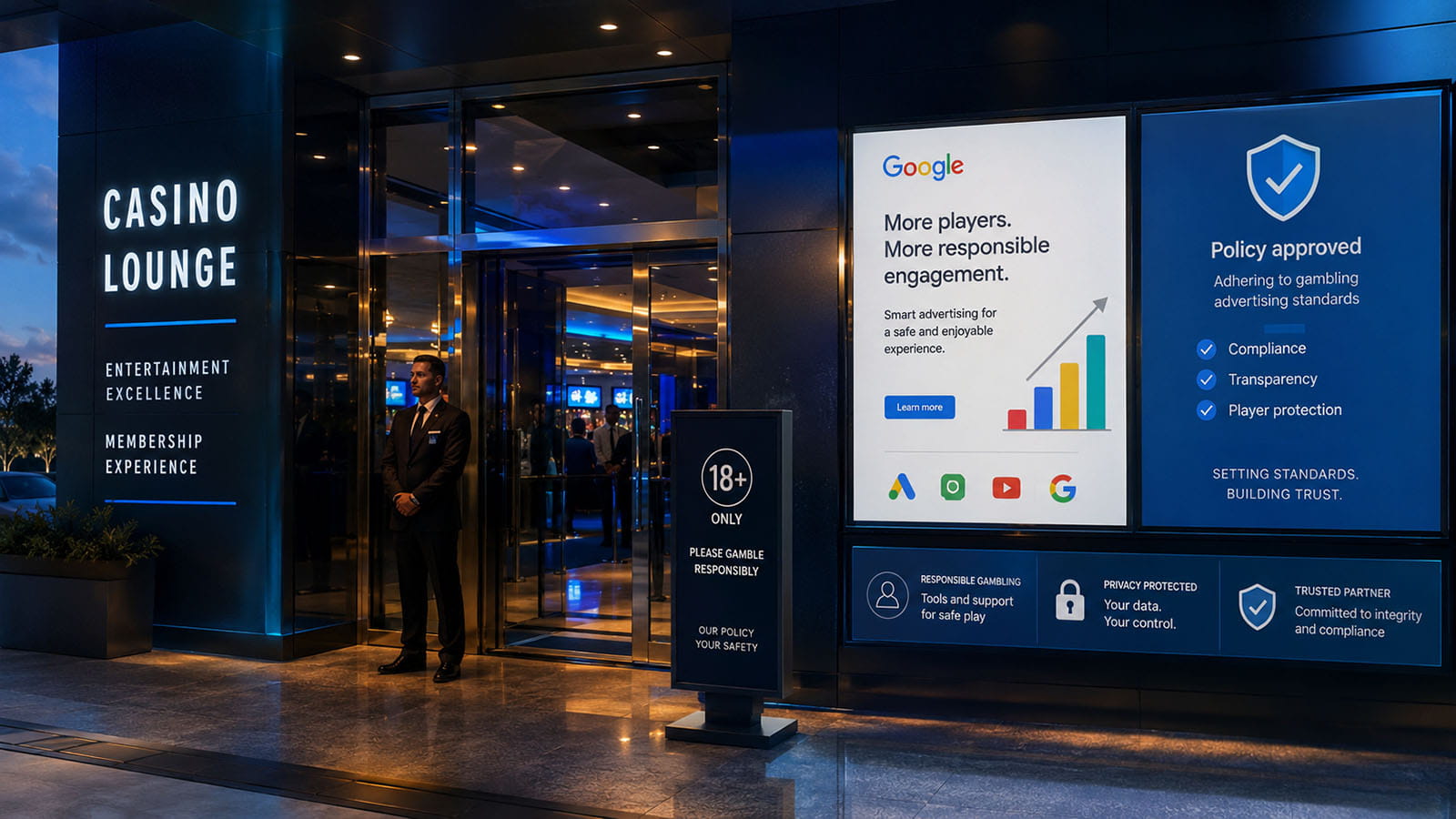
A second important date is September 14, 2026. Google says the stricter certification eligibility requirements introduced earlier in 2026 will expand to all categories under the Gambling and games policy. Accounts seeking certification must demonstrate “good policy health,” and manager accounts with repeated certificate revocations or repeated gambling-policy violations across managed accounts can lose eligibility to apply for new certificates and may lose existing certifications. Google has not published a numeric threshold for what counts as “repeated” or “significant” in this context.
For advertisers, the implication is straightforward: licensing alone is no longer enough. The account, domain, landing page, app, audience strategy, location setup and wider manager-account history all need to tell the same compliant story.

What changed on August 26, 2026?
Google’s August 2026 global Gambling and games policy update applies to new certification applicants in online gambling jurisdictions, online non-casino games where certification is required and social casino games. The revised requirements are now reflected in the live Gambling and games policy.
| Area | What Google now requires or states more explicitly | What advertisers should do |
|---|---|---|
| Local licence | A valid local licence is required for every region the advertiser intends to target where the country-specific policy requires one. | Match each campaign market to a current licence and Google certification before launch. |
| Advertiser-to-licensee relationship | If the relationship between the advertiser, licensee, gambling entity and domain is unclear, documentation must explain it. | Prepare corporate ownership, agency authorisation, brand-licensing or operating-company documentation before applying. |
| Destination disclosures | The site must prominently show an age warning, addiction resources, terms and conditions, licensee name, licence number and a privacy policy identifying the data controller. | Audit the actual landing page and footer, not only a legal-information page hidden several clicks away. |
| Operators | Operators must explicitly display their own registered business name and licence number. | Keep the name and number consistent with the regulator record and application. |
| Affiliates and aggregators | If not required to hold a licence themselves, they must link exclusively to properly licensed and authorised gambling entities in the target geography and state this in the footer. | Build market-specific outbound-link controls and remove operators that are not authorised for that market. |
| Mobile apps | The licensed domain must link to the official app-store listing, and the store listing must link back to the registered domain. | Check both directions before certification and after every app-store update. |
| Multi-country expansion | A separate application is required for each country. | Treat each new market as a certification project, not simply a campaign location edit. |
| Mixed gambling categories | One account cannot hold both online-gambling and social-casino certification. | Separate account architecture before applying. |
| Material changes | Advertisers must recertify immediately after a material change to application information. | Add certification review to legal, domain, brand, licensing and app-release change management. |
Why this is more than a form update
The most important part of the August update is not the existence of a revised form. It is the stronger connection Google now expects between four things:
Google Ads gambling certification workflow: local regulatory permission → verifiable licensee and operating entity → directly related and compliant domain or app → Google certification for the exact country and category → campaign targeting limited to certified markets → continuous policy monitoring → immediate recertification after a material change.
Historically, advertisers could think of the process as “we have a licence, therefore Google should approve the ads.” The updated wording makes that assumption risky. Google can now ask whether the entity paying for advertising is the same as the licensee, an authorised affiliate, a group company, an agency or another legal entity, and whether the destination is genuinely connected to that regulated operation.
This is especially relevant to international gambling groups. A consumer-facing brand may use one trademark across several countries while local licences are held by different subsidiaries. The Google Ads account may be billed by a group marketing company, while the domain is technically owned by another entity. None of these arrangements is automatically prohibited, but the relationship may need to be documented clearly enough for Google to verify it.
A useful pre-application evidence pack therefore includes the regulator record, licence certificate, legal company name, licence number, registered domain, any relevant brand or operating-company relationship and, where an agency applies on behalf of a client, written authority showing who the advertiser represents. This is an operational recommendation rather than a separate Google policy requirement, but it follows directly from Google’s demand for clear documentation where the advertiser-licensee relationship is not obvious.
The landing page is now part of the certification evidence
Google has long required gambling advertising to target approved locations, include responsible-gambling information and avoid minors. The August update makes the destination-site checklist much more concrete.
Before applying, an operator should be able to answer “yes” to all of the following:
- [ ] Is the legal gambling age clearly visible on the destination?
- [ ] Are responsible-gambling or addiction-support resources easy to find?
- [ ] Are terms and conditions accessible from the advertised site?
- [ ] Does the footer identify the licensee?
- [ ] Is the licence number visible and consistent with the regulator record?
- [ ] Does the privacy policy identify the data controller?
- [ ] Is the registered business name consistent across the site, licence and certification application?
- [ ] If the advertiser is an affiliate or aggregator, are all promoted operators authorised for the targeted geography?
- [ ] If an app is promoted, does the licensed domain link to its official store listing?
- [ ] Does that store listing link back to the registered domain?
For privacy teams, the requirement to identify the data controller is worth treating as more than a cosmetic footer change. Gambling advertisers often run multiple legal entities, CRM systems, payment providers and marketing platforms across markets. The entity named in the privacy notice should match the real data-governance arrangement. For a broader view of how Google Ads handles processor and controller roles, see metricfixer’s guide to Google Ads Data Processing Terms.
Operators, affiliates and aggregators are not treated the same way
Google’s policy distinguishes an operator that provides gambling services from “online gambling-promoting content,” such as an affiliate or comparison site.
For operators, the rule is direct: the site must show the operator’s own licensing details and the operator must satisfy the country-specific legal and certification conditions.
For affiliates and aggregators, Google allows certain sites that provide information about or comparisons of gambling services, but the destination must not itself provide gambling services or link to gambling services owned by that same destination operator in a way that falls outside the permitted model. More importantly after the August update, an affiliate that does not require its own licence must link only to gambling entities licensed and authorised in the geographic market being advertised. The site must also carry a prominent footer statement confirming that outbound links go exclusively to entities authorised for the relevant location.
This creates a practical problem for global affiliate sites: a single page with one universal list of operators may be compliant in one country and non-compliant in another. An affiliate targeting several jurisdictions should therefore maintain a market-by-market inventory of outbound operators and confirm that geo-specific pages never expose links to operators that are unlicensed for that market.
In other words, Google certification does not turn an affiliate domain into a universal passport for gambling traffic. The legal status of every promoted operator still matters.
Mobile gambling apps now need a two-way identity chain
For online gambling and online non-casino game operators promoting a mobile app, Google now explicitly requires a prominent working link from the licensed domain to the official App Store or Google Play listing, plus a direct link from the store listing back to the registered domain.
This closes a common identity gap. A website, app listing and Google Ads account can no longer be treated as independent marketing surfaces. Google wants to see that the app promoted in ads belongs to the same regulated business associated with the certified domain.
Before applying, check:
- the publisher or developer identity shown in the store;
- the website URL shown in the app listing;
- the exact domain submitted for Google certification;
- the legal entity named on the site;
- the licence holder and licence number;
- the geographic availability of the app.
If one of those elements changes during a rebrand, app transfer, acquisition or licence migration, assume the certification needs to be reviewed rather than waiting for ads to stop serving.
Account architecture matters more after the update
The revised process introduces account-structure limits that should be designed before campaigns are built.
| Scenario | Recommended Google Ads structure | Reason |
|---|---|---|
| Online gambling in several countries | Separate certification application for each country; one account may be used only where its certification structure remains valid. | Google requires country-specific applications and local eligibility. |
| Online gambling plus social casino | Separate Google Ads accounts. | A single account cannot hold both certification types. |
| Social casino campaigns across different certification groups | Separate accounts where the target groups are different. | Google prohibits mixed social-casino targeting groups in one certification structure. |
| Second gambling domain | Apply to certify the additional website rather than assuming the existing certificate covers it. | Google says gambling certification is tied to the website submitted in the application. |
| Agency managing multiple gambling clients | Keep client ownership, access, certification evidence and policy history clearly separated and monitored at MCC level. | From September 14, repeated certification problems under a manager account can affect future eligibility. |
The last row is particularly important for agencies. In an ordinary vertical, one problematic client account may be mostly a client-level problem. Under the 2026 gambling certification framework, policy health can create a wider manager-account risk.
The September 14 update: “good policy health” expands to all categories
Google’s separate July 2026 certification eligibility announcement says that on September 14, 2026 the requirements introduced earlier in the year will expand to all categories under the Gambling and games policy.
The key rule is that accounts seeking gambling or games certification must demonstrate good policy health. Google specifically warns that manager accounts with repeated online-gambling certificate revocations, or manager accounts whose managed accounts are repeatedly flagged for gambling-policy violations while relying on certification, can lose eligibility to apply for new online-gambling certificates and may have existing certifications revoked.
Google also reiterates three domain eligibility rules:
- sites hosted on free subdomains are ineligible;
- the domain must be directly owned and controlled by the business;
- domains unrelated to gambling are ineligible for certification.
Google does not publish a numeric threshold defining how many violations or revocations are enough to fail the “good policy health” test. Industry coverage has highlighted the same ambiguity. The safe interpretation for agencies is therefore not to manage toward a presumed strike threshold, but to treat every certificate revocation and repeated gambling-policy issue as a manager-account governance event.
This fits a wider direction in Google Ads toward advertiser-level trust and qualification signals. It should not be confused with Limited Ad Serving, which is a different policy mechanism, but advertisers operating in regulated verticals may find metricfixer’s review of account-level trust signals and Limited Ad Serving useful background.
Social casino advertisers should also watch the certification workflow migration
A separate Google certification-process update says that during August 2026 Google began gradually introducing in-account certification applications for Social Casino Games. The rollout is incremental, and Google said existing certifications and pending applications were not affected by that rollout.
The live Gambling and games policy now says Social Casino Games applications will no longer be supported through the Google Ads Help Center and will need to be submitted through the Google Ads account starting in September 2026. Advertisers should therefore expect the workflow to move into the Admin → Policy → Account area as the rollout reaches their account.
Social casino advertisers also need to remember that this category is not simply “gambling without cash withdrawal.” Google requires the game to state that it does not offer or promote real-money gambling and does not provide prizes of real-world value. It must disclose in-app purchases where applicable, avoid real-money gambling brand names and marks, and carry an age disclaimer. Google also states that sites or affiliates whose purpose is to promote engagement in third-party social casino games are not supported under the same model. Sweepstakes casinos should not be assumed to qualify as social casino games merely because they use virtual-currency mechanics.
The general Google Ads rules gambling advertisers still need to follow
The August update does not replace the existing Gambling and games policy. The core rules remain:
- Only approved countries and permitted product types may be targeted. Country-specific policy tables define what Google accepts and which licence or authorisation is required.
- Certification is separate from legal licensing. Being legally licensed does not automatically make a Google Ads account certified.
- Responsible-gambling information must be present. The landing experience must provide appropriate responsible-gambling or problem-gambling information.
- Minors must never be targeted. Local legal-age rules and Google’s own age restrictions apply.
- The licence must remain valid. Google requires advertisers to maintain any licence, authorisation or registration relied upon for certification and to notify Google if it expires, is suspended or is terminated.
- The certified URL matters. Google states that a gambling certificate is limited to the website included in the application. A different gambling domain requires its own approval process.
- Certification does not override product restrictions. A certificate cannot be used to advertise gambling products that are not permitted for the target country or certification type.
Google warns that submitting false information in a gambling certification application or using a certificate to advertise products not permitted by the policy can result in suspension. The current policy also treats violations of the Social Casino Games policy especially seriously and says qualifying violations can lead to suspension without prior warning.
Use conservative location targeting in regulated gambling markets
One of the easiest ways to create a compliance problem is to obtain certification for a legal market and then allow campaigns to reach users outside that market.
Google’s standard location setting can include both people who are in the target location and people who merely show interest in it. In its advanced location options guidance, Google specifically says advertisers should consider Presence targeting when the business operates in a sensitive vertical with strict targeting limitations.
For regulated gambling campaigns, the practical default should therefore be:
- use the narrowest legally appropriate target geography;
- where the campaign type supports it, consider Presence: people in or regularly in your targeted locations rather than the broader Presence or interest setting;
- exclude jurisdictions in which the product cannot legally or contractually be promoted;
- audit geographic reports after launch rather than assuming targeting is perfect;
- remember that Google describes location detection as a best-effort system and does not guarantee 100% physical-location accuracy.
In the United States this becomes especially important because legal availability and Google certification may vary by state and product. Similar logic applies to countries where different gambling types have different licensing regimes.
Do not build a gambling strategy around first-party remarketing audiences
Gambling is also covered by Google’s sensitive-interest rules for personalised advertising. This affects campaign design even after the advertiser has a valid gambling certificate.
Google says advertisers promoting sensitive-interest categories cannot use advertiser-curated audiences. The restricted examples include:
- Customer Match;
- Your data segments;
- Audience expansion;
- Lookalike segments.
Google does allow predefined Google audiences because it says sensitive user signals are excluded from those audience definitions. Examples include in-market segments, affinity audiences, permitted demographics, detailed demographics, life events and location targeting. Custom segments have additional serving limitations when sensitive creatives or destinations are involved.
This distinction is easy to miss because an advertiser may legally hold customer data and technically be able to build a list, yet the advertising policy still limits how that list can be used for gambling promotion. Demand Gen and similar campaign types also deserve extra scrutiny because Google notes that some campaigns rely on advertiser-curated audience mechanisms by default and may therefore have restricted serving for sensitive categories.
The practical recommendation is to design the acquisition strategy around eligible Search intent, contextual signals, permitted Google-defined audiences and compliant geographic targeting rather than assuming a normal ecommerce remarketing playbook will transfer into gambling.
What advertisers report in practice
Official policy is the primary source for certification decisions, but advertiser reports help explain where the process can become operationally difficult.
In a March 2026 discussion on Reddit, one lottery advertiser reported that a certification application was rejected because Google could not verify the lottery licence in an external government database, even though the advertiser said the licensing authority did not provide such a searchable database. This is an anecdotal report, not an official Google rule, but it illustrates why the August emphasis on up-to-date licensing credentials and clear evidence matters.
The useful lesson is not to look for a workaround. It is to make the regulator trail easier to verify. Where a public registry is incomplete, an advertiser can prepare official licence documents, regulator contact information, a regulator-hosted page if one exists, legal-entity evidence and a concise explanation of how the advertising entity relates to the licence holder.
Similarly, advertisers should avoid relying on the fact that a competitor appears to be running an ad. A competitor may have a different certification, different target geography, legacy approval, different legal status or simply be in temporary non-compliance. Competitor visibility is not evidence that a particular setup is permitted.

A pre-application checklist for gambling advertisers
Use this checklist before a new certification request, before entering a new country and before moving a gambling client into a new Google Ads account.
1. Legal and licensing
- [ ] Confirm that the gambling product is permitted by Google in the intended country or region.
- [ ] Confirm that the correct local licence, registration or authorisation is active.
- [ ] Confirm that the licence covers the exact product being advertised.
- [ ] Save evidence that can be independently checked.
- [ ] Document the relationship between advertiser, licensee, brand, domain and agency where it is not obvious.
2. Domain and destination
- [ ] Use a domain directly owned and controlled by the business where Google requires that ownership relationship.
- [ ] Do not rely on a free hosted subdomain.
- [ ] Ensure the domain is clearly related to the gambling business being certified.
- [ ] Display age restrictions prominently.
- [ ] Display responsible-gambling and addiction-support resources prominently.
- [ ] Make terms and conditions accessible.
- [ ] Show licensee name and licence number in the footer.
- [ ] Ensure the privacy policy identifies the data controller.
3. Affiliate and aggregator controls
- [ ] Maintain a country-specific list of outbound operators.
- [ ] Verify that every promoted operator is licensed and authorised for that target geography.
- [ ] Remove cross-market links that would expose users to an operator not authorised locally.
- [ ] Add the required footer statement about licensed and authorised outbound destinations.
4. Account architecture
- [ ] Do not mix online-gambling and social-casino certification in one account.
- [ ] Separate social-casino certification groups where Google requires separate accounts.
- [ ] Submit a separate application for every country being targeted.
- [ ] Review the policy history of the advertiser account.
- [ ] If an agency is involved, review the gambling-policy history of the MCC and other managed gambling accounts.
5. Campaign targeting
- [ ] Target only geographies covered by both local law and Google certification.
- [ ] Consider Presence-only location targeting where the campaign type supports it.
- [ ] Do not target minors.
- [ ] Do not use restricted advertiser-curated audiences such as Customer Match or Your data segments for gambling promotion.
- [ ] Review Custom Segment and Demand Gen eligibility carefully before launch.
6. Ongoing maintenance
- [ ] Monitor licence expiry and renewal dates.
- [ ] Recheck the footer, privacy policy and responsible-gambling resources after site releases.
- [ ] Recheck app-store links after app transfers or listing changes.
- [ ] Reassess certification after changes to the licence holder, domain, app ID, operating entity, brand relationship, product category or target market.
- [ ] Treat certificate revocations and repeated disapprovals as governance incidents, not routine optimisation noise.
What should be treated as a material change?
Google requires immediate recertification after a material change to information supplied in the application, but the August announcement does not provide an exhaustive list of material changes.
A conservative operational interpretation is to review certification whenever any of the following changes:
- licensee legal name;
- licence number or regulatory status;
- advertising entity;
- ownership or control of the certified domain;
- relationship between advertiser and licensee;
- app ID or app-store publisher relationship;
- operator versus affiliate/aggregator business model;
- gambling product category;
- country or region targeted.
This list is not an official Google definition. It is a risk-control framework based on the information Google now says it uses to qualify and maintain certification. If a change could make the original application materially misleading, recertification should be considered before campaigns continue.
What to do if certified gambling ads are still disapproved
Certification does not guarantee that every ad will be approved. Ads can still fail because of target geography, destination content, URL mismatch, audience configuration or other Google Ads policies.
A sensible troubleshooting order is:
- Read the exact policy reason in Policy Manager.
- Confirm that the campaign targets only certified locations.
- Confirm that the final URL uses the certified website.
- Check whether the landing page still contains every required responsible-gambling, licensing and privacy disclosure.
- Check whether a restricted audience is attached at campaign, ad-group or asset-group level.
- Fix the underlying issue before appealing.
- Use Google’s policy review and appeal workflow if the issue has been corrected or you believe the classification is wrong.
Google explicitly advises removing ads that cannot be brought into compliance rather than leaving repeated violations unresolved. Its account suspension documentation explains that repeated violations can lead to escalating enforcement and that serious violations can result in immediate suspension.
Recommended operating model for gambling advertisers and agencies
The strongest way to respond to the 2026 changes is to stop treating policy review as the last step before launch. It should become part of campaign architecture.
For an operator, ownership of certification should be shared between paid media, legal/compliance, web operations and analytics. Paid media controls the account and geography; legal confirms licensing; web operations maintain the required disclosures and domain relationships; analytics and privacy teams ensure the privacy notice and data-controller information are accurate.
For an agency, add an MCC-level compliance layer. Maintain a register containing:
- client name and legal advertising entity;
- Google Ads customer ID;
- certification category;
- certified country or region;
- licensed domain or app;
- licensee and licence number;
- certification date and recertification events;
- known policy disapprovals or certificate revocations;
- responsible owner on the client side;
- next licence renewal date.
This is more work than a one-time form, but it is also the direction Google’s policy now clearly rewards: verifiable identity, stable account history, transparent ownership and market-specific compliance.
Bottom line
The August 26 update makes Google Ads gambling certification more like vendor due diligence than a simple policy checkbox. Google wants to verify not only that a licence exists, but that the right entity, domain, app, market and business model are connected to that licence and remain compliant after approval.
The September 14 expansion raises the stakes further by applying “good policy health” across the full Gambling and games policy and by creating potential MCC-level consequences for repeated certificate problems.
For advertisers already running successfully, there is no reason to rebuild accounts simply because the form changed. But this is the right moment to audit the certification evidence, landing-page footer, privacy-controller disclosure, responsible-gambling resources, app links, country targeting, audience targeting and manager-account history. For new market launches, complete that audit before submitting the certification request.
Methodology and sources
This article is based primarily on Google’s official Gambling and games policy, the August 2026 global certification update, the July 2026 certification-eligibility update, Google’s certification-process announcement, personalised-advertising restrictions, location-targeting documentation, policy-review workflow and account-suspension guidance. Industry and advertiser discussions were used only as secondary context for practical implementation problems; they do not override Google policy or local law.
- Google Advertising Policies Help: Update to Gambling and games policy — Global (August 2026)
- Google Advertising Policies Help: Gambling and games
- Google Advertising Policies Help: Gambling and games certification eligibility update (July 2026)
- Google Advertising Policies Help: Update to the Google Ads certification process (August 2026)
- Google Advertising Policies Help: Gambling in personalised advertising
- Google Advertising Policies Help: Restricted targeting in personalised advertising
- Google Ads Help: About advanced location options
- Google Ads Help: Submit a campaign for policy review
- Google Advertising Policies Help: Google Ads account suspensions overview
- Search Engine Roundtable: Google Ads gambling and games certification eligibility and policy health
- Reddit r/Google_Ads: advertiser report about online gambling certification and licence verification
This article is for advertising-policy, compliance and operational information only and is not legal advice. Gambling laws, licensing rules, age restrictions, permitted products and Google Ads certification requirements vary by jurisdiction and can change quickly. metricfixer is not affiliated with Google, gambling regulators, Search Engine Roundtable, Reddit or other third parties mentioned in this article. Advertisers should verify the current Google policy and applicable local law before launching or expanding gambling campaigns.