
Published Sep 20, 2026
Meta Conversions API: When It Helps and When It Just Repeats Data
Meta Conversions API can recover missing purchases, add useful identifiers, and report CRM outcomes. But repeating the same data is not automatic enrichment, and Gateway does not guarantee longer-lived Safari cookies. Learn which setup addresses which gap.
Category: Analytics & Conversion Tracking · By Mikalai Sasau
Practical default: choose an integration to close an identified gap, not to clear every recommendation in Events Manager. CAPI can add value through event recovery, better identifiers, more reliable business events, or operational resilience. Without one of these improvements, a second delivery route is not a sound basis for promising a substantial matching or advertising-performance uplift.
Executive summary
The important distinction is additional information versus additional transmission. CAPI is a way to send events to Meta, not a feature that automatically makes the same email address more informative. Browser-side Advanced Matching already supports customer identifiers. Meanwhile, a backend can report outcomes that never reach a browser at all. Meta documents both Pixel Advanced Matching and server and CRM event sources.
It would also be wrong to conclude that CAPI is useful only when it adds new customer fields. Recovering a real purchase that Pixel missed is useful even with exactly the same identifiers. The defensible conclusion is narrower: when event coverage, actual identifier availability, timing, and business-event accuracy are already equivalent, duplication alone does not justify a large expected improvement. This is an architectural inference, not a claim that Meta publishes an exact zero-uplift rule.
Conversions API Gateway is one implementation option. It is neither required for a backend integration nor sufficient to extend cookie lifetime, capture a missing business event, or improve every account's results.
The Events Manager recommendation is not an account-level forecast
In the screenshot supplied to metricfixer, Events Manager recommends connecting Conversions API through Google Tag Manager and displays the statement "Median Cost per result is 36.6% lower." The recommendation is marked high priority.
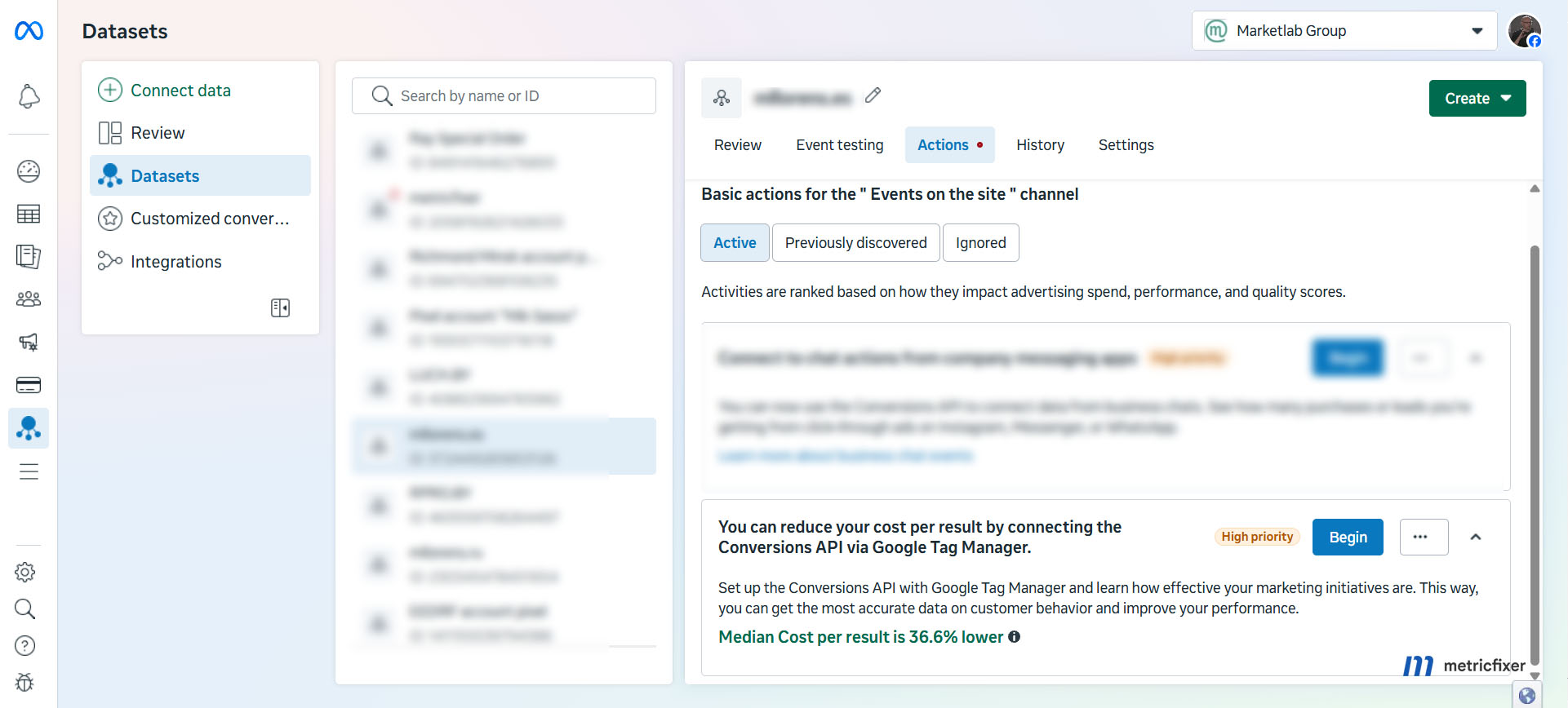
The visible card does not establish the comparison group, sample, dates, measurement method, or changes bundled with implementation. It does not show whether participating businesses previously lost purchases, lacked Advanced Matching, changed their conversion definitions, or added CRM signals.
That makes the headline unsuitable as a forecast for a website whose browser implementation already performs well. Equally, the screenshot does not prove that Meta's underlying result is false, or that most advertisers will receive no benefit. The unsupported leap is from a headline statistic to a promise about a specific implementation.
There is another distinction: better measurement and more business are different outcomes. Consider an illustrative example, not a campaign experiment. A business spends $1,200 and records 120 paid orders. Meta initially attributes 80 purchases, giving a reported cost per purchase of $15. After a measurement change, it attributes 100, giving $12. The reported metric improves by 20%, while spend and actual orders stay unchanged.
Recovering attribution can still be valuable. It simply does not prove that advertising generated additional sales. Our guide to the Meta event lifecycle explains why event receipt, matching, attribution, and campaign reporting should be evaluated separately.
Four improvements that should not be confused
Before selecting a product, identify the problem it is supposed to solve. The following is an evaluation framework, not a description of Meta's internal processing order.
| Improvement | What changes | What does not follow automatically |
|---|---|---|
| Event coverage | More genuine, permitted business events reach Meta. | Every recovered event will match a person or receive advertising credit. |
| Identity information | Events contain more useful, accurate, or consistently available identifiers. | Sending the same identifier twice creates a new matching signal. |
| Business-event quality | The event represents a verified payment, accepted lead, or qualified outcome rather than an unreliable interface action. | Every additional CRM status should become an optimization event. |
| Advertising performance | The business acquires more valuable outcomes for its spend. | A better diagnostic score or more attributed conversions proves incremental growth. |
Meta's CAPI best practices distinguish matching from basic measurement: unmatched events cannot be used for advertising attribution or delivery optimization. Delivering a conversion and identifying the person behind it are therefore separate achievements.
Why the same data on two routes is not automatic enrichment
Advanced Matching is not exclusive to CAPI
A browser Pixel can receive email addresses, phone numbers, and advertiser-defined customer identifiers through Advanced Matching. Meta supports automatic hashing of supplied email values and accepts properly normalized SHA-256 email hashes. The claim that customer matching becomes possible only after adding a server route is incorrect.
Suppose a permitted Purchase arrives through Pixel with the correct email, phone, browser context, and available click identifier. A CAPI copy carries the same information for that same purchase. There is no newly supplied email, recovered click, or previously unknown business outcome in the second message.
Meta's deduplication documentation says it generally prefers the first received event when browser and server copies do not differ meaningfully in content. It does not describe a guaranteed matching bonus for repeating identical data, or guarantee that every pair becomes a complete union of all submitted fields.
This is why agencies should not sell a duplicate delivery path as guaranteed identity enrichment. However, Meta does not expose every detail of its matching systems, so an equally absolute promise of zero effect would also go beyond the evidence.
Compare actual values, not identical-looking settings
Two integrations may list the same fields but populate them differently. In an illustrative case, the browser sends email on 30% of purchases because the tag fires before customer data is available, while the backend sends it on every eligible purchase. That is a real improvement in identifier coverage, even though both configurations contain an email field.
Check freshness and correctness as well. An outdated customer ID or another household member's email is not an improvement. For website events, the server must preserve the relevant visitor context: Meta notes that IP address and User-Agent information is added automatically to browser events but needs configuration for CAPI. Passing the hosting server's IP or a webhook sender's User-Agent is not equivalent to passing the visitor's details. See customer information parameters.
event_id solves a different problem. It identifies an event occurrence for deduplication, not a person. A perfectly paired purchase can still have weak identity information.
Three architectures that can all be called server-side tracking
1. A browser-originated event with a server relay
The browser detects an action and sends data to an intermediary, which forwards it through CAPI. The second network leg is server-to-server, but the event still depends on the browser producing the first message.
This can improve delivery when the direct Pixel request fails but the relay receives the event. It does not recover an action that never reaches the browser trigger. If the shared script fails before either message exists, both paths can fail together. This distinction follows from the dependency chain, not from the label on the integration.
2. The standard Pixel-connected Conversions API Gateway setup
In Meta's documented Gateway architecture, the Pixel script sends events to Meta and to Gateway. Gateway receives browser data and forwards CAPI events; a deduplication key is generated and propagated automatically.
This simplifies redundant delivery. It does not, by itself, connect an order database or CRM. Stape's Gateway troubleshooting documentation likewise explains that the standard setup depends on events tracked by Pixel.
The scope matters: this describes ordinary Pixel-based onboarding, not every possible extension. Meta also documents Business SDK requests through a Gateway endpoint. A separately connected backend source can add independent events. The extra source, rather than the Gateway name, creates that independence.
3. An independent backend or CRM event
The application records a payment or CRM transition and creates the event without waiting for a thank-you page. It can send through a direct CAPI integration, a suitable platform connector, or a configured server-side processing layer. Meta supports direct integrations; neither Gateway nor server-side GTM is mandatory.
Server-side GTM is a configurable processing environment, not an automatic source of orders. Google describes it as a system that receives and processes incoming requests. If its only input is a browser event, it inherits that input's limitations.
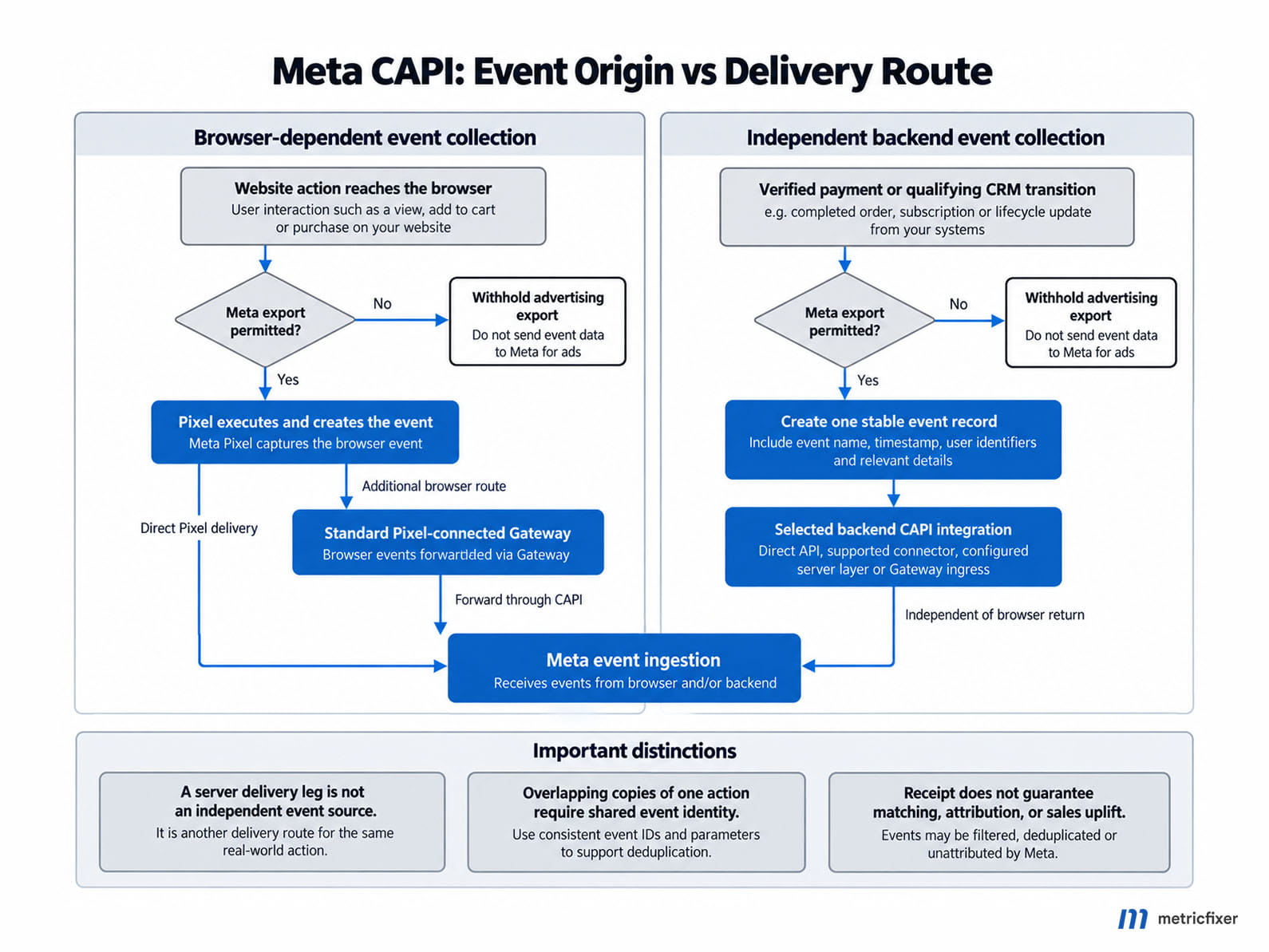
Ask the implementation team: if the customer pays and never returns to the website, which system creates the purchase event? The answer is more informative than whether the proposal contains the word "server-side."
The Gateway cookie myth: a custom domain is not a lifetime guarantee
Pixel can already use first-party cookies
A script's download domain and a cookie's storage domain are different things. Meta documents that, when Pixel uses first-party cookies, it creates _fbp for the website's domain. Its click identifier can be stored as _fbc. These are not automatically third-party cookies simply because Meta supplies the script. See Meta's browser and click identifier documentation.
Consequently, "install Gateway to make Pixel cookies first-party" is not an adequate explanation of the change. The site may already have first-party Pixel cookies while still being affected by Safari's restrictions.
Safari applies several different restrictions
WebKit describes default blocking of third-party cookies. That is different from allowing all third-party cookies for one week.
For first-party storage, WebKit's tracking-prevention documentation describes deletion of JavaScript-created cookies and other script-writable storage after seven days of Safari use without interaction with the website. It also describes a 24-hour expiry cap for JavaScript cookies on landing pages in detected cross-site link-decoration scenarios. This is not a universal claim that every Safari visitor loses every cookie exactly seven calendar days after creation.
Setting a cookie through an HTTP response is a different mechanism from creating it through document.cookie, but it is not automatically exempt. WebKit also documents seven-day caps for cookies set in detected third-party CNAME- or IP-cloaked responses. A custom subdomain and a long Expires value do not override browser enforcement.
What Gateway changes, and what must be tested separately
Gateway can change the delivery route. It may also improve the availability of matching data through features enabled during setup. For example, Stape describes Gateway Advanced Matching that stores hashed customer information in first-party cookies and includes it with events. If that makes permitted identifiers available on events that previously lacked them, there is a genuine information gain.
But storing more useful data and extending its browser lifetime are separate claims. Neither follows merely from adding another destination. A first-party cookie used by Advanced Matching still needs a documented storage and expiry analysis.
Do not confuse Meta CAPI Gateway with other products called Gateway, or with optional cookie-management features. For example, Stape documents Cookie Keeper as a separate server-side GTM power-up. Its existence does not establish that an ordinary Meta Gateway setup includes it or inherits its advertised behavior.
A meaningful cookie audit identifies the cookie, the component setting it, JavaScript versus Set-Cookie, hostname and infrastructure, actual Safari version, and consent behavior. Test continuity over time. A configuration screenshot showing a 90-day requested lifetime is not a completed 90-day browser test.
Preserving a known order's context is not extending a cookie
Meta also documents storing formatted click context in backend storage. A business can preserve permitted identifiers with a known lead or order and use the relevant context for a later event. This can remain useful after a browser cookie disappears, without changing that cookie's lifetime.
However, a database record cannot identify an otherwise unrecognized returning visitor by itself. A legitimate connection to the order, lead, or account must still exist. Nor does longer storage extend Meta's campaign attribution window. For the identifier model, see our guide to fbclid, _fbc, _fbp, and CRM tracking.
When CAPI genuinely adds something useful
A payment succeeds, but the customer never returns
A thank-you-page purchase depends on that page loading. This is not hypothetical as a payment-system design issue: Stripe's fulfillment guidance warns against relying on the landing page because customers are not guaranteed to visit it, and recommends webhooks for reliable payment handling.
The tracking counterpart is a backend event generated from verified payment state. Gateway replaying a thank-you-page Pixel cannot supply that missing origin on its own.
Replayed notifications must not create new purchases. Record the business transition once and keep delivery attempts separate. Stripe similarly requires payment handling that is safe when called repeatedly.
Delayed payments and subscription outcomes
For a payment method that completes later, the event should represent the qualifying payment outcome, not merely an earlier checkout submission. Recurring payments may also happen without a browsing session. These are reasons to use the payment or subscription system as the source. Stripe documents subscription and payment state notifications, while Meta lists system_generated for outcomes such as automatic subscription renewals.
Report the true event_time and use an action_source that reflects where the action occurred. A server-sent website purchase is not automatically system_generated. See Meta's server-event definitions.
A conversion occurring today after a long sales cycle is different from uploading an old conversion late. Meta's ordinary CAPI submission rules allow an event time up to seven days before submission, with separate rules for some other event sources. Do not backdate a new payment to the original visit or change an old timestamp to force acceptance. API acceptance and advertising-attribution eligibility remain separate questions.
CRM qualification and closed sales
A form submission does not reveal whether a lead becomes qualified or buys. A CRM integration can send that later outcome. This adds business information, even when the contact's email is unchanged.
Meta documents CRM integration separately from ordinary website CAPI. Do not assume that installing Gateway enrolls the business in a supported lead-quality optimization workflow. Check the relevant campaign goal, integration requirements, source identifiers, and account eligibility.
Define each stage clearly. Lead creation and a later qualification are different event occurrences; they should not share one deduplication identity. A sales team's repeated save operation should not create repeated qualifications.
Useful identifiers available only on the server
The backend may have a permitted customer identifier, a correctly normalized phone number, or a verified link between checkout and an existing account that the current browser event lacks. Keeping that information server-side can also avoid exposing unnecessary customer data in the page or a shared browser data layer.
The benefit is the actual additional information or improved coverage, not that hashing happens on a server. Compare the events that arrive, and omit unavailable optional fields rather than filling them with invented values.
A working fallback for a failed browser request
Even without additional customer fields, a second route can recover an event when one path fails and the other succeeds. A lightweight Gateway setup may be appropriate for this narrower problem.
Test the failure mode. Blocking the direct Meta request while allowing the Gateway request tests route redundancy. Preventing the shared Pixel script from running tests a different dependency. Neither test should be presented as proof that all browser restrictions have been overcome, and neither authorizes sending data against the user's choices.
Which solution fits which problem?
The following recommendations follow from the event-source and storage distinctions above. They are not a product ranking.
| Observed need | Reasonable starting point | What to verify |
|---|---|---|
| Reliable Pixel events; useful identifiers already present; no demonstrated gap | Keep the working setup, improve monitoring, and price any redundancy as resilience rather than guaranteed uplift. | Coverage is genuinely established, not inferred from matching totals or an absence of complaints. |
| Browser events lack customer data that the page already legitimately has | Audit Pixel Advanced Matching before adding infrastructure. | Correct values are available when the event is sent and are permitted for this purpose. |
| Some direct browser deliveries fail; existing events are otherwise adequate | Evaluate standard CAPI Gateway or another supported relay. | The alternative path survives the observed failure; overlapping events deduplicate. |
| Paid orders disappear when customers do not return, or payments complete later | A backend- or payment-driven connector or direct CAPI integration. | The event exists without the thank-you page and represents the agreed paid state. |
| Qualification, closed sales, or server-only identifiers are missing | A CRM/backend integration with appropriate event mapping. | Genuine new outcomes or identifiers, supported use, permissions, and timely delivery. |
| Several destinations need controlled routing, transformations, and enrichment | Server-side GTM or another managed server processing layer. | The necessary sources are connected; merely adding a container does not create them. |
| The principal concern is Safari identifier continuity | A separate cookie and identity-storage audit. | The actual storage mechanism and browser behavior, not a Gateway badge. |
A native ecommerce or CRM connector may already cover the required backend event. Inspect it before adding another integration. For broader server-side infrastructure, our multi-domain server-side GTM guide covers routing, isolation, consent, and cost allocation.
A practical Gateway option: businesses seeking managed, low-maintenance redundant delivery can evaluate Stape's Meta Conversions API Gateway. Choose it for the capabilities needed and verified in the proposed configuration, not as a promise of longer-lived Safari cookies or an independent payment feed.
Partner disclosure: the Stape link above is a metricfixer partner link. metricfixer may receive a commission when you sign up through it. This commercial relationship does not change the technical limitations or the need to test the setup.
Why enabling every option can make measurement worse
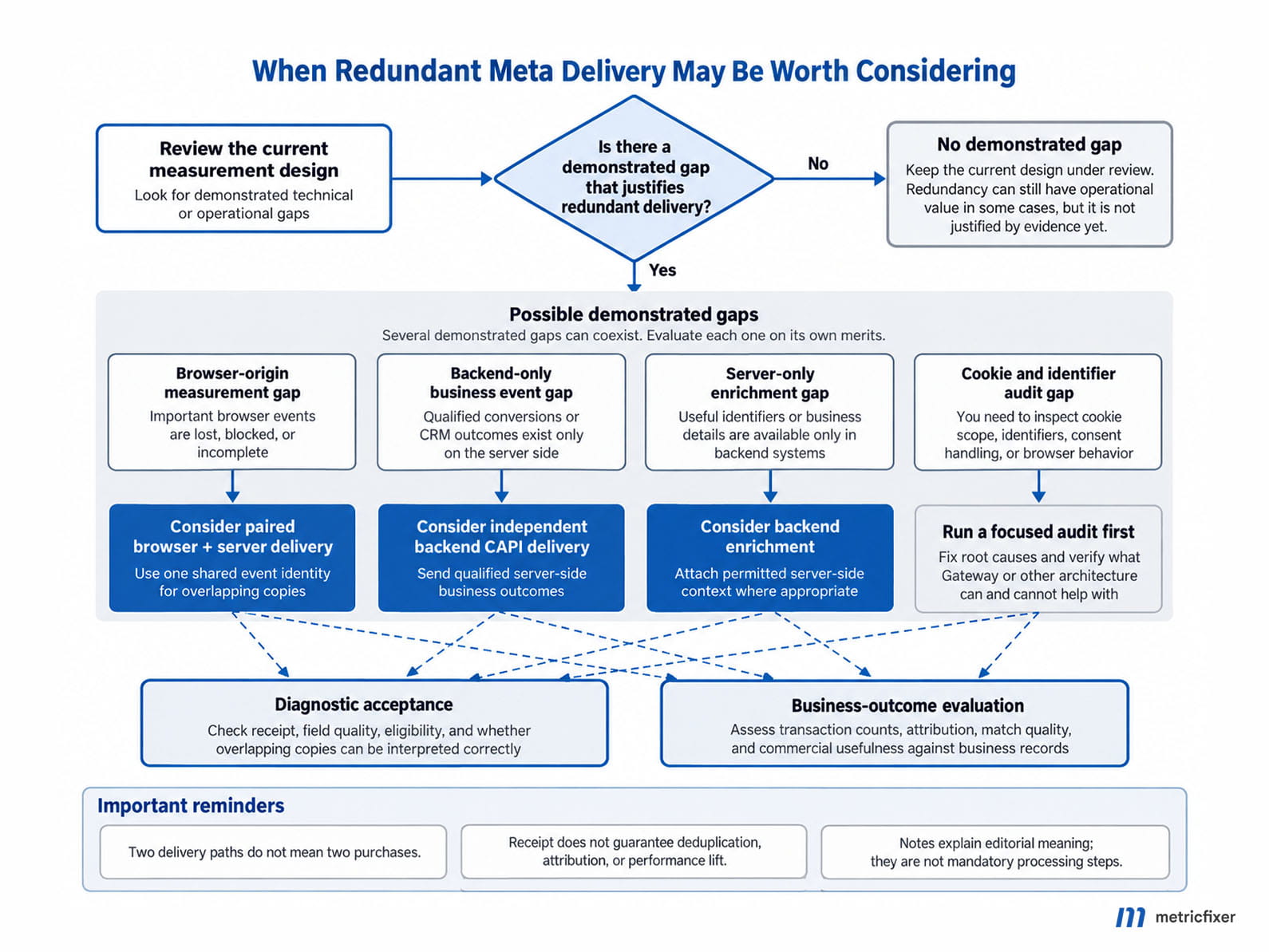
A native connector, a GTM CAPI tag, and Gateway may all send the same purchase. If their event identities or definitions disagree, the additional routes create a duplicate-counting risk rather than better evidence of a sale.
For overlapping browser and server events, Meta's recommended pairing uses matching event names and eventID/event_id values for the same Pixel, with a documented 48-hour window. That is not an unlimited replay policy. See our implementation guide to Pixel and CAPI deduplication.
Our recommended operating rule is one owner for each business-event definition and one shared event identity across its intended routes. Prevent duplicate jobs at the source; preserve the original event identity when retrying. Do not keep adding independent purchase producers and expect Meta to reconcile contradictory records.
Extra options also expand the maintenance and data-exposure surface. More automatic field capture can mean unnecessary collection; more destinations can mean inconsistent consent handling; more integrations can mean unclear responsibility when values disagree. Complexity is justified when it solves a real requirement, not merely because it is available.
How to establish whether the integration helped
1. Establish the browser baseline
Reconcile the agreed business outcome against your order or CRM records over a representative period. Separate paid, pending, cancelled, test, and refunded states according to the measurement definition. Compare only events eligible for advertising export; a consent-based exclusion is not an integration defect.
Use controlled transactions and protected event-level logs where available. Aggregate totals can hide offsetting losses and duplicates. Do not assume Events Manager provides a complete downloadable order-level receipt ledger for every production event. Where receipt cannot be established, label that part of the baseline uncertain.
2. State the additional capability before deployment
Write a testable sentence: "Payments confirmed after browser departure will produce a backend event," or "The eligible purchase events currently missing email will receive it from the customer record." "The recommendation will disappear" is not an acceptance criterion.
Compare delivered field coverage, not just field names in GTM. Keep any diagnostic logs minimized, access-controlled, and subject to a retention policy.
3. Test normal and failure scenarios
- Complete a normal purchase and inspect the intended browser/server pairing.
- Complete payment without returning, and confirm which source creates the event.
- Test a delayed success and a failed payment; only the qualifying outcome should produce the purchase.
- Replay a payment notification and reload the confirmation page; neither should create a new business event.
- Test browser-request failure separately from script failure.
- Test refusal or withdrawal of the relevant permissions; server export must follow the applicable decision.
Validate receipt, freshness, deduplication, and identifier availability separately. These are distinct checks in Meta's verification guidance. A server-only event is evidence of additional coverage only after confirming that it represents a genuine, eligible outcome rather than a duplicate, test, or incorrectly defined action.
4. Treat EMQ as a diagnostic, not an experiment
Meta defines Event Match Quality as an assessment of how effectively a server event's customer information may match an account. An EMQ score is not a match-rate percentage, and a newly visible score does not prove that the same customer was previously unmatchable through Pixel.
Use EMQ and related diagnostics to improve the implementation. Do not use them alone to claim a commercial return.
5. Separate measurement gains from business gains
Evaluate attributed reporting alongside actual paid revenue, qualified sales, and acquisition economics. Keep track of concurrent changes to campaigns, budgets, offers, and attribution settings. A simple before-and-after comparison cannot isolate the effect of CAPI when several things change together.
Meta's best practices recommend testing, including lift studies and split testing. Where a suitable experiment is available and adequately powered, measure business outcomes consistently across groups. Otherwise, report the observed improvement and its uncertainty rather than turning correlation into a performance guarantee.
Server-side is not permission to collect more
Meta's implementation guidance says to apply the same consent logic to CAPI that controls Pixel data sharing. A server must not treat a missing browser event caused by the user's decision as something to recover automatically.
Only add customer data that is permitted for the purpose. Hashing is a matching preparation step, not permission to upload anything the CRM holds. Apply relevant restrictions, retention rules, and withdrawal handling across both routes. Do not restore advertising identifiers to defeat a user's refusal or deletion choice.
Keep CAPI credentials out of browser JavaScript and client-visible GTM variables. A server container is optional; protecting a server integration's credentials is not.
The bottom line: improve the signal, not the number of routes
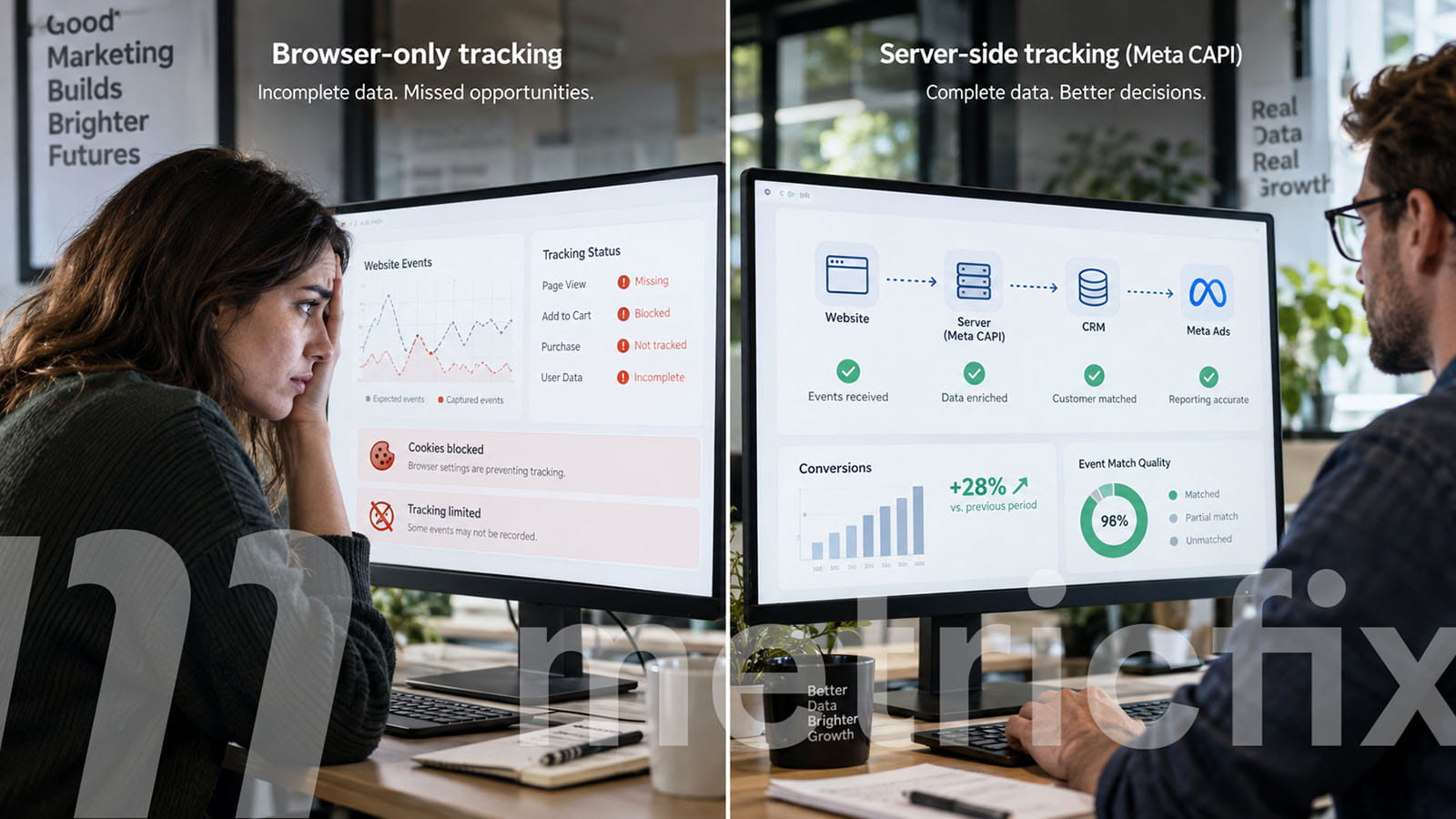
CAPI is valuable when it supplies something the current measurement setup lacks: a recoverable event, useful identifiers, a verified outcome, or demonstrable delivery resilience. Gateway can be an efficient way to implement part of that solution.
But repeating an already delivered event with the same information is not, by itself, a persuasive explanation for a substantial matching uplift. A custom domain is not a cookie-lifetime guarantee. And a high-priority recommendation is not a business case.
The right question is not "Have we enabled everything?" It is "What becomes more complete, more accurate, or more dependable after this change, and how will we verify it?"
Methodology and sources
This review was prepared on 20 September 2026 using Meta's developer documentation for CAPI, Pixel Advanced Matching, Gateway architecture, customer information, event parameters, deduplication, CRM integration, and verification; WebKit's published tracking-prevention documentation; Google's server-side tagging documentation; Stripe's payment guidance; and Stape's product and support materials. Source links are attached to the relevant claims throughout the article. Stape materials establish documented product behavior, not independent evidence of advertising uplift.
The recommendation screenshot was supplied to metricfixer. Its information tooltip and underlying study were not supplied, and the review did not independently verify the methodology behind the displayed 36.6% figure. The numerical example is illustrative. The decision framework, suggested workflows, and acceptance tests are editorial analysis of the documented mechanisms, not results of a controlled deployment or a longitudinal Safari test. No population-level claim is made about how many advertisers will or will not benefit.
This article provides technical and operational information, not legal advice or a guarantee of advertising performance. Platform features, reporting, browser protections, and integration behavior may change. Validate the exact setup and applicable data-use requirements before deployment. Meta, Google, Apple, Stripe, and Stape trademarks belong to their respective owners. The commercial relationship associated with the Stape partner link is disclosed above.