
Published Aug 6, 2026
Why Meta Ads Shows More Leads Than WhatsApp or Your CRM
Meta Ads can report more leads than WhatsApp or your CRM because the systems count different things. This guide separates clicks, conversation starts, new contacts, repeat inquiries, attributed contacts, and qualified leads—and shows how to reconcile them.
Category: Analytics & Conversion Tracking · By Mikalai Sasau
Meta Ads can show 20 or 30 leads while the WhatsApp inbox or CRM contains far fewer. The usual explanation is not that one system is simply wrong. Meta, WhatsApp, the integration layer, and the CRM often count different objects at different moments: an ad click, a conversation episode, a person, an attributed inquiry, or a sales-qualified opportunity.
Practical default: never compare a generic Results or Leads column in Ads Manager directly with a CRM lead total. First identify the exact Meta metric, then reconcile it against the matching unit: clicks against clicks, conversation starts against conversation episodes, new contacts against first-ever identities, and qualified leads against a documented CRM stage transition.
Executive summary
The word lead is overloaded across the Meta-to-WhatsApp funnel. In Ads Manager it may describe a campaign result, a contact event attributed to an ad, a messaging optimization outcome, or a conversion sent back through Conversions API. In a CRM, a lead may mean a newly created person, an open inquiry, an opportunity accepted by sales, or a contact that passed a qualification rule. Those definitions are not interchangeable.
The most important platform definition is Messaging conversations started. WhatsApp for Business describes it as people who begin messaging a business for the first time—or message again after at least seven days of inactivity—after clicking an ad. The same source explicitly warns that a person who starts a messaging conversation is not necessarily a likely buyer. A returning customer can therefore contribute another conversation start without becoming a new CRM contact, and a conversation start is still several steps away from a qualified lead.
A reliable reconciliation separates six stages:
| Stage | What is counted | When it is created | Can the same person create it again? |
|---|---|---|---|
| Ad click | An advertising interaction under a selected click metric | When the person taps the ad, CTA, or another clickable element | Yes |
| Conversation start | A messaging episode recognized by Meta | When the person starts messaging after the ad click and meets the metric's conversation rule | It can qualify again after the inactivity period described by Meta |
| New contact | A first-ever durable person record for the business | When identity resolution confirms that the sender has not existed before | No, unless the CRM fails to deduplicate identities |
| Repeat inquiry | A new commercial question or sales episode from an existing contact | When a returning person starts another inquiry | Yes |
| Attributed contact | A contact or inquiry with reliable evidence linking it to an eligible ad touch | When referral data, click ID, ad ID, or another accepted attribution signal is preserved | Yes; an existing contact can generate a newly attributed inquiry |
| Qualified lead | A contact or opportunity that passes written business rules | When the CRM records the qualification decision or stage transition | Potentially, if the business allows multiple opportunities per contact |
The clean architecture is not one contact table with one mutable source field. It is a chain of separate records: raw message, identity, contact, conversation or inquiry, advertising touch, sales opportunity, and conversion-delivery event. That model lets one person return through several ads without being counted as several new people, while still preserving the campaign that influenced each new inquiry.
For management reporting, use cost per conversation as a messaging KPI, cost per new contact as an acquisition KPI, and cost per qualified lead as a sales-quality KPI. Do not relabel all three as “cost per lead.”
First identify what Meta is actually calling a lead
A screenshot that says “30 leads” is not enough to diagnose the discrepancy. Ads Manager adapts its result labels to the campaign objective, conversion location, optimization setup, selected columns, and events available to the account. The first audit step is to open the column definition and write down the exact metric name and source.
| Ads Manager field | What it usually represents | What it should be compared with |
|---|---|---|
Results |
A context-dependent primary result selected for the campaign | Nothing until the underlying result type is identified |
Clicks (all) |
Multiple forms of interaction with the ad, not only movement into WhatsApp | The same click metric from an Ads export, not inbox conversations |
Link clicks |
Clicks on the destination link or CTA under Meta's reporting rules | Destination-click or app-open diagnostics, not sent messages |
Messaging conversations started |
Messaging starts that meet Meta's definition, including a return after the stated inactivity period | Conversation episodes reconstructed with the same rules, not lifetime-unique contacts |
Contacts |
Contact events tracked by Meta Business Tools and attributed to ads | The same event definition and attribution scope, not every CRM row |
Leads |
A lead result or conversion event whose meaning depends on the campaign and data source | The exact corresponding event, such as a CRM stage returned through Conversions API |
Purchases |
Attributed purchase events received or inferred under the account's setup | Eligible paid orders after matching event name, timing, value, deduplication, and attribution rules |
This distinction became more important as Meta expanded down-funnel optimization for ads that click to WhatsApp. Current WhatsApp guidance describes separate optimization paths for conversations, leads, and purchases. Selecting a Leads objective or lead optimization does not make every reported result equivalent to the sales team's definition of a qualified lead. It tells Meta which outcome the campaign should seek or report; the business still needs a precise operational definition for qualification.
The six stages that should never be collapsed into one number
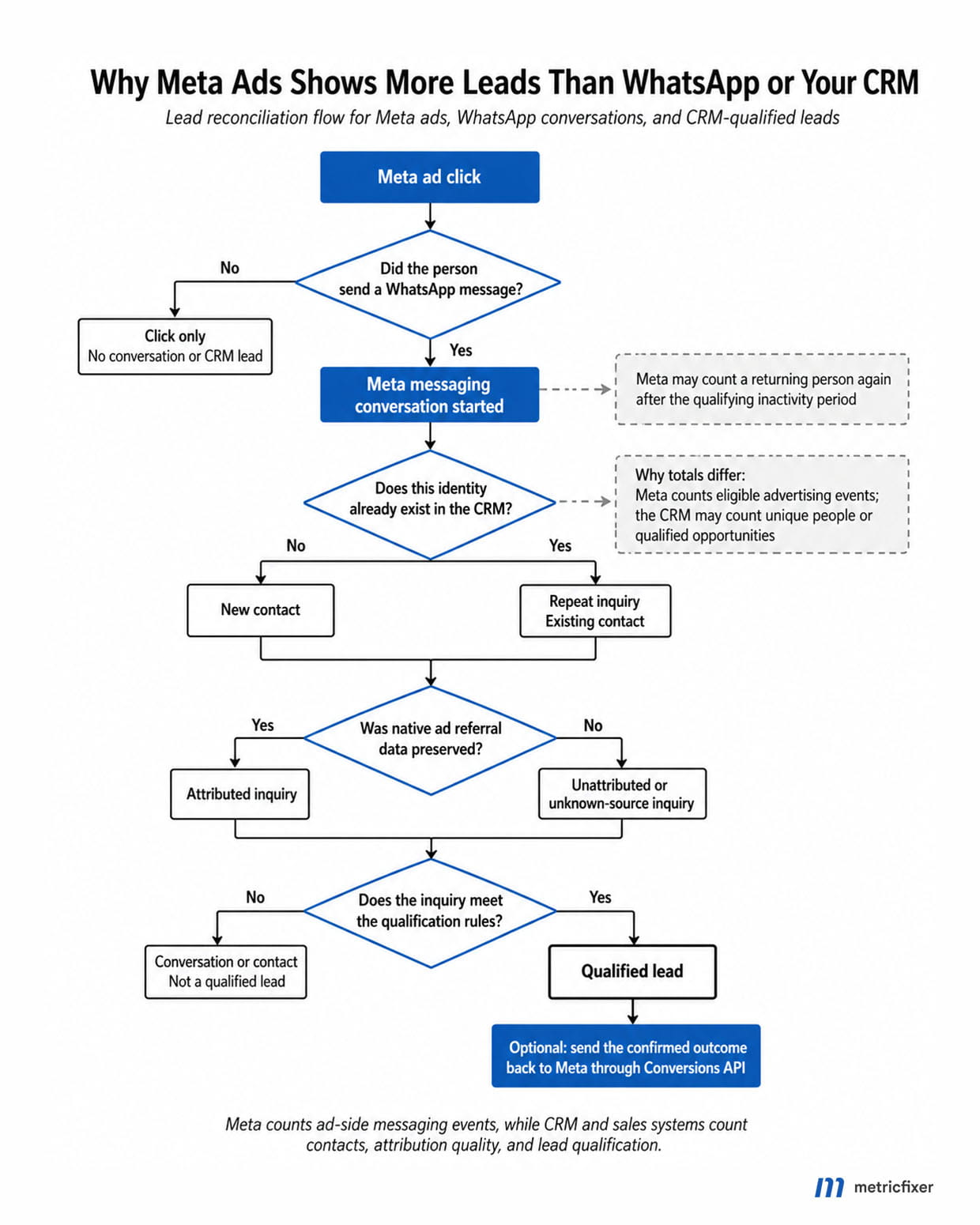
1. Ad click
An ad click proves that Meta recorded an interaction under a particular click metric. It does not prove that WhatsApp opened successfully, that the correct account or number was displayed, or that the person sent a message. The user can tap the CTA, see the WhatsApp composer, read a prefilled message, and leave without sending anything.
This is why a report such as 42 link clicks and 30 messaging conversations started can be completely normal. The meaningful diagnostic is the click-to-conversation rate, not an expectation that every click must become a chat.
2. Conversation start
A conversation start is closer to commercial intent, but it is still an interaction event rather than a customer-quality decision. Meta's published definition includes people messaging the business for the first time and people messaging again after seven days or more of inactivity. This makes the metric suitable for evaluating whether an ad starts conversations, but unsuitable as a count of first-ever prospects.
Three consequences follow:
- A returning customer can generate a new counted conversation start while remaining one CRM contact.
- A person can start a conversation with a low-intent message such as “price?”, an emoji, or an accidental send and still not meet the business's lead definition.
- A conversation start can be attributed to an ad even when the CRM keeps the person's original acquisition source from months earlier.
3. New contact
New contact should be an internal identity rule, not a synonym for a new chat. A useful definition is: the first time the business creates or recognizes a durable record for a WhatsApp identity after applying its merge and deduplication logic.
The contact may be keyed by a business-scoped WhatsApp identifier, a platform identifier, a normalized phone number where still available, and controlled identity-link records. The CRM should not create another person simply because the existing contact used a different spelling, a new display name, another agent inbox, or a newly introduced identifier format.
4. Repeat inquiry
A repeat inquiry is a new commercial episode from someone the business already knows. Examples include a previous buyer asking about another product, an old lead returning after seeing a new ad, or a contact requesting service for a different location.
Repeat inquiries matter commercially and may deserve their own opportunity records. They simply should not be counted as new customer acquisition. A useful CRM model therefore allows one contact to have many inquiries or opportunities, each with its own start time, source evidence, product, market, owner, status, and outcome.
5. Attributed contact
An attributed contact is not necessarily a new contact. It is a person or inquiry for which the business has accepted evidence linking the current episode to advertising. For Click-to-WhatsApp traffic, the strongest native evidence is the referral attached to the initiating inbound message, especially the Meta ad ID in source_id and the click identifier in ctwa_clid.
An existing customer who clicks a new ad and starts another WhatsApp inquiry can be:
- one existing CRM contact;
- one new repeat inquiry;
- one newly attributed advertising episode;
- zero new contacts;
- and, later, either zero or one qualified lead depending on the outcome.
6. Qualified lead
A qualified lead is a business decision. Meta cannot define it universally because qualification depends on the product, service area, minimum order, budget, timing, decision authority, eligibility, fraud controls, inventory, and sales process.
A defensible definition is a versioned rule that can be audited. For example, a local service business may require an eligible postcode, a supported service type, a real request within the next 30 days, and valid contactability. A B2B company may require company fit, problem fit, decision role, and an agreed next step. A retailer may treat a lead as qualified only after the person selects a product and provides delivery information.
The qualification event should be created once when the CRM first crosses that threshold. If the event is returned to Meta through Conversions API, retries should reuse the same deterministic event_id so one business transition does not become several advertising conversions.
New versus returning: the attribution matrix
Identity and attribution answer different questions. A contact can be new or returning, while the current inquiry can be attributed or unattributed. Combining those dimensions produces four valid states:
| Identity state | Reliable ad referral present | No reliable ad referral |
|---|---|---|
| First-ever contact | New attributed contact: new person and paid acquisition can both be supported | New unattributed contact: the person is new, but the source should remain direct, unknown, self-reported, or another controlled class |
| Existing contact | Repeat attributed inquiry: the person is not new, but the new commercial episode has paid evidence | Repeat unattributed inquiry: the relationship is known, but the source of this episode is not |
This matrix prevents two damaging shortcuts. First, it stops the CRM from calling every ad-attributed conversation a new person. Second, it stops analysts from calling every conversation without referral data “organic.” Missing evidence means the source is unknown unless another controlled marker exists.
Why Meta Ads can legitimately show more than WhatsApp or the CRM
Meta counts eligible conversation outcomes while the CRM often counts entities
The most common mismatch is a unit mismatch. Meta's messaging metric is designed around eligible conversation starts rather than lifetime-unique customer acquisition. The CRM may show unique contacts after duplicate merging. If five existing contacts return from ads after the qualifying inactivity period, Ads Manager can register messaging activity while the CRM creates no new people.
The correct comparison is:
Messaging conversations startedversus eligible conversation episodes;New contactsversus first-ever resolved identities;Qualified leadsversus first qualification-stage transitions.
The person clicked but never sent a message
A click is an earlier funnel step. Mobile app switching, slow loading, account selection, an unexpected prefilled message, privacy concerns, accidental taps, and simple loss of interest can all stop the user before sending. A larger click total is therefore expected and should not be “fixed” by creating CRM leads from clicks.
The seven-day reset turns returning people into new conversation starts
This is the most important reason Ads Manager can appear to overstate new leads. Meta's conversation metric recognizes a person messaging after at least seven days of inactivity as a conversation start. A CRM that correctly keeps one lifetime contact will show fewer new records by design.
The solution is not to force the systems to agree. Add a separate repeat_inquiry flag and report the distribution of first-ever contacts versus returning contacts within Meta-attributed conversations.
CRM deduplication reduces people while preserving multiple inquiries
A good CRM may merge duplicate phone formats, imported contacts, prior website leads, offline customers, and WhatsApp identities into one record. Ads Manager does not share the CRM's lifetime entity graph. It evaluates advertising interactions and attributed events under its own rules.
Deduplication is not data loss when it is documented correctly. The loss occurs when the merge also deletes the current inquiry, referral, ad ID, or click ID. Merge people; do not merge away their history.
The CRM may create a record later—or only after an agent action
Many connectors do not create a CRM lead for every inbound message. Common rules include:
- create only after the agent replies;
- create only after the person shares a name or email;
- ignore reactions, stickers, images, voice notes, locations, or unsupported message types;
- skip blocked, archived, spam-labeled, or already known contacts;
- create an opportunity only when an agent chooses a pipeline or product.
Those rules may be sensible for sales operations, but they make the CRM total a later-stage metric. Document the creation rule instead of treating every missing CRM row as proof that Meta invented a lead.
Attributed does not mean first acquired
Meta answers an advertising question: which eligible ad interaction receives credit for the event under the account's attribution configuration? A CRM may answer a customer-history question: how was this person first acquired? Both can be true at the same time.
For example, a customer first acquired through organic search in January may click a WhatsApp ad in August and request another service. The contact's original source remains organic search. The August inquiry can still be attributed to the Meta ad. A single mutable contact-level source field cannot represent both facts.
Meta and the CRM may assign the same event to different dates
Ads Manager reporting can associate attributed results with the date of the ad interaction, while operational systems commonly group records by message-received time, contact-created time, qualification time, or sale time. Account timezone, CRM timezone, UTC webhook timestamps, daylight-saving changes, and late qualification can move the same person across daily or monthly boundaries.
For reconciliation, retain at least four timestamps:
ad_interaction_timewhere available;message_received_atfrom the inbound event;contact_created_atorinquiry_created_at;qualified_atorpurchased_at.
Do not compare an Ads Manager report by interaction date with a CRM report by qualification date and expect daily equality.
The WhatsApp-to-CRM integration may lose or duplicate events
The WhatsApp Business Platform uses webhooks to deliver incoming messages and status changes. That creates an auditable integration path, but only if the receiving system stores the raw event, acknowledges it correctly, and processes it idempotently.
Typical failure modes include an expired subscription, the wrong WhatsApp Business Account, a phone-number override pointing to another callback, permission changes, timeouts, connector outages, unsupported message types, schema changes, and downstream CRM rate limits. Delivery retries can create duplicate CRM entries when the receiver does not deduplicate by the original WhatsApp message ID.
The correct control is a durable inbox keyed by wamid or the current documented message identifier. The webhook endpoint should store the raw event first and return success quickly; CRM updates, identity resolution, ad enrichment, and qualification logic should run asynchronously.
Returned conversion events can inflate the Meta lead column
When a business sends lead outcomes back through Conversions API, Ads Manager can report down-funnel events beyond conversation starts. This is valuable, but it introduces another source of discrepancy. A workflow that sends a lead event on every message, every agent update, or every retry can produce more Meta lead events than unique CRM opportunities.
Use one event for one defined business transition. A deterministic value such as qualified-lead:{opportunity_id}:v1 should be reused on retries. Track three separate totals:
- CRM events eligible to send;
- events accepted by the API;
- events displayed and attributed in Meta reporting.
Those totals answer different questions and should not be merged into one “sent leads” metric.
2026 identity changes make phone-only deduplication risky
Meta's current WhatsApp developer documentation says usernames are rolling out gradually in 2026 and introduces business-scoped user IDs for WhatsApp Business Platform integrations, including Click-to-WhatsApp advertisers. This is an important operational warning: integrations that assume the visible phone number is always the permanent primary key may split one person, merge the wrong records, or stop processing messages when identifier formats change.
The CRM should support an identity-link table rather than one irreplaceable phone field. Keep the stable business-scoped identifier when supplied, preserve historical identifiers, normalize phone numbers separately, and version the merge logic. Phone remains useful contact data where available; it should not be the only technical identity key.
An illustrative reconciliation: 30 Meta conversations can become 9 qualified leads
Consider one mature campaign cohort. The numbers below are illustrative, not a benchmark:
| Measurement layer | Count | What happened |
|---|---|---|
| Ad link clicks | 42 | People tapped the WhatsApp destination; not all sent a message |
| Meta messaging conversations started | 30 | Meta recognized 30 eligible starts under its messaging definition |
| Distinct WhatsApp identities | 25 | Identity resolution found fewer people than conversation episodes |
| First-ever contacts | 17 | Seventeen people were genuinely new to the business |
| Returning contacts with new inquiries | 8 | Eight existing people started another commercial episode |
| Inquiries with preserved paid attribution | 22 | Native ad evidence was retained for both new and returning inquiries |
| Qualified leads | 9 | Nine opportunities passed the written sales criteria |
No single subtraction explains the whole difference. Twelve clicks did not become qualifying conversations. Several conversation episodes belonged to the same identities. Eight identities were returning contacts. Some inquiries lacked retained attribution evidence. More than half of the attributed inquiries did not qualify.
The lesson is not that Meta overstated nine leads as thirty. The lesson is that thirty conversation starts and nine qualified leads are different metrics. The reporting error occurs when a dashboard labels both of them “leads.”
The data model that makes the numbers reconcilable
A single CRM contact row cannot carry the full measurement history. Use separate entities with explicit keys and relationships:
| Entity | Recommended key | Question it answers |
|---|---|---|
| Raw inbound message | wamid or the current documented message identifier |
Did this exact inbound event reach the integration, and was it processed once? |
| Identity link | Business-scoped WhatsApp identifier plus historical identifiers | Which technical identifiers belong to the same person? |
| Contact | contact_id |
Who is the durable person or organization known to the business? |
| Conversation or inquiry | inquiry_id |
What new commercial episode began, even if the person already existed? |
| Attribution touch | touch_id, preserving source_id and ctwa_clid |
What source evidence is attached to this episode? |
| Opportunity | opportunity_id |
Did the inquiry become a sales process, qualify, close, or fail? |
| Conversion delivery | Deterministic event_id |
Was the confirmed outcome sent once, accepted, retried, and attributed? |
For campaign-, ad-, and creative-level implementation details, see metricfixer's related guide: How to Track Click-to-WhatsApp Ads by Campaign, Ad, and Creative Without a Website.
What to preserve from the WhatsApp webhook
The incoming event should be stored before a connector strips fields or converts it into a simplified CRM record. A reduced example looks like this:
{
  "contacts": [
    {
      "wa_id": "WHATSAPP_USER_IDENTIFIER"
    }
  ],
  "messages": [
    {
      "from": "SENDER_IDENTIFIER",
      "id": "wamid.MESSAGE_ID",
      "timestamp": "1785842400",
      "type": "text",
      "referral": {
        "source_type": "ad",
        "source_id": "META_AD_ID",
        "ctwa_clid": "CLICK_TO_WHATSAPP_CLICK_ID"
      }
    }
  ]
}
The exact schema can change by API version, account configuration, and message type, so production code should tolerate optional and unknown fields. The measurement roles are more stable:
| Field | Operational use | Common mistake |
|---|---|---|
messages[].id |
Webhook idempotency and raw-message reconciliation | Generating a new CRM row on every retry |
contacts[].wa_id and current business-scoped identifiers |
Identity resolution within the business relationship | Assuming display name or formatted phone is a permanent key |
timestamp |
Message-time cohorting and timezone normalization | Using CRM import time as the original interaction time |
referral.source_id |
Resolve the source ad to campaign, ad set, ad, and creative metadata | Treating it as a campaign ID or joining by editable names |
referral.ctwa_clid |
Preserve the Click-to-WhatsApp click identifier for matching and conversion return | Dropping, transforming, or hashing it |
| Full raw payload | Reprocessing, troubleshooting, schema migration, and audit evidence | Saving only sender and message text |
The initial advertising referral should be treated as an attribution-capture opportunity. Save it immutably and link it to the inquiry. Do not assume every later message will contain the same referral, and do not overwrite the contact's original acquisition record with the latest ad.
A practical reconciliation workflow
Step 1: freeze the scope
Choose a period old enough for late messages and qualification to settle. Record the Meta ad account timezone, CRM timezone, WhatsApp Business Account, destination phone number, campaign IDs, attribution setting, and exact Ads Manager columns. Exclude partial current days from the first comparison.
Step 2: export exact Meta metrics
Export at least by day and ad ID. Include spend, the chosen click metric, Messaging conversations started, the exact lead or contact event being investigated, and the campaign, ad set, and ad identifiers. Do not use screenshots or rounded dashboard totals as the reconciliation dataset.
Step 3: build a raw inbound-message ledger
Create one row per inbound message ID with event time, destination number, sender identifier, message type, referral presence, source_id, ctwa_clid, processing status, and CRM result. This ledger reveals whether the gap is before the webhook, inside the connector, or during CRM creation.
Step 4: reconstruct conversation episodes
Group inbound activity by resolved identity and apply a documented inactivity rule. Keep this reconstruction separate from unique-contact counting. The goal is not to reverse-engineer every hidden Meta rule perfectly; it is to determine whether the apparent gap is mostly caused by repeat episodes, date boundaries, or missing events.
Step 5: classify new versus returning
For each inquiry, ask whether the resolved contact existed before the current episode. Store is_new_contact and is_repeat_inquiry independently. A returning attributed inquiry should not be forced into either “new lead” or “organic” merely because the CRM has one person row.
Step 6: audit attribution preservation
Measure the share of eligible inbound advertising messages that retain source_id and ctwa_clid through every layer: raw webhook, parser, database, CRM, opportunity, and conversion outbox. If a provider exposes only sender and text, it may support sales conversations but not deterministic advertising attribution.
Step 7: apply one qualification rule
Version the rule and capture the reason. Useful fields include qualified_at, qualification_version, qualification_reason, and disqualification_reason. Do not let each agent use a private definition of “good lead.”
Step 8: reconcile conversion return separately
For each CRM-qualified event, store the deterministic event_id, send time, response, retry count, dataset, event name, event time, and matching fields. Compare CRM-eligible, API-accepted, Meta-displayed, and Meta-attributed totals as separate stages.
Diagnostic matrix: what each mismatch usually means
| Observed mismatch | Likely explanations | First check |
|---|---|---|
| Meta clicks are higher than WhatsApp chats | Click without send, broad click metric, accidental tap, app-opening friction | Compare Link clicks with Messaging conversations started, not with CRM leads |
| Meta conversation starts are higher than distinct WhatsApp contacts | Returning people, seven-day inactivity reset, multiple episodes per identity, CRM deduplication | Reconstruct episodes by identity and mark first-ever versus repeat |
| WhatsApp inbound conversations are higher than CRM contacts | Connector delay or failure, filtered message types, agent-only creation rule, duplicate merge, wrong pipeline filter | Join raw message IDs to CRM import outcomes |
| CRM contacts are higher than Meta conversation starts | Profile, QR, direct, partner, saved-contact, organic, offline, or unattributed traffic | Classify source evidence; do not call every missing referral organic |
| Meta leads are higher than CRM-qualified leads | Meta field represents an earlier stage, repeat contacts, broader attribution, CAPI duplicates, different date basis | Identify the event source and compare with the exact CRM transition |
| CRM-qualified leads are higher than Meta-attributed leads | Missing ctwa_clid, source loss, qualification outside attribution scope, API rejection, non-paid leads |
Trace each qualified opportunity through attribution and conversion-delivery tables |
| Meta and CRM totals agree monthly but not daily | Interaction date versus outcome date, timezone, late-stage movement | Reconcile by stable cohorts and retain all relevant timestamps |
| The gap changed suddenly after a vendor or API update | Webhook subscription, schema, permissions, identity format, callback override, deduplication regression | Run a live ad-originated acceptance test and inspect the rawest event |
How the dashboard should label the funnel
A useful dashboard keeps media, messaging, identity, attribution, and sales layers separate:
| Layer | Recommended metrics | Business question |
|---|---|---|
| Media | Spend, impressions, reach, selected click metric, cost per click | Did the ad earn attention and traffic efficiently? |
| Messaging | Conversation starts, click-to-conversation rate, cost per conversation | Did the ad cause people to begin messaging? |
| Identity | Distinct identities, new contacts, repeat inquiries, cost per new contact | How many genuinely new people entered the business database? |
| Attribution | Attributed inquiries, referral capture rate, unresolved referrals | For how many inquiries can the paid source be supported? |
| Sales quality | Qualified leads, qualification rate, appointments, proposals, cost per qualified lead | How much usable demand did the campaign create? |
| Revenue | Orders, revenue, gross margin, cancellations, refunds, ROAS | Did the demand become durable business value? |
Useful formulas include:
click-to-conversation rate = conversation starts / link clicksnew-contact rate = new contacts / distinct inbound identitiesrepeat-inquiry share = repeat inquiries / all inquiriesreferral capture rate = inquiries with accepted native referral / eligible advertising-originated inquiriesqualification rate = qualified leads / chosen documented inquiry denominatorcost per qualified lead = ad spend / qualified leads
The denominator for qualification must be named. A rate using all conversations answers a different question from a rate using only new attributed contacts. Both can be useful; neither should be published as an unlabeled “conversion rate.”
Which numbers should actually match?
Exact equality is only a reasonable target when both systems count the same object under the same filters and time basis.
| Source number | Reasonable reconciliation target | Should it equal CRM new contacts? |
|---|---|---|
| Meta link clicks | The same Ads metric and export scope | No |
| Meta messaging conversations started | Eligible messaging episodes after applying comparable inactivity, destination, and date rules | No |
| Raw inbound WhatsApp messages | Webhook ledger after message-ID deduplication | No; one contact can send many messages |
| Distinct resolved identities | CRM contacts plus documented merge or rejection outcomes | Close, after identity rules and scope are aligned |
| CRM-qualified stage transitions | Conversion-outbox events eligible to send | Yes, if the trigger is exactly the same transition |
| Meta-attributed qualified events | Eligible CRM events that were accepted, matched, and attributed under Meta's rules | Not necessarily; non-paid, unmatched, out-of-window, or rejected events remain in CRM |
The operational goal is not a decorative 100% match. It is a row-level explanation for the variance: not sent, repeat person, merged identity, unattributed, filtered, not qualified, API-rejected, outside date scope, or outside attribution eligibility. “Unknown” should remain visible rather than being redistributed to make totals agree.
Implementation priorities
- Rename the dashboard fields. Replace “Meta leads” with the exact platform metric and reserve “qualified lead” for the CRM rule.
- Separate contacts from inquiries. One person can have many conversation episodes and opportunities.
- Store raw events before transformation. Preserve message IDs, timestamps, destination IDs, referral data, and current identity identifiers.
- Deduplicate at every stage. Use the inbound message ID for webhooks and a deterministic event ID for conversion return.
- Preserve three attribution views. Keep original acquisition, current inquiry source, and the touch used for conversion return as separate fields.
- Define qualification in writing. Include the version and reason in the CRM.
- Return only meaningful outcomes. Conversions API for business messaging is intended to measure down-funnel results beyond conversation starts; do not send every message as a lead.
- Monitor the joins. Track raw-message-to-CRM, referral-to-inquiry, qualified-to-outbox, and outbox-to-Meta success rates.
Audit checklist
- [ ] The exact Ads Manager metric behind the displayed “lead” total is documented.
- [ ] The ad account timezone, CRM timezone, destination number, attribution setting, and date basis are aligned.
- [ ]
Clicks (all),Link clicks, andMessaging conversations startedare not treated as synonyms. - [ ] A first-ever contact and a repeat inquiry are separate CRM states.
- [ ] Raw incoming message events are retained and deduplicated by their original message IDs.
- [ ] The integration supports current WhatsApp identity fields, including business-scoped identifiers where supplied.
- [ ]
source_idandctwa_clidsurvive the connector and are linked to the inquiry. - [ ] Missing referral is reported as unknown unless another controlled source signal exists.
- [ ] Contact merges preserve inquiries, touches, and opportunity history.
- [ ] Qualification criteria are written, versioned, and consistently applied.
- [ ] One qualification transition creates one deterministic conversion event.
- [ ] CRM-eligible, API-accepted, Meta-displayed, and Meta-attributed events are reconciled separately.
- [ ] Reporting distinguishes cost per conversation, cost per new contact, and cost per qualified lead.
- [ ] A live Click-to-WhatsApp test is repeated after provider, API, permissions, or identity changes.
Limitations and open questions
Meta's exact column names, optimization options, attribution controls, automatic messaging events, and API schemas can vary by account, region, campaign setup, provider, and Graph API version. The current account's column definitions, Events Manager configuration, webhook payloads, and provider documentation remain the implementation source of truth.
The seven-day messaging definition is a useful public anchor, but an external CRM cannot reproduce every internal reporting rule, identity decision, fraud filter, attribution rule, or modeled component used by Meta. Reconciliation should therefore focus on stable cohorts, preserved identifiers, and explainable row-level variance rather than pretending the CRM can reconstruct the platform's entire proprietary calculation.
WhatsApp Business App users without raw platform events may be able to reconcile visible conversations operationally, but they will have less evidence for message-level delivery, referral preservation, deterministic ad attribution, and automated CRM deduplication. Where those controls matter, use an API-capable WhatsApp Business Platform integration or a provider that exposes the required raw fields.
Methodology and sources
This article is based on a review of current official WhatsApp for Business materials on advertising metrics, ads that click to WhatsApp, lead and purchase optimization, and Conversions API for business messaging; Meta developer documentation for WhatsApp incoming webhooks, webhook delivery, business-scoped user IDs, and Conversions API parameters; Meta Business Help metric definitions; and metricfixer's implementation research on Click-to-WhatsApp attribution. The review was current on 4 August 2026. Where Meta does not provide a universal business definition—such as “new contact,” “repeat inquiry,” or “qualified lead”—the article uses explicit operational definitions intended for CRM governance and reconciliation.
- WhatsApp for Business: advertising metrics and messaging conversations started
- WhatsApp for Business: ads that click to WhatsApp
- WhatsApp for Business: how to create ads that click to WhatsApp
- WhatsApp for Business: lead and purchase optimization for ads that click to WhatsApp
- WhatsApp for Business: Conversions API for business messaging
- Meta for Developers: WhatsApp incoming webhook payload
- Meta for Developers: WhatsApp webhooks overview
- Meta for Developers: WhatsApp business-scoped user IDs
- Meta for Developers: Conversions API parameters
- Meta Business Help Center: Contacts metric
- Meta Business Help Center: reporting-time differences in Ads Manager
- WhatsApp Business Messaging Policy
This article is for technical, analytics, and operational information only. It is not legal advice and does not guarantee that Meta, WhatsApp, a CRM, or an integration provider will report identical totals. Meta Ads, WhatsApp Business Platform, attribution settings, metric definitions, identifiers, APIs, permissions, and optimization features may change after publication. metricfixer is not affiliated with Meta, WhatsApp, Facebook, Instagram, or the third-party CRM and integration providers that may be used in the workflow.