
Published Nov 2, 2026
Meta Ads Creative Testing: Why Some Ads Get Almost No Impressions
When a Meta ad receives almost no impressions, that is not proof the creative failed. This guide explains GenRecs, Andromeda and the difference between delivery optimization and deliberate testing, with a practical framework for planning distinct concepts, funding useful comparisons and avoiding unsupported conclusions.
Category: Online advertising · By metricfixer Expert Team
An ad that receives one impression has not failed a meaningful creative test. It has barely been observed. This guide explains the difference between Meta's predictions, its delivery decisions and the evidence an advertiser needs before judging a creative. It also shows how to plan useful creative diversity without producing an expensive library of ads that never gets a proper evaluation.
Practical starting point: give automated delivery a clear business objective and a manageable selection of genuinely different ideas. When learning about a particular idea matters, fund that learning deliberately. Do not mistake low spend for a proven loser, or force every asset to spend merely because it cost money to produce. Research reviewed: 1 November 2026.
Contents
Executive summary
The most useful distinction is between choosing where to spend and testing which creative is better. An advertiser can reasonably ask for either. They are not the same assignment.
In ordinary delivery, an ad competes for opportunities under the campaign's objective and constraints. A controlled comparison asks a different question: what happens when alternatives receive a deliberately designed opportunity to demonstrate their performance? Meta's own measurement training distinguishes A/B tests, creative testing and lift studies rather than treating every campaign as an experiment.
For planning purposes, three executions of the same promise may be one concept with three variants. That is a useful way to count ideas, not proof that Meta has merged them or knows their eventual results. Likewise, a creative that has received almost no delivery belongs in an insufficient evidence category, not automatically in the rejected pile.
The recommended approach is to protect economically useful delivery, develop a small number of distinct customer arguments, and reserve an affordable learning budget for questions that could change the next business decision. A fairer opportunity costs money; it should buy useful knowledge, not reassurance about sunk production costs.

What GenRecs changes, and what it does not
Meta's 19 October 2026 GenRecs Tokenization article describes how recommendation models represent ads and other items. Multimodal models encode content, including text and images. The tokenizer combines this with engagement-derived representations and produces a short sequence of learned tokens. Related items can share tokens, allowing an unfamiliar ad to benefit from patterns learned elsewhere.
In everyday terms, a new file need not be a blank slate for prediction. These tokens are internal learned codes, not keywords to insert into a creative brief. Similarity is an input, not a published rule that three similar ads receive one shared test.
Meta reports a 0.35% conversion lift for tokenization paired with GEM and Adaptive Ranking, measured internally in February 2026. This is not an account-level promise or evidence that delivery changed on 19 October. The article does not disclose a per-ad testing quota, similarity cutoff or exploration policy that explains a particular ad's one impression.
Model representations are not ad IDs
It would be misleading to summarize this as “individual creative IDs no longer exist.” Meta's official Business SDK documentation still describes separate Ad and AdCreative objects and their identifiers. An identifier used to manage an ad is a different thing from the representation used to make a prediction about it.
Think of a stock number and a product description. Two products can have separate stock numbers while sharing many characteristics. Recognizing those similarities does not make them the same product or guarantee identical customer responses.
Similar is not identical, and different is not automatically better
A new opening sentence might answer a different objection. A clearer demonstration might make an existing promise believable. Conversely, a completely different-looking video might still repeat exactly the same argument. Judge the commercial hypothesis, not visual novelty alone.
Do not turn a useful model explanation into a new superstition: there is no evidence here that renaming a file, changing a background or repeatedly duplicating an ad makes the system forget what it knows.
How Meta selects ads without giving each one a fair trial
“Andromeda will test everything” is the wrong promise. Meta describes Andromeda as a retrieval system: it narrows eligible ads to candidates for a later, more detailed ranking stage. The newer engineering article, published on 28 October 2026, describes scoring every eligible ad in the candidate pool. Being scored by a model is not the same as being shown to a person.
Nor is Andromeda the entire system. GEM is a foundation model that transfers knowledge to downstream recommendation models. Its inputs include ad content, engagement and other context. These names describe different parts of a broader stack, not interchangeable labels for a single creative-testing feature.
Meta's published auction explanation identifies bid, estimated likelihood of the desired action and ad quality as components of total value. The prediction concerns an ad and a person in an opportunity, not a permanent, universal grade attached to the creative.
The practical consequence is that an ad can be evaluated computationally many times without earning many impressions. You see the delivered outcomes, not every candidate evaluation or the result that an unshown alternative would have produced.
There is a genuine trade-off. Spending on an uncertain alternative can teach the advertiser something, but may displace an opportunity the system predicts will perform better now. A deliberate test makes that trade-off explicit. Ordinary delivery does not promise to resolve every question your creative team has.
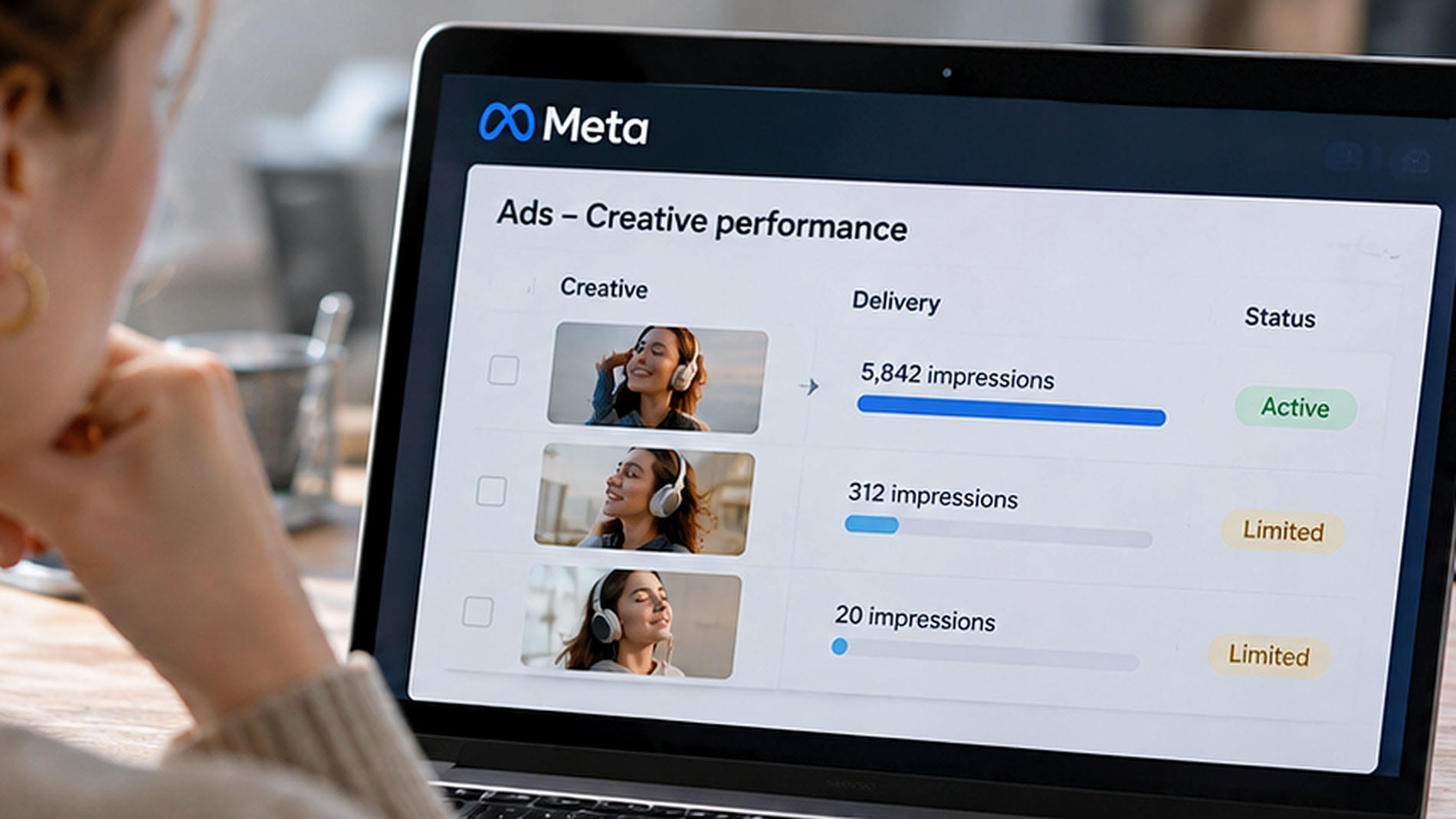
Why 20 impressions are not a creative verdict
The concern is justified: one or 20 impressions normally cannot establish whether a conversion-focused creative is good or bad. But the inference to avoid is that the delivery system must be relying only on those impressions. Its prediction and your account-level evidence are different things.
Consider a deliberately simplified example, not a Meta benchmark. Suppose the true click-through rate were 1%. With 20 independent opportunities, the probability of observing no clicks would be approximately 81.8%: 0.99^20. Zero clicks would be entirely unsurprising.
Now assume 3% of those clicks produce a purchase. The implied purchase probability per impression is 0.03%. Under the same simplified assumptions, the probability of no purchases in 20 impressions is approximately 99.4%. Real delivery is not independent or constant-rate; the calculation only illustrates how little information such a tiny sample contains.
Record the conclusion accurately: “This ad received insufficient exposure to evaluate its conversion performance.” That does not prove the system chose correctly. It also does not prove the ad would have succeeded with a larger budget.
Even a larger ordinary-delivery sample has a comparison problem. If one ad reaches different people, placements or times from another, their average costs do not isolate the effect of the creative. Equal spend alone does not fix that selection problem.
A small sample can still reveal a broken link, unreadable crop or misleading claim. Fix those immediately. What it cannot normally support is a confident ranking of purchase performance.
What practitioner experience shows
Public account reports are useful because they show what advertisers actually encounter. Their limitations matter just as much: screenshots and case descriptions rarely provide randomized controls, complete conversion histories or access to the account.
A documented case of concentrated spend
In a case first published on 24 November 2025 and updated on 4 April 2026, Jon Loomer reported that one of three ads received 99.9% of spend. He then tested a duplicate of an underexposed ad alongside a new variant, with dedicated budget. The previously neglected idea performed competitively, although the established ad still received much more budget afterward.
Loomer explicitly noted the alternative's smaller budget and fresh audience. The useful lesson is not that forced allocation “fixed” Meta. It is that almost no spend did not establish failure, and protected exposure answered a question ordinary delivery had left open. The report also predates the October 2026 engineering disclosures, so concentrated spend should not automatically be attributed to those publication dates.
Practitioners disagree because their questions differ
Bind Media's September 2026 account-structure article describes using campaign-level allocation to surface concepts and ad-set budgets for more deliberate comparisons. That is useful operational experience, but it does not establish that equal ad-set budgets alone create a randomized test. The article is a workflow recommendation, not a published controlled evaluation of the account structures.
In a 2026 practitioner discussion, advertisers described separate concept budgets, small batches and repeated validation. Their suggested daily budgets and stopping rules differed substantially. These are self-reported practices with unverified account context, not a consensus standard to copy.
What the evidence does not establish
None of these reports demonstrates a universal number of ads per ad set, a guaranteed spend floor, or a reliable “stop after this many impressions” rule. Nor do they reveal the internal reason Meta passed over a particular ad.
The defensible synthesis is narrower: separate questions about allocation from questions about comparative performance, pay for additional evidence when it has decision value, and accept that a promising result may not reproduce under a different delivery context.
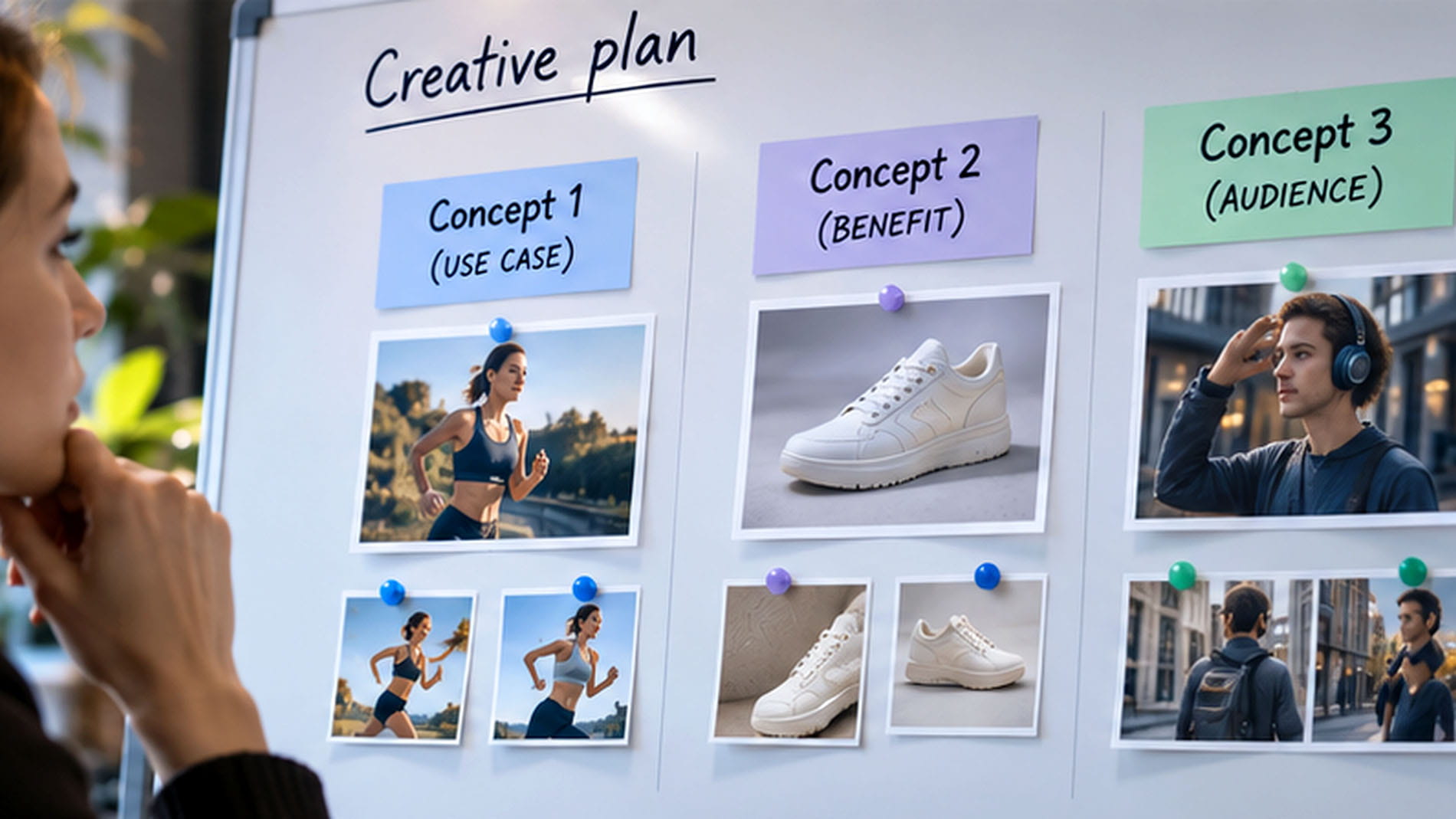
Plan concept diversity, not just file volume
Meta's creative diversification training distinguishes concepts, customer motivations and formats. For an advertiser, the useful translation is: give people different credible reasons to care, and present those reasons in suitable ways.
The following matrix is metricfixer's creative-planning framework, not Meta's token taxonomy. It uses a hypothetical bookkeeping service for small businesses.
| Dimension | A cosmetic or closely related variation | A meaningfully different hypothesis |
|---|---|---|
| Customer problem | Three versions of “save time on bookkeeping.” | Recover evenings versus avoid month-end surprises: two different reasons to seek help. |
| Situation | The same founder stock photo in three layouts. | A solo freelancer preparing invoices versus a shop owner reconciling daily sales. |
| Proof | The same claim with different typography. | A real workflow demonstration versus a permissioned customer account of the result. |
| Objection | Three versions of “easy to use.” | Show migration from an existing spreadsheet versus explain access controls and data handling. |
| Presentation | The same footage with three background colors. | A step-by-step demonstration versus a concise comparison, each adapted to its placement. |
| Offer | Different button wording for the same consultation. | A consultation versus a fixed-scope paid setup: a different commercial proposition, not merely a creative change. |
Before commissioning another asset, complete this sentence: “This should persuade someone the current ad does not because…” The answer should describe a need, objection, proof point or viewing situation, not only an editing change.
Small variations still have a role. A clearer first frame, better subtitles or a more concrete promise may improve an established concept. Label these as iterations. Do not count ten exports as ten independent ideas, and do not abandon a valuable iteration simply because it resembles the original.
Separate concept discovery from element isolation. During discovery, a demonstration and a customer story can differ in several creative dimensions: you are comparing complete approaches. Later, to learn whether a particular opening works, hold the rest constant. A multi-element winner cannot tell you which individual change caused the difference.
Likewise, changing the offer, price or landing page changes the test question. That can be worthwhile, but the conclusion concerns the combined proposition, not just the image or video.
Research objections in customer interviews, sales calls, support questions and permissioned reviews. Use competitor ads to identify arguments worth investigating, not as proof of profitable performance. metricfixer's competitor ad research guide explains that evidence boundary.
Creative diversity expands useful choice; it does not guarantee each concept a budget share or replace your audience and eligibility settings. Do not invent unsupported claims or sensitive audience assumptions merely to make a batch look diverse. Relevance, truth and brand suitability come before novelty.
Separate delivery optimization from deliberate learning
Use two operating modes. In delivery mode, judge the portfolio by its business outcomes and allow allocation to be uneven. In learning mode, define a question and reserve resources to answer it. These are management choices, not necessarily two permanent campaigns.
The table below is a decision aid. Meta's public measurement curriculum confirms that multiple study types exist; verify the design and eligibility of the actual workflow offered in your account.
| Approach | Appropriate question | Evidence boundary |
|---|---|---|
| Ordinary optimized delivery | Can this portfolio generate acceptable outcomes within our constraints? | Spend distribution is not a controlled creative ranking. |
| Native Creative Testing, where available | Can we give a batch of new alternatives a deliberate evaluation window? | Check budget allocation, audience handling and the results report. A top-performer label alone does not establish statistical certainty. |
| Push delivery, where available | What does this underexposed ad do when it receives some protected budget? | Exposure is not a randomized comparison or proof of incremental sales. |
| A properly designed randomized A/B test | Which defined strategy performs better under the test conditions? | Requires suitable groups, adequate data and uncertainty assessment. It does not establish universal superiority. |
| Separate ad-set budgets without randomization | Can we fund a directional pilot when native options are unsuitable? | Budget control does not ensure comparable audiences or remove selection bias. |
Native tools have different jobs
In his hands-on Creative Testing walkthrough, updated in January 2026, Loomer describes setting aside budget for new test ads rather than leaving allocation entirely to ordinary delivery. His example compared five configurations, including flexible ads with multiple assets. It therefore illustrates a comparison of configurations, not a clean verdict on each individual image.
His 9 June 2026 Push delivery walkthrough documents a separate control that allocates a budget share to an ad for a defined period. He observed interface constraints and conflicts with creative testing. Treat this as dated, first-hand evidence of the feature, not proof that every account has it or that all current limits are identical.
Before using either, inspect the live budget, duration, eligibility and warnings. Confirm what happens when the period ends. A promise of exposure, a comparative ranking and a statistically supported result are three different things.
Protect learning without fragmenting everything
For a decision that will drive substantial production or media spend, prefer a comparison that explicitly randomizes and separates study groups. Hold the objective, offer, conversion definition, attribution settings and non-tested delivery settings consistent. Decide in advance how much uncertainty is acceptable.
Creating one ad set per creative may improve budget control, but it is not automatically a scientific experiment. Nor is switching the winner off today and the challenger on tomorrow: timing changes alongside the creative.
A separate learning environment can be justified when isolation is important and the budget supports it. It should not become permanent account fragmentation by default. When funds are limited, fewer simultaneous questions are usually more useful than many nominal “tests” with no interpretable answer.
Budget the test before producing the whole batch
The number of creatives you can make and the number you can evaluate are different constraints. Start with the evaluation budget, then commission the batch.
Planning estimate: expected results per test arm = total test budget ÷ number of arms ÷ expected cost per result. This assumes equal allocation and a stable expected cost; it is feasibility arithmetic, not a sample-size calculation.
Suppose a business spends $100 per day, voluntarily reserves 20% for learning, and runs the exercise for 14 days. That creates a $280 learning budget. Across four concepts at an expected $35 per purchase, the arithmetic gives only two purchases per concept. The 20% share and all other numbers are illustrative, not Meta requirements.
Reducing the batch to two concepts would imply four purchases each. That may improve a directional read, but it still does not make small differences reliable. A longer test, more budget, a larger commercially meaningful difference or a less ambitious question may be necessary. None justifies spending beyond the business's risk limit.
For a formal comparison, plan around the baseline event rate, the smallest improvement worth acting on, the chosen error tolerance and conversion delay. Decide whether the available sample can answer that question. There is no universal impression count, spend multiple or conversion threshold that makes all creative tests valid.
Do not borrow a learning-phase benchmark and treat it as a statistical confidence rule. Account delivery status and experiment validity are different questions; see metricfixer's guide to low-volume campaigns and the Meta learning phase.
For expensive or delayed sales, a qualified lead or meaningful CRM milestone may be useful, provided it has a defensible relationship with revenue. Do not switch to cheap clicks merely to create a reassuring sample. The test would then answer a different question.
Agree on the learning budget and acceptable loss before production. Money already spent on a video is not, by itself, a reason to buy it more impressions. The relevant question is whether the next dollar of evidence could improve a future decision.
What to do when an ad gets almost no delivery
Do not start by blaming similarity. First distinguish an ad that is eligible but rarely selected from an ad that cannot run properly. Use the following operational checks.
- Verify the observation. Check the reporting period, account time zone, actual publication time, review status and delivery messages. Compare ads over a genuinely overlapping opportunity window.
- Check ordinary constraints. Inspect campaign and ad-set status, schedules, billing or spending limits, bid or cost controls, audience restrictions and placement compatibility. A campaign-wide delivery problem is not primarily a creative-diversity problem.
- Inspect the experience and measurement. Test the landing page, mobile rendering, checkout or lead flow, and the selected conversion event. Review diagnostics, duplicate-event risks and reporting delay. Do not weaken consent controls to manufacture more signal.
- Assess the business situation. Is the campaign meeting its commercial goal? Is a valuable product, use case or strategic question being neglected? A healthy aggregate result can coexist with a legitimate need for additional learning.
- Choose whether to buy evidence. Use a suitable native control or a properly designed comparison when the answer is valuable and affordable. Otherwise defer the idea, simplify the batch or label it untested.
- Review mature results. Apply the pre-agreed risk limit, allow for conversion delay, and assess qualified outcomes. Do not extend harmful exposure indefinitely in pursuit of a conclusive result.
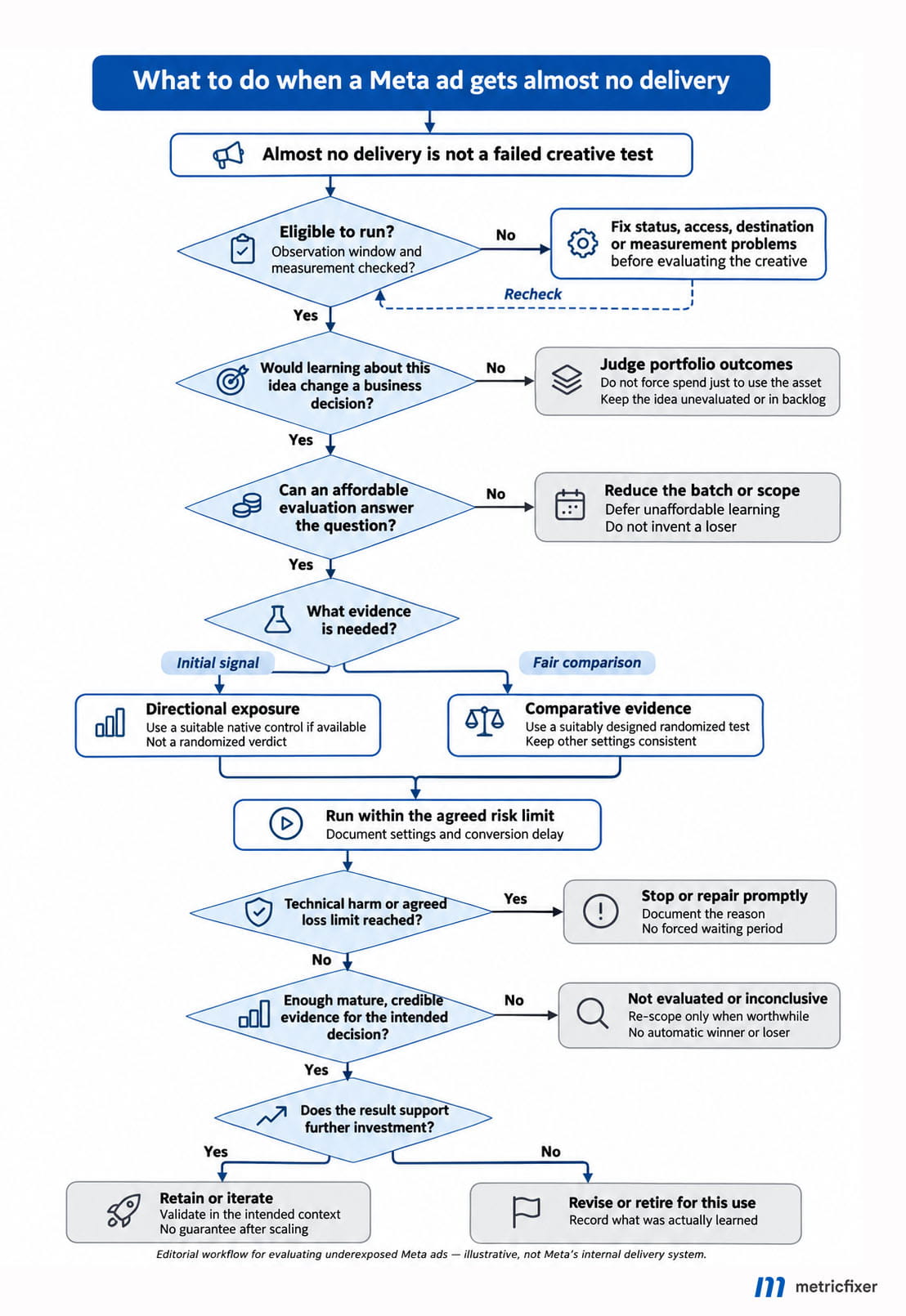
For example, an underexposed duplicate of an already effective message may deserve no extra intervention. An underexposed demonstration addressing a major, unanswered sales objection may justify a limited evaluation. The difference is the value of the question, not the team's emotional attachment to the asset.
If the broader campaign performs poorly, do not simply force all existing ads to spend. Reconsider the offer, landing page, signal quality and creative argument. Buying more exposure to the same unresolved problem may only make the loss easier to measure.
A practical creative planning cycle
The following is an editorial operating model, not a claim about Meta's required campaign structure or an account-tested recipe.
1. Write the learning question before the brief
For the bookkeeping example, the question might be: “Does showing how the monthly reconciliation works generate more qualified enquiries than promising time savings?” Define a qualified enquiry, the intended customer, the unchanged offer and the decision that a useful result would trigger.
Give every concept a short record: customer problem, central promise, supporting proof, principal objection, format and placement needs, conversion goal, test mode and planned decision. A concept without a decision attached is a production request, not yet a learning plan.
2. Produce the smallest useful batch
Keep the current time-saving ad as the reference. Produce a clear workflow demonstration as the challenger. Keep a third idea, such as a customer story about predictable month-end reporting, in the backlog until it addresses the next unresolved question.
Prepare the required placement adaptations, but count them as coverage versions of a concept rather than independent hypotheses. Build production modularly: reusable footage, permissioned proof, accurate captions and alternate openings can reduce the cost of later iterations without turning every export into another test arm.
3. Launch with a recorded design
Record the budget, comparison period, primary metric, acceptable loss and treatment of delayed conversions. Note whether automated creative features or multiple text options can change the served ad. For an element-level test, keep those transformations controlled; for a portfolio test, document them as part of the strategy.
Check for broken destinations, harmful claims and technical failures immediately. Otherwise, avoid redesigning the comparison every time a day's cost changes. Repeatedly checking and stopping at a favorable moment makes chance results easier to mistake for a repeatable advantage.
4. Close the loop with a decision, including no decision
If the demonstration produces more commercially useful enquiries with adequate evidence, invest in its next iteration. If the result is uncertain, record uncertainty. If it performs poorly within a valid evaluation, revise the argument or retire it. If it barely ran, do not translate that into “demonstrations do not work.”
Then verify performance in the intended operating environment. A small evaluation and a larger campaign are different contexts. Do not assume that moving, duplicating or scaling an ad preserves its cost or delivery share.
Finally, feed the next brief with an observation rather than a label: “Prospects asked fewer setup questions after the workflow explanation” is more useful than “video B won.” Keep that observation distinct from a causal claim unless the design supports one.
Measure business results, not spend share
A large share of spend tells you which opportunity the delivery system favored under the current setup. It does not reveal which creative caused the most additional sales. Equally, a low-cost ad at tiny spend does not prove it can absorb the whole budget at that cost.
Use the business's own outcomes alongside platform reporting: paid orders, contribution after media costs, refunds, qualified enquiries, attended appointments or closed customers, as appropriate. Keep attribution settings and reporting windows consistent, and allow recent conversions to mature.
Click-through rate, opening-view metrics and landing-page visits can diagnose a problem. They should not silently replace the outcome the campaign exists to produce. An attention-grabbing video that attracts unsuitable prospects is not necessarily a commercial improvement.
For the distinction between more reported conversions and more actual sales, see metricfixer's Meta conversion recovery analysis. To ask whether advertising generated additional outcomes, consider the separate role of lift studies covered in Meta's creative measurement training; a creative comparison alone does not answer every incrementality question.
Use a creative register that preserves the difference between evidence states:
| State | Meaning | Next action |
|---|---|---|
| Not evaluated | Too little eligible exposure or spend to assess the hypothesis. | Fund a valuable question, or keep it in the backlog without declaring failure. |
| Inconclusive | An evaluation ran, but volume, uncertainty or design prevents a useful comparison. | Re-scope, repeat when justified, or stop without choosing a winner. |
| Promising | The result merits further investment, but remains provisional. | Validate in the intended context within an agreed risk limit. |
| Supported in context | A suitably designed evaluation supports the stated decision for this setting. | Apply the learning and monitor whether it survives wider use. |
| Rejected for this use | A valid evaluation or a clear operational problem justifies stopping. | Record the reason; do not generalize beyond what was tested. |
Archive the concept, variant, relevant ad identifiers, dates, settings, spend, mature outcomes and decision rationale. A dashboard of winners and losers alone loses the most useful information: what was actually learned.
A checklist before the next launch
- Question: each proposed concept addresses a distinct customer reason or a clearly labeled iteration.
- Mode: the team knows whether the launch is optimized delivery, a directional pilot or a controlled comparison.
- Feasibility: the budget can support the question; production volume has not outrun evaluation capacity.
- Readiness: ads, placements, destinations, conversion signals and consent controls have been checked.
- Decision rule: the primary outcome, evaluation window, conversion delay and loss limit are recorded.
- Honesty: “not evaluated” and “inconclusive” are acceptable outcomes, not reporting failures.
The central principle: work with Meta by giving it useful alternatives and trustworthy business signals. Work for your own business by buying additional evidence only when it can improve a decision. Neither blind faith in allocation nor forcing every creative to spend is a complete testing strategy.
Methodology and sources
This review was prepared on 1 November 2026. It separates three evidence levels: Meta's documented architecture and public training; dated, first-hand practitioner observations; and metricfixer's editorial recommendations. Source links appear beside the relevant claims rather than as numbered footnotes.
The architectural explanation draws on Meta's GenRecs Tokenization disclosure of 19 October 2026, the newer Andromeda disclosure of 28 October 2026, its GEM explanation, its published auction overview and its official Business SDK. Public Blueprint course descriptions establish the distinction between diversification and different measurement approaches. The older auction document is used for its conceptual explanation, not as a complete specification of the current system.
Practitioner material was reviewed for actual allocation observations, testing choices and limitations. Named account reports receive more weight than anonymous forum recommendations, but none is treated as an independently audited experiment. Reports of interface controls are dated observations, not guarantees of availability. Some detailed Meta Help Center pages redirected to login or access-block pages during this review; precise current variant limits, duration limits and eligibility rules are therefore not asserted here.
No advertiser-account export was supplied, and metricfixer did not run a new campaign experiment for this article. The bookkeeping examples, planning matrix, decision workflow and budget scenarios are illustrative. The probability calculations use stated, simplified assumptions. Public evidence cannot reveal why a specific ad received one or 20 impressions, establish a universal similarity threshold, or guarantee that protected exposure will improve performance.
This article provides advertising, measurement and operational information, not a guarantee of campaign performance or a recommendation to spend beyond your business's risk limits. Results depend on the offer, audience, creative, measurement, market conditions and account configuration. Meta features and documentation may change after publication. metricfixer is not affiliated with Meta, Facebook, Instagram or the independent publishers mentioned. Respect platform policies, customer privacy and applicable consent requirements.