
Published Oct 10, 2026
Competitor Ad Research: Free and Paid Tools, Regional Insights and Data Limits
A practical guide to competitor ad libraries, local search checks and paid intelligence tools, with regional limits, user-reported drawbacks and an evidence-led research workflow.
Category: Online advertising · By metricfixer Expert Team
Competitor ad research is easier than it used to be, but the tools answer very different questions. An official ad library can reveal a message or a disclosed audience; a creative gallery can suggest an approach; a paid intelligence service can help monitor changes; and a local search check can show one result page. This guide explains how to combine those sources without mistaking a partial view for a competitor's complete advertising strategy.
Practical starting point: begin with the official libraries for your competitors' main platforms, define the countries and dates you need, and keep a dated evidence log. Add a paid service only when it solves a specific problem, such as recurring monitoring, historical storage, keyword discovery or team collaboration. Treat competitor spend and performance estimates as estimates, not account data.
Contents
Executive summary
The most useful question is not “Which ad spy tool has the biggest database?” It is “Which source can support the decision I need to make?” Finding a competitor's offer, checking whether it was advertised in a country, estimating its search activity and understanding whether it made money are four different tasks.
Start with Meta Ad Library, Google Ads Transparency Center and LinkedIn Ad Library when researching the relevant platforms. Add Microsoft Ad Library for eligible Bing activity. For TikTok, distinguish the inspiration-focused Top Ads dashboard from the more systematic Commercial Content Library. Their purposes and coverage differ, as their official documentation explains in the sections below.
For European Google research, also distinguish removal records from ordinary ad discovery and consider BigQuery/API access before buying a service solely to avoid manual lookups. These routes answer different questions; neither reveals a competitor's private commercial results.
Two services in the original shortlist need different labels. TelegramAds.com is an independent intelligence service, not Telegram's official advertising interface. iSearchFrom is a location-aware search tool with free and paid functionality, not an archive of every ad served in a market.
Paid tools become useful when manual research stops scaling. They can help you discover advertisers, save creatives, compare periods and monitor changes. They do not automatically make the underlying evidence complete. The right output is a small set of well-supported observations and testable ideas, not a confident-looking spreadsheet of unknowable competitor economics.

What competitor ad data can and cannot prove
Before comparing products, separate four kinds of evidence. This classification is an editorial framework for using the services, not a claim that every provider implements the same collection method.
| Source type | Useful conclusion | Conclusion to avoid |
|---|---|---|
| Official transparency repository | The platform disclosed this ad and these fields within the repository's scope. | This is the advertiser's entire account, complete targeting configuration or profitability report. |
| Curated creative gallery | This is an example selected for the gallery under its inclusion rules. | This represents all competitors, all ads or a universally successful formula. |
| Third-party intelligence database | The provider observed or collected this record; separately labeled metrics may be modeled. | Every ad was detected, or an estimated budget is the advertiser's actual bill. |
| Localized search observation | This result appeared under the recorded query and search conditions. | Every person in that city sees it, or its absence means the competitor is not advertising. |
Geography is not one field
Keep advertiser location, selected targeting, reported delivery location and the location used for your own search separate. A company registered in one country can advertise in another. An English-language creative does not, by itself, establish a UK audience. A channel's language does not establish where its readers live.
LinkedIn provides a concrete example: its documentation distinguishes targeting from impression geography and explains that travel or outdated profile locations can produce impressions outside the selected countries. It also rounds country percentages. A geographic discrepancy is therefore something to investigate, not automatic proof that a library is wrong or a campaign is misconfigured. Source: LinkedIn's targeting and impressions explanation.
Dates need the same discipline. A platform's first eligible impression, a third-party crawler's first observation and the original campaign launch are not interchangeable. Nor are a library card, a unique creative concept and a campaign. Write down what each field actually means before comparing totals.
The main tools at a glance
The table includes the seven starting services plus TikTok's separate transparency library. “Free” describes the research interface, not advertising spend, unrestricted API access or guaranteed access without occasional technical friction. Access classifications were checked on 9 October 2026; Google removal records and BigQuery access were reviewed separately on 10 October 2026.
| Tool and access | Best starting use | Main boundary |
|---|---|---|
| Meta Ad Library Free | Research Meta creatives, messages and available regional disclosures. | Historical availability and disclosure depth depend on the applicable category and region. |
| Google Ads Transparency Center Free interface; public-data queries may incur processing charges | Find Google creatives; investigate European removal records; use BigQuery/API access for repeatable analysis. | Scope and fields differ by dataset. Removal records are not viewable creatives. Not a keyword-bidding, budget or conversion report. |
| TikTok Top Ads Free; login expands access | Study selected creative examples and their presentation. | A curated, advertiser-authorized selection, not a complete ad archive. |
| TikTok Commercial Content Library Free | Research ads within its published regional and retention scope. | Separate from Top Ads; it is not a worldwide census. |
| LinkedIn Ad Library Free | Review B2B messaging, advertisers, payers and available audience disclosures. | Additional targeting and impression detail is region-dependent. |
| Microsoft Ad Library Free | Investigate eligible Bing ads delivered in the EU/EEA. | Not a global archive of every Microsoft advertising surface. |
| TelegramAds.com Freemium | Discover Telegram advertising examples and investigate available records. | Independent collection; completeness and geographic meaning require validation. |
| iSearchFrom Free browser search; freemium application | Run and, on suitable plans, monitor localized search checks. | A search sample is not proof of the full audience or targeting setup. |
Meta Ad Library: start with messages, not ad counts
Best for: reviewing how a competitor presents products, offers and calls to action across its Meta advertising. Use the official library as your first stop rather than assuming a third-party copy is more authoritative.
For ordinary commercial research, select the intended country and the appropriate all-ads category, then identify the actual advertiser Page. Search regional Pages and sub-brands separately. A brand name, its legal entity and its advertising Page may not be identical; choosing the first similar name is an avoidable source of error.
Do not assume the same historical window everywhere. Meta's EU transparency announcement describes a one-year archive for ads targeting people in the EU, with additional targeting and delivery information. That extended scope should not be generalized into an identical worldwide archive. Historical political-ad arrangements are also not a reliable template for ordinary commercial research.
How to make the research useful
Organize examples by offer, audience problem, evidence and next step. One competitor might lead with a price reduction, another with delivery speed, and a third with a demonstration. That is more useful than collecting fifty thumbnails without a question.
Count materially different ideas separately from technical variations. A change in crop, translation or call-to-action wording may belong to the same concept. Preserve the original ad identifiers, but add your own concept label. This prevents a heavily versioned advertiser from looking more strategically diverse than it is.
Record the date of your observation and revisit the same Pages. Continued availability can justify watching an idea more closely, but it does not prove profitable acquisition. The advertiser might be spending very little, pursuing awareness, retargeting a narrow audience or simply leaving a weak ad running. Use longevity as a research lead, not a performance certificate.
Verdict: a strong free starting point for creative and offer research. Its value falls when you try to turn visible ad counts into spend, sales or a complete campaign structure.
Google Ads Transparency Center: follow the advertiser and the website
Best for: identifying the creative messages associated with an advertiser or destination website. The Ads Transparency Center is an advertiser-and-website research tool, not a search-term report showing every query on which a competitor bids.
Google's current documentation covers ads on Search, Display, Gmail and YouTube. It also describes disclosures for advertisers that have not completed verification, using payment-profile information and an unverified label. Older advice that the tool contains only verified advertisers is therefore incomplete. Additional targeting and recipient information is available in specified countries, not uniformly everywhere. Source: Google's ads transparency documentation.
A practical search sequence
Search the website as well as the brand. Check the advertiser identity, then apply the relevant country, date and format controls available in the interface. For groups with multiple brands or agencies, keep distinct advertiser records until you have evidence that they belong together.
Read an advertiser's address or registration country as identity information, not proof of where an ad ran. Keep any delivery-country disclosure in a separate column. A useful research note says “this creative was returned under this market filter on this date,” not “the company targets only this country.”
Use search ads to examine promises and objections: pricing transparency, free trials, speed, guarantees, migration help or brand comparisons. Then inspect the public destination where available. Does it deliver the same promise? Does the local-language page actually support the advertised market? Record a mismatch as an observation to verify, not immediately as misconduct.
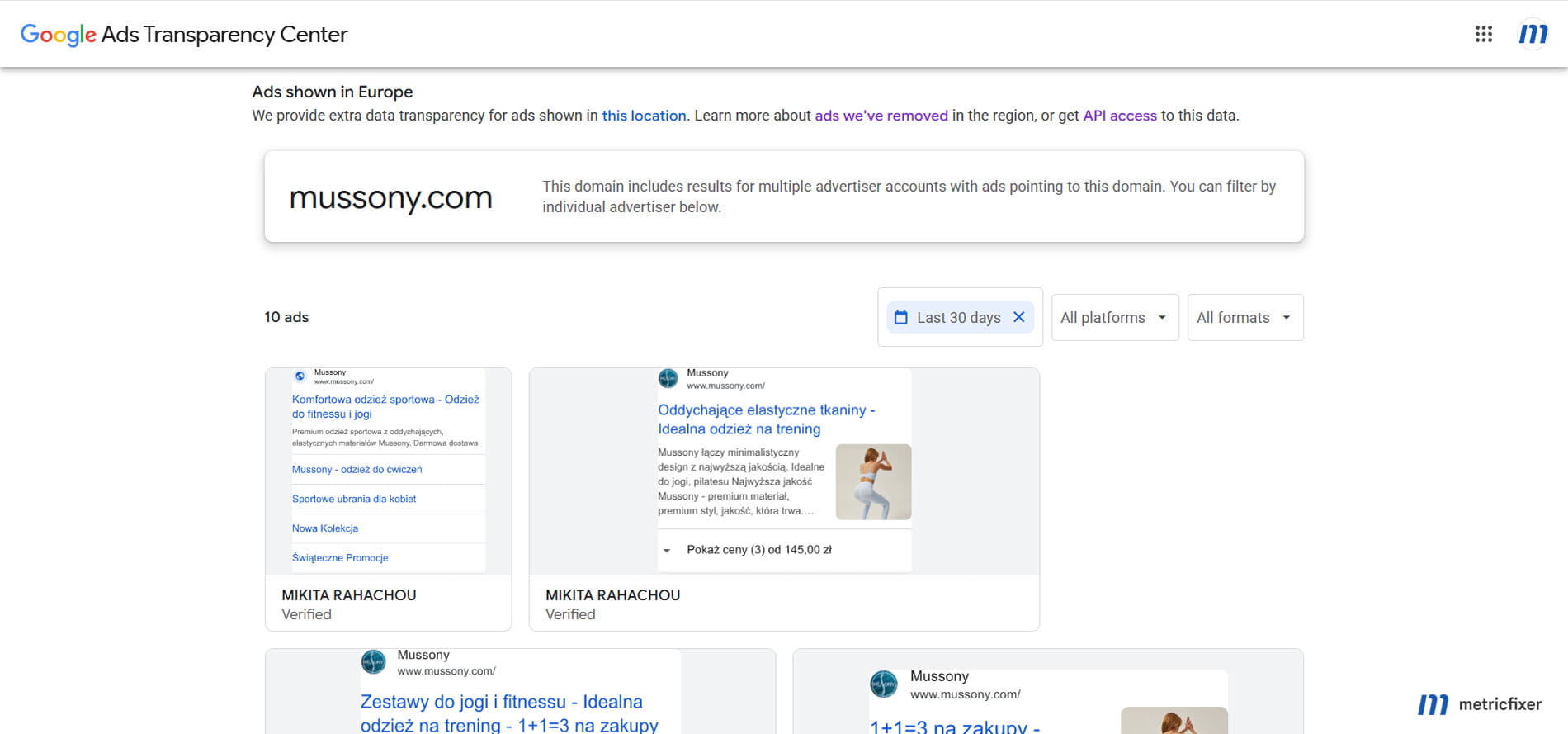
Main limitation: the library does not establish the actual search keyword, bid, conversion rate or return on ad spend behind an ordinary commercial creative. A search query observed in another tool is not automatically the advertiser's purchased keyword either. Match a creative to a business hypothesis without inventing account-level details.
Ads removed in Europe: what the records reveal
Google has a separate Ads we removed in Europe view; the linked example selects Poland. Google describes it as covering policy-related removals from the past year. The original creatives are not available to view, but information about why, how and where the ads were removed can remain available. This is an enforcement-transparency source, not a second gallery of reusable creative examples.
Do not confuse removal with disappearance. An advertiser pausing a campaign, an empty library search and a disclosed enforcement decision are different events. A missing preview does not establish a policy violation. Equally, an actual removal record is not, by itself, proof that the advertiser's whole account was suspended or that the company stopped advertising elsewhere.
For practical research, preserve the record link, capture date, selected market and the explanation actually disclosed. Keep the place where an ad was observed separate from the territory covered by the removal decision. Do not assume that selecting Poland means the decision applied only to Poland, or that the advertiser is Polish.
The useful output is a risk checklist for your own advertising: which claims, product categories or presentation choices deserve a policy review before launch? Treat the stated reason as Google's recorded decision, not as an independent legal finding about a business. Do not assign a removal to a named competitor unless the identity connection is supported, and do not calculate a competitor's violation rate from a collection whose identity matching and denominator you have not established.
When the page fails to load: record an access error and return later. Neither an unavailable interface nor an empty result proves that no removals occurred. Save relevant evidence within the permitted use of the service rather than assuming a rolling public view will remain a permanent archive.
BigQuery and API access: research beyond the interface
Google's transparency documentation explicitly provides for API access to data about ads served in the EEA. The official public dataset in BigQuery is an important route for research that would be cumbersome one card at a time. BigQuery is Google's service for querying structured datasets with SQL.
Public BigQuery data can be queried through Cloud Console, the bq command-line tool, the BigQuery REST API or client libraries, including Python. That is programmatic access to published transparency data, not permission to inspect a competitor's private advertising account. Source: Google's public-dataset access guide.
Google also offers free JSON downloads, sometimes split across files. Its dataset README and field guide documents two tables:
| Table | Documented scope | Useful disclosures |
|---|---|---|
creative_stats | EEA and Turkey | Advertiser and creative identifiers, names, verification, format, payer, regional dates, impression ranges and audience-selection categories. |
removed_creative_stats | EEA | Record links, regional statistics, audience-selection categories, removal reasons, violation categories, automation, removal geography and investigation source. |
The removed-ad field list does not include advertiser_id or advertiser names. Do not assume every removal can be joined to a competitor. Audience-selection fields describe category use, not customer-list membership; impression bounds are not exact counts of unique people. Check the current field definitions before building comparisons.
What becomes more practical: selecting a repeatable set of known advertisers and markets, preserving dated results, comparing disclosed formats or audience-selection approaches, and keeping enforcement research separate from ordinary creative discovery. These are proposed analytical uses, not promises of complete detection or of access to undisclosed bids, conversions, sales or profit.
A manageable first query. Start with an advertiser you have already identified, not a worldwide extraction. The following GoogleSQL example selects that advertiser's available Polish records and keeps each regional disclosure together. Replace REPLACE_WITH_ADVERTISER_ID with the actual identifier. The use of UNNEST follows BigQuery's array-query syntax. This example was checked against the published field guide, but was not executed against live data for this article.
SELECT
  c.advertiser_id,
  c.creative_id,
  c.creative_page_url,
  r AS regional_disclosure
FROM
  `bigquery-public-data.google_ads_transparency_center.creative_stats` AS c
CROSS JOIN UNNEST(c.region_stats) AS r
WHERE c.advertiser_id = 'REPLACE_WITH_ADVERTISER_ID'
  AND r.region_code = 'PL'
ORDER BY c.creative_id
LIMIT 100;
This is a capped selection of records, not a complete advertiser audit or a performance ranking. No query results are presented here. Before execution, inspect the live schema, choose an authorized project, verify the dataset's processing location and use the cost controls below. Never copy a personal project identifier into a public research example.
Keep the measurement boundaries intact. Retain each value's unit and reporting window. Filtering records by their last-shown date does not recalculate their impression ranges for your chosen month. Do not add an aggregate region to its constituent countries, replace a missing value with zero, or label a first observation as a confirmed campaign launch. These are analysis safeguards, not extra information supplied by an API.
Check freshness at the table, not the product page. Google notes that the Marketplace listing's update date describes the listing, while the table's Last modified field concerns the data. Check the table's Details panel and retain its timestamp alongside your retrieval time. A table update still does not establish that every individual record covers the same reporting period. Source: public-dataset freshness guidance.
Public data does not mean unlimited free processing. Google pays for storage of the public dataset; query processing can be charged to the project running the job. Its public-dataset guide describes a free allowance of the first 1 TB processed per month, subject to pricing conditions. Check current billing and any costs of storing your own copies before automating a recurring export. Source: access and billing conditions.
Use a dry run to validate a query and estimate processing before execution; Google says dry runs are not charged. For on-demand queries, set a maximum bytes billed limit, exposed as maximumBytesBilled in the API. A small LIMIT is not a reliable cost cap: it does not reduce scanned bytes for a non-clustered table. See Google's dry-run guidance and query cost controls.
Before paying for another tool: test whether this official route answers your actual question. A third-party product can still justify its price through an easier interface, cross-platform discovery, monitoring or collaboration. Compare that benefit with the engineering and maintenance work of your own queries, rather than assuming either option is automatically cheaper or more complete.
TikTok: Top Ads and the Commercial Content Library are different tools
Top Ads: useful inspiration with selection bias
TikTok Top Ads is a selection of high-performing creatives that advertisers have authorized for inclusion. That permission requirement matters: an absent competitor may simply not be represented in this selection. TikTok describes the selection here.
The dashboard supports filters such as region, industry and objective. Its desktop experience offers additional filters and performance-oriented sorting, while detailed creative views can help examine what happens during a video. TikTok says logged-out visitors see only five ads, so a tiny result set may be an access limit rather than a tiny market. Source: Top Ads dashboard instructions.
Study the structure: what appears first, when the product becomes visible, how the problem is demonstrated and when the viewer is asked to act. Compare like with like. An app-install example, a lead-generation ad and an ecommerce purchase ad should not be treated as interchangeable performance benchmarks.
A strong click or viewing signal does not establish margin, customer quality or repeat purchases. Even a displayed conversion-related measure needs its objective and context. Top Ads is most useful for developing creative hypotheses, not declaring a competitor's business model profitable.
Commercial Content Library: the better starting point for scoped transparency research
The separate Commercial Content Library is available without a TikTok account. TikTok's published scope includes the EEA, Switzerland and the UK. Ads with at least one view are retained for one year after their last view; new records and changes are generally reflected within about 24 hours. This is a regional, delayed repository, not a real-time global feed. Source: TikTok's Commercial Content Library guide.
Use it to investigate advertiser identity, payer information, dates and the audience fields available for a particular record. Keep the advertising library separate from the library's other commercial-content records: creator-disclosed branded content is not automatically the same thing as an ad bought through the platform.
Recommended combination: use the Commercial Content Library to investigate eligible advertising activity, then use Top Ads to widen the creative reference set. When the country you need is outside the transparency library's published coverage, record that boundary rather than treating an empty search as a competitor's absence.
LinkedIn Ad Library: useful B2B context, with regional limits
Best for: comparing business positioning, lead-generation offers and the audiences an advertiser is trying to reach. The LinkedIn Ad Library supports searches by advertiser, payer, keyword, country and date. Ads remain available for one year after their last impression; additional information is available for ads targeted to the EU. Source: LinkedIn's library documentation.
The payer search is particularly worth remembering when an agency or a differently named legal entity is involved. Do not merge two records solely because their logos or names look similar. Record the relationship only when the available evidence supports it.
For eligible EU records, LinkedIn explains the main targeting categories and whether they were used for inclusion or exclusion. Its estimated impression information is not a list of identifiable viewers. Nor does an audience category expose a competitor's customer database or every detail of a private audience. Source: targeting parameters and impressions.
What to analyze in practice
Build an offer map. Is the competitor asking for a demo, a webinar registration, a report download, a free assessment or a direct purchase? How much knowledge does the copy assume? What objection does the offer address, and how much information is required before the prospect receives value?
Those observations can suggest a different route to the same business audience. For example, a low-commitment diagnostic may be worth testing against a demo request. But do not conclude that a report download produces cheaper qualified pipeline just because it appears frequently in the library.
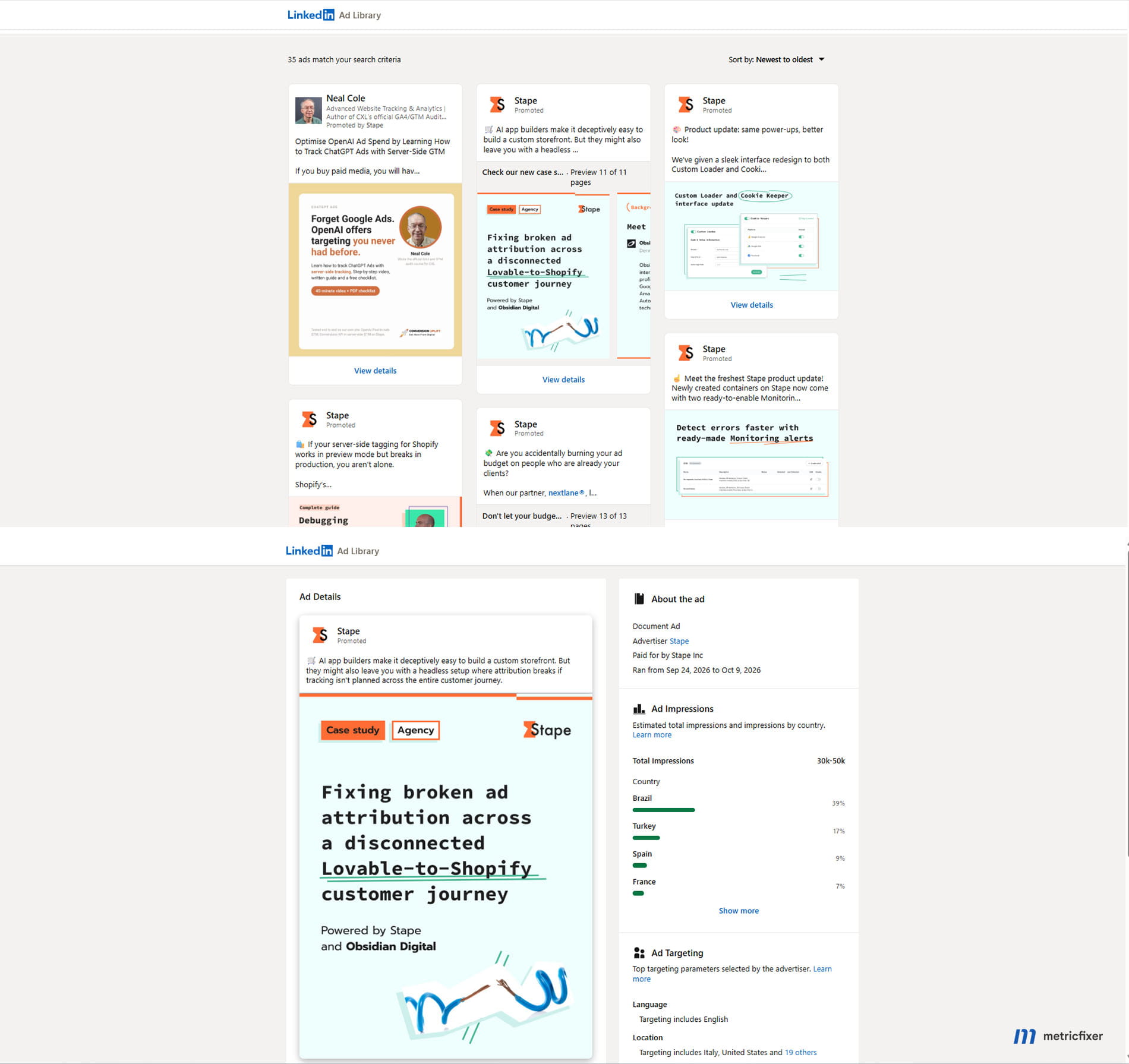
Verdict: useful for understanding B2B messages and available audience disclosures. Not a substitute for evidence about lead quality, sales-cycle length or closed revenue.
Microsoft Ad Library: useful for Bing, not a global archive
The Microsoft Ad Library covers Bing ads that received impressions in the EU or EEA, regardless of where the advertiser is based. A US-only campaign is not something this scope promises to reveal. Microsoft's official library guide is unusually important reading before analysis.
Three details change how the evidence should be interpreted. Records and edits can take 24–48 hours after an eligible impression to appear. Retention runs for one year after the last eligible impression. Most importantly, a historical date filter does not retrieve a historical creative version: Microsoft says the library displays the most recently updated version.
The documentation also defines its “estimated reach” field in terms of estimated impressions and a country breakdown. Do not silently relabel that number as unique people. Likewise, the dates describe eligible EU/EEA activity, not necessarily the advertiser's first or final activity worldwide.
How to use it without overstating the evidence
Search the advertiser and relevant ad text, then compare eligible markets. Record the current creative alongside the date on which you captured it. When the research question is “What exact wording did the competitor use last quarter?”, a current library preview alone cannot answer it.
Preserve your own dated captures for future comparison, subject to the service's terms. Write “creative visible at our October review” rather than assigning today's wording to every month in the record's date range.
Verdict: a valuable free source for its defined Bing scope. The main analytical risks are expanding that scope to the whole Microsoft network or treating the interface as a version-control archive.
TelegramAds.com: independent intelligence, not an official library
TelegramAds.com should not be confused with Telegram's official advertising platform. The former is an independent research product. Its published pricing page separates free access to basic information from a paid PRO offering with more detail and statistics.
Use it to discover advertising messages and investigate the available advertiser, destination, date and placement-related fields. However, a vendor's statement about collecting advertising is not an independently audited completeness guarantee. This review did not establish a reliable public benchmark for how much of the relevant Telegram advertising universe the service captures.
Why regional research needs extra care
Do not assume that a channel name, channel language or an account-currency label proves the country in which viewers received an ad. Record the exact field the service provides and ask what it represents: an observed placement, a declared targeting choice, an advertiser property or the vendor's own classification.
Also separate platform-served advertising from promotional posts purchased directly from channel administrators. Researching one does not automatically map the other. For a Telegram-heavy business, those may be different buying routes with different discovery methods and commercial relationships.
TGStat, discussed below, can complement the investigation of channels and public posts. It should not be used to convert a channel's subscriber count into verified ad reach or sales.
Before subscribing: test several advertisers you already know, inspect which fields are actually available, and check whether the destinations and dates are useful for your market. A paywalled or unavailable field is unknown, not zero. Ask for a clear explanation before putting an opaque “audience” or “targeting” field into a client report.
Verdict: potentially useful for a specialist Telegram workflow, but it needs a stronger validation step than an official repository with an explicit disclosure specification.
iSearchFrom: local search checks, not targeting proof
iSearchFrom addresses a different problem: examining search results under a chosen location, language and device context. The website distinguishes a free direct browser-search route from proxy-based and monitoring functionality. Calling the entire product “completely free” is no longer a useful description.
The current application pricing includes a limited free Starter plan and paid plans with token allowances and additional capabilities. Check the allowance for the action you need, not just a headline about unlimited searches. Direct browser search, metered retrieval, recurring tracking, exports and API access are different entitlements.
Use a repeatable search protocol
Choose a small set of commercial queries and keep them unchanged between checks. Record the requested city or country, language, device, search method, time and visible results. Compare several observations instead of treating one screenshot as a market census.
For example, a service business could compare the same local-intent query on mobile and desktop across two cities. The useful result is a record of which offers appeared under those conditions, not a declaration that one advertiser owns the entire city.
A simulated location setting and a request made through a local IP address are also different methods. Neither recreates every characteristic of a real customer. Previous activity, audience eligibility and the timing of an auction may still differ. The safe interpretation is “observed under these test conditions”, not “exactly what every local user sees.”
When investigating your own Google ads, use Ad Preview and Diagnosis where appropriate: Google documents its advantage of previewing without accumulating ordinary search impressions. Do not assume a third-party browser launcher has the same property, and do not repeatedly click competitors' sponsored results.
Verdict: a useful complementary tool for local search observation and recurring checks. It cannot reveal a competitor's full geographic targeting, bid strategy or all the auctions you did not observe.

More free tools worth adding
Google Ad Preview and Diagnosis
Access: no separate research subscription; used through Google Ads. Purpose: preview search results and diagnose the eligibility of your own ads under selected conditions. Google cautions that the tool may not reflect every part of campaign activity and that results can change. It does not diagnose why a competitor's ad is absent. Official guide.
Use it to separate “I cannot see our ad in my normal browser” from an actual delivery problem. For competitor research, preserve its limits: a preview is a preview, not an ongoing archive of all advertisers.
Google Auction Insights
Access: included for eligible activity in your Google Ads account. Unlike a public library, Auction Insights uses your own competitive auction context. It supports Search, Shopping and the relevant Search/Shopping activity within Performance Max, subject to reporting requirements. It is not a report on every Performance Max surface.
This can help answer whether another advertiser is appearing alongside you more often or outranking you in the reported context. It cannot tell you that advertiser's total budget or universal market share. Your eligibility and the report's thresholds define which comparisons you can see.
Use the report to decide where to investigate, then use libraries and landing pages to understand the competing proposition. A rise in auction overlap and a change in message are separate observations; neither, alone, explains the other's cause.
Snap Ads Gallery
Access: free public gallery. Snap's Ads Gallery documentation describes EU advertising from the preceding twelve months. It is a useful addition when Snapchat matters to your target audience, but that documented scope should not be promoted as a complete global archive.
Before relying on a collection session, confirm that the interface actually returned records rather than an access error. A 2026 independent investigation and subsequent fix, discussed later, show why availability and underlying coverage should be checked separately.
Reddit Ads Inspiration Library
Access: available through Reddit Ads without a separate inspiration-library subscription. Reddit describes a selection of successful active ads from the past year, with filters and an advertiser opt-out mechanism. That makes it closer to a creative gallery than a complete transparency repository. Official description.
Use it to examine how advertisers explain an offer in Reddit's context. Do not turn an example's inclusion into proof that the message will work in another community, country or conversion funnel.
Paid ad intelligence tools: what is worth paying for?
The best reason to pay is usually a repeatable workflow that saves time or adds relevant evidence, not a promise of unrestricted access to competitors' accounts. Match the subscription to a market, channel and question before comparing prices.
For the Google portion of an EEA research project, include the official BigQuery route in that comparison. Evaluate what a subscription adds beyond the available public data, while accounting for the time and processing costs of maintaining your own queries.
| Service and access | Useful job | What to check before buying |
|---|---|---|
| Semrush Advertising Toolkit Paid; trial availability depends on the offer | Paid-search discovery, ad copy, historical comparisons and landing-page research. | The specific toolkit, country database, history, exports and local-campaign limitations. |
| SpyFu Paid plans; limited public research access | Search competitor research and observed advertising history. | Coverage of your actual markets and queries; the distinction between captured ads and modeled metrics. |
| AdClarity Paid | Investigate display, video and social advertising activity. | Included markets, channels and history; modeled spend is not an invoice. |
| Similarweb paid-search intelligence Paid; trial or demo access | Compare paid-search traffic, keywords, landing pages and estimated spending. | Minimum data requirements, geographic coverage and the scope of each estimate. |
| Foreplay Paid; free trial | Save creative references, organize boards and monitor selected competitors. | Which discovery, monitoring and collaboration features the chosen plan includes. |
| BigSpy Paid; introductory offers vary | Search a third-party creative database across supported networks. | Networks included in the tier, usable unique results, freshness and download limits. |
| PiPiADS Paid; introductory access varies | Discover and monitor creatives, particularly for TikTok-focused and ecommerce research. | Country relevance, platform coverage, record provenance and the meaning of performance estimates. |
| TGStat Freemium; paid analytics, search and API offerings | Research Telegram channels, public posts and mentions. | Which subscription covers the needed function; public channel metrics are not verified ad outcomes. |
Semrush and SpyFu: useful search research, with real blind spots
Semrush Advertising Research organizes competitor information around positions, changes, ad copies, history and destination pages. That is useful for building a shortlist of competing propositions and queries to investigate.
Its methodological caveat is especially relevant to regional research: Semrush says its Advertising Research estimates use national-level rather than local-level data. Local-only campaigns, ads shown outside collection times, queries outside its database and specially targeted audiences can be missed. This is a documented limitation, not merely a dissatisfied user's allegation. Source: why Semrush differs from Google Ads.
SpyFu likewise distinguishes captured search evidence from calculated metrics. Use observed ads as research leads and estimated spending as directional context. Testing the service against your own account can reveal mismatches, but it does not establish a universal correction factor that can safely be applied to every competitor.
AdClarity and Similarweb: useful context, not audited budgets
AdClarity broadens the investigation beyond search. Check the purchased market and channel allowance carefully: a provider's overall coverage is not necessarily the coverage included in your subscription.
Similarweb explicitly describes PPC Spend as an estimate built from paid visits, keywords and cost-per-click information. Its documentation identifies missing local campaigns and other data gaps, excludes display and referral visits from this calculation, and specifies a threshold of more than 5,000 paid-search visits in the selected period. It is not intended to replace an advertiser's own reporting.
For a large competitor, such estimates may help prioritize investigation. For a small local advertiser, a missing number may reflect insufficient data rather than negligible spending. Even a trend deserves a cross-check: changed coverage or collection can resemble a changed advertising strategy.
Foreplay, BigSpy and PiPiADS: distinguish inspiration from measurement
Foreplay's product descriptions separate saved references and community-curated discovery from competitor monitoring. Its connected-account creative analytics are a different function: results from accounts you authorize do not mean the service has equivalent access to competitors' private performance.
For BigSpy and PiPiADS, inspect representative results before paying for a large allowance. A thousand records are less useful than twenty recent, relevant, distinct examples with identifiable advertisers and working destinations. Ask whether a country filter represents observed delivery, declared targeting or a database classification.
A creative-saving tool may be worthwhile even without better coverage if it stops your team losing references and makes briefs easier to assemble. Evaluate that benefit honestly rather than rebranding convenience as data accuracy.
TGStat: a complementary Telegram research route
TGStat's channel and content research complements a Telegram ad-intelligence workflow. Its paid offerings cover different analytics and search needs. Use public-post evidence to investigate mentions, placements and channel context; do not assume every promotional-looking post was paid or that subscriber totals establish the audience of a particular ad.
Pricing rule: check the actual checkout, billing period, renewal, taxes, country allowance and cancellation terms. An annual-billing monthly equivalent is not the same as a month-to-month price. A free trial is not a permanent free plan, and API or export access may require a different tier.
Completeness and accuracy: what users and researchers report
Public feedback is useful, but it needs careful labeling. A user report can identify a failure worth testing; it cannot establish how often that failure happens across all accounts. An independent study is stronger evidence for its tested conditions, but its findings also have a date and scope.
| Evidence and date | What was reported | Appropriate interpretation |
|---|---|---|
| SpyFu user reviews on G2 16 October 2025 and 12 February 2026 | One reviewer reported a known advertiser missing from results; another noted gaps in keyword data. | Test detection on familiar advertisers and queries. These were otherwise positive reviews, not controlled accuracy studies. |
| Google Ads community report 15 December 2025 | A user reported visible ad details but unavailable creative content. Community replies proposed different explanations. | A missing preview and a missing database record are different problems. The discussion does not establish a verified root cause. |
| BigSpy user reports on Trustpilot April 2020; June 2026 | An older review described repeated copies of the same videos; a 2026 review complained about slow loading. | The duplication report concerns a historical product experience, not a verified current defect. Check unique-result quality and usability in today's trial. |
| Mozilla and CheckFirst research 16 April 2024 | The assessment found gaps in search, access, data and comparability across major ad repositories; none met all of its baseline criteria. | Evidence that official libraries need scrutiny, not a current 2026 ranking or a measured missing-ad rate for your market. |
| AI Forensics study of Snapchat 13 May 2026 | April testing found severe access problems. The authors also reported that a 29 April fix restored near-complete availability in their follow-up. | Report both the problem and the fix. Do not recycle the original failure as evidence of an ongoing October outage. |
The review platforms themselves also deserve caution. G2's page contains generated summaries as well as individual reviews; the examples above refer to the dated reviews, not only the summary. Trustpilot warns that BigSpy's review collection may not be representative. Neither platform supplies an independently measured completeness score for the product.
Missing data is not always a malfunction
Some gaps follow directly from a tool's design. A curated gallery excludes material outside its selection process. A regional repository excludes activity outside its scope. A sampled search database misses some queries and audiences. An unavailable preview can coexist with a valid record. A genuine loading failure is yet another category.
Semrush's own explanation of limited or missing data makes that distinction concrete. Before treating a result as unreliable, establish what the service promised to cover. Before treating it as complete, establish what it did not promise.
What we could not verify
This review did not establish an independently audited, market-by-market completeness percentage for TelegramAds.com, iSearchFrom or the paid creative databases discussed here. Their marketing claims and database counters were therefore not converted into accuracy rankings. “No reliable independent benchmark found” is different from “the service is inaccurate.”
A practical workflow for regional competitor research
The following is a proposed research process, not a platform's internal workflow. Its purpose is to make findings reproducible and keep unsupported conclusions out of campaign planning.
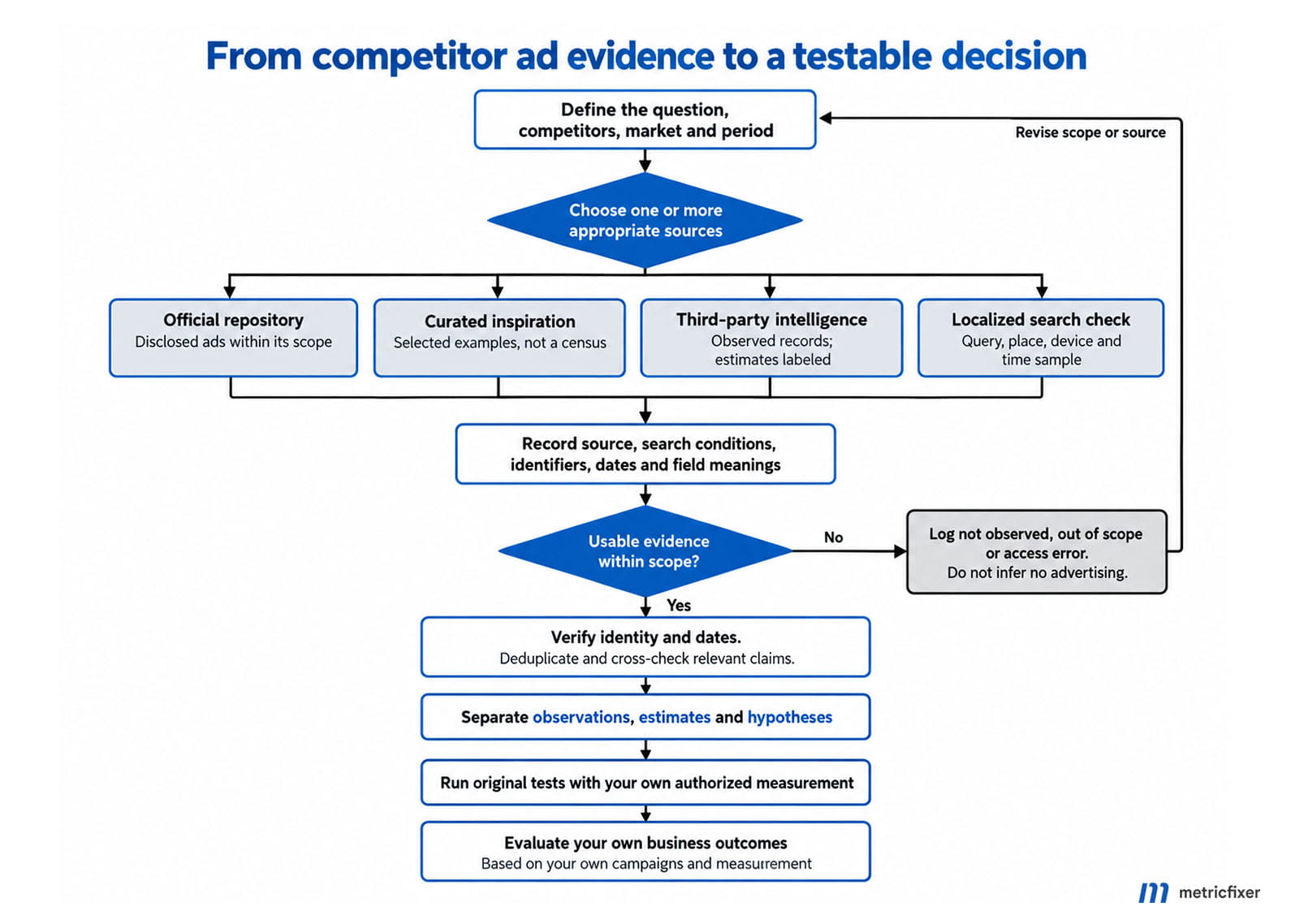
Research workflow: define the question and market → choose appropriate sources → record scope and evidence → verify identity and remove duplication → distinguish facts from hypotheses → design an original test → evaluate your own business outcomes. When evidence is absent or inaccessible, revise the search rather than inventing an answer.
1. Define a decision, not an unlimited collection exercise
Start with a concrete question: “How do three competitors present their offer to buyers in Germany and Poland?” or “Which claims appear in the search ads we observe for these local service queries?” Specify the platforms, languages, devices and period you need.
A first pass with three to five competitors is usually more actionable than an unstructured collection of hundreds of brands. This is a practical starting suggestion, not a statistically representative sample. Expand when an unanswered question justifies it.
2. Build an advertiser identity map
Record the brand, legal name where disclosed, advertiser identifier, Page or account, public destination and regional variants. Include known agencies or payer names as separate fields rather than treating them as aliases automatically.
For international brands, inspect the actual regional landing pages. A country-code domain and a language subdirectory can represent different parts of the same business. The related metricfixer guide to ccTLDs and subdirectories explains the wider site-structure decisions behind those regional versions.
3. Capture enough context to reproduce the finding
A screenshot without filters or a timestamp is a weak research record. Keep an evidence log that another team member can interpret without remembering what you clicked.
| Field group | What to record |
|---|---|
| Source and capture | Tool, record URL, ad identifier where available, capture date, time zone and saved evidence filename. |
| Programmatic extraction | Dataset and table, query or query version, filter values, retrieval timestamp, table freshness and reporting windows. Keep ordinary ad records and enforcement records distinguishable. |
| Identity | Brand, disclosed advertiser, payer, account or Page identifier and public destination. |
| Scope | Country selection, what that country field means, period, platform and available format filters. |
| Search conditions | Exact query, requested city, language, device, search method and relevant login or consent context. |
| Dates | Each displayed first/last date with its original label, plus your own first and latest observation. |
| Creative and offer | Main promise, evidence, format, call to action, offer terms and your own concept-group label. |
| Measurement status | Platform disclosure, direct observation, vendor estimate or analyst inference; retain ranges and units. |
| Limitations | Unavailable fields, access errors, untested assumptions and outstanding checks. |
For failed searches, use separate statuses such as not_observed, out_of_scope and access_error. None means not_advertising. An unknown value should remain unknown rather than becoming zero during an export or AI-generated summary.
Log a documented removal as a separate enforcement observation, with its source and any supported identity link; do not use it as a default explanation for a missing creative. For database work, preserve the returned values alongside your analysis so another researcher can check what was disclosed and what you inferred.
4. Normalize without destroying the original evidence
Keep the original record and a separate analysis layer. Group near-identical creatives into concepts, but retain the ad IDs underneath. Preserve raw destination URLs; a normalized version can help group equivalent landing pages without erasing potentially meaningful parameters.
Do not treat a tracking label such as utm_campaign as reliable proof of an advertiser's current campaign structure or objective. Labels can be inconsistent or outdated. The visible offer and the observed destination are stronger evidence than your interpretation of a naming convention.
When analyzing your own tests, keep landing-page reporting definitions equally precise. See metricfixer's explanation of GA4 landing page, page path and page location before combining unlike page dimensions into a performance comparison.
5. Cross-check the claim, not just the screenshot
A second website displaying the same library record is not necessarily an independent observation. Ask where the evidence originated. Two wrappers around one source may improve convenience without improving certainty.
The same caution applies when a public interface and a database export represent the same underlying disclosure. Agreement between them can help check extraction, but it is not two independent witnesses to the competitor's results.
Match corroboration to the question. A public landing page can verify the offer currently available there. A repository can disclose eligible advertising activity. A local search capture can document one appearance. None of these, alone or combined, proves the competitor's actual customer acquisition cost.
Repeat important observations on a consistent schedule and record changes. Avoid interpreting a single disappearance as a campaign stop or a one-day spike in records as a budget increase.
6. Run a small validation pilot before buying a subscription
Use known, authorized examples from your own advertising as a test set where possible. Include different countries, recent and established ads, and several formats. Check eligibility and allow for the provider's documented delay before judging whether an ad was missed.
A simple pilot measure can make the decision less subjective:
Pilot detection rate (%) =
  100 x known, in-scope ads found by the tool
      / known, in-scope ads checked in the pilot
This measures only your test set. It is not the provider's global completeness rate, and it says nothing about whether an ad was effective. Also assess false matches, duplicate records, usable previews, delay, export quality and whether the tested plan includes your target markets.
Compare the full operating cost: subscription, extra markets, seats and the time needed to clean results. A cheaper tool that requires repeated manual verification may not be cheaper for the workflow.
Before sharing the findings
- Scope: countries, dates, devices and source boundaries are visible.
- Identity: advertiser, brand and payer have not been merged without evidence.
- Metrics: estimates, ranges, impressions and unique people are not relabeled as one another.
- Absence: missing results, inaccessible records and excluded markets remain separate.
- Interpretation: observed facts are separated from hypotheses about strategy or results.
- Access and conduct: research uses permitted interfaces, does not bypass restrictions and does not create fake leads or unnecessary paid clicks.
Turn competitor evidence into original tests
Consider a hypothetical B2B software company researching Germany and Poland. It finds demo offers in LinkedIn ads, onboarding promises in Google creatives and short product demonstrations in selected TikTok examples. These are illustrative observations, not results from a real competitor audit.
The weak conclusion would be: “Competitors are succeeding with demos and video, so we should copy them.” The stronger conclusion is: “Reducing uncertainty about implementation may be a useful proposition to test.”
From there, write an original test. Compare a general product message with a specific onboarding proposition that your business can substantiate. Keep the intended audience and offer conditions clear. Choose a primary outcome before launch: qualified demo requests, completed purchases or another business result you can actually measure.
Use click-through rate and engagement to understand the response, but do not let them replace the business outcome. A message that attracts more clicks can still generate worse leads. Conversely, a narrower proposition may produce fewer clicks and more relevant inquiries.
For app campaigns, verify the measurement chain before evaluating a borrowed creative idea. The TikTok app campaign measurement checklist covers the practical launch checks that should precede performance conclusions.
Respect the distinction between research and copying. Learn from the problem being addressed, the sequencing of evidence and the clarity of the offer. Do not reuse another advertiser's assets, imply an affiliation or repeat claims that your own product cannot support.
The useful deliverable from a research session is therefore a short brief: what was observed, why it might matter, what remains unknown, what you will test and what evidence would change the decision. A large folder of competitor ads is not a strategy by itself.
Which tool stack should you choose?
These are editorial starting combinations based on the jobs described above, not rankings of universal accuracy.
| Situation | Start here | Add a paid tool when |
|---|---|---|
| Local service business | Google transparency research, repeatable localized checks and your own eligible Auction Insights. | Recurring query and location monitoring saves meaningful work. |
| B2B advertiser | LinkedIn and Google libraries, offer mapping and public landing-page review. | You need broader keyword discovery, historical comparisons or automated monitoring. |
| Ecommerce or app creative team | Meta Ad Library, the relevant TikTok library and carefully matched inspiration examples. | Creative discovery, reference storage and team briefing become bottlenecks. |
| Telegram-focused advertiser | TelegramAds.com records plus public channel and post research. | A trial demonstrates useful additional detail or monitoring in your niche. |
| Multi-market agency | A shared evidence log with platform-specific scope and a small recurring competitor set; evaluate BigQuery for the eligible Google portion. | Exports, alerts, relevant regional coverage or team access add enough value over the official-data workflow to justify the total cost. |
Do not buy several overlapping databases before identifying a gap. One official source, one well-chosen supplementary tool and a disciplined evidence log can be more useful than a large subscription stack with inconsistent definitions.
Bottom line: use competitor research to improve the questions you ask and the tests you run. The tools can reveal useful parts of the advertising landscape. They cannot make a competitor's private commercial results public simply by displaying a confident number.

Methodology and sources
This review was prepared from public product pages, official help documentation, published access and pricing descriptions, dated user reviews and original independent research available on 9 October 2026. Official platform documentation was prioritized for geographic coverage, inclusion rules, retention, field definitions and access conditions. Provider methodology pages were prioritized over promotional descriptions when discussing estimated metrics.
Google transparency update, 10 October 2026: the removal-record and BigQuery/API additions were checked against Google's public removal-page description, transparency help, dataset README and BigQuery documentation. This was a documentation review, not a live audit of removal records or an authenticated Cloud Console session. No queries were run in a reader's project, and no competitor-level query results are claimed. The SQL example uses documented fields and requires validation against the live schema before use. Other providers' review dates remain unchanged.
Sources are linked beside the claims they support. They include Meta, Google, TikTok, LinkedIn, Microsoft, Telegram and the listed tool providers; individual G2, Trustpilot and Google Ads community reports; and the original Mozilla/CheckFirst and AI Forensics research. User comments are presented as reported experiences, not independently verified diagnoses or a representative customer survey. Older studies and reviews retain their dates and are not presented as current defect reports.
This is a documentation-based editorial review, not an exhaustive hands-on benchmark. Interactive, login-dependent and paid features were not tested uniformly. Some public interfaces could not be fully inspected through the research environment. No controlled, complete list of all ads served across the reviewed markets was available, so the article does not rank tools by a measured universal accuracy or completeness percentage.
Free, paid and freemium labels describe the published access model at review time. Exact checkout prices, introductory offers, taxes, billing terms, quotas and included markets should be confirmed before purchase. The suggested workflows, evidence log, validation pilot and example tests are metricfixer's editorial recommendations; the B2B example is hypothetical.
This article provides marketing research and operational information, not legal advice or a guarantee of advertising results. Platforms may change their libraries, coverage, interfaces, retention rules and prices. Public availability does not certify the truth of an advertiser's claims or grant unrestricted rights to reuse creative assets or collect data. Follow applicable law and service terms, protect non-public account information, and verify important findings against the original source. References to third-party products do not imply endorsement of metricfixer by their operators.