
Published Nov 4, 2026
Bing AI Performance vs. Google: How to Measure AI Visibility
Bing's AI Performance report adds citation data and query context, while Google Search Console breaks AI impressions down by country and device. Learn what missing clicks really mean and what can be measured for ChatGPT, Claude, Gemini, and Perplexity.
Category: SEO & Web Marketing · By metricfixer AI Studio
Bing Webmaster Tools now gives publishers a direct view of how their pages are cited in AI-generated answers. Google's Search Console offers a different view: impressions in its generative search features, with country and device breakdowns. Both are useful, but neither is a complete measure of AI traffic. Understanding what each report counts is the first step toward measuring visibility in Copilot, Google, ChatGPT, Claude, and other assistants without confusing citations with customers.
Start here: review Bing's cited pages and Google's AI impressions separately, then use GA4 to investigate identifiable visits and business outcomes. For assistants without an accessible publisher report, combine controlled answer checks with referral analysis and crawler diagnostics. Do not turn these different datasets into a single AI click-through rate.
Contents
Research reviewed: November 4, 2026. Platform announcements and documentation are distinguished from anonymized account screenshots and the measurement workflow proposed below.
What has changed in Bing Webmaster Tools
A report can be new to a website owner without being newly launched. Microsoft announced the AI Performance public preview on February 10, 2026. Its stated coverage is Microsoft Copilot, AI-generated summaries in Bing, and selected partner integrations. Recently noticing the report in an account should therefore not be presented as evidence of a November launch.
The product has also developed beyond its original dashboard. Microsoft announced Intents, Topics, Citation Share, and Compare on June 16. On October 13, it introduced Topics Portfolio, a beta view that puts a site's citation activity into a wider thematic context.
That October addition is the more recent news. Topics Portfolio brings together topic size, the number of cited sites, grounding-query counts, and potential query opportunities. These are approximate planning signals, not precise market measurements. Microsoft says sites with insufficient activity may not see the feature; its absence is not, by itself, a technical fault.
Google's comparable reporting has its own timeline. The company announced its generative AI performance reports on June 3, 2026, and later marked the worldwide rollout complete on August 31. Our earlier article on Google's multimodal search reporting introduced this separate AI view. The question now is how the two reporting approaches fit together.
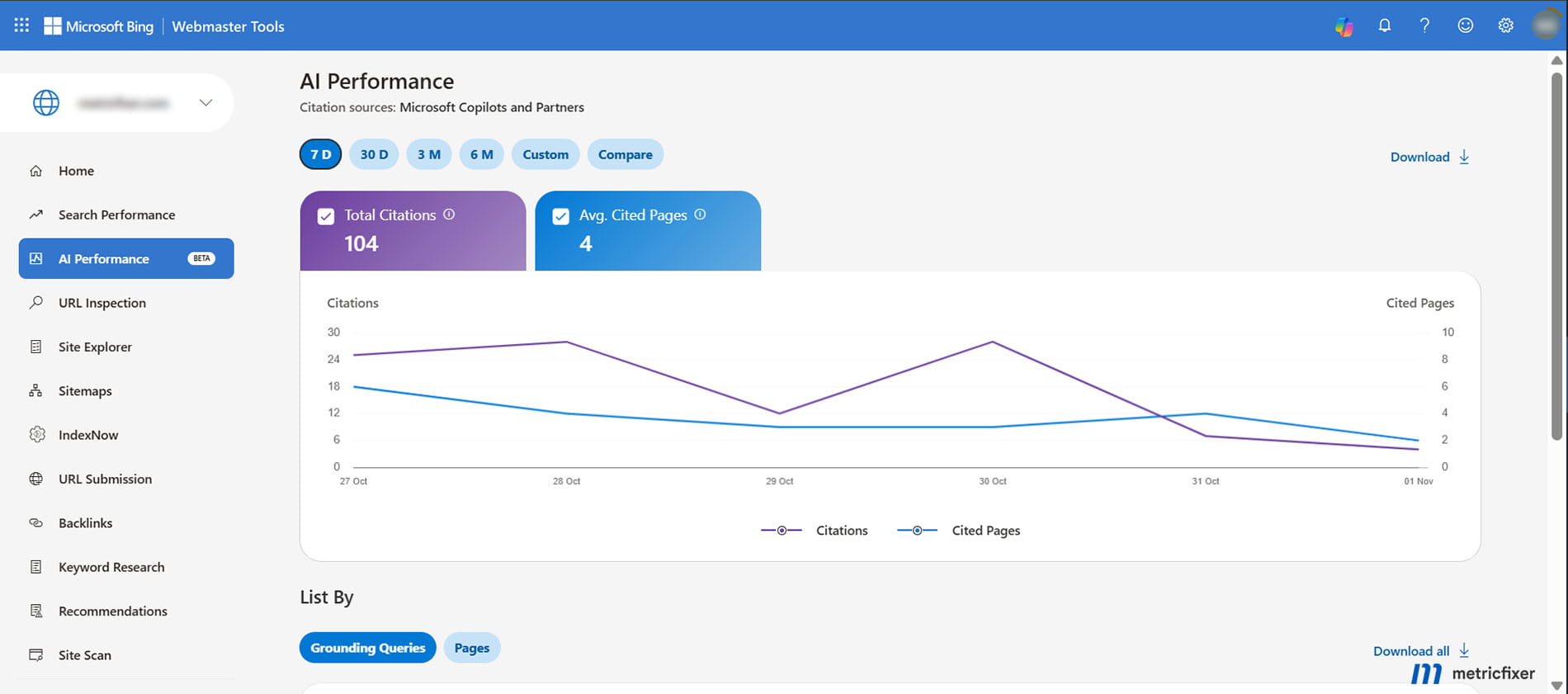
How to read Bing's AI Performance report
The AI Performance help page and launch announcement describe visible citation activity, not every occasion on which an AI system might have encountered your content. Its central measures are straightforward:
- Total Citations: the reported number of times content from the site was shown or referenced as a source.
- Cited Pages: distinct site URLs cited on a particular day. Average Cited Pages averages that daily count across the selected period.
- Grounding Queries: grouped retrieval phrases associated with citations, not the original conversations or a complete list of users' prompts.
In the screenshot, an average of four cited pages does not mean that only four different pages appeared during the entire period. Nor do 104 citations establish 104 people, 104 visits, or 104 independent conversations. Keep the report's labels intact when presenting these numbers.
One especially useful capability is the mapping between grounding queries and pages. It lets an editor investigate which URLs support a phrase and which phrases lead to a particular URL. The relationship can run in both directions and is not necessarily one-to-one.
This is a practical starting point for content review. A troubleshooting guide cited for a related diagnostic phrase deserves a different review from a company homepage appearing for its own brand name. Ask whether the page answers that task accurately and whether its next step is useful. The query phrase alone does not explain why the system selected it.
The June expansion adds another distinction: Citation Share concerns a site's proportion of citations for a particular grounding query. It is not traffic share or a ranking score. Intents and Topics add classification, while Compare supports period comparisons. These capabilities make a blanket description of Bing as simply "less informative than Google" too broad.
There is an important accounting limit. Bing describes the data as sampled and aggregated: low-volume activity may be absent, totals can differ between views, and later processing may refine results. Use it to investigate patterns, not to reconstruct a complete ledger of AI answers.
Bing AI Performance vs. Google's Generative AI report
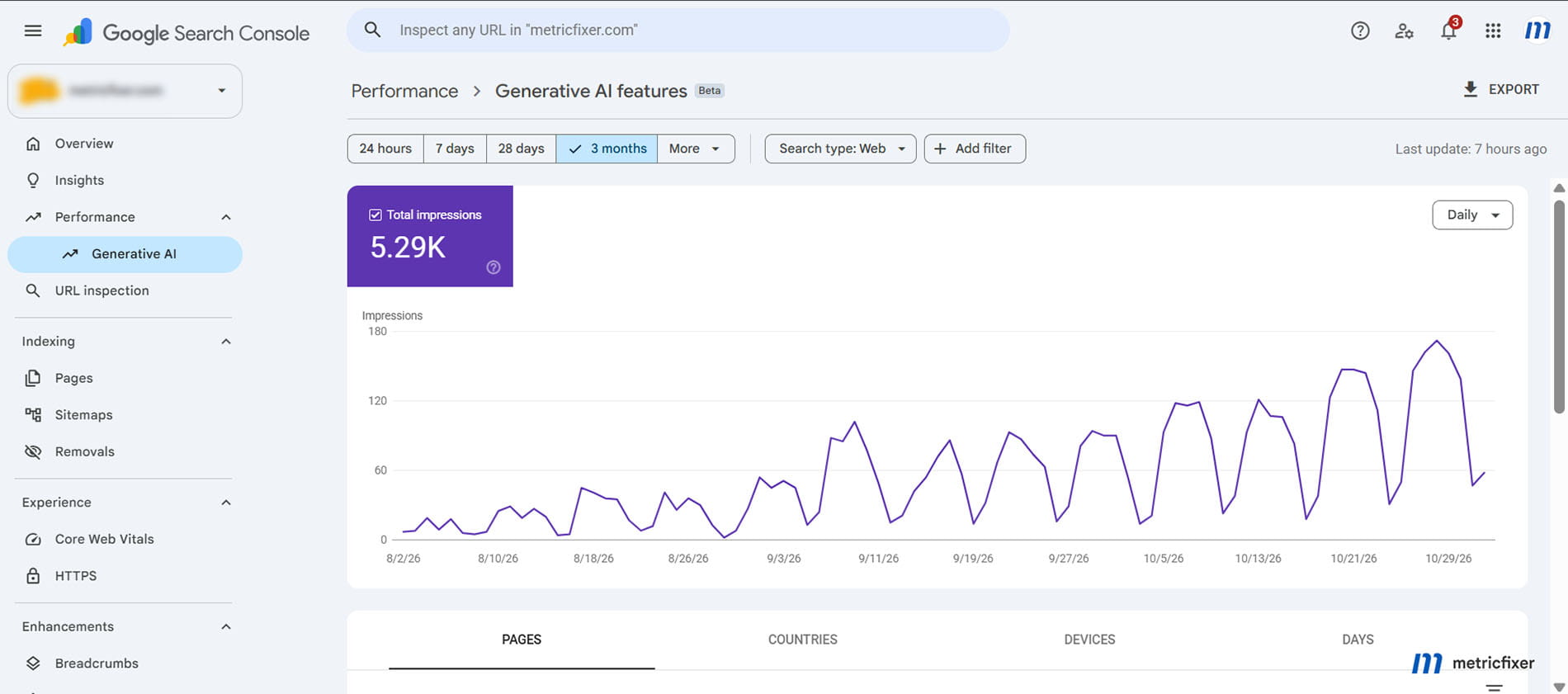
Google's Generative AI performance report for Search is an impression report for AI Overviews and AI Mode. It provides page, country, device, and date dimensions, plus text-based and multimodal search views. A separate report covers generative features in Discover.
The following comparison concerns these dedicated AI reports, not every capability in either webmaster platform.
| Question | Bing AI Performance | Google Generative AI: Search |
|---|---|---|
| Which experiences? | Copilot, Bing AI summaries, and selected partner integrations. | AI Overviews and AI Mode in Google Search; not a standalone Gemini usage report. |
| What is counted? | Reported citations and cited URLs. | Link impressions in supported generative search features. |
| Which pages? | URL-level citation activity and query-to-page relationships. | Page-level impressions. |
| Country and device? | Not documented as breakdowns in the reviewed AI report. | Country and device class: desktop, mobile, or tablet. |
| Query context? | Grouped grounding phrases, with additional intent and topic capabilities. | No query dimension documented for this dedicated report. |
| Relative visibility? | Citation Share and topic-level opportunity signals, subject to their preview limitations. | No equivalent citation-share measure documented. |
| AI-only clicks or CTR? | Not supplied by this report. | Not supplied by this report. |
| Export route? | Download the available citation, page, and time-series data. | Export the displayed chart and table data. |
Google is stronger for geographic and device segmentation; Bing is stronger for understanding retrieval themes. Device class is not a full technical profile: it should not be described as browser, operating-system, or app-level reporting.
The units also differ. Google explains that its default chart is aggregated by property: two links from the same property in one qualifying generative search feature can count as one chart impression. Page-level aggregation differs. Its broader aggregation guidance explains why chart and page totals need not match. Do not assume a Bing citation and a Google impression describe the same event.
Google's AI view overlaps with its wider Web performance data. It is not an extra audience to add to the Web total. Likewise, Bing's reference to selected partners is not evidence that the report covers every ChatGPT, Claude, or other assistant response. The reviewed Microsoft sources do not provide an exhaustive partner-by-partner coverage map.
Why clicks are missing: what the evidence supports
The hypothesis is understandable: AI answers appear in different websites, applications, and partner interfaces, so collecting consistent click data across them may be difficult. But that is a possible implementation challenge, not a verified explanation for Microsoft's reporting decision. We did not find an official statement establishing that rationale or saying clicks can never be added.
There is direct evidence against the broader claim that AI clicks cannot be measured. Microsoft's Search Performance definitions explicitly include clicks from Chat responses among Bing interactions. Google's click-counting documentation also counts outbound clicks from AI Overviews and AI Mode. This does not establish complete coverage of every assistant or partner surface; it establishes that AI interfaces and measurable clicks are compatible.
For Google, the broader Web performance reporting includes AI search activity, while the dedicated generative AI view exposes impressions. An absent AI-only click column should not be read as an absence of clicks in the underlying experience.
A click and an identifiable visit are different things
An assistant can record an outbound-link interaction within its own interface even when the destination website receives no usable referrer. Browser referrer policies govern what source information accompanies navigation; they do not make the original interaction inherently unobservable to the service handling it.
Website analytics measures a later part of the journey. Google's explanation of how Analytics collects website data starts with measurement on the destination page. A source-side click is therefore not the same event as a successfully recorded GA4 session. A failed page load, missing measurement, or lost acquisition signal presents a different problem from an uncited page.
The defensible conclusion: the current dedicated reports are visibility tools. Missing click columns do not prove technical impossibility, and missing referral attribution does not prove that nobody clicked.
Do not calculate an "AI CTR" by dividing GA4 AI Assistant sessions by Bing citations or Google AI impressions. The numerator and denominator do not represent the same measured population. Matching dates does not repair differences in coverage, counting rules, or source identification.
Where GA4's AI Assistant channel helps
GA4 is the right next layer when the question becomes: What did identifiable visitors from AI assistants do on our website? Google announced native AI Assistant traffic measurement on May 13, 2026. Its channel definitions use the medium ai-assistant; matching recognized assistant referrers also sets the campaign to (ai-assistant).
Crucially, that channel excludes Google's AI Overviews and AI Mode. It is not an analytics counterpart to Search Console's generative AI impression total. A visit from the standalone Gemini assistant and a visit from an AI-generated Google Search result should not automatically be treated as the same acquisition category.
A practical review starts in Reports → Acquisition → Traffic acquisition, whose navigation may vary in customized collections:
- Filter Session default channel group to AI Assistant.
- Inspect Session source / medium to see which identifiable sources contribute visits.
- Review landing pages in a suitable report or exploration, alongside sessions, engagement, key events, and relevant revenue.
- Investigate source-labelled visits outside the native channel separately, rather than silently rewriting their attribution.
Countries and devices in this analysis describe measured visitors, not everyone who saw a citation. Similarly, key events associated with those sessions are not proof that an unobserved AI exposure caused the outcome.
For links you control, campaign parameters can preserve declared acquisition information. They are not an instruction that all public assistants must follow, and a copied tagged link can travel beyond its original context. Keep paid campaigns distinct and never add AI campaign tags to ordinary internal navigation.
Our detailed guide to tracking and attributing ChatGPT and AI traffic in GA4 covers referrer loss, source-only tags, app handoffs, and custom channel groups. The principle remains simple: organize the signals you collected, but do not manufacture the ones you did not.
Can you measure visibility in other AI assistants?
Partly, but there is no verified universal "AI Search Console" for a website owner. In the public documentation reviewed for this article, we could not verify a generally available, site-wide organic impression report for ordinary website owners covering ChatGPT, Claude, or the standalone Gemini assistant. This finding does not rule out private publisher agreements, restricted programs, or future releases.
The distinction is not simply "search engines versus AI." Standalone assistants can use web search and external retrieval. The useful questions are which product generated the answer, what its reporting covers, and whether the evidence comes from real usage, your own website, or a test you initiated.
| Platform or route | What you can investigate | What it does not establish |
|---|---|---|
| ChatGPT | Identifiable referrals, captured answers and citations, and the access activity described in OpenAI's crawler documentation. | The total number of real users who saw the site in ChatGPT. |
| Claude | Identifiable visits, repeatable answer checks, and distinct crawler or user-triggered activity documented by Anthropic. | A site-wide impression count inferred from request volume. |
| Standalone Gemini | Observed answers and identifiable incoming visits; keep these separate from Google's Search AI reports. | Complete Gemini visibility derived from Search Console or the GA4 AI Assistant channel. |
| Perplexity | Referrals, answer checks, and potentially publisher-partner analytics through its documented program. | Automatic access to comprehensive publisher reporting for every domain. |
| Your own assistant or integration | Instrument the answers, source displays, and outbound interactions within the product you operate. | Activity in independently operated public assistants. |
Publisher partnerships are a real exception
Perplexity's Publishers' Program announcement describes analytics intended to help partners understand content citation. Its program expansion announcement also identifies data analytics as a partner benefit.
That is a documented route worth investigating for an eligible publisher, not a reason to promise a free dashboard to any website. Ask which products are covered, how citations are defined, what history and exports are available, and what contractual or eligibility conditions apply. Do not assume a historical program announcement describes every current commercial term.
Controlled answer checks measure a sample, not the audience
For platforms without accessible first-party visibility reporting, build a repeatable set of realistic questions. Separate non-branded discovery questions from questions that explicitly name your company. Record the product, visible model or mode, language, location settings, search availability, date, and exact prompt. Save the answer and its actual citation URLs.
Distinguish a brand mention from a link to your own website, and distinguish both from a citation to an unrelated third-party page discussing the brand. A recommendation can matter commercially without citing your domain; a citation can appear in an answer that recommends somebody else.
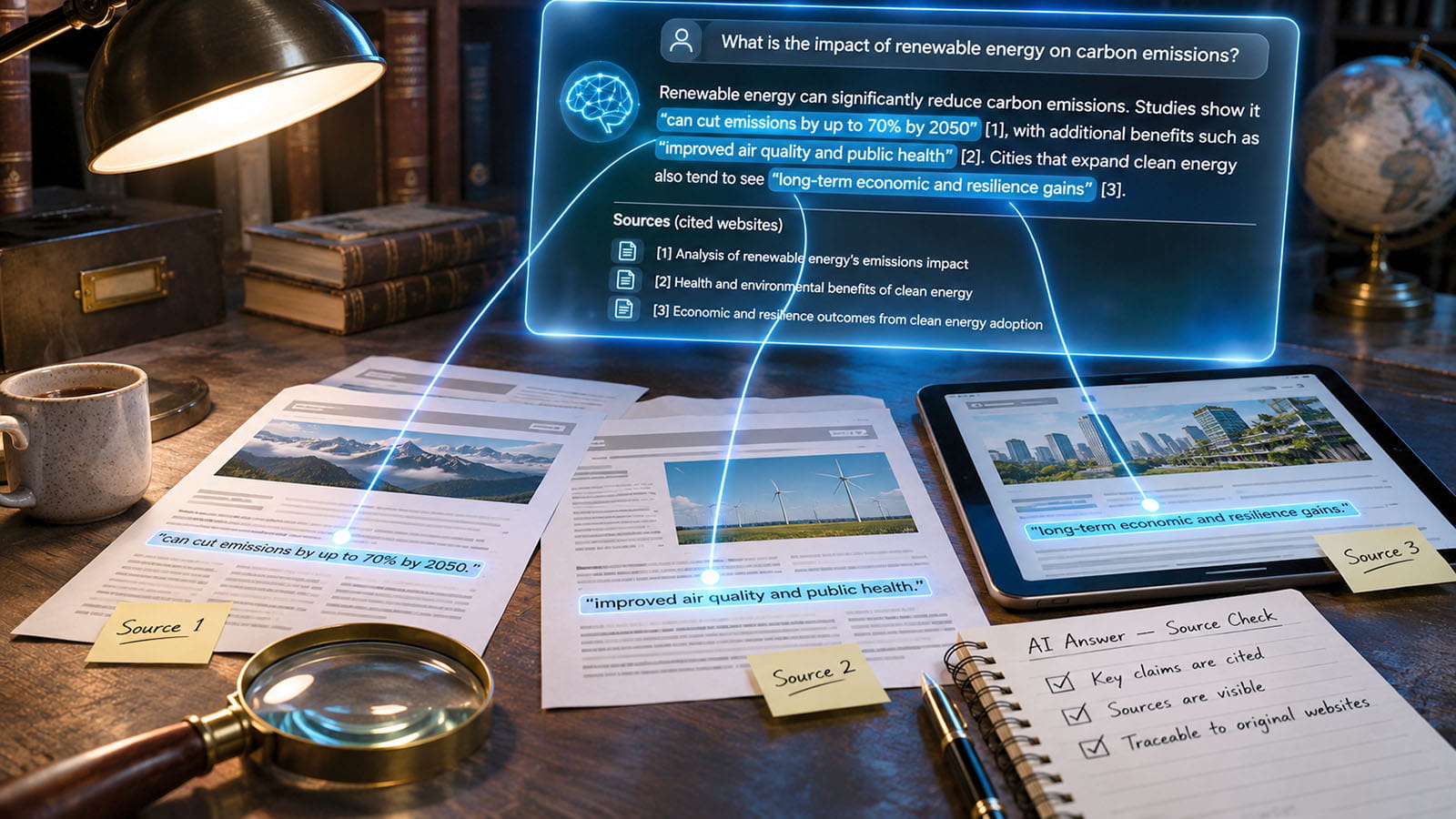
Our suggested panel metric is the proportion of completed test answers containing a link to the site. For example, 12 / 40 = 30% would mean that 12 of 40 completed checks contained such a link. This is an illustrative calculation, not a metricfixer result. Failed requests should be reported separately rather than quietly counted as absent citations.
APIs can support this work. For example, OpenAI's web-search API returns citation annotations for the responses your application generates. Those responses are evidence about your test configuration, not a census of consumer ChatGPT conversations. Check the real consumer interface separately when it is the experience you intend to evaluate.
The same due diligence applies to a commercial monitoring service: ask to see its prompt set, collection method, raw answers, citation extraction, failure handling, and weighting. A useful repeatable sample does not need to pretend to be measured population-wide impressions.
What server logs can and cannot tell you
Server and CDN logs answer an access question: Which requests reached our infrastructure, and what response did they receive? That is valuable for diagnosing blocked retrieval, but it is not an audience report.
OpenAI distinguishes OAI-SearchBot for search, GPTBot for potential training use, and ChatGPT-User for certain user-initiated actions. Anthropic similarly separates Claude-SearchBot, ClaudeBot, and Claude-User. These distinctions are documented in the provider references above; a generic "AI bot" total throws away useful information.
Perplexity's documentation distinguishes its search crawler from its user-triggered fetcher, Perplexity-User, and provides verification guidance. Use the relevant provider's current identity checks where available; a self-declared User-Agent string alone is not reliable authentication.
For teams using Cloudflare, AI Crawl Control can help inspect crawler requests, response outcomes, and requested paths. Referrer analytics are also documented, with plan-dependent availability. Keep the request and referral views distinct.
A successful fetch does not prove the material was displayed, linked, or read by a person. A user-triggered fetch does not prove an outbound click to the publisher. Equally, a reused copy can support an answer without a fresh request appearing in the publisher's logs. There is no defensible one-request-to-one-impression conversion factor.
For the same reason, do not report the location of a fetching server as the location of the human audience. Logs are most useful here for access, delivery, and infrastructure diagnosis.
A practical AI visibility measurement workflow
The following is metricfixer's proposed working method, not a platform's internal attribution pipeline. Start with a small set of important pages and a reporting question that can lead to a decision.
Define the scope before collecting numbers
Record the property, platform, report, selected dates, available timezone information, filters, and export date. Keep a note of preview features and missing tabs. Compare equivalent periods within the same source before attempting any cross-platform interpretation. Do not assume that identical calendar dates imply identical reporting boundaries.
Export the data available in the interface and preserve the originals. Do not promise a dedicated AI-report API, a fixed retention period, or a complete historical backfill unless you have checked that specific capability. Newly visible data should be annotated as a measurement change, not automatically celebrated as newly created demand.
Maintain four separate views
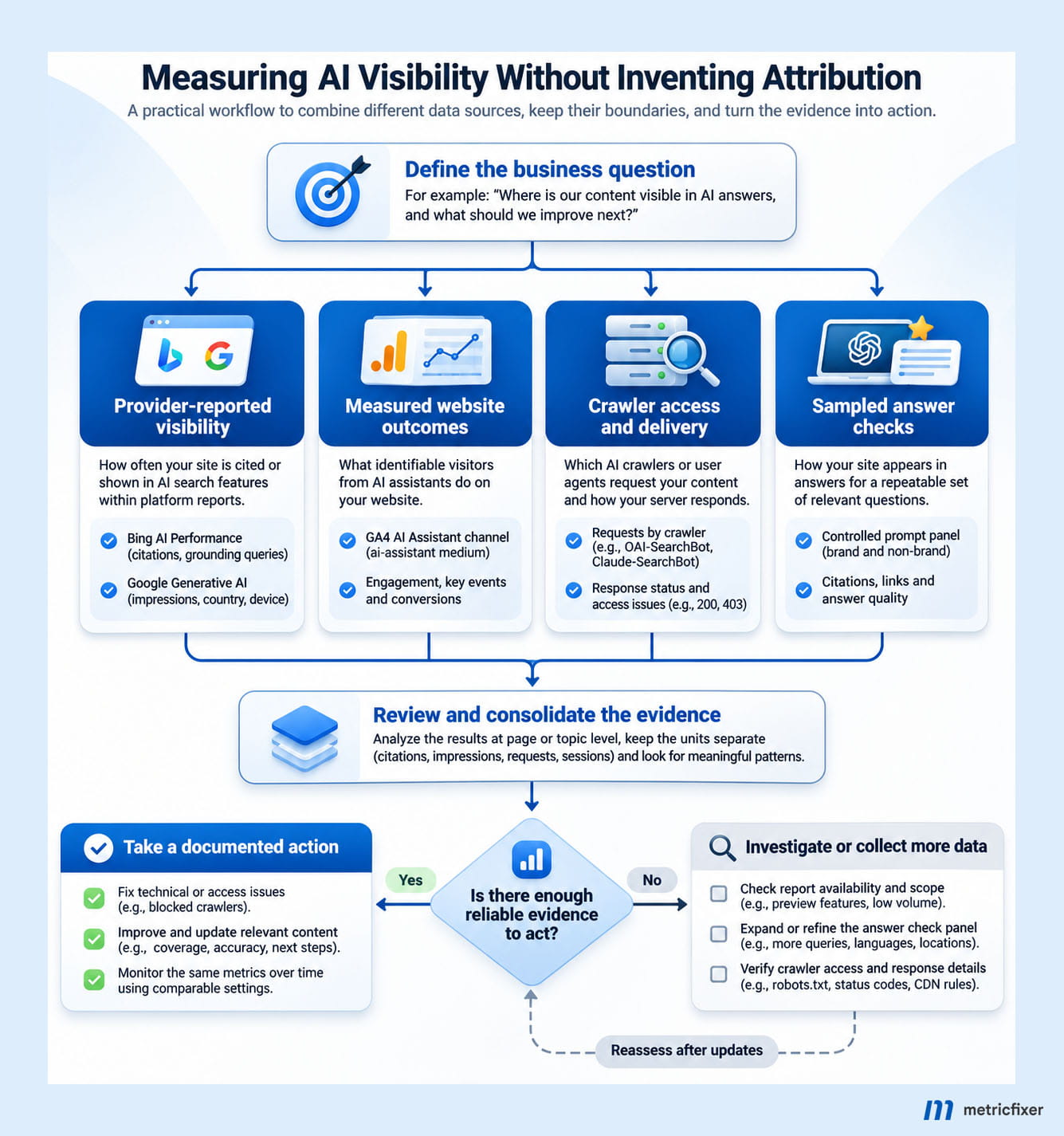
Keep provider-reported visibility, measured website outcomes, crawler access, and controlled answer samples in separate datasets. They can share a page or topic label for editorial review without becoming a person-level funnel.
Working sequence: define the business question → identify the evidence available → preserve each source's scope and units → review relevant pages and topics → make a documented change → repeat comparable measurements. Missing exposure data remains unknown; an unidentifiable visit does not become attributed AI traffic.
Make comparisons auditable
Map equivalent URLs carefully, retaining the original URL and the mapping rule. Do not collapse language versions, product variants, or genuinely different landing pages merely to make a join work. Where one source assigns data to a canonical page and another records the actual landing URL, explain the reconciliation.
Attach the date and purpose of each content or technical change. Keep the same prompt panel for comparisons, or clearly label a revised panel. Separate successful checks, failures, and unavailable data. A rise after an update is a reason to investigate, not sufficient evidence that the update caused it.
For example, a useful page-level review might say: "This guide is receiving more reported Bing citations, its sampled answers link to the correct updated section, and identifiable assistant visitors complete the intended action." It should not say: "These citations produced these sales," unless an appropriate measurement design actually supports that claim.
Turn the evidence into useful changes
Use the reporting to choose a small number of pages for inspection. Check factual accuracy, the question each page answers, clear explanations, original supporting evidence, and a sensible next step. A page that helps someone diagnose a problem may need a troubleshooting path, while a comparison page may need transparent criteria and current limitations.
Topics Portfolio can suggest a theme to investigate, but an opportunity label is not an editorial assignment. Microsoft warns that classifications may be imperfect and that branded competitor queries can appear among opportunities. Assess relevance to your audience before commissioning new content.
When a technically important page is not accessible, repair that problem before attributing poor visibility to writing style. Google's AI search guidance emphasizes ordinary technical eligibility and useful content rather than a special AI-only schema. Review crawler permissions deliberately; do not disable broad security protections merely to increase request counts.
An empty AI report also needs a scoped diagnosis. It is not automatically proof that the whole website has been removed from search, and a conventional search impression is not proof of an AI citation. For the wider indexing investigation, see our guide to diagnosing disappearing Bing impressions before buying backlinks.
The practical goal is not the largest possible "AI visibility" number. It is a clearer understanding of where useful content is being surfaced, whether the representation is accurate, and what identifiable visitors do next. Report progress against the question you can actually measure.
A reporting checklist before sharing the numbers
- Scope: name the platform, product surface, reporting period, and filters.
- Units: keep citations, impressions, requests, sessions, and business outcomes distinct.
- Availability: label samples, preview features, missing data, and processing limitations.
- Attribution: do not calculate CTR from unmatched reports or relabel unknown traffic as AI.
- Testing: preserve prompts, answer captures, URLs, settings, and failed-run counts.
- Interpretation: distinguish an observed change from a demonstrated cause.
- Action: connect each recommendation to a page, a reader task, and a checkable result.

Methodology and sources
This article reviews official Microsoft and Google announcements and reporting documentation, provider documentation from OpenAI, Anthropic, and Perplexity, Cloudflare's analytics guidance, and MDN's referrer-policy reference. Sources were checked on November 4, 2026, and are linked beside the relevant explanations rather than repeated in a technical bibliography.
Two anonymized account screenshots, with the site name blurred, establish the displayed interface, selected date presets, and visible headline values. They are not raw exports, a representative industry sample, or evidence of the exact date a feature became available to the property. No authenticated account audit, click-reconciliation experiment, or cross-assistant prompt study was performed for this article. The sample calculation and workflow are editorial proposals.
We found no published technical explanation proving why the dedicated reports omit click metrics. Our findings about unavailable public publisher consoles are limited to the documentation reviewed and do not cover confidential partner arrangements. UI availability, data coverage, sampling, and platform definitions can change.
This article is for technical and operational information only. metricfixer is not affiliated with Microsoft, Google, OpenAI, Anthropic, Perplexity, or Cloudflare. Reporting access and feature behavior may change after publication. Visibility, crawler access, and sampled citations do not guarantee traffic, rankings, leads, or revenue. Apply analytics and data-collection methods in accordance with applicable privacy requirements and platform terms.