
Published Oct 20, 2026
Bing Impressions Dropped to Zero? Don't Rush to Buy Backlinks
When Bing impressions disappear and Webmaster Tools warns about missing backlinks, buying links can be the wrong response. An anonymized case and public reports show what to check first.
Category: SEO & Web Marketing · By Mikalai Sasau
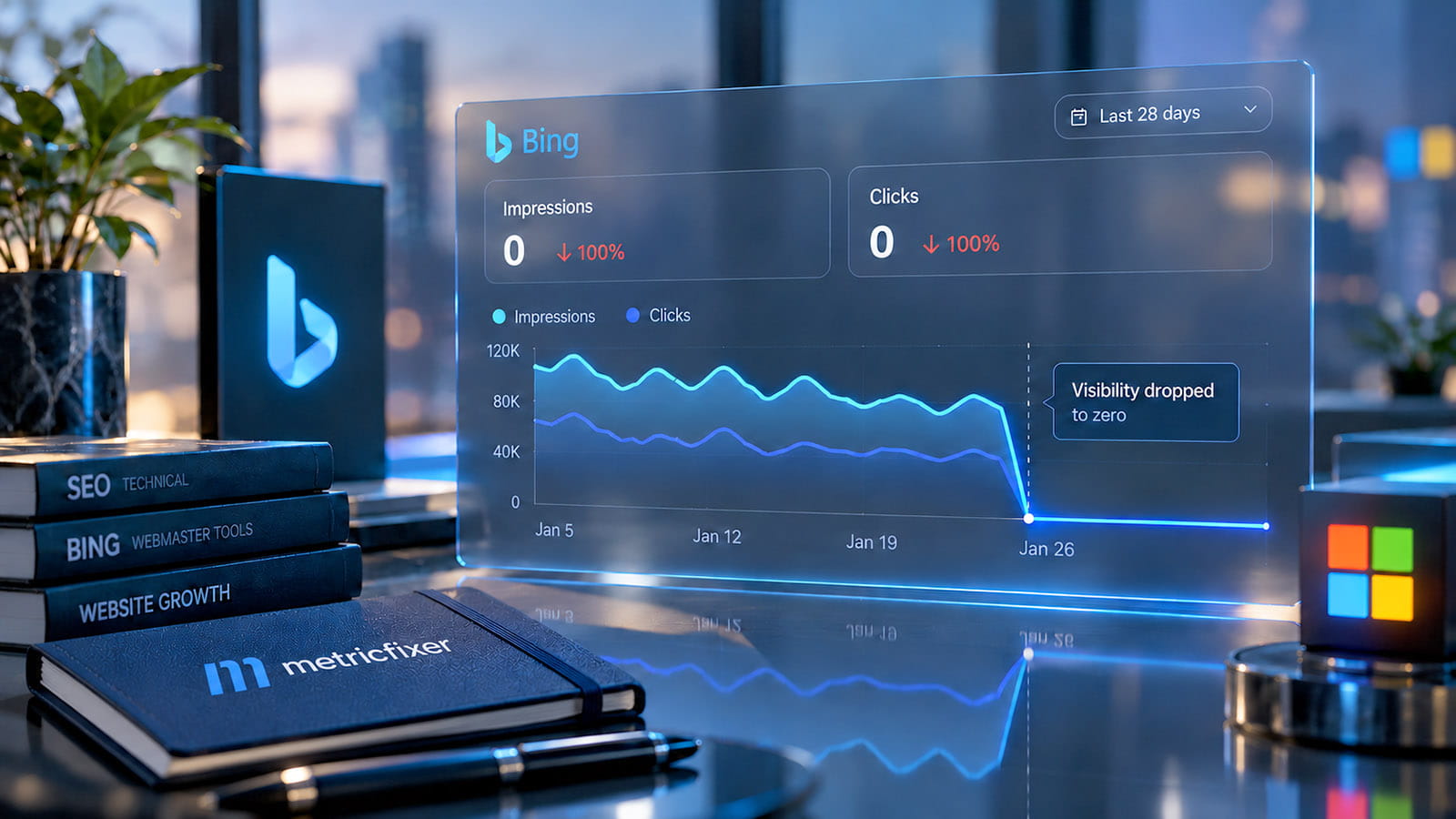
Bing traffic drops to zero. Webmaster Tools says the site is indexed, but its most prominent recommendation is to get more links from high-quality websites. Before treating that message as a diagnosis, separate three questions: can Bing access the site, does it report the pages as indexed, and does it actually show them in search? This investigation combines an anonymized young-site case, public accounts from other owners, and Microsoft's documentation to explain what to do next.
Practical starting point: do not buy links to clear a dashboard warning. Preserve the evidence, check representative pages and site-level controls, reproduce the search problem, and contact Bing support when the results remain inconsistent. Work on useful content and genuine recommendations alongside that investigation, not instead of it.
Contents
The warning is not a diagnosis
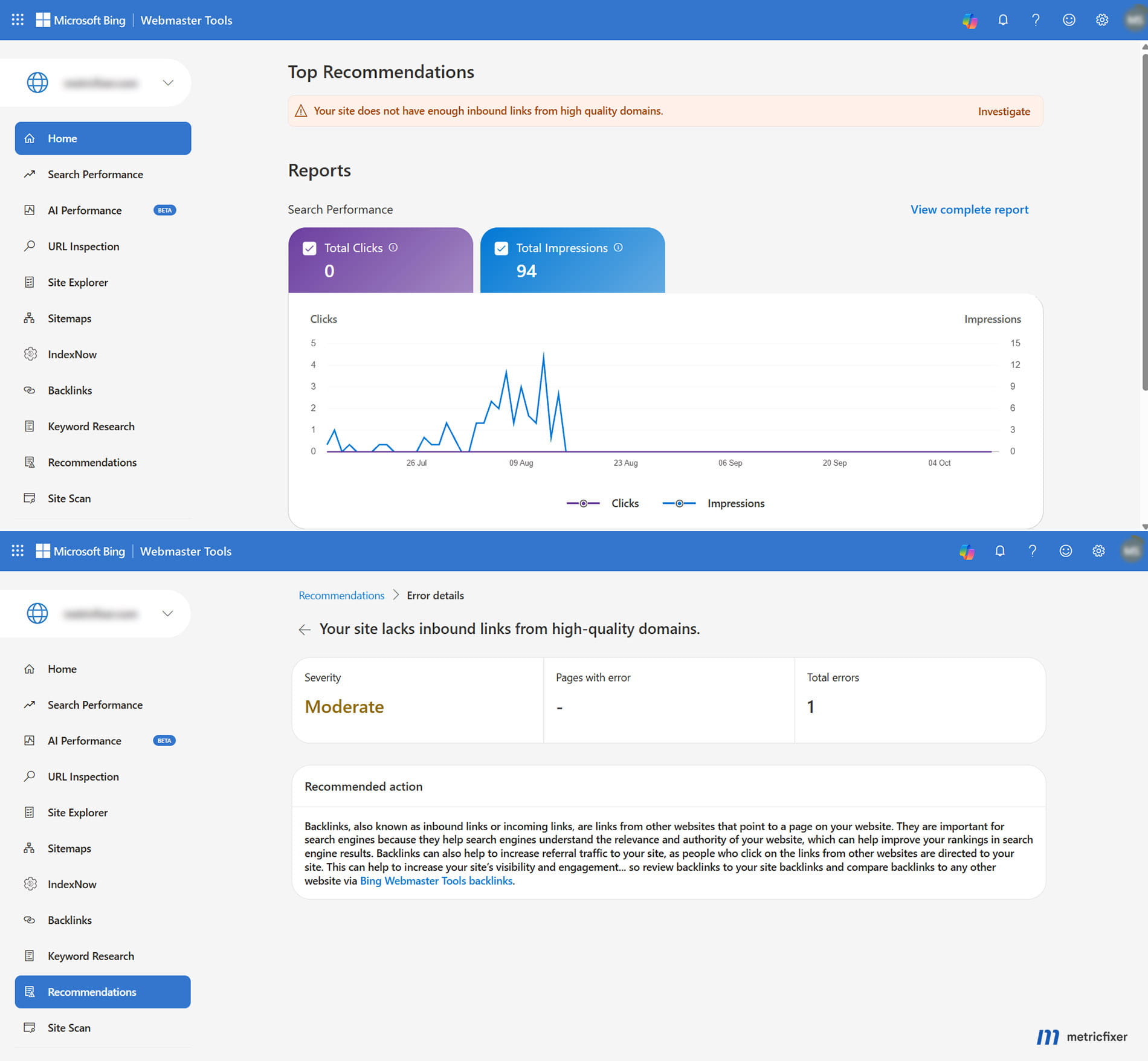
For a new publisher, this is an alarming sequence: a small amount of search visibility appears, the graph suddenly becomes flat, and an orange banner announces:
Your site does not have enough inbound links from high quality domains.
The natural interpretation is that Bing has identified the reason for the disappearance. The next step can seem obvious: acquire links, quickly. That is the dangerous leap. A recommendation about the site's link profile is not, by itself, an explanation of a particular traffic drop, a penalty notice, or an instruction to purchase links.
An impression is a recorded appearance of a link; a click records someone selecting it. A site can receive impressions without receiving any clicks.
A backlink simply means a link from another website to yours. Links do matter. Bing's explanation of why sites may be missing from its index lists a lack of incoming links among several possible obstacles for new websites. It also lists discovery delays, crawling problems, indexing directives, quality concerns, and penalties. The same article favors a few relevant, authoritative links over hundreds from unrelated sources. It does not establish that every missing site has a backlink problem.
In the case examined here, the backlink recommendation was marked Moderate. Its explanatory text discussed relevance, authority, and referral traffic, then directed the owner to the Backlinks report. It did not identify an offending URL, a dated enforcement decision, or a link threshold that would restore search visibility.
| What you see | What it establishes | What it does not establish |
|---|---|---|
| A backlink recommendation | Bing is suggesting an area for improvement. | That missing links caused this particular disappearance. |
A failed fetch or detected noindex | A concrete access or indexing issue for the checked URL. | That the same problem affects every page. |
| An explicit policy finding | A stated policy concern that needs investigation. | The exact repair, unless affected pages or practices are identified. |
| A support email saying the issue is resolved | Support reports that the case's issue has been addressed. | The original cause or complete recovery in public search. |
The editorial concern is real, but limited: placing a general backlink warning next to a collapsing graph can encourage owners to confuse a suggestion with a diagnosis. That is not evidence that Microsoft intends to encourage paid links, or that most affected owners actually buy them.
The case: a young content site disappears from Bing
Our starting point is a young content website whose project name we are not disclosing. The case record includes dashboard screenshots, URL Inspection results, public search checks, analytics screenshots, and Bing support correspondence. Identifying details are withheld; the figures and observed statuses are retained.
The owner reported that the sitemap and IndexNow integration had operated for more than four months without reported errors. That is owner-supplied background, not a retrospective audit of every submission. The initial Bing screenshot showed 94 impressions and zero clicks in the selected period, with the visible impressions concentrated before approximately mid-August 2026. The line then stayed at zero into October.
This was a small baseline, not the collapse of a large established traffic stream. A few zero days would have been weak evidence. The prolonged absence, combined with the following checks, made the case worth investigating.
What the checks showed
The Backlinks report displayed 33 referring pages from four domains. That count described the report, not necessarily every link on the internet: Bing says its Backlinks data is a representative set rather than a complete profile. A missing link in this report is therefore not proof that the link no longer exists or has been penalized.
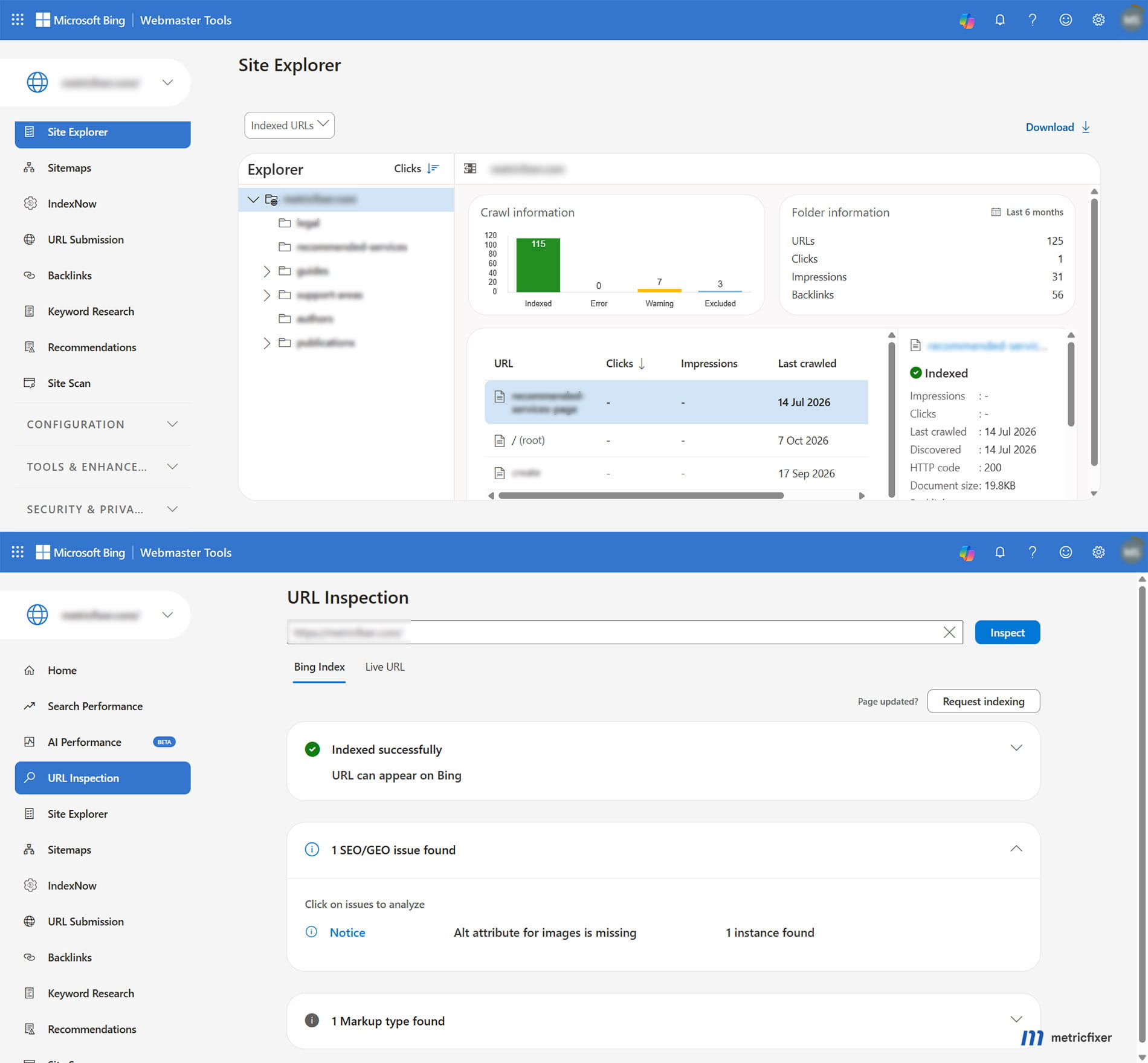
For the homepage, URL Inspection reported Indexed successfully. The last crawl shown was October 10, 2026. Crawling was allowed, the page fetch was successful, and indexing was allowed. A subsequent Live URL test also found the page eligible for indexing, subject to Bing's quality checks and indexing decisions.
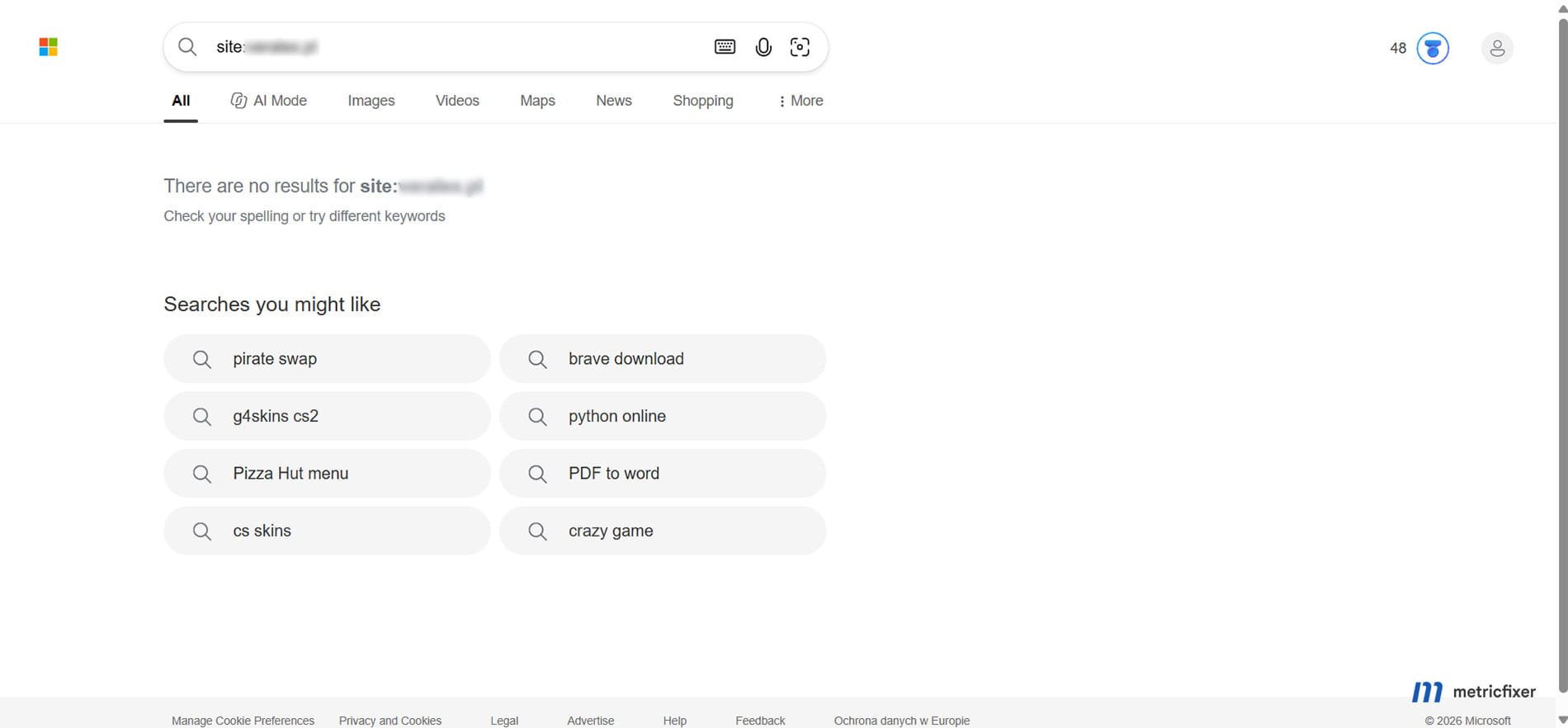
Nevertheless, the supplied public Bing searches using the site's domain and exact homepage address returned no results. A branded search showed other platforms mentioning the project, but not the official website in the captured results. This was a documented mismatch between the tools and the checked search results, not proof of a particular hidden penalty.
The support and analytics timeline
| Date or period | Evidence in the case record | Interpretation |
|---|---|---|
| Approximately mid-August 2026 onward | The Bing impressions graph becomes flat at zero. | A visibility change to investigate; the exact start requires the daily export. |
| October 10 | The homepage's last crawl is successful, according to URL Inspection. | Bing could fetch that page at the recorded crawl. |
| Mid-October | The owner completes inspection and public-search checks, then obtains a Bing support case. | The discrepancy is submitted for investigation. |
| October 15 | GA4 records two sessions attributed to bing / organic. | A new analytics signal, not two independently verified Bing search clicks. |
| October 17 | Bing support says the site's issue has been resolved, without identifying its cause. | A reported resolution, not a disclosed technical diagnosis. |
| Evidence reviewed on October 18 | GA4 shows nine Bing-attributed sessions in a period ending October 17; the supplied Bing chart still shows zero, with October 16 as its last visible date. | The screenshots do not establish matching reporting coverage or complete recovery. |
The response also mentioned a possible two-to-three-week wait when a site still needs crawling or indexing, suggested IndexNow, and linked to the Webmaster Guidelines. It did not name a violation, say that insufficient backlinks caused the problem, or describe what had been changed.
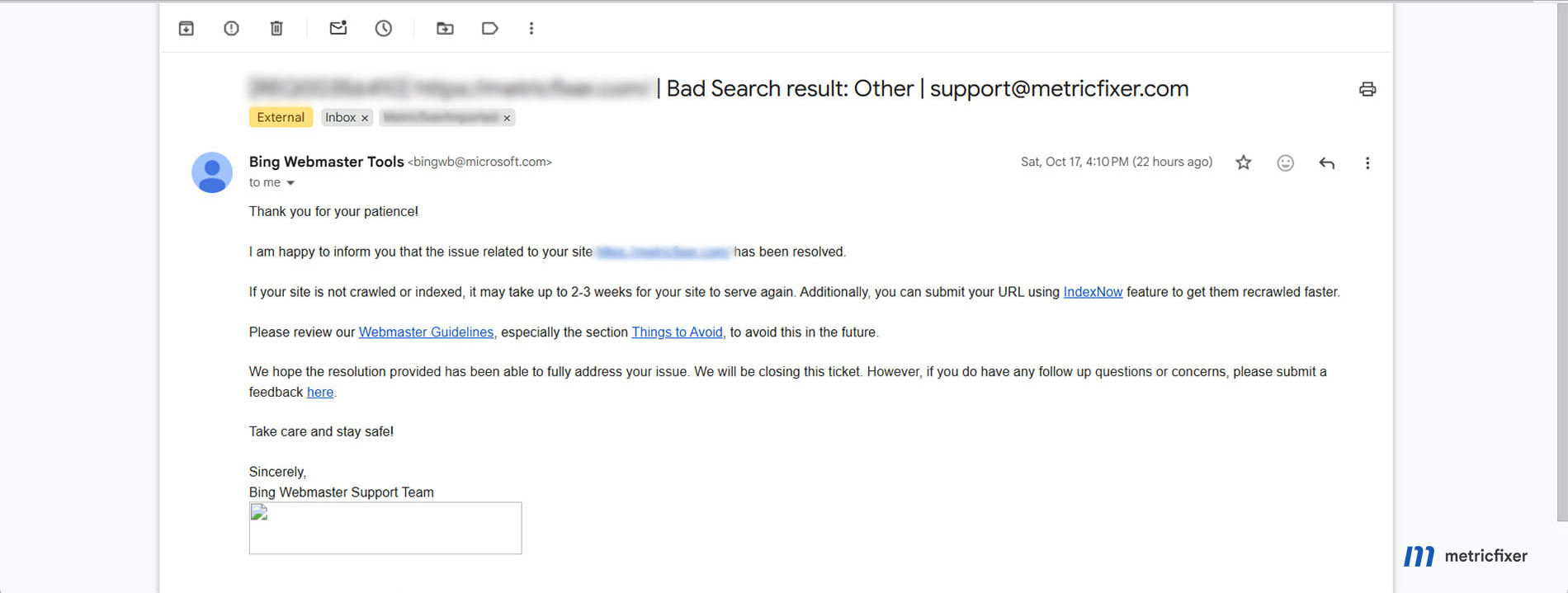
The defensible outcome is narrow: support reported a resolution and Bing-attributed sessions appeared around the support interaction. A confirmed manual ban, the removal of a named quality filter, and sustained organic recovery were not established by the available evidence.
What other website owners have reported
The pattern is not confined to this case. Public reports span several years, but they describe symptoms and personal experiences, not a single proven cause.
| Public account | What the owner reported | What remains uncertain |
|---|---|---|
| Jesse Squires, March 2022 | Bing reported hundreds of indexed pages while public search and search metrics stopped returning the expected results. | The original post could not identify the mechanism behind the disappearance. |
| Squires' July 2022 follow-up | Support cited unspecified guideline violations. The owner later reported restoration without making remedial website changes. | No explanation established why the assessment or visibility changed. Waiting without investigation is not a general remedy. |
| Microsoft Q&A, March 2026 | An owner described 930 indexed pages but no public results after a hosting outage. A later update disclosed 13 accidentally published demo product pages. | The owner suspected those pages contributed, but Bing did not publicly confirm that diagnosis in the reviewed thread. |
| Microsoft Q&A, August 2026 | An owner reported 174 indexed URLs, an abrupt loss of impressions, and the same high-quality-inbound-links warning. | The thread did not establish that the warning caused the disappearance. |
| A second owner in the same August thread, September 2026 | The owner reported 264 indexed URLs and similar missing results, then shared a support resolution message while saying public visibility had not yet returned. | The support message did not disclose the cause or prove completed recovery. |
The March account is an important counterweight. An owner can reasonably suspect a search-engine problem while still having an undiscovered problem on the site. Its author initially treated the abrupt drop as ruling out content quality, then found unrelated demo pages. The speed of a decline cannot identify its cause on its own.
These reports justify an investigation route. They do not establish a universal Bing bug, a specific August 2026 update, or a policy that deliberately blocks young websites until they acquire enough links. Nor are all the reported sites young.
There is also evidence of the warning being misread
A May 2025 BlackHatWorld discussion began with an owner asking whether Bing was telling them to create backlinks. The thread reproduced the same warning and explanatory text. Some replies welcomed its directness; others incorrectly treated it as evidence that manipulative link building was acceptable for Bing.
This is useful evidence of interpretation, not evidence that buying links restored any affected site. It is also a commercial SEO forum, not a Microsoft policy source. Nevertheless, it illustrates the practical risk: a general recommendation can be repackaged as permission to use the very tactics a search engine warns against.
A clearer interface would separate an authority-building suggestion from an incident diagnosis and offer a direct path to investigate an indexed-but-missing site. That is our product-design recommendation, not a claim about Microsoft's intent.
What Bing's rules do and do not say
Microsoft's current Webmaster Guidelines prohibit manipulation through purchased links, link spam, and private networks. Other listed concerns include deceptive content delivery, copied or substantially duplicated content, large-scale generation without editorial oversight, low-value affiliation, malicious behavior, and misleading structured data.
For a content publisher, a targeted review should ask whether readers receive original, checked information; whether many pages merely repeat one another; whether paid recommendations add useful analysis; and whether the page and its structured data make the same claims. These are review questions, not findings against the anonymized site.
AI assistance is not the same thing as uncontrolled publishing at scale. Likewise, a small link profile is not the same thing as a manipulative one. The reviewed guidance does not provide a numerical backlink quota that would diagnose or cure this case.
Why the documentation can feel confusing
A separate Bing Link building help page contains the permissive-sounding sentence, "You may choose to buy a link from a trusted website." Its next sentence warns that Bing can identify purchasing patterns. The page also describes paying for direct referral traffic as a marketing option and otherwise favors naturally earned links.
That wording should not be extracted as permission to buy ranking influence. Bing's explicit statement about link schemes and the retirement of its disavow tool warns that link buying and link spam can lead to delisting. A reader who stops at the permissive sentence could miss that distinction; it does not remove the risk.
There is also a difference between paying for exposure and buying an apparent editorial endorsement to manipulate rankings. Google's spam policies make that distinction explicit: advertising and sponsorship links can be legitimate when qualified with rel="sponsored" or rel="nofollow", while buying links for ranking purposes is link spam. Those attributes are not a promise of Bing ranking credit or a repair for missing search results.
Do not turn uncertainty into a purchase. A seller promising to clear the warning or remove a supposed Bing ban with a link package is claiming a diagnosis that your evidence may not support.
A safer order of action
The following sequence is an editorial troubleshooting workflow, not a description of Bing's internal systems. Start with observations that you can verify, fix demonstrated problems, and escalate unresolved discrepancies.
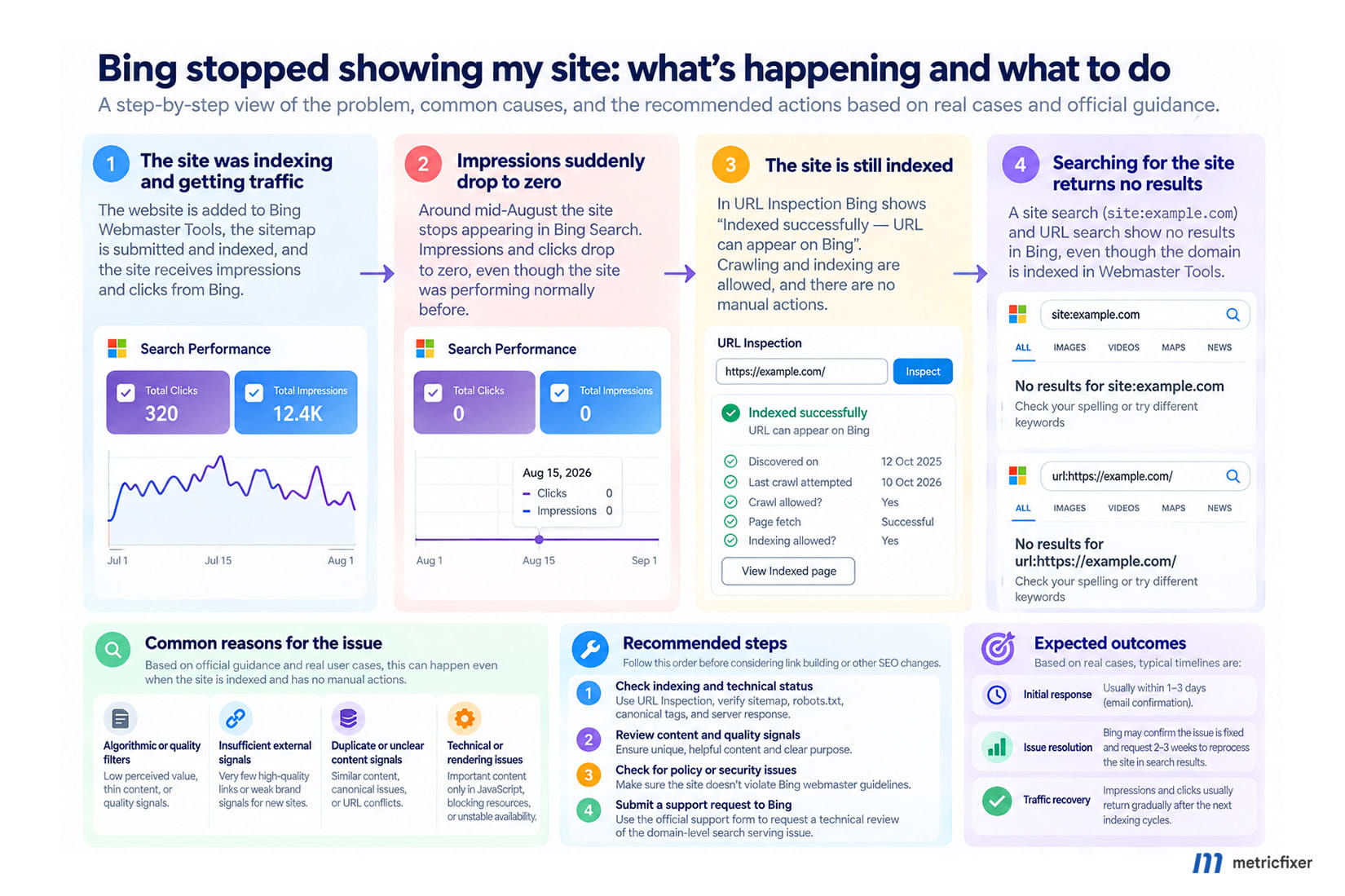
1. Save the report and establish the scope
Export the daily Bing data before making changes. Record the property, selected source, filters, dates, and last available day. Compare a period before the decline with one after it. Check whether impressions disappeared across the site or only for particular pages and queries.
Use the Web source for a conventional web-search check, where available, and inspect the combined total separately. Bing's Search Performance documentation distinguishes traffic sources and says the Keywords and Pages tables cover Web traffic rather than every experience included in the overall totals. A table and a chart can therefore describe different slices of activity.
Record changes made around the start: a deployment, hosting interruption, domain move, security rule, new publishing integration, or a large batch of pages. Do not change several things at once merely to see whether the graph moves. That makes the original problem harder to reconstruct.
2. Inspect more than the homepage
Choose a small representative set: the homepage, a main content category, an older article that previously received impressions, and a recent article. Enter each exact URL into URL Inspection.
For the stored result, save the reported index status, last crawl, fetch outcome, and whether crawling and indexing are allowed. Then run the live test and examine the returned page. Bing's URL Inspection documentation explains that the tool separates index information, SEO findings, markup, and the live fetch.
The distinction matters. A green indexed result describes the information Bing reports about that URL. A successful live fetch says the tool can currently retrieve it. Neither is a site-wide health certificate. A minor missing image alt notice should be fixed appropriately, but it is not evidence explaining a domain-wide disappearance.
3. Check site-level controls and actual access
Use Site Explorer to examine indexed, error, warning, and excluded URLs, opening the reasons rather than treating all exclusions as penalties. An intentionally excluded account page is different from an unexpectedly excluded article. Record guideline-related findings where the interface provides them.
Also check Block URLs for active owner-requested removals and the Notifications Center for crawl, indexing, or malware messages. An accidental removal request is a much more specific lead than a generic link recommendation.
Ask the person managing the site to inspect robots.txt, HTML robots directives, the X-Robots-Tag response header, redirects, and canonical destinations. A canonical identifies the preferred version of a page; an unexpected one can point attention to the wrong URL. Look at the returned content, not only a 200 status: an error or challenge screen can also be delivered with a successful-looking status code.
Review server and security logs for the period of the decline, especially denied requests, rate limiting, server failures, and timeouts. Bing documents crawl alerts involving access, DNS, and connection problems. When identifying crawler requests, do not trust a familiar User-Agent alone: Microsoft's Bingbot troubleshooting guidance recommends verifying the crawler's identity.
Make narrow, tested security exceptions where justified; do not disable site protection wholesale. For the difference between crawl restrictions and indexing controls, see our related guide to robots.txt, canonical tags, and noindex.
4. Reproduce the public search problem
Check the domain, homepage address, and a distinctive site or article name directly in Bing. These are illustrative queries; replace the example values with your own:
site:example.com
url:example.com
"Your distinctive site name"
Bing itself suggests the url: operator in its missing-index guidance. When its public result conflicts with URL Inspection, preserve both observations rather than declaring either one a complete account of the index. An unsuccessful operator search is supporting evidence, not a standalone certificate of a ban.
Record the date, query, market or location setting, and whether you were signed in. Repeat a surprising result in a clean browser session. If brand searches return only external profiles, note that, without assuming you have tested every possible query or market. Microsoft's explanation of search results describes crawling, indexing, and ranking as separate processes and identifies contextual settings that can influence results.
5. Choose the next step from the evidence
| Observed situation | Best next action |
|---|---|
| Bing cannot fetch pages or detects an unwanted indexing block | Fix the specific fault, validate the response, and notify Bing of relevant changes. |
| Pages are new or discovered but not yet indexed | Review discovery, internal links, content value, and submission processing. Do not describe this as a confirmed site-wide restriction. |
| The site appears in search, but gets few impressions | Investigate demand, query relevance, page usefulness, and competition. Build authority as a longer-term activity. |
| Representative pages are reported indexed, yet repeated public checks fail and impressions remain absent | Submit the discrepancy to support with evidence, while continuing targeted technical and content checks. |
| The evidence is incomplete or contradictory | Collect the missing export, URL result, or log sample. Do not replace missing evidence with a backlink theory. |
6. Keep submission tools in their proper role
A sitemap is an inventory. IndexNow is a notification that content was added, changed, or removed. Neither is a guarantee that a URL will be indexed or displayed. The IndexNow FAQ explicitly leaves crawling and indexing decisions to the receiving search engine.
Check acceptance responses, URL accuracy, and actual processing rather than relying only on a plugin's green status. Continue normal notifications for genuine changes. If support asks for specific URLs to be resubmitted, follow that instruction; do not repeatedly submit the entire unchanged site as an attempted reset. Bing's URL Submission guidance states that repeated manual submissions do not accelerate indexing.
How to contact Bing support with useful evidence
Use the official Webmaster Support route for the verified site. The useful message is not simply that traffic is low. Explain the observable discrepancy: inspection reports indexing, public checks do not return the site, and the change is visible in the performance history.
In the anonymized case, the owner used Bad Search Result → Other. The form led to a Copilot conversation and an Issue still not resolved? control. Marking the issue unresolved led to a support request and an email with a case reference. That is a documented route from this case, not a promise that every account will present identical categories or controls.
A chatbot can help summarize a problem, but a generated explanation is not evidence that an engineer has reviewed the domain or that a particular restriction exists. Look for a submitted request and case reference, rather than treating conversational reassurance as the completion of escalation.
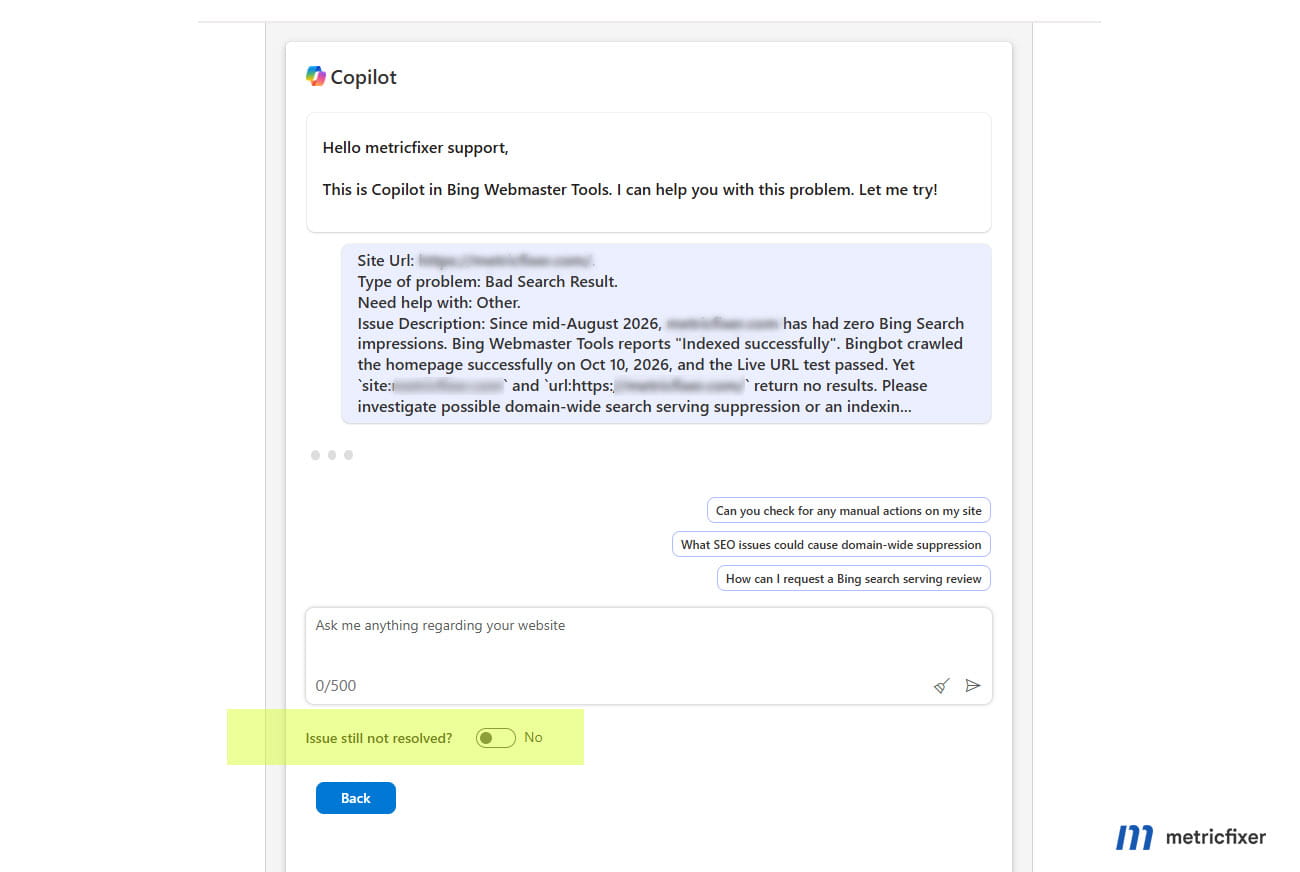
A short support message
The following template fits within 500 characters before you replace its placeholders. Recheck the length after inserting your domain and dates, and remove any claim you have not verified.
Since [date], example.com has shown zero Bing impressions. URL Inspection reports the homepage as indexed, with a successful crawl on [date]; the live test also succeeds. Yet domain and exact-URL searches return no results. Please investigate this discrepancy and confirm whether a technical, quality, policy, or reporting issue is involved. Screenshots and affected URLs are available.Keep an evidence packet ready: before-and-after performance exports, inspection and live-test results for several URLs, public-query screenshots, relevant site-level findings, and a short change history. Give support the real domain and complete evidence privately. Anonymization is for publication, not for preventing support from identifying the affected site.
If the reply only repeats general guidance, ask which observation explains the disappearance, whether specific URLs or practices require correction, and how to verify that the reported resolution has taken effect. Support may not disclose internal signals. That limitation does not make a generic backlink recommendation a confirmed root cause.
Why GA4 sessions and Bing clicks may disagree
The most tempting conclusion in the case was also the easiest to overstate: GA4 began showing bing / organic, so Bing must have restored the site. The entries were encouraging, but they did not settle the question.
GA4's session-scoped traffic-source dimensions describe the attribution of sessions on the website. Bing's report describes impressions and clicks recorded across its search experiences. These are different measurements. Two GA4 sessions are not automatically two independently verified clicks in Bing Webmaster Tools.
The supplied analytics screenshot showed nine sessions attributed to Bing in the period ending October 17, including two on October 15. It also showed zero engaged sessions and an average engagement time per session of two seconds. Google's engagement documentation distinguishes engagement measures from the mere existence of a visit. Those short interactions are not proof of bots, and they are not proof of valuable organic traffic either.
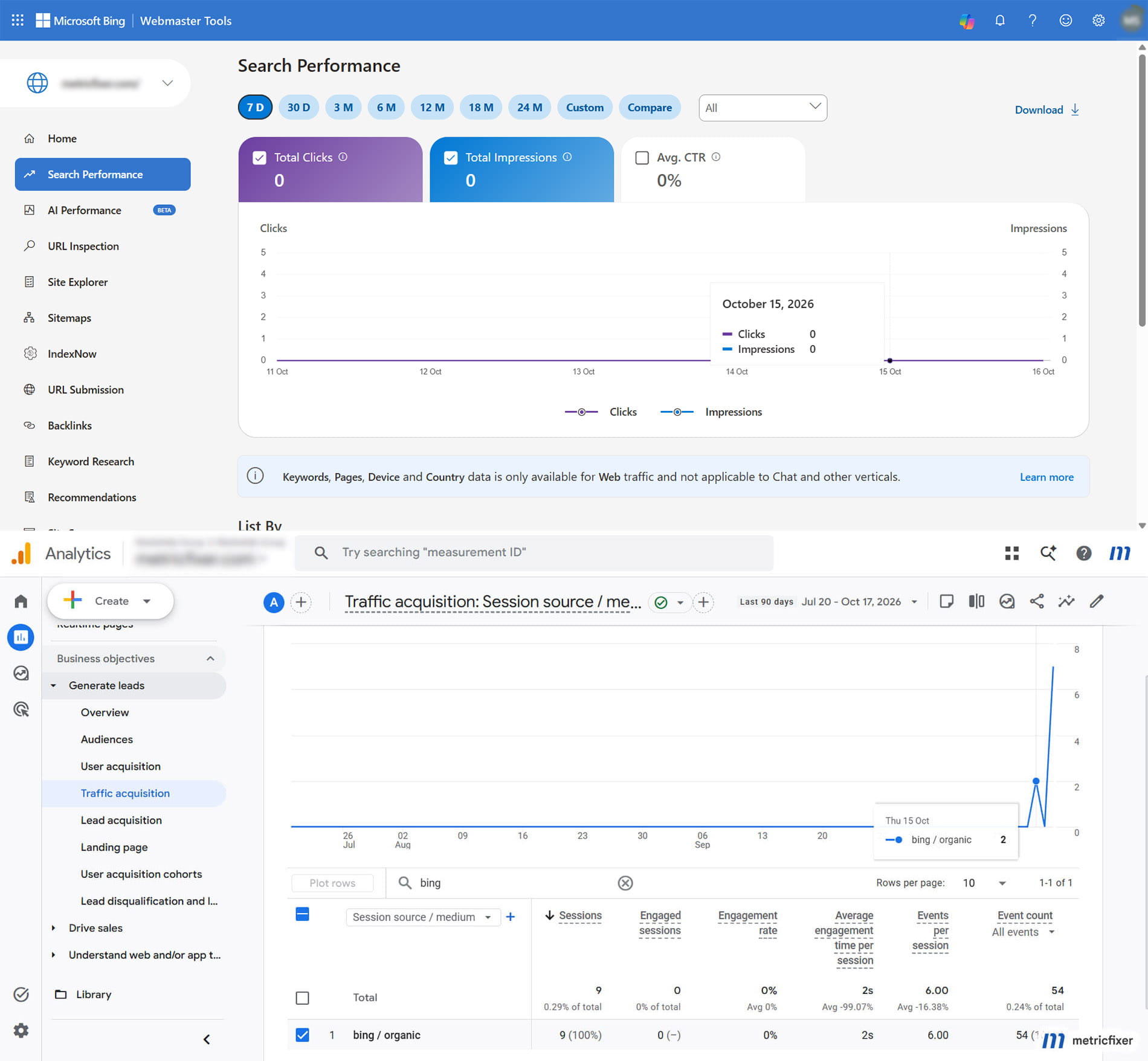
That date difference matters. The Bing screenshot cannot establish the absence of activity for a later day that is not visible in it. At the same time, a date mismatch does not explain away every discrepancy: October 15 appears in both records and still requires investigation.
Start by aligning the property, completed dates, filters, and relevant time-zone settings. Then check the landing pages, recorded entry-page referrers, campaign parameters, and any known owner or agency test visits. Google's traffic-source tagging documentation explains how campaign tagging contributes to attribution. A source label alone is not a record of the exact search result a visitor clicked.
Allow for processing differences, but do not claim a particular reporting delay caused the gap unless you can demonstrate it. Similarly, do not declare the sessions to be support staff, crawlers, or spam without evidence. If entry-level data was not collected or retained, the aggregate screenshot cannot reconstruct it later.
The strongest recovery evidence is a combination: relevant URLs reappear in ordinary public searches, Bing's completed reporting periods show visibility again, and analytics records plausible landing visits over time. Keep AI citation metrics separate from clicks and sessions; Bing's AI Performance report measures another kind of visibility.
What to do after support says the issue is resolved
Save the response and case reference, but keep monitoring. A statement that an issue is resolved is meaningful support correspondence; it is not a substitute for checking public results. Nor does a closing paragraph linking to the guidelines prove a particular violation.
In this case, the two-to-three-week estimate applied conditionally to sites needing crawling or indexing. It should not be presented as a universal Bing recovery deadline, especially when the inspected homepage was already reported indexed. Likewise, the relatively quick reply here does not establish a support response-time guarantee.
Use a small watch list rather than repeatedly searching every page. Check the homepage, important categories, and a few representative articles. Record public results and the newest completed reporting date. A single returning URL is progress, not complete recovery; a returning impression is not necessarily restored rankings.
As an operational routine, make an initial check after the response and then review progress weekly. If a timeframe supplied for your case passes without corroborating evidence, follow up with the case reference and fresh observations. Report what is still missing instead of opening multiple indistinguishable requests.
Do not freeze necessary security fixes or corrections while waiting. Fix demonstrated defects, document what changed, and avoid unrelated mass rewrites, domain moves, or link purchases justified only by the warning. For an August decline, investigate what existed in August: a page first published in October cannot explain the initial event.
How a young site can earn links without buying rankings
Rejecting panic purchases does not mean ignoring promotion. A useful publication still needs to reach people who might read, recommend, or cite it. Treat that as an ongoing publishing task with its own objectives, not as payment to unlock a search engine.
For a young content site, start with one resource that offers something worth referencing: an original test with a clear method, a small reusable tool, a maintained comparison, a downloadable checklist, or a well-documented case that answers a recurring question. Give it a stable page, a clear explanation, sources, and an obvious way to use the result.
Then introduce it selectively to relevant authors, communities, and practitioners. Explain the specific problem it solves. Where someone already uses your findings, request accurate attribution without demanding a particular anchor or an unqualified link. Maintain genuine organization, project, and partner profiles because they help readers identify you, not because a famous platform automatically transfers authority.
A practical four-week cycle is to choose one useful resource, improve its evidence and usability, share it with a small relevant audience, and review the response. Measure useful referral visits, voluntary citations, returning readers, and qualified enquiries. A quota of newly created links is a poor substitute for those outcomes.
Paid distribution can also be legitimate: a clearly disclosed newsletter placement or sponsorship may reach the right readers. Buy the exposure on its merits, with appropriate link qualification, not a claim of guaranteed search-ranking influence. A commission paid to an outreach specialist does not by itself make an earned editorial link purchased; the relevant question is what the placement agreement actually requires.
Avoid package offers built around private networks, guaranteed followed links, rented authority, or a promise to clear a Bing warning. Also avoid indiscriminate cleanup of unfamiliar links. Bing removed its disavow feature in 2023, explaining that it can discount unnatural links. A few unsolicited links are not a reason to invent a removal campaign.
For the wider content and discoverability foundations, our guide to making a website indexable, usable, and recommendable separates technical availability from the usefulness and credibility that readers need.
The checklist to use before spending money
- [ ] I have saved the original graph, warning, filters, and daily export.
- [ ] I know whether this is a new-site discovery problem, an ordinary visibility decline, or a reproducible tools-versus-search discrepancy.
- [ ] I have checked several URLs, not just the homepage, using both stored inspection results and live tests.
- [ ] I have reviewed site-level exclusions, active removal requests, notifications, and relevant technical or content changes.
- [ ] I have dated public-search examples without treating a search operator as conclusive proof of a penalty.
- [ ] I have a registered support case when the discrepancy remains unexplained.
- [ ] I have separated GA4 sessions, Bing clicks and impressions, and AI citations, and aligned their reporting windows.
- [ ] Any proposed link-building spend has a legitimate audience objective and is not being sold as an unverified cure.
Do not make clearing the warning your main goal. Make the problem understandable. Technical evidence should drive technical fixes, policy evidence should drive policy corrections, and a sustained publishing strategy should drive earned recommendations.
Methodology and sources
Research cut-off: October 18, 2026. This is an editorial investigation and practical diagnostic guide, not a controlled experiment or a prevalence study.
The anonymized case is based on original screenshots and support correspondence supplied for this investigation. The record distinguishes dashboard observations from the owner's account of the sitemap and IndexNow history. No comprehensive historical server-log or content audit was available. The project name and account identifiers are withheld from the published case. It is a documented troubleshooting experience, not a randomly selected sample.
Public research used targeted searches for Bing's inbound-link warning, indexed-but-missing sites, abrupt impression losses, and support outcomes. Selected first-person reports were checked for dates, follow-up statements, alternative explanations, and the difference between an author's suspicion and an established result. Localized copies of the same discussion were treated as one source. Public reports are self-selected and cannot establish how common the problem is.
Microsoft's guidelines, search explanations, and tool documentation provide the policy and product basis. IndexNow documentation explains what submission does and does not establish; Google Analytics documentation explains the measurement distinctions. Links appear next to the relevant discussion rather than in a repeated technical bibliography. Forum replies, independent advisers, and automatically generated Q&A answers are not treated as Bing engineering findings. The BlackHatWorld discussion is used only as evidence of how people interpreted the warning, not as advice to follow.
The reviewed material does not identify a common internal Bing cause, prove an industry-wide August incident, or establish that insufficient backlinks triggered the anonymized case. Current documentation is also not an archived record of the exact policy wording at the time the decline began. As of the cut-off, support had reported resolution, but the available record did not yet demonstrate sustained recovery.
This article provides SEO and operational information, not a guarantee of indexing, rankings, traffic, support escalation, or recovery. metricfixer is not affiliated with Microsoft, Bing, Google, or the third-party publishers and communities mentioned. Product interfaces and policies may change. Apply changes to your site's actual configuration, preserve security controls, and distinguish documented findings from hypotheses.