
Published Oct 23, 2026
How to Track and Attribute ChatGPT and AI Traffic in GA4
Learn how to attribute identifiable AI visits in GA4 using the native AI Assistant channel, referrers, UTM parameters, and carefully defined custom groups. Understand where app handoffs, dark traffic, and automated requests limit what the numbers can prove.
Category: Analytics & Conversion Tracking · By metricfixer Expert Team
A visit from ChatGPT is not always a Referral in Google Analytics 4, and a visit influenced by AI is not always identifiable at all. This guide explains how to measure ChatGPT and other AI sources in 2026: the native AI Assistant channel, referrers, UTM parameters, mobile app handoffs, custom channel groups, dark traffic, and the difference between a visitor and an automated fetch.
Practical default: start with GA4's native AI Assistant channel, then audit session sources for identifiable visits outside it. Preserve real acquisition signals, keep uncertain and paid traffic separate, and never turn unexplained Direct traffic or crawler requests into invented AI conversions. Documentation and published observations were reviewed on October 22, 2026. A metricfixer document-request observation was added on October 23, 2026.
Contents
Executive summary
The starting point changed on May 13, 2026. Google's Analytics release notes introduced native AI Assistant traffic measurement: a recognized AI referrer can produce the medium ai-assistant, the campaign (ai-assistant), and the AI Assistant default channel. Advice that all AI traffic must first appear under Referral is now incomplete.
That update improves classification, not visibility into every AI interaction. A recommendation without a click, a copied untagged URL, or a browser handoff without an acquisition signal does not become identifiable just because a new channel exists. Meanwhile, Google's default-channel definition explicitly excludes Google AI Overviews and AI Mode from AI Assistant.
The useful distinction is between recorded AI-attributed acquisition and AI influence. The first is supported by collected source information. The second can include a buyer who reads an AI recommendation, searches your brand elsewhere, and visits days later. They belong in related analyses, not in one supposedly exact counter.
Use the native channel as a baseline, a carefully defined custom group for additional identifiable sources, and separate evidence for surveys, search visibility, and automation. A channel label is neither proof of a human visitor nor proof that AI caused a sale. For the underlying terminology, see metricfixer's guide to GA4 medium values and AI classification.
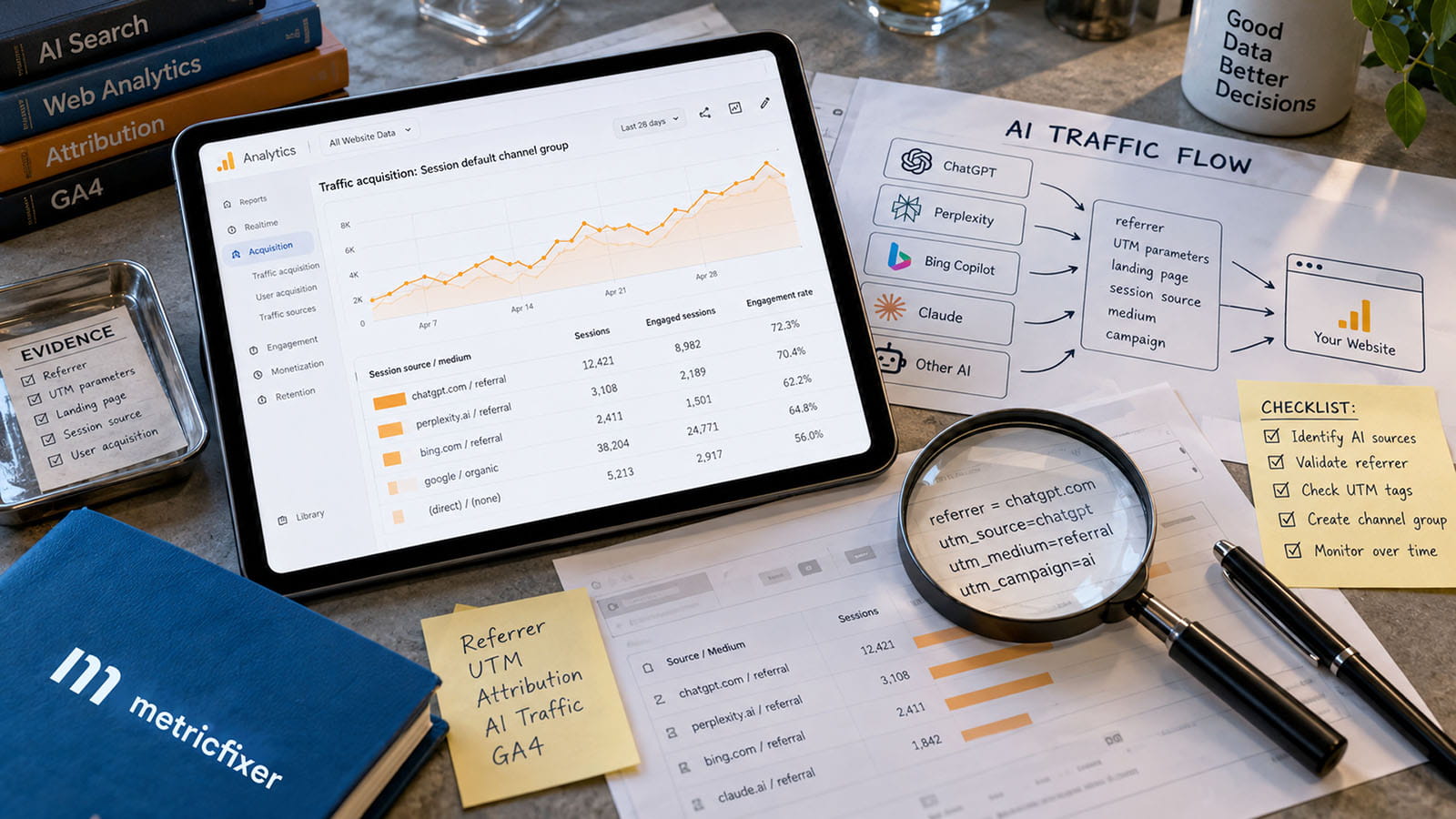
How referrers reach GA4
An AI service does not send a complete attribution record to your website. Several different signals may survive the journey, and each answers a different question.
| Signal | Where to inspect it | What it tells you |
|---|---|---|
Referer request header | The initial document request and edge/server logs. | The referring information supplied for that HTTP request, if any. The header's spelling is intentional. |
document.referrer | The landing page's browser context. | The referrer exposed to the loaded document, possibly only an origin or an empty string. |
page_referrer and page_location | The actual GA4 event payload. | The referrer and destination URL collected by Analytics, including any implementation overrides. |
| Session source, medium, and channel | Processed acquisition reports. | The reporting result after acquisition processing, session rules, and channel classification. |
Google's GA4 configuration reference documents that page_referrer defaults to document.referrer, while page_location defaults to the document URL. An HTTP log and a GA4 report can therefore disagree without either being fabricated: they observe different stages.
For an ordinary HTTPS link from a web-based assistant, the browser may send an origin such as https://chatgpt.com/. The common strict-origin-when-cross-origin policy retains the origin across HTTPS sites but removes the source path and query. That can preserve platform attribution without exposing a conversation URL or prompt. A stricter policy can remove the referrer entirely. These are browser referrer-policy rules, not a promise that every assistant surface behaves identically.
rel="noreferrer" suppresses referring information. rel="noopener" does not itself do so, and opening a new tab does not inherently make a visit Direct. MDN documents the distinction between noreferrer and noopener. Removing sensible security attributes is not an attribution fix.
Nor can your destination page force an external application to provide information it never sent. Google's referrer best-practices guidance warns that incoming behavior can change outside the receiver's control. Inspect the real navigation instead of assuming that a desktop result also describes iOS, Android, or an embedded browser.
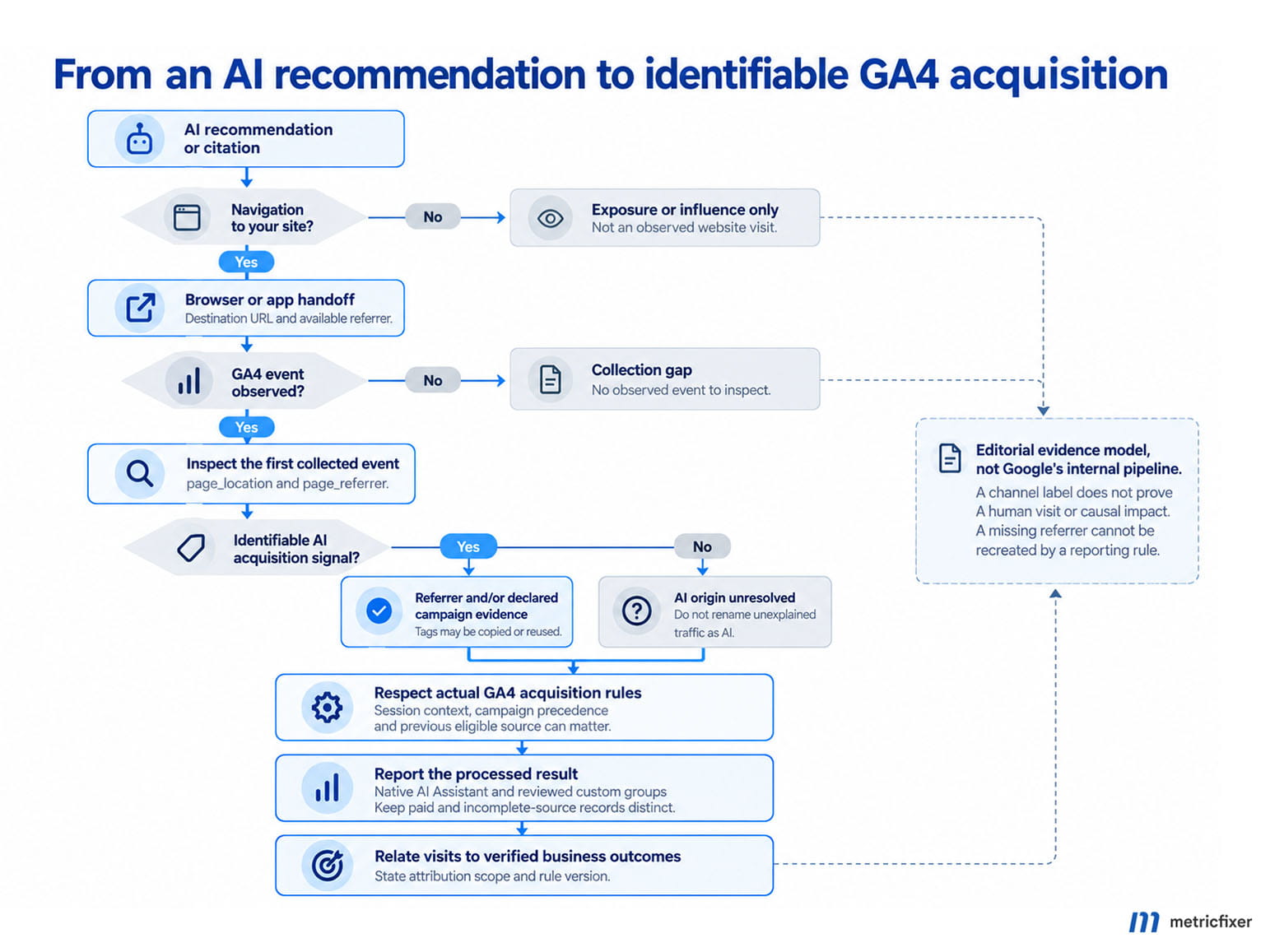
Text workflow: AI recommendation → possible click or later visit → browser/app handoff → landing URL and available referrer → consent-aware measurement → GA4 acquisition processing → channel reporting. A missing click, missing event, or missing source creates a different measurement gap.
Direct, Unassigned, and missing visits are different problems
Google defines (direct) / (none) as traffic without a clear referral source. It is not a reliable label for people who deliberately typed your address, and it is not an AI category waiting to be renamed.
| Arrival or measurement condition | Possible reporting outcome | Correct interpretation |
|---|---|---|
| A recognized AI referrer reaches GA4 without conflicting campaign information. | Native AI Assistant classification. | GA4 has an identifiable AI acquisition signal. |
| An assistant source survives, but its medium is missing or does not match a channel rule. | A source such as chatgpt.com with (not set), potentially Unassigned. | Some source evidence exists; channel classification or campaign completeness is the issue. |
| An unrecognized assistant domain survives as a referrer. | Referral or another applicable classification. | A reviewed custom rule may categorize existing evidence. |
| No referrer or campaign signal survives. | Direct, or an existing/prior source under applicable attribution rules. | The immediate AI origin is not recoverable from this visit's missing signal. |
| A click returns during an already active session. | The session can keep its original source. | A new click is not necessarily a new acquisition session. |
| No Analytics event is collected. | No observed GA4 visit, rather than an extra Direct visit. | Investigate collection separately from source classification. |
These are diagnostic possibilities, not guaranteed outputs for every configuration. Google's campaign-processing documentation states that encountering a new campaign does not start a new session. It also describes source precedence under which a later direct visit does not override an existing referrer. Inspect the session boundary before declaring a test broken.
Common loss points include copied links, native-app handoffs, redirectors that discard query parameters, a router that cleans the URL before the first event, and tags that replace the genuine page_referrer. Redirects are not automatically harmful; the question is what each hop preserves.
Check exclusions too. Adding ChatGPT or another assistant to unwanted referrals does not create an AI channel. It suppresses the referrer as an acquisition source. An unnecessary ignore_referrer implementation can undermine the very measurement you are trying to improve.
Consent and blockers need their own diagnosis. A tag that never runs produces no observed event; a visit that is collected without usable source data is a different case. Consent-mode behavioral modeling, where available, estimates unobserved behavior. It is not a tool for recovering the missing ChatGPT referrer of a particular visitor. See metricfixer's Direct, (not set), and Unassigned diagnostic guide for a wider investigation.
What UTM parameters in AI links actually prove
A UTM parameter travels inside the destination URL, independently of the referrer. That makes it useful when an application opens an external browser without a referring page. But the tag must still be present when measurement reads the landing URL.
ChatGPT's source-only tags are useful, but incomplete
utm_source=chatgpt.com is an observed ChatGPT link pattern, including in Profound's October 2026 link research. Do not assume every generated link, citation, product card, app, or browsing mode includes it. A source-only tag is also not a complete campaign taxonomy: it does not specify a medium or campaign.
Google's manual-tagging documentation warns that missing campaign parameters can produce (not set). Inspect actual source/medium pairs rather than assuming that a ChatGPT source always has referral or ai-assistant as its medium. A custom group can organize incomplete records; it cannot supply evidence that was never collected.
Tag links you control, not recommendations you merely hope to receive
For an assistant, custom integration, or distribution surface your organization controls, generate destination URLs deterministically. Use an allowlisted source, a real traffic type, and a campaign that identifies the owned activity. For example:
https://www.example.com/demo?utm_source=owned_assistant&utm_medium=referral&utm_campaign=product_advisor_2026This is an illustrative owned-assistant campaign, not a way to label all public ChatGPT recommendations. Track it separately from independently earned assistant citations. Asking a model to append tags may help a controlled workflow, but the emitted URL still needs validation; a prompt is not an enforcement mechanism.
Use the metricfixer UTM naming guide to keep source and medium consistent. Avoid inventing a medium such as ai and assuming GA4 understands it. The documented native channel uses ai-assistant; manually assigning a recognized medium is still a declared label, not verification of the underlying journey.
A tagged URL is not proof of the immediate click origin
Suppose someone copies a ChatGPT-tagged link into an email. The next recipient can carry the same UTM value even though the immediate navigation came from email. Tags can also be invented, reused, or spoofed. Referrers and UTMs should therefore be treated as acquisition evidence, not authentication.
Do not add AI UTMs to internal links, append them to every landing page after arrival, or overwrite existing campaign values to make a dashboard cleaner. Preserve explicit paid campaign attribution. Do not put prompts, email addresses, or customer details into utm_term, utm_content, or diagnostic URLs.
Find AI traffic in your existing GA4 reports
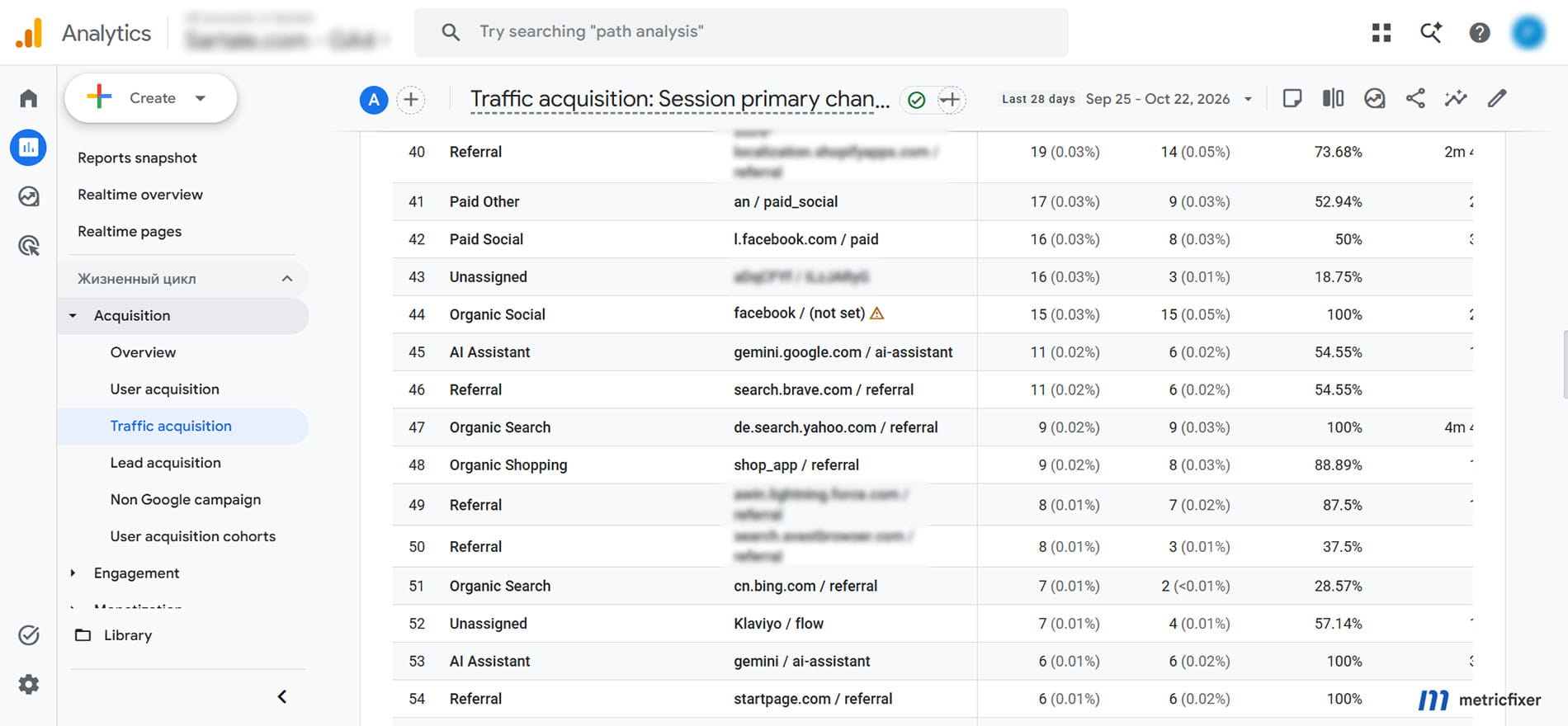
Start with Reports → Acquisition → Traffic acquisition. Google's Traffic acquisition documentation explains that this report covers both new and returning visitors; navigation can differ in customized report collections.
- Select Session default channel group explicitly, rather than assuming the currently selected primary or custom group is Google's default. Review the AI Assistant row.
- Add or switch to Session source / medium. Inspect the assistants behind the total and the exact medium values.
- Remove the AI-channel restriction and search those sources across all channels. Otherwise, you cannot discover identifiable AI sources sitting in Referral or Unassigned.
- Create a saved report or exploration with session source/medium, landing page, sessions, engaged sessions, selected key events, and purchase revenue where relevant.
There is another useful 2026 update: Google introduced Source Group on June 11, consolidating source variants and including platforms such as ChatGPT and Perplexity. Its release notes describe retroactive population. Where available in your reporting surface, compare this normalized view with the original source/medium values. Source Group, Source Platform, and a channel group are different dimensions; none reconstructs a referrer that was never collected.
Use three clearly named views: native AI Assistant, additional identifiable assistant sources, and uncertain or incomplete source records. They can be reconciled, but the native number should remain visible so that changes in your rules do not masquerade as platform growth.
Scope matters. First-user dimensions describe the user's original acquisition; session dimensions describe session acquisition; event-scoped attribution can allocate key-event credit differently. A returning customer can have an older first-user source, an AI-attributed session, and a purchase attribution result that credits several interactions. These are not interchangeable reports.
Maintain an AI-platform domain list
A small, reviewed list is safer than matching every source containing ai or gpt. The following hostnames are a starting registry, not Google's complete recognition list and not a guarantee that a platform sends a referrer from every surface.
| Platform | Hostnames to inspect | Boundary to preserve |
|---|---|---|
| ChatGPT | chatgpt.com; historical chat.openai.com | A source tag and a real referrer are different evidence. Do not classify all of openai.com as assistant clicks. |
| Perplexity | perplexity.ai, www.perplexity.ai | Review additional domains and aliases before adding them; crawler infrastructure is a different inventory. |
| Gemini | gemini.google.com; historical bard.google.com | Do not expand the match to all Google traffic. |
| Microsoft Copilot | copilot.microsoft.com, copilot.com | Do not relabel every Bing or Microsoft referral as Copilot. |
| Claude | claude.ai | The referring product is not necessarily the underlying model used by an intermediary. |
| Grok | grok.com | Generic x.com and t.co traffic does not establish a Grok interaction. |
| DeepSeek | chat.deepseek.com | Prefer the observed chat hostname over a broad company-domain assumption. |
| Mistral's assistant | chat.mistral.ai | Keep the hostname stable in historical reporting even when product naming changes. |
The major-source examples are supported by AI Rank Lab's published source observations and Google's named assistant examples. The additional product hosts can be checked against DeepSeek's chat service, Grok's product page, and Mistral's account-migration guidance, which retains chat.mistral.ai. A valid product hostname establishes where a service lives, not how it behaves on a particular click.
Expand the registry for additional assistants only after checking your evidence. Record the source string, platform, observation date, referrer-versus-UTM origin, medium, test surface, and approval owner. A bare alias such as chatgpt is not automatically equivalent to a verified hostname; add it when your campaign inventory or collected data supports the mapping.
Build custom AI channel groups without rewriting the evidence
Custom groups remain useful for historical referrals, additional platforms, and incomplete tags. They change how available data is grouped, not what the original visit contained.
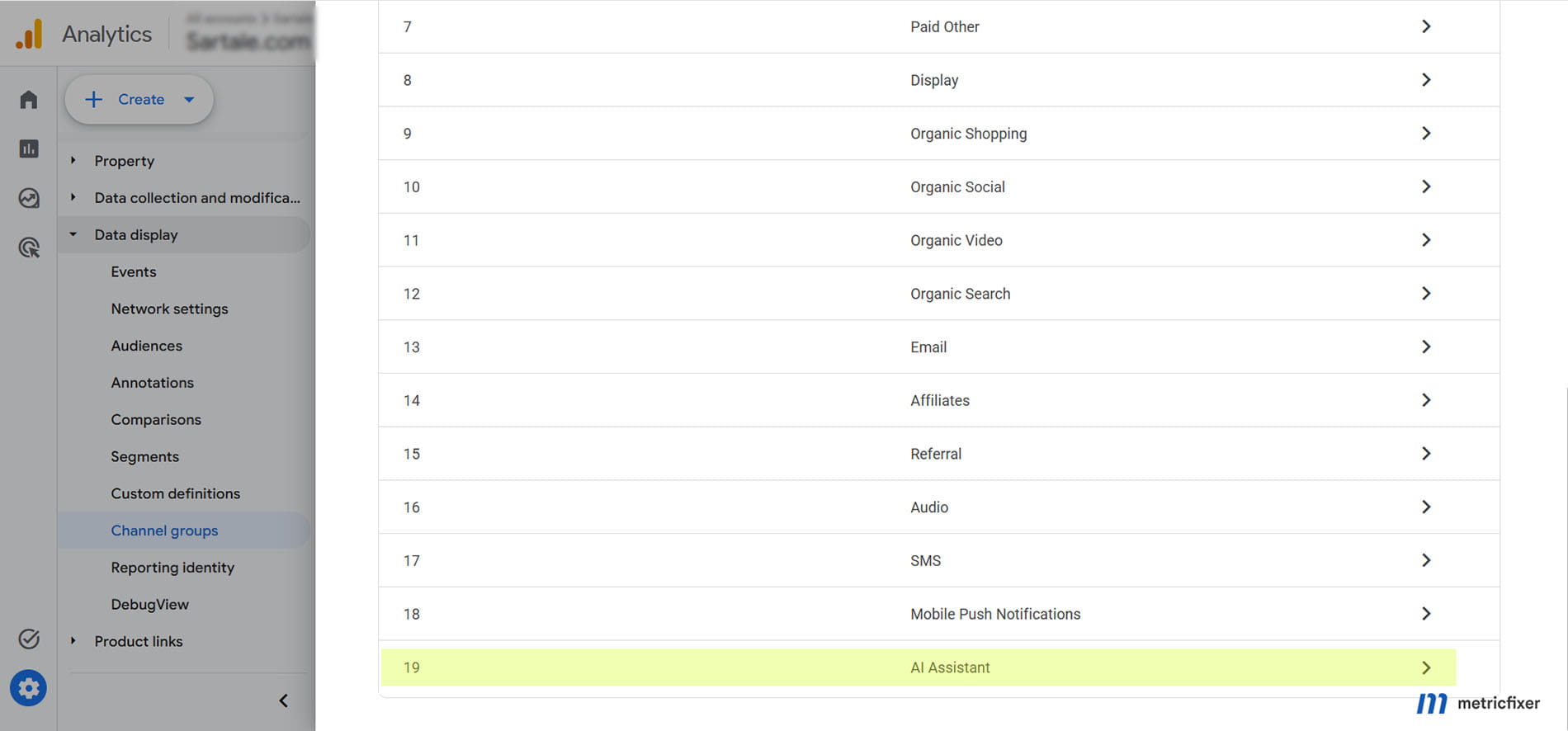
In Admin → Data display → Channel groups, copy a suitable group and name it AI acquisition audit v1. Editor access or higher is required. Google's custom-channel documentation confirms that the first matching channel wins, so ordering is part of the definition.
Use separate rules for observed and incomplete acquisition
The following is a proposed reporting design, not Google's internal taxonomy. Keep verified paid campaign rules ahead of broader source rules. Edit the copied AI channel rather than leaving two overlapping AI channels whose names appear interchangeable.
Channel: AI Assistant - observed
Match either condition group:
A. Medium exactly matches ai-assistant
OR
B. Source matches an approved hostname pattern
   AND Medium matches ^(referral|app|link)$

Channel: AI source - medium unknown
Source matches an approved hostname pattern
AND Medium exactly matches (not set)

Keep other channels, including Direct and Unassigned.
Place these AI rules before general Referral rules.
Keep verified paid-campaign rules ahead of broader AI-source rules.
The second channel is deliberately not called unpaid AI traffic. A missing medium cannot establish whether a visit was earned, paid, or tagged incorrectly. Validate how (not set) matches in your report and rule interface before relying on that branch.
For the Source condition, use the following patterns as alternative matches. They target source hostnames, not complete referrer URLs or a combined source/medium string:
Pattern A
^(www\.)?(chatgpt\.com|chat\.openai\.com|perplexity\.ai|gemini\.google\.com|bard\.google\.com)$

Pattern B
^(www\.)?(copilot\.microsoft\.com|copilot\.com|claude\.ai|grok\.com|chat\.deepseek\.com|chat\.mistral\.ai)$
Paste each regex without its label. Where a rule editor requires separate condition groups, duplicate the medium constraint: (Pattern A AND permitted medium) OR (Pattern B AND permitted medium). Do not create an OR branch that accidentally bypasses the medium check. Use lowercase, reviewed source values; add verified aliases explicitly.
Anchors and escaped dots matter. The pattern must reject chatgpt.com.example.net, notchatgpt.com, and unrelated names containing ai. Applying a hostname pattern directly to https://chatgpt.com/ will also fail, correctly: that is a URL, not the Source value the pattern was designed for.
| Source / medium example | Expected result in this proposed group |
|---|---|
chatgpt.com / ai-assistant | AI Assistant - observed. |
www.perplexity.ai / referral | AI Assistant - observed. |
chatgpt.com / (not set) | AI source - medium unknown, after the placeholder match is verified. |
chatgpt.com / cpc | Not captured by these AI rules; retain the applicable paid classification. |
chatgpt.com / email | Not captured; investigate the campaign's actual distribution. |
google / organic or bing / organic | Organic Search, not automatically AI. |
chatgpt.com.example.net / referral | Not captured. |
Some historical assistant rows may have another medium, including a deliberately assigned organic. Review them separately and add a versioned exception only when the campaign or collection evidence justifies it. Do not broaden the default rule to make a historical chart look smoother.
Historical reclassification is not historical recovery
Google documents that custom-group edits apply to underlying data in reports and explorations. Selecting a group as the property's primary channel group instead populates that primary dimension under the new criteria going forward. Keep a separate audit group first, record rule changes, and do not silently replace established dashboards.
A historical chat.openai.com / referral row can be regrouped because the source exists. A historical record with no identifiable AI signal cannot. Likewise, compare periods around the native-channel launch with a consistent source-based definition rather than assuming old Referral totals and new AI Assistant totals form an uninterrupted series.
Test browser, mobile app, and redirect handoffs
A useful test records the route and the evidence, not just whether a source appears in Realtime. Keep the destination constant, use a dedicated test property or clearly documented test segment where possible, and separate fresh-session tests from returns within an active session.
For each assistant relevant to your audience, test a desktop web citation, a mobile-browser citation, the native app's default opening behavior, opening in an external browser, copying and pasting the URL, and any actual redirect or checkout path. Record operating system, browser/app version, date, consent state, clicked link, and final URL. A matrix with empty results is better than a fabricated universal compatibility table.
- Inspect the link before navigation. Distinguish a source citation, generated text link, product card, ad, or link supplied by your own integration. Record which parameters were already in the link, including any deliberately supplied for a test; their survival does not establish who originally added them.
- Inspect the document request. Preserve the browser Network log and check redirects, final query parameters, and the initial
Refererheader where available. - Inspect the first measured event. Check
page_location,page_referrer, consent state, and collection timing. Do not substitute a later page view. - Inspect processed reporting. Check the session source/medium and channel after processing, alongside the active-session state. DebugView confirms collection; it is not the final attribution report.
For a local, read-only browser check on your own test landing page, this snippet prints the path, referring hostname, and the presence of common UTMs without printing their values:
(() => {
  const page = new URL(window.location.href);
  let referrerHost = "(none)";
  try {
    if (document.referrer) {
      referrerHost = new URL(document.referrer).hostname;
    }
  } catch {
    referrerHost = "(invalid referrer)";
  }
  console.table({
    landingPath: page.pathname,
    referrerHost,
    hasUtmSource: page.searchParams.has("utm_source"),
    hasUtmMedium: page.searchParams.has("utm_medium"),
    hasUtmCampaign: page.searchParams.has("utm_campaign")
  });
})();
This sends nothing to Analytics and does not change attribution. Run it on a nonsensitive test page: paths can contain personal information too. It only shows the browser's current state, so use the original request and event payload to diagnose an earlier redirect or URL rewrite.
Native apps are not a single behavior class. A handoff can preserve a tagged URL while losing the referrer; copying an untagged URL can lose both. An in-app browser may also have a different cookie context from the external browser. Test rather than treating all app visits as Direct or all app clicks as recoverable.
metricfixer test: UTM tags survived without a referrer
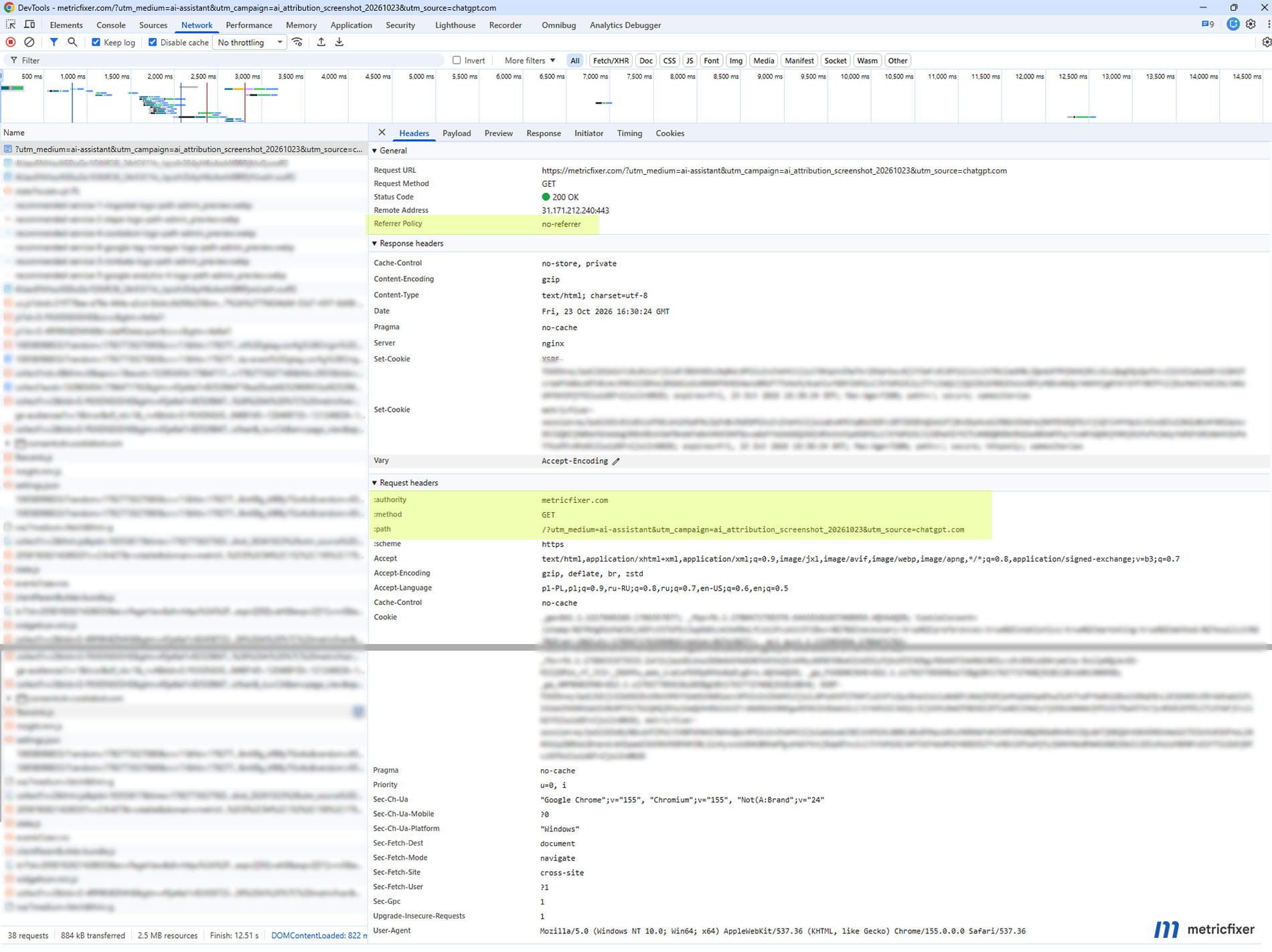
On October 23, 2026, metricfixer tested a deliberately tagged link supplied in a ChatGPT conversation, leading to the site's homepage. Two owner-supplied Chrome DevTools captures show the same document request on Windows: the request overview and the continuation of its headers. The page returned 200 OK, and all three test UTM parameters remained in the requested URL.
The tags were prepared for the test. The link already contained utm_source=chatgpt.com, utm_medium=ai-assistant, and utm_campaign=ai_attribution_screenshot_20261023 before it was clicked. This does not demonstrate that ChatGPT automatically adds those parameters to ordinary citations or assigns that medium to untagged links.
The destination URL shown in the capture was:
https://metricfixer.com/?utm_medium=ai-assistant&utm_campaign=ai_attribution_screenshot_20261023&utm_source=chatgpt.comThe complete Request headers list contained no Referer header. The overview also displayed Referrer Policy: no-referrer, consistent with the policy's documented behavior. These captures do not establish where that policy was set, or that other ChatGPT links, browsers, or apps behave the same way.
What this establishes: a deliberately supplied source tag can reach the website even when the document request carries no HTTP referrer. It does not establish that GA4 received the tags, that the visit became Direct, or that the session was assigned to AI Assistant. Existing Analytics cookies were present, so this was not an empty-cookie browser context; they do not establish whether a GA4 session was still active.
What remains unverified: the first GA4 page_view payload, its actual page_location and page_referrer values, the effective measurement-consent state, and the processed session source/medium and channel. Analytics requests visible in the Network list are not a substitute for inspecting their payloads. The next check is the first relevant event from this same navigation, followed by processed reporting. As Google's campaign-processing guidance explains, a new campaign does not itself start a new session.
What practitioner tests and recent cases actually show
Ahrefs: an AI click can arrive without an AI source
In its February 6, 2025 study, Ahrefs described repeated clicks from Copilot to an obscure page that appeared as Direct in Ahrefs Web Analytics, with similar checks on Mistral and Jasper. Patrick Stox's explanation was straightforward: the analytics system can only use the referrer it receives.
This was an original navigation observation, not a current GA4 compatibility certification. It demonstrates a possible signal-loss mechanism. It does not prove that every present-day Copilot click loses its referrer or establish a percentage of your AI traffic that is hidden.
Analytics Mania: ordering is part of a custom channel rule
Julius Fedorovicius's guide updated May 12, 2026 emphasizes placing a dedicated AI rule above the general Referral rule. That implementation lesson remains useful. Its timing also matters: the guide predates Google's native-channel announcement by one day, so its Referral-first framing should not be treated as the complete current setup.
October 2026: a tagging change can resemble a traffic decline
Profound's updated first-party analysis reports a decline in tagged ChatGPT answers beginning on October 8, a sharper deterioration on October 14, and a recovery to approximately 99% by 06:30 UTC on October 16. Crucially, the percentage describes collected answers with citations that included at least one tagged source link, not the percentage of all visits or all links successfully attributed.
The operational response is to annotate the affected reporting window and compare observed sources, landing pages, and outcomes. Missing UTMs do not automatically mean Direct: a usable referrer may still identify the source. Conversely, a recovered tag does not backfill previously missing acquisition evidence. The study is a dated observation of sampled answers, not an OpenAI guarantee or a site-specific correction factor.
Should AI referrals be combined with Organic Search?
At the acquisition-detail level, keep them separate. A human may use an assistant like a search engine, but that does not make the underlying source, medium, or measurement coverage identical. Rewriting assistant traffic to google / organic, or tagging every assistant link organic, destroys useful distinctions.
A management dashboard may legitimately add a higher-level view called unpaid discovery. Define it as the sum of mutually exclusive Organic Search and reviewed unpaid assistant sessions, while retaining both components. Exclude paid AI campaigns, owned promotional distributions unless explicitly included, and the medium-unknown bucket. Publish the definition beside the chart.
Google Search introduces another boundary. AI Overviews and AI Mode are Search experiences, not the separate Gemini assistant. Their visits remain within the relevant Search acquisition reporting rather than the native AI Assistant channel; the channel definition itself excludes them. Do not turn every google / organic session into an AI visit.
Search Console now adds AI visibility evidence, not a session join
As of the review date, Google's Generative AI performance report for Search documents impressions from AI Overviews and AI Mode, with worldwide rollout noted as August 31, 2026. It can provide page, country, device, and time-based visibility evidence; availability also depends on sufficient impressions.
That is useful, but an impression is not a website session. The documented report does not provide a per-person bridge from an AI display to a GA4 purchase. Align page URLs and dates for aggregate analysis, account for canonicalization and reporting differences, and keep impressions, sessions, and attributed revenue as separate measures. Do not calculate an AI conversion rate by dividing GA4's entire Google organic revenue by those impressions.
Measure dark traffic without inventing attribution
For this article, dark traffic means visits or influence whose true origin is not available in the collected acquisition evidence. An AI recommendation can lead to an untagged copied link, a later bookmark visit, a branded Google search, or a different-device purchase. Those journeys are not all Direct, and some generate no visit.
A practical reporting model keeps three evidence layers side by side. Recorded acquisition covers sessions with identifiable assistant signals. Self-reported discovery records what customers say helped them find you. Visibility and influence indicators cover mentions, citations, AI impressions, and changes in branded demand. None should silently overwrite another.
At lead submission or purchase, ask an optional, neutral question such as How did you first hear about us? Allow multiple answers or an AI-assistant option with an optional platform field. Preserve both the response and the measured acquisition fields in the CRM. A person reporting ChatGPT while GA4 reports Google organic may be describing a different stage of the same journey.
A rise in Direct sessions on deep pages is an investigation lead, not an attribution rule. Email, messaging, browser privacy behavior, untagged campaigns, returning readers, and implementation changes can produce similar patterns. Stronger causal work needs a defined intervention, comparison groups or periods, and explicit assumptions; even then, label the output an estimate rather than repaired session history.
Avoid claiming that a fixed percentage of AI visits is invisible. Also avoid calling the recorded number a mathematically guaranteed lower bound on human AI clicks: forwarded UTMs, spoofed sources, and undetected automation can introduce false positives. The defensible description is the identifiable, recorded slice under the stated rules.
Separate human visitors, AI fetchers, and browser agents
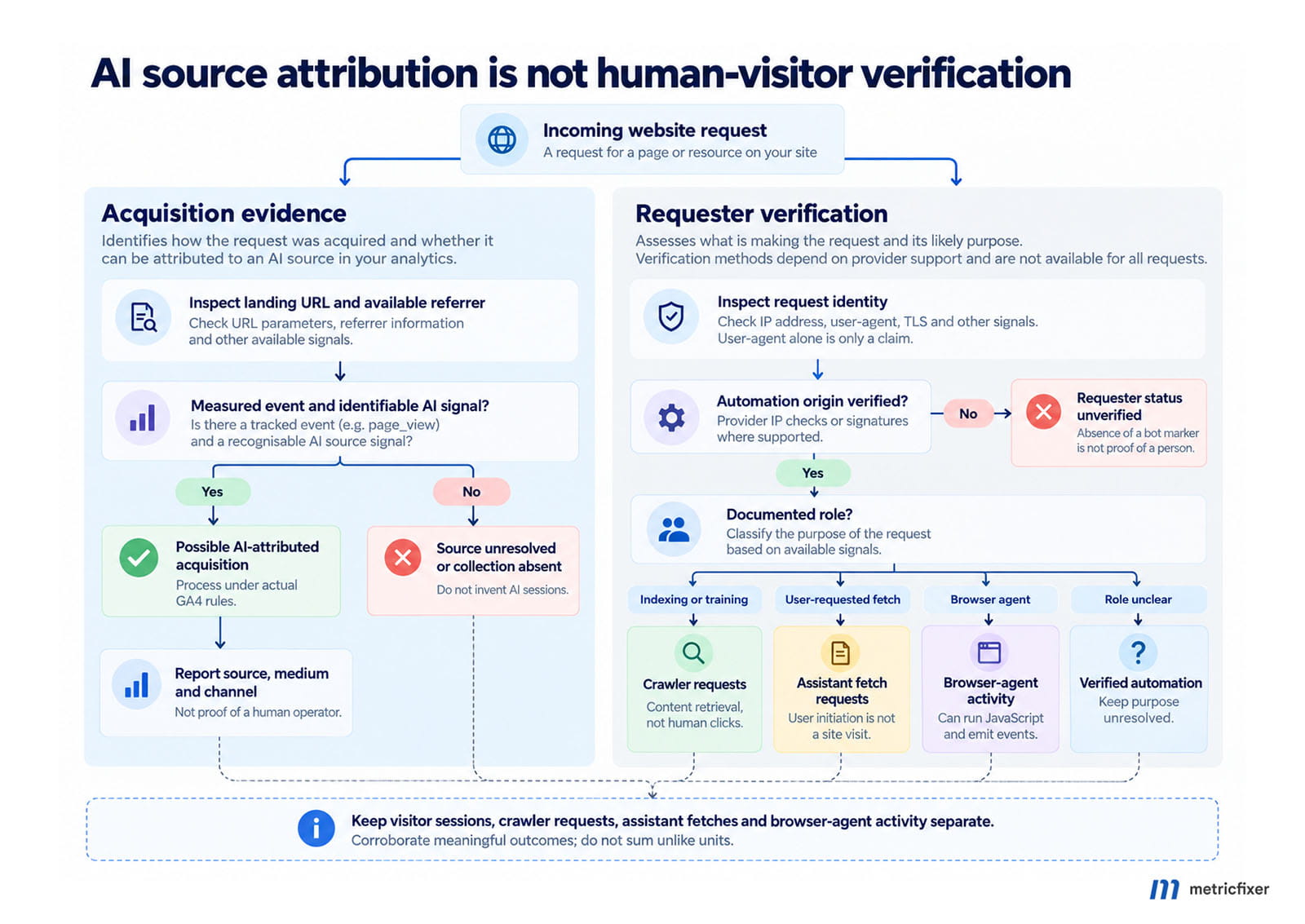
A server request from an AI company is not necessarily a person opening your website. Even an agent with User in its name can fetch a page on someone's behalf without that person visiting it in a browser.
| Activity | Examples | Where to measure it |
|---|---|---|
| Human-operated browser visit | A person follows a citation and interacts with the destination. | Consent-aware browser analytics and business outcomes; a source label alone does not prove humanness. |
| Search or indexing crawl | OAI-SearchBot, Claude-SearchBot, PerplexityBot. | Edge/server logs and verified bot classifications, not referral-session totals. |
| Potential training crawl | GPTBot, ClaudeBot. | A separate crawler inventory and access-policy review. |
| User-requested fetch | ChatGPT-User, Claude-User, Perplexity-User. | Fetch/request logs. A user initiated the task, but the request is not proof of a browser click. |
| Browser automation or agent | An agent navigates pages and may execute website JavaScript. | Verified agent evidence, automation monitoring, and a separate business-activity category. |
The crawler roles above follow the providers' own documentation: OpenAI's crawler overview, Anthropic's bot definitions, and Perplexity's crawler documentation. Treat their access controls as distinct choices; blocking a training crawler is not the same decision as blocking search discovery or user-requested retrieval.
Google states that known bots and spiders are automatically excluded from GA4, without a switch to disable the exclusion or a report showing the excluded volume. The word known matters. This is not a guarantee that every automation system is detected or that every remaining event represents a person.
Use the correct evidence for the request. A user-agent string is a claim that can be copied. Where providers publish bot IP ranges, verify the source address against the current provider data as well. Perplexity explicitly recommends combining user-agent and IP checks. For supported browser agents, cryptographic request verification can provide stronger origin evidence: OpenAI documents signed Cloud browser requests and signature verification.
None of that proves a human click. A valid signature proves an authenticated agent origin, not that a person operated the destination page. Conversely, the absence of a known bot marker does not prove a human. Keep uncertain automation separate, investigate abnormal request patterns, and corroborate business outcomes instead of using zero engagement or a familiar referrer as a definitive test.
Do not forward every AI-bot HTTP request into GA4 as page_view. That manufactures sessions from content retrieval. Keep crawler requests, user-requested fetches, browser-agent activity, and identifiable visitor sessions as different counting units. A crawl-to-referral ratio is a descriptive relationship, not an attribution model.
Connect identifiable visits to leads and revenue
Once acquisition is trustworthy, ask whether it produces useful business activity. Report sessions, engaged sessions, qualified leads, confirmed purchases, and revenue with a consistent date range and attribution scope. Keep raw counts visible when volumes are small; one high-value transaction can dominate an assistant's apparent performance.
For session-level reporting, Google defines the session key-event rate as the percentage of sessions in which a key event was triggered. For a selected key event, divide sessions containing that event by all sessions and multiply by 100. It is not the same as event count divided by sessions. Likewise, revenue attached to AI-attributed sessions and event-scoped attribution credit answer different questions. State which one the dashboard uses.
Preserve the acquisition context through the actual customer journey. Where both sites support it, GA4 cross-domain measurement addresses continuity between domains you control. Do not add ChatGPT, Claude, or other external assistant domains to your own cross-domain configuration. They are acquisition sources, not parts of your website.
For hosted checkout, bookings, or delayed lead qualification, maintain a consent-appropriate first-party record linking the visit to the business transaction. Metricfixer's cross-domain attribution architecture explains why UTMs, Analytics identity, and a business journey identifier solve different problems.
A server-side purchase is not repaired by simply appending an AI source. Google's Measurement Protocol guidance describes it as a supplement to browser or app collection. Preserve the relevant client/session relationship and meet the applicable timing and consent requirements; do not invent a fresh campaign interaction at purchase time. Keep delayed-outcome attribution in the CRM or warehouse when GA4 cannot represent the intended relationship reliably.
Use the warehouse to separate collected evidence from attribution
In BigQuery, Google's export schema distinguishes traffic_source, which describes first-user acquisition, from event-level collected_traffic_source and session_traffic_source_last_click, where available. Inspect them alongside the first relevant event's page_location and page_referrer; do not use first-user source as a substitute for session source.
A useful audit record keeps the event timestamp, available session identity, landing path, normalized referring host, allowed campaign fields, processed source/medium, rule version, and separately established automation status. Missing identifiers remain missing; do not force them into a fabricated session key. Reproduce custom-channel logic explicitly in the warehouse rather than assuming the GA4 custom group is exported.
Keep raw, normalized, and interpreted fields separate. For example, retain the original source value beside a normalized platform label and a flag such as source_tag_only. This makes it possible to revise a mapping without rewriting the original observation. Limit access and retention, and avoid collecting full conversations, personal URLs, or unnecessary identifiers.
Implementation and monitoring checklist
- [ ] Inspect the native AI Assistant channel and the exact session source/medium pairs behind it.
- [ ] Search approved assistant sources across all channels, including Referral and Unassigned.
- [ ] Keep source-only records, owned assistant distributions, and paid campaigns distinguishable from reviewed unpaid referrals.
- [ ] Version the hostname registry and test positive, negative, alias, and paid-medium examples.
- [ ] Put narrow channel rules before general fallbacks, with verified paid rules protected.
- [ ] Test desktop, mobile web, native-app handoffs, copied URLs, redirects, consent states, and active-session returns.
- [ ] Verify the first collected URL and referrer; remove accidental assistant referral exclusions or source overrides.
- [ ] Keep Google Search AI visibility separate from assistant sessions and from purchase attribution.
- [ ] Reconcile leads and purchases against business records without overwriting observed acquisition with survey responses.
- [ ] Monitor crawler and browser-agent activity outside referral-session totals; retain an uncertain category.
- [ ] Annotate platform changes, tagging incidents, and rule edits. Recheck the routes that matter after material app or site updates.
The goal is not the largest possible AI traffic number. It is a number whose collection boundary, classification rules, and limitations remain explainable when someone asks where it came from.
Methodology and sources
This article is a documentation-led technical review, checked on October 22, 2026. Google Analytics documentation is the primary authority for source collection, channel definitions, scope, custom-group behavior, bot filtering, export fields, and measurement continuity. Google Search Console documentation is used separately for AI visibility reporting. Browser behavior is checked against MDN and Google's web.dev guidance; crawler roles and agent verification are taken from the providers' own documentation.
Practitioner material is used for first-party observations and implementation experience, not to override current platform rules. The dated examples are Ahrefs' February 2025 navigation checks, Analytics Mania's May 12, 2026 setup guidance, Profound's October 8-16, 2026 tagging observations, and AI Rank Lab's October 22, 2026 source examples. Their samples, products, and observation windows differ. No percentage from one study is applied to another website.
A limited first-party observation was added on October 23, 2026, using two Chrome DevTools captures supplied by metricfixer for the same document request. The reported route was a deliberately tagged link in a ChatGPT conversation to the metricfixer homepage. The captures support retention of the three pre-existing UTM parameters, absence of the document's Referer header, the displayed no-referrer policy, and the presence of existing cookies. They do not establish automatic ChatGPT tagging, universal platform behavior, the first GA4 event's contents, effective consent, active-session state, or processed attribution. This addition is a request-header observation, not an end-to-end attribution test or a new review date for all cited research.
No private GA4 property or customer server logs were directly accessed, and no live mobile-app testing was performed for this review. The proposed channel rules, diagnostic examples, and diagrams remain editorial implementation models rather than independently validated production configurations or Google's exact internal processing sequence. The regex patterns are narrow starting points; their actual report matches and platform coverage must be validated against the reader's data. The supplied captures require redaction of both request Cookie and response Set-Cookie values before publication; unredacted evidence belongs in an access-controlled internal record.
Source links appear beside the relevant explanations rather than in a repeated technical bibliography. The review also avoids treating cached search snippets as permanent platform promises: the formerly indexed OpenAI publisher FAQ URL redirected to an Atlas-retirement page during checking, so it is not used as a current guarantee that every ChatGPT link receives a UTM tag. Observed tagging behavior is instead attributed to the dated research discussed above.
This article is for analytics, technical implementation, and operational information only; it is not legal advice or a guarantee of complete attribution, bot detection, or commercial results. metricfixer is not affiliated with Google, OpenAI, Anthropic, Microsoft, Perplexity, Mistral, DeepSeek, or the other platforms and publishers mentioned. Product interfaces, referrer behavior, source recognition, and reporting rules can change. Validate material decisions in your own environment and respect applicable privacy, consent, security, and data-retention requirements.