
Published Aug 15, 2026
Google Ads Language Targeting Is Changing for Search and Performance Max
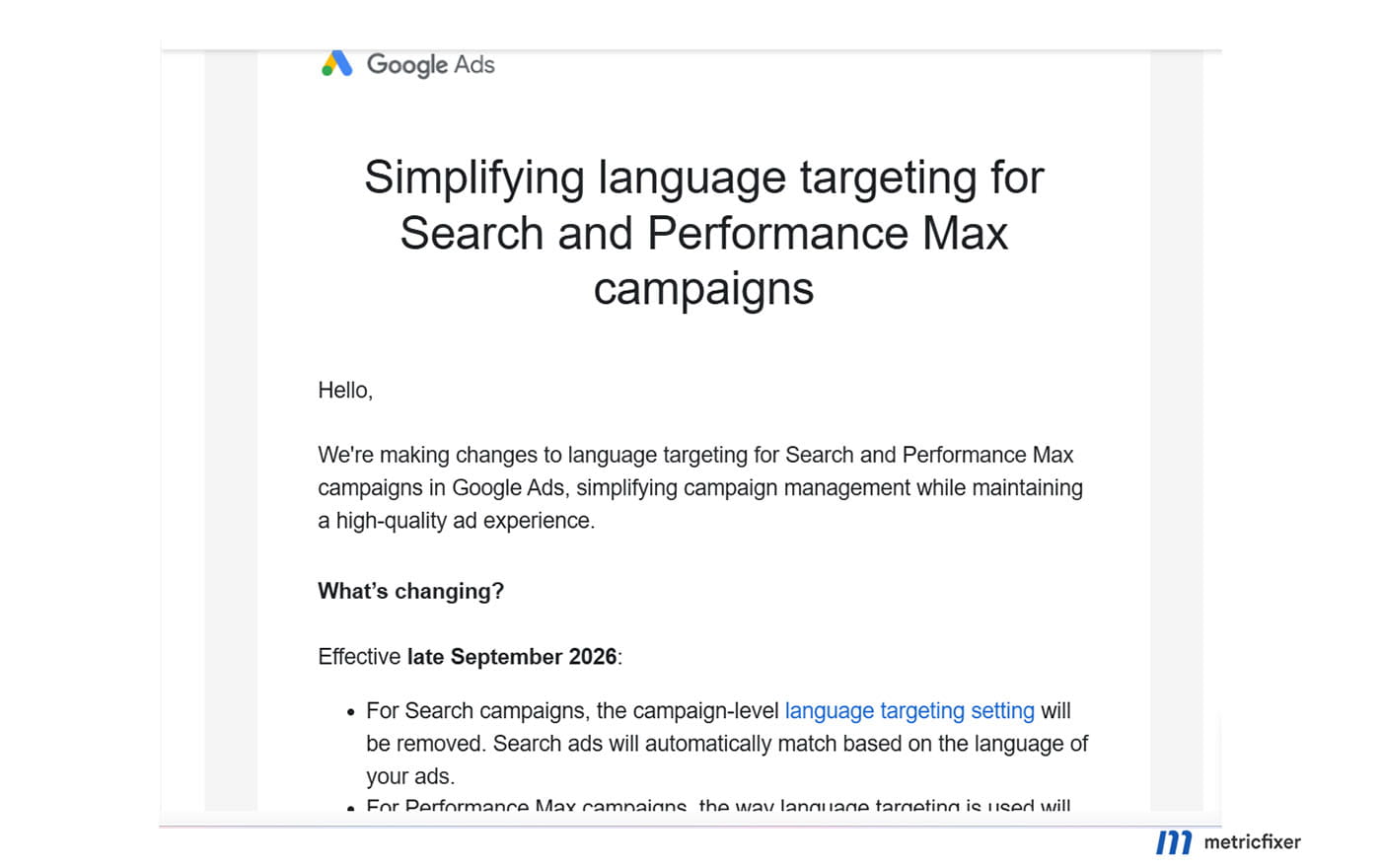
In late September 2026, Google Ads will stop using campaign-level language targeting for Search and the Search inventory inside Performance Max. This review explains the new matching logic, performance risks, API impact, and the audit advertisers should complete before rollout.
Category: Online advertising · By Mikalai Sasau
Starting in late September 2026, Google Ads will stop using campaign-level language targeting for Search campaigns, AI Max for Search campaigns, and the Search inventory inside Performance Max. Search language matching will instead rely primarily on the language of available ads and landing pages, together with Google's estimate of which languages each user understands.
Practical default: do not merge or rebuild language-separated campaigns simply because the setting is disappearing. Before rollout, make every Search ad group and Performance Max asset group clearly monolingual, align it with the correct landing pages, review automatically generated text and Final URL expansion, preserve a pre-change reporting baseline, and update any API workflow that still writes Search language criteria.
Executive summary
Google describes the update as a simplification, but it is more accurately understood as the removal of an advertiser-controlled eligibility layer from the Search auction. Language matching itself is not disappearing. Google will continue estimating the languages a user understands from signals such as the search term language, account or interface settings, and other preferences. What disappears is the advertiser's ability to use a campaign-level language selection as a separate Search targeting gate.
The distinction matters because Google Ads language targeting was never a strict "query language equals ad language" rule. A bilingual user could already search in Spanish and receive an English ad if Google believed that user understood English. After the September 2026 change, the system will keep making that comprehension decision, but the candidate ad's own language and its landing page become more important because there is no longer a Search campaign language setting to constrain eligibility.
Performance Max becomes the most operationally complex case. One Performance Max campaign will have different language behavior depending on inventory:
- Google Search text inventory: campaign-level language settings will no longer apply.
- YouTube, Display, Discover, and Gmail: selected campaign languages will continue to guide delivery.
- Shopping ads: Google states that they are not affected by the campaign language setting; Merchant Center feed and landing-page language rules remain important.
This means the language field may remain visible and meaningful in Performance Max even though it no longer controls one of the campaign's most commercially important environments. Agencies should document this split clearly so that account reviews do not treat the field as a universal campaign rule.
For many single-language advertisers, the performance effect may be modest. The largest upside is recovery of eligible multilingual demand that was previously excluded by an incomplete campaign setting. The largest downside is reduced predictability in multilingual accounts where language settings were being used as a budget boundary, a customer-service boundary, a compliance control, or a substitute for clean creative and landing-page architecture.
The safest interpretation of Google's broader direction is: campaign setup is moving from manual targeting switches toward AI-led matching that advertisers steer with creative, feeds, landing pages, conversion data, exclusions, and brand or compliance guardrails. This is an inference, not an announced roadmap. It is supported by the timing of the language change alongside the September 2026 migration of legacy campaign-level broad match and automatically created asset configurations into AI Max.
What exactly changes in late September 2026
Google announced the change for Search, AI Max for Search, and Performance Max. The practical effect differs by campaign type and channel.
| Campaign or inventory | Before the rollout | From late September 2026 | Operational consequence |
|---|---|---|---|
| Standard Search campaigns | The advertiser selects one or more campaign languages, while Google also estimates which languages a user understands. | The campaign-level language setting is removed from targeting. Matching uses ad language, landing-page signals, and user language preferences. | Creative and destination structure replace the campaign setting as the main advertiser-controlled language signal. |
| AI Max for Search campaigns | Language settings coexist with AI-powered query matching and creative features. | The Search language setting is removed in the same way as standard Search. | Generated text, URL expansion, and language-pure ad group structure require closer review. |
| Performance Max on Google Search | The campaign-level language setting can participate in Search delivery. | The language setting no longer applies to Search inventory. Matching follows the Search model. | A PMax campaign can serve on Search under different language rules from its other channels. |
| Performance Max on YouTube, Display, Discover, and Gmail | The campaign language setting guides who may see ads. | No announced removal. The selected languages continue to guide delivery. | Do not delete or ignore PMax language settings merely because they stop affecting Search. |
| Shopping ads inside Performance Max | Campaign language settings do not control Shopping ads in the same way as text inventory. | Google says Shopping ads are unaffected by this update. | Feed language, product data, destination language, currency, and Merchant Center rules remain the relevant controls. |
| Google Ads API for Search | Integrations can create and update CampaignCriterion.language. |
Existing language criteria may still be returned in queries but are not used for Search targeting. Attempts to add or update them return ContextError.OPERATION_NOT_PERMITTED_FOR_CONTEXT. |
Campaign builders, scripts, templates, and third-party tools must stop writing Search language criteria. |
| Google Ads API for Performance Max | Language criteria can be managed at campaign level. | Google does not apply the same mutation error because the criterion remains relevant to non-Search channels. | Automation must branch by campaign type instead of removing language handling globally. |
Google says no advertiser action is required for existing campaigns and that old language criteria do not need to be removed for Search campaigns. That is technically true: campaigns can continue serving. It does not mean that no preparation is useful. The change alters how multilingual candidates become eligible, and API writes can fail after rollout even when historical criteria remain visible.
What language targeting did before - and what it never guaranteed
The old mental model used by many advertisers is too simple:
Target English, receive English searches; target Spanish, receive Spanish searches.
Google's documented behavior has long been broader. On Search, it uses several signals to estimate which languages a person understands. These can include the language of the search term, language settings, and other preferences inferred by Google. A person with a Spanish browser interface who frequently searches in English may be eligible for both English and Spanish ads. A Spanish query can already produce an English ad when Google believes the user understands English.
Before the change, the campaign setting still mattered because Google evaluated the user's inferred language knowledge against the advertiser's selected languages. It was not a precise query-language filter, but it was an additional eligibility condition. After the change, that advertiser-selected condition disappears from Search.
Three distinctions are therefore essential:
- Query language is the language of the words entered or the intent inferred from a more complex Search experience.
- User language understanding is Google's model of the languages the person can understand, which may include more than the current query language.
- Ad language is the language Google detects in the available creative and supporting destination content.
These variables can disagree. A user can search in one language, understand two languages, and receive an ad in the second language. The update does not remove that possibility; it makes Google's selection among ad languages more central.
How Search language matching will work after the change
Google has disclosed the main signals, but it has not published a complete language-scoring formula. The documented model can be summarized as follows:
Simplified Search matching flow after September 2026: a user searches on Google -> Google estimates the user's intent and understood languages -> eligible Search ad groups and PMax asset groups are identified -> identical exact keywords retain their documented priority -> identical phrase or broad keywords and PMax search themes are considered next -> AI-based relevance uses the search meaning, ad group or asset group context, keywords or search themes, landing pages, and language relevance -> Ad Rank determines which remaining candidate enters the auction -> the selected ad may be in a language different from the query when Google believes the user understands it.
This workflow is deliberately described as a simplified operational model. Google does not expose a standalone language score, does not state exactly where every language signal is applied inside retrieval and ranking, and has not announced an advertiser-facing control that forces the ad language to equal the query language.
Exact-match priority still matters
The language announcement does not mean Performance Max automatically takes every multilingual query away from Search. Google's account-level prioritization rules continue to give an identical exact-match Search keyword priority over broad or phrase keywords and over Performance Max. If there is no identical exact keyword, identical phrase or broad keywords and identical PMax search themes are considered in the next priority tier. AI relevance and then Ad Rank resolve less exact overlaps.
That distinction is important when diagnosing post-rollout traffic shifts. A PMax increase may result from broader eligibility or better relevance, but it should not be explained with the inaccurate rule "PMax always wins." Eligibility can also be affected by budget, location, policy status, negative keywords, campaign targets, and whether the preferred ad group has an approved ad and landing page.
Ad language is not a new manual targeting field
Google's wording may sound as if advertisers will select a language for every ad. That is not what has been announced. Search ads contain text assets, and Google can also use landing-page content and, in AI Max or Performance Max, generated text and dynamic destinations. The practical advertiser control is therefore the clarity and consistency of the creative set, not a replacement language dropdown.
A responsive search ad that mixes English and Spanish headlines, an asset group that combines French video with English descriptions, or a landing page that auto-redirects between locales gives the system a less consistent language signal. Even if such combinations pass policy checks, they create avoidable ambiguity for matching, user experience, reporting, and compliance review.
Why Performance Max is the harder case
Performance Max is designed to optimize across Google's channels toward a shared conversion objective. The language update shows that a single campaign-level field does not necessarily have the same meaning across all of that inventory.
One campaign, at least two language rulebooks
After rollout, the same PMax campaign can behave like this:
- On Search text inventory, Google ignores the selected campaign languages and chooses among ad languages using its Search language-comprehension model.
- On YouTube, Display, Discover, and Gmail, the selected campaign languages continue to guide delivery.
- For Shopping ads, the campaign setting is not the primary language control; product source and landing-page requirements remain separate.
This makes campaign-level analysis less intuitive. An advertiser may see total PMax CPA improve while Search traffic expands into bilingual users and another channel contracts. Aggregate performance alone will not reveal whether the language change contributed. The Performance Max channel performance report should therefore be part of the before-and-after review.
Asset groups become the practical language containers
Google already recommends separating Performance Max asset groups by theme, product, audience, or language. That recommendation becomes more important when Search matching is based on the language of available ads rather than the campaign's language selector.
A strong multilingual PMax structure usually follows one of two patterns:
- One campaign with separate monolingual asset groups: useful when languages share the same budget, bidding target, conversion economics, geography, and product scope.
- Separate campaigns by language or locale: useful when budgets, targets, legal text, product availability, customer support, seasonality, or conversion values differ materially.
The language update is not a reason to combine campaigns. Campaign separation still controls budget, bid targets, conversion goals, schedule, geography, brand settings, and other business requirements. Google has explicitly said existing language-separated structures can continue.
Text customization and Final URL expansion increase the review surface
In AI Max and Performance Max, text customization can create new messaging from existing ads, assets, and landing-page copy. Final URL expansion can send a user to a different, query-relevant page and generate text that matches that destination. These features can improve relevance, but they also make language governance more dependent on the website and URL controls.
Before September, agencies should verify:
- which campaigns have text customization enabled;
- which campaigns allow Final URL expansion;
- whether every eligible URL resolves to the intended language and market;
- whether URL exclusions prevent cross-locale paths, login pages, legal pages, internal search pages, and unsupported regional pages from becoming destinations;
- whether mandatory disclaimers and prohibited phrases are protected with available text guidelines or disclaimer controls;
- whether automatically generated images or videos contain text or voiceover in a language that does not match the asset group.
Google's expansion of text guidelines and AI Brief-style steering suggests the product direction is not pure automation without controls. Instead, Google is replacing some legacy switches with natural-language and content-level guardrails. Advertisers still need to test those controls rather than assume generated assets will remain inside an intended locale.
Shopping remains a separate language system
Google states that Shopping ads inside Performance Max are not affected by campaign language settings. This does not make localization irrelevant. Merchant Center requires product data and key landing-page elements to use a consistent supported language, and a mismatch can limit performance or lead to disapproval. Navigation and checkout elements needed to make a purchase decision should also match the product source language.
Retailers should therefore analyze two PMax paths separately:
- Shopping path: product source language, product title and description, feed country, price and currency, product landing page, and checkout language.
- Search text path: asset-group text language, generated creative, search themes, Final URL expansion, and Google's estimate of user language understanding.
A campaign can perform well in Shopping while its Search text ads have a localization problem, or the reverse. The PMax search terms report can segment search terms by landing page and ad format, helping distinguish Shopping ads from Text ads.
How the change can improve campaign performance
There is no official forecast showing how much CPA, ROAS, CTR, or conversion volume will change because of the language update itself. Any performance expectation should therefore be framed as a scenario, not a guarantee.
1. Recovering demand excluded by incomplete language settings
An English-only campaign in a multilingual market may currently miss users whom Google understands to be comfortable with English but who do not satisfy the selected language condition in a particular auction. Removing the advertiser-set gate can increase eligible reach without requiring the advertiser to predict every language a customer may use.
This may help travel, software, higher education, international ecommerce, and other sectors where customers research in several languages but are comfortable buying in one shared language.
2. Better routing between eligible language versions
When an account contains strong, monolingual English and Spanish ad groups with matching landing pages, Google's prioritization can choose the candidate it estimates is more relevant to the user. That can reduce the need for advertisers to approximate language knowledge through campaign settings alone.
3. Fewer setup errors in new Search campaigns
Language targeting is frequently misunderstood as query-language targeting. Removing the setting eliminates one source of accidental under-reach, inconsistent bulk templates, and campaign duplication. It also aligns Search with Google's broader goal of simplifying campaign construction around automated matching.
4. More use of creative and site context
Well-localized advertisers can benefit because the system has richer signals than a campaign dropdown. A coherent ad group with local-language assets, a matching page, localized offers, and relevant terms gives Google more context for choosing a useful candidate.
How the change can reduce performance or make it harder to interpret
1. "Understands" is not the same as "prefers"
A user may understand English but prefer French for a financial product, medical service, legal form, or customer-support interaction. Google's language model can identify comprehension, but it does not automatically know the advertiser's operational language constraints or the user's preferred transaction language.
An ad can therefore be technically understandable but commercially weaker. Possible symptoms include lower CTR, a drop in landing-page engagement, more form abandonment, calls in unsupported languages, or lower qualified-lead rates even when reported conversion volume appears stable.
2. Language-separated campaigns can overlap more visibly
Advertisers often use separate campaigns to reserve budget by language. Those campaigns can remain separate, but the language setting will no longer be the Search eligibility boundary. If Google believes a user understands both languages, both campaign structures may produce candidates and the prioritization system can decide which one is more relevant.
This can shift spend between language campaigns, especially for:
- brand names and product codes that look the same in every language;
- short commercial terms with shared spelling;
- locations with large bilingual populations;
- English loanwords used inside other languages;
- searches generated through Lens, AI Mode, AI Overviews, or autocomplete where the reported term is an approximation of intent.
3. Mixed assets can create wrong language pairings
A single responsive ad or asset group that contains several languages can make automated assembly less predictable. The risk extends beyond headlines and descriptions to sitelinks, callouts, images with text, video captions, voiceovers, lead forms, price assets, and business information.
The immediate problem is user experience. The deeper problem is diagnosis: Google does not currently provide a dedicated report that proves which language it assigned to every served ad or how user language understanding affected eligibility.
4. Aggregate PMax reporting can mask channel-level movement
Because PMax optimizes across inventory, a Search language expansion can change the internal allocation of traffic. Total campaign CPA may stay flat while the channel mix, search-term mix, landing pages, and lead quality change. Agencies that report only campaign totals may miss the mechanism.
5. Automated creative can expand the language surface
AI Max and Performance Max can derive text from landing pages and create new combinations. Industry reporting from a Google advertiser roundtable indicates that an English query can trigger French creative when Google believes the user understands French. That is consistent with Google's existing documentation: query and ad language do not have to match.
For regulated or tightly governed brands, the relevant question is not only whether the generated ad is grammatically correct. It is whether the correct disclosure, approved terminology, product scope, destination, and service language appear together.
6. API and tooling failures can interrupt deployment
A campaign builder that always adds language criteria to Search campaigns can begin returning errors after rollout. The serving campaign may remain healthy while a deployment pipeline, cloning script, onboarding template, or scheduled synchronization fails. This is an operational risk rather than an auction risk, but agencies managing many accounts should treat it as a release dependency.
7. Some advertisers lose a simple piece of compliance evidence
Language settings were never proof of actual delivery, but they were a visible declaration of intended targeting. Advertisers in insurance and other regulated sectors have asked how they will document equitable language availability after Google makes language eligibility decisions automatically. According to Search Engine Journal's report from a Google roundtable, Google did not announce a new language-level delivery report with the change.
That does not make the update non-compliant by itself. It means legal and compliance teams may need a different evidence package: approved creative inventories, asset-group structure, destination maps, change history, geographic reporting, search-term samples, call or CRM language outcomes, and documented monitoring procedures.
Likely impact by account scenario
| Scenario | Likely impact | Main risk | Recommended response |
|---|---|---|---|
| Single-language business, one market, one site language | Usually limited; possible incremental reach among multilingual users. | Unexpected queries from users whose interface language differs from the ad. | Confirm language consistency and monitor search terms rather than rebuilding. |
| Multilingual market with separate campaigns and pages | Potential spend and conversion redistribution between language campaigns. | Google selects a different campaign language than the advertiser expected for bilingual users. | Keep separation where it supports budgets or business rules; compare language-specific outcomes before and after rollout. |
| Mixed-language responsive search ads or PMax asset groups | High uncertainty. | Mixed combinations, wrong destination language, weak classification signals. | Split into monolingual ad groups or asset groups before rollout. |
| Language-neutral brand names, model numbers, or product codes | Higher candidate overlap. | Traffic migrates to the campaign or asset group with stronger relevance or Ad Rank rather than the expected language campaign. | Review duplicate terms, search themes, negatives, budgets, and landing-page relevance. |
| PMax lead generation with text customization and Final URL expansion | Possible reach and relevance gains, but a larger localization surface. | Generated copy or dynamic URL crosses locale boundaries. | Audit eligible URLs, exclusions, generated assets, forms, and CRM language quality. |
| PMax retail with Merchant Center feed | Shopping path largely unchanged; Search text path may change. | Teams incorrectly remove PMax language settings or overlook feed-page language mismatches. | Separate Shopping and text-ad analysis; preserve feed localization rules. |
| Regulated or public-service advertising | Performance may be stable while auditability changes. | No dedicated proof of language eligibility or delivery decision. | Agree on a monitoring and evidence framework with compliance stakeholders before rollout. |
| API-managed or template-generated accounts | Serving impact may be low, but campaign operations can fail. | Search language criterion mutations return an error. | Update integrations, tests, error handling, and campaign-type branching. |
What agencies and advertisers should audit before rollout
1. Build a language and inventory map
Export every active Search, AI Max, and Performance Max campaign and record:
- intended language and locale;
- target geography and location option;
- campaign budget and bid target;
- ad groups or asset groups;
- search themes and important keyword overlaps;
- final URLs and eligible expanded URLs;
- conversion goals and CRM outcomes;
- customer-support languages;
- Merchant Center sources where applicable;
- automated creative and URL settings.
The purpose is not to recreate a disappearing setting. It is to identify where language currently represents a real business boundary.
2. Make each serving unit clearly monolingual
Review all text and visual assets, not only the primary ad copy. A monolingual unit should normally have:
- headlines and descriptions in one intended language;
- sitelinks, callouts, structured snippets, prices, promotions, and lead forms in that language;
- images without conflicting embedded text;
- video captions, supers, and voiceover aligned with the same locale;
- a final URL whose page, forms, navigation, legal notices, and confirmation messages support that language.
For PMax, follow Google's own recommendation to separate asset groups by language when languages share one campaign.
3. Audit landing pages, locale routing, and URL expansion
Test destinations as a new user, a returning user, and from major target regions. Watch for:
- automatic redirects to a browser-language version;
- geo-IP redirects that change locale or currency;
- cookie-based language persistence from a previous session;
- canonical or
hreflangerrors that lead to the wrong localized page; - forms and thank-you pages that fall back to another language;
- URLs that Final URL expansion can select outside the intended locale folder.
Correct lang and hreflang markup is good web practice, but Google Ads has not announced either as a hard replacement targeting control. Treat the actual visible ad and landing-page language as the operational priority.
4. Review AI Max and PMax automation controls
Document the state of:
- search term matching;
- text customization;
- Final URL expansion;
- URL inclusions and exclusions;
- brand inclusions and exclusions;
- text guidelines, prohibited wording, and mandatory disclaimers;
- automatically generated image or video assets.
Do not assume that turning off one feature disables every generated or dynamic element. Review the exact settings and asset sources in each campaign.
5. Review cross-language overlap and prioritization
List high-value terms that are identical or nearly identical across languages. Include brand names, model numbers, acronyms, city names, English loanwords, and short generic terms. Compare them with PMax search themes and Search keywords.
Remember the documented priority: an identical exact-match Search keyword remains above broad or phrase candidates and PMax. For less exact intent matches, AI relevance and Ad Rank become more important. Use negatives only where the exclusion reflects a genuine business rule; do not attempt to rebuild language targeting with enormous translated negative lists.
6. Verify the full conversion and service-language chain
A multilingual click is valuable only if the post-click process can support it. Check:
- form language and validation messages;
- call-center routing and agent availability;
- email and SMS follow-up language;
- CRM ownership and qualification rules;
- sales scripts and contract language;
- offline conversion imports by language or market;
- refund, cancellation, and customer-support capability.
Use qualified leads, completed sales, revenue, or downstream conversion value where possible. A top-of-funnel form submission can hide a deterioration in language fit.
7. Preserve a pre-rollout baseline
Save at least four to six weeks of data before the change, adjusted for seasonality where possible. The baseline should include:
- campaign, ad group, and asset group spend;
- impressions, clicks, CTR, CPC, conversions, conversion value, CPA, and ROAS;
- search terms and search-term categories;
- landing pages and ad format;
- geographic performance;
- PMax channel distribution;
- lead quality, sales acceptance, revenue, and call-language outcomes;
- change history and automated recommendation history.
Use stable campaign naming, language-specific URL paths, and tracking parameters to preserve diagnostic context. The metricfixer Google Ads ValueTrack guide explains how to retain campaign and creative identifiers in analytics and CRM systems. A custom diagnostic language label can be useful, but it records the advertiser's intended language; it does not reveal Google's inferred user language.
8. Update API, scripts, and third-party tools
Audit every workflow that creates, clones, edits, or validates Search campaigns. After rollout, Search language criteria may still appear in query results even though they no longer affect targeting. Do not let historical rows mislead dashboards into showing an active Search control.
The following GAQL query can help identify campaign language criteria that an integration currently reads or manages:
SELECT
  campaign.id,
  campaign.name,
  campaign.status,
  campaign.advertising_channel_type,
  campaign_criterion.resource_name,
  campaign_criterion.status,
  campaign_criterion.language.language_constant
FROM campaign_criterion
WHERE campaign_criterion.type = 'LANGUAGE'
  AND campaign.status != 'REMOVED'
For Search and AI Max for Search, stop adding or updating these criteria. For Performance Max, retain campaign-type-aware handling because the setting still guides non-Search channels.
9. Agree on compliance evidence before the setting disappears
Where language availability matters for legal, policy, accessibility, or internal fairness requirements, define what evidence is actually needed. A campaign setting never proved individual delivery, and its removal makes that limitation more visible.
A practical evidence package may include:
- approved creative and destination inventories by language;
- screenshots or exports of asset-group and ad-group structure;
- change-history records;
- policy approvals and required disclaimers;
- search-term and geographic samples;
- landing-page and form QA results;
- CRM or call-center outcomes by service language;
- a written escalation process for wrong-language delivery.
10. Freeze unrelated structural changes around rollout
Late September 2026 is already a busy period for Search automation because Google is migrating some legacy campaign-level broad match and automatically created asset setups into AI Max during September. Avoid combining the language rollout with large budget shifts, new conversion goals, broad landing-page changes, and mass asset replacement unless business conditions require it.
When several changes happen together, performance movement becomes difficult to attribute. This is the same governance problem discussed in metricfixer's review of Google Ads target-based bidding changes: fewer visible controls increase the importance of clean measurement, change logs, and controlled testing.
A practical monitoring plan for the rollout
| Period | What to do | What to avoid |
|---|---|---|
| Four to six weeks before rollout | Export baselines, map languages and URLs, review asset purity, record automation settings, test API changes. | Do not merge campaigns only because the setting is scheduled for removal. |
| Rollout week | Annotate reporting, monitor API errors, change history, disapprovals, Search/PMax spend distribution, and obvious wrong-language destinations. | Do not react to one or two days of noisy data unless there is a hard user-experience or compliance failure. |
| First one to two weeks | Compare search terms, geographies, landing pages, PMax ad formats, channel contribution, and lead quality against the baseline. | Do not judge only by aggregate PMax CPA or ROAS. |
| Weeks three to six | Evaluate statistically and commercially meaningful shifts; adjust structure, negatives, URL controls, creative, budgets, or service routing. | Do not remove a language version solely because another version temporarily won more bilingual traffic. |
For Performance Max, use both the search terms and landing pages report and the channel performance report. Segment PMax search terms by ad format so that Shopping and text-ad behavior are not mixed. Review conversion quality outside Google Ads when leads or sales require language-specific service.
Google recommends allowing one to two weeks for PMax channel delivery to stabilize after significant changes, and its asset-group guidance suggests waiting two to three weeks before replacing low-performing assets. Those are useful operational reference points, not a reason to tolerate a clearly wrong language, prohibited statement, or invalid destination.
What this suggests about the direction of Performance Max and Search
The language change is small compared with a new campaign type, but it is strategically revealing. The strongest trend is not simply "more AI." It is a redistribution of control.
1. From targeting switches to model steering
Google is reducing the number of campaign settings that act as hard Search eligibility gates. At the same time, it is expanding inputs and guardrails that help models decide what to match and what to generate:
- search themes and broader semantic matching;
- text customization and landing-page-derived creative;
- Final URL expansion with inclusions and exclusions;
- brand controls;
- text guidelines and mandatory disclaimers;
- audience and matching guidance through AI Brief-style controls;
- conversion value and downstream measurement.
The advertiser's role moves from specifying every eligibility rule to supplying high-quality business context and enforcing boundaries that the model cannot infer safely.
2. Search and Performance Max Search inventory are converging
Standard Search, AI Max, and the Search portion of Performance Max increasingly share semantic matching and account-level prioritization logic. Google is also moving legacy broad match and automatically created asset configurations into AI Max in September 2026, with Dynamic Search Ads migration scheduled for February 2027.
This does not mean Search and PMax become identical. Search retains keyword structures, exact-match priority, campaign-specific controls, and different reporting. PMax remains a goal-based cross-channel campaign. The convergence is at the Search retrieval and creative layer: both rely more heavily on intent, content, landing pages, and machine-selected candidates.
3. Performance Max is becoming a channel-aware inventory router
The language update demonstrates that PMax is not one uniform auction system. It is a shared campaign and optimization layer over several inventories, each with its own eligibility and format rules. A setting can apply on YouTube and Display, be ignored on Search, and be irrelevant to Shopping.
The practical implication is that agencies should stop treating every PMax campaign setting as global. Future audits will increasingly need a matrix of setting x channel x format.
4. Automation is being followed by more diagnostic reporting
Google has expanded PMax search-term visibility, landing-page and ad-format reporting, channel performance reporting, and API-level channel segmentation. This pattern is important: Google often automates execution first and then adds ways to inspect outcomes.
The language change exposes a remaining gap. Google has not announced a dedicated language-of-served-ad or inferred-user-language report. It is reasonable to expect advertisers to request more localization diagnostics, but there is no confirmed launch to rely on.
5. Localization is moving closer to assets, feeds, and destinations
A likely long-term consequence is that language strategy becomes less campaign-setting-centric and more content-centric. The highest-value inputs will be:
- monolingual asset groups and ad groups;
- localized product feeds;
- clean regional URL architecture;
- complete local-language creative coverage across formats;
- explicit brand and compliance guidance;
- measurement that distinguishes language intent from actual business outcome.
This is an informed forecast, not an official promise that Google will remove language settings from YouTube, Display, Discover, or Gmail. Those environments use different context and consumption signals, so their campaign language controls may remain useful for longer.
What not to do before September
- [ ] Do not combine all language campaigns. Separate budgets, targets, markets, legal copy, product scope, and service capabilities remain valid reasons for separate campaigns.
- [ ] Do not remove PMax language settings globally. They continue to guide YouTube, Display, Discover, and Gmail.
- [ ] Do not assume query language will equal ad language. That was not guaranteed before and will not be guaranteed after rollout.
- [ ] Do not mix languages in one RSA or asset group to "give Google options." Give Google clear monolingual candidates instead.
- [ ] Do not use browser language, URL locale, or a custom tracking label as proof of Google's delivery decision. Each is a diagnostic clue, not the missing language report.
- [ ] Do not rebuild the old setting with huge negative-keyword lists. Use negatives for irrelevant intent and real business exclusions, not as an unreliable language detector.
- [ ] Do not judge the change only from clicks and platform conversions. Review qualified leads, sales, revenue, support language, and refunds.
- [ ] Do not make several major account changes during the same rollout window without documentation. September also includes AI Max migrations that can complicate attribution.
Frequently asked questions
Do Search campaigns need to be restructured?
No. Google says existing campaigns can continue, including accounts separated by language. Restructure only when the current ad groups, assets, destinations, budgets, or business rules are not clean enough for the new matching model.
Can an English ad show for a Spanish query?
Yes. Google already documents this possibility when it believes the user understands English. The September change removes the campaign-level language gate; it does not create a strict query-language match.
Will Performance Max ignore language settings everywhere?
No. Search inventory inside PMax will ignore them, but YouTube, Display, Discover, and Gmail will continue using them as guidance. Shopping ads are not affected by the campaign setting.
Does this mean PMax will beat an exact-match Search keyword?
No. Google's documented account prioritization still gives an identical exact-match Search keyword priority over broad or phrase keywords and Performance Max. Other eligibility conditions and exceptions still apply.
Should advertisers select all languages before the setting disappears?
There is no general need to do so for Search because the setting will stop applying. In PMax, the selected languages still matter outside Search, so any change should be based on the intended YouTube, Display, Discover, and Gmail audience.
Will html lang or hreflang control ad language?
They help describe site language and regional versions, but Google has not announced them as hard Google Ads targeting controls. Visible landing-page content, URL consistency, creative language, and the user's inferred language understanding remain the relevant operational signals.
Can advertisers report the language Google actually served?
Google has not announced a dedicated report that exposes the inferred user language or a language decision for every impression. Advertisers can use campaign and asset structure, search terms, destinations, geography, creative IDs, and downstream CRM or call data as indirect diagnostics.
What happens to existing Search language criteria in the API?
They may continue to appear in query results but no longer affect Search targeting. Adding or updating CampaignCriterion.language for Search will return ContextError.OPERATION_NOT_PERMITTED_FOR_CONTEXT. PMax is different because the setting still applies to non-Search channels.
Bottom line
Google is not removing language intelligence from Search. It is removing the advertiser's campaign-level language gate and making ad language, landing-page context, user language understanding, and AI-based prioritization carry more of the decision.
For well-structured, single-language accounts, this may be mostly a simplification. For multilingual advertisers, Performance Max users, regulated sectors, and API-managed agencies, it is a meaningful control and observability change. The correct response is not a rushed rebuild. It is a disciplined audit of creative language, asset groups, landing pages, automated generation, URL expansion, Merchant Center localization, conversion quality, reporting baselines, and deployment tooling.
The broader lesson for Performance Max is clear: as Google removes manual auction gates, the quality of the inputs and guardrails becomes the targeting strategy. Advertisers will have fewer opportunities to describe customers with a dropdown and more responsibility to describe the business accurately through assets, feeds, destinations, exclusions, conversion data, and measurable service constraints.
Methodology and sources
This article was prepared from Google's August 2026 announcement, current Google Ads language-targeting and account-prioritization documentation, Google Ads API guidance, Performance Max asset, search-term and channel-reporting documentation, Merchant Center language requirements, and Google's 2026 AI Max product announcements. Authoritative industry reporting was used for questions raised during Google's advertiser briefing and for the unresolved language-reporting issue. Statements about the likely future direction of Performance Max are explicitly presented as analysis rather than as an announced Google roadmap.
- Google Ads Developer Blog: language targeting changes starting September 2026
- Google Ads Help: About language targeting
- Google Ads Help: ad group and asset group prioritization
- Google Ads Help: Performance Max asset group best practices
- Google Ads Help: Performance Max search terms and landing pages report
- Google Ads Help: Performance Max channel performance report
- Google Ads Help: How AI Max for Search works
- Google Merchant Center Help: supported languages and currencies
- Google Ads Developer Blog: September 2026 AI Max migrations
- Google Ads: Dynamic Search Ads and legacy feature upgrade to AI Max
- Google Ads: new AI Max steering and compliance controls
- Search Engine Journal: advertiser briefing and multilingual use cases
- Search Engine Land: Search, PMax, Shopping, and API implications
This article is for advertising, analytics, and campaign-operations information only. It is not legal advice and does not guarantee campaign performance. Google Ads eligibility, AI matching, language detection, reporting, API behavior, and product controls may change during or after rollout. metricfixer is not affiliated with Google, Search Engine Journal, Search Engine Land, or other third-party platforms and publishers mentioned in this article.