
Published Oct 8, 2026
Country Domains or One Global Website? International SEO, Costs and ROI
Separate country domains can support local growth, but more websites do not automatically mean more sales. Compare ccTLDs and regional subdirectories through technical SEO, real-world evidence and a transparent break-even model.
Category: SEO & Web Marketing · By Mikalai Sasau
Will eight country websites generate more traffic and sales than one global domain? Not simply because there are eight of them. Separate country domains can support a stronger local business, but they also create additional acquisition, maintenance and measurement work. This guide compares country-code domains with regional subdirectories, explains the technical SEO requirements of both, and shows how to calculate whether the extra investment can pay back.
Practical starting point: for one brand entering unproven markets with a shared team, start by evaluating localized sections on the existing .com. Choose separate country domains where an identifiable commercial or operational advantage justifies their additional cost. Compare the same markets, localization quality and investment horizon, not eight localized stores against one untranslated website.
Contents
Executive summary
The number of domains is not a growth strategy. The useful question is which architecture will attract and convert customers most profitably in each market. One global domain can contain independently localized stores, product ranges, editorial content and checkout experiences. Separate domains can share a platform and central team. Neither choice dictates how seriously the business serves local customers.
Google's international site guidance recognizes country-code domains, subdomains and subdirectories. A country-code top-level domain, or ccTLD, provides a clear geographic signal. However, Google's SEO Starter Guide also describes the domain ending as usually a low-impact ranking signal, even when targeting a country. A strong indication of geography is not the same thing as a large guaranteed ranking advantage.
Our recommendation is therefore conditional: favor a shared domain when resources, brand and operations are shared; consider country domains when local autonomy, established assets or demonstrable customer preference create enough additional value. A hybrid can preserve successful local sites while new markets launch on the global domain. The final decision should be based on incremental contribution after costs, not combined traffic screenshots.

Why eight domains do not guarantee more sales
Imagine two expansion plans. Both offer the same products in eight markets, with equally good local content, delivery and support. One uses eight domains; the other uses eight regional sections of one domain. Both can address the same search demand. The first plan does not gain eight independent copies of that demand just by registering more names.
Google describes its ranking systems as primarily page-level, with site-wide signals also contributing. That is more nuanced than either popular claim: that a strong domain automatically makes every new page rank, or that every new domain creates an additional entitlement to search visibility. A useful local page still needs relevance, discoverability and a competitive offer.
There is a real resource trade-off. Under a shared domain, teams can build a coherent navigation and publishing system around existing content and relationships. Under separate domains, they must also establish and maintain the new web properties. Links to the original site do not automatically become equivalent endorsements of every new country domain. Equally, linking the sites together does not turn them into a single pooled ranking asset.
It is more useful to assess actual linked pages and relevant audiences than to add third-party authority scores. A partner's link to a helpful country-specific resource may matter more to the expansion than another generic homepage mention. Our guide to inbound and outbound links explains why link quality and context are better decision inputs than a simple count.
Nor should the plan depend on occupying many results for the same query with near-identical sites. Google's doorway abuse policy explicitly covers certain networks of slightly varied sites or regional pages designed to funnel visitors elsewhere. Genuine localized stores are not automatically doorways, and sharing a checkout does not by itself make them abusive. The concern is manufacturing search entry points without meaningful standalone value.
Countries, languages and URL structures
Start with a market-and-language map, not a shopping list of domain names. Germany and Austria can both need German content, but different delivery terms or offers. Canada can need both English and French. A French-language page is not automatically a France-specific page.
The following are illustrative patterns, not audited customer domains. The folder names are a publishing convention; they do not themselves configure Google's targeting.
| Audience | Country-domain approach | One-domain approach | Hreflang value |
|---|---|---|---|
| English-speaking customers in Canada | example.ca/en/ | example.com/en-ca/ | en-CA |
| French-speaking customers in Canada | example.ca/fr/ | example.com/fr-ca/ | fr-CA |
| German-speaking customers in Germany | example.de/ | example.com/de-de/ | de-DE |
| German-speaking customers in Austria | example.at/ | example.com/de-at/ | de-AT |
| French-speaking customers in France | example.fr/ | example.com/fr-fr/ | fr-FR |
| Polish-speaking customers in Poland | example.pl/ | example.com/pl-pl/ | pl-PL |
| General English-language audience | example.com/en/ | example.com/en/ | en |
In Google's supported annotations, the language comes first and an optional country follows. de-AT means German for Austria; AT alone is not a language declaration. Use en-GB, not en-UK. Do not invent values such as en-EU for a European storefront. A language-only version can be appropriate where the offer is genuinely shared across countries.
| Structure | Main advantage | Main trade-off |
|---|---|---|
| Country domains | Visible country identity and a natural boundary for local ownership. | Additional domains, releases, monitoring and acquisition work. |
| Subdirectories on a generic domain | A shared web presence with reusable navigation, templates and governance. | Regional requirements must fit, or be carefully integrated into, the shared architecture. |
| Subdomains on a generic domain | A practical option for separate applications or deployment teams. | More hostname-level operations without the automatic country meaning of a ccTLD. |
This is an operational comparison, not a ranking league table. Google's guidance on subdomains and subdirectories is to choose what fits the business. Also remember that .de signals Germany, not every German-speaking market. Neither a ccTLD nor a regional folder prevents customers elsewhere from visiting.
What the evidence actually shows
A useful expert framework, with an outdated setting to discard
In her international web structure framework, Aleyda Solis considers the target audience, competitors, existing link strength and available resources. That is the right kind of analysis: examine what the business can realistically compete with, rather than choosing the architecture that looks most international.
The framework was published in 2019 and includes references to country targeting in Search Console. Do not copy that implementation step today. Google confirms that the International Targeting report and its country-targeting setting are no longer supported. This does not remove support for hreflang.
Consolidation can work: the NFON case
Eoghan Henn's first-hand NFON case study reports that Austrian organic traffic increased 90% and organic leads increased 100% year over year during the first five months after its local site moved to a shared global domain. Importantly, he also discloses a simultaneous redesign. The results support investigating consolidation; they do not isolate the domain structure as the sole cause or provide a forecast for another company.
Country domains can also work: the Pinterest case
Pinterest Engineering's March 2018 account describes positive traffic, click and view growth after moving country subdomains to ccTLDs. It also describes substantial authentication and infrastructure work. This was an established international platform migrating existing properties, not eight new stores starting from zero, and not a clean comparison against subdirectories.
Pinterest also discussed crawling benefits. Today's Google crawl-budget documentation defines the relevant site boundary as a hostname, including subdomains, and explains that crawling depends on both capacity and demand. Separate crawl budgets therefore are not an exclusive benefit of ccTLDs. For an ordinary expansion, creating domains to obtain more crawling is a weak business case unless a real bottleneck has been demonstrated. More crawling does not guarantee more indexing or sales.
The evidence supports a conditional decision, not a universal winner. Successful migrations in opposite directions are a warning against turning individual case studies into guaranteed uplift percentages.
When country domains make sense
The local operation is genuinely independent
A separate domain can be sensible for a franchise, acquired brand, distributor or country business with its own commercial ownership. Independent pricing, assortment, customer service and release priorities can make a shared storefront difficult to govern. The benefit is autonomy that helps the business operate, not an assumed SEO bonus.
Ask which requirement actually needs separation. Separate legal entities, payment providers or data-handling rules may require controls in contracts and systems; the domain ending alone does not supply those controls. Conversely, a shared backend does not prevent a business from presenting clearly separated local stores.
There is valuable local equity to preserve
An existing local domain with customers, editorial references, partner links and recognized branding is a different investment from a newly registered domain. Keeping that asset may avoid a disruptive migration. Before consolidating, inventory what the business could lose, not just the maintenance costs it could save.
Do not assume an acquired or previously used domain is clean. Investigate its former use, relevant links, Search Console access, security history and any manual actions. An attractive name is not evidence of useful search value.
Customers show a commercially meaningful preference
A local ending may reinforce local positioning. Treat the size of that benefit as a hypothesis to test through customer research and commercial data. Competitors using ccTLDs demonstrate a market convention, not that the ending caused their rankings or conversion rates.
The stronger case is a combination: customers recognize the local proposition, the store delivers the expected service, and the additional completed orders cover the additional cost. Native copy, familiar payments and credible delivery promises should not be credited to the domain when they could also exist on a regional subdirectory.
The resources and registration rights are available
There should be a named owner, budget and maintenance plan for each market. Check registry eligibility before committing to naming, design and launch dates. For example, CIRA requires .ca registrants to qualify under its Canadian Presence Requirements; simply wanting Canadian customers is not sufficient.
Country domains can also make economic sense when their operating model is cheaper for a particular organization. Integrating eight incompatible legacy systems behind one global site may cost more than maintaining standardized local sites. Obtain estimates for the actual alternatives instead of assuming that one domain always means lower engineering cost.
When one domain or a hybrid is better
For a single brand with a shared product, central team and limited expansion budget, regional subdirectories are a strong starting candidate. They let the business invest in market validation and localization without simultaneously launching a new web property for every country. This is our operational recommendation, not a claim that Google mandates subdirectories.
The case is especially strong when the main domain already has useful content and relationships, demand in the new countries is uncertain, and local teams cannot yet sustain separate publishing and outreach. A focused launch in two promising markets may be more valuable than eight sites with shallow content and no accountable owner.
A language-led business may not need a separate storefront for every country. For example, a common German-language information resource can serve several audiences, while country-specific delivery or product pages cover real differences. Do not manufacture regional copies merely to fill a market matrix.
A hybrid is a legitimate design. An established German operation could retain its ccTLD while Canada and Poland launch on the global domain. Equivalent pages can participate in cross-domain hreflang relationships. What matters is a deliberate mapping and clear responsibility, not making every country look identical in a diagram.
Registering suitable country domains defensively is also different from launching separate indexed sites. Subject to eligibility and ownership checks, a domain can redirect permanently to the appropriate regional section. That can support brand protection or offline communications, but the redirect does not create an additional independent organic storefront.
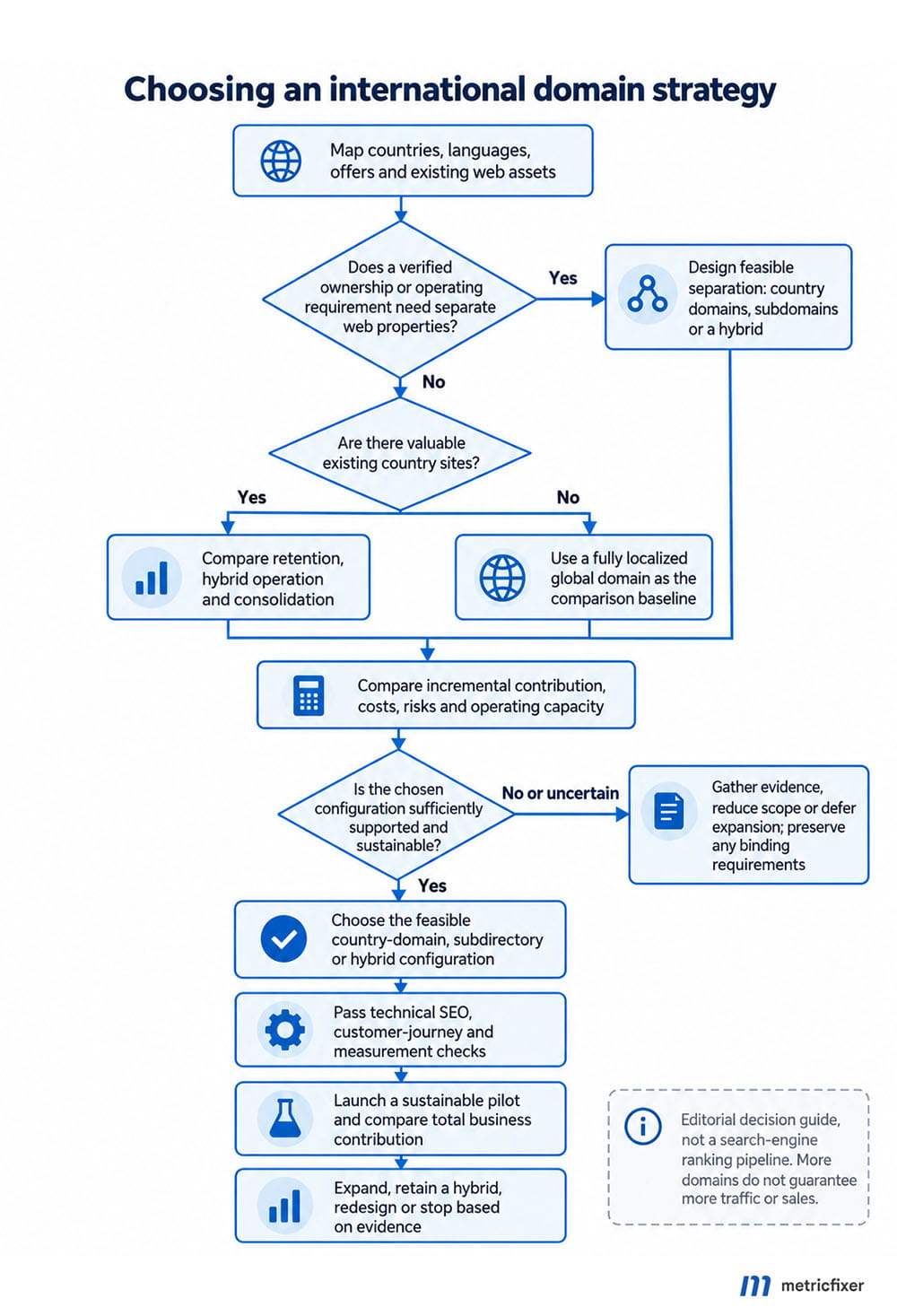
Decision workflow: map real audiences and offers → identify any requirement for separate ownership or operation → compare local advantages with a fully localized global-site alternative → calculate incremental costs and contribution → launch the smallest sustainable configuration → expand only when the evidence supports it.
Technical SEO foundations for both models
Make the local experience available at a stable URL
Every search-targeted version should have a directly accessible URL. Do not make French content available only after changing a cookie, choosing a country in a modal or sending a particular browser-language header. Google's locale-adaptive crawling guidance warns that it may not discover or index every variation served this way.
Prefer a visible country/language selector with normal links and a dismissible recommendation over forced location redirects. Keep the chosen URL stable for users arriving from search, email or an overseas trip. When switching markets, preserve the equivalent product or article where available; otherwise explain that the item is unavailable rather than silently pretending a homepage is its equivalent.
Localize the offer, not just the menu
Research how people describe the problem and buy the product in each market. Review titles, main copy, navigation, support information, units, currencies, delivery, returns and payment options. A translated menu around unchanged main content is not the same as a translated page. Google distinguishes translated main content from untranslated duplicates.
Use real company and service information. Do not invent local addresses or regional credentials to make a site look established. Assign local review and update responsibilities, including what happens when a product, policy or source-language article changes.
Keep discovery and indexing signals consistent
Build crawlable navigation within each locale, not a collection of pages reachable only through a selector. Google's link guidance favors real <a href> links with useful anchor text. Regional category pages should lead to the appropriate regional products.
Check representative templates against Google's technical requirements: intended landing pages must be accessible, return a successful response and contain indexable content. Remove accidental production noindex rules and crawler blocks. Test the initial HTML and rendered page, particularly when routing or content depends on JavaScript.
Use sitemaps to expose preferred URLs and separate locale inventories for easier diagnosis. Prevent uncontrolled combinations of filters, sorting, session identifiers and tracking parameters from becoming the default navigation structure. Google's ecommerce URL guidance is relevant whether the catalog lives on one domain or several.
Check robots.txt separately for each live host. Google applies its rules only to the host, protocol and port where the file is served. The global site's file does not govern its country domains. Regional folders on the same host share the root file, so a central rule can unintentionally block an entire market.
Make performance and product data local too
Test mobile loading and checkout from the markets being served. A country domain does not require a physically local server for its geographic meaning, and a global domain can use distributed delivery. Inspect the real delivery architecture rather than treating the suffix as a performance feature.
Product markup, visible prices, availability and shipping information must agree. Validate regional templates against Google's merchant listing documentation. Do not copy a default currency or offer into every locale's structured data while showing customers something different. Keep feeds and landing-page destinations aligned when those pages also support shopping campaigns.
Hreflang and canonicals without conflicting signals
hreflang describes alternative language or regional versions. rel="canonical" indicates the preferred representative of duplicate or very similar content. They solve different problems. Neither is a tool for instructing Google to rank every copy independently.
Build relationships between equivalent pages
Follow Google's alternate-page rules: use fully qualified URLs, include the current page, and maintain reciprocal references. Alternatives can be on different domains. Choose HTML, HTTP headers or XML sitemaps as the primary implementation method; implementing all three does not add a search advantage.
In practice, maintain a shared content or product identifier that maps to the published URL in each locale. Generate annotations from that mapping instead of replacing path segments by guesswork. Translated slugs, different catalogs and unpublished translations otherwise create broken or misleading relationships.
The following simplified cluster has three equivalent product pages: global English, Germany and Austria. It assumes the two regional offers justify maintaining separate pages. On the German page of the one-domain implementation:
<link rel="canonical" href="https://example.com/de-de/produkt-a/">
<link rel="alternate" hreflang="en" href="https://example.com/en/product-a/">
<link rel="alternate" hreflang="de-DE" href="https://example.com/de-de/produkt-a/">
<link rel="alternate" hreflang="de-AT" href="https://example.com/de-at/produkt-a/">
<link rel="alternate" hreflang="x-default" href="https://example.com/en/product-a/">
On the corresponding German page of a country-domain implementation:
<link rel="canonical" href="https://example.de/produkt-a/">
<link rel="alternate" hreflang="en" href="https://example.com/en/product-a/">
<link rel="alternate" hreflang="de-DE" href="https://example.de/produkt-a/">
<link rel="alternate" hreflang="de-AT" href="https://example.at/produkt-a/">
<link rel="alternate" hreflang="x-default" href="https://example.com/en/product-a/">
Use one architecture's example, not both. Its English and Austrian pages repeat the same alternate set, while each has its own appropriate canonical. Add other locales only when equivalent published pages exist. Here, x-default intentionally uses the equivalent English product as the fallback; it is not a command to redirect visitors. A universal homepage is not automatically a suitable fallback for every product.
Choose the canonical policy before rolling out templates
| Situation | Practical policy |
|---|---|
| Genuinely translated pages | Normally keep a self-referencing canonical for each intended indexable translation and connect equivalents with hreflang. Do not canonicalize every translation to English. |
| Same-language pages with meaningful regional offers | Self-referencing canonicals can express the intention to retain each version. Local content, navigation and annotations must support that intention; separate indexing is not guaranteed. |
| Unnecessary same-language mirrors | Consider removing the duplication or choosing a preferred same-language canonical. Keep any necessary regional alternate relationships deliberate rather than declaring every mirror independently valuable. |
Google's regional duplicate-content guidance recommends a preferred version with canonical and hreflang signals for similar same-language pages. Its canonicalization guidance also recommends a same-language canonical when using hreflang. Therefore, neither "all regional pages must canonicalize to the main site" nor "every regional duplicate must always be self-canonical" is a reliable universal rule.
Ordinary duplication is not automatically a spam penalty. The practical risk is that Google selects a representative URL differently from the business's intention. Do not expect a self-canonical to force separate indexing, or cross-domain canonicalization to create independent rankings while also consolidating all signals elsewhere.
Validate the whole cluster and the indexed result
Audit missing return links, invalid language codes, redirects, error responses and non-indexable targets. Screaming Frog's hreflang audit documentation provides a practical testing reference. For the self-canonical pattern above, the alternate URLs should be the intended canonical destinations, not tracking URLs or old redirected addresses.
Then compare declared and Google-selected canonicals in the indexed version of Search Console URL Inspection. The live test cannot predict Google's canonical choice. A valid annotation file is implementation evidence, not proof that the intended regional result is being served.

What changes operationally with each architecture
Multiple domains do not require eight unrelated codebases. One platform can serve many storefronts. Equally, one public domain does not require every locale to run on one physical server. Ask vendors to separate the URL decision from the platform, infrastructure and ownership decisions in their estimates.
| Area | Separate country domains | Regional sections on one domain |
|---|---|---|
| Release and security controls | Inventory DNS, certificates, host configuration and access for every domain. Shared deployments still need domain-by-domain checks. | Check that routing, cache keys and access controls preserve the correct locale. A shared template error can affect every region. |
| Search monitoring | Verify each domain and monitor its preferred URLs, sitemaps and technical health. | Monitor the whole property and segment by locale path; add URL-prefix properties for regional sections where useful. Reporting scope is not a country-targeting setting. |
| Content governance | Prevent local sites drifting into stale offers, broken alternate references or unsupported template variants. | Prevent central changes overwriting local requirements, and assign clear market-level publishing permissions. |
| Customer journeys | Test country switching, login, carts, payments and measurement across domain boundaries. | Test the same journeys across locale changes and any external checkout or booking domains. |
The browser boundary is real: a normal cookie cannot simply be scoped to unrelated .com, .de and .fr domains. Cookie domain rules make shared login and cart behavior an implementation task, not a free consequence of common ownership.
For a permitted, unified customer journey, configure and test GA4 cross-domain measurement where appropriate. Its standard setup uses the same tag ID from the same web data stream across participating domains and passes linking information between them. Do not enable it indiscriminately across separate businesses, and do not assume it overrides consent requirements. Redirects and checkout integrations must preserve the relevant parameters.
Our guides to preserving attribution across domains and using one server-side GTM container for multiple domains cover the measurement implications. Sharing tracking infrastructure can reduce operational duplication; it does not automatically merge identities or provide data isolation.
Finally, distinguish operational resilience from ranking diversification. Separately operated sites may limit some outages, but domains sharing code, credentials, infrastructure and content weaknesses remain exposed to common failures. A network of domains is not reliable insurance against search-performance problems.
When the extra investment can pay back
Separate localization costs from architecture costs
Translation, local keyword research, product compliance, customer support and credible delivery are not costs unique to ccTLDs. A serious regional section needs them too. Charging all localization to one option while treating the other as a generic English site produces a misleading comparison.
Estimate the difference between viable alternatives: implementation, licenses, domain acquisition, integration, ongoing QA, local operations, acquisition work and the expected cost of a future migration. Count savings from shared components, but also coordination delays and the opportunity cost of spending the expansion budget on infrastructure rather than customers.
Country domains create economic value when they produce additional profitable demand, improve customer conversion, preserve valuable local assets, or reduce operational friction enough to exceed that difference. The same logic can favor one domain when faster rollout and lower overhead let the business enter markets earlier or invest more in local content.
A transparent break-even example
The following figures are invented planning assumptions, not market prices, client results or promised SEO uplifts. They compare an already planned, fully localized global site with a country-domain alternative covering the same markets. All traffic and order figures are totals across the evaluated markets, not per-domain figures.
| Input | Illustrative value | Meaning |
|---|---|---|
| Additional upfront investment | €48,000 | Country-domain setup cost above the localized one-domain alternative. |
| Additional recurring cost | €1,500 per month | Net additional operating cost after any shared-platform savings. |
| Evaluation horizon | 24 months | A simple planning period, without discounting. |
| Contribution per additional order | €35 | After expected refunds and variable product, fulfillment, payment and support costs, excluding VAT. |
| One-domain baseline | 25,000 qualified visits; 2.0% order rate | 500 orders per month under the comparable localized alternative. |
For this simplified model, assume the same contribution per order under both architectures, no extra paid-media cost, and steady monthly results:
Monthly additional cost hurdle
= additional recurring cost + additional upfront investment / months
= EUR 1,500 + EUR 48,000 / 24
= EUR 3,500

Additional orders required each month
= EUR 3,500 / EUR 35
= 100

Required country-domain total
= 500 baseline orders + 100 additional orders
= 600 orders per month
At unchanged traffic, the order rate would need to increase from 2.0% to 2.4%: 0.4 percentage points, or a 20% relative improvement. At an unchanged 2.0% order rate, traffic would need to rise from 25,000 to 30,000 qualified visits. Neither improvement follows automatically from a new domain ending.
| Country-domain scenario | Visits per month | Order rate | Orders | Monthly result versus one domain, after the cost hurdle |
|---|---|---|---|---|
| Slower acquisition | 22,500 | 2.0% | 450 | -€5,250 |
| No performance difference | 25,000 | 2.0% | 500 | -€3,500 |
| Some conversion improvement | 25,000 | 2.2% | 550 | -€1,750 |
| Simple break-even | 25,000 | 2.4% | 600 | €0 |
| Traffic and conversion improve | 27,500 | 2.4% | 660 | +€2,100 |
The last column spreads the additional setup cost over 24 months; it is not a monthly cash-flow statement. In the final scenario, additional operating cash contribution before recovering setup cost is (660 - 500) × €35 - €1,500 = €4,100 per month. Simple payback is approximately 11.7 months after that steady performance begins, assuming no earlier losses. A realistic model must include the launch ramp, seasonality, financing and downside scenarios.
When margins differ by country, model each market separately and sum contribution, not revenue. Subtract incremental acquisition spend unless it is already included in the cost assumptions; do not count it twice. For lead generation, replace orders with qualified leads multiplied by a realistic close rate and contribution per sale, allowing for the sales-cycle delay. Count repeat-customer value only with defensible retention evidence.
The crucial comparison is against what the regional sections would have achieved. Moving existing orders from the global domain to local domains is not incremental growth. Nor is a higher sum of reported users proof that the business acquired more people.
A phased launch and measurement plan
Stage 1: establish the commercial and search baseline
Map demand, competitors, current customer geography, delivery capability and contribution by market. In Search Console, examine performance by country, query and landing page rather than relying on one global average. Separate branded from non-branded demand and record which existing pages already attract the new markets.
Create a comparable one-domain plan before approving the multi-domain budget. For each proposed ccTLD, write down the expected source of additional value, its owner, its cost and the evidence that would disprove the assumption. A domain without a convincing answer should not become a compulsory launch item.
Stage 2: launch a sustainable subset
Choose markets with credible demand and operational readiness. Build complete journeys for the priority products, not unfinished copies of the entire catalog. Set technical acceptance criteria before launch, then evaluate commercial performance once there is enough indexing, traffic and completed sales-cycle evidence. There is no universal number of weeks that makes an SEO architecture test conclusive.
Customer interviews and paid landing-page experiments can investigate trust or checkout friction. They do not establish the organic-ranking effect of a ccTLD. Similarly, a before-and-after migration is not a clean experiment when content, design, pricing and media spend change at the same time. Use comparable cohorts and document confounders; treat residual uncertainty honestly.
Stage 3: expand, retain a hybrid or stop
Track intended versus observed landing locale, valuable indexed pages, qualified organic visits, completed orders, net contribution and ongoing maintenance effort. Reconcile orders with the commerce or CRM system using stable identifiers. Cross-domain reporting should explain customer journeys, not count a country switch as a new business win.
Where a later change of architecture is justified, treat it as a migration rather than a naming edit. Google's site-move guidance recommends URL mapping, permanent server-side redirects, updated internal links and annotations, monitoring, and retaining redirects for generally at least one year. Expect possible temporary search fluctuations. Do not redirect every old product to a homepage.
Distinguish expansion from replacement: launching a new market does not require redirecting the whole global site away. If only one regional section moves, redirect its mapped URLs, not unrelated countries. Search Console's Change of Address tool is not a generic control for every path-level move.
Pre-launch checklist
- Market scope: each country/language combination has a real audience, an offer and a named owner.
- Business case: incremental costs are compared with an equally localized alternative, including a downside scenario.
- Ownership: domain eligibility, registration control, renewals, access and historical use have been checked.
- Accessibility: local landing URLs work directly without mandatory geolocation, cookies or manual language selection.
- Content: copy, prices, delivery, returns, product data and support have been reviewed for the intended market.
- Search signals: canonical policy, reciprocal alternate mappings, internal links and sitemaps agree.
- Technical QA: status codes, crawler access, mobile rendering, redirects, cache behavior and structured data have been tested.
- Measurement: country switches, checkout, consent, attribution and order reconciliation have passed end-to-end tests.
- Operations: releases, incidents, translation updates and ongoing acquisition work have accountable owners.
- Exit plan: review criteria and the cost of retaining, expanding or migrating the setup are understood.
The recommendation for an expanding brand
For a brand proposing several new country domains primarily because "more sites will produce more traffic," the investment case is not yet established. Begin with a properly localized global-domain alternative and require each separate domain to justify the difference.
Choose ccTLDs when they support a meaningful local business advantage and the organization can sustain them. Choose regional sections when a shared presence, faster execution and reusable infrastructure make better use of the budget. Keep a hybrid when existing local strengths and new-market economics point in different directions.
metricfixer can help turn that decision into a market-and-URL map, a technical SEO and measurement specification, and a contribution-based launch plan. The objective is not to maximize the number of websites. It is to build the least wasteful architecture that can support profitable international growth.

Methodology and sources
This article was researched on 8 October 2026. It prioritizes Google's current Search Central, crawling infrastructure, Search Console and Analytics documentation for platform behavior. Registry eligibility and browser cookie behavior are supported by CIRA and MDN. The technical discussion is principally Google-focused; it is not a claim that every search engine processes international annotations identically.
Aleyda Solis's published framework, Eoghan Henn's first-hand NFON case study, Pinterest Engineering's original account and Screaming Frog's testing documentation provide practitioner context. Historical cases are identified as such. Their reported outcomes are not treated as controlled experiments or universal forecasts, and obsolete Search Console targeting instructions are not carried into the recommendations.
Source links appear beside the relevant claims rather than in a repeated reference dump. The decision workflow, cost comparison, scenarios and recommendations are metricfixer's editorial synthesis. The financial figures are explicitly hypothetical. No private analytics, backlink inventory, technical stack, domain eligibility evidence or client financial data was audited for this article.
This article provides technical and operational information, not legal, tax or investment advice. Search visibility, indexing, traffic and commercial returns are not guaranteed. Registration requirements, platform behavior and local obligations can change. Validate the architecture, ownership rights, privacy requirements and financial assumptions for the specific business before implementation. metricfixer is not affiliated with the search engines, registries or independent publishers cited in this article.