
Published Nov 14, 2026
AI Content on TikTok: Labels, Recommendations and Creator Rules
A practical guide to AI content on TikTok: when to disclose it, what labels mean for reach, how creator and Shop rules differ, and what to check from generation to publication.
Category: SEO & Web Marketing · By metricfixer AI Studio
AI content on TikTok is not governed by one yes-or-no rule. This guide explains when disclosure is required, how creator and automatic labels work, what recommendation controls do, and why Creator Rewards, TikTok Shop and paid promotion need separate checks. It follows the practical journey from a generator or editor to the post viewers actually see.
Practical starting point: approve the content and its intended use before choosing a label. Keep the source files and permissions, review the exact export, disclose relevant AI use and commercial relationships separately, and check the published result. A successful export or upload is not the end of that review.
Contents
Executive summary
The useful question is not simply whether a video was made with AI. Ask what it depicts, what viewers might believe, whose rights are involved, and whether it will be an ordinary post, a commercial recommendation, a Shop video or an ad.
TikTok introduced its creator-label tool in 2023 to make disclosure easier. Its original announcement distinguishes a broad encouragement to identify AI-made work from the requirement to disclose realistic synthetic media. That distinction still matters: using AI to help write a script is not the same as publishing a convincing recording of something that never happened.
Three decisions should stay separate: may the material be published, must AI use be disclosed, and does the intended distribution or earning route accept it? This article uses those questions as an editorial framework, not as a substitute for TikTok's individual policies.
The review is dated 12 November 2026. Product announcements are treated as announcements, not proof that every account has a feature. Regional Shop rules and program terms are identified where they are used.
Where AI content comes from
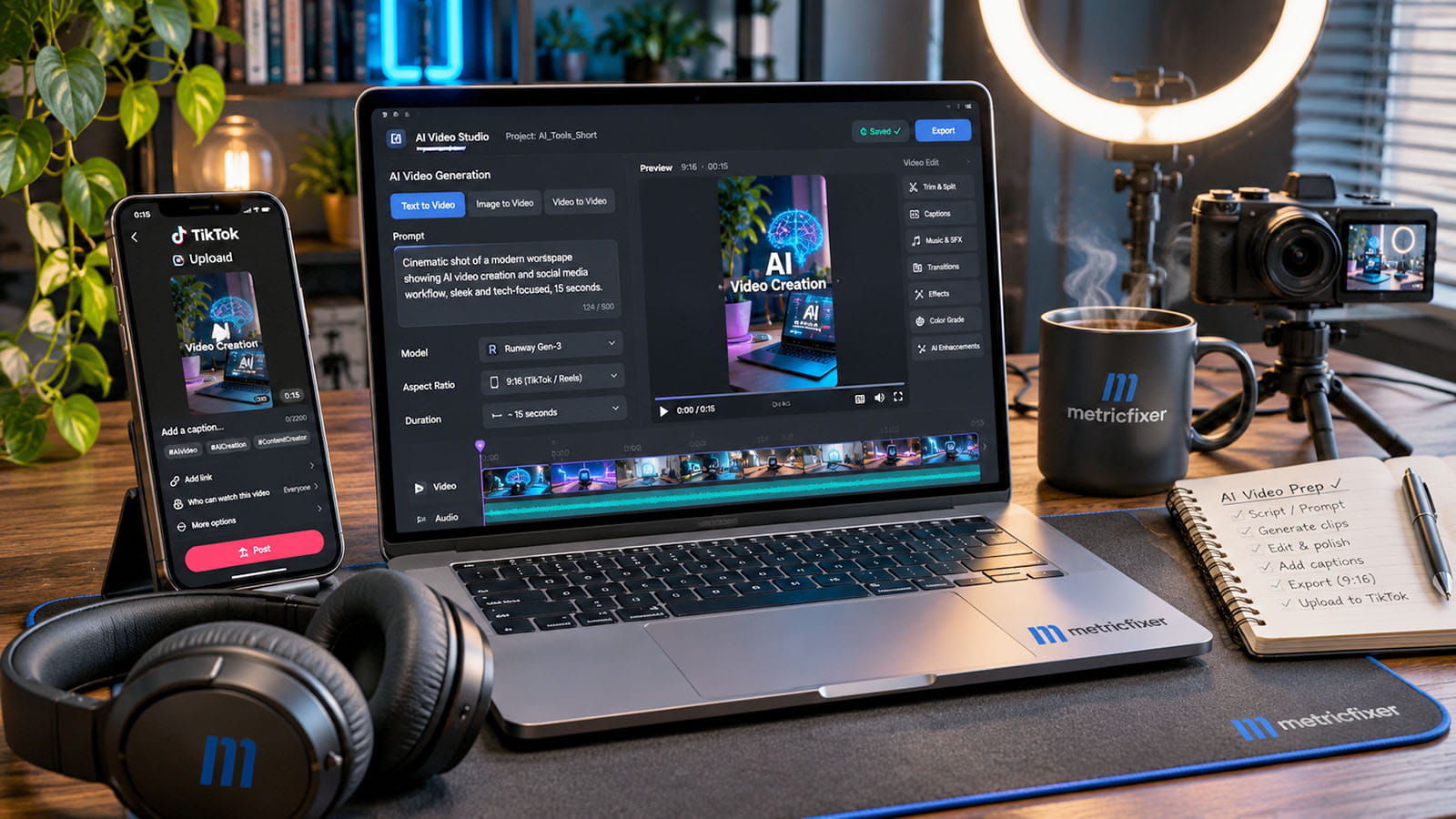
Start with a production record, not a list of app logos. A useful record distinguishes four routes: an effect applied inside TikTok; media generated elsewhere and uploaded; real footage changed in an editor; and a mixed production combining these sources. In a mixed video, review the synthetic parts as well as the final message.
CapCut, Dreamina and Seedance describe different parts of that process. CapCut is an editing environment, Dreamina is a generation platform, and Seedance is a model used to generate media. CapCut's Dreamina Seedance 2.0 announcement describes video and audio generation, integration into several products, and a phased rollout with updates through April 2026. It also describes visible AI marks, Content Credentials and an invisible watermarking safeguard.
Those are product capabilities and safeguards, not a ruling on your particular TikTok post. A tool accepting a reference image does not establish that you own it. A convincing product animation does not establish that the product works that way.
The CapCut terms reviewed for this article also allow differences by jurisdiction, device and service, with additional terms for some features. Record the actual feature, account, subscription and applicable terms rather than writing only "made in CapCut" in a handoff.
Recommended production note: identify the generated scenes, altered faces or voices, original footage, stock assets and music. Describe what changed in ordinary language. "Synthetic adult presenter, original product footage, translated narration" is more useful to the publisher than "AI-assisted."
When AI disclosure is required
The central threshold in TikTok's edited-media rules is realistic-looking people or scenes created or significantly changed by AI or editing. Its AI help page also covers realistic audio. The detailed rules distinguish generic text-to-speech from a recognizable imitation of a real person's voice.
The table applies those distinctions to ordinary organic posts. It is not a clearance decision for rights, harmful claims, Shop content or ads.
| Production scenario | Disclosure starting point | Editorial check |
|---|---|---|
| AI helps draft a script; the creator records real footage | Script assistance alone is not the realistic synthetic-media scenario. | Verify the script's claims. |
| Minor color correction or reframing | The detailed rules exempt minor edits. | Check that the meaning remains unchanged. |
| An obviously illustrated or anime-style scene | Artistic styles are outside the stated realism-based requirement. | Recheck any separate commercial rules. |
| Generic synthetic narration | The rules exempt generic text-to-speech that does not imitate a recognizable individual. | Listen for implied identity or authority. |
| A cloned or recognizable synthetic voice | Disclose the realistic imitation. | Confirm permission and the intended message. |
| A photorealistic fictional adult or invented event | Disclose realistic generated media. | Would viewers mistake it for documentary evidence? |
| Real footage with a meaning-changing synthetic element | Assess and disclose the significant realistic alteration. | Review the whole post, not just the inserted shot. |
Assess picture and sound separately: an exempt generic voice does not exempt realistic generated visuals. These are not percentages of AI use. A short fabricated statement can change the meaning of an otherwise authentic video. Conversely, many small technical improvements do not necessarily create a false event. The editorial test is what the finished post communicates.
Where disclosure is needed, TikTok accepts its AI setting or a clear caption, sticker or watermark. Our practical preference is to use the native setting when applicable and add plain-language context when the audience needs it: for example, identifying a scene as a visualization rather than footage of a real test. That extra explanation is an editorial recommendation, not a promise that a particular wording satisfies every rule.
Creator labels, automatic labels and mistakes
The Help Center's posting instructions put the video AI setting under More options after recording or uploading and continuing to the posting stage. For photos, they identify Post settings. Interface placement can vary; locate the actual AI-generated-content setting in the account being used.
A creator label reflects the uploader's disclosure. An automatic label is applied by TikTok, including through supported AI effects or recognized provenance information. The same help page says creators cannot remove an automatically applied AI label. Native effects may already provide disclosure, but that does not settle additional AI changes made outside TikTok.
Do not label genuinely unaltered media as AI-generated just to be cautious: the help page also warns against misleading disclosure.
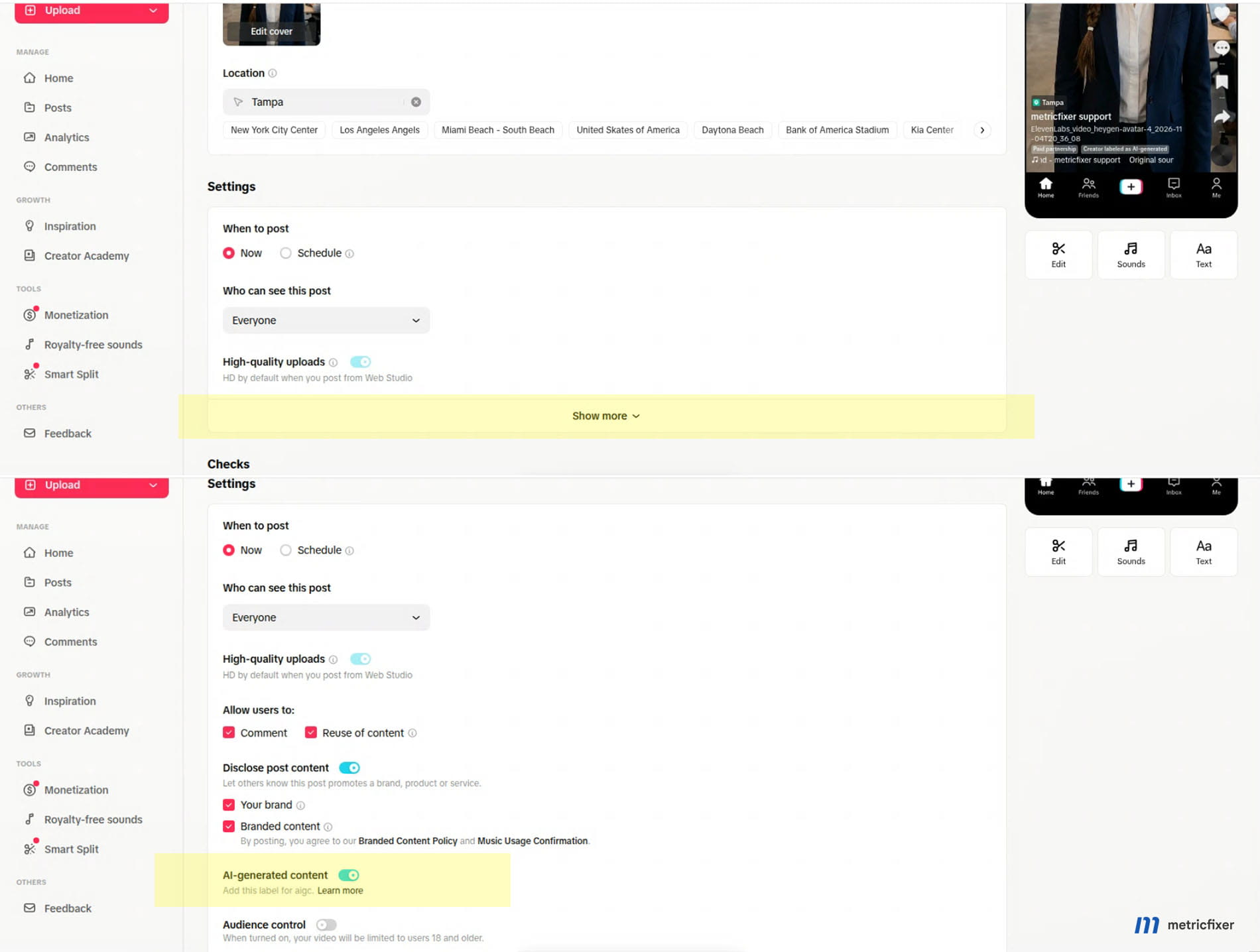
For a suspected mistake, preserve evidence before changing the post. Keep the original recording, project history, exported file, label screenshot and post identifier. Explain which elements were generated or edited when contacting the available support route. The reviewed guidance does not establish a universal removal control for every label type. Do not promise a client that support can simply switch an automatic label off.
A label question is different from an enforcement appeal. TikTok's notice and appeals rules say removal, restrictions and For You ineligibility can be appealed, and that recommendation restrictions appear in analytics. Use the route attached to the actual decision. A support request about provenance is not evidence that an enforcement decision has been reversed.
What survives editing and export
A visible label, file metadata and an invisible watermark are different things. TikTok's May 2024 announcement introduced automatic labeling for supported external content carrying C2PA Content Credentials, initially describing images and videos. It was not a promise to identify every generated file or every audio export.
C2PA records can describe the origin and editing history of media. The C2PA FAQ explains that provenance information can become separated from a file, and that durable credentials can use mechanisms such as watermarks or fingerprints to reconnect it. Its technical explainer makes a separate point: verifiable provenance is not a verdict that the depicted claim is true.
For example, a valid record could establish that an image was generated and edited in particular tools. It does not prove that a demonstration is scientifically sound, that a customer testimonial happened, or that a music license covers an ad. Those require other evidence.
TikTok's November 2025 transparency announcement described testing its own invisible-watermark approach alongside Content Credentials, partly because metadata may be lost during editing or reposting. Treat such signals as complementary systems, not interchangeable badges.
Recommended export check: compare the source, edited project and exact delivery file. Check available provenance with a suitable tool, avoid uploading confidential client material to an unapproved verification service, and record any unexpected loss. Preserve required notices and keep an honest disclosure plan even when the file no longer triggers an automatic label.
An absent credential is not proof of human authorship. Nor does detecting one establish that every frame was generated. For mixed productions, retain a shot-level explanation so a publisher can describe the synthetic component accurately. Do not make removal of provenance a delivery requirement.
Recommendations, viewer controls and reach
Permission to stay online is not a promise of recommendations
TikTok's For You feed standards explicitly distinguish content that can remain on the service from content suitable for broad recommendation. They also caution that low views do not necessarily mean a rule was broken. Accordingly, a drop in views is a reason to investigate, not a diagnosis of an "AI shadowban."
TikTok says enabling the AI disclosure setting alone does not affect distribution when the content otherwise complies. That statement is not a reach guarantee. Audience response, recommendation eligibility and other content characteristics are separate questions.
The AI preference control is not an account-wide off switch
The 19 November 2025 announcement described a test allowing viewers to request more or less AI-generated content through Manage Topics. It did not describe removing all AI material. A 10 July 2026 update still referred to testing these controls. Those announcements do not establish that the AI option is available in every account as of this review.
The general Manage topics instructions give the route Settings and privacy → Content preferences → Manage topics. They say these preferences affect the For You feed, not every part of TikTok, and may take time to influence recommendations. Check which options actually appear before promising a reader an AI slider.
For creators, the reasonable inference is that a viewer's preferences can change the audience available to a particular type of content. It does not follow that disclosure imposes a fixed ranking penalty. The reviewed documents provide no universal percentage reduction to use in a forecast.
AI spam is a separate enforcement issue
In the July 2026 update, TikTok announced testing improved detection of accounts dedicated to AI-generated spam, particularly around current affairs, financial advice and medical content. This is a warning about an account's activity and its consequences, not an announcement that every AI-assisted creator is banned.
Our recommended diagnostic order is to check the post's eligibility and any account notices first, inspect the published video and disclosures second, and then compare performance across genuinely comparable posts. Keep format, topic, duration, audience and posting conditions in view. A labeled animation and an unrelated viral recording are not a controlled experiment.
For discovery outside the app, metricfixer's guide to social-platform reporting in Google Search Console addresses a different measurement question. Keep external search visibility separate from TikTok's own recommendation and monetization reporting.
Realistic people, events and product claims
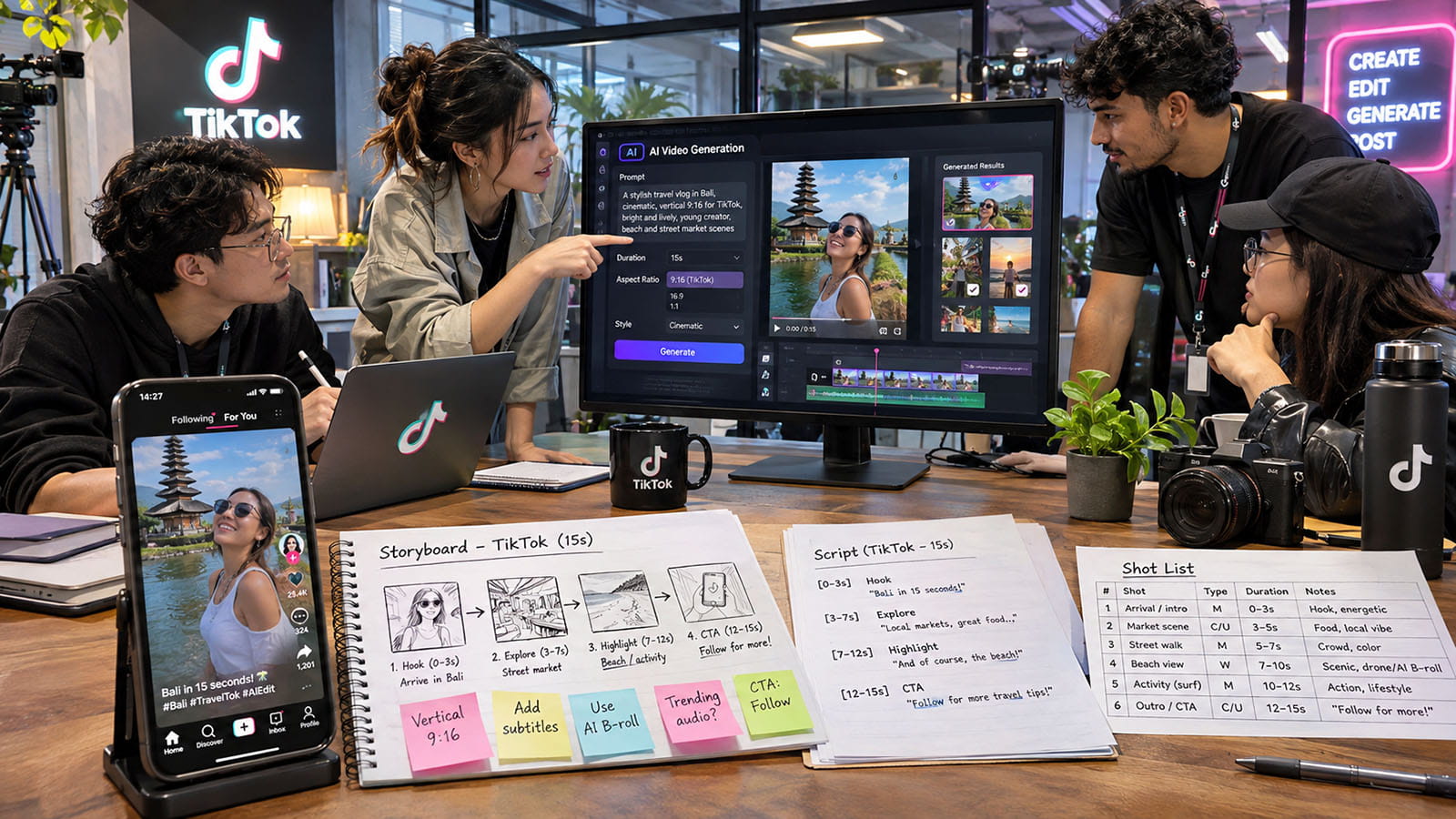
The most important review question is often what the audience is being asked to believe. A fictional host can introduce an explanation without pretending to be a real customer. The same host saying "this treatment cured me" creates a claim about personal experience that the production team must not invent.
In its report to the Disinformation Transparency Centre, TikTok describes prohibitions on nonconsensual private likenesses, harmful synthetic depictions, fabricated authoritative news and crisis events, and false public-figure endorsements. The report also distinguishes Shop-specific restrictions on fabricated experts and misleading product performance. A disclosure does not convert these scenarios into approved uses.
For a recognizable adult's face or voice, our recommended rights record should specify the script or context, permitted edits, languages, platforms and commercial use. Permission to use a photograph is not, by itself, a production brief authorizing every synthetic performance.
Do not simplify the rules around minors
The public documents reviewed are not perfectly aligned. The AI Help Center broadly lists under-18 likenesses among prohibited content; the detailed Community Guidelines discuss private figures, consent and specific harms. Do not turn that difference into a blanket assurance that parental consent plus an AI label makes a realistic minor likeness acceptable. Escalate the actual proposed use and applicable rules before production.
Check the claim, not just the pixels
For commerce, the US TikTok Shop Content Policy reaches beyond the video itself to promotional text and other presentation elements. Inaccurate demonstrations, unsupported claims and misleading product presentation remain problems even when an illustration looks polished.
A useful internal test is to ask: would a reasonable buyer believe this is the supplied product, an observed result, a genuine endorsement or a real qualification? When the answer is yes, require evidence for that belief. Replacing a factual claim with a tiny "AI-generated" note does not answer the underlying question.
Creator Rewards and other monetization
Being allowed to publish is not the same as being eligible to earn through a particular program. The US Creator Rewards terms require an eligible personal account, residence in a supported country, the applicable minimum age, account compliance, at least 10,000 authentic followers and 100,000 authentic video views in the preceding 30 days. Eligible videos must be at least one minute long. Local onboarding and terms still control the actual application.
Regional availability needs its own check. TikTok's 1 October 2025 Mexico launch names Mexico alongside the United States, the United Kingdom, Germany, Japan, South Korea, France and Brazil. These are markets confirmed in the official materials reviewed, not a claim that no expansion could have occurred elsewhere. Availability of TikTok or TikTok Shop in a country does not establish Creator Rewards eligibility there.
The program overview emphasizes originality, viewing duration, search value and audience engagement. TikTok's comparison with the former Creator Fund expressly excludes Duets, Stitches and sponsored content from its description of eligible original videos, and describes video-eligibility appeals.
None of these materials provides a blanket promise that an AI-generated video qualifies because it is a newly rendered file. Equally, they do not justify saying that all AI-assisted videos are automatically excluded. A one-minute export solves only the duration question.
For a creator planning an AI-heavy channel, our recommendation is to identify the value that is actually being produced: original reporting, an explanation, a documented experiment, a carefully developed story or another distinct contribution. Repeating a template with different generated scenery should not be the financial assumption on which the business depends. This is an editorial risk assessment, not an unpublished TikTok eligibility formula.
Keep reward eligibility, qualified performance and ordinary view totals separate in reporting. Before scaling production, inspect the program information and decisions available for the real account rather than projecting earnings from another creator's screenshots.
A similarly named program has different rules: the Effect Creator Rewards FAQ says AI-generated effects are currently ineligible for that program. That concerns effects made for TikTok, not a universal rule for all videos using AI. Do not combine the two programs in advice to creators.
Branded, affiliate, Shop and paid content
There are two separate disclosures to assess: how the media was made and why the product is being promoted. TikTok's commercial-content guidance requires disclosure for promotion of one's own business and for third-party promotion involving payment or another incentive. A commercial label does not explain synthetic media, and an AI label does not disclose a commercial relationship.
The business help instructions distinguish Promotional content for one's own business from Paid partnership for another brand. Choose the applicable relationship, not whichever label seems less intrusive.
| Intended use | Additional review |
|---|---|
| Ordinary editorial or entertainment post | AI disclosure, content safety, rights and the meaning of the final post. |
| Promotion of the publisher's own business | Commercial disclosure and evidence for product claims. |
| Paid, gifted or commission-based recommendation | The commercial relationship, partner permissions and an honest account of experience. |
| TikTok Shop product content | The relevant market's Shop rules, product accuracy and format-specific requirements. |
| Paid distribution, including reuse of a creator post | Advertising rules, paid-use rights, music, destination and final disclosures. |
The table is a recommended review structure. It does not mean a post becomes eligible for every use after the first row is completed.
Shop has its own AI policy
The US TikTok Shop AI policy requires proactive disclosure of fully generated or significantly AI-edited content. Its examples include artistic styles as well as realistic media. Do not apply the ordinary organic-post anime exception as a universal Shop exemption.
That policy also requires product accuracy and prohibits misleading AI displays and false professional endorsements. Review generated demonstrations against the real item and reliable evidence, including size, material, functions and expected results. These are US Shop requirements reviewed here; sellers in another market should consult that market's version.
A prerecorded post is not the same as Shop LIVE
The separate US Shop video and LIVE quality requirements restrict static or looping promotions and require meaningful, dynamic product presentation. For LIVE, they specifically prohibit non-real-time verbal interaction such as AI-generated voices or recorded audio. An AI-assisted prerecorded clip and an unattended synthetic livestream therefore need different decisions. Do not extrapolate a general statement that "AI is allowed" into approval for either format.
Paid promotion needs another check
TikTok's advertising policy on misleading and false content has its own disclosure requirements for significantly edited or AI-generated advertising, along with restrictions on misleading claims. Minor technical edits are treated differently. Moving a post into paid distribution is a new review point, not a reuse instruction that bypasses the policy.
Before promoting a creator's post, reconfirm the approved version, destination, product claims, commercial and AI disclosures, and permission for advertising use. Keep this decision separate from whether the same post generated organic views or Creator Rewards.
From generator to published post
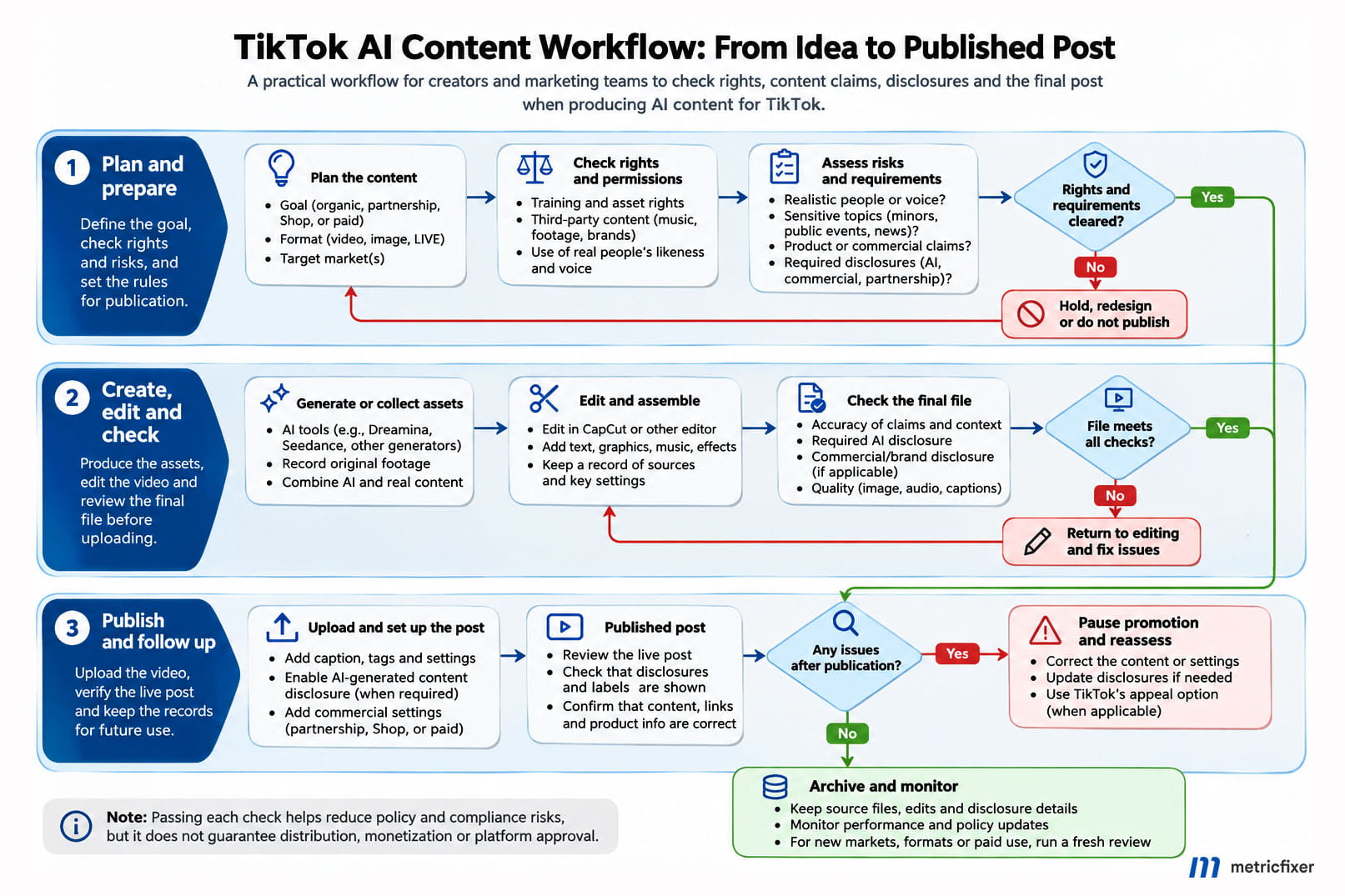
The following is metricfixer's recommended production workflow. It combines the checks above; it is not TikTok's official approval process.
Production chain: define the use and market → review inputs and permissions → generate and edit → check the actual export → resolve claims and disclosures → publish → inspect the viewer-facing post and any notices → archive the evidence. Stop and correct the material when a check fails; review it again when its use changes.
Before generation and during editing
Define the destination first. Write down the account, audience, market and intended use: organic post, sponsorship, Shop, LIVE or paid ad. Identify whether Creator Rewards is part of the plan. Resolve whether real people, sensitive subjects or product-performance claims are involved before commissioning realistic media.
Keep a usable source record. Retain reference permissions, scripts, generated outputs and the editing project. Mark synthetic sections and substantive alterations. Review translations and dubbing against the approved meaning rather than checking only whether the audio sounds fluent.
At export and handoff
Review the delivered file from start to finish. Inspect visuals, narration, on-screen text, subtitles, opening frame and ending. Ask whether a late edit introduced an unapproved claim or changed the apparent speaker. Record the filename or version identifier so the approved export cannot be confused with an earlier draft.
Check asset licenses separately from AI output. The reviewed non-US CapCut Materials License Agreement distinguishes personal-use assets from limited commercial-use materials and points US users to separate terms. Its Commercial Sounds license names CapCut, TikTok and TikTok for Business as permitted platforms; reuse elsewhere can require separate permissions. A client receiving a video should not assume it receives unrestricted rights to every included asset.
Accordingly, keep a destination-specific music and asset record. A TikTok-ready export is not automatically an Instagram-, YouTube- or website-ready export. Recheck the relevant license before changing the destination or paid-use scope.
At upload and after publication
Make the disclosure decision deliberately. Check AI and commercial settings independently, and add any necessary explanation of a visualization or synthetic presenter. Review the cover, caption and product link as part of the same message. Do not rely on an expected automatic label to correct an incomplete publishing process.
Inspect the published post. Confirm that the intended version, sound, caption, links and disclosures appear. Record any platform-applied label separately from the creator's choices. Check actual eligibility or enforcement notices through the account, and keep monitoring responsibilities with a named owner.
When the use changes, return to the relevant checks. A new language, different product, paid campaign or cross-platform repost can require a fresh review even when most of the video remains unchanged.
Contractor-to-brand handoff checklist
A handoff should let the publisher answer specific questions without reconstructing the production. Use this checklist as an internal sign-off, not as a declaration that TikTok has approved the material.
- Destination and owner: identify the account, market, format, intended commercial use and person responsible for publication.
- AI-use record: identify the generator, model or feature where known, editing tools, production date and synthetic scenes, faces or voices.
- Source permissions: provide the relevant image, voice, footage, music and asset permissions, including limits on paid use or cross-posting.
- Claim evidence: supply support for product features, results, endorsements and other factual assertions, with the approved script and translation.
- Final version: deliver the exact approved export, project or recoverable source files where agreed, and an unambiguous version identifier.
- Provenance record: describe available Content Credentials and watermarks, plus any unexplained changes during editing or export.
- Disclosure instruction: state the AI and commercial decisions separately, with proposed contextual wording and any unresolved issue.
- Publication evidence: assign responsibility for saving the post identifier, date, viewer-facing disclosure and relevant account notices.
- Correction and reuse: name the person who can pause promotion, correct an error, respond to a complaint and approve a new use.
The simplest operational rule is to hold the release when a material question remains unresolved. Do not ask the uploader to infer missing rights, invent claim evidence or guess which label the contractor intended.
Legal obligations beyond TikTok
A platform control is not a complete legal assessment. The European Commission's Article 50 guidance says the AI Act transparency rules apply from 2 August 2026. It distinguishes machine-readable marking duties for AI providers from disclosure duties for organizations and others using those systems, including relevant deepfakes and certain public-interest text. Scope, exceptions and transitional arrangements matter; this is not a rule that every AI-assisted caption must carry the same label.
For a brand publishing in the EU, assess the actual synthetic media and its use rather than assuming the TikTok toggle resolves every obligation. Do not confuse a transition for a provider's technical marking system with permission for a publisher to conceal a deepfake.
This article does not determine copyright ownership, likeness rights or the advertising law of every market. Those are separate checks for the particular production. Keep their outcome in the handoff record and obtain qualified advice for material uncertainty, especially where a realistic person or consequential product claim is involved.
Methodology and sources
This is a document-based review completed on 12 November 2026. It uses TikTok's Community Guidelines, Help Center, regional Shop and advertising policies, program terms, and dated Newsroom announcements. CapCut's product and contract pages address the production side; C2PA documentation addresses provenance; European Commission guidance supplies the limited EU legal context. Source links appear beside the relevant claims rather than in a duplicate reference list.
Requirements and contractual conditions take priority over product marketing. Announcements establish what was announced on a date, not universal account availability. The 2025 AI preference announcement and the July 2026 update are therefore described as tests. The Shop analysis uses explicitly identified US materials; the country examples for Creator Rewards are confirmed examples, not an independently verified exhaustive worldwide list.
Public help pages, translations and policy pages can differ in wording or update timing. The article flags the difference concerning minors rather than presenting a negotiated interpretation as an official answer. Some support material was available through indexed official text when its direct page redirected or could not be retrieved. No claim is made that every document or interface was freshly served to a logged-in account.
No account-level experiment, controlled reach study or end-to-end metadata-survival test was performed for this article. The tables, workflow and checklist are metricfixer's editorial synthesis. Hypothetical production examples are not client cases. Screenshot positions are reserved for separately captured, authorized evidence, not generated interface illustrations.
This article provides editorial, technical and operational information, not legal advice or a guarantee of publication, reach, monetization or advertising approval. metricfixer is not affiliated with TikTok, ByteDance, CapCut, Dreamina, C2PA or the other organizations mentioned. Rules, terms, interfaces and availability can change and may differ by market, account and format. Check the requirements that apply to the actual content and intended use before publication.
Expert help with this topic
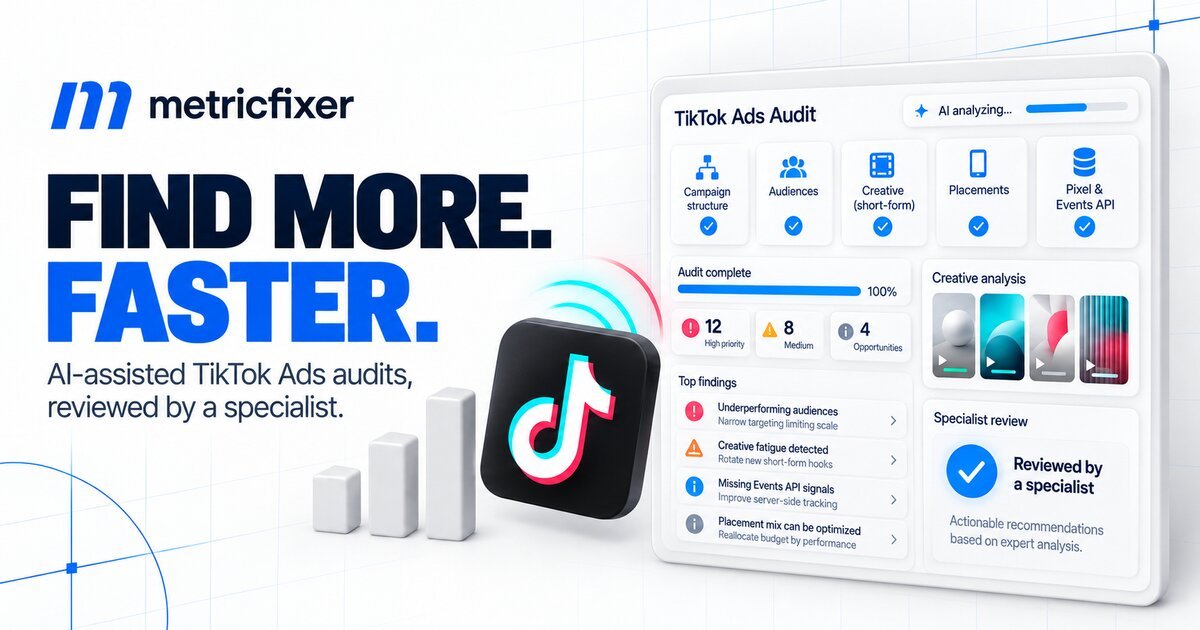 AI-Assisted TikTok Ads Account Audit
Investigate a TikTok Ads question with specialist-planned, specialist-reviewed AI-assisted analysis and a PDF report.
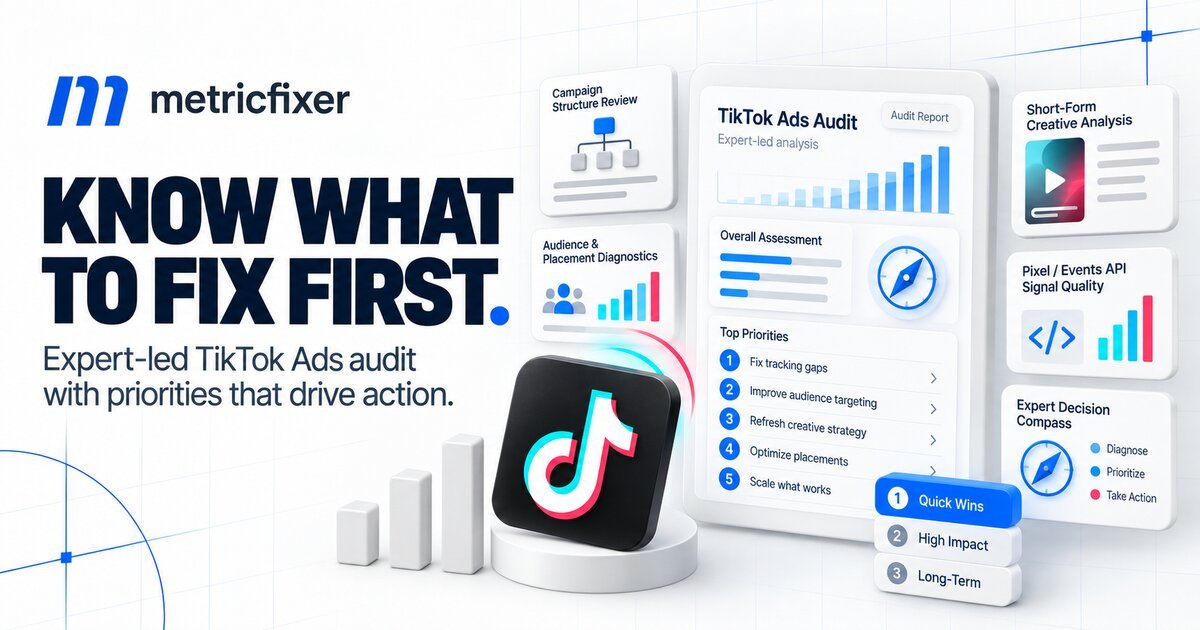 Expert-Led TikTok Ads Account Audit
Get a TikTok Ads diagnosis led by a specialist with at least 8 years of PPC experience and delivered as a PDF report.
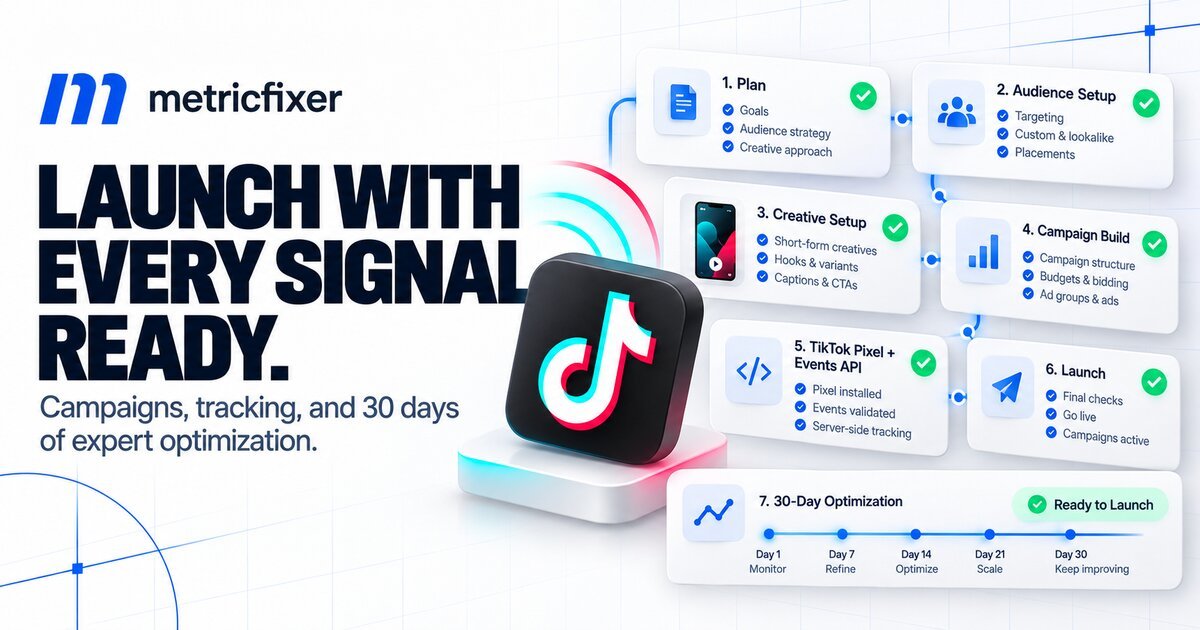 TikTok Ads Full Setup
Launch TikTok Ads from an agreed strategy with ready standard measurement and 30 calendar days of initial management.
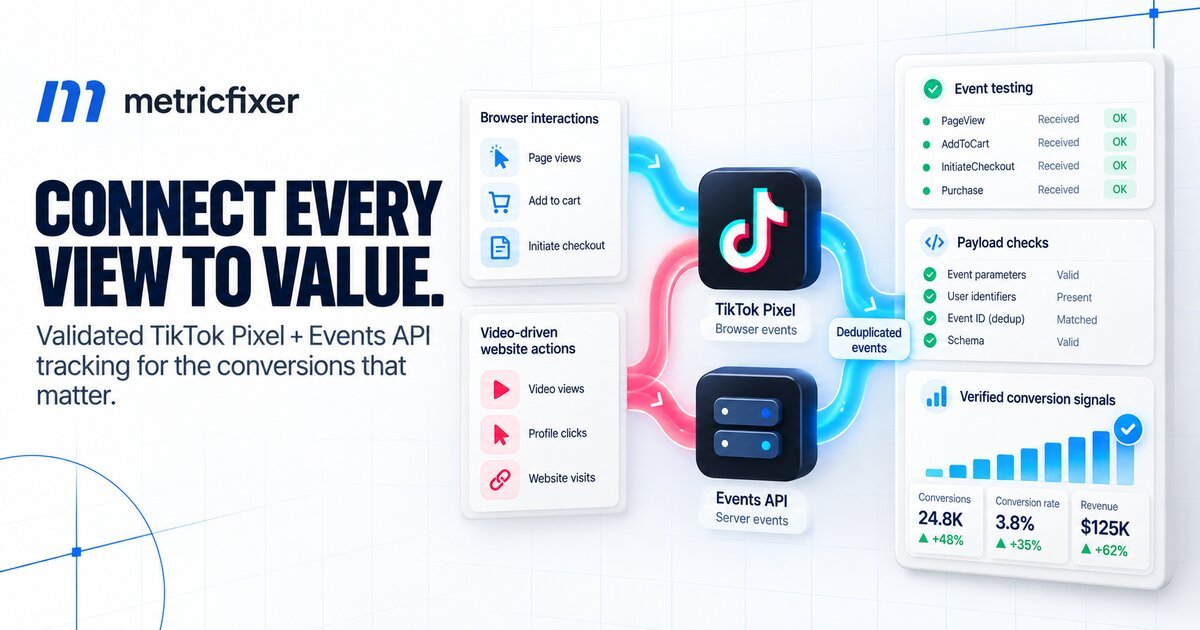 TikTok Pixel and Events API Tracking Setup
Measure meaningful customer actions with TikTok Pixel and a suitable Events API path, including browser/server overlap checks.