
Published Oct 25, 2026
How to Configure Cookiebot and Google Consent Mode for a Global Website
A practical global CMP architecture for Cookiebot and Google Consent Mode: group countries by consent model, route EEA, U.S., Brazil, notice-and-preference, and special-market traffic, honor GPC, and test every downstream signal.
Category: Consent Management · By metricfixer AI Studio
A global website does not need a separate cookie banner for every country, but it does need more than one universal consent assumption. The practical task is to route each visitor into the correct privacy and advertising state: prior opt-in where optional storage must remain off, opt-out and browser-signal handling in covered U.S. states, transparent notice and preference controls in many other markets, and dedicated review for countries with special transfer, localization, profiling, or platform rules. This guide turns that regional map into a deployable Cookiebot and Google Consent Mode architecture.
Practical default: organize the site around a small number of regional rule families rather than one domain group per country. Keep the real domain in one primary Cookiebot group, use alternative groups only as regional configuration profiles, make the primary profile a conservative fallback for unresolved locations, and route visitors to strict opt-in, U.S. opt-out, Brazil/LGPD, and notice-and-preference experiences as needed. Set Google consent before any Google tag processes data, send all four core signals, honor Global Privacy Control independently of the visible banner, and test browser, server-side, and uploaded-data paths separately.
Executive summary
Global consent is best understood as a signal-routing system, not as a collection of popups. The same website can be subject to several different kinds of rules at the same time:
- Device-access rules can require prior permission before non-essential cookies or similar technologies are stored or read. The European ePrivacy model is the clearest example.
- General privacy laws govern lawful processing, transparency, objection, withdrawal, transfers, sensitive data, and proof, even where there is no cookie-specific statute.
- U.S.-style opt-out laws can focus on sale, sharing, targeted advertising, profiling, and universal opt-out mechanisms rather than prior cookie opt-in.
- Private technical frameworks such as Google Consent Mode, IAB TCF, IAB GPP, Microsoft UET Consent Mode, and Amazon consent signals translate a legal or product decision into machine-readable values.
This is why one global banner can fail in opposite directions. An EU-style opt-in banner shown everywhere may reduce analytics and advertising data in markets where prior opt-in is not the selected model, while still failing to recognize a valid U.S. browser-level opt-out. A U.S.-style notice-and-opt-out banner can leave optional trackers active too early for EEA or UK visitors. A banner that looks correct can also fail technically if the user's choice never reaches Google Ads, GA4, server-side GTM, a conversion API, or an uploaded customer list.
The regional comparison in metricfixer's Website Consent Signals Around the World should be treated as the legal and UX map for this implementation. The article you are reading focuses on the next layer: how to translate that map into Cookiebot configurations, Google consent states, browser-signal handling, tag rules, evidence, and QA.
The companion Online advertising guide, How Global Advertisers Should Configure GA4 Audiences, Google Ads, and Regional Consent, continues from this website layer into the GA4-Google Ads link, audience sharing, regional personalization, U.S. Restricted Data Processing, Data Manager defaults, Customer Match, enhanced conversions, and uploaded-data governance.
For most international ecommerce, SaaS, lead-generation, travel, marketplace, and media websites, a practical architecture has four operational profiles:
- Strict prior opt-in: EEA and UK by default, usually Switzerland for Google advertising consistency, and Brazil where the business adopts consent for non-essential cookies.
- U.S. notice, opt-out, and universal-signal handling: one U.S. profile with state-aware logic, GPC handling, sale/share and targeted-advertising controls, and Google Restricted Data Processing where appropriate.
- Notice and preference: selected markets such as Canada, Uruguay, South Africa, Kenya, Nigeria, Japan, Singapore, Australia, and New Zealand, subject to the site's actual processing and local assessment.
- Special-market review: countries such as China, Russia, Belarus, Kazakhstan, Moldova, or other markets where localization, cross-border transfers, account-level personalization, or local consent rules justify a dedicated implementation or complete suppression of the global advertising stack.
These profiles are implementation clusters, not declarations that the laws inside each cluster are identical. A company should split a cluster whenever the actual legal basis, first-layer controls, vendor disclosures, age rules, local language, data flow, or platform configuration materially differs.

A global audience does not mean one legal state
Before configuring Cookiebot, define what “global” means for the business. A site can be technically accessible worldwide while commercially targeting only ten countries. Conversely, a single English-language site may actively ship to dozens of markets, run region-specific Google Ads campaigns, collect local tax identifiers, and upload customer data from several CRMs.
Create a market worksheet that separates:
- countries where the company has an entity, employees, or local establishment;
- countries actively targeted through advertising, language, pricing, shipping, sales teams, or local domains;
- countries that generate meaningful traffic but are not commercial priorities;
- countries where the site does not intend to provide analytics or advertising services;
- the location of the visitor, the customer's stated residence, and the billing or delivery country;
- the controller or business unit responsible for each data flow;
- the vendors, tags, SDKs, APIs, server endpoints, and upload destinations used in each market.
IP geolocation is useful for routing a banner, but it is not a complete legal determination. A traveler, VPN user, corporate proxy, mobile carrier gateway, or customer with a foreign billing address can be classified differently by different systems. The CMP therefore needs a documented fallback for unresolved or contradictory locations. For a genuinely global site, the lowest-risk technical fallback is usually the stricter profile, not an automatic assumption that consent is granted.
Also distinguish ad campaign targeting from site availability. Excluding Europe from Google Ads does not stop an EEA user from visiting the website organically, through a referral, or through a direct URL. Regional consent logic follows the user and the data flow, not only the campaign settings.
Regional rule families for a global CMP
The table below converts the broader country-by-country review into implementation families. It is deliberately operational. It does not claim that every jurisdiction in a row has the same law.
| Region or market | Practical default for optional tracking | Banner or preference pattern | Recommended global profile |
|---|---|---|---|
| EEA | Keep non-essential storage and tracking off until a valid affirmative choice. | Reject, customize, and accept controls; no preselected optional purposes; easy withdrawal. | Strict prior opt-in. |
| France | Same prior opt-in baseline, with particularly strong attention to refusal parity. | Place a clear reject-all choice on the first layer rather than hiding it in settings. | Use the EEA profile if it already meets the stricter first-layer pattern; otherwise create a French sub-profile. |
| United Kingdom | Non-essential cookies and similar technologies should normally wait for consent. | Clear first-layer choices and an equally usable rejection route. | Strict prior opt-in. |
| Switzerland | Local rules can be less uniformly opt-in than the EEA model, but Google names Switzerland in its EU User Consent Policy. | A European-style profile is often the simpler operational choice for sites using Google advertising features. | Usually strict prior opt-in, or a separately approved Swiss hybrid profile. |
| California and U.S. states with universal opt-out requirements | Do not treat the problem as prior cookie opt-in only. Honor sale, sharing, targeted-advertising, and universal-signal rights where applicable. | Notice, preference center, visible opt-out route, and GPC or other recognized signal handling. | U.S. opt-out and browser-signal profile. |
| Other U.S. privacy-law states | Usually notice and opt-out rather than a European prior-consent default, with state-specific differences. | State-aware privacy link or preference center; sensitive-data and child-data controls where relevant. | U.S. profile, with state logic inside it. |
| Canada | Meaningful consent and understandable notice matter when identifiers support behavioral advertising or other non-obvious uses. | Clear category and advertising choices; easy withdrawal or opt-out. | Notice-and-preference profile unless the business adopts a stricter common standard. |
| Brazil | Where consent is used for non-essential cookies, start optional categories off and record the choice. | A visible reject-all control and category-level detail are the practical low-risk pattern. | Brazil/LGPD opt-in profile, often close to the EEA design. |
| Uruguay | Focus on transparency around cookies and profiling, with objection or preference controls. | Explain categories and profiling consequences rather than copying a banner layout mechanically. | Notice-and-preference or Latin America profile. |
| Other Latin American markets | General privacy laws may govern identifiers, profiling, transfers, notice, consent, and objection even where no regulator prescribes one cookie-banner layout. | Use a reviewed notice-and-preference profile only after confirming the countries actually targeted and the data uses involved. | Regional notice-and-preference profile or a dedicated local profile where the market is material. |
| South Africa, Kenya, and Nigeria | General privacy, direct-marketing, lawful-processing, notice, objection, and withdrawal rules are more relevant than one uniform cookie statute. | Use the CMP as a transparency, choice, and evidence layer. | Notice-and-preference profile, adapted to the actual market and processing. |
| Japan | Review whether cookie-derived identifiers become personal data or personally referable information in transfers. | Accurate ad-tech transfer disclosures and opt-out or consent controls where required. | Notice-and-preference profile with a Japan-specific disclosure review. |
| China | Consent, personalized recommendation, profiling, sensitive information, and cross-border processing can require separate controls. | Privacy notice, consent prompts, personalization switches, and account-level settings may all be relevant. | Special-market profile or a locally approved stack. |
| Singapore | Consent, notification, purpose limitation, and reasonableness operate through the general privacy framework. | Clear notice and meaningful choices for advertising and behavioral profiling. | Notice-and-preference profile. |
| Thailand | Practical implementations distinguish necessary and optional categories and explain refusal. | A category-based CMP can be appropriate even though the source is broader privacy law. | Notice-and-preference or a stricter opt-in profile after local review. |
| Australia and New Zealand | No general EU-style cookie-banner statute, but notice, fair handling, unexpected tracking, and consent can still matter. | Transparent notice and a preference center for advertising or profiling. | Notice-and-preference profile. |
| Belarus | Regulator materials distinguish necessary cookies from optional categories. | Separate categories and record the user's choice for optional cookies. | Dedicated profile or the strict profile after local review. |
| Russia and Kazakhstan | General personal-data, consent, and localization requirements may be more important than a prescribed banner design. | Local notices and consent where required; review data localization and cross-border architecture. | Special-market profile or suppress non-essential global tags. |
| Moldova | Law No. 195/2024 is scheduled to enter into force on 23 August 2026, so the regulatory position should be rechecked at launch and again after implementation guidance develops. | Do not copy the EEA or rest-of-world profile without confirming the effective framework. | Temporary special-review profile. |
A business does not need to implement every row merely because the site can be opened there. The relevant question is whether the company targets the market, processes meaningful traffic, uses data in a way covered by local rules, or is subject to a platform requirement. A global CMP should be expandable, but unnecessary profiles create maintenance risk.
Recommended Cookiebot architecture
Cookiebot can support multiple regional experiences through domain groups, geolocation, banner presets, consent records, cookie scans, and integrations with Google Consent Mode. The important design decision is how many profiles the business can realistically maintain and test.
Option 1: one strict banner globally
The simplest global implementation is one primary domain group with a prior-opt-in banner shown everywhere. Optional analytics and advertising remain off until the visitor chooses.
This can be appropriate when:
- the company prefers one high-trust global standard;
- its major markets already use prior opt-in;
- measurement loss outside those markets is acceptable;
- the legal, product, and support teams want one interface and one consent record model.
However, it is not automatically sufficient for U.S. state requirements. The implementation must still detect and honor GPC or another applicable universal opt-out signal, expose the required sale/share or targeted-advertising controls, and propagate the result to downstream vendors. A strict cookie banner is not a substitute for browser-signal handling.
Option 2: a two-profile global model
A practical small-business architecture uses:
- Primary strict profile: EEA, UK, Switzerland, Brazil, and unresolved locations.
- Alternative U.S. and rest-of-world profile: notice, preference, U.S. opt-out logic, and GPC handling.
This is easier to maintain than a country-by-country system, but it can be too coarse for a business with material Canadian, Chinese, Japanese, or regulated Latin American operations. It also requires careful U.S. state logic inside the second profile.
Option 3: a four- or five-profile model
This is the recommended architecture for a genuinely global project:
- Primary: Global strict fallback / EEA, UK, and Switzerland. The real domain, scans, cookie classifications, consent records, and reporting remain here.
- Alternative: United States. Notice, state-specific opt-out language, GPC response, and an accessible privacy preferences control.
- Alternative: Brazil. A first-layer reject option, category-level choices, and LGPD-aligned wording.
- Alternative: Notice and preference. Selected Canada, Latin America, Africa, Asia, and Oceania markets where this model is approved.
- Optional: Special markets. A separate profile, local platform, or no-ad-tech path for China, Russia, Belarus, Kazakhstan, Moldova, or another market requiring distinct governance.
Cookiebot's multi-legislation documentation imposes a critical operational rule: only the primary domain group should contain the real domain. Alternative groups are configuration profiles. Adding the same domain to several groups can duplicate scanning and charges, while splitting the source of truth for classification and reporting.
For a global site, making the strict profile primary has one additional benefit: a visitor who does not match any alternative geolocation rule receives the conservative fallback. A U.S.-first or rest-of-world primary profile can also work, but the fallback must then be handled separately.
Cookiebot does not currently provide one generic EUROPE code for regional implementation. The team must either use the appropriate distribution controls or maintain the actual country list. Do not assume that a label such as “EU” includes Iceland, Liechtenstein, Norway, the UK, or Switzerland.
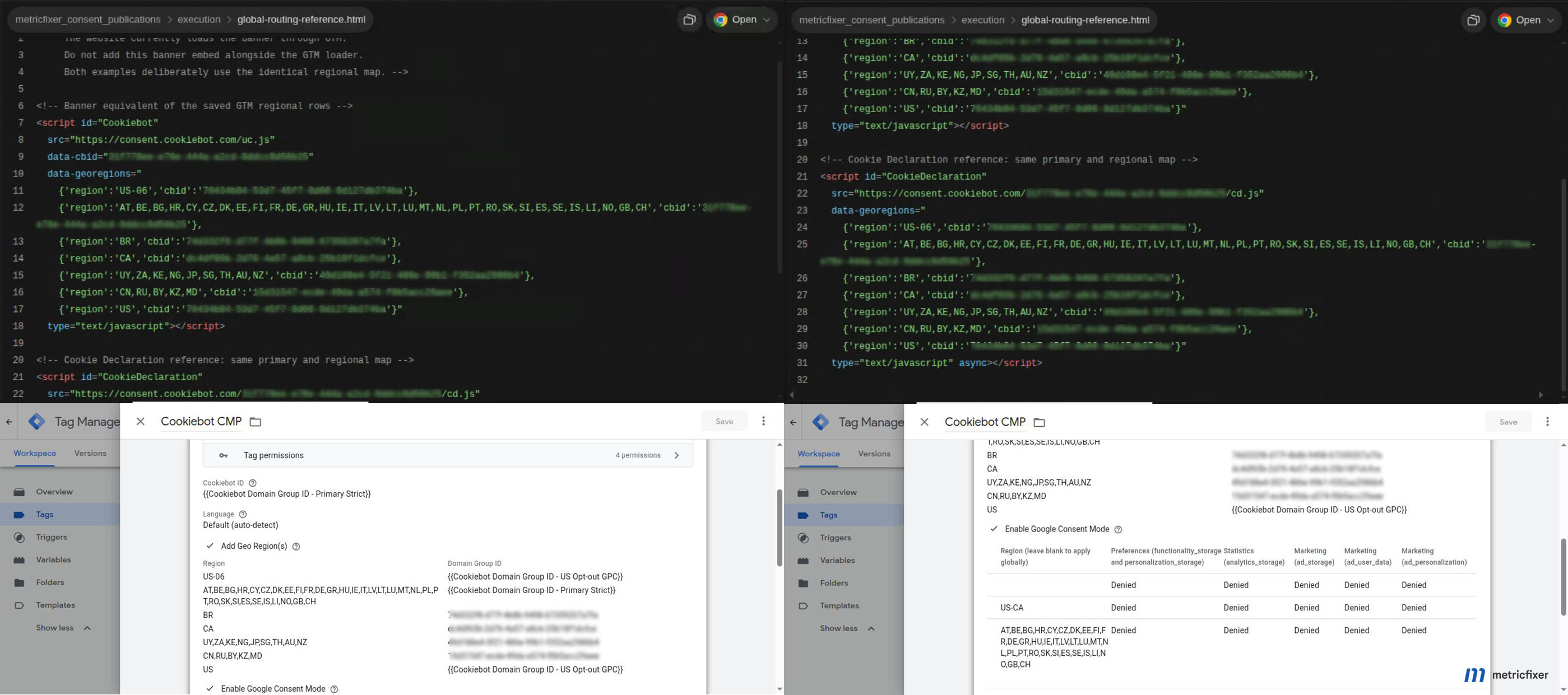
A direct-script implementation can route alternative domain-group IDs with data-georegions. The example below is schematic. Use the exact region codes and IDs from the production account, and apply the matching routing to the Cookie Declaration.
<script
  id="Cookiebot"
  src="https://consent.cookiebot.com/uc.js"
  data-cbid="PRIMARY-STRICT-DOMAIN-GROUP-ID"
  data-blockingmode="auto"
  data-georegions="{'region':'US','cbid':'US-PROFILE-ID'},{'region':'BR','cbid':'BRAZIL-PROFILE-ID'},{'region':'CA,UY,ZA,KE,NG,JP,SG,TH,AU,NZ','cbid':'NOTICE-PROFILE-ID'}"
  type="text/javascript">
</script>
When Cookiebot is delivered through Google Tag Manager, use the current CMP template and its regional mapping fields. The CMP tag should fire on Consent Initialization - All Pages, before ordinary initialization and page-view tags. Regional routing inside Cookiebot and regional defaults inside Google Consent Mode must describe the same market model.
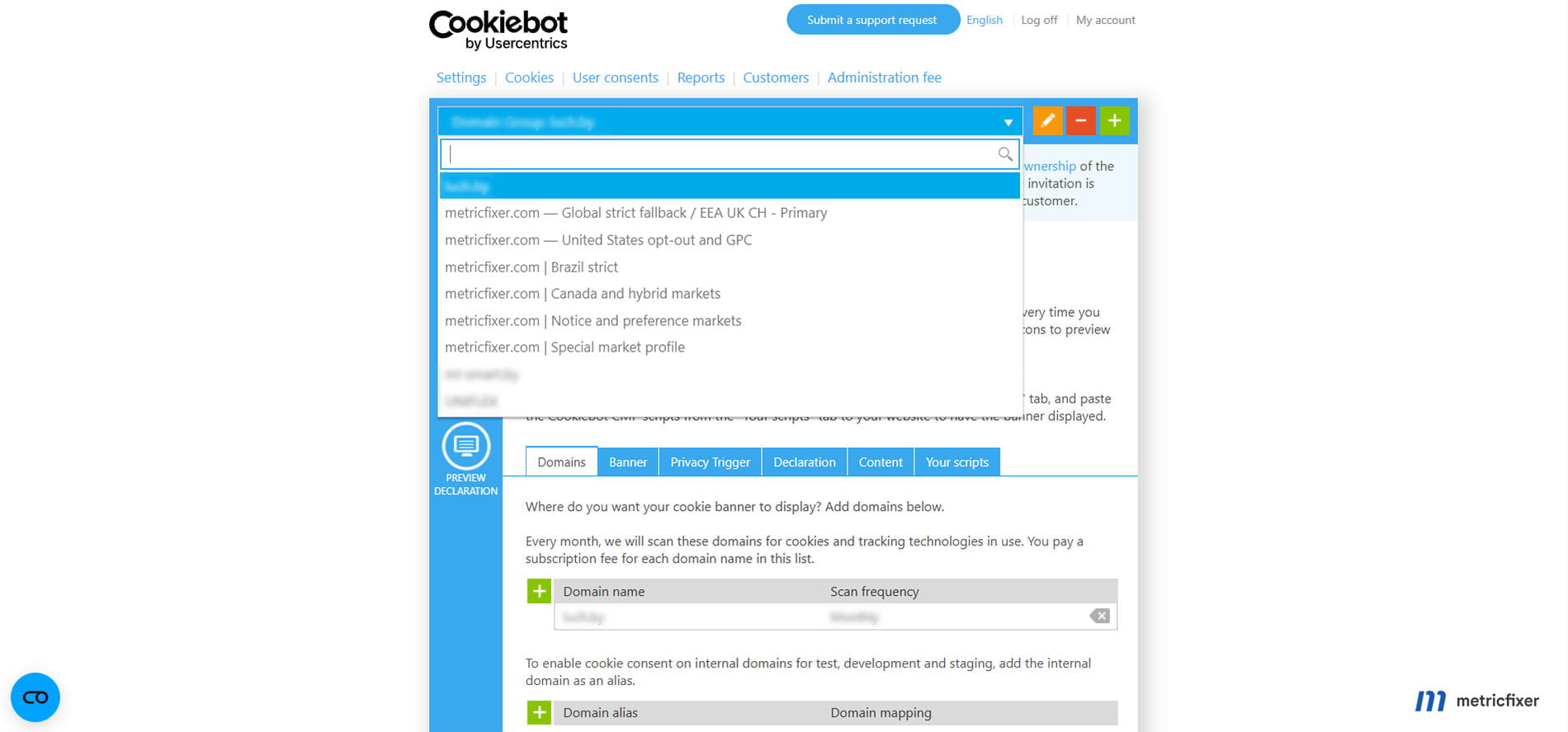
Banner and preference-center design by profile
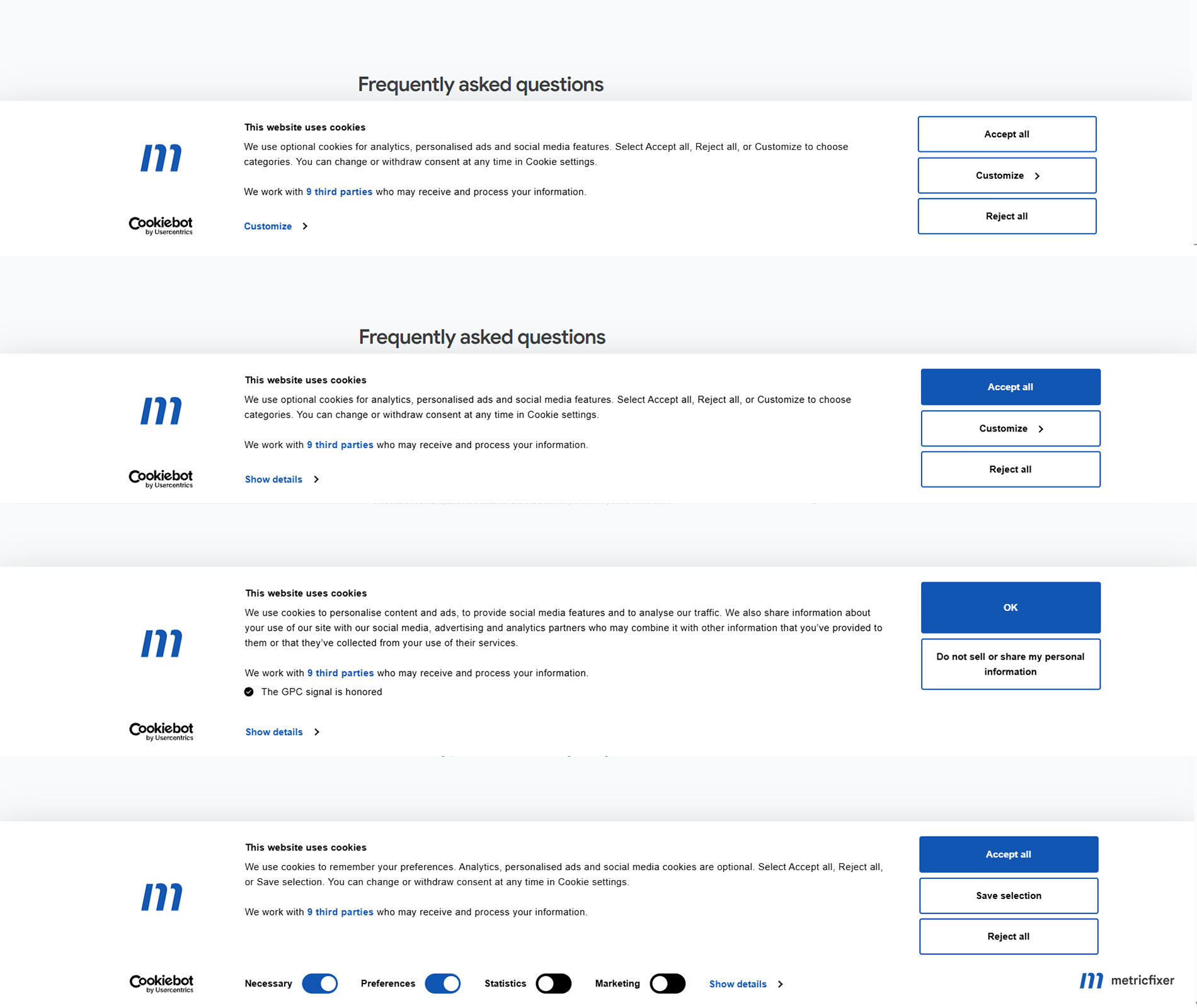
A global CMP can reuse one visual system, but the decision model should change with the approved regional profile. The first layer, default state, browser-signal behavior, and persistent privacy controls are more important than cosmetic differences.
| Profile | First-layer pattern | Default and downstream behavior |
|---|---|---|
| EEA / UK strict | Visible reject, customize, and accept choices; optional categories off; no preselected optional purposes. | Google advertising and analytics states remain denied or blocked until the relevant affirmative choice, according to the approved Basic or Advanced design. |
| Brazil strict | Visible refusal for non-necessary cookies plus category-level detail and locally reviewed wording. | Optional categories remain off until the selected legal basis and user choice permit them. |
| U.S. opt-out / GPC | Notice, privacy preferences, sale/share and targeted-advertising controls, plus clear confirmation when a recognized browser signal is applied. | GPC or another applicable universal opt-out must restrict the relevant processing even before the visitor uses the website preference interface. |
| Notice and preference | Clear disclosure, category or purpose controls, and an easy persistent route to object, opt out, or withdraw. | Use the locally approved default; do not assume that a less prescriptive banner means unrestricted advertising use. |
| Special market | Local-language prompt, account setting, separate vendor stack, or no non-essential advertising technology. | Apply the market-specific transfer, localization, profiling, or platform decision before loading the global advertising stack. |
Option 4: no visible banner in selected markets
A global site does not necessarily need to show the same popup in every country. For a market where the approved implementation relies on transparent notice, a persistent privacy link, and opt-out or objection controls rather than prior cookie consent, the regional profile may load without a first-layer banner.
This path is reasonable only when all of the following are documented:
- the market does not require the selected optional technologies to wait for prior consent in the site's actual use case;
- the privacy and cookie notices clearly explain the technologies, purposes, recipients, and choices;
- the user can reach a persistent preference or opt-out control;
- GPC or another applicable browser-level preference is still honored before conflicting advertising use;
- Google and other platform-specific signals receive the correct state;
- server-side and uploaded-data workflows apply the same restrictions.
“No visible banner” is therefore a regional interface choice, not permission to hard-code every Google consent type as granted. It is also not a suitable fallback for strict opt-in traffic. The website still needs a routing layer so that EEA, UK, Brazilian, U.S. opt-out, and special-market visitors receive the correct behavior.
Option 5: server, CDN, or custom privacy-platform routing
Large organizations may route privacy configurations before the page is rendered. The server or CDN can select a regional CMP property, omit non-essential vendors entirely, choose a local analytics stack, or send a country/market value into the client-side privacy layer.
This architecture is useful when:
- the company has different controllers, sites, or legal entities by region;
- China, Russia, or another market uses a separate hosting and vendor stack;
- the site must prevent even the CMP or Google bootstrap from loading in a territory;
- server-side events and CRM activation are controlled by a central policy engine;
- the organization needs one consent record across web, app, CRM, and customer support.
The server decision must not be cached globally. A CDN that varies HTML by geography should include the correct cache key and a safe fallback. Otherwise, an EEA visitor can receive a U.S. script bundle, or a U.S. visitor can be unnecessarily held in the strict state.
Configure Google Consent Mode as a regional state machine
Google Consent Mode is not the banner and does not determine which law applies. It receives the decision from the CMP or another consent system and changes the behavior of Google tags.
| Consent type | What it controls | Global implementation note |
|---|---|---|
analytics_storage |
Storage used for analytics, such as analytics cookies. | Can be granted independently of marketing where the approved banner permits statistics but not advertising. |
ad_storage |
Advertising-related storage and, from 15 June 2026, the principal Google Ads control for cookies and identifiers collected through the Analytics tag or SDK for linked Ads use. | Do not use Google Signals as a substitute for this visit-level state. |
ad_user_data |
Sending user data to Google for advertising-related measurement, including supported user-provided-data use cases. | Relevant to enhanced conversions and other first-party identifier flows. |
ad_personalization |
Use of data for personalized advertising and remarketing. | Google has announced that later in 2026 this signal will become the exclusive control for using linked Analytics data for personalization in Google Ads. |
For a custom implementation, Google supports regional consent defaults. The safest pattern is to define a global fallback and then more specific rows for regions whose approved defaults differ. The following example is illustrative, not a legal recommendation for any particular country:
window.dataLayer = window.dataLayer || [];
function gtag() { dataLayer.push(arguments); }

// Strict opt-in markets and conservative fallback.
gtag('consent', 'default', {
  ad_storage: 'denied',
  analytics_storage: 'denied',
  ad_user_data: 'denied',
  ad_personalization: 'denied',
  region: ['AT', 'BE', 'BR', 'CH', 'DE', 'DK', 'ES', 'FI', 'FR', 'GB', 'IE', 'IS', 'IT', 'LI', 'NL', 'NO', 'PL', 'PT', 'SE']
});

// Global fallback. Change only after the approved regional model is documented.
gtag('consent', 'default', {
  ad_storage: 'denied',
  analytics_storage: 'denied',
  ad_user_data: 'denied',
  ad_personalization: 'denied'
});
In production, use the complete region list and the CMP's supported API. Do not maintain a partial European list copied from an example. If a CMP template already sets and updates consent, avoid a second custom default unless precedence and timing have been tested.
Basic and Advanced Consent Mode can differ by policy, not by dashboard preference
| Mode | Before the required consent | Global use |
|---|---|---|
| Basic Consent Mode | The relevant Google tags remain blocked; no Google data is sent before the user grants the required consent. | Use in markets or data flows where the approved design requires no pre-consent Google request. |
| Advanced Consent Mode | Google tags can load with denied states and send cookieless pings. | Use only where the pre-consent transmission, disclosure, and modeling design have been approved. Do not describe it as “Google is disabled.” |
A global website can run Basic mode in one profile and Advanced mode in another, but this increases testing complexity. The team must verify the live network behavior, not only the label selected in the CMP interface.
Global Privacy Control requires a separate U.S. decision path
GPC is a browser or device-level signal that can express an opt-out preference in covered U.S. contexts. It is not the same as Do Not Track, and it is not represented completely by the four Google Consent Mode values.
Cookiebot currently responds to GPC only for specified banner types and behaviors. Its documentation describes changes for Decline Only, Do Not Sell, and multilevel configurations; other banner setups may not change automatically. Therefore, a global implementation must test the exact U.S. banner, not assume that installing Cookiebot makes every GPC path work.
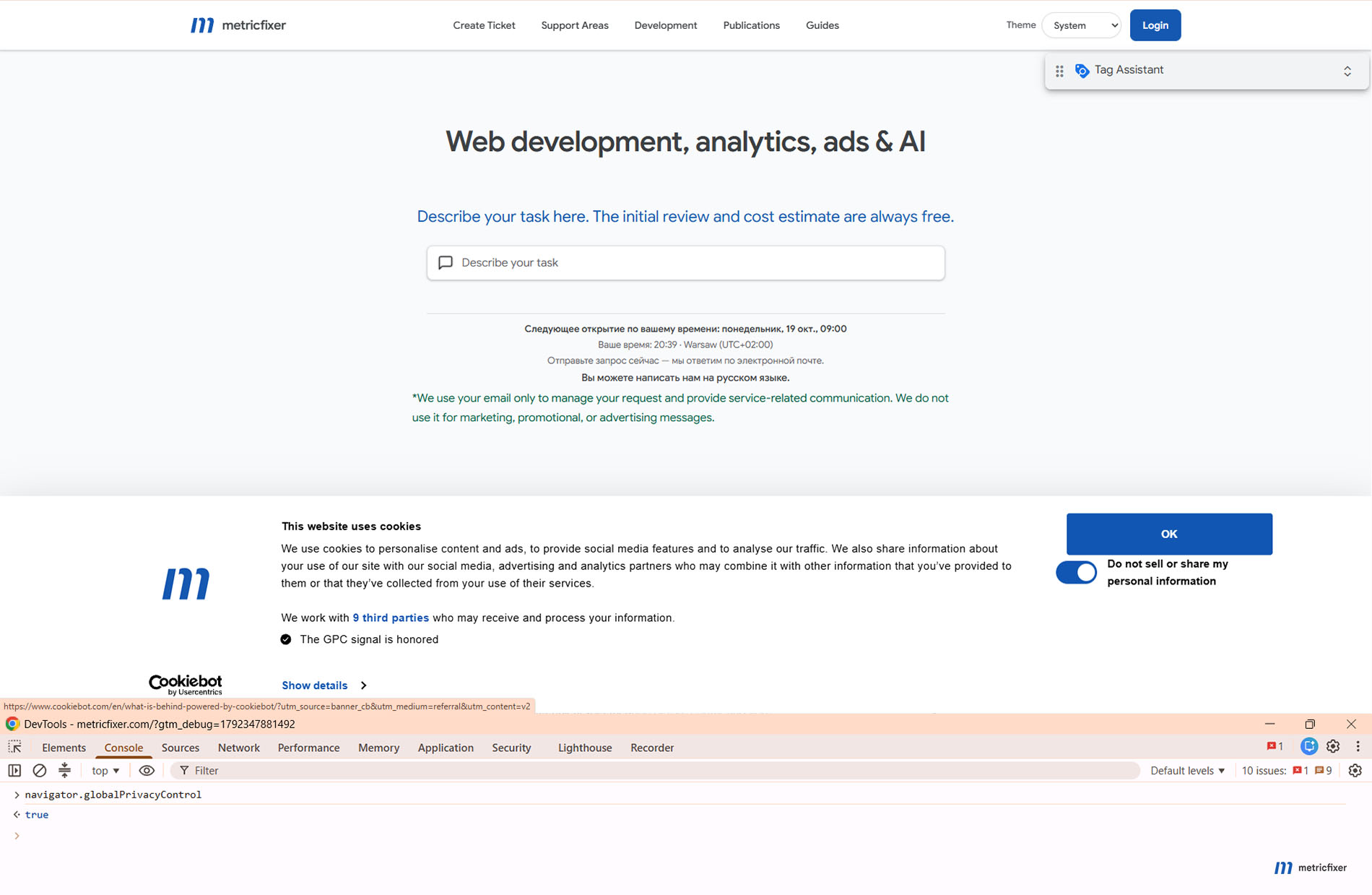
The U.S. signal flow should be:
U.S. browser-signal flow: visitor requests the page → the site or CMP checks the applicable location and browser-level signal → a valid GPC or universal opt-out preference is applied before targeted-advertising or sale/share processing → the site records the signal and exposes confirmation or preferences → Google, Meta, Microsoft, programmatic, server-side, and CRM activation paths receive the corresponding restrictions.
Google states that, in applicable U.S. states, it can receive GPC directly and activate Restricted Data Processing for relevant ad requests. Advertisers can also send the restricted_data_processing parameter or enable the relevant account setting. RDP is a Google-specific limitation; it does not control every other vendor, and it does not replace the site's own response to the opt-out.
Separate TCF, GPP, Consent Mode, and the visible banner
A global CMP may generate several signals from one user interaction. They have different scopes:
| Framework | Primary role | When to use it |
|---|---|---|
| Google Consent Mode | Controls Google tag behavior for analytics, advertising storage, advertising user data, and personalization. | Use wherever Google tags need to follow a visitor's choice. |
| IAB Europe TCF | Communicates purposes, features, legal bases, and vendor choices in the European advertising supply chain. | Relevant mainly to publishers and ad-tech implementations that participate in TCF. It is not required for every advertiser website. |
| IAB Global Privacy Protocol | Provides a multi-jurisdiction structure for privacy strings and sections. | Useful where the CMP, publishers, exchanges, and vendors actually support the relevant sections. Do not assume a generic banner automatically generates every required GPP signal. |
| Cookiebot category state | Stores the site's necessary, preferences, statistics, and marketing choices and controls classified technologies. | Map it deliberately to platform-specific signals; category names alone do not govern downstream use. |
| GPC or another universal opt-out signal | Expresses a browser-level opt-out preference in covered contexts. | Read it before relying on the site's own U.S. preference UI. |
Cookiebot supports an optional IAB Europe TCF v2.3 integration and is registered as an IAB CMP. Cookiebot notes that the implementation attribute still uses data-framework="TCFv2.2" even though the generated framework support is TCF v2.3. Enable TCF only when the site's publishing or ad-tech model requires it. A simple advertiser that runs Google Ads and GA4 does not gain clarity by showing hundreds of vendors it does not use. Conversely, a publisher cannot replace a required TCF vendor-and-purpose flow with four Google Consent Mode values.
2026 transition note: IAB Europe published TCF Specifications v2.4 in July 2026. Its confirmed deadline for CMPs to implement the new disclosures in web environments is 23 October 2026, while the mobile-app and CTV deadline is 23 February 2027. Publishers and vendors using TCF should therefore treat framework version support as a scheduled release and re-test live installations before the applicable deadline.
The same principle applies beyond Google. A global privacy decision may need to update Microsoft UET, Microsoft Clarity, Amazon Ads, Meta Pixel and Conversions API, TikTok, affiliate systems, call tracking, chat, experimentation, and session-replay tools. The legal map and the vendor signal map should be maintained together.
Consent records, languages, and withdrawal
A useful global consent record should capture more than “accepted” or “rejected.” Depending on the platform and approved privacy program, retain:
- the timestamp and consent identifier;
- the region or routing profile applied;
- the banner language and version;
- the purposes, categories, and vendors displayed;
- the user's granular choices;
- whether a GPC or other browser-level signal was detected;
- the downstream Google, TCF, GPP, Microsoft, Amazon, or internal states sent;
- the source domain, app, or customer account;
- the subsequent withdrawal, update, or expiration event.
Language routing should follow the page or user's chosen language predictably. Do not translate only the buttons while leaving purposes and vendor details in English. For local markets, legal terminology and advertising disclosures should be reviewed by a qualified local resource rather than copied from a generic machine translation.
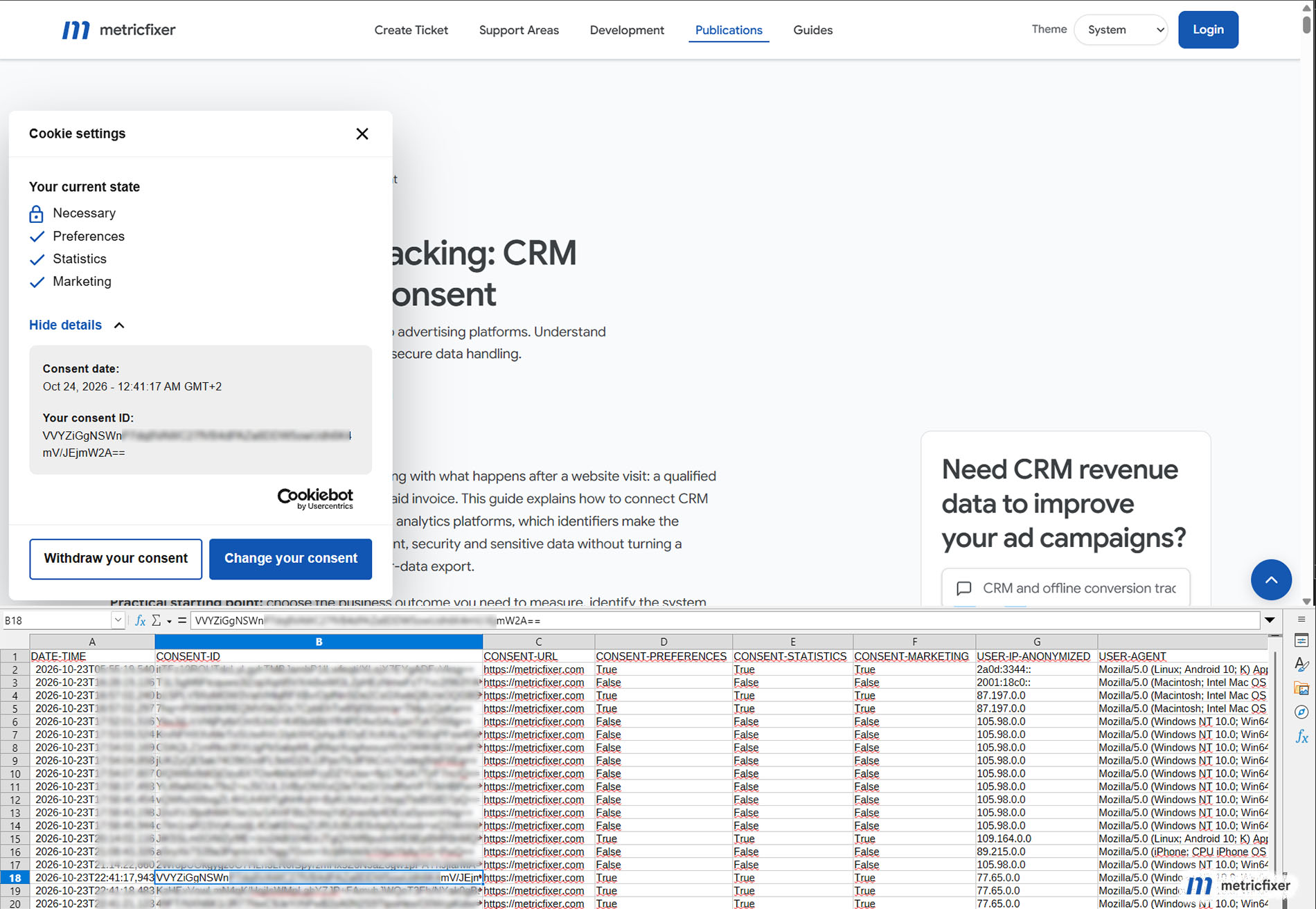
Withdrawal should be available through a persistent Privacy settings or Cookie settings control. The withdrawal must update the same downstream systems that received the original choice. Removing a browser cookie while leaving the CRM record eligible for Customer Match is not a complete withdrawal workflow.
Browser consent does not automatically control server-side, offline, or app data
A global implementation often includes paths that never pass through the web banner:
- server-side GTM forwarding browser events;
- GA4 Measurement Protocol events;
- Google Ads enhanced conversions;
- offline conversion imports;
- Customer Match and CRM audience synchronization;
- mobile apps and Firebase SDKs;
- payment, booking, call-tracking, and lead webhooks;
- Meta, Microsoft, Amazon, or other conversion APIs.
The browser consent identifier or purpose state should be carried into the backend record where appropriate. The server should decide whether the event may be sent, whether identifiers must be removed, whether the event is measurement-only, and whether the record remains eligible for audience activation.
Do not use a browser geolocation result as the only source for an offline customer. A CRM record may have a residence, billing market, sales contract, consent source, and later withdrawal that differ from the website visit. Maintain record-level provenance and regional rules for uploaded data.
Validation plan for a global rollout
Test the complete state machine from clean sessions. A VPN alone is not sufficient because CDN, CMP, Google, and browser geolocation can disagree. Where possible, use real regional test devices or a testing service and record the observed country from each layer.
| Test case | Expected banner or signal | What to inspect |
|---|---|---|
| EEA first visit, no interaction | Strict banner; optional categories off; denied Google defaults. | Tag Assistant, cookies, local storage, Google network requests, third-party pixels. |
| EEA reject all | Advertising and non-essential analytics remain denied or blocked according to the selected Basic/Advanced design. | Consent update, request payloads, cookies, server-side forwarding. |
| EEA statistics only | analytics_storage can be granted while advertising states remain denied. |
GA4 behavior, Google Ads tags, audience eligibility, other analytics vendors. |
| France first layer | Reject is as accessible as accept. | UI parity, keyboard navigation, mobile layout, translated text. |
| UK and Switzerland | The intended European or Swiss profile loads, not the generic rest-of-world profile. | Country lists, regional defaults, Google policy disclosures. |
| California without GPC | U.S. notice and preference experience. | Sale/share and targeted-advertising controls, privacy link, vendor states. |
| California or Colorado with GPC | Browser preference is recognized and applied before conflicting site choices. | navigator.globalPrivacyControl, Cookiebot behavior, RDP, network and server logs. |
| Brazil first visit | Brazil profile with visible refusal and category choices. | Optional tag blocking, local text, consent record. |
| Canada, Japan, Singapore, Australia, or New Zealand | The approved notice-and-preference profile, not an accidental EEA or U.S. experience. | Disclosure, optional controls, Google defaults, withdrawal. |
| China, Russia, Belarus, Kazakhstan, or another special market | The dedicated profile, local stack, or complete suppression design. | Scripts delivered, endpoints contacted, data localization, local vendor configuration. |
| Unknown location | The documented safe fallback. | Primary domain-group behavior, cache variation, error logs. |
| Consent withdrawal | Browser state, server record, audiences, and uploads stop or change according to the policy. | CMP log, Google updates, CRM flag, server-side queue, audience refresh. |
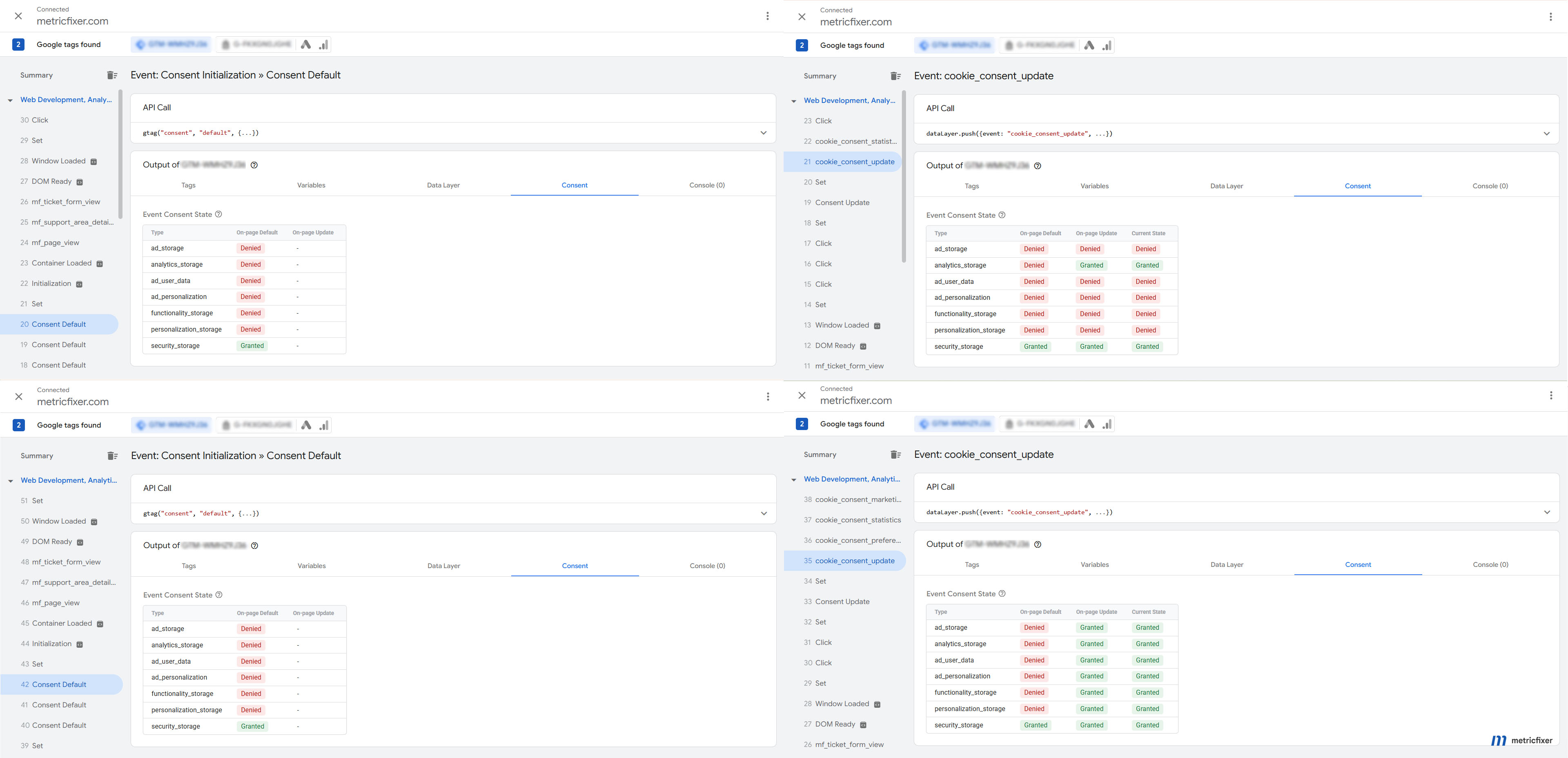
Google Ads and GA4 diagnostics can take time to update. Tag Assistant and network inspection are the primary live tools. Cookiebot's Google Consent Mode Checker is useful for finding installation-order and missing-signal issues, but it should be combined with manual regional and category tests.
Common global consent mistakes
- Creating one domain group per country. This multiplies text, languages, scans, QA, and drift without improving the legal model.
- Using one EU banner worldwide. It can unnecessarily suppress data and still ignore GPC, sale/share, or targeted-advertising rights.
- Using one U.S. opt-out banner worldwide. It can allow non-essential tracking before consent in strict opt-in markets.
- Assuming Cookiebot has a generic Europe region code. The team must verify the actual country list and the UK, EEA non-EU states, and Switzerland.
- Adding the real domain to every alternative group. Cookiebot instructs users to keep it only in the primary group.
- Setting Google consent to
grantedglobally and relying on a later correction. The first requests may already have used the wrong state. - Treating GPC as a banner preference only. The restriction must reach tags, APIs, server-side events, and activation systems.
- Equating Consent Mode with legal consent. It communicates a choice; it does not create the legal basis or required notice.
- Using Google Ads account defaults to manufacture consent. Account defaults are fallback labels, not proof that a user chose.
- Ignoring server-side and uploaded data. Browser controls do not automatically govern Measurement Protocol, enhanced conversions, Customer Match, or CRM imports.
- Caching a regional script globally. The wrong privacy profile can be served across countries.
- Enabling TCF everywhere. TCF should reflect the actual publisher and ad-tech use case, not be added as decorative complexity.
Global CMP implementation checklist
- [ ] List the commercial target markets, material traffic markets, legal entities, and responsible controllers.
- [ ] Assign each market to a rule family and record why.
- [ ] Choose the primary Cookiebot group and the unknown-location fallback.
- [ ] Keep the actual domain only in the primary group.
- [ ] Build only the regional profiles the business can maintain.
- [ ] Verify every country and U.S. state code used by Cookiebot and Google.
- [ ] Load the CMP before Google tags and ordinary GTM triggers.
- [ ] Configure
analytics_storage,ad_storage,ad_user_data, andad_personalization. - [ ] Choose Basic or Advanced Consent Mode per approved profile.
- [ ] Test GPC and any supported universal opt-out mechanism independently of the visible banner.
- [ ] Map Cookiebot choices to Google, TCF/GPP where used, Microsoft, Amazon, Meta, and other vendors.
- [ ] Preserve the banner version, language, region, user choice, browser signal, and downstream state.
- [ ] Provide a persistent route to change or withdraw preferences.
- [ ] Carry the relevant purpose and regional state into server-side and CRM records.
- [ ] Test strict opt-in, U.S. opt-out, Brazil, notice-and-preference, special-market, and unknown-location paths.
- [ ] Repeat the audit after changes to the CMP, GTM, Google tag, consent defaults, vendors, domains, or advertising products.
Methodology and sources
This article converts the jurisdictional patterns documented in metricfixer's global consent-signal review into a technical architecture for Cookiebot, Google Consent Mode, browser-level opt-out signals, tag management, and server-side activation. The review uses official regulator, platform, and CMP materials available at the time of preparation. Where a jurisdiction has general privacy law but no prescribed cookie-banner layout, the article describes the CMP as a transparency, choice, objection, and evidence layer rather than claiming that one visual template is legally mandatory.
- Google EU User Consent Policy
- Google Ads: About consent mode
- Google Tag Manager consent mode support
- Google Analytics data-control changes in 2026
- Google Ads guidance for U.S. state privacy laws and Restricted Data Processing
- Cookiebot: supporting multiple legislations on one website
- Cookiebot region codes
- Cookiebot Google Consent Mode implementation
- Cookiebot and Global Privacy Control
- Cookiebot and IAB TCF
- IAB Europe Transparency and Consent Framework
- IAB Tech Lab Global Privacy Protocol
- IAB Europe CMP and vendor notifications, including the TCF 2.4 timeline
- EDPB cookie-banner taskforce report
- UK ICO guidance on cookies and similar technologies
- California Attorney General CCPA and Global Privacy Control materials
- Brazil ANPD guide on cookies and personal data
- Office of the Privacy Commissioner of Canada consent materials
- Japan Personal Information Protection Commission legal materials
- Singapore PDPC advisory guidelines
- Australian Privacy Principles guidelines
- Moldova NCPDP guidance on Law No. 195/2024
- Moldovan Ministry of Justice notice on the 23 August 2026 effective date
This article is for technical and operational information only and is not legal advice. Global privacy and advertising requirements depend on the jurisdictions targeted, the user's location and status, the controller and processor relationships, the data collected, the vendors used, and the exact purpose of processing. Cookiebot, Google, IAB, browser, and regulator documentation may change after publication. metricfixer is not affiliated with Google, Cookiebot/Usercentrics, IAB, or the regulators and platforms mentioned.