
Published Oct 19, 2026
Meta Pixel Conversion Recovery: How It Works, Consent and Safari
Meta's planned on-device conversion recovery could reveal missing purchases, but it is not a consent bypass or proof of extra sales. Learn how to audit Safari coverage, attribution and campaign reporting.
Category: Analytics & Conversion Tracking · By metricfixer Expert Team
Meta is preparing a Pixel update that aims to bring previously unreported conversions back into campaign reporting by measuring them on the customer's device. That could make some advertising results more visible, but it does not automatically restore every missing purchase, override a visitor's consent choice, or prove that an ad caused a sale. This guide explains what the announcement establishes, how the feature could interact with Consent Mode and Safari, and what advertisers should check before trusting a higher conversion count.
Practical starting point: keep your existing consent controls and purchase tracking in place. Record a reporting baseline before the announced 12 November 2026 availability date, then compare any increase in Meta-attributed conversions with paid orders and revenue in your own systems. Research reviewed: 18 October 2026. This is a pre-rollout assessment, not a performance test of the new feature.
Contents
Executive summary
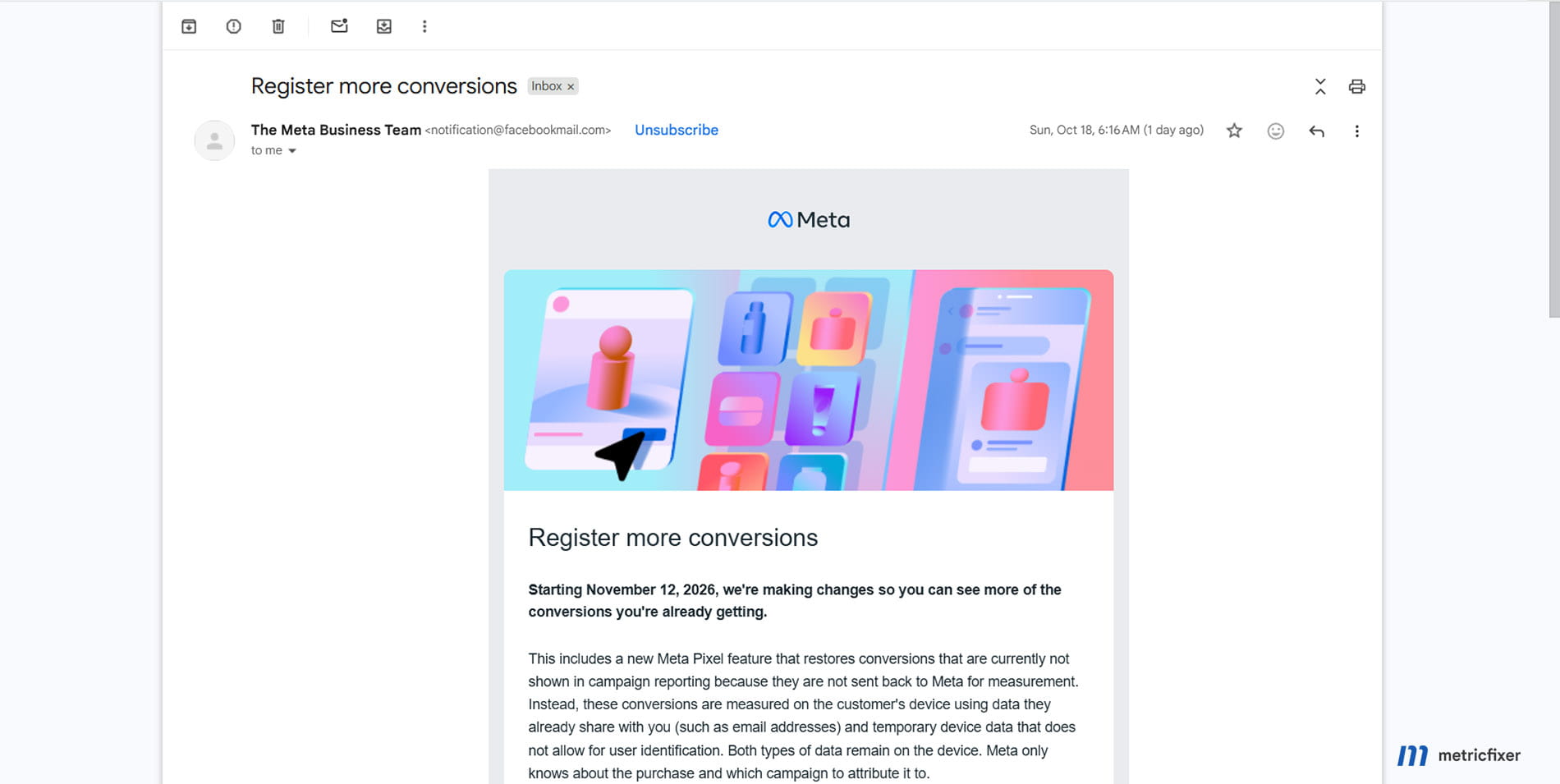
The announcement describes a new way to measure conversions that already happen, not a way to create additional sales. Meta says the customer's device will use information already shared with the business, such as an email address, together with temporary device information that does not identify the user. Those inputs stay on the device; Meta receives information about a purchase and the campaign to which it should be attributed.
That is a meaningful architectural change, but the email is not a full technical specification. It does not establish the precise matching algorithm, supported browsers, treatment of refused website consent, reconciliation with Conversions API events, or whether recovered results will be separately identifiable in reporting.
Our practical assessment is conditional. Recovery could reduce some measurement gaps where the necessary on-device information is available and the processing is permitted. It cannot be assumed to operate when the required Pixel code is blocked, and it should not be used as a reason to weaken a consent banner. A rise in reported conversions may improve the accuracy of reporting; better advertising performance is a separate claim that needs separate evidence.
The most important distinction: a real purchase, a correctly matched purchase, a purchase credited under Meta's attribution rules, and a purchase caused by advertising are four different things. The rollout should be assessed against all four, rather than against the conversion total alone.

What Meta announced for 12 November 2026
An advertiser notification shared with metricfixer describes a Meta Pixel feature intended to recover conversions missing from campaign reports because they are not being returned to Meta for measurement. The notice gives 12 November 2026 as the availability date, says existing integrations do not require updating, and provides an opt-out through Events Manager.
| What the notice says | What advertisers can conclude |
|---|---|
| Measurement takes place on the customer's device. | Some processing moves to the device. The notice does not identify the underlying protocol or algorithm. |
| Customer-provided information and temporary, non-identifying device information remain there. | This describes the inputs to the new measurement path, not every data flow in an existing Meta integration. |
| Meta learns that a purchase occurred and which campaign should receive credit. | Information still leaves the device. The exact report fields and granularity are not specified. |
| The update applies to datasets already sending events; no integration update is required. | This is not an instruction to rebuild tracking. It is also not confirmation that every dataset configuration or event type is supported. |
| Advertisers can opt out in Events Manager. | Review the actual setting and availability in each dataset. Advertiser participation and visitor consent are separate decisions. |
The wording presents an opt-out change for existing event-sending datasets. It does not establish a universal activation time for every account, country or integration. In particular, the purchase example should not be stretched into a promise covering all lead, app, offline and custom events.
No integration update is not the same as no processing change. The standard Pixel installation loads a Meta-hosted JavaScript library. A vendor-delivered capability can therefore change without an advertiser editing its installed snippet. The absence of a development task is not a reason to skip a consent and data-flow review.
We use conversion recovery as a descriptive term in this article. It should not be mistaken for a verified product label or an exact Events Manager setting name.
How on-device conversion recovery works
First identify what is missing
A missing advertising conversion can have several different causes. The purchase may never have generated a valid event. An event may exist but fail to reach the platform. The platform may receive it without enough information to connect it to an eligible ad interaction. Or the purchase may simply fall outside the reporting rules being used.
Only some of those situations are measurement gaps that a new recovery mechanism might address. An unpaid checkout is not a lost purchase. A sale with no qualifying Meta interaction is not automatically a missing Meta conversion. Our guide to the Meta Pixel and CAPI event lifecycle explains these boundaries in more detail.
The architecture described in the email
The announcement's essential idea is that the device can do some of the work needed to associate a conversion with a campaign without sending the underlying customer and temporary device inputs back to Meta through that new path. Meta receives the measurement outcome described in the notice instead.
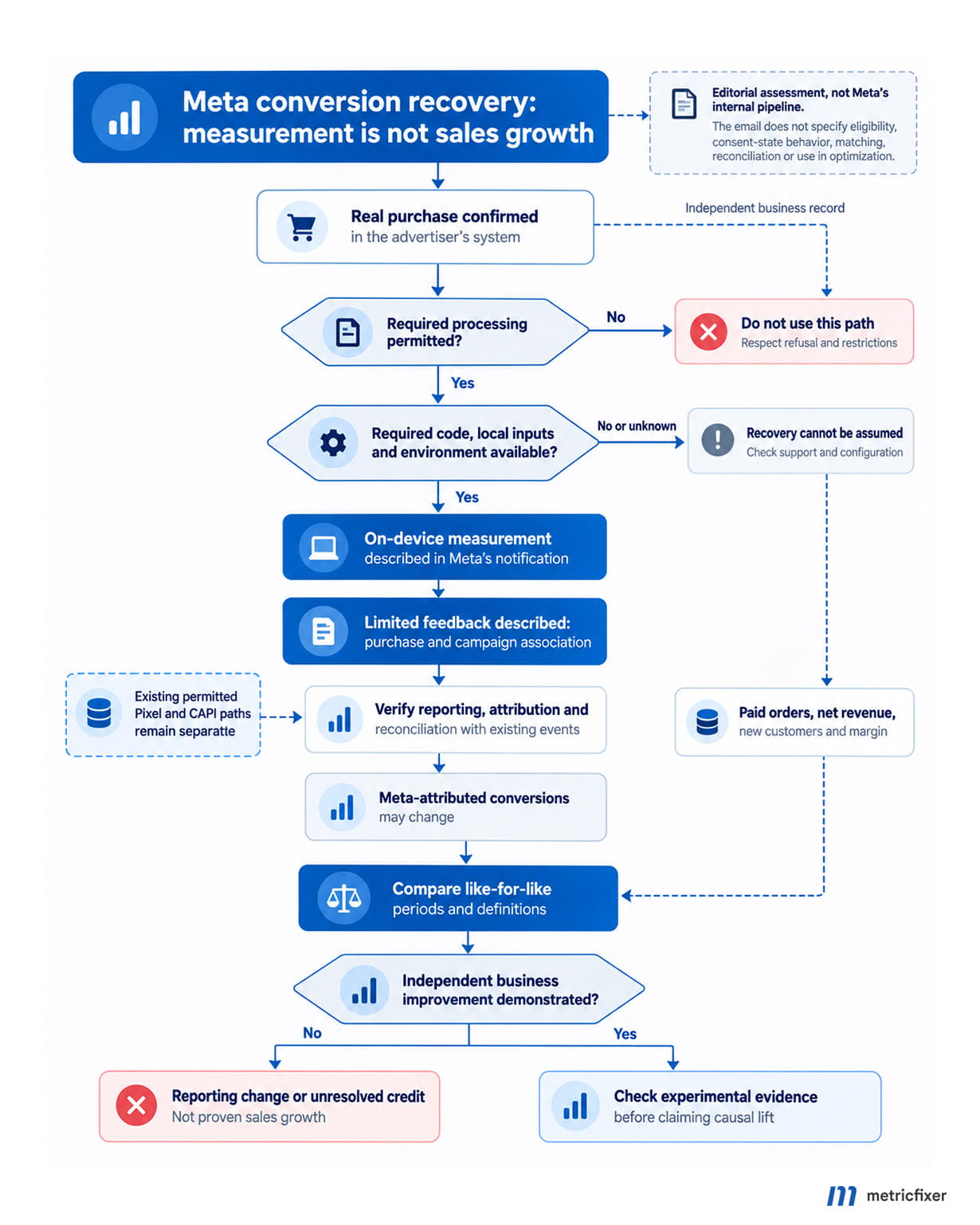
A useful conceptual sequence is: an actual conversion occurs; the required information is available to a permitted on-device process; that process determines a campaign association under the feature's rules; a limited result is returned for measurement. This is an interpretation of the notice, not Meta's published implementation pipeline. How the device obtains the relevant campaign context, how long it retains information, and how the association is validated remain important unanswered questions.
Editorial workflow: real purchase → permitted processing and available local inputs → possible on-device campaign association → limited measurement feedback → reconciliation and attribution in reporting. Missing permission, unavailable inputs or an unsupported environment mean recovery must not be assumed. A higher reported total still needs an independent business-outcome check.
What the announcement does not reveal
Meta has previously described privacy-enhancing approaches, including on-device learning, secure multi-party computation and differential privacy. Those materials explain the broader technology family. They do not prove that this particular Pixel update uses any specific combination of those techniques.
It would therefore be premature to label the feature deterministic matching, probabilistic fingerprinting, federated learning or statistical conversion modeling. The email's reference to temporary device information is not enough to identify the method. Equally, the claim that inputs remain on-device is not an independent security audit.
There is another practical boundary: local processing in this feature does not mean your whole Meta setup becomes local-only. Existing Pixel requests, Advanced Matching and server integrations remain separate data paths. Review them separately rather than interpreting the announcement as a new privacy guarantee for everything already installed.
Recovery, modeling, Advanced Matching and CAPI
These mechanisms address related problems, but they are not interchangeable.
| Mechanism | What it does | What not to assume |
|---|---|---|
| Announced on-device recovery | Uses the local measurement approach described in the notification to recover previously unreported conversions. | That it recovers every missing event, exposes an order-level trail, or uses a particular estimation method. |
| Conversion modeling | Estimates outcomes that cannot be directly observed, using an available evidence base. | That each modeled result corresponds to a separately inspectable purchase record. |
| Advanced Matching | Uses additional customer information to help match website events with Meta users. | That the new feature's local-only input description also applies to ordinary Advanced Matching. |
| Conversions API | Provides a server or platform connection for sending events to Meta. | That it removes consent obligations or makes browser and server duplicates impossible. |
The distinction about customer information matters. Meta's Advanced Matching documentation describes hashing customer information before sending it to Meta. Hashing and keeping the information entirely on-device are not the same operation.
The Conversions API, meanwhile, can send website, app, messaging and offline events through supported integrations. It remains useful for independently confirmed outcomes and reliable event delivery. Nothing in the recovery email establishes that advertisers should remove it. See our review of when CAPI helps and when it merely repeats existing data.
Do not build a reporting formula that blindly adds ordinary conversions, recovered conversions and modeled conversions. A new signal might replace an estimate, overlap with an existing event, or alter an attribution decision. Without a documented reconciliation rule, the gross number of recovered signals is not necessarily the net increase in reportable conversions.
Consent Mode and your consent banner
Google Consent Mode is not a universal Meta consent switch
A consent management platform, or CMP, records the visitor's choices. Google Consent Mode communicates consent states to supported Google tags and changes their behavior. Google parameters such as ad_storage, ad_user_data and ad_personalization do not, by themselves, establish permission for every Meta data flow.
Google Tag Manager can enforce consent requirements for other tags through templates and additional consent checks. But that requires a deliberate mapping between the visitor's choices, the purposes and vendors involved, and the Meta integration. Seeing a Google consent update in Tag Assistant does not prove that a Meta plugin, a directly embedded Pixel or a server webhook respects it.
Google's Basic and Advanced Consent Mode also should not be imported into Meta terminology. In Google's advanced implementation, Google tags can send cookieless pings under denied storage consent. That is Google-specific behavior, not proof that Meta offers an equivalent mode or that any particular no-cookie processing is legally exempt.
What happens in the main consent scenarios?
| Website situation | Practical implication for recovery |
|---|---|
| The CMP prevents the required Pixel script from loading or executing until permission is granted. | That script cannot perform local recovery while blocked. Do not remove the gate merely to increase reported conversions. |
| The visitor grants the relevant permission and the required code runs. | Recovery may be possible, subject to feature eligibility and available inputs. Consent does not guarantee a recoverable campaign association. |
| The Pixel is loaded, but its consent API is set to revoke. | Verify both outgoing events and the new local processing. Existing documentation does not settle how the new feature behaves in this state. |
| Browser tags are blocked, but CAPI continues sending. | This is a separate server-side governance issue, not proof of successful on-device recovery. Audit the server's permission checks. |
| Consent is withdrawn after an earlier grant. | Test subsequent pages, queued activity, local processing and server jobs. Do not assume the browser change automatically reaches every sender. |
Meta documents fbq('consent', 'revoke') and fbq('consent', 'grant') as a way to pause and resume sending Pixel events, with revocation applied on every page where required. That wording is not a feature-specific guarantee that all local collection, storage or computation stops. Where your approved architecture requires preventing execution before consent, preserve that stronger gate while seeking clarification.
Also test the transition from refusal or no choice to acceptance. A blocked purchase tag may need an appropriate consent-update trigger; a one-time page-load trigger should not be assumed to replay correctly. Our guide to blocked tags after consent is granted covers that implementation problem. Replaying an event must still follow the approved consent policy and preserve its original business identity.
On-device does not automatically mean consent-free
European privacy rules are not limited to sending readable email addresses to an advertising server. The EDPB's final guidance on the technical scope of Article 5(3) of the ePrivacy Directive specifically discusses local processing: making the resulting information available to a third party can still fall within the rule's scope. Scope and any applicable exemption require analysis of the actual implementation; the phrase on-device does not decide the answer.
The UK's ICO likewise states that storage and access technologies used for online advertising require consent. Advertising measurement can be covered by valid advertising consent without necessarily needing a separate checkbox, but that does not mean measurement is consent-free.
For an advertiser, the practical question is whether the existing notice, consent scope and enforcement cover the new processing. An email address supplied for an order receipt does not, by itself, establish permission for every advertising use. Requirements vary by jurisdiction, and the advertiser's opt-out setting in Events Manager is not a substitute for the customer's rights or choices.

Safari, cookie restrictions and Apple's ATT
Could it compensate for Safari cookie losses?
Potentially, for some eligible situations. A measurement path that does not depend on a long-lived cross-site cookie could retain useful information where cookie-based association becomes difficult. But this is an architectural possibility, not a verified Safari recovery rate for the announced feature.
WebKit's tracking-prevention documentation describes several different restrictions: third-party cookie blocking, limits on script-writeable storage, and additional treatment of detected link decoration and cloaking. The seven-day rule should not be reduced to a claim that every first-party cookie always disappears seven days after creation. Storage type, interaction and the relevant tracking-prevention conditions matter.
Equally, a blocked third-party cookie is not the same as a blocked script or a blocked network request. A visitor may have a working Pixel event path but weaker historical matching information. That is a different problem from an extension preventing the required code from running at all.
| Source of missing measurement | What recovery might change |
|---|---|
| A cookie-based link has expired, but permitted local inputs and campaign context are available. | A possible recovery opportunity. Browser and feature support still need confirmation. |
| The required script cannot execute. | No basis to expect that script to perform the new local measurement. |
| The ad interaction and purchase occur on different devices or in isolated browser contexts. | Cross-device or cross-context recovery is not established by the email. |
| The purchase happens after a long delay or through a server-only process. | Local retention, event eligibility and available context become decisive; the notice provides no guarantee. |
| No permitted or qualifying association is available. | A real purchase does not become attributable merely because recovery is enabled. |
Compatibility is also a moving target. Apple documented stronger protections against known fingerprinting scripts in Safari 26.0. That is a reason to test actual browser versions, not evidence that Meta's new feature fingerprints users or that Safari will necessarily block it.
ATT refusal is a different question from website consent
Apple's App Tracking Transparency guidance contains an important qualification: linking app data with third-party data solely on the device, without sending it off-device in a way that identifies the user or device, is not considered tracking under that definition. This makes some privacy-preserving measurement conceptually possible without ATT permission.
That is not confirmation that the announced Meta feature meets every condition, nor permission to disregard website consent. Apple separately rejects using a hashed email as an alternative tracking identifier when ATT permission is required but absent. Keep three questions separate: what Safari technically permits, what ATT permits for app-related data, and what the applicable privacy rules and visitor choices permit.
WebKit's Private Click Measurement provides a separate example of privacy-preserving attribution. It demonstrates that limited measurement need not be identical to unrestricted user tracking. There is no basis in the notification, however, to assert that the new Pixel feature uses that protocol or inherits its reporting limits.
Reported performance versus real business growth
A better-looking report can be a measurement change
Suppose a store spends $10,000 on Meta ads and receives 500 paid orders across all channels. Before a measurement change, Meta reports 200 attributed purchases. Afterwards, it reports 250 for an otherwise equivalent period. Assume, purely for illustration, that each attributed purchase carries $100 of reported value.
| Metric | Before | After |
|---|---|---|
| Meta spend | $10,000 | $10,000 |
| Actual paid orders across the store | 500 | 500 |
| Meta-attributed purchases | 200 | 250 |
| Reported cost per attributed purchase | $50 | $40 |
| Meta-attributed revenue | $20,000 | $25,000 |
| Reported return on ad spend | 2.0 | 2.5 |
The report shows 25% more purchases and a 20% lower cost per purchase, while the business has not sold one additional order. That does not make recovery useless: the earlier report may have understated legitimate attribution. It does mean the reporting improvement is not evidence of incremental sales.
These are invented arithmetic examples, not a forecast or a Meta test result. The value illustration assumes the relevant purchase value is included in reporting; the notification does not specify value-recovery behavior. Actual reconciliation could also revise existing estimates rather than simply add the illustrated number of conversions.
Could better signals improve campaign delivery?
Yes, in principle. More representative and accurate outcome information could help an optimization system distinguish productive ad opportunities from unproductive ones. But a reporting benefit becomes an optimization benefit only if the recovered information is used for that purpose and improves the relevant decisions.
The email does not establish how these particular signals feed bidding, learning-phase calculations, audience creation or value optimization. Do not transfer performance claims from CAPI, another attribution feature or a different AI update to this rollout. Nor should a recovery increase trigger an automatic budget increase: noisy matches or an overrepresentation of existing customers could make the platform's preferred campaigns look more valuable without increasing profit.
Maintain separate scorecards for platform-attributed performance and business outcomes such as paid orders, new customers, net revenue and contribution margin. Reassess historical CPA and ROAS benchmarks after a reporting change rather than treating the old and new series as perfectly comparable.
Can conversions be nonexistent or wrongly attributed?
There is no evidence in the notification that Meta intends to invent purchases. There is also not enough public feature-specific information to certify the accuracy of every recovered conversion. The sensible response is neither blanket trust nor an assumption of fraud, but a distinction between several failure modes.
A purchase event can exist without a valid sale
A tracking implementation can label a checkout visit, a click on Pay or a reload of a confirmation page as a purchase. Payment retries, repeated webhooks and browser/server overlap can also produce multiple delivery attempts for one business event. Recovery cannot be treated as a repair for an incorrect purchase definition.
For ordinary overlapping Pixel and CAPI events, Meta's recommended deduplication method uses matching event names and matching identifiers: browser eventID and server event_id. Preserve those controls. The announcement does not explain how the new recovery path reconciles with them, especially when an ordinary server event arrives later.
Our Pixel and CAPI deduplication guide covers the underlying implementation. One business occurrence should retain one stable event identity across eligible senders and retries. Do not create an extra synthetic Purchase in CAPI or GA4 merely because Meta later reports a recovered result.
A real sale can receive questionable campaign credit
Identity errors and attribution disagreements are different issues. Shared accounts, shared contact information or shared devices are examples to investigate in any matching system; they are not proven defects of this feature, whose matching logic remains undisclosed.
Even with a correct association, an ad interaction inside an attribution window does not establish causation. A regular customer might see an ad and later buy something they already intended to purchase. Another advertising platform might also claim the same sale under its own rules. Cross-platform overlap is not necessarily a duplicate event inside either platform, but adding those platforms' attributed revenue together can overstate the business total.
Use current attribution definitions when auditing. Meta's March 2026 measurement announcement moved website and in-store click-through attribution toward link clicks only and separated other qualifying engagement into engage-through attribution. An old explanation that treats every social interaction as a website click is not a reliable basis for a new audit.
Reporting can differ from the order ledger without a fabricated purchase
Conversion dates and ad-interaction dates may place the same outcome in different reporting periods. A paid order may later be refunded. Platforms may apply different attribution windows and revenue definitions. Any use of estimates or privacy-related reporting adjustments also needs to be understood before expecting one report row per order; this email does not disclose whether such adjustments apply to recovery.
Start with comparable definitions, then investigate the unexplained remainder. Reconciling Meta revenue with transaction records explains why an advertiser's event identifier is not, by itself, a guaranteed order-level attribution export.
A practical rollout audit
Before the announced availability date
Create one change record per relevant dataset. Record its identifier, the actual setting displayed, who approved participation, and the time any change takes effect. Preserve the notification and any feature-specific help text. Inspect Events Manager through your normal authenticated route rather than relying on the email button.
- Define a valid purchase. Identify the authoritative paid-order transition, how delayed payments are handled, and how cancellations, refunds and test orders are excluded from business reporting.
- Map every sender. Include the browser Pixel, GTM, commerce plugins, CAPI integrations, gateways and payment or CRM jobs. A quiet browser does not prove that the backend is quiet.
- Preserve event identity. Check event names, shared identifiers, event timestamps, currency and value across the ordinary browser/server paths.
- Review permission and data scope. Document which purposes and vendors the visitor authorizes, where that decision is enforced, and how withdrawal reaches each relevant process. Do not add extra personal or sensitive data merely to pursue recovery.
- Export a baseline. Save daily paid orders, net revenue, Meta spend, attributed purchases and attributed value, together with attribution settings and known tracking changes. Use enough representative history to see normal variation.
- Agree on escalation. Decide who investigates an unexplained jump, who can disable the feature, and what evidence is required before budgets change.
Test the implementation, not just the dashboard
Run a small documented matrix on real browser environments. Include Safari on representative Apple devices, another major browser, and the in-app browsing route used by your customers where relevant. Record browser and OS versions instead of assuming that a desktop emulation reproduces their privacy behavior.
| Test | Evidence to collect |
|---|---|
| No choice and explicit refusal | Whether the required scripts execute; browser requests and storage; the backend's permitted or suppressed sends under the approved policy. |
| Permission granted on the current page | Consent update timing, which tags run, and whether the same confirmed action is emitted once rather than lost or replayed twice. |
| Withdrawal, navigation and a later return | Persistence of the choice, new requests, queued actions and separate server processing. |
| A confirmed purchase followed by reloads and server retries | One authoritative order and stable event identity despite multiple delivery attempts. |
| Missing or expired browser context | Observed ordinary tracking behavior and any documented recovery evidence. Do not mark an unobservable recovery result as a successful test. |
| Feature enabled versus disabled, where the control is available | Exact setting, timestamp and observed changes. This diagnostic comparison alone does not establish causal advertising lift. |
Use authorized test accounts and platform test facilities where available. Keep test activity out of production performance conclusions, avoid real customer details in shared logs, and do not disable browser protections or bypass a refusal to manufacture a successful test. A synthetic QA purchase can validate parts of the event path without proving that real campaign recovery works.
Meta's setup-verification documentation explicitly distinguishes received events from later processing: the described Events Manager overview includes events before deduplication, consent-related discarding and other processing. Those raw counts are not interchangeable with Ads Manager's attributed conversions. Event Match Quality is useful for checking matching inputs, not a certificate that every event represents a paid order or a correctly credited campaign.
A useful escalation rule: if reported purchases persistently exceed the corresponding universe of real purchases after you align event definitions, dates, windows and duplication rules, pause any recovery-driven budget increase and investigate. That is a reconciliation warning, not automatic proof that the platform fabricated transactions.
Network inspection also has a limit: it can show a request or its absence, but it does not reveal all local processing or prove the accuracy of an internal match. Combine it with documentation, storage inspection, controlled tests and a question to Meta where the new behavior cannot be observed directly.
How to measure whether recovery actually helps
Separate three questions
First: did measurement coverage change? Look for changes in attributed purchases relative to independently confirmed paid orders, keeping definitions and attribution settings stable. Annotate the actual activation time, not just the date announced in the email. Allow the relevant attribution window and reporting delays to mature before comparing periods.
Second: did attribution become more credible? Check whether a change is concentrated in certain campaigns, interaction types, customer groups or browser journeys, where comparable data is available. Do not invent a Safari-specific recovery rate when the reporting interface does not expose one. First-party landing data and campaign parameters provide supporting evidence, but they do not settle view-through attribution or prove causation.
Third: did advertising create better business outcomes? Evaluate paid-order growth, customer acquisition cost, new-customer share and profit using a stable independent measurement source. A reporting-only improvement can answer the first question without answering the third.
Use experiments carefully
For causal claims, use an appropriately designed holdout, lift study or randomized business experiment with adequate sample size. The outcome should be measured consistently across groups from an independent business system; changing the measurement method in only one group can manufacture an apparent effect.
Distinguish a test of advertising incrementality from a test of the recovery feature itself. The latter requires a supported way to vary the feature across genuinely comparable units. Two campaigns sharing one dataset do not necessarily provide separate feature settings. A simple before-and-after switch is vulnerable to changes in promotion, targeting, spend, seasonality and customer mix.
The November timing makes this especially important: a store changing its offers and budgets during the same period cannot attribute every improvement to measurement recovery. When a clean experiment is unavailable, label the analysis observational and report its limitations instead of calling the difference lift.
Finally, check the direction of the business trade-off. If Meta-attributed revenue rises while total net revenue, new-customer volume and profit do not improve, the evidence supports a reporting or credit-allocation change, not a claim that the feature generated more profitable demand.
Enable, disable or wait?
Retaining or enabling the feature is reasonable when the actual setting is available, the processing has been approved for your use case, consent enforcement is understood, ordinary event quality is sound, and someone can monitor the change against a reliable business baseline. Treat participation as a monitored measurement change rather than an automatic performance upgrade.
Deferring or disabling it is reasonable when you cannot establish the relevant consent behavior, client authorization is missing, unexplained overcounting already exists, or the new local processing creates a privacy question that your team cannot yet resolve. Save evidence before changing the setting so that the investigation remains possible.
Neither decision requires abandoning a well-governed Pixel and CAPI setup. Fix incorrect purchase triggers, duplicate senders and missing permission controls independently. Recovery is an additional measurement capability, not a replacement for an accurate order ledger, consent architecture or event contract.
Questions Meta still needs to answer
Before treating recovery as an established part of your measurement architecture, request feature-specific answers rather than relying on a general Pixel help page.
| Area | Question to resolve |
|---|---|
| Eligibility | Which countries, browsers, browsing contexts, integration types and events are supported? Does a server-only dataset qualify? |
| Local processing | Which customer and device inputs are used, where is campaign context obtained, and what are the retention and deletion rules? |
| Consent and controls | What exactly happens before consent, after refusal and after withdrawal? Does the Pixel consent API stop local processing as well as transmission? |
| Reconciliation | How are recovered outcomes reconciled with browser events, CAPI, late arrivals and any existing modeled estimates? |
| Reporting | Is recovery separately identifiable in the interface or API? What values, timestamps, attribution rules, thresholds and delays apply? |
| Use in advertising | Are these signals used only in reporting, or also in optimization and audiences? What feature-specific evidence supports any performance claim? |
Until those answers are available for the actual implementation, the defensible conclusion is narrow: Meta has announced a way to recover some previously unreported conversions using on-device measurement. It has not, through this notification, demonstrated universal recovery, consent-free operation or additional sales.

Methodology and sources
This review was prepared on 18 October 2026, before the notification's stated availability date. Its feature-specific starting point is an advertiser-supplied screenshot of a Meta Business Team email. The screenshot was read directly; complete email headers and sender authentication were not available. The article attributes the announcement's claims to the notice rather than treating them as independently validated implementation results.
Technical context was checked against the official Meta Pixel and Conversions API documentation, Meta's privacy-enhancing technology and measurement announcements, Google Consent Mode and Tag Manager documentation, WebKit's tracking-prevention materials, Apple's ATT guidance, and current EDPB and ICO guidance. Primary sources are linked alongside the relevant explanations. Some Meta developer pages were accessible through their indexed official Markdown versions while direct page retrieval was rate-limited.
We did not locate an accessible public specification in the reviewed sources that resolved this feature's exact matching method, browser coverage, consent-state behavior, deduplication rules or reporting breakdowns. No post-rollout account experiment, recovery-rate measurement or independent accuracy audit was performed. Mechanistic possibilities are presented as possibilities, and the numerical example and audit workflow are editorial illustrations, not observed advertiser results.
This article provides technical and operational information, not legal advice or a guarantee of advertising performance. metricfixer is not affiliated with Meta, Google, Apple, the EDPB or the ICO. Feature availability, platform documentation, attribution rules and privacy requirements may change. Evaluate the actual account configuration, applicable jurisdiction and visitor choices before changing data collection or campaign budgets.