
Published Aug 2, 2026
How to Track Click-to-WhatsApp Ads by Campaign, Ad, and Creative Without a Website
Track Click-to-WhatsApp conversations without a landing page by capturing Meta referral data and ctwa_clid, enriching each lead with campaign, ad set, ad, creative, and target-city metadata, and returning qualified leads or purchases from the CRM through Meta Conversions API.
Category: Analytics & Conversion Tracking · By Mikalai Sasau
Click-to-WhatsApp ads can be measured without a website, browser cookies, or UTM parameters. The reliable attribution key is the referral data attached to the first advertising-originated WhatsApp message—especially the Meta ad ID and ctwa_clid. The rest of the job is an integration problem: preserve that first touch, enrich it with campaign and creative metadata, attach it to the correct CRM opportunity, and return only meaningful outcomes such as a qualified lead or paid sale to Meta.
Practical default: treat the WhatsApp webhook as an attribution intake endpoint, not as a CRM import shortcut. Save the raw referral before any connector transforms it; use stable Meta IDs rather than editable names; keep campaign target city separate from the lead's actual city; and send CRM-confirmed outcomes through Conversions API with the original ctwa_clid. A missing referral must be classified as unknown or non-deterministic, not automatically as organic.
Executive summary
A no-website Click-to-WhatsApp funnel can still support campaign-, ad-, and creative-level measurement. When a person starts a WhatsApp conversation from a Meta click-to-WhatsApp ad, the incoming webhook can contain a referral object with the source ad ID, the ad's text or headline snapshot, media information, and a click identifier called ctwa_clid. The ad ID is the bridge to Meta's Marketing API or a scheduled Ads export, where the business can resolve the campaign, ad set, ad, creative, and targeting metadata.
The webhook does not solve every attribution question. It does not provide a trustworthy current city for the person. It does not prove that an untagged conversation is organic. It may not identify the exact served asset in every dynamic or multi-asset creative. It also should not be expected to repeat the original advertising referral on every later message. The implementation must therefore preserve the first attributable touch as an immutable record and use additional, explicitly lower-confidence methods for non-ad sources.
The reference architecture is:
Closed-loop Click-to-WhatsApp flow: Meta ad → WhatsApp message with referral data → verified webhook → durable raw-event inbox → immutable attribution touch → asynchronous Meta Ads metadata enrichment → CRM contact, conversation, and opportunity → qualified-lead or purchase state transition → conversion outbox → Meta Conversions API → Events Manager and campaign optimization.
For source separation, use a hierarchy rather than one “source” field. Native ad referral with ctwa_clid is deterministic paid attribution. Unique links, QR codes, phone numbers, or prefilled source codes can provide operational attribution for profile, partner, store, city, or offline campaigns, but the user can edit a prefilled message and forward a link, so these signals deserve a lower confidence level. Conversations with no reliable marker should remain direct_or_unknown.
For closed-loop optimization, return only stages that have a stable business definition. A new message is not automatically a lead; a lead is not automatically qualified; and a quoted order is not a paid sale. The CRM should trigger one idempotent conversion event when the stage first becomes qualified or when payment is confirmed. The original ctwa_clid must be sent un-hashed with the WhatsApp Business Account ID and action_source set to business_messaging.
Why “without a website” does not mean “without measurement infrastructure”
Traditional paid-media measurement often starts on a landing page: an ad click carries a click ID or UTM parameters, JavaScript records a session, a form captures the lead, and a server or CRM later returns the outcome. A direct-to-WhatsApp campaign removes that browser layer. There may be no page request, no first-party website cookie, no form submission, and no dependable place to store a UTM value.
The measurement chain instead begins inside the messaging platform. Meta attaches referral data to an advertising-originated inbound message; the WhatsApp Business Platform exposes that data through a webhook; and the CRM must preserve the relationship between the conversation and the advertising click. The absence of a website therefore changes the transport, but not the core measurement principles:
- capture the acquisition identifier at the first reliable moment;
- store IDs and the original payload before enrichment;
- separate acquisition, conversation, opportunity, and revenue records;
- define qualification and sale in the CRM rather than in the ad platform;
- send the confirmed outcome back through a server-to-server interface;
- reconcile accepted events with CRM totals instead of assuming every accepted request was attributed.
Running the ad itself does not require a conventional website. Building the architecture described here does require an API-capable WhatsApp setup—either a direct WhatsApp Business Platform integration or a business solution provider that exposes the necessary webhook fields—plus a webhook receiver, a CRM data model, and a Meta Conversions API connection.
What Meta sends with a Click-to-WhatsApp message
The most valuable object in an incoming advertising conversation is referral. In Meta's documented WhatsApp webhook payload, it can include:
source_id— the Meta ad ID;source_url— the source URL associated with the ad;source_type— a source classification such asadorpost;ctwa_clid— the Click-to-WhatsApp click identifier used for conversion matching;headlineandbody— text snapshots associated with the source;media_typeand media or thumbnail URLs where applicable;- an optional welcome-message reference in supported flows.
The surrounding webhook also contains identifiers such as the WhatsApp Business Account entry ID, the receiving phone_number_id, the message ID, message timestamp, and sender identifiers. These fields answer different questions. The ad ID says which Meta ad generated the referral; ctwa_clid identifies the advertising click; phone_number_id says which business number received the message; and the message ID provides the strongest basis for webhook idempotency.
A simplified payload looks like this:
{
  "object": "whatsapp_business_account",
  "entry": [
    {
      "id": "WABA_ID",
      "changes": [
        {
          "field": "messages",
          "value": {
            "metadata": {
              "phone_number_id": "PHONE_NUMBER_ID"
            },
            "contacts": [
              {
                "wa_id": "WHATSAPP_USER_IDENTIFIER"
              }
            ],
            "messages": [
              {
                "id": "wamid.MESSAGE_ID",
                "from": "SENDER_IDENTIFIER",
                "timestamp": "EVENT_TIMESTAMP",
                "type": "text",
                "text": {
                  "body": "I would like more information"
                },
                "referral": {
                  "source_id": "META_AD_ID",
                  "source_url": "SOURCE_URL",
                  "source_type": "ad",
                  "headline": "AD_HEADLINE_SNAPSHOT",
                  "body": "AD_PRIMARY_TEXT_SNAPSHOT",
                  "media_type": "image",
                  "image_url": "MEDIA_URL",
                  "ctwa_clid": "CLICK_TO_WHATSAPP_CLICK_ID"
                }
              }
            ]
          }
        }
      ]
    }
  ]
}
This is an architectural example, not a schema contract for every account or API version. Production code should tolerate optional fields, preserve unknown fields, and follow the current payload documentation for the account's WhatsApp Business Platform version.
The two identifiers that matter most
source_id is the lookup key. It lets the integration resolve the ad to a campaign, ad set, creative, account, market, product, and internal naming taxonomy. It is not itself the campaign ID or creative ID.
ctwa_clid is the return-path key. It should be captured exactly as received and later supplied to Meta when the CRM sends the qualified lead or purchase. Unlike email addresses or phone numbers used as customer information parameters, ctwa_clid must not be hashed.
Do not call source_type=post “organic”
The presence of the referral object is the important context. A value such as post can describe the source object backing the messaging entry point; it is not a reliable business rule that the conversation was unpaid. Use the complete referral plus the ad lookup and account data. For deterministic paid attribution, the safest classification is a valid advertising referral containing ctwa_clid and an ad ID that resolves in the expected Meta ad account.
Capture the referral on the first opportunity
Do not design the CRM on the assumption that every later message will repeat the original referral. Treat the initiating message as a one-time attribution capture opportunity. Save the full raw webhook, parse the referral into an immutable touch record, and link that touch to the subsequent conversation and opportunity. A connector that imports only message text and sender number has already discarded the most valuable measurement data.
What the webhook cannot tell you
A reliable architecture is defined as much by the claims it refuses to make as by the fields it captures.
| Question | What the webhook can support | What it cannot prove by itself |
|---|---|---|
| Was this a paid Click-to-WhatsApp conversation? | A valid ctwa_clid and resolvable ad ID provide high-confidence paid attribution. | A missing referral does not prove the conversation was organic. |
| Which campaign and ad set produced it? | Join the referral's ad ID to a Marketing API or Ads export dimension table. | The referral does not normally provide the full campaign hierarchy directly. |
| Which creative produced it? | Resolve the ad to its configured creative and preserve the text/media snapshot supplied in the referral. | Exact served-asset attribution may remain ambiguous for dynamic, flexible, or multi-asset creative. |
| Which city is the lead from? | Store the campaign or ad-set target city after enrichment; ask for or validate the service city in the conversation. | Campaign target city is not the person's verified physical location. |
| Was the conversation from a profile, QR code, partner, or saved contact? | Controlled links, QR codes, dedicated numbers, source codes, and self-declared answers can provide operational evidence. | WhatsApp cannot retrospectively infer a source that was never encoded or supplied. |
| Did the lead qualify or buy? | The CRM can define and confirm those outcomes. | Message receipt, chat sentiment, or an ad-platform inference is not the same as a CRM-confirmed business result. |
Reference architecture
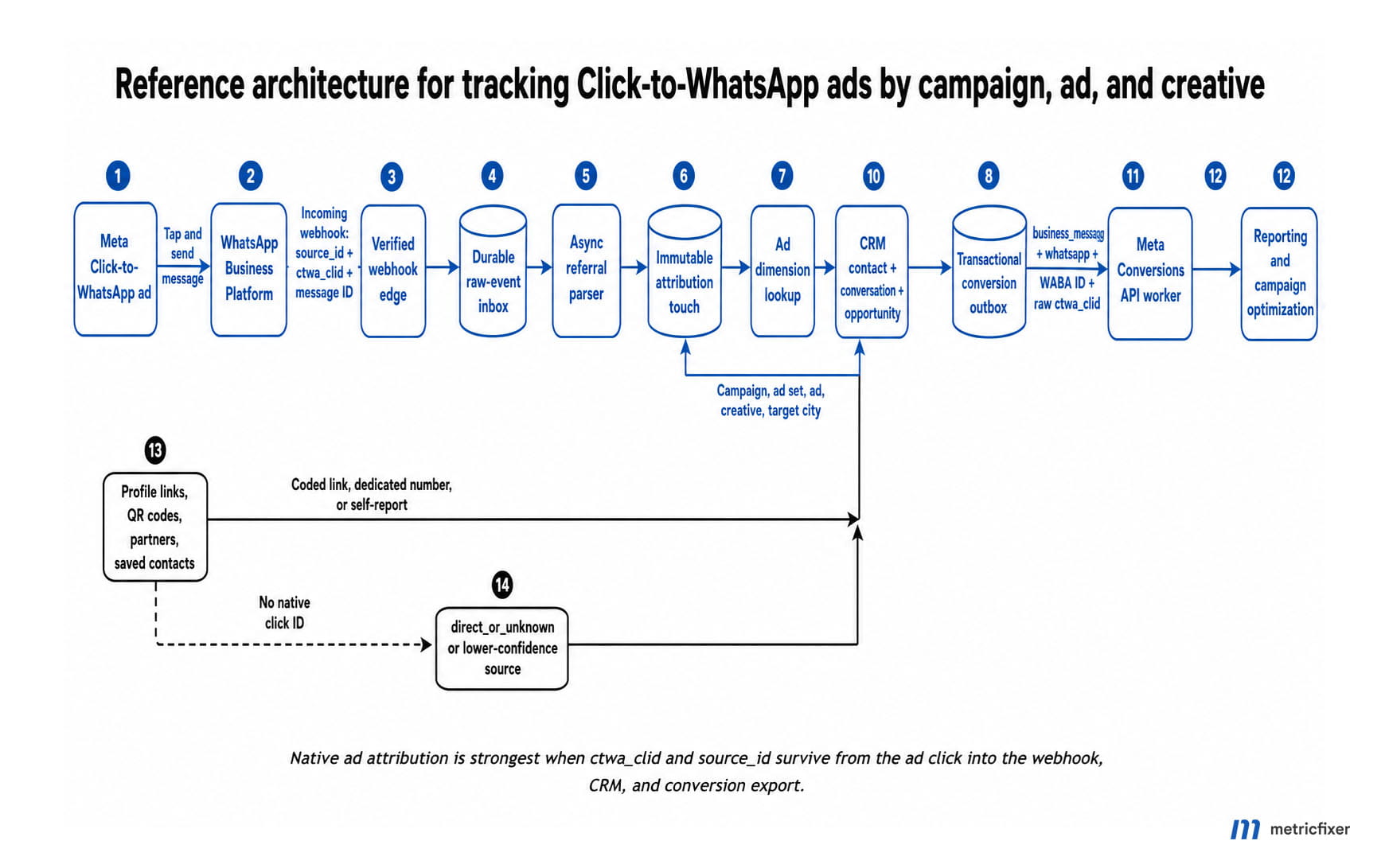
1. Meta ad and WhatsApp entry
The ad starts a conversation with one business number. The number can be shared by multiple campaigns, markets, products, and organic entry points; therefore the destination number alone is not a sufficient source key. The first inbound advertising message carries the native referral.
2. Webhook edge
The endpoint verifies the request, stores the raw body durably, creates an idempotency record, and returns success quickly. It does not wait for CRM APIs, Marketing API calls, AI classification, or Meta conversion delivery.
3. Attribution parser
An asynchronous worker extracts the WABA ID, receiving number, message ID, sender identifiers, referral fields, and timestamps. It creates an immutable attribution_touch even if the ad metadata has not yet been resolved.
4. Ad dimension service
A separate service or scheduled job maintains a local table of campaign, ad set, ad, creative, and market metadata. The webhook worker joins by stable ID. If the ad is not yet present, the touch remains pending_enrichment and is retried later rather than being discarded or assigned to “unknown campaign.”
5. CRM
The CRM links four concepts without collapsing them into one record: the person, the WhatsApp conversation, the attribution touch, and the sales opportunity. A returning person can start a new conversation from a different ad. One conversation can create more than one opportunity. One opportunity should have a clearly documented acquisition touch and conversion-return touch.
6. Conversion outbox
When a CRM state transition meets the qualification or payment rule, the transaction writes a conversion job to an outbox. A delivery worker sends that job to Meta, retries temporary failures with the same event_id, stores the response, and prevents a second event for the same business transition.
This is the same durable inbox/outbox principle used for dependable payment-webhook measurement. A related implementation pattern is described in metricfixer's guide to tracking purchases when users do not return from an external payment gateway.
How to distinguish ads, profile traffic, organic contacts, partners, and unknown sources
One WhatsApp inbox can receive conversations from ads, Facebook or Instagram profile buttons, Google Business Profile, QR codes, email signatures, printed materials, partners, repeat customers, shared contacts, and manually typed numbers. The source model must be explicit about confidence.
| Source evidence | Recommended source class | Confidence | Operational rule |
|---|---|---|---|
Valid referral with ctwa_clid and an ad ID resolved in the expected account | meta_ctwa_paid | High | Use as native paid acquisition and preserve click ID for Meta return. |
| Referral is present, but the ad lookup is pending or fails | meta_referral_unresolved | High that it is Meta-originated; incomplete campaign detail | Queue enrichment and investigate account permissions or stale ads. |
Unique controlled wa.me link or QR code with a source token | coded_link or coded_qr | Medium | Record the token as operational attribution; do not manufacture ctwa_clid. |
| Dedicated business number used only for one channel or city | dedicated_number | Medium to high | Attribute to the number's controlled channel while still allowing exceptions. |
| Agent or bot asks “How did you find us?” | self_reported | Low to medium | Store the answer separately from native acquisition. |
| No referral, source token, dedicated number, or reliable answer | direct_or_unknown | Unknown | Do not relabel as organic to make reports add up. |
| Existing customer starts another chat without a new source marker | returning_unattributed | Known relationship; unknown current acquisition | Keep original acquisition history but do not assume the new conversation came from the old ad. |
Controlled links and prefilled messages
For non-ad entry points, create a source registry and issue a distinct link or QR code for every controlled placement. A simple example is a prefixed message such as:
https://wa.me/15551234567?text=Hello%20%5Bsrc%3DIG_PROFILE_WARSAW%5DThe parser can extract src=IG_PROFILE_WARSAW and map it to a profile, campaign, city, partner, or offline placement. This is useful, but it is not equivalent to native Meta click attribution: the person can edit the text, reuse an old link, or forward it to someone else. Keep fields such as declared_source_code and source_confidence instead of writing the value into the same column as ctwa_clid.
Dedicated numbers are the strongest non-ad fallback
Where regulatory, operational, and budget constraints allow, a dedicated number per market or major channel provides a stronger source boundary than editable text. It is especially useful when a business must distinguish cities or franchises and expects a high volume of organic contacts. The trade-off is number management, agent routing, customer recognition, template governance, and potential fragmentation of conversation history.
Keep acquisition source and current touch separate
A common CRM mistake is to store one source field on the contact and overwrite it whenever a new message arrives. That destroys history. Keep:
original_acquisition_touch_id— the first accepted acquisition touch for the opportunity or customer;current_conversation_touch_id— the touch that initiated the current conversation;conversion_return_touch_id— the click selected under the documented rule for the event returned to Meta;- all underlying touch records, never overwritten.
For many businesses, the most defensible rule is: use the most recent eligible paid Click-to-WhatsApp touch that is linked to the active opportunity and falls within the business's documented lookback. Do not send one sale against several click IDs merely because the contact has multiple historical ad conversations.
From one ad ID to campaign, ad set, ad, and creative
The incoming referral normally gives the ad ID, not a finished reporting row. Resolve it through the Meta Marketing API or a scheduled export. The local dimension table should contain both stable IDs and human-readable names:
| Field group | Recommended fields | Why it matters |
|---|---|---|
| Account | ad_account_id, account name, business unit | Prevents collisions across accounts and supports permission checks. |
| Campaign | campaign_id, campaign name, objective, status | Supports campaign-level CRM revenue and lead-quality reporting. |
| Ad set | adset_id, ad-set name, optimization goal, target market/city taxonomy | Separates audience, geography, schedule, and optimization setup. |
| Ad | ad_id, ad name, status, creation time | Primary join from the WhatsApp referral. |
| Creative | creative_id, creative name, object/story IDs, format, internal creative UID | Enables durable creative analysis even after names change. |
| Versioning | valid_from, valid_to, last_synced_at, payload hash | Preserves what the metadata meant when the lead arrived. |
An illustrative ad lookup request is:
GET https://graph.facebook.com/v{API_VERSION}/{AD_ID}?fields=name,campaign{id,name,objective},adset{id,name,optimization_goal},adcreatives{id,name,image_hash,image_url,effective_object_story_id,effective_instagram_media_id,call_to_action_type},status,created_timeUse the current Graph API version, access token scopes, and fields supported by the account. In production, pull metadata in a scheduled job or cache. Do not make the WhatsApp webhook wait for a live Marketing API request: API latency, rate limits, permission changes, and deleted or archived ads would turn an otherwise valid inbound message into a webhook failure.
IDs are keys; names are labels
Campaign and ad names are useful for humans but unsafe for joins. Teams rename campaigns, clone ad sets, reuse creative labels, add city suffixes, or change taxonomies. Store the Meta ID as the canonical key and snapshot the name at enrichment time. Reporting can show both “name when lead arrived” and “current name” without corrupting historical joins.
Creative attribution limits
For one ad mapped to one stable creative, ad-to-creative enrichment is straightforward. For dynamic, flexible, carousel, or multi-asset setups, “the creative” can mean several things: the creative object attached to the ad, the combination selected for delivery, or the exact text/image/video asset the person saw. The WhatsApp referral's headline, body, and media fields are valuable evidence, but they are not a universal asset-level performance key for every format.
For audit-grade creative tests, use a measurement-friendly structure:
- one ad per creative concept where feasible;
- a stable internal creative UID in the ad or creative naming taxonomy;
- separate ad IDs for material variants;
- a snapshot hash of referral text and media metadata;
- Ads Insights reporting for platform-level asset analysis where the format supports it.
Do not promise exact asset-level CRM attribution when the delivery format does not expose a deterministic asset identifier in the messaging referral.
How to separate leads from different cities
City is usually two or three different variables that are incorrectly forced into one field:
campaign_target_city— the city or market the ad set was intended to target;declared_city— the city the person selects or types in WhatsApp;serviceable_city— the city accepted after address or service-area validation;sales_region— the internal routing territory, franchise, or branch.
The first comes from the ad dimension table or the business's campaign taxonomy. The second comes from the conversation. The third comes from a validation rule, postcode lookup, booking address, or agent review. They should not be substituted for one another.
A person can be physically outside the targeted city, travel, use a different phone-country code, request service for another address, or arrive through a forwarded ad. Therefore:
- do not infer city from the phone prefix;
- do not claim actual location from the ad set's target city;
- do not use city mismatch alone to reject attribution;
- do use declared and serviceable city to qualify and route the opportunity;
- do report lead quality by both target city and serviceable city.
A practical first bot or agent question is “Which city or service area do you need?” with controlled quick-reply options. The answer becomes a CRM qualification field, not a replacement for the advertising touch.
CRM data model: do not store everything on the contact
The minimum useful model has six entities:
- Person or contact — a business-scoped person identifier where supplied, WhatsApp identifiers, phone attributes, and consent/preferences.
- Conversation — one thread or operational session on one business number.
- Inbound message — message ID, timestamps, type, and a restricted reference to content.
- Attribution touch — immutable source evidence captured when a conversation starts or a new attributable entry occurs.
- Lead or opportunity — qualification, value, product, city, owner, and sales lifecycle.
- Conversion outbox — the one-time job used to deliver a qualified lead, purchase, or other approved event to Meta.
Since Meta began introducing business-scoped WhatsApp user identifiers, integrations should not key the entire CRM only by a mutable phone representation. Accept the current business-scoped user identifier when present, retain wa_id and phone data as attributes, and implement controlled merge logic. This reduces duplicate contacts when WhatsApp identity presentation changes.
Recommended attribution-touch fields
| Category | Fields |
|---|---|
| Identity and timing | touch_id, received_at, message_id, waba_id, phone_number_id, business-scoped user ID where present, wa_id |
| Native referral | ctwa_clid, source_id, source_url, source_type, headline_snapshot, body_snapshot, media metadata |
| Classification | source_class, source_confidence, classification_reason, declared_source_code |
| Enriched Ads hierarchy | ad_account_id, campaign_id, adset_id, ad_id, creative_id, names and internal taxonomy |
| Geography | campaign_target_city, declared_city, serviceable_city, sales_region |
| Data lineage | raw_webhook_id, payload_hash, enrichment_status, enriched_at, parser version |
A simplified schema illustrates the separation:
CREATE TABLE wa_attribution_touch (
  touch_id              VARCHAR(64) PRIMARY KEY,
  received_at           TIMESTAMP NOT NULL,
  waba_id               VARCHAR(64) NOT NULL,
  phone_number_id       VARCHAR(64) NOT NULL,
  message_id            VARCHAR(255) NOT NULL,
  business_user_id      VARCHAR(255),
  wa_id                  VARCHAR(255),
  source_class           VARCHAR(64) NOT NULL,
  source_confidence      VARCHAR(32) NOT NULL,
  ctwa_clid_ciphertext   TEXT,
  ad_id                  VARCHAR(64),
  campaign_id            VARCHAR(64),
  adset_id               VARCHAR(64),
  creative_id            VARCHAR(64),
  campaign_target_city   VARCHAR(128),
  declared_city          VARCHAR(128),
  serviceable_city       VARCHAR(128),
  raw_webhook_id         VARCHAR(64) NOT NULL,
  enrichment_status      VARCHAR(32) NOT NULL,
  UNIQUE (waba_id, phone_number_id, message_id)
);

CREATE TABLE conversion_outbox (
  outbox_id              VARCHAR(64) PRIMARY KEY,
  opportunity_id         VARCHAR(64) NOT NULL,
  touch_id               VARCHAR(64) NOT NULL,
  event_name             VARCHAR(64) NOT NULL,
  event_id               VARCHAR(255) NOT NULL UNIQUE,
  event_time             TIMESTAMP NOT NULL,
  delivery_status        VARCHAR(32) NOT NULL,
  attempt_count          INTEGER NOT NULL DEFAULT 0,
  last_response_code     INTEGER,
  last_response_body     TEXT,
  created_at             TIMESTAMP NOT NULL
);
Keep ctwa_clid access-restricted and encrypted at rest where appropriate. Sales agents normally need the campaign and creative labels, not the raw click identifier.
Webhook implementation: capture first, enrich later
WhatsApp webhooks are event delivery, not a one-time RPC call. Meta can retry notifications, networks can fail after the receiver has committed data, and downstream CRM APIs can be slow. The endpoint must be idempotent.
Recommended request path
Receive raw HTTP body
→ verify the platform signature against the raw body
→ extract WABA ID, phone_number_id, and message ID
→ insert the raw payload into a durable inbox with a unique key
→ return HTTP 200 after the durable write commits
→ parse and classify asynchronously
→ create the immutable attribution touch
→ enrich ad dimensions asynchronously
→ upsert CRM links
→ monitor failures and replay from the raw inbox
When using a direct Meta endpoint, verify the current request-signature mechanism, commonly represented by X-Hub-Signature-256, before trusting the payload. When using a provider, verify both the provider's signature and how the provider proves the original Meta event. Do not parse a reconstructed object and then attempt to verify a signature that was calculated over the original bytes.
Idempotency
A practical message idempotency key combines the WABA, receiving number, and WhatsApp message ID:
whatsapp:{WABA_ID}:{PHONE_NUMBER_ID}:{WAMID}On duplicate delivery, return success without creating another message, touch, lead, or automation. This is different from contact deduplication. Two different message IDs from the same person are not duplicates; two deliveries of the same message ID are.
Raw payload retention
Store the original JSON, a receipt timestamp, parser version, and payload hash in a restricted archive for a documented retention period. This gives the team evidence when a connector drops fields, Meta changes an optional object, a CRM mapping is corrected, or historical leads must be re-enriched. Avoid broad application logs that copy chat content, access tokens, click IDs, and customer data into systems with longer retention and weaker access control.
Provider acceptance test
Before approving a BSP, omnichannel inbox, automation platform, or CRM connector, run a real ad-originated conversation and inspect the provider's rawest available event. The acceptance test should prove that the integration preserves:
ctwa_clidwithout modification;source_idand the full referral object;- WABA ID and
phone_number_id; - the original WhatsApp message ID and timestamp;
- business-scoped user identifiers when supplied;
- signature or verifiable event provenance;
- retry and duplicate-delivery behavior.
A vendor's statement that it “supports WhatsApp leads” is not sufficient. Many CRM connectors expose only sender, phone, and message text, which is enough for sales operations but not for deterministic advertising attribution.
Returning a qualified lead or sale to Meta
Meta Conversions API supports server events from business messaging as well as website, app, and offline sources. In the no-website architecture, the CRM or integration service sends the event to the dataset connected to the ad account. The event should contain the business result, the real event time, a deterministic event_id, the WhatsApp messaging source, the WABA ID, and the original un-hashed ctwa_clid.
The endpoint pattern is:
POST https://graph.facebook.com/v{API_VERSION}/{DATASET_ID}/events
Authorization: Bearer {ACCESS_TOKEN}
Qualified-lead example
{
  "data": [
    {
      "event_name": "LeadSubmitted",
      "event_time": 1785686400,
      "event_id": "wa-qualified-lead:LEAD-10482:v1",
      "action_source": "business_messaging",
      "messaging_channel": "whatsapp",
      "user_data": {
        "whatsapp_business_account_id": "123456789012345",
        "ctwa_clid": "ARAx_EXAMPLE_CLICK_ID"
      }
    }
  ]
}
The exact lead event name available in a business-messaging dataset can differ by interface and current Meta configuration. Practitioner and provider implementations commonly expose LeadSubmitted, while other Conversions API workflows use or map to Lead. Confirm the event name shown by the current Events Manager setup and document the mapping. Do not silently change event names between deployments.
Paid-sale example
{
  "data": [
    {
      "event_name": "Purchase",
      "event_time": 1785697200,
      "event_id": "wa-purchase:ORDER-93015:v1",
      "action_source": "business_messaging",
      "messaging_channel": "whatsapp",
      "user_data": {
        "whatsapp_business_account_id": "123456789012345",
        "ctwa_clid": "ARAx_EXAMPLE_CLICK_ID"
      },
      "custom_data": {
        "currency": "USD",
        "value": 1250.00,
        "order_id": "ORDER-93015"
      }
    }
  ]
}
Use the payment-confirmation time as event_time, not the time the WhatsApp conversation began and not the time a retry was sent. If the business also sends email or phone for matching, follow Meta's formatting and hashing rules for those parameters. Keep ctwa_clid raw.
Use one stable event_id per business transition
The event ID should be deterministic and remain unchanged across retries. A useful pattern is:
{channel}:{business-transition}:{record-id}:{version}Examples are wa-qualified-lead:LEAD-10482:v1 and wa-purchase:ORDER-93015:v1. A timeout or temporary API error must cause a retry with the same ID. A genuine reversal, refund, corrected value, or second purchase should follow a separately documented event policy rather than reusing or randomly replacing the original event.
“Accepted” is not the same as “attributed”
Store the HTTP response, response body, platform trace reference where supplied, attempt count, and final delivery state. An accepted API request means Meta processed the request at the transport/schema level; it does not guarantee that the event will appear immediately, be attributed to the expected ad, or be used in optimization. Reporting can be affected by matching, event eligibility, account settings, attribution windows, privacy controls, aggregation, and platform processing.
Reconcile at least three numbers separately:
- CRM state transitions that should have generated events;
- events successfully delivered and accepted by Meta;
- events displayed or attributed in Events Manager and Ads reporting.
Which CRM stages should be sent
The event policy should reward real business progress, not chat activity. A useful baseline is:
| CRM transition | Return to Meta? | Suggested event | Guard condition |
|---|---|---|---|
| Conversation started | Usually no additional CRM event | Platform already knows the messaging start | Do not count every inbound message as a lead. |
| Lead details collected | Optional | Lead-submission event supported by the account | Required identity and demand fields are present. |
| Qualified lead | Yes, for lead-generation optimization | LeadSubmitted, Lead, or the configured equivalent | Meets documented product, geography, budget, and validity criteria. |
| Appointment or booking confirmed | Optional | Configured schedule/booking event if supported | Booking exists in the system of record, not merely proposed in chat. |
| Payment confirmed | Yes | Purchase | Order is paid or recognized under the business's revenue rule. |
| Agent reopens or edits the same stage | No duplicate event | None | The outbox already contains the deterministic transition ID. |
Organic or unknown chat without an eligible ctwa_clid | Do not pretend it is CTWA-attributed | Only send through another legitimate matching workflow if separately configured | Never fabricate or borrow a click ID. |
A qualified lead definition might require a real person, supported product, serviceable city, confirmed need, and minimum budget or timing. It should not depend on an agent's subjective “good lead” checkbox unless that decision is audited. Version the qualification rule so campaign comparisons remain interpretable after the sales process changes.
Implementation options
| Option | Best fit | Advantages | Main risk |
|---|---|---|---|
| Direct WhatsApp Cloud API + custom webhook + CRM integration | Teams with engineering ownership and strict data requirements | Maximum access to raw events, identifiers, versioning, and delivery controls | Higher build and maintenance responsibility |
| BSP/omnichannel platform + custom middleware | Teams needing inbox, templates, routing, and support but retaining data control | Faster operations with an independent attribution and CAPI layer | Provider may transform or omit referral fields; acceptance testing is essential |
| BSP/CRM native Meta CAPI integration | Teams with limited engineering resources and simple stage logic | Fast setup and agent/bot-triggered events | Black-box mappings, weak replay/audit controls, account portability, and limited event diagnostics |
| WhatsApp Business app only | Small manual operations that do not yet need deterministic closed-loop reporting | Simple day-to-day messaging | Insufficient raw webhook and automation control for the full reference architecture |
Direct integrations using only their own business data generally have a different permissions path from software providers that access client WABAs. Agencies, SaaS platforms, and BSP-style products should confirm current App Review and Advanced Access requirements before promising deployment dates.
Automatic events are supplementary, not the CRM source of truth
Meta's current WhatsApp webhook documentation includes optional automatic-event capabilities for supported Click-to-WhatsApp conversations, where the platform may detect outcomes such as a lead or purchase. This can be useful as an additional signal or QA comparison. It should not replace CRM-confirmed outcomes when “qualified lead” depends on a business-specific rule, when revenue is confirmed in a payment or booking system, or when sensitive conversations make message-derived inference inappropriate.
Use platform inference as a separate field such as meta_inferred_event. Compare it with crm_confirmed_event; do not merge them into one status without provenance.
QA and reconciliation plan
Test the full chain with real ads and real CRM transitions. Preview tools and synthetic webhook JSON are useful for development, but they do not prove that a live mobile click, provider connector, campaign lookup, and Events Manager configuration work together.
- Create one controlled test ad per market and creative pattern.
- Tap the ad on a real mobile device and send the first message.
- Confirm the raw webhook contains the expected
referral,source_id, andctwa_clid. - Confirm the unique message key prevents a replay from creating another touch.
- Confirm the ad ID resolves to the correct account, campaign, ad set, ad, creative, and target city.
- Confirm the CRM displays both the paid acquisition and the separately collected actual/service city.
- Repeat with a profile link, QR code, manually typed number, and returning contact to verify non-ad classifications.
- Move one test lead into the qualified state and verify exactly one outbox record.
- Deliver the event in Meta's test workflow where available, then verify production delivery with a separate controlled record.
- Retry the same delivery and confirm the
event_idremains unchanged. - Complete a paid test order and confirm the purchase time, value, currency, and order ID.
- Compare daily CRM eligible events, CAPI accepted events, errors, and displayed events.
Recommended monitoring
- percentage of new WhatsApp conversations with native referral;
- percentage of native referrals with a non-empty
ctwa_clid; - percentage of ad IDs enriched within the service-level target;
- referral loss rate by provider, number, app version, and deployment;
- duplicate webhook rate and idempotency conflicts;
- qualified-lead and purchase outbox backlog;
- CAPI acceptance, temporary failure, permanent rejection, and retry rates;
- CRM-to-Meta count variance by day and event type;
- share of leads in
direct_or_unknown; - target-city versus serviceable-city mismatch rate.
Common failure modes
| Failure | Why it breaks measurement | Correction |
|---|---|---|
| Using one contact-level source field | Returning contacts overwrite prior acquisition and mix separate opportunities. | Store immutable touches and link them to conversations/opportunities. |
| Treating every no-referral chat as organic | It combines profile, direct, saved contact, forwarded links, repeat users, and metadata loss. | Use direct_or_unknown unless a controlled marker exists. |
| Using the prefilled message as paid attribution | Text is editable, reusable, and forwardable. | Use native ctwa_clid for paid attribution; assign lower confidence to source codes. |
| Joining by campaign or ad name | Names change and are reused. | Join by Meta IDs and snapshot names. |
| Calling the Marketing API inside the webhook request | API latency or failure causes webhook retries and message loss risk. | Persist first; enrich asynchronously from a cache or queue. |
| Saving only transformed CRM fields | Dropped referral fields cannot be recovered or reprocessed. | Retain the raw event with restricted access and a retention policy. |
| Keying people only by phone | Identity representation can change and duplicate contacts. | Support business-scoped WhatsApp user IDs plus controlled merge logic. |
| Calling target city the user's city | Ad targeting is campaign metadata, not verified location. | Keep target, declared, serviceable, and routing cities separate. |
| Claiming exact dynamic-creative asset attribution from the ad ID | An ad can contain or select among multiple assets. | Use measurement-friendly ad structure and disclose asset-level limits. |
Hashing ctwa_clid | Meta expects the click ID in its original form. | Send it raw; hash only customer identifiers that require hashing. |
| Sending a conversion for every message | Chat activity becomes inflated optimization feedback. | Trigger on documented CRM state transitions. |
Generating a new event_id on every retry | Retries can become duplicate conversions. | Use one deterministic event ID per business transition. |
| Borrowing a click ID for an unattributed lead | Creates false attribution and corrupts optimization. | Send only with legitimate event-source and matching data. |
Privacy, security, and governance
A no-website flow is not exempt from privacy, consent, notice, security, or platform-policy requirements. The business still processes messaging identifiers, conversation content, click IDs, location or service-area data, and CRM outcomes. WhatsApp's business policy places responsibility on businesses to provide required notices and permissions and to use data in an appropriate, secure way.
Recommended controls include:
- publish or surface an accessible privacy notice through the business profile and onboarding flow;
- collect only the information needed for the conversation and service;
- restrict raw chat and click-ID access by role;
- encrypt sensitive identifiers and rotate access tokens;
- do not send message text, diagnoses, free-form notes, or unnecessary sensitive data to Meta;
- document retention for raw webhooks, message content, attribution touches, and delivery logs separately;
- record the system and user responsible for qualification and purchase transitions;
- review processor, agency, BSP, CRM, and Meta responsibilities contractually;
- use test records rather than real sensitive customer cases during implementation.
For healthcare, finance, legal, or other sensitive services, the advertising platform should receive a controlled conversion signal—not the confidential story behind it. Metricfixer's review of healthcare booking analytics maturity discusses the broader principle of separating operational truth from marketing-platform data.
Implementation checklist
- [ ] The WhatsApp setup exposes raw incoming webhook events or an equivalent provider event.
- [ ] A live ad test confirms
ctwa_clid,source_id, WABA ID,phone_number_id, and message ID survive the full connector path. - [ ] The raw body is verified, stored durably, and deduplicated before downstream calls.
- [ ] Referral parsing creates an immutable attribution touch.
- [ ] Missing referral is classified as unknown unless another controlled source marker exists.
- [ ] Meta ad IDs are enriched asynchronously into campaign, ad set, ad, creative, and market dimensions.
- [ ] IDs are canonical keys; names are snapshotted labels.
- [ ] Dynamic or multi-asset creative limitations are documented.
- [ ] Campaign target city, declared city, serviceable city, and routing region are separate fields.
- [ ] The CRM separates person, conversation, touch, opportunity, and conversion-delivery records.
- [ ] Business-scoped WhatsApp user IDs are supported where supplied.
- [ ] Qualified lead and purchase definitions are written, versioned, and auditable.
- [ ] CRM transitions create one transactional outbox record with a deterministic
event_id. - [ ] Business-messaging CAPI events contain the correct WABA ID and original un-hashed
ctwa_clid. - [ ] Phone/email identifiers are normalized and hashed only where Meta requires it.
- [ ] Retries reuse the same event ID and do not create duplicate CRM transitions.
- [ ] CAPI accepted events are reconciled separately from displayed and attributed events.
- [ ] Privacy notice, retention, access control, and sensitive-data exclusions are documented.
- [ ] Provider field preservation and permission requirements are re-tested after major upgrades.
Limitations and open questions
Meta's WhatsApp and Marketing APIs evolve, and exact payload fields, permissions, event names, automatic-event availability, and reporting interfaces can vary by account, region, provider, and API version. The examples in this article use placeholders intentionally. Production code should be validated against the current account's webhook payloads, Events Manager setup, Graph API version, and App Review status.
The native referral provides strong ad- and click-level evidence, but it is not a universal answer for exact asset-level delivery in every dynamic creative format. Where exact creative-asset attribution is a business requirement, campaign structure and available Ads Insights breakdowns must be reviewed before launch.
Profile, direct, QR, partner, and offline traffic cannot be reconstructed retrospectively if no source signal was encoded. Controlled links and questions improve operational reporting but remain weaker than a native advertising click ID.
Finally, automatic platform detection of lead or purchase outcomes can complement measurement, but CRM-confirmed qualification and payment should remain the source of truth whenever the business requires auditable definitions.
Methodology and sources
This article was prepared from a review of Meta's current WhatsApp Business Platform webhook documentation, Click-to-WhatsApp creative guidance, business-scoped user ID transition materials, Marketing API and Ads Insights documentation, Conversions API documentation and parameter reference, official Meta Postman examples, WhatsApp business policy, and practical implementation materials from messaging and CRM providers. The review was current on 2 August 2026. Practitioner sources were used to compare real integration patterns and failure modes; Meta's current account documentation and live payloads remain the implementation source of truth.
- Meta: WhatsApp incoming webhook payload reference
- Meta: WhatsApp webhooks overview
- Meta: WhatsApp business-scoped user IDs
- Meta: Get started with the WhatsApp Business Platform
- Meta: WhatsApp Business Platform permissions
- Meta: Click-to-WhatsApp ads in the Marketing API
- Meta: Marketing API Insights
- Meta: Conversions API overview
- Meta: Conversions API parameters
- Meta official Postman collection: retrieving ad details
- WhatsApp Business: Conversions API for business messaging
- WhatsApp Business Messaging Policy
- Twilio: Click ID callback parameter for inbound WhatsApp messages
- Sprinklr: Meta Conversions API integration for WhatsApp
- Meta Business SDK issue: WhatsApp business-messaging conversion payload implementation detail
This article is for technical, analytics, and operational information only. It is not legal advice and does not guarantee Meta attribution, reporting, or campaign-performance outcomes. Meta, WhatsApp, Facebook, Instagram, Graph API, Events Manager, and Conversions API configurations, policies, identifiers, permissions, and supported event schemas may change after publication. metricfixer is not affiliated with Meta, WhatsApp, Twilio, Sprinklr, or the other third-party services mentioned. Businesses should validate current documentation and live account behavior and obtain appropriate privacy and legal advice for their markets and data categories.