
Published Sep 22, 2026
Offline Conversion Tracking: Testing, Attribution and Smart Bidding
Learn how to test CRM and offline conversion tracking, investigate missing or duplicate events, reconcile advertising reports with real sales, and choose reliable bidding goals.
Category: Analytics & Conversion Tracking · By Mikalai Sasau
Offline conversion tracking becomes useful when you can explain what happened to each business event and why the advertising reports show the numbers they do. This guide covers testing CRM and offline integrations, diagnosing missing or duplicate conversions, reconciling platform reports with real sales, and deciding when qualified leads or revenue are reliable enough to guide automated bidding.
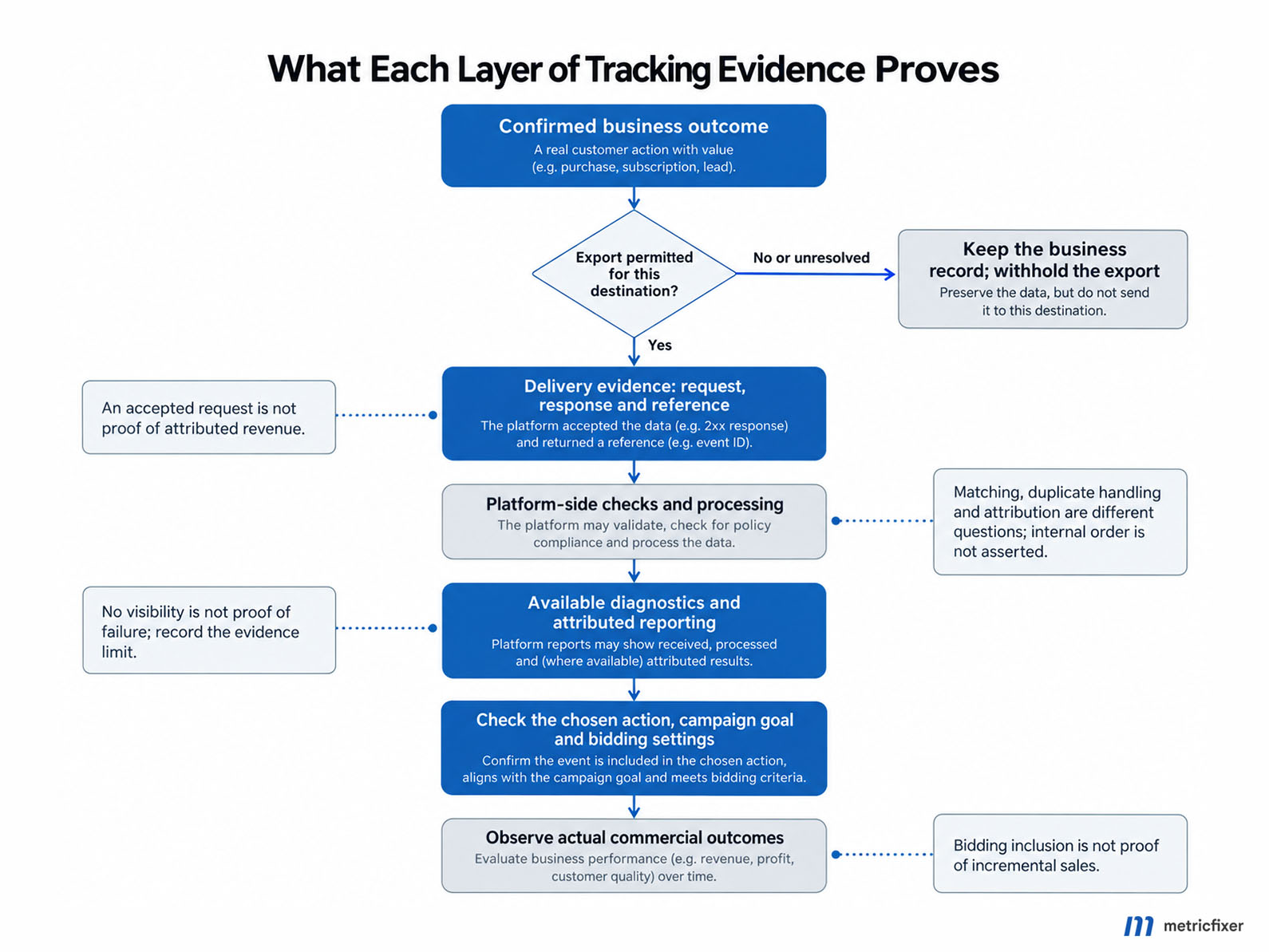
Practical starting point: do not switch campaigns to a new conversion goal just because an API request succeeds. Verify the business event, permitted identifiers, delivery result and reporting behavior first. Then approve the bidding goal separately. A received event, an attributed conversion and an improvement in sales are three different results.
Executive summary: what a working integration must prove
A CRM may contain a hundred paid orders while an advertising platform reports fewer conversions. That difference alone does not establish a tracking failure. Some orders may have no eligible advertising interaction, some exports may be prohibited, and some records may still be processing. Equally, a larger platform total does not prove better coverage: duplicate events or several counted stages can inflate it.
The useful question is not simply, Can we see the event? It is, What does this particular piece of evidence establish? Google's conversion troubleshooting guide explicitly warns that a successful import does not guarantee attribution and recommends starting with import diagnostics rather than campaign totals.
This article uses a practical acceptance model: first confirm the business facts and export permissions; then validate delivery and investigate the reporting boundary; finally approve the conversion goals used for bidding. These are operational checks, not a description of every platform's internal processing order.
For the business owner, the outcome should be understandable: the team knows which sales were eligible for export, which exports succeeded, which gaps remain unexplained and which objective advertising is pursuing. For the implementation team, that means preserving stable event identities, useful diagnostics and a documented chain from source record to destination.
Received, matched, attributed and used for bidding are different things
Imagine sending a paid invoice to an advertising platform. Delivery confirms that the recipient received a message. Matching concerns whether the available identifiers connect it to a recognized journey or user. Attribution determines whether advertising receives credit under the applicable rules. Bidding configuration determines which eligible outcomes guide the campaign.
| Check | Useful evidence | What it does not prove |
|---|---|---|
| The outcome is genuine | A source record confirms the agreed payment or qualification transition. | That the advertising platform received it. |
| The export is permitted | The destination-specific policy and permission decision is recorded. | That the available identifiers will match. |
| The request was accepted | The response, request reference and immediate warnings were inspected. | That every record survived later processing. |
| The destination processed the data | Available processing diagnostics and duplicate-handling evidence. | That each event was attributed to advertising. |
| Advertising received credit | The relevant conversion metric, date basis, attribution settings and reporting scope. | That the event is a selected optimization goal or that advertising caused an incremental sale. |
| The intended goal is active | The action, campaign goal and bidding settings are checked together. | That the new goal will improve profitability. |
Platforms do not necessarily expose an individual receipt for every matching, deduplication or attribution decision. A missing person-level answer should be recorded as not observable through this interface, rather than converted into an invented diagnosis. Match-quality scores and aggregate diagnostics are not customer-by-customer attribution reports.
Build a verification plan before sending test data
Agree on what should happen
Choose an event definition that can be checked without interpreting a sales representative's free-text notes. For example: the billing system changes a payment from pending to captured; the integration creates one event; the correct destination receives the approved fields; a repeated notification does not create another sale.
Include negative cases in the specification: missing permission, an unknown identifier, a duplicate webhook, a refund, a failed destination and a delayed record. These cases should have defined outcomes. An intentionally withheld export is a successful privacy control, not a broken conversion.
Before release, identify every existing route for the same business result. A CRM connector, ecommerce plugin, server tag and GA4 import can coexist. Testing only the newest sender will miss duplicate routes already active elsewhere.
Keep an evidence record, not an unrestricted customer-data log
The following is an illustrative internal ledger entry, not an API payload. Its purpose is to show how a developer or authorized internal assistant can investigate an event without copying personal identifiers into a support conversation.
{
  "business_event_id": "evt_payment_7842_captured",
  "source_record_ref": "billing:payment_7842",
  "occurred_at": "2026-09-18T14:35:00Z",
  "destination_ref": "approved_google_ads_action",
  "mapping_version": "2026-09-01",
  "permission_decision": "allowed",
  "permission_evidence_ref": "permission_record_441",
  "attempt_number": 1,
  "sent_at": "2026-09-18T14:35:08Z",
  "transport_status": "accepted",
  "provider_request_ref": "request_reference_redacted",
  "processing_status": "pending",
  "reporting_verification": "not_yet_reviewed"
}
Keep one business identity across attempts, but record each attempt separately. Store destination outcomes separately too: one recipient may succeed while another fails. Batch-level warnings must not be represented as an individual event's proven failure unless the response provides that association.
Access tokens, raw emails, phone numbers, hashes and sensitive URLs do not belong in routine logs. Retain approved references, field-presence indicators and sanitized error details instead. Restricted payload retention, where genuinely necessary, needs separate access and deletion controls.
Synthetic identifiers test formatting, not real attribution
A made-up identifier can demonstrate that code accepts a string. It cannot demonstrate that an advertising platform recognizes an actual customer journey. A syntactically valid hash is not evidence that it represents a permitted customer account known to the recipient.
| Verification method | What it can establish | Important limit |
|---|---|---|
| Synthetic records in local or isolated tests | Mapping, normalization, timestamp conversion, duplicate handling and error paths. | They do not establish matching or attribution. Never borrow another person's identity for a test. |
| A documented validation-only endpoint | The checks that this validator actually performs. | It may not execute ingestion or validate every credential and downstream requirement. |
| A destination's test-event view | Visibility and field inspection within that test workflow. | It is not a campaign attribution or business-performance test. |
| Authorized verification of genuine production journeys | Evidence that real business records retain their permitted acquisition context and reach the intended reporting route. | Not every destination exposes individual matching decisions; one journey does not establish population-wide coverage. |
Use genuine, lawfully handled journeys to assess real attribution, preferably through an approved review of normal production activity. Do not manufacture advertising clicks, reuse an unrelated click ID, or inject fake revenue into active optimization goals. Where no eligible genuine journey exists yet, sign off the technical checks and leave attribution verification explicitly open.
Do not assume a flag containing the word debug makes an upload harmless. Some mechanisms validate without ingesting; others send events to a collection endpoint and change how they can be inspected. Confirm isolation separately for each route.
Google Ads: diagnose the import before the campaign report
Data Manager API has immediate and later checks
For new offline conversion and enhanced-conversions-for-leads integrations, start with the current Data Manager API route. Legacy Google Ads API upload examples remain relevant to some existing integrations, but their response fields and access rules must not be copied into a new Data Manager implementation.
In Data Manager, validateOnly: true validates without executing the ingestion. A live ingestion can return requestId and fieldWarnings; an HTTP success is therefore not the entire result. See the event-ingestion reference.
The error model rejects the whole request when basic structural or required-field checks fail. Optional-field issues can produce warnings, and later processing can produce destination-specific failures. In other words, immediate rejection and later partial success are different situations.
Google's diagnostics workflow recommends capturing the request ID, starting the status check after 30 minutes and using backoff while processing continues. Documented processing can take up to 24 hours. Check each destination for SUCCESS, PARTIAL_SUCCESS or FAILED, and inspect warnings even after success. These are processing expectations, not a guarantee of campaign-report visibility within that time.
Implementation detail: in the REST status response, eventsIngestionStatus.recordCount includes successful and failed records; it is not a success count. Use the exact enum and field names for your API interface. Error and warning summaries may be aggregate counts, not a downloadable list of your failed business IDs. Preserve the submitted batch membership and use available field paths or record-level evidence; do not guess which orders failed from a total alone.
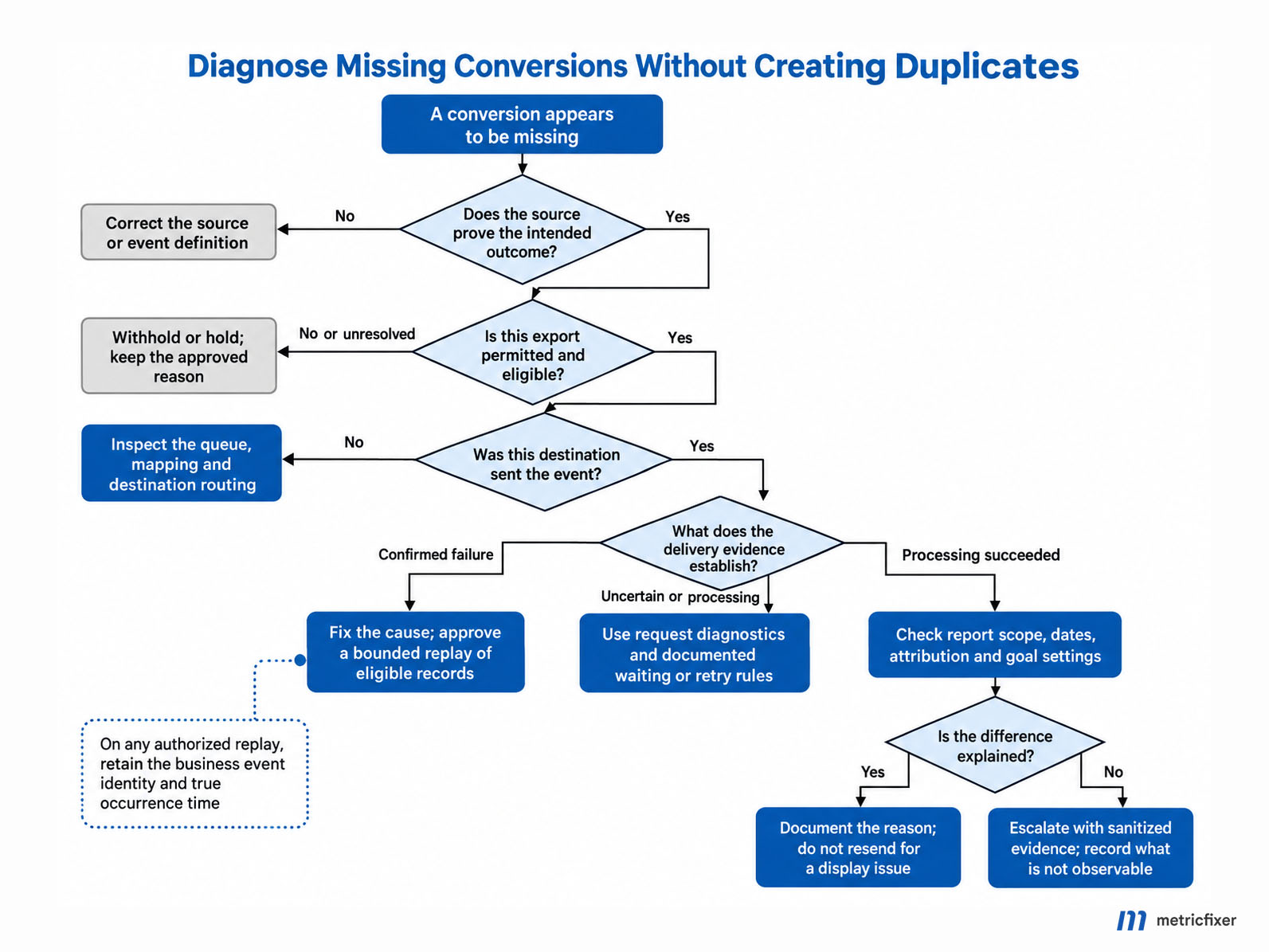
A practical order for investigating missing conversions
| Symptom | Check first | Do not conclude |
|---|---|---|
| The request is rejected | API route, authorization, destination ownership, action type and required-field validation. | That the platform cannot match the customer. Ingestion may not have started. |
| The request succeeds but processing is incomplete | Request status, warnings, destination-level errors and elapsed processing time. | That resending the whole batch is necessary. |
| Imports look healthy but attribution is low | Actual click/customer identifiers, permitted normalization, acquisition tagging, consent mapping and applicable windows. | That every unmatched record is a technical failure or should receive an invented identifier. |
| A conversion is visible in one column but absent in another | Conversion action, primary/secondary status, campaign goals, date basis and report filters. | That another upload will fix the display. |
| Values or counts are unexpectedly high | Competing routes, several funnel stages, repeated attempts, currency and units. | That the extra count represents incremental sales. |
This sequence combines Google's troubleshooting guidance with the delivery ledger recommended here. In legacy UploadClickConversions integrations, inspect partial_failure_error; do not assume a successful request means that every row succeeded. That is not the Data Manager response contract.
For enhanced conversions for leads, also verify the acquisition-side configuration. Google specifically warns that missing or incorrect lead-form tagging can lead to poor attribution. An email appearing in the CRM does not establish that the intended matching workflow was configured correctly.
Meta: Graph API Explorer, Test Events and Ads Manager answer different questions
What the adapter observation actually tells us
During a recent adapter project, the metricfixer team reported that test events could not initially be confirmed through Meta Graph API Explorer, but later appeared in pixel statistics. The reported observation is useful, but it does not identify the cause, prove a particular processing delay or demonstrate advertising attribution.
Graph API Explorer is used to issue API requests and inspect their responses; it is not a universal live feed of everything received by a pixel or dataset. The answer depends on the endpoint, request, access and filters used. Without the original request and response evidence, we cannot determine what that particular Explorer check established.
Meta's official Conversions API request model sends events to the selected pixel's events endpoint and directs test_event_code verification to Test Events in Events Manager. It also exposes response information including events_received, messages and fbtrace_id. Preserve those fields, with sensitive information removed.
Check the destination, the event and the reporting purpose
Confirm the numeric destination ID, event name, actual event time, source and test-code configuration. Then inspect the documented test view and dataset diagnostics, followed separately by the relevant Ads Manager conversion metric and attribution settings. Matching the display name of two data sources is weaker evidence than matching their IDs.
For the adapter case, a wrong inspection surface, destination mismatch, filtering, test-mode configuration or later reporting availability are hypotheses to check, not findings. Do not turn the anecdote into a fixed instruction to wait a particular number of minutes or hours.
Where Event Match Quality is available, use it to investigate matching-data quality. Do not read a score of eight as proof that 80% of CRM orders were attributed, and do not collect additional prohibited information merely to improve a score. Similarly, a received-event count does not say which campaign deserves credit.
Browser and server copies of the same website outcome need coordinated event identity: Meta's official event model uses event_name together with event_id to identify identical copies. A later CRM qualification is a different outcome from the original inquiry, not automatically a duplicate of it. Our Meta Pixel and CAPI deduplication guide explains this distinction; the Meta event-lifecycle guide covers the reporting surfaces in more detail.
GA4: validation, DebugView and attribution are separate checks
A validation response is not a collected event
GA4 Measurement Protocol has a dedicated validation endpoint. Google's validation guide states that events sent there do not appear in reports. It also warns that validation does not establish the correctness of every credential, including api_secret.
Validation endpoint path: /debug/mp/collect
Collection endpoint path: /mp/collect
During development, Google recommends strict validation using validation_behavior set to ENFORCE_RECOMMENDATIONS. An empty validationMessages array confirms the validator's checks, not an attributed conversion. Production collection does not return detailed validation errors for every malformed event, so the HTTP response alone is weak evidence.
DebugView is not the validation server
Google's implementation-verification guide describes sending collected test events with debug_mode and a positive engagement_time_msec for DebugView inspection. That is a different operation from sending a request to the validation server.
For a web stream, verify the intended measurement_id and the actual browser's client_id; for an app, check the appropriate app identifiers. A random new client ID does not reconstruct the existing customer's acquisition history. Check test/developer filters and the selected property before blaming event delivery.
Keep diagnostic engagement settings out of ordinary delayed CRM events unless they represent genuine measured activity. A payment recorded overnight is not evidence that somebody spent that time engaging with the website. Do not create sessions or engagement merely to force appearance in Realtime.
A later sale cannot be moved into an earlier session
Google's Measurement Protocol use-case guide distinguishes session attribution from exports to advertising products. Session attribution requires the genuine session_id, delivery within 24 hours of session start and an event timestamp inside that session. Advertising export has separate requirements, including the latest online event, a 63-day limit, the key-event attribution window and a timestamp within the last 72 hours.
The sending guide additionally warns about a 48-hour delivery condition for events intended to join or be processed together with particular client-collected events. These conditions address different processing purposes. Do not treat any one of them as a universal promise that arbitrary CRM history will recover its original campaign.
For example, a payment made twenty days after an inquiry is a new event at its real payment time. It is not a twenty-day-old event to backdate into the inquiry session. A dedicated Google Ads offline feed and a GA4 analytical event may be appropriate separate routes, as explained in Part 1's platform comparison.
Server-side GTM and other platforms: inspect the correct boundary
When server-side GTM is involved, Google's server-container preview and debugging tools help inspect incoming requests, the client that handles them, event data, tags and outgoing requests. They do not turn a tag-firing message into proof of attribution.
A backend webhook does not automatically appear in the same preview session as a browser visit. Configure the supported preview routing for that request. Confirm the production container and published version separately, and remove debug routing from production traffic after the approved check.
Trace both sides: the request entering the container and the request leaving for the destination. A successful response from the container to the CRM is not necessarily the advertising API's response. Check any template-specific handling of outbound errors, and keep durable delivery state outside transient preview output.
| Platform | First diagnostic checks | Next boundary |
|---|---|---|
| Microsoft Advertising | Inspect PartialErrors and their record indices in ApplyOfflineConversions. Confirm goal name, account, event time and matching fields. | Check the actual goal and its bidding inclusion; a batch response is not the final conversion report. |
| Verify the conversion rule, account permissions, campaign association, event time and supported identifiers using the Conversions API guide. | LinkedIn distinguishes matching from ingestion and notes that matched events support attribution and optimization. Review campaign configuration separately. | |
| TikTok | Check the chosen source and event mapping, API response and Events Manager diagnostics. Use the testing tools appropriate to the integration. | Verify that the campaign uses the intended eligible event or mapped CRM stage, not merely the dataset receiving it. |
The shared diagnostic questions are useful across platforms; response fields, supported event sources and correction rules are not interchangeable. A web-pixel helper also cannot observe a server-only CRM request simply because both belong to the same advertiser.
Separate the dates before comparing reports
One customer journey has several clocks. Mixing them is a common reason that a correct integration looks broken.
| Time | What happened | Use it for |
|---|---|---|
| Advertising interaction time | The customer interacted with an eligible ad. | Acquisition analysis and interaction-based advertising reports. |
| Business occurrence time | The agreed qualification or payment actually happened. | Business-event reconciliation and conversion-time reporting. |
| Upload time | The integration sent the record. | Queue health, delays and import diagnostics. |
| Reporting availability time | The processed result became visible in a particular report. | Determining whether a comparison is premature. |
Google's reporting-discrepancy guidance explains why interaction-based reporting differs from conversion-date reporting and identifies columns such as Conversions (by conv. time) and All conv. (by conv. time). Match the time basis before comparing against the CRM. Upload date is not the default campaign-report date.
Use the correct action scope, count setting, time zone, currency, attribution window and reporting cut-off as well. A sales ledger covering every channel is not the same population as one advertising platform's credited conversions. Different platforms can also credit the same order under their own rules; adding their attributed revenue is not a unique company revenue total.
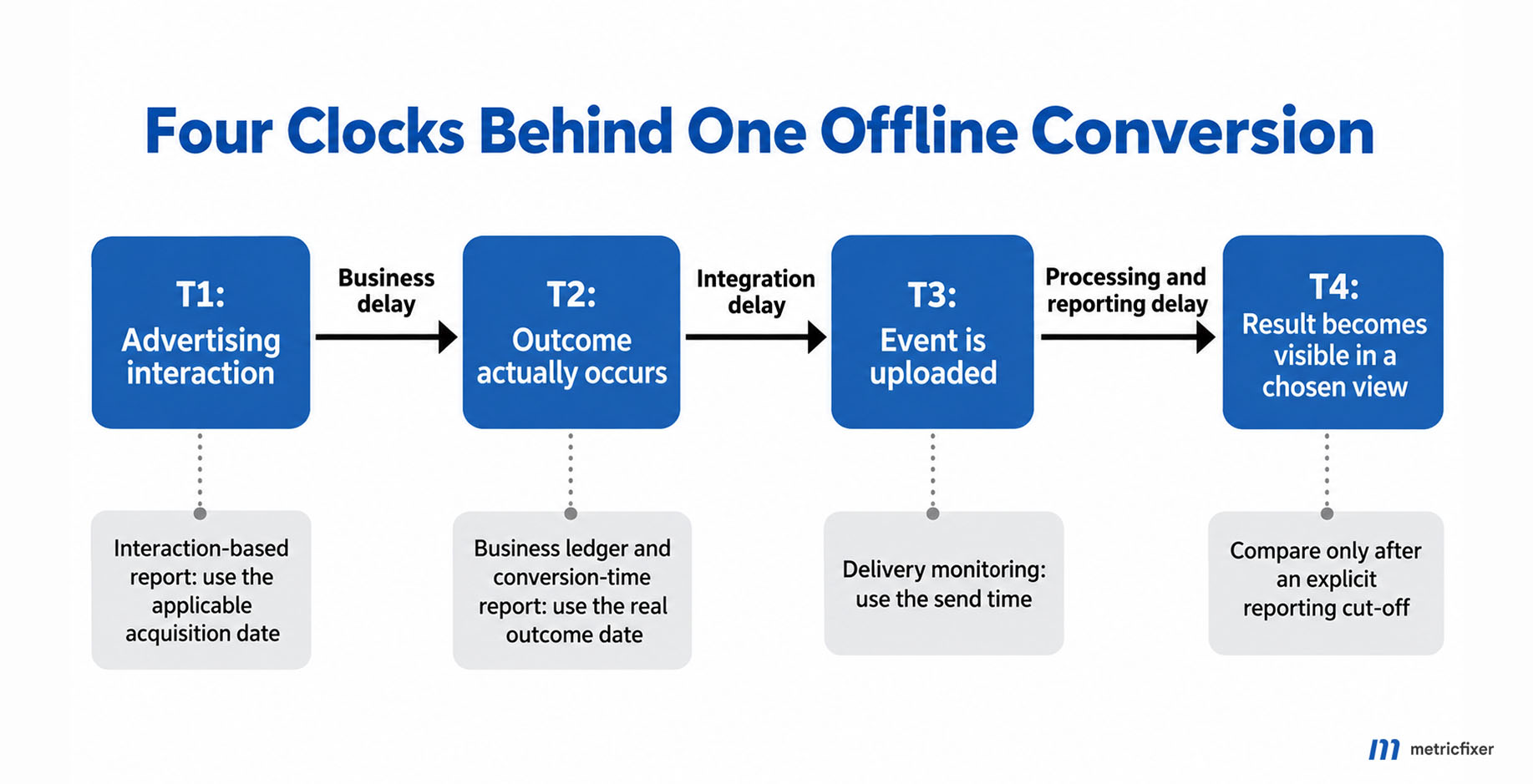
Finally, distinguish a sales delay from an integration delay. A salesperson may need ten days to qualify a lead; a connector may then hold the result for another two days. Improving the connector can remove the second delay, not the first. Store and monitor both.
Duplicates, retries and corrections need different handling
Preserve the event, not the delivery attempt
A repeated webhook, a retry after a timeout and a scheduled re-export can all describe the same payment. Reuse its stable business event identity and original occurrence time. A new random ID on every attempt defeats your own duplicate controls.
Conversely, a genuine second order needs a new identity. A customer ID cannot distinguish two purchases, and a single lead ID cannot by itself distinguish every legitimate later lifecycle event. Define whether the business counts one qualification per lead, per opportunity or per qualification episode.
For Google imports, the offline-import guidelines describe duplicate checks based on the relevant identifier, conversion name and time. Meta's matching browser/server identity is covered in our deduplication guide. Neither mechanism is permission to assume unrelated conversion actions or destinations deduplicate against one another.
An uncertain result is not a confirmed rejection
A timeout can occur after the recipient accepted the data. Record it as uncertain, investigate available request diagnostics, and follow the endpoint's documented duplicate and retry behavior. Do not blindly resend all successful members of a partly failed batch with new IDs.
As a design recommendation, separate temporary failures from configuration errors, invalid records and policy-blocked exports. Retry temporary failures with bounded backoff. Correct a mapping error before resending. Recheck permission and destination eligibility before replaying a queued record; preserve the original event time.
A refund is not another negative purchase everywhere
Google documents conversion adjustments for conversions already recorded, including retractions and value restatements under the supported conditions. Preserve the original conversion-action and order reference, and check identifier support and adjustment eligibility for that route. Do not assume the ingestion API also provides the correction method.
For a restatement, send the replacement total rather than the amount of change. In an illustrative example, reducing a recorded value from EUR 1,000 to EUR 700 means reporting EUR 700, not minus EUR 300. Google's restatement schema makes that distinction explicit. A later genuine correction requires its own later adjustment occurrence time; retrying the same correction should not pretend it happened again.
A GA4 refund, a Google Ads adjustment and a custom event sent to a social platform are different operations. Never assume that one automatically reverses the others. Maintain the true financial record internally even when a destination cannot accept a late correction or does not expose an equivalent mechanism.
Reconcile the business ledger first, then explain advertising credit
Build a reconciliation with two views: what the business recorded and exported, and what each advertising platform reports under its own rules. This avoids forcing advertising attribution into the role of an accounting ledger.
The following figures are illustrative, not project results or expected benchmarks. Assume one destination, one event per paid order and mutually exclusive internal classifications at a fixed reporting cut-off.
| Internal status | Orders | Interpretation |
|---|---|---|
| Confirmed paid orders | 100 | The authoritative business total for the selected occurrence period. |
| Withheld by permission or policy rule | 12 | Not export failures. Keep the approved reason without exposing sensitive details. |
| No usable permitted matching path | 8 | Still real sales; excluded from this export population. |
| Eligible for this destination | 80 | The population against which delivery is assessed. |
| Successfully processed under the chosen diagnostic definition | 75 | Distinct business records, not HTTP request count and not attributed sales. |
| Rejected and requiring investigation | 3 | A known delivery or processing gap. |
| Pending at the cut-off | 2 | An open status, not automatically a failure. |
Under these assumptions, delivery completion is 75 / 80 = 93.75%. Dividing by all 100 orders would mix delivery reliability with permission and matching availability. Report those coverage limits too, but label them separately.
Now suppose the platform reports 60 attributed conversions for the aligned scope. That does not establish that exactly 15 of the 75 records failed identity matching. Advertising eligibility, attribution rules, counting, duplicate handling, reporting maturity and aggregate or modeled outputs can prevent that subtraction from identifying a specific cause.
Reconciliation workflow: confirm business totals → classify export eligibility → reconcile attempted and processed records → align advertising report scope → investigate the remaining differences without inventing person-level decisions.
Calculate identifier coverage only where collecting the identifier is permitted. Review unmatched or unavailable context by approved, non-sensitive source categories. A missing field concentrated in one landing-page flow suggests a different investigation from a broad reporting change after an attribution-setting update.
Where authorized GA4 event-level exports are available, they can help inspect transaction IDs and event parameters. They are not an export of every proprietary Google Ads or Meta attribution decision. For Meta-specific reporting boundaries, see reconciling campaigns, transaction IDs and real revenue.
Compare customer groups that have had time to convert
A cohort is simply a group of leads acquired during the same period. Comparing this week's new leads with last month's fully developed pipeline can make the current campaign look worse even when nothing changed.
Set a maturity cut-off using the business's observed qualification, payment and reporting delays. Review both recent operational health and older, more complete acquisition groups. Do not divide today's paid invoices from older leads by today's new leads and label the result a lead-to-sale conversion rate.
Annotate measurement changes. More recorded sales after a connector repair can be better capture, not more sales. A before-and-after comparison on its own also cannot separate tracking changes from seasonality, pricing, campaign edits or sales-team performance.
Choose the business outcome before choosing the bidding strategy
Automated bidding needs a clear definition of success. An integration can make a weak definition travel faster, but it cannot make that definition commercially useful. Here, Smart Bidding refers to Google Ads; the other platforms have their own optimization products and controls.
| Candidate outcome | Why it may help | Main risk |
|---|---|---|
| Raw inquiry | Fast feedback and relatively frequent events. | Spam and low-intent inquiries can look like success. |
| Qualified lead | Closer to commercial relevance while often available before a sale. | Inconsistent qualification or slow CRM updates can distort the signal. |
| Accepted opportunity | A stronger indication of fit and sales commitment. | Lower volume and greater dependence on sales-team workflow. |
| Paid sale | A confirmed commercial outcome. | Long delays, few events, refunds or incomplete payment links. |
| Value-bearing outcome | Distinguishes commercially different leads or sales. | A misleading value model can optimize for the wrong customers more efficiently. |
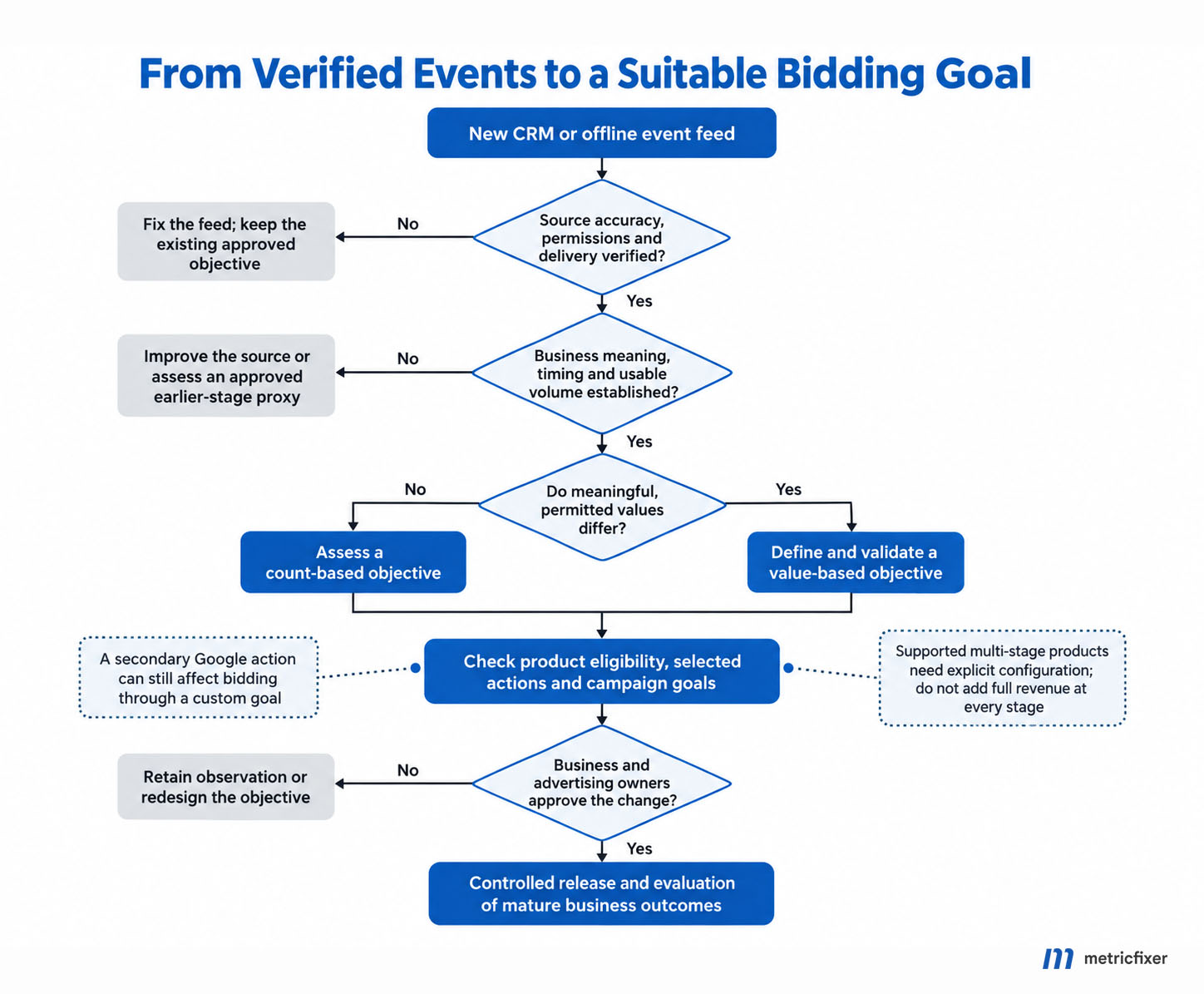
Recommended decision: use the deepest outcome that is consistently defined, permitted, sufficiently frequent and timely for the intended product. The deepest imaginable stage is not always the most usable current signal. An earlier stage is a defensible proxy only when its relationship with real sales is monitored.
Do not automatically turn an unqualified-lead status into a negative-value conversion. Nor is every lost deal a retraction of an earlier genuine qualification. Preserve the lifecycle history and use only the destination's supported feedback mechanism.
Google Ads: check the action and the campaign together
Under the normal Google Ads goal arrangement, an action must be primary and belong to a goal used by the campaign to drive bidding. A secondary action can nevertheless be used for bidding when included in a custom goal assigned to the campaign. This exception is documented in Google's conversion-goal guide.
Consequently, we marked the new event secondary is not a complete rollout safeguard. Inspect campaign-specific and custom goals as well as account defaults. An offline sale sent directly to Ads and the same sale imported from GA4 can be separate actions; do not assume a shared order ID prevents both from influencing bidding.
A sensible default is to measure the funnel but avoid making every stage an equally important success. Purpose-built multi-stage optimization products can work differently, as the platform section below explains. The rule is deliberate goal design, not a universal ban on multiple signals.
Use values that represent the business, not arbitrary scores
For Google Ads, distinguish count-based optimization from value-based optimization. A campaign maximizing conversions aims at the selected count; value-based bidding evaluates the supplied values. Google's Target ROAS documentation requires conversion values and sets eligibility requirements by campaign type.
If every qualified lead is treated as equally valuable, a count-based goal may be easier to interpret. If the values genuinely differ, agree on what they represent: revenue, contribution margin or an estimated future outcome. Do not label a margin-based return as revenue ROAS, or a predicted lead value as already collected cash.
One illustrative model is:
Expected lead value = probability of becoming a paid customer
                      x expected value of a paid customer

Illustrative example:
0.20 x EUR 1,000 = EUR 200 expected value per qualified lead
This is a mathematical example, not a recommendation that every business use 20%. Estimate probabilities from sufficiently mature records, document the value basis and review whether the model remains calibrated. Do not use prohibited health or financial characteristics to improve a prediction.
A later EUR 1,000 sale is not automatically another EUR 1,000 to add to the same objective after counting EUR 200 of expected value. Choose a defined approach: one optimization stage, a supported value-update mechanism, or a platform feature designed for multi-stage learning. Otherwise the same customer journey can accumulate misleading value.
Keep model versions and effective dates. A sudden doubling of assigned lead values can change reported return without changing the business. A bidding target calibrated on old values should not be carried forward unquestioningly.
What CRM feedback can do across advertising platforms
Google Ads: qualified leads, sales and eligible values can become selected conversion goals. Target CPA and Target ROAS express different objectives; importing data does not automatically choose the right one. Google's Target ROAS eligibility guidance lists at least 15 conversions in the previous 30 days at the conversion-tracking level for Search and Shopping, with different requirements elsewhere. That is an eligibility condition, not a universal definition of a reliable model.
Meta: CRM feedback can support lead-quality optimization in eligible setups, but the performance goal and source mapping still need configuration. Meta's published CRM announcement describes combining CRM-connected Conversions API with the conversion-leads performance goal. That explains the mechanism; it is not a current account-eligibility guarantee or evidence that any custom CRM event automatically becomes an optimization event.
TikTok: Deep Funnel Optimization explicitly combines a first optimization event with a deeper event and supports CRM stage mapping in the documented setup. This is a useful exception to a simplistic instruction to use only one funnel signal. It is a defined product configuration, not permission to add every stage's full revenue together.
Microsoft Advertising and LinkedIn: imported conversion data can support eligible optimization setups, but check the goal's bidding inclusion or campaign association rather than stopping at ingestion. Microsoft's offline-goal model includes ExcludeFromBidding; LinkedIn's conversion rule and campaign relationship are separate configuration objects.
Do not generalize one platform's minimum volume, learning period or value-bidding requirements to the others. Account eligibility and product behavior must be checked for the actual campaign.
Move from verified delivery to bidding in controlled stages
First collect evidence without changing the commercial objective
Keep the existing approved campaign objective while the new feed is being verified, where the platform's controls allow that separation. Check all goal settings so the new action does not enter bidding unintentionally. Record the release date, mapping version, affected campaigns and rollback owner.
Technical acceptance should confirm source accuracy, permissions, identifiers, values, duplicate handling, recoverable failures and understandable reconciliation. Business acceptance should confirm that the chosen stage represents value and that the team can interpret the expected delay. These approvals may happen at different times.
Reduce avoidable delays, but keep the real business timestamp
Google's Search and Shopping value-based bidding guidance recommends regular offline uploads and favors shorter click-to-reported-conversion delays. It notes that a complete absence of early feedback can materially lengthen the initial ramp-up. The recommendation is about useful feedback timing, not rewriting when a sale occurred.
Measure source-to-queue, queue-to-upload and upload-to-visible-result delays separately. Monitor both typical delay and the slow tail: an acceptable average can hide orders that arrive after a destination deadline.
A large historical backfill is not the same as a healthy ongoing feed. Keep original timestamps, current export permissions and destination limits. Diagnose and approve the backfill separately; do not change event times to make old records look recent or repeatedly upload history to compensate for low volume.
Then approve and observe the goal change
Before switching, record the previous goal, new goal, affected actions, chosen value basis, starting target and evaluation cut-off. Avoid changing several unrelated campaign controls at the same time when the purpose is to understand the new measurement signal.
A raw-lead CPA and a qualified-lead CPA are not directly comparable. In a simplified example, if 25% of leads qualify, a EUR 20 cost per raw lead corresponds to EUR 80 per qualified lead, before other differences. Carrying EUR 20 into the deeper goal would express a very different constraint. Use mature, relevant results rather than a target inherited from another stage.
Do not announce success because reported ROAS improved immediately after a tracking change. Review actual paid outcomes, refund-adjusted value where appropriate, sales quality and matured acquisition groups. Improved capture and improved commercial performance should be reported separately.
Monitor the feed, not just the advertising dashboard
| Monitor | What an unexpected change may indicate | First owner |
|---|---|---|
| Source event volume and stage distribution | A business change, CRM workflow change or missing source integration. | Business-system owner. |
| Permission and identifier availability | A consent change, broken acquisition mapping or changed record joins. | Privacy and measurement owners. |
| Queue age, failed records and uncertain attempts | Delivery failure, expired credentials, rate limits or unresolved responses. | Integration owner. |
| Duplicate rate, currencies and value distribution | Repeated exports, changed units, unexpected defaults or distorted value models. | Engineering and analytics owners. |
| Destination diagnostics and report maturity | Processing issues, configuration changes or premature comparisons. | Platform specialist. |
| Goals, bidding inclusion and real business outcomes | An unintended optimization change or a signal that no longer reflects commercial value. | Advertising and business owners. |
Set alert thresholds from the business's actual volume and schedule. A quiet weekend may be normal; zero weekday events from a normally busy payment stream deserves investigation. A small business should not inherit an arbitrary enterprise event-count threshold.
During an incident, preserve evidence, stop any prohibited or clearly incorrect export, identify the affected records and protect queued data. Repair the cause before replaying eligible events. Do not erase valid sale history merely to simplify a report.
For supported Google campaigns, bidding data exclusions are a distinct control to evaluate during a measurement incident. They are not transaction deletion or a substitute for refunds and corrections. Confirm scope and timing with the advertising owner; do not apply them automatically because a dashboard declined.
Privacy rules still apply during debugging and AI-assisted support
A debugging task is not an exception to the data rules in Part 1. Use approved access, redacted evidence and the minimum fields necessary. Testing in a regulated industry should not distribute patient records, financial-account details or sensitive application outcomes through support tickets and advertising tools.
TikTok's prohibited-data troubleshooting guidance explicitly includes URLs, query parameters and event names in the review, and directs advertisers to stop sharing prohibited data. A dashboard warning should trigger a disclosure investigation, not a search for a different encoding that bypasses detection.
For internal AI assistants, provide restricted lookup tools and structured decision rules. They may summarize sanitized diagnostics or compare approved mappings. They should not infer consent from a sales note, invent a missing click ID, turn an uncertain response into success, change event time to fit an upload window, or replay production events without authorized controls.
Require every diagnostic conclusion to state its evidence and confidence: confirmed mapping error, documented platform limitation, plausible hypothesis, or insufficient evidence. Keep approval for privacy exceptions, source-field changes, replay operations and bidding-goal changes with the responsible human owners.
A practical sign-off checklist
- Business accuracy: event meaning, occurrence time, order identity, currency, value and correction rules match the authoritative system.
- Permitted export: destination rules, permission history and current restrictions are enforced, including queued records and diagnostic data.
- Delivery evidence: request responses, later processing results, partial failures and unresolved outcomes are traceable without unrestricted personal-data logs.
- Counting and reconciliation: retries do not create new sales; competing routes are mapped; business and advertising totals are compared on documented scopes and dates.
- Optimization approval: the intended stage and value basis are selected, custom-goal exceptions are checked, product eligibility is confirmed and reporting-only events remain outside bidding where intended.
- Operations: monitoring, ownership, incident handling, replay approval and an evaluation cut-off are agreed before the integration is treated as production-ready.
A useful acceptance report should say more than the events are showing. It should explain what was verified, what could not be observed, which discrepancies are understood and whether the new signal is approved for bidding. That is the standard to request from an internal team or an implementation provider such as metricfixer.
Methodology and sources
This article continues the architecture and terminology established in Part 1. Platform-specific statements were checked against official documentation available on 21 September 2026: Google Data Manager and Google Ads conversion documentation; GA4 Measurement Protocol; server-side Google Tag Manager; Meta's official Business SDK and published CRM material; Microsoft Advertising and LinkedIn API documentation; and TikTok's diagnostics, data-policy and optimization guides.
Some Meta developer and help pages required authentication or could not be retrieved during this review. The article therefore does not assert an unverified current Meta eligibility threshold, exact processing delay or proprietary matching formula. Meta's older CRM announcement is used only to explain the documented connection between CRM feedback and an appropriate performance goal, not to establish present account availability.
The evidence model, ledger structure, reconciliation example, value illustration and rollout controls are editorial implementation recommendations, not universal platform schemas or measured performance results. The adapter observation was supplied by the metricfixer team; its root cause was not established. No new advertiser-account experiments were conducted. Sources are linked beside the relevant discussion rather than repeated as a technical bibliography.
This article is for technical and operational information and is not legal, medical or financial advice. A successful test or upload does not establish lawful processing, individual attribution, advertising incrementality or improved campaign performance. Obtain appropriate privacy, security and legal review, particularly for regulated industries. metricfixer is not affiliated with the third-party platforms mentioned. API behavior, diagnostics, policies, account eligibility and bidding requirements may change after publication.