
Published Sep 30, 2026
Google Business Profile for AI Search: A Practical Optimization and Audit Guide
A research-based guide to Google Business Profile optimization for AI search, with practical evidence, a 12-step workflow, current reporting guidance, and a 50-point audit.
Category: SEO & Web Marketing · By metricfixer Expert Team
Optimizing a Google Business Profile for AI search is not about inserting more keywords into a listing. It is about making a real business easy to identify, accurately describe, compare, and contact. This guide connects Google's documentation with public local-search research and practitioner tests, then turns the findings into a 12-step workflow and a 50-point audit.
Practical takeaway: treat the profile, its linked website, independent business information, and the customer journey as one maintenance job. Fix facts and eligibility first. Then improve evidence for the services and situations you genuinely serve. Measure whether AI answers are accurate and useful, not simply whether they mention your name.
Contents
What changes when local search becomes conversational?
A conventional search might be “bicycle repair nearby.” A conversational request might be “Find a workshop that services cargo bikes, has a step-free entrance, and can accept a drop-off after work.” Our practical recommendation is to audit every meaningful condition in that second request. A correct business category alone cannot explain all of them.
Google's generative AI optimization guide says established SEO remains relevant, describes retrieval and related-query expansion, and encourages businesses to keep their Business Profiles current. It does not publish a separate formula for ranking a profile in AI answers. Google's local-ranking guidance still identifies relevance, distance, and prominence as its main local factors.
The important distinction is between being found, being represented correctly, and being chosen. These are useful audit outcomes, not three stages of a Google algorithm that we can inspect.
| Surface | What to examine | Do not assume |
|---|---|---|
| Google Maps and the conventional local pack | The correct listing, proximity, relevant categories, and available actions. | A strong Maps position guarantees an AI recommendation. |
| AI Overviews and AI Mode | The recommended business, supporting sources, stated reasons, and linked website pages. | A website citation and a business recommendation are the same event. |
| Ask Maps | Answers to practical local constraints and the path to visiting, ordering, or booking. | Every account, country, or business type has identical functionality. |
| Other AI assistants | Their actual sources and recommendations in your market. | GBP is a universal feed that controls all assistants. |
Google's Ask Maps announcement describes conversational discovery and personalized recommendations. Its August 2026 update expands availability and action-oriented capabilities. Those developments justify testing real customer tasks, rather than auditing only short keywords. Check the features actually available to your customers instead of relying on an old launch-country list.
For the conventional foundations, see our companion Google Maps visibility and Business Profile guide. The additional question here is: Does the information surrounding this business support the particular recommendation the customer is asking for?
What research and experienced practitioners actually show
Public evidence is useful, but not all of it answers the same question. An observed citation pattern does not prove that changing one profile field caused a recommendation. A test of traditional local rankings is not automatically a test of AI Mode.
Large-scale observations: profile visibility and AI visibility are different
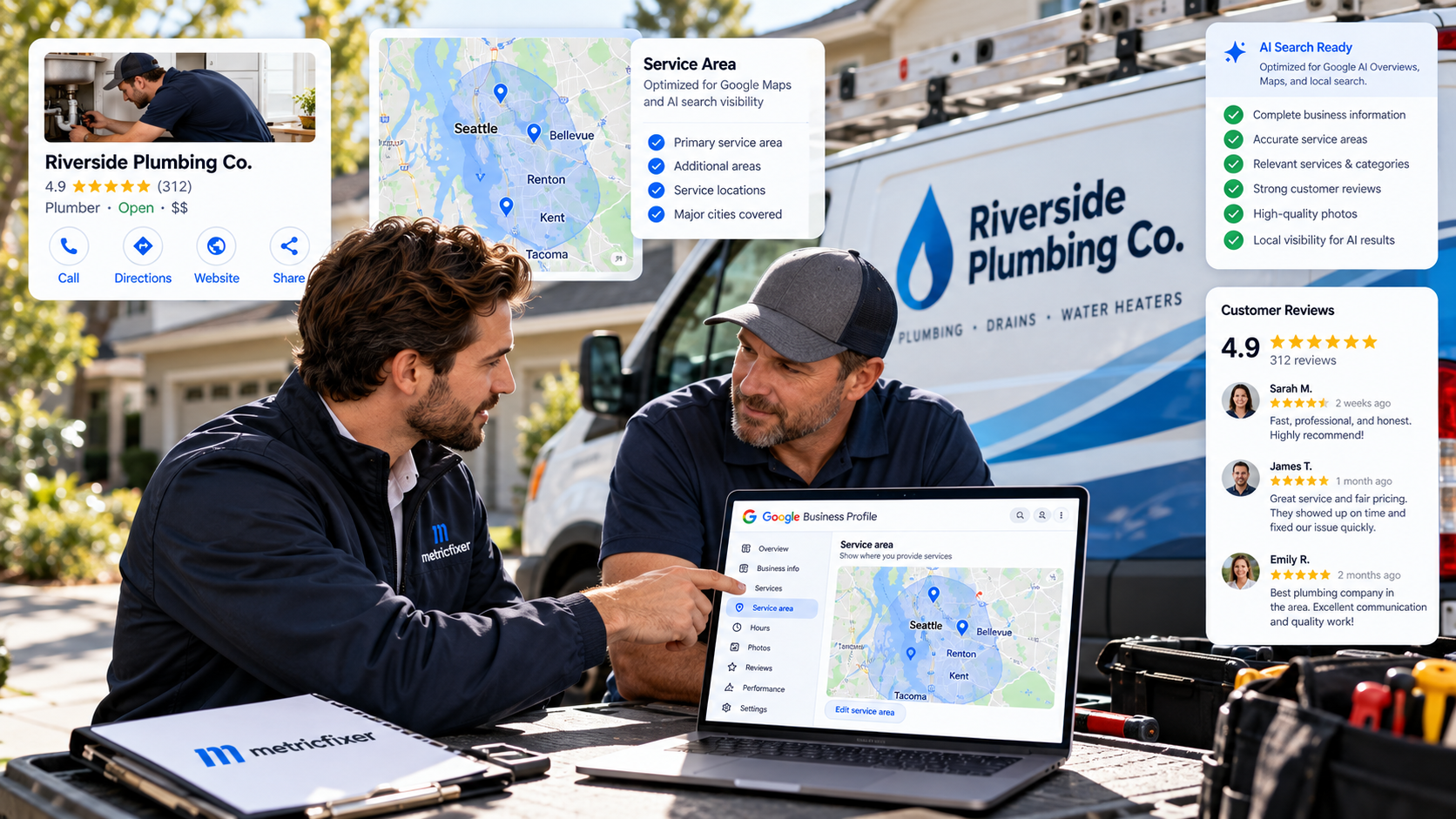
BrightLocal's September 2026 study examined around 200,000 localized searches, repeating non-branded prompts across locations and time. In its sample, the tracked business appeared in 66% of Maps searches, compared with 32–38% across the AI surfaces. Business websites represented 93% of unique cited domains but 42% of citation occurrences. Those are different denominators: the finding is not that 93% of AI citations came from company websites.
This is evidence for maintaining both the listing and the website, and for repeated measurement. It is not a market-wide visibility benchmark or a causal estimate of an optimization tactic. The research comes from a commercial tracking platform and a selected sample; its overview and methodology give slightly different sample totals.
BrightLocal's related source-and-directory analysis covered the US, UK, and Australia and found meaningful differences between platforms and industries. Google sources were especially prominent in Google's AI results; ChatGPT's sample leaned more heavily on other directories. Treat its directory lists as research leads, not a compulsory global submission list. The two BrightLocal publications should not be counted as independent replications.
Expert consensus: the work extends beyond profile fields
In Whitespark's 2026 Local Search Ranking Factors survey, contributors put dedicated service pages, relevant industry websites, editorial mentions, and authoritative review platforms among the leading AI-visibility considerations. These are expert assessments. Their scores are not disclosed Google weights, and they do not prove that buying a place on a “best businesses” page will help.
Miriam Ellis provides a more operational approach in her September 2026 citation playbook: investigate the sources that appear for your brand, important customer questions, and nearby competitors; then correct or develop the relevant listings. This is more defensible than purchasing hundreds of unrelated directory entries.
In a Near Media discussion and demonstration, Mike Blumenthal and Darren Shaw use conversational local search to investigate customer-experience and competitive gaps. The practical lesson is to look for issues such as unclear availability, service limitations, or recurring complaints. Verify any AI-generated comparison against the actual reviews before treating it as evidence.
Field tests: useful clues, with clear boundaries
Joy Hawkins' Sterling Sky services research describes an unsuccessful 2019 test followed by 2022 retests in which adding predefined services improved related local rankings for a lawyer and a dermatology business. Although the article was updated in September 2026, these were not September 2026 AI experiments. They support checking omitted services, not promising an AI uplift within a fixed number of days.
Two other Sterling Sky tests help set priorities. A 2021 test of weekly posts on three listings for nine weeks found no attributable local-ranking improvement. A geotagging test reported in 2024 found no measurable ranking improvement across five listings. Neither establishes that useful posts or photographs are worthless; neither supports selling a posting quota or EXIF-tagging routine as a proven AI-ranking mechanism.
Our conclusion: the strongest practical strategy is to improve truthful, specific, maintainable information and then test its effect. Public evidence does not establish a universal causal checklist that guarantees AI recommendations.
A 12-step Google Business Profile optimization workflow
Recommended order: verify the business → reconcile its facts → complete relevant profile fields → support them on the website → correct important external sources → test customer questions → measure qualified outcomes → maintain the information.
1. Establish a reliable business record before editing
Create one approved record for each real location. Include the customer-facing name, location identity, phone, website, services, customer-facing hours, service-specific restrictions, booking route, and accessibility details. For each changing fact, record who verified it, when, and where the supporting evidence is kept.
This is our recommended operational control, not a ranking field. It prevents different team members from publishing contradictory information. For a multi-location business, add an internal location identifier so that a phone number, review link, and landing page cannot accidentally be assigned to the wrong branch.
Google explains that profile information comes from several sources, including owners, websites, third-party data, users, and its interactions with businesses. Consequently, the value saved in your editor is not the only information worth checking. Compare the public listing, website, booking provider, and important third-party listings.
Also save a dated baseline: the visible profile, its actions, existing performance data, and a small set of customer searches. Do not postpone correcting dangerous misinformation simply to preserve an experiment.
2. Resolve eligibility, ownership, and identity problems
Start with Google's eligibility and ownership rules. An online-only business or a lead-generation listing is not made eligible merely by registering a company or renting a mailing address. Individual rental properties are also not equivalent to eligible customer-facing business locations. Apply the appropriate exceptions rather than forcing every business model into GBP.
Under the business representation guidelines, use the real-world name customers recognize. Do not append services, cities, “best,” or “24/7” solely to capture searches. Check the map pin, branch identity, duplicate records, and authorized owner access. Legitimate departments and practitioners have special rules; “one profile per location” is not a reason to remove valid exceptions blindly.
For service-area businesses, follow the service-area and address-visibility rules. Do not display a home or office as a visitable storefront when customers are not served there. Publish the areas actually served. An area setting is not evidence that Google must rank the business throughout that territory.
Pass condition: a customer, an operator, and an auditor can all identify the same eligible business without ambiguity.
3. Choose categories and services that describe real capabilities
Google says categories affect local ranking. Choose the most specific available primary category that describes the core business, then add relevant additional categories for genuine business activities. Do not choose categories merely because a competitor uses them. Category changes can require reverification, so make deliberate corrections rather than frequent experiments.
Next, inspect the services editor. Add applicable predefined services and sensible custom services where supported. Use the description and price fields for details; do not put phone numbers, promotional clutter, or prices into a custom service name.
Build a simple comparison between actual capability, GBP service, and supporting website content. For a workshop, “bicycle repair” may be accurate but insufficiently specific for questions about hydraulic brakes or cargo bikes. Equally, an e-bike service entry must not imply battery rebuilding when the team only handles mechanical repairs.
Prioritize profitable services you genuinely deliver and important omissions that create confusion. There is no need to invent a new service for every wording of a customer question. The audit should reveal missing facts, not manufacture a larger keyword inventory.
4. Write a useful description, not an AI pitch
In the profile, open Edit profile → Description. Explain what the business does, who it serves, and any meaningful specialization. Google's profile-editing guidance limits this field to 750 characters, excludes URLs and HTML, and prioritizes business details over promotions and prices.
The following is an original example for a fictional workshop, not a tested ranking formula:
Harbor Cycle Workshop is an independent bicycle repair shop serving commuters and cargo-bike riders. We provide mechanical repairs, brake servicing, and routine maintenance for conventional and electric bicycles. We do not rebuild batteries or repair electrical drive systems. Customers can book a repair assessment or bring a bicycle in during our published opening hours.
Keep volatile information, such as temporary opening hours or live appointment availability, in the appropriate fields and systems rather than embedding it everywhere. A description should not contradict those sources.
Google offers AI-assisted description writing for some users. It is a drafting aid, not a certification that the text is true or “AI optimized.” Check every service, qualification, and promise before saving it. A naturally written description is preferable to repeated city names or a string of superlatives.
5. Make practical constraints explicit: hours, access, and availability
Ask which details would change a customer's decision. These may include an accessible entrance, evening collection, parking, an appointment requirement, languages actually available, or the difference between on-site service and home visits.
Google's attribute documentation confirms that certain attributes can help a business appear for searches involving those attributes. It also explains that available attributes differ by country and category, and some are based on customer input rather than direct owner control. Review the relevant fields; do not indiscriminately select everything.
Separate facts that sound similar but mean different things. A ground-floor premises may still have entrance steps. A building may be open after the repair desk closes. A receptionist answering calls overnight does not establish overnight service availability. An item described as suitable for a dietary preference does not establish a medical safety guarantee.
Our suggested evidence table has four columns: customer question, verified answer, location of the published answer, responsible owner. Where GBP lacks a suitable field, explain the qualification on the linked location or service page. Mark genuinely unavailable profile fields as not applicable rather than pretending they were completed.
6. Improve review quality without trying to script reviewers
Make it easy for real customers to leave honest feedback using a Google review link or QR code. A neutral invitation might say: “Thank you for visiting. You are welcome to share an honest review of your experience on Google.” Link to the correct location.
Do not ask customers to insert your target service, city, or staff member's name. Google's current Maps contribution policy prohibits requesting specific review content, pressuring customers to review on the premises, incentives, and selectively soliciting positive reviews. Avoid review gating, employee quotas, prewritten customer reviews, or offers to reward the removal of criticism.
For our recommended audit, read recent genuine reviews for recurring themes: unexpected charges, difficulty finding the entrance, missed calls, or confusion over what is included. Fix the underlying service and information problems. Respond where a reply can help, without publishing private customer details or using every response as a keyword container.
Do not invent a minimum review count or a “safe” rating that guarantees selection. Use competing businesses as context for customer expectations, not as justification to manipulate your rating.
7. Use photos, posts, and answers as evidence
Follow Google's business-specific photo guidance to show the real entrance, interior, relevant equipment, services, and products. Our recommendation is to prioritize images that resolve uncertainty: where to enter, whether a cargo bike fits through the door, or what a particular service actually involves. Obtain permission where people or customer property are identifiable.
Do not fabricate a larger premises, nonexistent equipment, or a step-free entrance with generated imagery. Accurate photography has a different purpose from decorating a profile with generic visuals.
Use Business Profile posts for meaningful announcements, events, offers, or changed arrangements. Assign an expiry or review date to time-sensitive information. Publishing every day is not a substitute for maintaining the underlying facts.
Update old Q&A instructions: the My Business Q&A API was discontinued on November 3, 2025. Do not promise an automated owner-seeded question campaign through that API. Inspect the question or AI-answer functionality actually present on the profile; publish lasting customer answers on the website regardless of interface availability.
Also distinguish the owner's description from generated or editorial displays. Google documents separate controls for business descriptions, editorial summaries, and review-derived topics. You cannot directly rewrite all of them. Record an incorrect statement and use the relevant correction or feedback route instead of repeatedly editing an unrelated field.
8. Make the linked website a dependable source
For a multi-location business, link each profile to the page for that location when it is the most useful destination. A single-location business may use its homepage if that page already provides the essential local information. The goal is a clear destination, not an unnecessary page template.
Our suggested page brief includes the actual services, customer-facing location or service area, phone, hours, arrival instructions, meaningful qualifications, service exclusions, and a working contact or booking route. Add genuine examples of completed work where permission allows. Keep crucial details readable as text rather than available only in a promotional image, a chat widget, or an inaccessible booking interface.
Check that important pages are indexable and eligible for snippets. Also check Search Console → Settings → Search generative AI. Google's current inclusion control supports inclusion, exclusion, and inheritance from a parent property. Inspect the effective setting for the location pages; an unnoticed parent exclusion can matter. This website control does not remove independent information about the business elsewhere. It is also distinct from the Google-Extended training control.
Use normal LocalBusiness structured data where appropriate and keep it consistent with visible content. Identify real locations correctly; do not invent a customer-facing address merely to satisfy a markup requirement. Validate the implementation, but do not mistake validation for guaranteed selection. Do not expect self-serving business-review stars from adding your own testimonials to LocalBusiness markup: Google's review-snippet rules impose specific restrictions.
For broader technical checks, use our guide to making a website indexable, usable, and recommendable for AI systems. Supporting pages should answer genuinely different needs; avoid manufacturing hundreds of near-identical service-and-suburb combinations.
9. Correct important external sources and earn real corroboration
Start with the sources customers and search systems actually encounter. Our recommended working list records the source URL, the business identity it describes, the important claims, any discrepancy, and whether you can correct it directly or must contact the publisher.
Prioritize consequential errors over typographic perfection. An old phone number, wrong branch, discontinued service, or obsolete booking page deserves attention before harmless variations in punctuation. Keep meaningful facts consistent while allowing each publication to use its own wording.
Extend this work to relevant professional associations, manufacturer dealer directories, tourism resources, local media, and specialist review or booking platforms. These are examples of possible corroboration, not a universal list of mandatory accounts. A directory that matters in one industry or country may be irrelevant in another.
Earn coverage through something worth documenting: qualified expertise, a useful local project, a distinctive service, or credible participation in a professional community. Do not create fake awards, undisclosed endorsements, or networks of supposedly independent recommendation pages. Our guide to inbound and outbound links explains how to evaluate placements without relying on “link juice” folklore.
10. Make the next customer action work
Inspect every visible website, booking, ordering, and menu link. Google's local-business-link documentation explains preferred links and third-party provider links, some of which can appear automatically. Test the public journey rather than checking only the URL saved in the editor.
Our acceptance test is simple: a person on a phone should reach the correct branch, choose the correct service, see applicable conditions, and receive a real confirmation. Distinguish an enquiry from a confirmed booking. Do not treat an uploaded product photo as proof of live stock, or an old offer as proof that its price remains available.
For relevant business types, reconcile menus, local inventory, and booking-provider data with the systems staff actually use. Google's newer Ask Maps actions make that operational consistency increasingly important, but they do not make every business eligible for every action.
Prepare staff for Google's automated business inquiries, where available. Google can ask about appointments, prices, availability, or business information; separate settings control several types of contact and updates. Teach staff to distinguish a provisional quote from a confirmed commitment. Google says it will not ask for account passwords or payment to keep a business listed. Enabling automated calls is not a ranking guarantee.
11. Test the questions customers actually ask
Create a small fixed test set before expanding it. Our suggested starting point is 20 meaningful prompts, grouped by intent, repeated across a few genuinely relevant locations and the available search surfaces. This is a practical sampling plan, not a statistical minimum or a Google requirement.
| Intent | Example | What to verify |
|---|---|---|
| Basic discovery | “Bicycle repair near [neighborhood].” | The correct business and location appear, when relevant. |
| Specific service | “Who can service hydraulic brakes on a cargo bike?” | The recommendation matches actual capability. |
| Multiple constraints | “Cargo-bike repair with a step-free entrance and evening drop-off.” | Every condition is supported, not merely one of them. |
| Brand verification | “Does Harbor Cycle Workshop repair e-bike batteries?” | The answer preserves the service exclusion. |
| Reputation | “What do customers say about repair estimates at this workshop?” | The summary reflects identifiable, relevant reviews. |
| Action | “How do I book a repair assessment at the Riverside branch?” | The link and branch are correct; availability is not invented. |
Record the exact wording, date, surface, displayed or inferred location, language, device, and relevant account or personalization conditions. Use fresh conversations where possible. Do not assume that a private browsing window neutralizes location or every source of personalization.
For each answer, record four separate outcomes: business mentioned, business actually recommended, supporting source linked, and factual accuracy. Open important sources. An answer can cite your website without recommending you, recommend you without citing your website, or recommend the wrong branch. Classify factual claims as verified, contradicted, or not verifiable from the available evidence. A missing source link is not, by itself, proof that a claim is false.
Repeat comparable runs before and after a meaningful change. Keep a separate category for “feature not available” or technical failure; do not silently score these as business absence. Also record a completed search that produced no AI answer. Never prompt the system to include your business and then count its compliance as independent discovery.
12. Maintain facts and investigate errors at their source
Assign an owner for changes to hours, services, prices, booking providers, and temporary closures. Our suggested routine combines event-triggered updates with a weekly exception review and a periodic wider audit. It is a maintenance schedule, not a publishing-frequency signal.
Check notifications promptly. Google's current profile-update guidance gives a four-day response window for certain suggested edits; some updates can be applied without prior review. A monthly login alone may therefore miss changes that deserve attention.
When an AI answer is wrong, save the answer and its context, identify the cited or likely conflicting source, correct information you control, and contact the relevant publisher where needed. Use the feedback route for the answer or summary. Then repeat the same factual check later. Do not promise immediate propagation across Google or other platforms.
Treat safety-relevant errors, false service promises, wrong contact details, and branch confusion as more urgent than whether a favorable adjective appears. The objective is not to make the business sound suitable for everyone. It is to help the right customer make the right decision.
Worked example: turn vague claims into verifiable answers
Consider the fictional Harbor Cycle Workshop used above. Suppose its profile says “complete bike services,” the website says “e-bike specialists,” an old directory says “battery repair,” and staff confirm that only mechanical e-bike work is available. The priority is not to repeat “e-bike” more often. It is to remove the misleading implication.
| Problem | Recommended correction | Acceptance check |
|---|---|---|
| Electrical repair is implied but not offered. | Clarify scope in GBP services, the website, and the outdated directory. | A branded battery-repair question returns an accurate limitation or acknowledges missing evidence. |
| “Accessible” is used without details. | Inspect the entrance and select only verified attributes; publish a real entrance photo. | The answer does not infer facilities that have not been verified. |
| “Evening drop-off” conflicts with the booking page. | Agree the actual drop-off procedure and update the relevant customer-facing information. | A customer can follow the instructions successfully. |
| The booking link opens the wrong branch. | Correct the public action link and test the final confirmation. | The confirmation names the intended location and service. |
Notice the success criterion: fewer misleading recommendations and a more reliable customer journey. A narrower but accurate answer may be better for the business than an enthusiastic recommendation that generates unsuitable enquiries. This example predicts no ranking increase and reports no observed conversion improvement.
How to measure progress without inventing AI attribution
Keep visibility, website visits, profile actions, and verified business outcomes in separate columns. Each answers a different question. A rise in one does not establish a rise in the others.
Use the current Search Console report, with its actual boundaries
Google's dedicated generative AI reporting announcement and Help Center note a worldwide rollout on August 31, 2026. Advice saying that no separate Search Console AI report exists is now outdated.
The Generative AI performance report for Search documents impressions of links to your website in AI Overviews and AI Mode, with page, country, date, and device views. It is not a complete count of business mentions, profile appearances, Ask Maps recommendations, customer prompts, or sales. Do not present it as an AI-specific click-and-conversion report.
Its data overlaps the ordinary Search performance report, so do not add the two as independent reach. Property totals and page totals can also differ because of aggregation. A missing report or sparse data is a diagnostic question, not proof that the business has never appeared in an AI answer.
Separate profile activity from website and CRM evidence
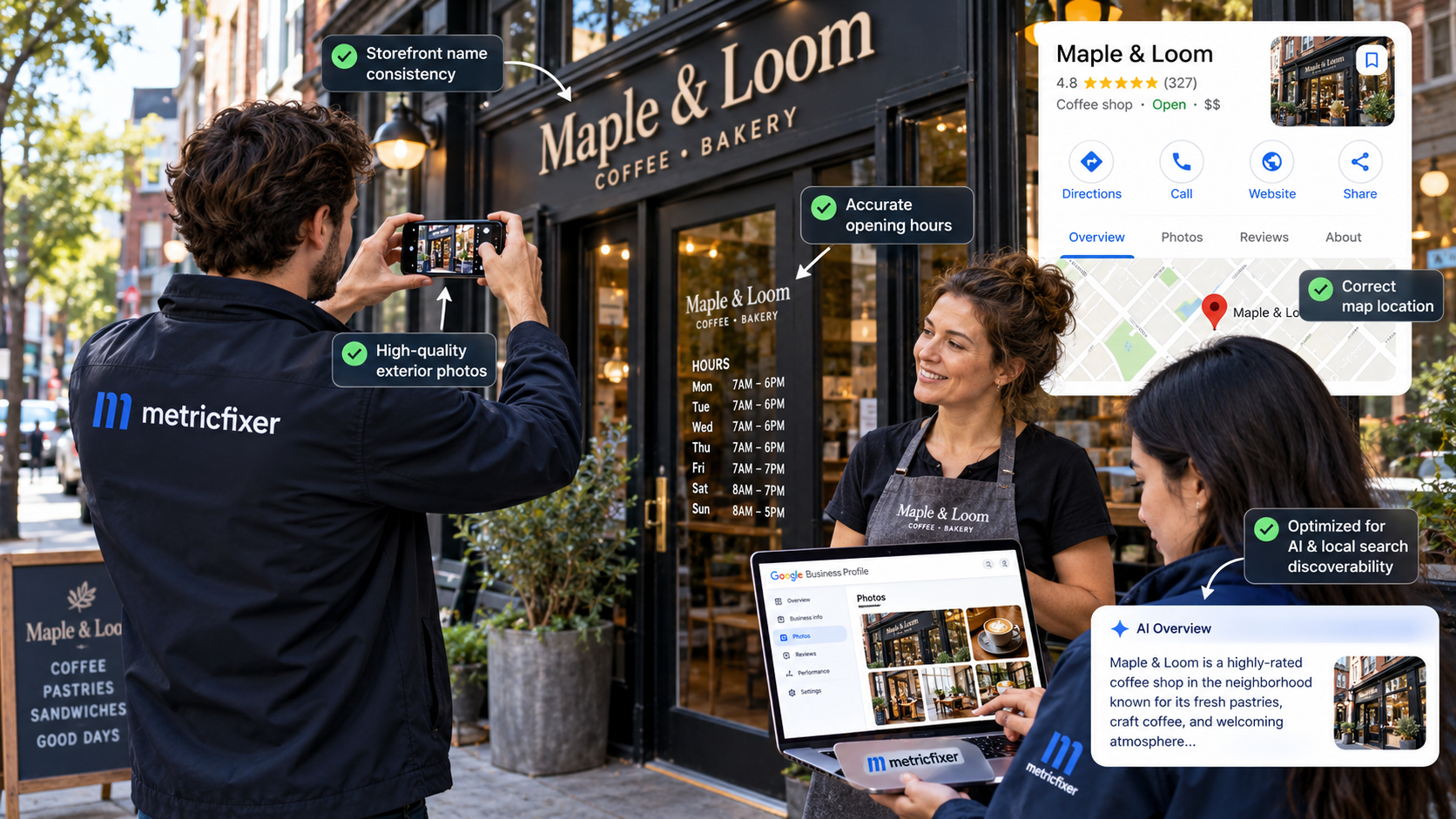
According to Google's GBP performance definitions, a “call” records a call-button click, not a completed conversation. Profile reporting can include activity from organic results and Google Ads. Booking metrics also depend on the relevant supported implementation. Keep these qualifications visible in client reports.
Google's campaign-URL documentation explains how UTM parameters label referring campaigns. Our suggested convention below distinguishes the profile link and location without claiming to identify the AI surface. For example:
https://www.example.com/locations/riverside/?utm_source=google&utm_medium=organic&utm_campaign=gbp&utm_content=riverside_websiteThis is an illustrative campaign-labeling scheme. Adapt it to the existing analytics convention, test redirects and consent behavior, and keep personal information out of URL parameters. A visit using this link identifies that tagged link, not whether the visitor first encountered it in Maps, AI Mode, or another presentation. Do not label every Google organic visit “AI traffic,” and do not add campaign tags to internal navigation.
Where permitted, connect enquiries and bookings to confirmed CRM outcomes. Track answered calls, qualified enquiries, confirmed appointments, completed transactions, and revenue separately. A voluntary “How did you hear about us?” answer can add context, but it is not precise attribution.
Use an observation panel, not one impressive screenshot
Our proposed scorecard reports the fraction of comparable completed test runs that recommended the business, the share of evaluated factual claims that were correct, and the number of successful action-path tests. State the sample size and conditions. Keep unavailable features and failed runs separate, and do not generalize a small panel into a population estimate.
Change one coherent group of information at a time where practical. Log changes in advertising, seasonality, availability, reviews, website content, and competitors. For multiple branches, comparable unchanged branches can help contextualize a change, but they do not automatically make the comparison causal. Do not preserve harmful misinformation for the sake of a control group.
The business outcome to seek is more suitable demand and fewer broken journeys. Report an observed association honestly; reserve claims of incremental lift for a design that actually supports them.
The 50-point Google Business Profile AI-search audit
Use Pass, Fail, Not tested, or Not applicable, with evidence and a responsible owner for every item. The priorities used in the audit are our operational triage, not Google's ranking weights: P0 means an eligibility, safety, identity, or broken-journey problem; P1 means core information or measurement work; P2 means enrichment or ongoing improvement. Do not average away a P0 failure with a high completeness score.
Put the guidance into practice
The complete audit now has its own workspace in Guides. Record evidence, assign owners, review urgent failures, and export your results. Use it yourself or with a WebMCP-capable AI agent.
Open the interactive 50-point audit
One location per audit. No Google sign-in required. The worksheet does not edit your Business Profile.
A pass means that the stated check was verified. It does not mean the profile has passed a Google “AI readiness” certification, and it does not guarantee that an assistant will recommend the business.
A practical first-month implementation plan
| Period | Work | Deliverable |
|---|---|---|
| Days 1–3 | Confirm ownership and eligibility, fix urgent inaccuracies, capture a baseline. | An approved location record and prioritized issue log. |
| Days 4–10 | Correct categories, services, attributes, descriptions, hours, and action links. | A verified public profile with working customer paths. |
| Days 11–20 | Improve the linked pages, check technical inclusion, and correct important external sources. | Consistent, accessible evidence for real services and constraints. |
| Days 21–30 | Repeat the test panel, review data quality, investigate remaining errors, assign maintenance. | An evidence-based progress report, not a guaranteed uplift claim. |
For a small business, this may be a focused cleanup. For a chain, the same process needs branch-level ownership and change controls. Do not let a shared template overwrite real differences in services, opening hours, or accessibility.
Shortcuts that should not drive the strategy
Google's AI optimization guide rejects special AI markup and files such as llms.txt as requirements for Google Search. It also rejects a mandatory content length or chunking formula and warns against mass-producing pages for query variations. Use headings and clear answers because they help readers, not because somebody claims a fixed answer length unlocks recommendations.
The research discussed above likewise does not establish guaranteed benefits from geotagging photos, posting on a rigid schedule, stuffing review replies, or achieving a particular review count. Nor does a correlation between mentions and visibility prove that artificial mentions created the visibility.
Paying for an agency, software, or advertising can buy work, tools, or ad exposure. It does not purchase a better organic local ranking. Google explicitly says there is no way to request or pay for that outcome.
Frequently asked questions
Is Google My Business different from Google Business Profile?
This guide uses Google Business Profile, or GBP, the current product name. Older research and checklists may still use Google My Business or GMB. Check when the described feature or test actually existed before applying the advice today.
Can a business appear without a website?
A website is not a universal condition for an eligible business to have a profile. However, our recommendation is to maintain a useful website when feasible: it gives you space to explain services and limitations that a listing cannot fully express. It also gives customers a destination you control.
Should every possible service and nearby city get its own page?
No. Create a separate page when it serves a distinct customer need and contains genuinely useful information. A change in a city name alone is not a reason to manufacture another page. Real branch pages should explain the differences that matter to that branch's customers.
Should AI-generated business descriptions be avoided?
Not necessarily. Use them as editable drafts, then verify the details against the business record. The important distinction is between accurate, useful writing and unsupported claims, not between human and machine keystrokes.
What should happen when an assistant recommends a service we do not provide?
Preserve the answer, check its sources, correct the relevant profile and website information, request corrections elsewhere where appropriate, and submit feedback. Test the factual question again later. Do not add the unwanted service to make the answer appear correct.
How long does AI-search optimization take to work?
There is no defensible universal deadline. Information changes must be processed, results vary, and visibility may not improve. Judge early work by verified corrections and functioning journeys, then evaluate comparable observations and business outcomes over time.
Methodology and sources
This review was prepared on September 30, 2026. It prioritizes Google's current documentation and policies, original BrightLocal research, Whitespark's expert survey and practitioner guidance, Sterling Sky's published tests, and Near Media's original discussion. Sources are linked beside the relevant claims.
Product announcements, current Help Center definitions, study dates, and article update dates are treated separately. Historical local-ranking tests are not presented as modern AI experiments. Survey opinions are not algorithm weights; repeated-query observational datasets are not randomized trials. Where older recommendations conflict with current review policy or discontinued APIs, current official guidance takes precedence.
No live client profile, Search Console property, analytics account, or CRM was accessed. No ranking experiment was performed for this article. The workflow, priorities, prompt panel, tagging example, and fictional workshop are editorial proposals. They are designed to support an auditable implementation, not to claim a measured performance gain.
This article provides technical and operational information, not legal advice, a Google certification, or a guarantee of search visibility or revenue. metricfixer is not affiliated with Google or the other platforms and publishers mentioned. Features, interfaces, policies, and availability can change. Publish only substantiated business claims, respect customer privacy and platform terms, and verify safety-relevant details with the people responsible for the service.