
Published Oct 28, 2026
OpenAI Ads Creative Enhancement: Default-On Automation and What to Check
OpenAI is moving creative enhancement toward automatic activation. Learn what can change, how to protect qualifying copy, and what new bidding, budget and measurement settings mean for advertisers.
Category: Online advertising · By metricfixer Expert Team
OpenAI Ads is giving automation more control over creative, bidding and budget delivery. Creative enhancement deserves particular attention: an advertiser may carefully approve an ad, yet allow its message, language or destination to be adapted during delivery. This October 2026 review explains what the available evidence establishes, which changes matter since our September coverage, and how to protect qualified demand rather than simply attract more clicks.
Practical priority: check the active account and campaign settings before your next budget increase. Where exact wording, offer conditions or a particular landing page are essential, keep adaptation off until the business has explicitly approved the risk. Where adaptation is acceptable, test it against qualified leads, completed sales and an agreed spending limit.
Contents
Executive summary
The important question is not whether AI can write a more appealing headline. It is whether the advertiser has authorized a different way of presenting the offer, and whether the resulting traffic still meets the business's requirements.
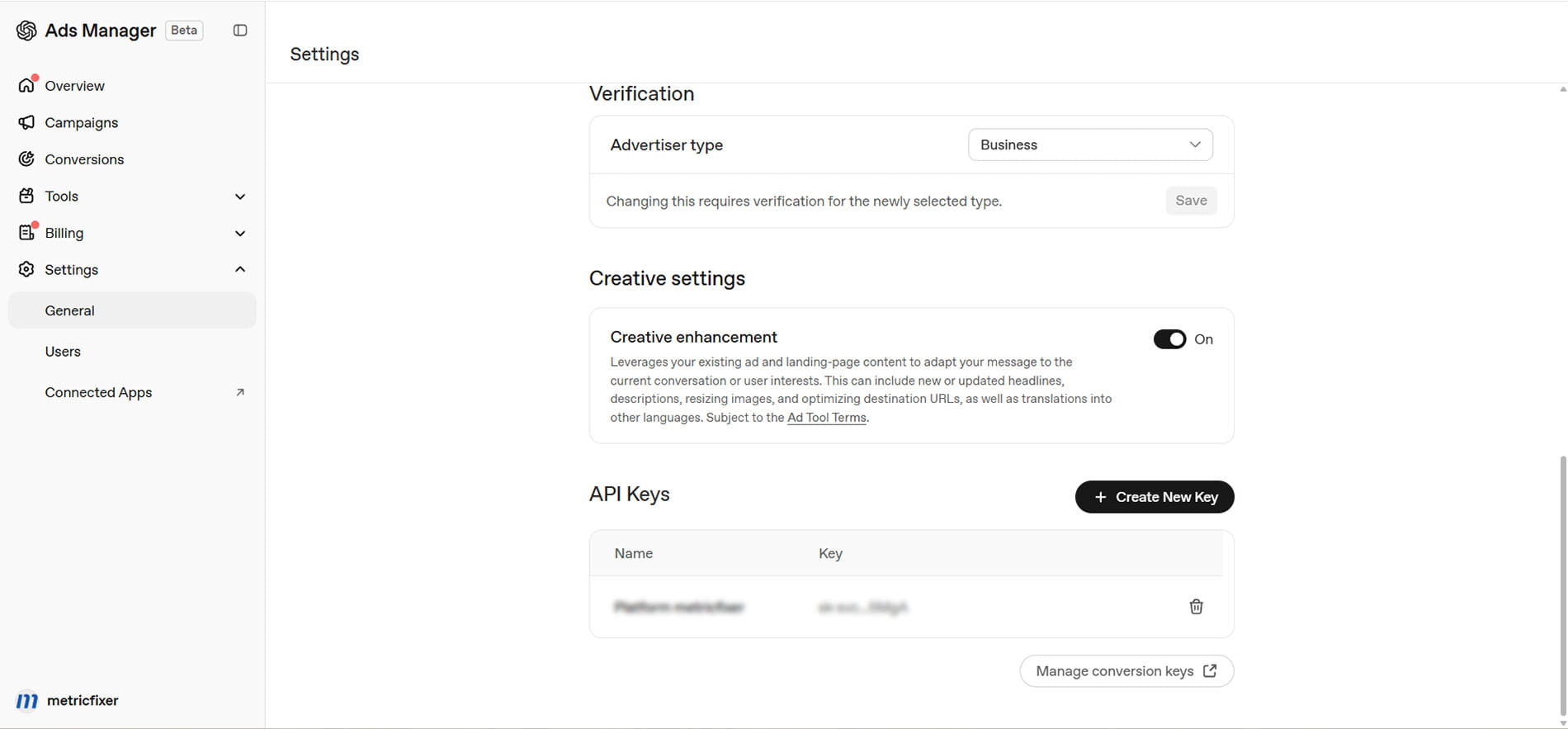
A screenshot supplied to metricfixer shows Creative enhancement switched On in one Ads Manager account. Its description covers changes to copy, images, destinations and language. This establishes the visible state of that account, not when it changed, who enabled it, whether a particular variation ran, or whether every advertiser has the same setting.
OpenAI now documents an automatic rollout, alongside opt-out controls. That makes a settings audit warranted, but it does not justify claiming that all accounts have already been switched or that previous opt-outs have been ignored. The timing and control details are addressed below.
Our recommendation is selective, not anti-automation: protect essential qualifying information, test useful adaptation, and judge the outcome with business records. Review bidding and budget settings separately so that a creative experiment does not accidentally become a simultaneous change in spending strategy.

What changed since the September review
This article follows metricfixer's 17 September OpenAI Ads review and the 24 September attribution and CRM reconciliation guide. The earlier overview already covered conversion-optimized impression billing, flexible attribution windows, platform targeting, Event Quality Score, Shopify, HubSpot and Sponsored Agents. Those are not being presented here as newly launched October features.
The September review described text customization as an opt-in. The current documentation introduces a broader Creative enhancement setting and automatic-enablement language. That is the material editorial change: advertisers need to review the permission to adapt an ad, not just the original ad itself.
| Area | Evidence and timing | Practical consequence |
|---|---|---|
| Creative enhancement | Enabled in the supplied screenshot; automatic rollout and opt-outs documented. | Record the effective setting and decide which campaigns may use adaptation. |
| Creative and advertising terms | Current Advertising Terms dated 15 October; Ad Tools Terms dated 21 October. | Review responsibility for automated outputs and agency authorization. |
| Maximize results | Current documentation describes a default for eligible new ad groups. | Do not assume a new group retains your preferred manual bid strategy. |
| Average daily budgets | Documentation describes automatic migration of existing daily-budget campaigns. | Review day-level exposure, not only the number in the budget field. |
| GA4 connection | Currently documented as a beta with early access through an account manager. | Review data access and event mapping before connecting a property. |
| Measurement and brand suitability | Expanded partnerships and controls announced on 5 October. | Separate attribution, experiments and brand-suitability evaluation. |
| Visual advertising | A US test during image generation was announced on 5 October. | Treat it as a limited test, not a universally available placement. |
| International availability | Expansion announcements on 23 September and 21 October. | Check advertiser eligibility and campaign eligibility separately. |
Sources for these rows are linked in the relevant sections. For undated Help Center capabilities, documented now does not mean launched on 26 October. A recent documentation update is not a reliable substitute for a release history.
What Creative enhancement can change
The supplied interface places the control under Settings → General → Creative settings. Its description says the system uses the existing ad and landing-page content to adapt the message to the conversation or user interests. The following review translates the capabilities visible in that screenshot into advertiser checks.
| Visible capability | Potential benefit | What the advertiser should protect |
|---|---|---|
| New or updated headlines and descriptions | A clearer connection between the offer and the user's actual task. | Price, paid-versus-free distinctions, customer fit and limits on promises. |
| Image resizing | A better fit for the presentation surface. | Legibility, product context and any essential information in the image. |
| Destination-URL optimization | A potentially more relevant page instead of a generic destination. | The approved offer, supported markets, tracking and the intended conversion path. |
| Translation | Useful language adaptation for a genuinely supported audience. | Meaning, prices, service availability and the language of the post-click experience. |
These are review questions, not evidence that OpenAI has removed qualifiers or broken a destination. An account-level switch does not reveal which transformations were used for an individual impression.
OpenAI's Creative enhancements guide says variations can be prepared beforehand or at delivery time and can run without individual advertiser approval. A preview of every variation is not provided.
Rollout timing requires care: the live guide checked on 26 October names 30 October 2026 as the automatic-enablement start for new and existing campaigns, while also retaining wording about opting out before 31 October. It says existing account and campaign opt-outs are preserved and campaign settings override the account default. Verify settings now rather than treating the inconsistent dates as an extra safe day.
Drafting help is not the same as permission to change a live ad
OpenAI's ad-creation guidance also describes Suggested ad drafts: website metadata prefills a draft for review and editing, and that specific feature does not generate new copy or imagery with AI. It should not be confused with automatic adaptation during delivery.
The operational distinction is simple. Reviewing a draft approves a particular asset. Allowing delivery-time adaptation approves a process that can produce other presentations. A team may be comfortable with the first and not the second.
Why more clicks can produce worse business results
Good advertising copy does two jobs. It explains the benefit, and it helps unsuitable prospects decide not to click. Removing friction is valuable only when the friction is unnecessary. A price, minimum commitment or eligibility condition may be doing important qualification work.
Consider an illustrative business-software offer: Inventory software for multi-location retailers. Plans from $300 per month. A broader alternative such as Discover an easier way to manage your stock may be attractive, but it no longer communicates the same customer fit or cost. These are editorial examples, not observed OpenAI-generated ads.
The risk is not limited to obviously exaggerated language. A perfectly grammatical, positive headline can attract students, very small businesses, people looking for a free tool or readers who only want general advice. Whether that is a problem depends on the advertiser's objective.
Curiosity-led or emotionally engaging clicks are not automatically bad clicks. They become commercially weak when the campaign pays for attention that does not progress toward an appropriate outcome. Nor does this concern establish that Creative enhancement intentionally exploits emotions or necessarily lowers lead quality.
An illustrative calculation
The following numbers demonstrate the economics of click quality. They are not metricfixer campaign results, an OpenAI benchmark or a prediction of feature performance. Assume the same number of impressions and the same average CPC in both scenarios.
| Metric | Qualifying message | Broader message |
|---|---|---|
| Impressions | 100,000 | 100,000 |
| Click-through rate | 1.0% | 1.5% |
| Clicks | 1,000 | 1,500 |
| Average CPC | $5.00 | $5.00 |
| Media spend | $5,000 | $7,500 |
| Click-to-qualified-lead rate | 5.0% | 3.0% |
| Qualified leads | 50 | 45 |
| Cost per qualified lead | $100.00 | $166.67 |
Here, a 50% increase in CTR produces fewer qualified leads and roughly 67% higher cost per qualified lead. The reverse is also possible: adaptation may improve both relevance and sales. The calculation shows why CTR alone cannot settle the decision.
Cost per qualified lead = media spend / CRM-accepted leads
Click-to-qualified-lead rate = CRM-accepted leads / ad clicks
For a click-based comparison:
Cost per qualified lead = average CPC / click-to-qualified-lead rate
Use the same cohort, qualification definition and maturity window for both sides. Do not divide today's spend by a mixture of today's form submissions and older leads qualified this week.
For ecommerce, the equivalent question is whether traffic produces fulfilled, profitable orders after cancellations and returns. For lead generation, track accepted leads, opportunities and eventually sales, rather than treating every completed form as equally valuable.
How to audit or turn off Creative enhancement
The supplied screenshot provides a starting point for the account-level control. It does not show campaign overrides, the history of the setting or the result of saving a change. Use the following as an audit procedure, not as a claim that those checks have already been performed.
- Record the current state. In the relevant account, open Settings, General and Creative settings. Record the Creative enhancement state, review date and responsible person. Avoid including credentials in the evidence.
- Classify the campaigns. Identify which offers depend on exact wording, a particular language, essential qualifications or a fixed destination. Separate these from offers for which variation is acceptable.
- Apply the intended account preference. Where the business does not authorize adaptation, switch the account control off and complete any save or confirmation shown by the interface.
- Inspect campaign-specific controls. Check whether each campaign follows the default or has its own setting. Do not infer the effective campaign state from the account switch alone.
- Read the state back. Reopen the relevant settings and verify that the intended values persisted. Record unresolved cases rather than marking them complete.
- Contain unacceptable exposure. If misleading output is confirmed, stop the affected adaptation immediately. If its effective state cannot be established, pause the affected ads or campaign while the issue is resolved.
Do not wait for a statistically mature test when a material claim is false or an essential commercial restriction is missing. Performance uncertainty and an unacceptable customer promise are different problems.
For agencies, the decision should be client-specific. One client may welcome broad language adaptation; another may require pre-approved messaging. A common account-management process is useful, but a universal enable-or-disable policy can ignore the actual brief.
Maintain a small register of permitted transformations, essential facts, approved destinations, supported languages and the person who can authorize an exception. A request to preserve a phrase is not an enforceable product control unless the platform actually provides and documents that control.
OpenAI's context-hint guidance is explicit that hints provide relevance information, not targeting rules or exclusions. Use them to describe a genuine fit, not as a substitute for hard delivery restrictions or a promise that wording will remain unchanged.
What the October terms say about responsibility
The current Advertising Terms, updated 15 October 2026, expressly address optional features enabled by default. Section 1.5 refers to disclosure and available disabling controls. Section 5.3 assigns campaign responsibility to the customer, including outputs from optional tools that remain enabled. Agency authority and written advertiser arrangements are addressed in Section 2.
The Ad Tools Terms, published 21 October 2026, separately cover AI Creative Tools. Section 3 describes reviewable or automatically applied creatives, advertiser responsibility for their accuracy and supporting claims, and the absence of guarantees that generated material preserves the intended meaning or meets every legal requirement.
These are current contractual provisions, not a clause-by-clause finding that every obligation first appeared in October. Applicable agreements and regional versions may differ; the Advertising Terms page, for example, directs customers located in Brazil to a separate version.
The practical implication is that the platform generated it is not a sound approval policy. Decide who reviews the source material, who permits adaptation and who responds when a problematic version is reported. Keep evidence of that decision alongside the campaign brief.
OpenAI's ad policies also require truthful claims and consistency between the ad and destination. Automation does not make a prohibited category eligible or make an unsupported promise acceptable. Businesses with material legal or regulatory exposure should obtain advice for their actual jurisdiction and agreement.
Automatic bidding and average daily budgets need a separate review
Maximize results is another default worth checking
The current Maximize results guide says the strategy is preselected for eligible new ad groups. It adjusts bids toward the selected result type, such as clicks or conversions. OpenAI does not promise a particular CPC, CPA or ROAS. Advertisers needing direct bid limits can review the available Manual: Max bid or other supported controls.
This is a volume-oriented buying decision, not evidence that existing ad groups were universally migrated. It also has no necessary relationship to the Creative enhancement switch: one governs bidding, while the other governs adaptation of the advertising message and experience.
A useful configuration review asks three separate questions: what result is the campaign pursuing, what event is billed, and what limits govern auction participation? A conversion objective does not mean payment occurs only when a customer converts.
OpenAI's conversion-campaign guide distinguishes click and impression billing and currently supports one selected standard conversion event per campaign, not custom events for that objective. The objective, billing choice and selected event cannot simply be changed in place. A bid cap is not a guaranteed achieved acquisition cost.
Choose the deepest supported event that is both trustworthy and sufficiently frequent to be useful. A rare sale may provide little feedback; an easy form submission may reward volume without quality. That trade-off should be deliberate, and the CRM should retain the more demanding business outcome even when the platform optimizes to an earlier event.
A daily budget is not a strict daily spending ceiling
OpenAI's daily-budget documentation describes an average over a Sunday-to-Saturday week in the ad account's time zone, with up to twice the daily amount spent on one day and seven times over the applicable week. Existing daily-budget campaigns are described as updating automatically without changing the entered amount.
With an unchanged $100 setting for a complete budget week, the documented limits are $200 for a day and $700 for the week. That does not mean $200 will be spent every day. Nor should the weekly limit be interpreted as a fresh allowance for every rolling seven-day window.
The guide says an intraday change uses the highest daily budget active that day for the day's maximum. Midweek changes involve proration through the next Sunday. Check the limits displayed in Ads Manager rather than assuming that lowering a field immediately restores an earlier cap.
For a creative test, this means a $100 daily setting is not enough documentation for a $100 maximum daily risk. Agree on a test-total exposure, monitor it and use an appropriate campaign-total budget where a fixed overall cap is the requirement.
The pacing guide also warns that a campaign-total budget is not guaranteed to last until the end date. Pacing helps distribute spending; it does not promise equal daily delivery, full budget use or a perfectly timed finish.
GA4 and measurement: more visibility, different evidence
The GA4 connection is a data-sharing decision, not just another report
The GA4 integration guide describes a beta available through an account manager. One advertiser account connects one selected property, using a Google identity with at least Viewer access and organizational authorization.
OpenAI documents read-only access to aggregate reports, including source/medium, campaigns, events, key events and purchase revenue. The initial import covers the preceding 30 completed days across traffic sources, with daily updates. Data can support attribution comparisons and eligible optimization; the imported activity total is not a count of conversions caused by OpenAI ads.
The documented path is Conversions → Data Sources → Create → Google Analytics 4. Review the property and event mappings before saving. Access to this workflow should not be assumed for every account.
The word aggregate should not make the governance review disappear. A property-wide report can still reveal commercially sensitive information about other channels. Confirm who owns the property, which business it represents, what authorization the connecting person has and what the intended use is.
Likewise, an event named generate_lead is not necessarily a qualified lead. Map events according to what actually happens in the implementation, not what their names appear to promise. Keep the distinction between an imported event, a platform-attributed conversion and a CRM-accepted outcome.
Reporting now requires more explicit definitions
The current reporting guide documents 7-, 14- or 30-day click windows and either zero or one day of view-through reporting. Changing these report windows does not change optimization, bidding or billing.
It also distinguishes the default ad-event time from conversion time. Spend can lag by roughly 7–8 hours, while attributed conversions can take 24–48 hours. The Order Created Sales and Order Created ROAS columns use attributed order_created events, not every event included in a broader conversion total.
These definitions matter when investigating an apparent improvement after enabling automation. A different window, event column, time basis or reporting delay can change the result without any improvement in customer quality. Keep the report definition stable before interpreting a creative change.
Use metricfixer's attribution reconciliation guide for the deeper comparison. For the observable click path, retain consistent campaign identifiers and use the OpenAI Ads UTM and dynamic-parameter guide. A tagged click record and an impression-attributed conversion answer different questions.
Measurement partners widen the options, not the certainty
OpenAI's 5 October measurement announcement describes data connections including Hightouch, Tealium and LiveRamp; web and app attribution partners; early geo-experiment work with Haus, Measured and WorkMagic; and early brand-measurement testing with Kantar and Cint.
The same announcement cites partner findings for named advertisers. Those results are examples with their own populations and methods, not evidence that Creative enhancement improves performance for everyone. An attribution study, a geographic experiment and a new-visitor report measure different things.
Ask what a proposed integration actually supplies: event transmission, matching, attributed reporting, an experimental comparison or a brand survey. Connecting more tools cannot resolve an unclear definition of success, and multiple reporting systems can all credit the same sale.
New formats, brand controls and international access
Visual ads during image generation remain a limited test
In its 5 October product announcement, OpenAI described a visual format to be tested later in the month during image generation, initially in the US with selected advertisers and Free and Go users. The ads are separate from the generated image. That announcement is not proof that the test has started in every eligible account or that advertisers can buy placement inside an image.
For planning, prepare imagery that explains the real product or use case. Do not build a media commitment around a test format until access, specifications, reporting and the actual buying route have been confirmed.
Negative Phrases and brand-suitability work are not copy locks
The same announcement makes Negative Phrases available to qualifying advertisers for narrower brand-placement requirements and describes controlled brand-suitability pilots with DoubleVerify and Integral Ad Science. Those pilots do not give advertisers access to private conversations.
A placement restriction and a creative restriction solve different problems. Negative Phrases should not be presented as a universal negative-keyword system, a way to preserve an approved sentence, or a guarantee against weak leads. The public announcement does not establish those capabilities.
Broader country coverage does not remove account restrictions
OpenAI announced expansion into Indonesia, Malaysia, the Philippines, Singapore, Thailand, Vietnam and Taiwan on 23 September. On 21 October, it announced 26 additional countries, bringing the stated total to 89, and reported that more than 100,000 advertisers had run campaigns.
Those are OpenAI's platform-wide statements, not a delivery promise for a particular advertiser. The availability guide ties self-service access to the country of the advertising and billed legal entity. The country table currently lists Poland as available, although introductory text still refers to partner-led access in new European markets.
The campaign guide additionally describes initial home-country restrictions for some new self-service accounts. International eligibility depends on verification and qualifying actual spend; merely selecting another country does not override the restriction.
The same guide now limits new product-feed campaigns to country-level geographic targeting and exclusions, while earlier subnational selections may remain in existing feed campaigns. This is a current limitation to check when rebuilding campaigns, not a release date established by this review.

Sponsored Agents and the management plugin are different kinds of automation
Sponsored Agents, covered in September, remain described as a selected-advertiser alpha rather than general availability. A contractual reference to Business Agents does not establish product access.
The current Ads Manager plugin guide describes confirmed campaign changes and recommendation-only recurring reviews. That is distinct from a creative setting that permits automatic adaptation. Approval of a management action should not be confused with approval of every future served variation.
How to test without confusing automation with growth
A reasonable test begins with a business hypothesis: adaptation may explain a valid use case more clearly without attracting materially worse prospects. It should not begin with the assumption that higher CTR is the desired outcome.
Define what must not change
Write down essential facts before designing the comparison: the paid nature of the offer, minimum order or subscription, supported service area, important product limitations and the page that should handle the next step. Mark requirements that must appear before the click rather than only after it.
If those requirements cannot be reliably maintained through the available controls, a live adaptation test is not suitable. Use separately approved static variants instead. That still allows creative experimentation without delegating every wording decision.
Check the destination path, not just the ad editor
Where destination adaptation is acceptable, review the pages to which an interested customer could plausibly be sent. Check whether they contain the relevant offer, a working action, current pricing, the correct language and an appropriate consent flow.
For observed traffic, inspect the actual arrival URL, subsequent redirects and the resulting analytics and CRM record. Verify that utm_source, utm_medium, campaign identifiers and the available oppref click reference survive where required by your measurement implementation. Do not fabricate a click reference or assume URL optimization necessarily strips tracking.
OpenAI's creative guide notes that the displayed hostname in the iOS in-app browser is not the complete URL; Share can be used to inspect the full link. A shortened display alone is therefore not evidence of lost parameters.
Choose a comparison the account can actually support
Use an account-supported randomized experiment if one is genuinely available and isolates this setting. This review did not verify a native Creative enhancement experiment. Do not call two concurrently running campaigns a randomized A/B test simply because their budgets match.
A staged or matched comparison may still inform a decision, but it is more exposed to auction changes, audience overlap, learning, seasonality and differences in traffic mix. Record these limitations. Where there is too little volume, the honest result is inconclusive, not a winning percentage.
Keep the offer, targeting, optimization event, bid strategy, budget logic and reporting preset stable. Do not introduce new bidding, translation, a redesigned landing page and creative adaptation together and then attribute the outcome to one feature.
The current campaign guide also says Clone Campaign does not duplicate a campaign while retaining both its objective and billing model. A same-objective comparison may require manual creation. Recheck settings rather than assuming that a clone produces an identical control.
Set stopping rules before spending
Define the primary business metric, an acceptable deterioration, a test-total budget and the qualification delay. Stop immediately for materially misleading output, an unsupported destination or a breached spending boundary. Do not preserve harmful exposure merely to complete a planned test period.
For ordinary performance variation, allow enough time for the relevant customers to convert and for reporting to settle. The appropriate duration depends on the buying cycle and volume, not a universal seven-day rule. Repeatedly checking for a positive result and stopping at the first improvement also weakens the conclusion.
Editorial decision workflow: record effective settings → contain unacceptable exposure → decide whether adaptation is permitted → validate measurement and a usable comparison → run a bounded test → retain, revert or record an inconclusive result.
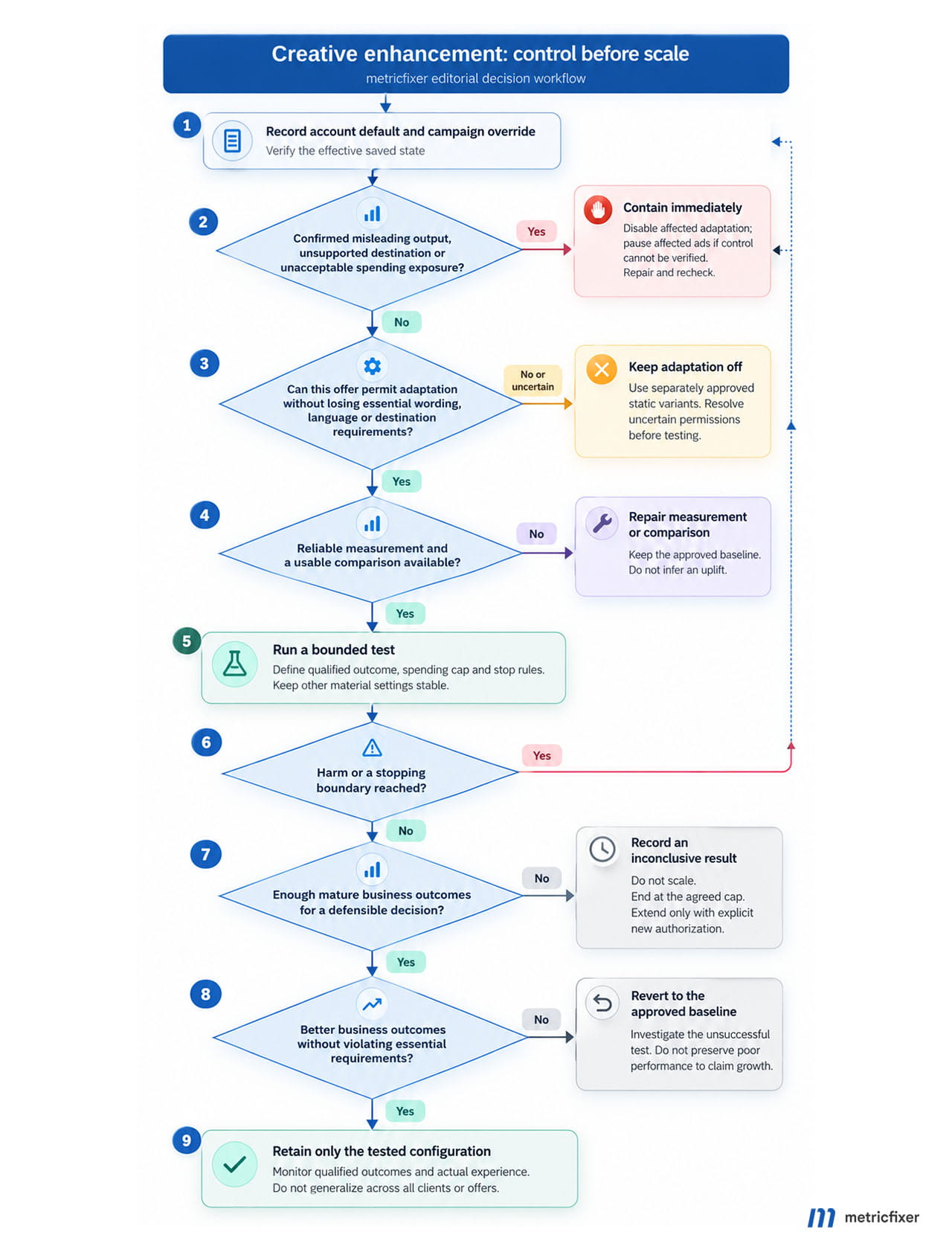
The conclusion should identify the scope actually tested. A favorable result for one offer, language and market is a reason to retain that configuration and monitor it, not a reason to enable every automation feature across every client.
Practical advertiser and agency checklist
- Effective creative setting: record the account default and each relevant campaign override, then verify the saved state.
- Business permission: name the person authorized to allow adaptation and document which offers require approved wording.
- Source quality: check current prices, availability, qualifications and limitations in the ads and landing pages.
- Language and destination: confirm that any permitted adaptation leads to a supported offer and a workable customer journey.
- Buying configuration: record the objective, billed event, optimization event and active bid strategy separately.
- Spending exposure: review maximum daily and weekly amounts, account time zone, campaign-total limits and the test stop.
- Measurement: keep one documented attribution preset, distinguish event types and reconcile mature outcomes with business records.
- Data connections: approve the selected GA4 property, mappings, access owner and permitted data use before connecting it.
- Availability: distinguish an announcement, a limited beta, account access and actual campaign delivery eligibility.
- Change record: log what changed and when; do not credit creative automation for results from a simultaneous bidding or reporting change.
Bottom line: automation should make a truthful offer easier for the right customer to understand. It should not silently remove the information that helps the wrong customer avoid an expensive click. The appropriate decision is the one supported by the offer's constraints, the effective controls and the quality of the resulting business.
Methodology and sources
This review was prepared on 26 October 2026. The comparison baseline is metricfixer's 17 September platform overview, supplemented by its 24 September attribution article. Primary sources are OpenAI's current Help Center, the dated September and October product announcements, the Ads Blog, Advertising Terms and Ad Tools Terms. Links are placed beside the claims they support rather than repeated as a technical reference dump.
The supplied Ads Manager screenshot is separate evidence of one visible account setting. No authenticated account, campaign history, delivery log, generated-variation archive, spend export, GA4 property or CRM dataset was inspected for this review. No account settings were changed. The screenshot does not establish the original default, universal rollout, delivered output or a performance effect.
Announcement dates, document dates, observed interface states and this review's verification date are treated separately. The Creative enhancement guide's inconsistent 30/31 October wording is retained as a source limitation, not resolved by inventing a launch time. Feature availability and documentation can change after publication.
The numerical example, risk analysis, audit procedure and decision diagram are metricfixer's editorial work. They are not an OpenAI experiment or an empirical finding about advertiser results. The review identifies no controlled evidence isolating this feature's effect on qualified leads or profit. It also does not establish a platform-wide CPC benchmark or that every feature discussed first launched after September.
This article provides independent advertising, analytics and operational information, not legal advice or a guarantee of campaign performance. metricfixer is not affiliated with or endorsed by OpenAI, Google or the other platforms and providers mentioned. Product access, defaults, contracts, policies, measurement and regional availability may change and may differ by account. Verify the current settings and applicable agreements before changing campaigns or sharing data, and obtain appropriate legal or privacy advice where needed.