
Published Nov 20, 2026
Google Ads Management: Daily Monitoring, Deliberate Changes
Effective Google Ads management separates daily oversight from evidence-based changes. Learn how metricfixer uses conversion maturity, decision cycles and clear reporting to manage performance campaigns.
Category: Online advertising · By Mikalai Sasau
Good Google Ads management is not measured by how many changes appear in an account every day. For campaigns intended to generate sales or qualified leads, the more useful question is whether each decision improves the business outcome. This article explains why metricfixer separates daily monitoring from planned optimization, how conversion delays and incomplete reports affect decisions, and when a campaign needs immediate intervention rather than more time. It combines our experience across more than 500 Google Ads projects with platform guidance and early research on conversion prediction.
Practical starting point: monitor delivery, spending, tracking and business-critical problems frequently. Review strategy against sufficiently mature conversion data, not yesterday's apparent return. A 10–15-day checkpoint can be a useful working rhythm, but it is neither a universal learning period nor an instruction to change targets every two weeks. Agree the test budget, intervention rules and reporting schedule before launch.
Contents
Executive summary
Advertisers are right to expect attention, accountability and a clear explanation of where their money goes. The mistake is treating visible activity as evidence of effective management: another bid adjustment, another campaign split, another negative keyword, another daily report followed by another change.
At metricfixer, we use a different operating principle: observe frequently, intervene for a reason, and judge results on the timescale at which those results become meaningful. The absence of a routine settings change is not the absence of work. It can be the result of checking the account and finding no evidence that justifies intervention.
This article concerns performance advertising: campaigns intended to produce sales, qualified leads or another defined business outcome. It does not propose ROAS as the universal measure for awareness, reach or every advertising objective.
Our working approach has three parts:
- Daily oversight: detect broken tracking, failed checkout, spending outside agreed limits, policy problems and clear targeting mistakes.
- Planned decision reviews: examine sufficiently mature results, business feedback and the effect of the previous change before choosing the next action.
- Longer business reviews: reconcile advertising results with actual sales, lead quality, margins, refunds and the company's capacity to fulfil demand.
This is not a claim that Smart Bidding is fragile or that changing a target erases its memory. Google's target-adjustment guidance says the bidder responds quickly and can handle rapid changes. It also advises against multiple ROAS target changes within one conversion cycle without a genuine business need. The important distinction is between the system's ability to react and our ability to assess the outcome.

Why busy accounts can be poorly managed
In onboarding conversations, metricfixer frequently encounters an understandable expectation: successful advertising requires someone to keep changing the account. Daily monitoring becomes daily intervention. Search-term review becomes a requirement to keep extending negative-keyword lists. Reporting becomes a daily verdict on whether the campaign works.
Our team informally estimates that these expectations arise with roughly three in four prospective advertisers who have not previously experienced successful paid-advertising management. This is an observation from client conversations, not a representative survey or an industry statistic.
Much of the expectation comes from a manual-first way of working: keyword-level bids, very small ad groups, extensive campaign segmentation and numerous diagnostic metrics. In that setting, more separate controls could provide useful flexibility. But the number of controls was never the business outcome. A hundred campaigns and thousands of ads could represent necessary complexity, or simply complexity.
It would also be inaccurate to say that conversion-based automation did not exist 12 years ago. Google announced Conversion Optimizer in September 2007, and introduced Smart Bidding as a name for conversion-based automated bidding in July 2016. The change was an evolution in capability and working practice, not a single moment when useful manual work became useless.
The practical problem today is importing an old operating model without asking what job each activity still performs. A negative keyword can protect commercial relevance. A campaign split can protect a separate budget. A manual review can uncover a tracking failure. None needs to become a daily quota.
Likewise, click-through rate, cost per click, engagement time and pages viewed can help explain what is happening. They should not compete with sales or qualified leads as interchangeable definitions of success. A customer who finds the answer quickly and buys may generate less engagement time than someone who is confused and leaves.
Our recommendation: agree a hierarchy of measures. Business outcomes determine whether the activity is worthwhile; advertising outcomes help steer delivery; diagnostic metrics help investigate causes. Do not reward the diagnostic layer for improving while the business layer deteriorates.
What Smart Bidding predicts, and what research shows
A search query matters, but it is not a complete description of a person or a buying situation. Two people can enter the same words and have different budgets, urgency, previous experience and likelihood of buying. Conversely, people who eventually purchase may begin with quite different searches. These examples explain why query wording alone cannot settle every bidding decision.
Google's Smart Bidding documentation explicitly includes the actual search query among its signals, alongside context such as device, location, time and eligible audience information. Its technical overview describes query-level conversion modeling across the account and combinations of signals. The defensible conclusion is that query meaning remains important, while richer evidence can support more informed predictions.
No single study proves that keywords do not matter
We looked for an original study establishing that search-query wording is generally a weak predictor of conversion. We did not find a source that supports that broad claim or establishes who first proved it. The relevant research is more specific:
| Research | What it supports | What it does not establish |
|---|---|---|
| Benjamin Rey and Ashvin Kannan, Yahoo! Labs, 2010: Conversion Rate Based Bid Adjustment for Sponsored Search. | Conversion-based bid adjustments can use multiple measures of query-to-ad matching and historical performance. The paper reports a live search-advertising experiment. | That query relevance is unimportant. Matching quality is part of the model. |
| Kuang-chih Lee, Burkay Orten, Ali Dasdan and Wentong Li, Turn, 2012: Estimating Conversion Rate in Display Advertising from Past Performance Data. | Combining historical observations across user, publisher and advertiser groupings helps address sparse conversion data. | A universal finding about search queries. This is display-advertising research. |
| Olivier Chapelle, Criteo Labs, 2014: Modeling Delayed Feedback in Display Advertising. | A person who has not converted yet cannot always be treated as someone who will not convert. Modeling delay can improve conversion prediction. | A recommended 10–15-day management schedule or proof of how today's Google bidding model is implemented. |
The 2010 paper is an early directly relevant search-advertising study located in this review, not a claim of historical priority. These works document parts of a broader development: predicting outcomes from multiple signals, learning despite sparse data, and handling delayed feedback.
There is another important boundary. The future behavior of a particular visitor is not available before that visitor clicks. Historical outcomes can inform a prediction for a new auction; that does not mean the bidder can inspect that person's future session. Nor do these sources establish that every GA4 engagement metric automatically becomes an individual Smart Bidding input.
For an advertiser, the useful question is therefore not “Can we guess the perfect keyword?” It is “Have we defined the right outcome, supplied trustworthy feedback, and preserved sensible commercial boundaries?”
Five clocks behind advertising results
A campaign can be working, its tracking can be functioning, and its newest results can still be unsuitable for a final performance judgment. Several different clocks are running at once. Treating all of them as “the learning phase” hides the cause of the uncertainty.
| Clock | What is happening | Management consequence |
|---|---|---|
| Customer decision time | A click may lead to a purchase or enquiry immediately, later that day, or much later. | Recent clicks have had less opportunity to convert than older clicks. |
| Tracking and reporting time | Events must be collected, processed and sometimes imported from another system. | A missing reported conversion is not automatically a missing sale. |
| Bidding adaptation | The bidder responds to changed goals or conditions while additional outcomes arrive. | Immediate changes in delivery and a reliable assessment of their results are different things. |
| Sample accumulation | A campaign needs enough relevant observations to distinguish a pattern from a few outcomes. | Calendar time alone does not create strong evidence. |
| Demand and business cycles | Weekdays, promotions, stock, competition and sales-team availability change the operating environment. | Compare reasonably similar periods and record material external changes. |
Fresh data is not necessarily complete data
Google's GA4 data-freshness guidance distinguishes near-real-time, intraday and daily processing. Standard intraday processing typically takes 2–6 hours, while processing can take 24–48 hours and reports can change during that time. Attribution credit for key events can continue changing for up to 12 days. These are different processes, not a universal instruction to wait 12 days for every metric.
In Google Ads, core metrics such as clicks, impressions and cost generally have an hourly freshness objective. Conversion availability depends on the conversion source and attribution processing, while late conversions and other adjustments can revise earlier periods. An hourly spending figure and an incomplete revenue figure should not be mistaken for an equally mature pair.
Operationally, a business that imports qualified leads or completed sales from a CRM also needs to consider its own upload schedule. A weekly upload creates a different reporting rhythm from a reliable daily feed. This is why we recommend documenting the complete route from ad interaction to business outcome to platform reporting.
Customer delay is not the same as a conversion window
A configured conversion window defines which later outcomes may be credited. It does not mean every customer waits that long, and it is not a learning-period setting. Google's guide to finding how long customers take to convert helps examine observed delay rather than assuming it from an account setting.
Some purchases happen within minutes; some sales processes take weeks or months. We should not claim that every product has a material multi-day delay. The management requirement is to understand the delay that actually matters for the selected conversion outcome, including qualification or sales completion when those are the outcomes being measured.
Our interpretation of these clocks is simple: near-real-time monitoring is useful, but near-real-time profitability judgments often are not. Reporting latency does not make tactical oversight impossible. It limits what particular numbers can reasonably tell us.
Daily monitoring is not daily optimization
Separating observation from intervention makes management more accountable, not less. The person responsible should know what is being checked, which findings trigger action, and which findings should be documented for the next review.
| Operating layer | Typical questions | Expected output |
|---|---|---|
| Frequent health checks | Are ads serving? Is spending within the agreed risk envelope? Do checkout, forms, tracking and imports work? | An exception alert, a corrective action, or a documented confirmation that no intervention is needed. |
| Planned optimization review | What do mature outcomes say? Did the previous change help? Is the constraint efficiency, volume, measurement or the offer? | A decision to hold, test a defined change, investigate, or stop an unsuccessful approach. |
| Business review | Are leads useful? Do attributed sales survive refunds? Are margins and fulfilment capacity acceptable? | Revised commercial priorities, resource decisions and an updated advertising brief. |
These are recommended responsibilities, not fixed universal frequencies. A large account may need intraday spending alerts. A small account may need a short daily check. Neither necessarily needs a fresh bidding target every morning.
The same distinction applies to negative keywords. Google's search-terms guidance still recommends excluding irrelevant searches. It also explains that some low-volume queries are omitted for privacy reasons, so a visible report is not a complete inventory of every query.
Our rule is to separate clear business irrelevance from uncertain performance. A service the company does not provide can justify an immediate exclusion. A commercially relevant query with two recent clicks and no reported sale is not the same kind of evidence. Repeatedly blocking such terms can turn random early outcomes into permanent targeting decisions.
Keeping a campaign stable does not require ignoring obvious waste. It requires a reason stronger than “we have not changed anything today.”
Learning does not mean starting from zero
The phrase “you reset the algorithm” is often used too loosely. Google's current dedicated Smart Bidding learning page says budget, target, creative and targeting edits do not erase historical data or trigger the visible Learning status. Structural changes, including a new strategy or a substantial conversion-goal change, can trigger it.
The same page distinguishes a visible status lasting up to seven days from performance convergence, which typically takes one to two conversion cycles. It recommends subsequent evaluation over two conversion cycles or two weeks, whichever is longer, allowing for conversion delay. A status disappearing is therefore not a certificate that the newest ROAS is final.
There is some inconsistent wording elsewhere in Google's help material about changes “resetting” learning. This review prioritizes the dedicated learning page and the specific target-adjustment guide rather than repeating a blanket reset rule. Platform documentation should be read in context, not reduced to one memorable warning.
For management purposes, the strongest argument against unnecessary daily changes is not memory loss. It is interpretability. Suppose Monday's target is tightened, Tuesday's budget is reduced, Wednesday's offer changes, and Thursday's lead uploads are delayed. Friday's result combines several interventions and several stages of data maturity. Even a capable bidder cannot make that a clean before-and-after test for the person reviewing it.
This distinction is also reflected outside Google. In its 18 November 2026 automated-bidding update, Microsoft recommends evaluating campaign or portfolio outcomes with sufficient conversions and allowing one to two conversion cycles after major changes. It describes 15% target increments as an optional way to reduce volatility, not a universal limit. Microsoft's guidance supports the broader principle; its exact settings and timelines should not be copied into Google Ads as platform rules.
When reviewing a period that includes target changes, compare actual ROAS with the average target for that period, not only the latest setting. Google recommends this comparison in its performance-measurement guidance.
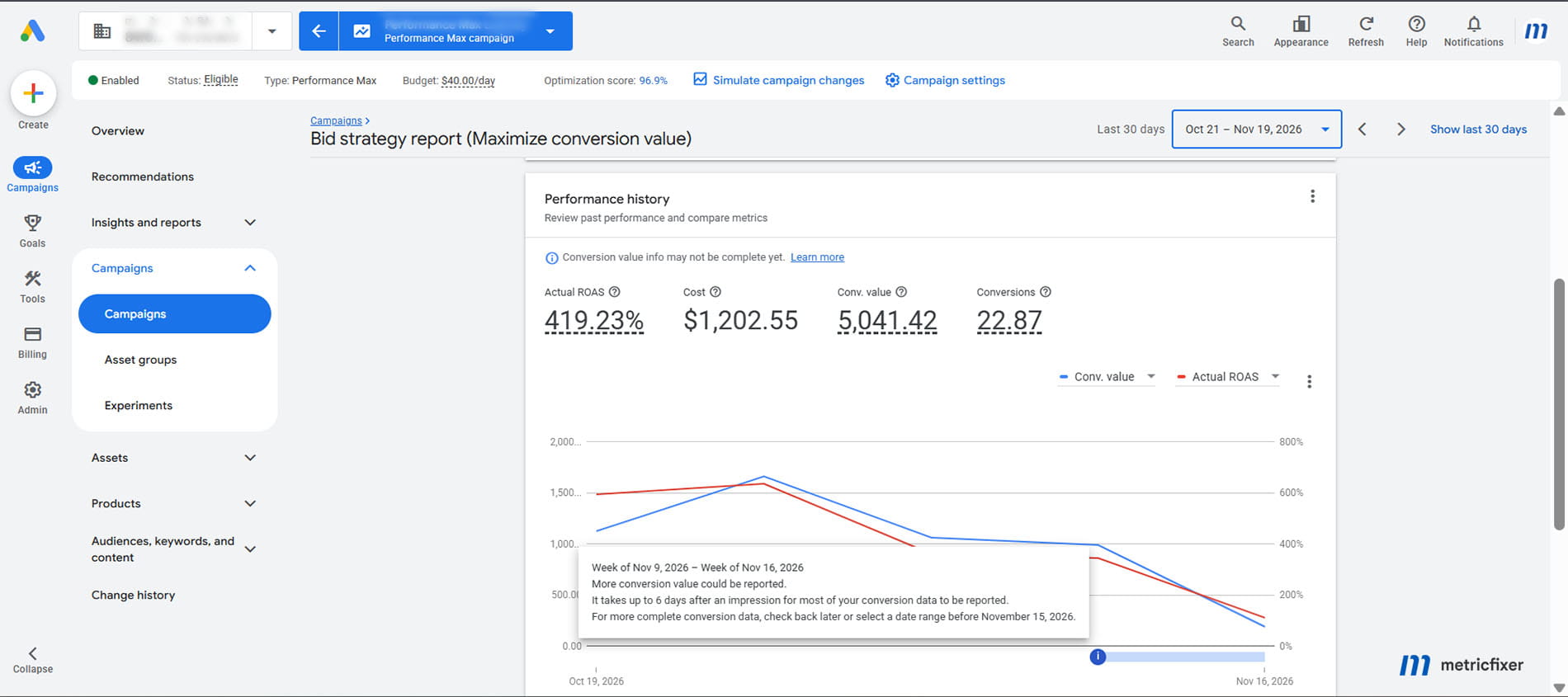
The metricfixer management cycle
Across more than 500 Google Ads projects, metricfixer has developed a working process built around deliberate changes and observation periods. The project count describes our operational experience; it is not the sample size of a controlled trial comparing management schedules.
For a new project without useful history, a common starting rhythm is a first checkpoint after approximately 10–15 days, followed by another planned review after a comparable interval. The rhythm is adjustable. Its purpose is to prevent reactive management while keeping responsibility explicit.
Before launch: define the decision
Agree what counts as a useful outcome, which values will be reported, what result is commercially acceptable, and how much the business is prepared to spend on learning. Record the expected customer delay, the reporting route, the people responsible for checking lead quality and the conditions that require pausing or changing course.
Choose the initial bidding approach based on the campaign type, available history and reliable measurement. A new campaign in an established account is not the same as a new account with no usable history. Do not assume every project must begin with manual bidding, or that every new project is ready for Target ROAS.
For example, Google's Target ROAS requirements currently specify at least 15 conversions in the previous 30 days at the conversion-tracking level for Search and Shopping; requirements differ for other campaign types. Eligibility is not the same as having enough evidence for a confident business decision.
After launch: check health without forcing a verdict
During the first observation period, the specialist checks delivery, tracking, spending, obvious relevance problems and business feedback. A campaign should not be abandoned simply because conversions do not appear immediately.
In some metricfixer projects, around ten days before the first reported conversion has been compatible with an otherwise normal start. That is an experience-based observation, not an acceptable waiting period for every account. Ten days with very little traffic is different from ten days with substantial mature traffic and no valid outcomes.
“Wait for more data” must therefore have boundaries: the tracking has been checked, delivery is real, the remaining uncertainty is understood, and spending remains within the agreed test allowance. Otherwise, waiting is not a method; it is simply continued exposure to risk.
At the checkpoint: decide whether the evidence is ready
The first question is not “What should we change?” It is “What can this evidence support?” Review how much of the conversion delay has elapsed, how many useful outcomes are available, whether one unusually large order dominates the result, and whether the offer or measurement changed during the period.
Then choose one of four outcomes: keep the current setup, make a defined adjustment, investigate a specific problem, or stop an approach that no longer fits the agreed economics. Holding the settings is a valid decision. So is extending the observation window without extending the spending allowance.
After a change: preserve a readable test
Record the date, the previous and new settings, the hypothesis, the expected trade-off and the next review condition. Avoid stacking unrelated material changes when the purpose is to understand the effect of one intervention. Continue safety monitoring throughout.
Work does not stop between reviews. The team can validate CRM feedback, improve the next creative brief, investigate landing-page friction, check product information and prepare the next test. When such work changes the live customer experience, record it because it can affect the interpretation of campaign results.
Management workflow: define the outcome and risk limit → validate measurement → launch or make one planned change → monitor health while outcomes mature → review comparable evidence → hold, adjust, investigate or stop → repeat. Operational problems can interrupt the cycle at any point.
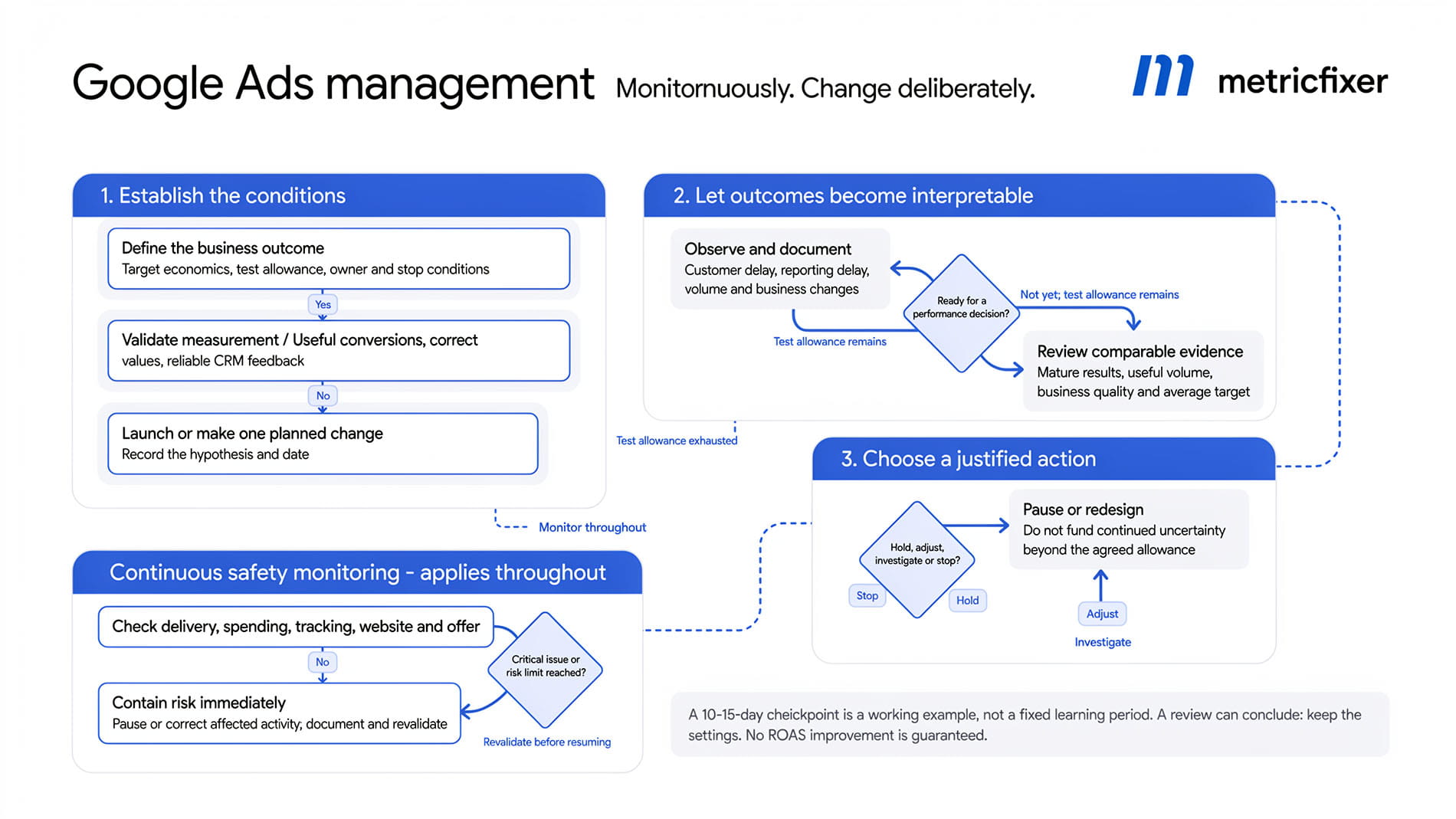
The 150% to 180% ROAS example
Consider the example we use when explaining this process to advertisers. The business needs a 330% return on ad spend. An early review shows 150%. Rather than immediately demanding 330% from a new campaign, a proposed next step is a Target ROAS of 180%, followed by an observation period.
The first task is to distinguish three different numbers:
| Number | Meaning | What it does not mean |
|---|---|---|
| 330% business requirement | The return the advertiser needs under its agreed commercial model. | A guarantee that current market conditions can deliver that return at the desired volume. |
| 150% observed ROAS | Reported conversion value divided by advertising cost for a defined period. | A mature baseline unless the values, period and conversion delay have been checked. |
| 180% bidding target | An operating instruction for the next bounded test. | A forecast, a guaranteed minimum, or proof that the campaign has already improved. |
If values represent revenue, 150% means $1.50 of attributed revenue for each $1 of advertising cost. It is not a 50% profit margin. Product costs, fulfilment, refunds and other business expenses still matter.
The arithmetic from 150% to 180% is a 20% relative increase, or 30 percentage points. If 150% is the observed result rather than an existing target, this is not technically a 20% increase in the previous target setting.
In metricfixer's practice, a step of roughly 20% can be a useful starting hypothesis for a controlled adjustment. We do not present it as a Google rule, a proven safe boundary, or a level that every strategy will reach without difficulty.
An initial target and a tighter target are different decisions
Google's performance guidance recommends grounding an initial ROAS target in historical performance, at or below the historical ROAS, rather than an aspirational requirement. Consequently, 180% should not be an automatic first setting merely because the early report shows 150%. It is an intentionally tighter test, justified only when the data, strategy eligibility, commercial objective and tolerance for lower volume support it.
A higher ROAS target can reduce the opportunities the bidder is willing to pursue. A better ratio with sharply lower revenue is not automatically a better business result. Evaluate spend, conversion value, useful volume and profitability together; do not celebrate the ratio in isolation.
There is also a current platform consideration. Google's August 2026 target-based bidding update changed how affected budget-constrained campaigns optimize toward their stated targets. The rollout completed on 27 August 2026. An old habit of setting a loose target and assuming a tight budget will preserve a much higher actual return is not a reliable operating assumption.
If 330% is a hard immediate requirement and the business cannot fund a lower-return test, the project must be designed around that constraint. There is no justification for quietly substituting a 180% commercial objective. A temporary operating target below the business requirement needs an explicit budget, end condition and owner approval.
Finally, increasing targets in steps does not create an automatic staircase to 330%. The limiting factor may be pricing, margin, the offer, lead quality, landing-page performance or the available demand. When mature evidence shows that bidding adjustments alone are not solving the problem, the next sprint must address the actual constraint.
How long should a review cycle be?
Our 10–15-day checkpoint is a scheduling convention, not a statistical law. The timing of a decision should reflect conversion delay, meaningful volume, the magnitude of the change and the risk of continuing.
A high-volume campaign with a short buying cycle can produce useful evidence quickly. A campaign generating a handful of qualified opportunities per month may need a substantially longer evaluation window. Spending more only shortens the observation period when it produces more relevant outcomes; it does not shorten a customer's approval process or guarantee a better result.
Where possible, compare complete weeks or otherwise match the weekday mix. Keep the definition of the conversion and value consistent. Look at longer rolling periods alongside the current sprint, and distinguish the adaptation period after a material change from the period used to judge the settled outcome.
Why zero conversions can mean different things
A simple hypothetical calculation illustrates why calendar time is insufficient. Suppose each mature, independent click has a 2% chance of producing a conversion. The chance of observing no conversions is 0.98^n, where n is the number of clicks.
| Mature clicks | Probability of zero conversions under the assumption | Interpretation |
|---|---|---|
| 30 | About 54.5% | Zero conversions would not be surprising in this simplified example. |
| 300 | About 0.23% | Zero conversions would be much harder to reconcile with the assumed rate. |
These are calculated examples, not Google benchmarks or estimates for a particular advertiser. Real clicks differ, conversion probabilities are uncertain, and recent clicks may not be mature. The lesson is to examine exposure, measurement and expected behavior rather than treating “ten days” as either proof of failure or a guaranteed safe waiting period.
A management sprint is not an experiment duration
A scheduled review is also different from a formal bidding experiment. Google's bidding-test guidance describes a ramp-up period of two weeks or three conversion cycles, whichever is longer, followed by at least 30 days of uninterrupted testing. It also advises excluding recent days for which fewer than 90% of conversions have been reported and avoiding simultaneous ad or landing-page tests.
That guidance is for experiments, not a mandatory duration for every routine adjustment. It demonstrates why a two-week management meeting should not automatically end a test. The team can review progress and risk while leaving the experiment running.
Our operational decision rule is to change course when there is sufficient mature evidence for the intended decision, or when a predefined risk condition requires action. When neither condition is met, preserve the setup and state what evidence is still missing.
Reporting with two conversion clocks
Google Ads offers two useful views of when a conversion belongs in a report. Confusing them can make both campaign performance and business activity appear to move for the wrong reasons.
Google's conversion reporting documentation explains that the main conversion columns are associated with the time of the ad click. The separate Conversions (by conv. time) and Conv. value (by conv. time) columns show outcomes by when the conversion occurred. Use the first perspective to evaluate the outcomes associated with advertising activity; use the second to understand when attributed outcomes happened.
For a simple example, assume one attributable ad click on 3 October and a $300 purchase on 10 October. The ordinary conversion reporting associates that result with 3 October. The conversion-time view shows it on 10 October. More complex attribution can distribute credit across interactions, but the distinction between the reporting clocks remains important.
Do not divide today's conversion-time revenue by today's spend and call it the return earned by today's clicks. The revenue may come from earlier advertising activity, while today's clicks may still convert later. That ratio can describe cash-flow-related activity, but it is not a matched assessment of the same traffic.
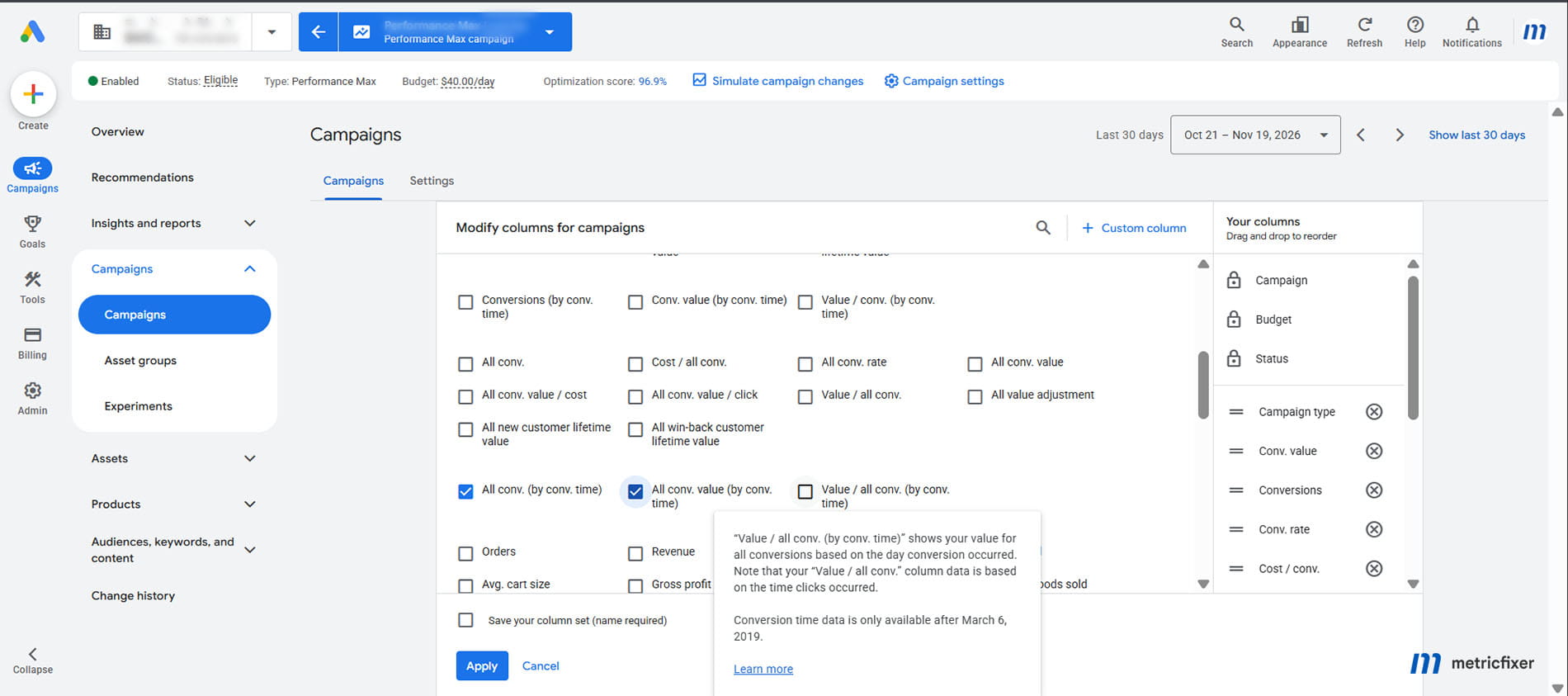
Revisit the same period instead of only changing the date range
The following numbers are illustrative, not a metricfixer client result. They show how a report for a fixed group of clicks can mature:
| Click period | Report checked on | Cost | Attributed conversion value | Reported ROAS |
|---|---|---|---|---|
| 1–14 October 2026 | 15 October 2026 | $1,000 | $1,500 | 150% |
| 1–14 October 2026 | 22 October 2026 | $1,000 | $2,400 | 240% |
No new clicks were added to the selected period. Later outcomes changed what was known about the original activity. The apparent improvement is not evidence that an optimization made on 16 October improved clicks purchased before that date. It is a reminder to separate outcome maturation from the effect of an intervention.
Our reporting recommendation is to save an “as of” date with each export, retain the original date range, and revisit earlier periods. Label recent figures as provisional. When comparing periods, either allow comparable maturation time or explain the remaining difference. Do not compare a nearly complete previous month with an incomplete current month as though they had equal opportunity to accumulate outcomes.
Neither reporting clock establishes that every attributed sale was caused by advertising. Google describes Conversion Lift as a separate controlled approach to measuring incremental outcomes. Routine ROAS reporting and a causal test answer different questions.
The conversion-time view is useful for reconciliation, but it does not automatically make Google Ads match the CRM or GA4. First align the event definition, scope, timezone, attribution and value treatment. A qualified sale, a form submission and a modeled advertising conversion are not interchangeable records.
Consolidation without losing business control
Our structural preference is to avoid fragmentation that exists only to make manual management look organized. Group activity around shared business goals and meaningful differences in budgets, economics and customer experience, rather than creating a separate campaign for every keyword variation.
This is not based on an assumption that each campaign is an isolated memory box. Google's Smart Bidding overview describes query-level learning across the account. Its conversion-goal guidance also explains the value of consistent account-default goals when they genuinely apply.
Where appropriate, a portfolio strategy can coordinate supported campaigns around a common objective without requiring every campaign to be merged. However, portfolios are not available for every campaign type; for example, Google's Target ROAS documentation excludes Performance Max from portfolio support. Verify the actual strategy and campaign eligibility before proposing this structure.
Keep a separation when it serves a real purpose: different commercial owners, incompatible lead definitions, protected budgets, materially different margins, language-specific customer journeys or separate regulatory requirements. Brand and non-brand activity may also need separate evaluation when an easy aggregate return would hide weak acquisition.
Consolidation is therefore a design choice, not a goal in itself. Too much fragmentation can make decision-making unnecessarily noisy. Too much consolidation can hide a problem that the business needs to see. Preserve useful reporting segments even when bidding is coordinated.
Tracking quality and management quality work together
A reliable measurement system and a disciplined decision process solve different parts of the same problem. Correct tracking cannot prevent a manager from overreacting to incomplete data. A patient management schedule cannot make incorrect conversions useful.
Our pre-launch and recurring checks include the following:
- Outcome definition: the selected action represents a useful sale or lead, not merely an easy-to-generate interaction.
- Accuracy: events fire at the intended point, duplicate measurement is controlled, values and currencies are correct, and test or internal activity is handled appropriately.
- Business feedback: lead quality, sales completion, refunds and value changes are available to the people making decisions, with a documented reporting delay.
- Consistency: changes to tags, consent handling, website behavior, imports and conversion settings are tested and recorded.
Google distinguishes primary and secondary conversion actions. Under standard goals, primary actions are used for bidding when the goal is selected; secondary actions are normally observational. Custom goals are an important exception because included secondary actions can also be used for bidding. Check the campaign's actual configuration rather than relying on an action's label alone.
Our practical recommendation is not to make page views, engagement time or every funnel step a bidding outcome simply to increase the conversion count. An earlier-stage event may be appropriate when it is the best available signal, but its relationship to qualified demand should be tested and made explicit. A growing number of cheap leads is not progress when the sales team cannot use them.
Changing the measurement definition also changes the meaning of the performance history. Google's conversion-goal transition guidance treats changes to goals, actions, sources and value scales as changes that require adaptation. Do not compare results before and after such a change as though the ruler stayed the same.
For a concrete example of why event-level checks matter, our article on GTM dataLayer state and old ecommerce data explains how earlier values can persist into later events. More observation time does not repair a faulty measurement implementation.
When to intervene before the next review
A stable optimization plan must include exceptions. The following are our recommended triggers for immediate investigation or a proportionate protective action, not reasons to wait for a scheduled meeting:
| Finding | Appropriate response |
|---|---|
| Checkout, forms or essential landing pages are broken. | Verify the failure, contain avoidable spend and repair the customer journey. |
| Conversions disappear or values change unexpectedly. | Check real business outcomes, tags, consent behavior and imports before assuming demand collapsed. |
| Spending exceeds the agreed risk allowance. | Apply the agreed budget or pause controls; do not use learning as an excuse to exceed authorization. |
| Ads promote unavailable products, incorrect prices or an expired offer. | Correct the affected feed, assets, page or campaign promptly. |
| Traffic is clearly outside the business's service or geographic scope. | Correct the relevant eligibility or exclusion settings and document the reason. |
| Lead quality or sales capacity changes materially. | Investigate with the business and adjust the plan before generating more unusable demand. |
Budget alerts need to reflect how the platform actually bills. Google's spending-limit documentation explains that most campaigns can be billed up to twice their average daily budget on a particular day, with monthly limits and rules for budget changes. An average daily budget is not a hard same-day spending cap. Set commercial guardrails with those mechanics in mind.
Where conversion measurement was genuinely corrupted, Google's data exclusions may help protect Smart Bidding from affected data. They apply to the relevant click dates, require attention to conversion delay, and do not remove the conversions from reporting. They are not a tool for deleting genuinely disappointing results.
Similarly, seasonality adjustments address anticipated major short-term changes in conversion rate. Google describes them as best suited to short events of 1–7 days, not routine weekly fluctuations. Use them for a justified scenario, not as another daily tuning mechanism.
Unusual traffic also deserves evidence rather than an instant fraud diagnosis. Our Google Ads invalid-traffic investigation workflow separates platform reporting, website evidence and escalation. A weak recent ROAS figure alone does not identify the cause.
What an advertiser should expect from reporting
Clients should not have to choose between constant account changes and silence. Access to information, a clear response process and an agreed review rhythm are compatible with stable campaign settings.

Our recommendation is to align the main optimization report with the decision cycle. A report intended to justify strategic changes should not pretend that a shorter observation period provides more reliable evidence. A daily dashboard or short status message can still be useful for spending visibility, incident management or an agreed communication need.
For an ordinary decision review, the report should answer a small set of substantive questions:
- What happened? Show spending, useful outcomes, conversion value and the relevant efficiency measure, with business-quality feedback.
- How complete is the evidence? State the reporting date, conversion delay, excluded immature period and any measurement limitations.
- What changed? Separate campaign interventions from changes in pricing, stock, offers, measurement or sales handling.
- What is the decision? Explain why the team will hold, adjust, investigate or stop, what risk remains, and when that decision will be reconsidered.
A short “no change recommended” report can be valuable when it explains which checks passed, why the newest data remains provisional and what would trigger action. A long report is not valuable merely because it contains more charts.
Likewise, an agency's change history is evidence of activity, not proof of effectiveness. Advertisers should be able to see the hypothesis behind an intervention, the quality of the outcome being optimized and the reasoning behind leaving a working setup alone.
The central principle is not “touch the account less.” It is make the account answerable to the business, and make each decision answerable to evidence. Accurate tracking establishes what is being measured. A sensible management rhythm establishes when that measurement is useful enough to act on. Both are necessary; neither guarantees commercial success on its own.

Methodology and sources
This review was prepared on 20 November 2026. It combines three types of material: metricfixer's first-hand description of its management practice, current platform documentation, and historical research papers. These categories are kept separate because they support different kinds of conclusions.
The experience base of more than 500 Google Ads projects, the informal onboarding estimate, the 10–15-day checkpoint and the approximately 20% adjustment example were supplied by metricfixer for this article. No client-level dataset, randomized comparison or independently audited aggregate performance analysis was provided. They are practice-based observations, not measured proof that one schedule causes better ROAS across all advertisers.
Platform verification focused on Google's documentation for Smart Bidding, target adjustments, learning, conversion goals, data freshness, reporting, experiments and protective controls. The review also includes Microsoft's 18 November 2026 guidance. Where Google help pages use inconsistent learning-period language, this article gives priority to the dedicated learning and target-adjustment pages and discloses the inconsistency rather than asserting that all edits reset learning.
The literature search examined early conversion prediction, query-to-ad matching and delayed-feedback work. The cited Yahoo, Turn and Criteo papers are original research, but they address different advertising systems and questions. They do not identify a universal first study proving that query wording is weak, validate a particular sprint length, or reveal the complete implementation of current Smart Bidding.
The probability calculation and reporting tables are explicitly illustrative. The operational recommendations are an editorial synthesis, not the output of a new controlled experiment. Platform guidance describes platform behavior and recommended use; it is not independent evidence that a platform will achieve a particular advertiser's profit requirement. Sources are linked at the relevant points in the article rather than repeated as a technical bibliography.
This article provides technical and operational information, not a guarantee of advertising performance or an individualized financial forecast. Suitable budgets, targets and review periods depend on the business, campaign type, measurement quality and conversion cycle. Platform features and guidance can change after publication. metricfixer is not affiliated with Google, Microsoft, Yahoo, Turn or Criteo. Platform names and trademarks belong to their respective owners.
Expert help with this topic
 Google Ads Full Setup
Launch Google Ads around a clear business goal, with a tailored strategy, an agreed scope, and 30 days of post-launch management. Start with a free strategy outline and estimate.
 Google Ads Management
Ongoing Google Ads strategy and optimization around one agreed primary KPI, with scope and priorities confirmed before paid work begins.
 Supported Google Ads Self-Service
Keep control of your Google Ads account with help for account setup, promotion eligibility, and separately scoped expert support when you need it.
 Expert-Led Google Ads Account Audit
Get a PPC-specialist-led review of your Google Ads account, with clear evidence, priorities, limitations, and practical next actions.