
Published Oct 2, 2026
Russia in Google Ads Location Targeting: What It Actually Enables
Russian locations can appear in Google Ads while domestic ad serving remains paused. An audit, Google's support reply and earlier advertiser reports explain location interest, VPN limits and useful overseas demand.
Category: Online advertising · By Mikalai Sasau
Russia and Russian cities are selectable in the Google Ads accounts we inspected, but this is not evidence that ads have resumed inside Russia. Our audit, a Google support reply and earlier advertiser observations reveal an important distinction: targeting interest in a place is not the same as reaching people physically located there.
Before changing budgets: check users' physical locations, not just the Moscow row in a targeting report. A campaign can attract a legitimate Moscow-related inquiry from someone in another country. Selecting Russia does not override Google's ad-serving restrictions.
Contents
Executive summary
As of 1 October 2026, we found no public Google announcement lifting the pause on ad serving to users located in Russia. The restriction remains published in Google's current advertising documentation. The support response received during our audit also says that Russian locations being selectable does not mean domestic ad serving has resumed.
However, the selector is not meaningless. In the account examined, Moscow was a campaign target with recorded impressions, clicks and conversions. Google's explanation was that users in Belarus had shown interest in Moscow. For an eligible advertiser serving customers outside Russia, that distinction can have genuine commercial value.
There is also a historical correction to the apparent news: an earlier practitioner case says Russian locations were selectable by April 2024. Its accompanying screenshot shows Moscow, Moscow Region and Saint Petersburg. That is an attributed observation, not a verified platform-wide rollout date, but it prevents us from presenting the interface's availability as an established new development in autumn 2026.
The useful question is therefore not simply whether Google Ads has "returned." It is which audience the campaign can actually reach, what the location label means, and whether the resulting inquiries match a serviceable business need.
What our audit found
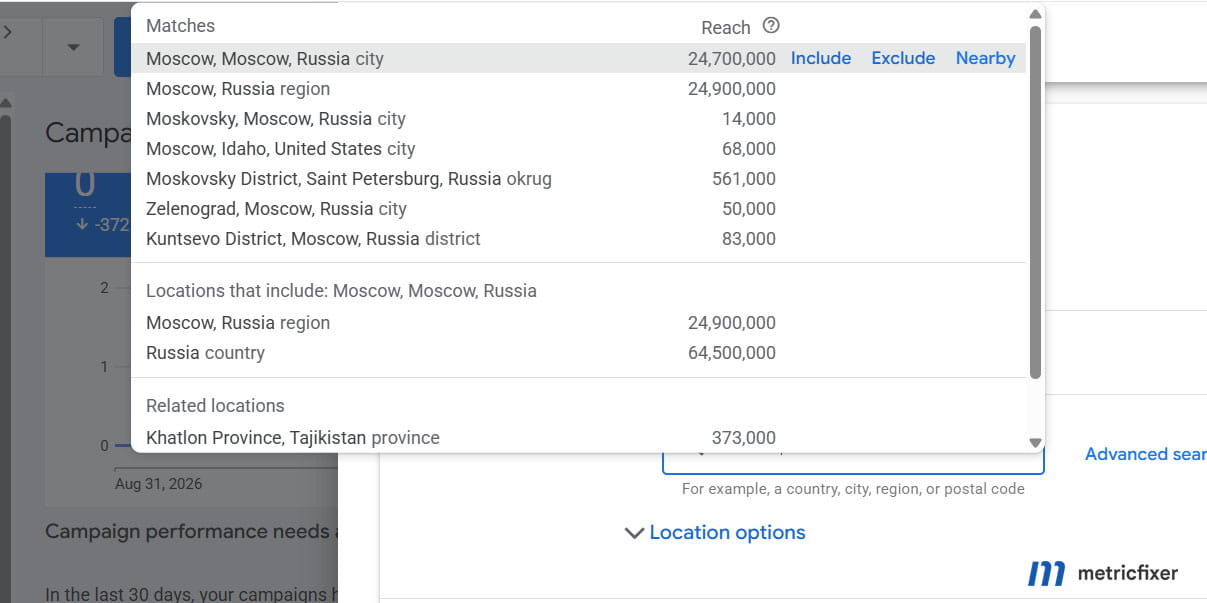
During an advertiser account audit, metricfixer found Russian locations in the ordinary Google Ads location selector. Moscow appeared with the usual inclusion controls and a reach estimate. No Russia-specific ad-serving warning was visible in the supplied selector screenshot. This describes the screen we inspected, not every campaign type, account or interface surface.
Our team also found Russian locations in several other accounts it checked. This was a convenience check, not a representative survey or a test of every Russian region. The evidence supports current availability in the inspected interfaces; it does not establish when the locations returned everywhere.
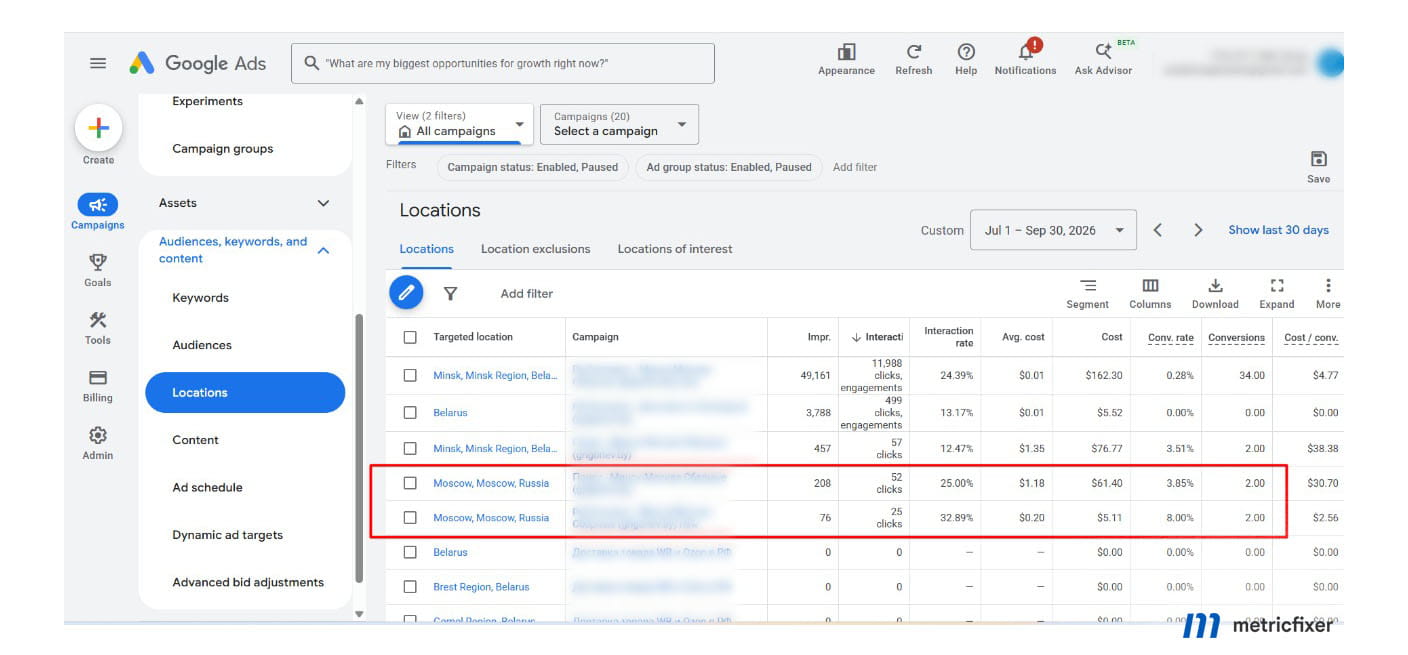
| Anonymized campaign | Impressions | Clicks | Conversions |
|---|---|---|---|
| Search campaign | 208 | 52 | 2 |
| Second campaign | 76 | 25 | 2 |
| Combined highlighted rows | 284 | 77 | 4 |
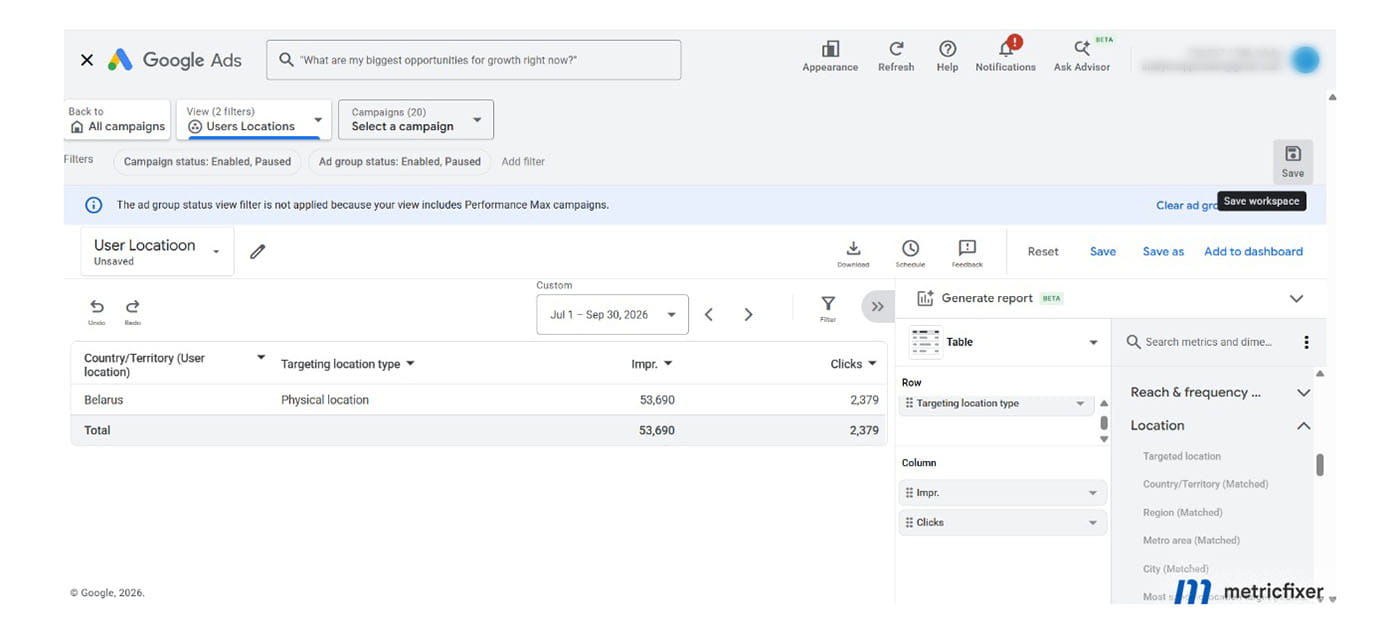
The account-level User Location report told a different story. Under its visible filters, its only country row was Belarus, with the location type Physical location. The row contained 53,690 impressions and 2,379 clicks, matching the displayed totals.
These are wider account totals, not an individual mapping of the 77 Moscow-target clicks. Nevertheless, the screenshot provides no affirmative evidence of Russian physical delivery in that report's scope. A campaign-filtered export is the appropriate next step for a stricter comparison.
The selector's large reach estimate does not resolve the discrepancy. Google describes reach as a general estimate, not the number of impressions a campaign will receive. It should not be repurposed as a forecast of available Russian advertising inventory or VPN users.
What Google support confirmed
We asked support to explain both the Moscow statistics and the reappearance of Russian locations. In the reply received on 1 October 2026, Google Ads Support identified the audited Search campaign as using Presence or interest. It explained the Moscow results as activity from users in Belarus searching with an interest in Moscow.
On the policy question, the reply stated:
"Google's pause on ad serving in Russia remains fully in effect. The availability or selectability of Russian locations within the Google Ads location selection tool does not signal a resumption of ad serving in Russia. Ads remain blocked from serving to users who are physically located in Russia."
The provenance matters: the email is signed "Google Ads Support, powered by Google AI," and its footer warns that AI-generated information about an account or Google Ads may be inaccurate. We treat it as a case-specific support explanation that is consistent with published documentation, not as a human-reviewed policy ruling, a press statement or a product-launch announcement.
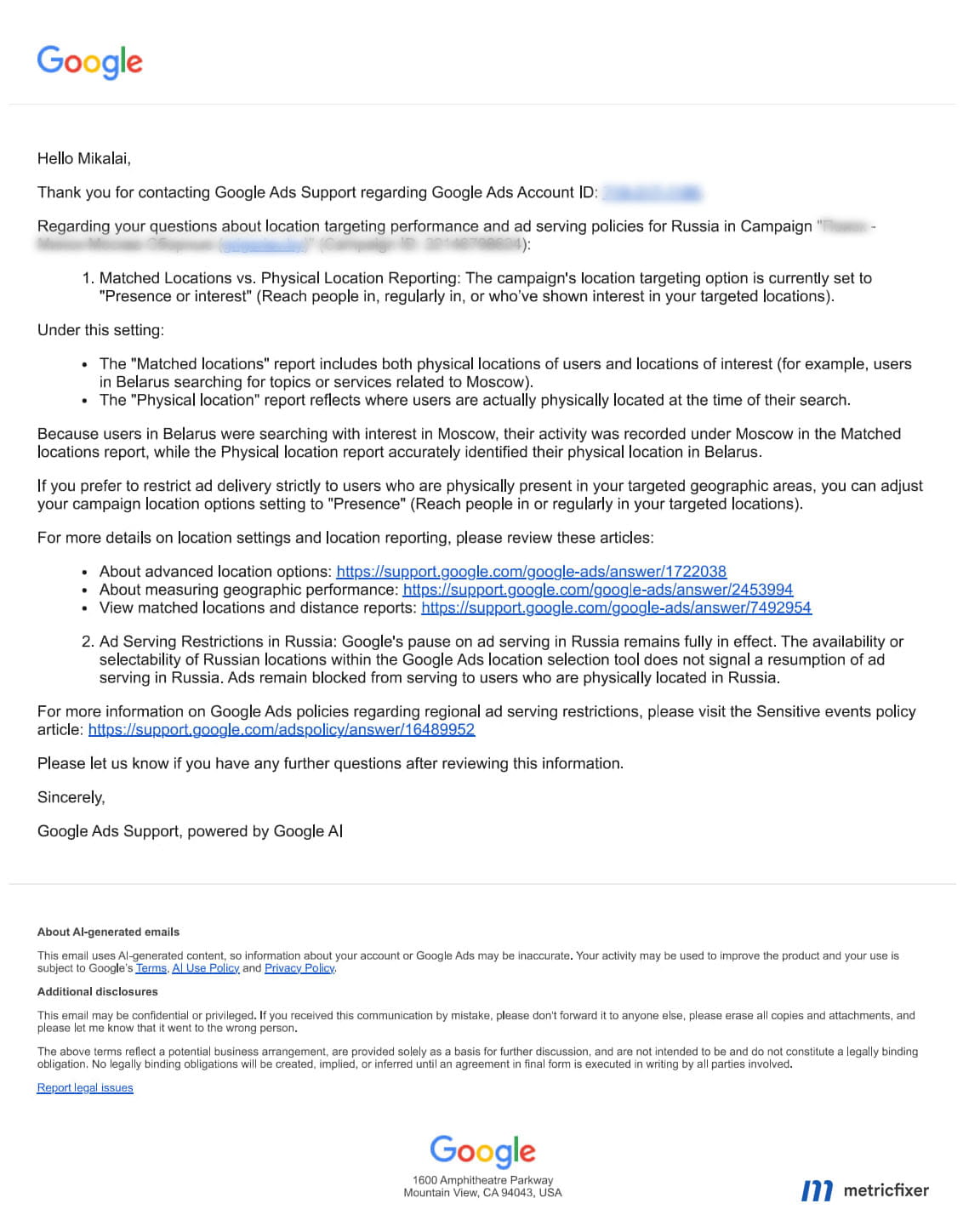
There are limits to what the reply establishes. It discusses one named Search campaign, not an independent review of every highlighted conversion in both campaigns. It refers to Matched locations, whereas the initial screenshot is labelled Targeted location. Those report names should not be silently substituted for each other.
Most importantly, the email does not date the return of the selector, confirm that every Russian region is available, or announce future reopening plans. It acknowledges current selectability and explains why that is compatible with the pause.
What remains restricted
Two separate restrictions are relevant. Google's 3 March 2022 announcement paused ad serving to users located in Russia. Its 10 March 2022 announcement separately paused ads from advertisers based in Russia across Google's properties and networks globally.
The first concerns where the audience is located; the second concerns where the advertiser is based. An overseas audience does not automatically make a Russia-based advertiser eligible, and access through an agency or a different billing arrangement is not itself a policy exemption.
The current Sensitive events policy continues to reference the Russia restrictions. Our review of the 2026 policy-change directory did not identify a public announcement of their full or partial removal.
It is also inaccurate to describe a selectable city as "sanctions lifted." Google's Russia-specific serving pause and its separate country and territory restrictions are not a complete statement of every legal obligation affecting an advertiser. The business examples below assume an independently eligible advertiser and an offer that is lawful and permitted in the relevant jurisdictions.
Earlier advertiser observations: a clue from 2024
We searched English- and Russian-language public sources for earlier reports of Russian locations returning, not merely claims that someone had seen an advertisement. The most directly relevant result was a first-person case published by Freelancers.Marketing.
The author says he noticed Russian locations had returned by April 2024 and tested a campaign targeting Moscow and Saint Petersburg. The page includes a settings screenshot with Moscow, Moscow Region and Saint Petersburg selected. This is substantially more relevant than a screenshot of an ad on YouTube.
However, the live article has been updated to discuss later campaigns. We did not establish an independently archived date for the original observation. The image supports the displayed configuration, but its filename is not proof of capture date or of a global rollout.
| Source and timing | Observation | Evidence boundary |
|---|---|---|
| Freelancers.Marketing case, recalling April 2024 | The author reports Russian targets returning; a screenshot shows three Russian locations selected. | A directly relevant practitioner account, not a Google release date or proof of physical delivery. |
| Searchengines.guru discussion, 15-16 February 2025 | Participants report seeing YouTube ads; one says he checked that his mobile connection had a Russian IP. | An unverified ad-serving observation. No matching campaign settings, platform location classification or controlled test is supplied. |
| Freelancers.Marketing commentary about 2025 | The same publisher describes VPN-related traffic and says Russia geotargeting remains unavailable. | The terminology conflicts with its earlier selector account. The text does not resolve whether this means selectability or effective physical delivery. |
| metricfixer audit and support correspondence, October 2026 | Selectable Russian locations, Moscow-target statistics, Belarus physical-location reporting and a support explanation. | A documented account case, not evidence that Russia has just reopened. |
We have not treated commercial case-study performance claims as independently verified, nor adopted forum speculation about why ads appeared. These sources document what their authors reported, not an exemption from Google's rules.
The historical finding changes the framing: this may be a long-overlooked interface capability rather than a recent relaxation. The exact restoration date, account coverage and any intermittent changes remain unverified.
How location-interest targeting works
A geographic name in Google Ads can describe different things. According to Google's geographic reporting documentation, Targeted locations organizes performance around campaign targets, while Matched locations may reflect either a user's location or a location of interest. Neither label alone proves physical presence.
Presence or interest can include people in or regularly in a target area, as well as people interested in it. Location interest is not a newly invented Russia-only feature, and this campaign setting is not an interest-only switch.
For example, a buyer in Minsk searches for a freight service to Moscow. Moscow is the destination of the requested service, not the buyer's current location. An eligible ad can match that demand without being served inside Russia. A later inquiry from a Moscow-headquartered customer also does not establish where the person saw the ad.
Google's location-matching explanation describes interest signals such as searches and other activity. The location of interest need not be in the user's country. Conversely, an interest in Moscow does not identify citizenship, ethnicity, residence or the language a person necessarily understands.
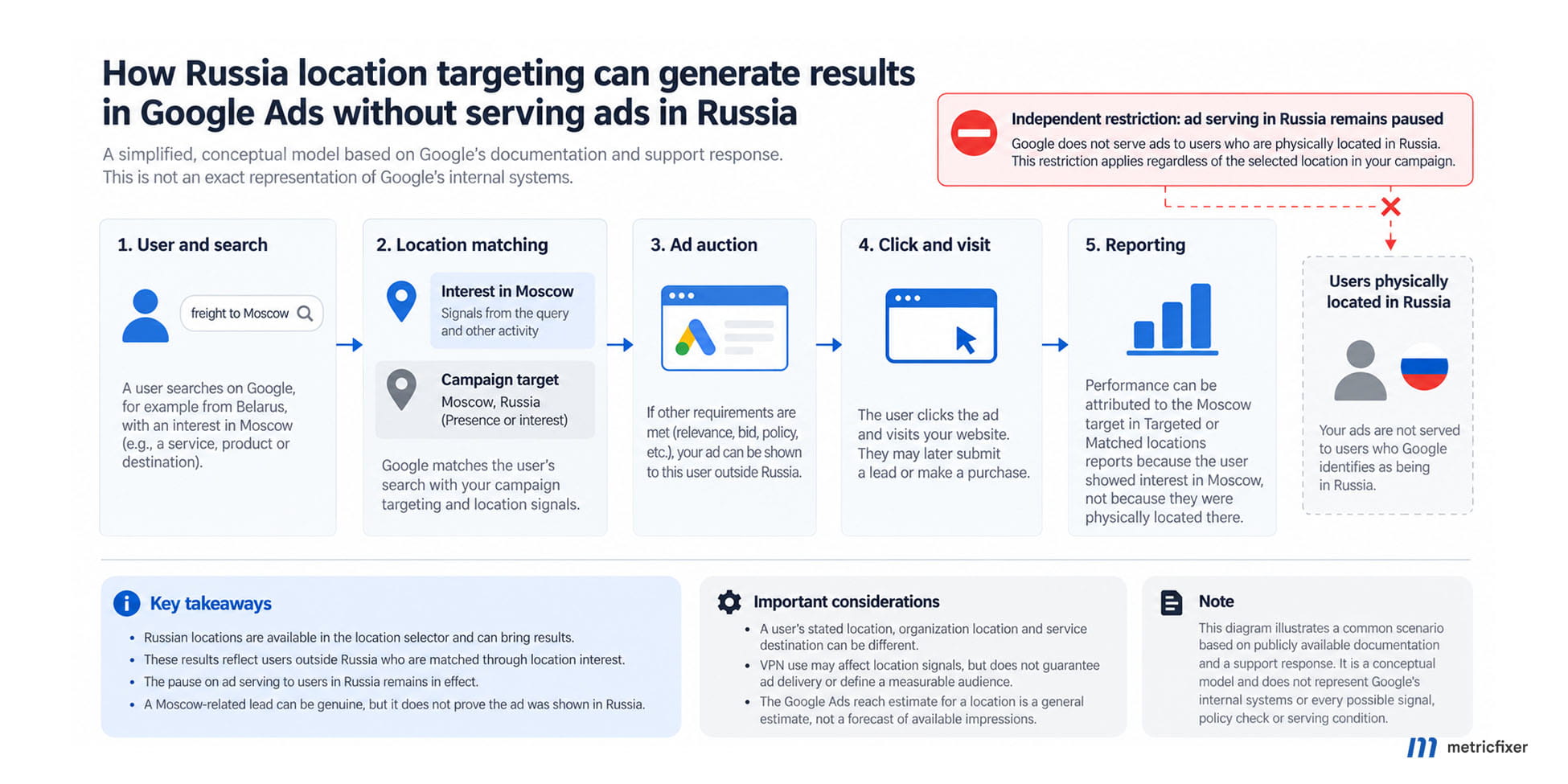
The Presence setting deserves care too. Google's definition includes users regularly in the selected area, not only people demonstrably there at the exact instant of a search. Changing a Moscow campaign to Presence does not remove the Russia pause or provide a guaranteed domestic audience.
At a technical level, even a place's existence in Google's geographic database is not sufficient evidence of delivery eligibility. The Google Ads geographic reference notes that some locations can appear in reporting despite being unavailable for targeting. The catalog, saved settings, matching rules and actual serving permission answer different questions.
Does this signal an easing of restrictions?
There is a limited operational interpretation worth considering: where a selector was previously unavailable and is now usable, the advertiser has more visible control over location-related demand. Our observations are consistent with that narrower possibility.
But that is not evidence that Google has relaxed its published rule on delivering ads to people located in Russia. The earlier 2024 account also weakens the idea that a recently noticed selector is a fresh signal of an approaching reopening.
It is possible to have both an unchanged domestic serving restriction and a commercially useful audience abroad interested in Russian destinations. Describing all Russia-related demand as completely inaccessible would miss that distinction. Describing the distinction as permission to advertise inside Russia would be equally misleading.
We found no basis to infer Google's intentions from the interface alone. Stronger evidence of an actual change would be a public policy update specifying the affected audience and products, or a substantive confirmation explicitly changing the serving rule. An ordinary selector, an unexplained impression or speculation about future plans does not meet that standard.
VPN users: plausible reach, unproven audience
The VPN question is reasonable because a foreign exit IP can affect the location signals available to a platform. However, Google says its location determination uses multiple signals, including IP and, where available, device information. It does not guarantee perfect accuracy.
Our inference is therefore conditional: some connections from people actually in Russia may be classified outside Russia and receive ads, but a VPN does not guarantee that classification. This would be a measurement or enforcement limitation, not proof that the advertiser has been authorized to reach the Russian domestic market. Neither the supplied screenshots nor the support email establish VPN use in the audited traffic.
Survey evidence suggests VPN use is substantial, but it cannot size a Google Ads audience. Levada's March 2025 survey reported use by 36% of respondents: 20% regularly and 16% sometimes. Its sample comprised 1,615 adults aged 18 and over, interviewed on 22-26 March.
MAR CONSULT's June 2026 survey of 1,200 respondents aged 18-65 reported 52% using VPNs: 27% regularly and 25% occasionally. Another 11% did not use them personally but said people close to them did. Adding that last group would incorrectly turn 52% personal usage into 63%.
These surveys cover different populations and should not be presented as a directly comparable growth series. Neither measures how many users have a VPN enabled during a relevant search, how Google classifies them, or how many eligible ads they can receive.
There is no demonstrated, reliably measurable "Russian VPN audience" in this case. A Russian-language visitor, a Moscow customer address and a foreign reported location can occur together for several reasons. Do not turn that combination into a guaranteed targeting product or a forecast based on national VPN adoption.
Business uses for Russia-related demand outside Russia
The practical opportunity is to reach a decision-maker outside Russia whose task concerns a Russian destination. The following are campaign hypotheses, not measured outcomes from this audit. Each requires advertiser eligibility, lawful fulfillment and any applicable category-specific approvals.
| Business task | Why a Russian region matters | What should count as success |
|---|---|---|
| Cross-border freight and logistics | A buyer abroad needs an allowed shipment to or from Moscow or another Russian region. | A serviceable route, permitted cargo and a qualified quote or booked shipment, not a city-labelled click. |
| Permitted gifts or deliveries ordered from abroad | The payer is outside Russia while the recipient is in a particular city. | A fulfillable order with payer and delivery locations recorded separately. |
| Relocation and shipment planning | A person already abroad arranges the movement of permitted personal belongings from a Russian city. | A qualified inquiry within the provider's actual service area and legal scope. |
| Travel research by overseas customers | A person outside Russia researches a destination, itinerary or service that an eligible provider may lawfully sell. | A permitted, serviceable booking rather than general destination interest. |
| Region-specific translation or business research | An overseas organization needs language or research services connected with a Russian location. | A relevant, permitted project from an identifiable buyer, not an assumed Russian resident. |
These examples do not mean a Russia-based provider becomes eligible simply by using an overseas intermediary. Nor does ordinary Search targeting imply that the same settings exist in every specialized ad product. For example, Google's location-options documentation describes a different limitation for hotel campaigns.
The key design change is in the brief. Replace "show our ads in Moscow" with a testable statement such as "reach eligible customers outside Russia who need our permitted service involving Moscow." That immediately improves landing-page copy, qualification questions and the definition of a useful lead.
The selector may offer a convenient way to express that regional relevance. It does not establish that all such demand was previously unreachable through destination-specific search terms, or that adding a location target will produce incremental sales.
Designing a controlled campaign test
Start with the audience you are allowed and able to serve
Our conservative starting design is a Search campaign focused on selected outside-Russia markets, with the appropriate presence setting, destination-specific search terms and an explicit service proposition. This tests a commercial need without making domestic Russian delivery or VPN use a requirement.
An alternative is a separately budgeted campaign using the available Russian location with Presence or interest, while closely reviewing the actual origin of its traffic. Treat that as a test of overseas regional interest, not as a Moscow physical-reach campaign. It may reach a wider set of origin countries than the business can serve.
Do not assume that adding Belarus and Moscow to one campaign means "people in Belarus AND interested in Moscow." Two included campaign locations are not, by themselves, a two-part audience condition. Use a design that explicitly preserves the intended relationship between origin and destination.
Do not confuse campaign location options with AI Max locations of interest
Google separately documents ad-group locations of interest for AI Max Search campaigns. In that feature, a user must meet the campaign's geographic requirements and the ad group's location-interest condition. This is a different control from simply adding another campaign target.
It is conceptually relevant to an overseas-origin, Russian-destination brief, but we did not test Russian locations in that feature. Availability and compatibility must be checked in the actual account. Google also says campaign-excluded locations cannot be used as locations of interest. Do not remove an exclusion automatically to make a test run; resolve the intended configuration and eligibility first.
Judge the test by qualified business outcomes
Set a small, deliberate spending limit and agree on acceptable origin countries, service destinations and lead-quality criteria before launch. Record the original settings and compare like-for-like periods and campaign types. Avoid changing geography, bidding, conversion goals and creative simultaneously and then attributing the result to one setting.
The audit's four reported conversions are not enough to establish scalable demand or incremental return. A controlled comparison should focus on qualified inquiries and completed business, allowing for conversion delay. Our guide to Google Ads experiments and budget testing provides a broader framework for structuring such comparisons.
Verifying geography and lead quality
The practical audit checklist is not "find Moscow somewhere in analytics." It is to align the evidence that describes targeting, delivery, visits and business outcomes.
- Align scope. Use the same dates, account, campaigns, status filters and relevant networks. Record reporting time zones. Check that the analytics property actually measures the advertised landing pages; a familiar property name is not sufficient.
- Record the location setting and its history. Capture included and excluded locations and whether Presence or interest was active during the reported period, not just today.
- Separate location interest from user location. Keep the original report titles. Compare target or matched-location results with physical user-location reporting, beginning at country level.
- Use the appropriate GA4 source scope. For visits attributed to a campaign, inspect session-level acquisition rather than relying only on the user's first acquisition source.
- Inspect conversion actions. Establish whether the reported conversions are actual submissions, calls, other interactions or multiple actions from the same inquiry.
- Reconcile with the business record. Distinguish the person's stated location, customer organization location, service destination and shipping or billing address. Record what is known without treating any one field as proof of impression location.
For analysts working through the API, Google's UserLocationView documentation describes country-level aggregation by users' physical locations. This is not a list of individual users or an independent GPS record. Google's reporting instructions also warn that geographic detail below country level may not account for every impression.
Why the supplied GA4 screenshot is not a verdict
The GA4 screenshot contains a Moscow row with two users under First user source / medium = google / cpc. It covers 3 July through 30 September, rather than the Ads report's 1 July start. This does not establish that there were exactly two Moscow ad clicks, nor that every other advertising visit came from elsewhere.
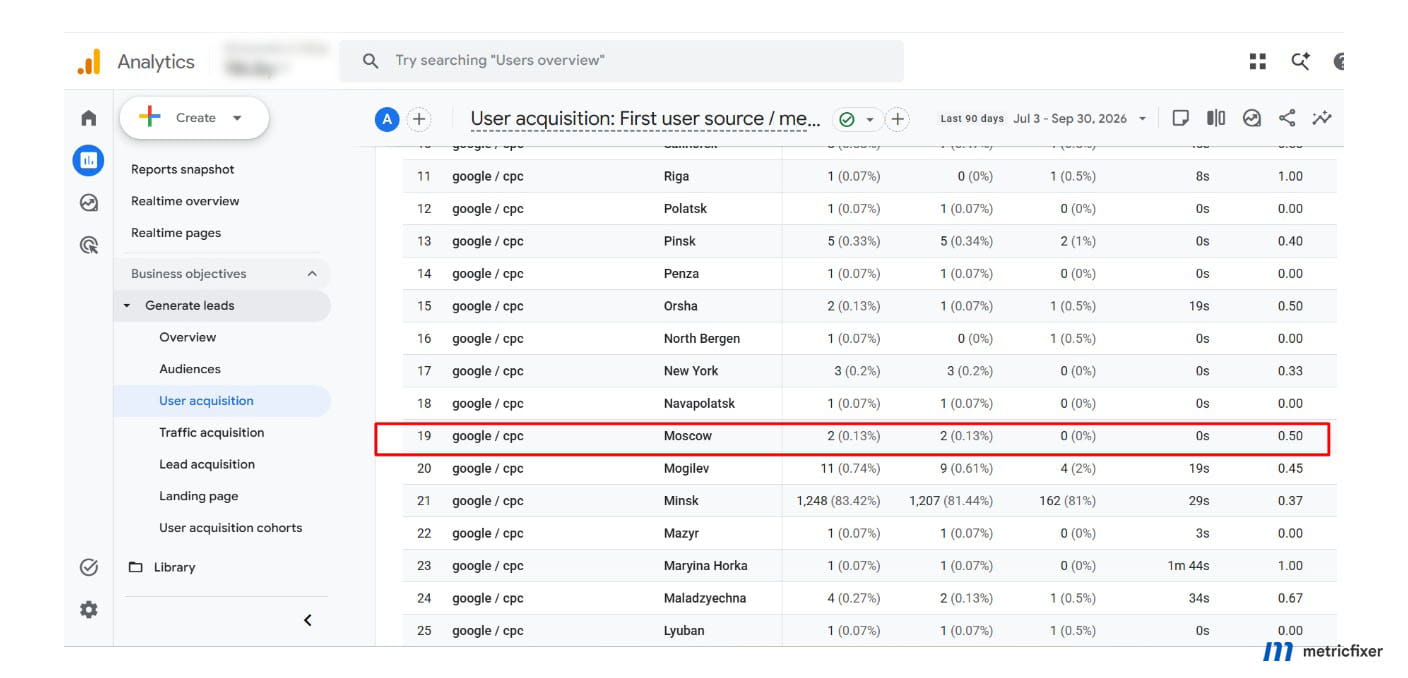
Google distinguishes first-user, session and event acquisition scopes. Someone first acquired through another channel can later click an ad without changing their first-user source. Conversely, a person first acquired through an ad can later return through another channel.
The screenshot's displayed zero engagement value should not be treated as proof of fraudulent traffic or no business inquiry, especially with metric headings cropped. GA4's geographic data is also derived from network information, not from a verified customer residence register.
Keep a lead's destination separate from the visitor's location
For a freight inquiry, a practical CRM record might contain separate fields for customer country, collection country, delivery city and qualified route. For gifts, distinguish purchaser country from recipient city. The question "Was this a Moscow lead?" is too ambiguous unless the business has defined what Moscow describes.
For future diagnostics, Google's ValueTrack documentation includes {loc_interest_ms} and {loc_physical_ms}. These can provide platform-assigned geographic IDs in supported configurations. They are not a VPN detector, are subject to availability conditions and do not retroactively reconstruct missing click context.
Where lawful and appropriately configured, campaign identifiers and qualified CRM outcomes can improve evaluation. They should not be used to manufacture a row-level attribution claim that the stored data cannot support. See our guide to testing offline conversions, attribution and bidding.
If a properly scoped user-location report genuinely shows Russian physical delivery, retain the dates, filters and campaign details and ask Google to explain that specific observation. That warrants investigation, not an automatic declaration that the policy has changed.
What to tell clients
A useful explanation for the audited advertiser is:
"Moscow is available as a location target, and the campaign has recorded results against that target. This does not prove that the ads were shown inside Moscow. The available user-location report shows Belarus, and Google's support response explains the Search campaign's Moscow results as location interest. A Moscow-related lead can still be genuine. We should evaluate whether the inquiry is useful, without presenting it as evidence that Google has resumed advertising inside Russia."
For planning purposes, the distinction is straightforward: Russia-related demand abroad may be worth testing; reliable domestic Russian ad delivery is not what this setting promises. Treat a change in the selector as something to investigate, not as a substitute for a policy announcement or a measured audience.

Methodology and sources
This article combines original audit evidence supplied to metricfixer, the Google Ads Support response received on 1 October 2026, and a review of public documentation and practitioner observations completed on that date. The audit evidence includes a location selector, targeted-location statistics, a user-location report and a GA4 acquisition report. It is a case study, not a representative sample of Google Ads accounts.
Google's published policy notices and product documentation are used for policy scope and reporting definitions. The support email is identified as AI-generated and is not treated as a public reopening announcement. The advertiser screenshots show specific settings and aggregate reports; they do not provide a complete click-level reconciliation, independently verified CRM outcomes or a controlled VPN experiment.
English- and Russian-language searches covered earlier selector reports, Russia-related campaign cases, community discussions and Google's policy updates. The practitioner account recalling April 2024 is presented as an attributed historical observation. We did not verify its original publication version, establish a universal restoration date, or resolve contradictory terminology in other accounts. Public search also cannot establish what was discussed only in private groups.
The Levada and MAR CONSULT figures are survey findings for their stated dates and respondent populations, not measurements of current Google Ads reach. The business scenarios and test designs are editorial recommendations, not claims of proven performance or platform approval. External sources are linked where their evidence is discussed.
This article provides technical and operational information, not legal advice or instructions to bypass advertising restrictions. It is an independent metricfixer publication, not a Google announcement or endorsement. Advertiser eligibility, applicable law, campaign settings and platform policies must be assessed separately. Selectable locations, reported conversions and support correspondence do not guarantee ad delivery, attribution or business results. Interfaces and policies may change after the review date.