
Published Aug 26, 2026
OpenAI Ads in Europe: Geo-Targeting, the 31-Country Rollout, and What Advertisers Can Use
OpenAI has expanded ChatGPT Ads inventory across 31 European markets, but inventory, self-service access, geo-targeting, personalization, billing, and measurement are rolling out on different timelines. This guide explains the full country list and a practical launch model for European advertisers.
Category: Online advertising · By Mikalai Sasau
OpenAI has expanded ChatGPT Ads inventory across 31 European markets, but ad availability, advertiser access, geo-targeting, personalization, billing, and measurement are not rolling out as one single feature. This review explains the full country list, why only nine countries appeared in the announcement sentence, what the Ads Manager location picker does and does not confirm, and how advertisers should structure early European campaigns.
Practical finding: the nine countries named in OpenAI's announcement were examples introduced with the word “including,” not the complete rollout. The official Ads Manager availability page lists all 31 European markets. However, as of 26 August 2026, those countries are still marked Coming Soon for self-service advertiser accounts, while European ad inventory launched through OpenAI Ads Solutions, agency partners, and technology partners. A country appearing in the campaign picker therefore does not, by itself, prove that every advertiser can open an account there or that delivery is already available in every configuration.
Executive summary
OpenAI currently calls the consumer-facing product ChatGPT Ads, while advertisers buy and manage campaigns through OpenAI Ads Manager Beta. In market discussions, “OpenAI Ads” is often used as the broader platform name. This article uses both terms, but they describe the same developing advertising ecosystem rather than two separate networks.
The first point to correct is the apparent nine-versus-31-country conflict. OpenAI's 18 August 2026 announcement says that ChatGPT Ads is expanding to 31 European countries, including Germany, France, Spain, Italy, Sweden, Norway, Denmark, the Netherlands, and Austria. Those nine are illustrative examples. The complete OpenAI availability table contains 31 European markets.
The second point is more operationally important: there are several different meanings of “available.” OpenAI said that ChatGPT Ads would become available in the 31 European countries on 24 August 2026, initially through its Ads Solutions team and approved partners. At the same time, the current Ads Manager availability table marks every one of those 31 countries as Coming Soon for self-service access. The location picker may already expose the full geo catalog, but advertiser-country eligibility, billing, campaign creation, review, and actual delivery remain separate controls.
The 31-country footprint maps exactly to the 27 European Union member states, Iceland, Liechtenstein, Norway, and Switzerland. In other words, it matches the European Economic Area plus Switzerland. This is a strong geographic inference from the official lists, not an explicit statement by OpenAI about the legal reason for choosing those markets. The United Kingdom is not missing: it launched earlier, on 11 August 2026, and is already listed as available for Ads Manager.
For campaign strategy, Europe is currently a contextual-first environment. OpenAI says personalized ads are not initially available in the EEA or Switzerland, and its developer documentation says Custom Audiences cannot be used for campaigns targeting those markets. Advertisers therefore need to rely on country selection, platform selection, semantic context hints, localized creative, relevant landing pages, bidding, and conversion signals rather than CRM-list inclusion, lookalike-style logic, or cross-chat personalization.
The platform is already more developed than it was when metricfixer reviewed OpenAI Ads UTM templates in July 2026. Ads Manager now publicly documents CPM, CPC, and conversion-optimized CPC; country and selected subnational location targeting; iOS, Android, and web targeting; product-feed campaigns; the OpenAI Pixel and Conversions API; one-day view-through reporting for eligible accounts; country and device segmentation; third-party measurement integrations; and four dynamic landing-page macros. The product is nevertheless still in beta, OpenAI publishes no cross-advertiser performance benchmarks, and several European details remain unresolved.

Why the press release appeared to confirm only nine countries
The misunderstanding comes from reading one sentence as a closed list. The English announcement states that the platform will expand to 31 European countries, “including” nine named markets. In normal editorial usage, including introduces examples rather than an exhaustive list. The localized German announcement is even more specific: it says ChatGPT Ads would become available in 31 European countries on 24 August and repeats the same nine examples.
| Evidence level | What the evidence supports | What it does not prove |
|---|---|---|
| Confirmed by OpenAI | The European rollout covers 31 markets. The nine named countries are examples, and the official availability table contains the complete 31-country list. | It does not mean European self-service advertiser accounts were fully open on the same day. |
| Confirmed by OpenAI | European access starts through OpenAI Ads Solutions, agency partners, and technology partners; self-service follows later. | OpenAI has not published a country-by-country self-service activation calendar. |
| Observed in Ads Manager | metricfixer has observed all 31 European markets in the campaign location selector. | A selectable location does not guarantee account eligibility, immediate impressions, sufficient inventory, or approval for every advertiser and vertical. |
| Reasonable inference | The official 31-country list is exactly the EU-27 plus Iceland, Liechtenstein, Norway, and Switzerland: the EEA plus Switzerland. | OpenAI has not publicly stated that EEA law or one specific regulatory test is the reason for the market boundary. |
| Still unconfirmed | Self-service dates, local billing currencies and minimums, subnational coverage outside the US, language controls, and early inventory depth may vary. | The current interface should not be treated as a permanent product specification. |
The complete 31-market European list
The current OpenAI Ads Manager availability page identifies the following 31 countries as the European markets where self-service advertiser access is Coming Soon. OpenAI's separate launch announcement says ad inventory in these markets began rolling out on 24 August through direct and partner-supported access.
| Group | Countries | Current practical interpretation |
|---|---|---|
| Nine examples named in the launch announcement | Austria, Denmark, France, Germany, Italy, Netherlands, Norway, Spain, Sweden | These are confirmed launch examples, not a privileged or exclusive nine-country tier in the public documentation. |
| Twenty-two additional markets in the official availability table | Belgium, Bulgaria, Croatia, Cyprus, Czech Republic, Estonia, Finland, Greece, Hungary, Iceland, Ireland, Latvia, Liechtenstein, Lithuania, Luxembourg, Malta, Poland, Portugal, Romania, Slovakia, Slovenia, Switzerland | These complete the 31-market European footprint even though they were not named in the announcement sentence. |
Viewed institutionally, the list contains all 27 EU member states plus the three non-EU EEA states—Iceland, Liechtenstein, and Norway—and Switzerland. Switzerland is not part of the EEA, but OpenAI applies the same initial restriction on personalized ads and Custom Audiences to the EEA and Switzerland.
The phrase “31 European markets” should not be interpreted as every country geographically associated with Europe. It is a defined rollout footprint. The United Kingdom belongs to the earlier international expansion and is already available in Ads Manager, while other European countries outside the published list should not be assumed to be supported.
Five different layers of OpenAI Ads availability
Most confusion disappears once the platform is separated into operational layers. Google Ads and Meta advertisers are accustomed to mature systems where account availability, billing, targeting, inventory, and reporting often feel integrated. In a fast-moving beta, they can be activated independently.
| Layer | What it answers | European status as of 26 August 2026 | How to verify it |
|---|---|---|---|
| 1. User inventory | Can eligible ChatGPT users in the market be shown ads? | OpenAI announced availability in 31 European countries from 24 August, initially through direct and partner-supported buying. | OpenAI launch communications and observed delivery, not merely the advertiser signup screen. |
| 2. Advertiser-country access | Can a business based in that country create its own Ads Manager account? | All 31 European countries are currently marked Coming Soon on the official self-service availability page. | Check the live Ads Manager Availability table and the account signup flow. |
| 3. Geo-target catalog | Can a campaign select the country or another geographic unit? | The full European country set is visible in at least some live accounts. OpenAI provides a location picker, downloadable catalog, and geo lookup API. | Search the location in the exact campaign account or query the current geo lookup endpoint. |
| 4. Billing and account configuration | Can the account use the correct country, currency, time zone, payment method, and legal entity? | European self-service details are still rolling out. OpenAI's current minimum-spend table does not publish euro, Swiss franc, Norwegian krone, Swedish krona, or Danish krone minimums. | Verify the live onboarding flow before creating the account; country, currency, and time zone cannot currently be changed later. |
| 5. Campaign delivery eligibility | Will this specific campaign actually serve? | Depends on account verification, billing, advertiser category, ad and landing-page review, dates, budget, bid competitiveness, targeting, and available eligible conversations. | Use account and object statuses, review messages, reporting, and support—not the location selector alone. |
This distinction also explains why a European advertiser may see a targetable country but still be unable to complete self-service onboarding, while an agency or technology partner with approved access can already run campaigns into that market.
What OpenAI Ads geo-targeting currently supports
OpenAI's campaign documentation describes campaign-level country targeting as the standard geographic control. It explicitly documents state, DMA, and ZIP targeting in the United States. A separate FAQ says supported states or regions, cities, DMAs, and postal codes may be available in other countries, but availability varies by market. The Advertiser API guide currently documents country, region, and DMA location types.
That creates an important implementation hierarchy:
- Country targeting is the reliable planning baseline. It is the only geographic level described as generally supported across campaigns.
- Subnational targeting is market-dependent. Do not build a media plan around cities, regions, or postal codes until the exact location appears in the live account.
- UI and API capabilities may not be identical. The Help Center mentions cities and postal codes where available, while the current public API guide names country, region, and DMA.
- No geo selection means broad eligibility. OpenAI's API documentation says a campaign without location targeting can target all locations available to that account.
- Location selection is inclusion-based. The documented API pattern passes location IDs into
targeting.locations.include.
How to verify the current geo catalog through the API
Approved API users can query the live geo lookup endpoint rather than hard-coding a country list from an old screenshot:
curl -G "https://api.ads.openai.com/v1/geo_lookup/search" \
  -H "Authorization: Bearer $OPENAI_ADS_API_KEY" \
  --data-urlencode "q=France" \
  --data-urlencode "limit=5"
A successful result can provide the location id, display name, canonical name, country code, type, and region code. It confirms that the location exists in the current targeting taxonomy for that API context. It still does not confirm that a new advertiser in France can self-register, that every account has the same feature flags, or that a campaign will immediately receive impressions.
Geo-targeting is not language targeting
The public campaign setup documentation lists country, platform, budget, dates, objective, conversion event, and optional Custom Audiences. It does not currently describe an advertiser-controlled campaign language setting comparable to Google Ads language targeting. OpenAI's consumer FAQ separately says that general location or language may be used internally as basic context when selecting ads.
These two facts should not be combined into an unsupported conclusion. The platform may understand conversation language, but advertisers do not currently have a publicly documented language-targeting control. A country selection therefore cannot replace creative and landing-page localization.
This matters particularly in multilingual markets:
- Belgium: Dutch, French, and sometimes English campaigns may need separate creative and landing-page paths.
- Switzerland: German, French, Italian, and English business contexts cannot be represented by one generic “Switzerland” message.
- Luxembourg: French, German, Luxembourgish, and English usage creates mixed-language intent.
- Ireland, Malta, and Nordic B2B markets: English may work for part of the market, but it should be tested rather than assumed from country targeting.
How ChatGPT Ads differs from keyword advertising
ChatGPT Ads appears below the end of a ChatGPT response, clearly labeled and visually separated from the answer. During the beta, a response may be followed by one or more ad units. The unit can include the advertiser name, logo, title, description, landing page, and image; product-feed formats can show product information such as images, titles, ratings, prices, and sale prices.
Ads may be shown to eligible users on the Free and Go plans. Plus, Pro, Business, Enterprise, and Edu accounts are ad-free, accounts identified as belonging to people under 18 are excluded, and Temporary Chats do not show ads. This means the addressable audience is not simply “all ChatGPT users in a country.”
OpenAI says the ads system evaluates expected relevance and outcomes using signals such as:
- the context and intent of the current conversation;
- the landing page;
- the ad title and copy;
- advertiser-provided context hints and targeting settings;
- broader ChatGPT signals only where ad personalization is enabled;
- advertiser bids when multiple ads are eligible.
OpenAI describes the auction as relevance-weighted and second-price. This is not a traditional paid-search auction built around exact or phrase-match keywords. The user can explain a problem, constraints, preferences, and intended outcome in natural language, and the ad system tries to identify relevant commercial opportunities around that richer context.
Context hints are semantic guidance, not keywords
Context hints live at the ad-group level and describe what the product offers, who it helps, and when it may be useful. OpenAI recommends natural phrases such as “cushioned everyday running shoes for beginners training for their first 5K” rather than a disconnected term such as “running shoes.”
They should be treated as semantic product-and-use-case descriptions:
- They can cover several related ways a customer describes the same need.
- They should add information beyond the title, copy, and landing page.
- They are not exact-match controls.
- They are not audience rules.
- They do not guarantee delivery for a word, topic, user type, or conversation.
For European campaigns, context hints are one of the most important controllable inputs because personalized audience targeting is unavailable. Build separate ad groups when use cases require different copy, proof, offers, or landing pages rather than placing every possible intent into one broad group.
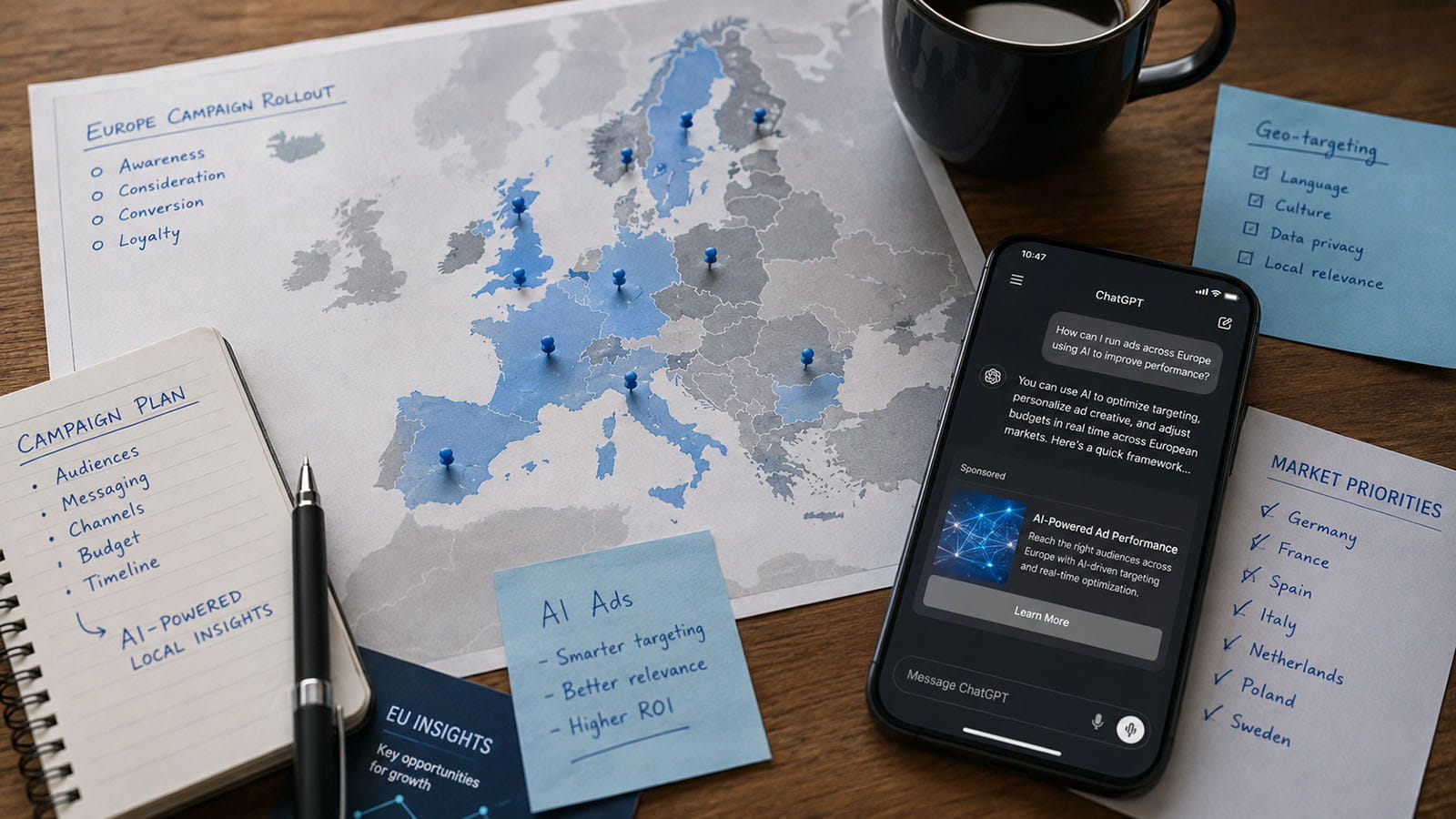
Why Europe is a contextual-first launch
OpenAI says personalized ads are not initially available in the European Economic Area or Switzerland. Its Custom Audiences documentation separately states that customer or prospect list targeting is not supported for campaigns targeting those markets. These restrictions apply across the entire 31-country footprint.
The practical consequence is not that OpenAI Ads has no targeting in Europe. It means the targeting stack is narrower and more contextual:
| Control or signal | European availability | Practical use |
|---|---|---|
| Country targeting | Supported | Separate delivery and reporting by market. |
| Subnational locations | Where available | Verify each region, city, or postal area in the live picker; do not assume universal coverage. |
| Platform targeting | Supported | Choose iOS App, Android App, and/or Web. Web includes desktop and mobile web. |
| Current-conversation context and intent | Core delivery signal | Use clear ad copy, context hints, and highly relevant landing pages. |
| General language or location as internal context | Used by OpenAI | OpenAI may use these basic signals, but the advertiser does not receive precise location or a raw conversation. |
| Personalization from past chats, memory, and ad history | Not initially available in EEA/Switzerland | Do not plan European performance around cross-chat personalization. |
| Custom Audience inclusion or bid multipliers | Not supported for EEA/Switzerland campaigns | CRM-list prospecting and customer-list bid strategies are unavailable for the 31-market rollout. |
| Advertiser-controlled language targeting | Not publicly documented | Localize and separate creative manually; validate delivery by country and landing-page language. |
Advertisers do not receive users' chats, chat history, memories, names, email addresses, precise location, IP address, or sensitive information through ad reporting. OpenAI says advertisers receive aggregated, non-identifying performance information. This protects users, but it also means advertisers must resist treating conversational intent as a downloadable audience attribute.
Recommended campaign architecture for the European rollout
A single “Europe” campaign may look efficient, but it makes early beta data difficult to interpret. Countries differ in language, currency, shipping, consumer expectations, conversion rates, legal presentation, and inventory depth. OpenAI already supports country segmentation, so campaign structure should preserve those differences.
| Business situation | Recommended structure | Reason |
|---|---|---|
| One major market with a localized offer | One country campaign, separate ad groups by customer need or use case, multiple creative variants per group. | Creates the cleanest learning loop for context hints, copy, landing pages, bids, and conversions. |
| Several countries sharing language, currency, offer, and fulfillment | Start with separate country campaigns even if creative is reused; consolidate only after country-level evidence is stable. | Country-level budgets and reporting prevent one market from consuming spend and hiding weaker markets. |
| Multilingual country | Use separate language-oriented ad groups and landing pages; consider separate campaigns when budgets or offers differ. | Country targeting alone does not document language control, and mixed-language performance can be misleading. |
| Cross-border ecommerce catalog | Country campaigns with product-feed filters for availability, currency, shipping, and product line. | Prevents ineligible products or inconsistent commercial terms from being promoted across markets. |
| European B2B campaign in English | Use a limited country cluster only where the English landing page, sales coverage, pricing, and legal information are genuinely suitable; segment country results from the first day. | Business English may travel, but conversion economics and intent quality still vary by market. |
| Small exploratory budget | Prioritize a few high-value markets rather than all 31; use CPC, narrow product/use-case groups, and strict measurement. | Spreading a beta budget across 31 countries can produce too little signal per market to support decisions. |
A practical naming model might separate region, country, language, objective, and offer:
EU-FR-FR-CPC-SummerTrial
EU-BE-FR-CPC-SummerTrial
EU-BE-NL-CPC-SummerTrial
EU-CH-DE-CPC-SummerTrial
This is not an OpenAI-required naming convention. It is an operational pattern that keeps country and language differences visible in exports, analytics, and agency reporting.
Objectives, bidding, and budgets
Ads Manager currently offers three campaign objectives:
| Objective | Billing | Optimization goal | Best early use |
|---|---|---|---|
| CPM | Per 1,000 impressions | Reach and visibility | Awareness campaigns with enough scale and brand-safe creative. |
| CPC | Per valid click | Clicks from users likely to engage | New European market tests where the first goal is traffic quality and conversion measurement validation. |
| oCPC | Per valid click, not per conversion | Clicks more likely to produce one selected conversion event | Campaigns with stable tracking and enough conversion volume to support optimization. |
OpenAI's general CPC guidance recommends starting with a maximum bid of $3–$5 USD per click. This is platform guidance, not a European benchmark, target CPA, or guarantee. OpenAI also says it does not yet have cross-advertiser performance benchmarks by industry or campaign type. European advertisers should not convert the US-dollar recommendation into a rigid local bid without observing actual delivery and conversion value.
Important oCPC limitations
Conversion-optimized CPC is in open beta for standard and product-feed campaigns. It requires:
- an account enabled for conversion bidding;
- the OpenAI Pixel, Conversions API, or both;
- exactly one active standard conversion event as the optimization goal;
- enough conversion signal to evaluate performance.
Custom events cannot currently be oCPC optimization goals. The selected goal cannot be changed after campaign creation, and an existing CPM or CPC campaign cannot simply be converted into oCPC. A new campaign must be created. The ad-group bid acts as a CPA-oriented optimization input, but OpenAI still bills valid clicks and the auction determines the actual CPC.
metricfixer recommendation: begin a new European market with CPC until click tracking, landing-page behavior, consent, conversion events, and the oppref path are validated. Move to a separate oCPC campaign only when the selected standard event is reliable and has enough volume. Starting with oCPC on a broken or low-volume event gives the system a weak optimization signal and makes diagnosis harder.
Budget behavior is not the same as strict daily pacing
Advertisers can choose a campaign-total budget or an average daily budget. A campaign-total budget is a hard total-spend limit, but it is not evenly paced across the scheduled dates. A daily budget is an average over seven days: OpenAI says an individual day can spend up to twice the selected daily amount, while the seven-day total should not exceed seven times the selected daily budget, subject to proration when budgets change.
As of this review, the published minimum-spend table contains values for existing self-service markets but does not list European billing currencies. Do not infer a euro minimum from the US, UK, or Australian values. Confirm the exact amount in the live account or partner proposal.
Creative and landing-page requirements
OpenAI advises advertisers to create multiple distinct ads per offering rather than repeating the same message. Clear, specific, benefit-focused copy is more useful than vague slogans because the system evaluates conversational relevance. A strong ad should explain:
- what the product or service does;
- who it is useful for;
- the situation in which it helps;
- the practical benefit or differentiator;
- what the user can expect after clicking.
The landing page is part of ad selection and review, not only a post-click destination. It should match the offer, language, price, currency, availability, delivery area, and claims in the ad. OpenAI says landing pages must be reachable and must not block OAI-AdsBot or OAI-SearchBot. A campaign can fail review or delivery when OpenAI cannot evaluate the destination.
For Europe, localization should go beyond translation. Check VAT presentation, shipping countries, returns, legal business identity, cookie and measurement disclosures, local currency, and whether the promoted product is actually available in the selected market. OpenAI's policies require geographic compliance and prohibit misleading location or service-area claims.
Product feeds, bulk workflows, and the Advertiser API
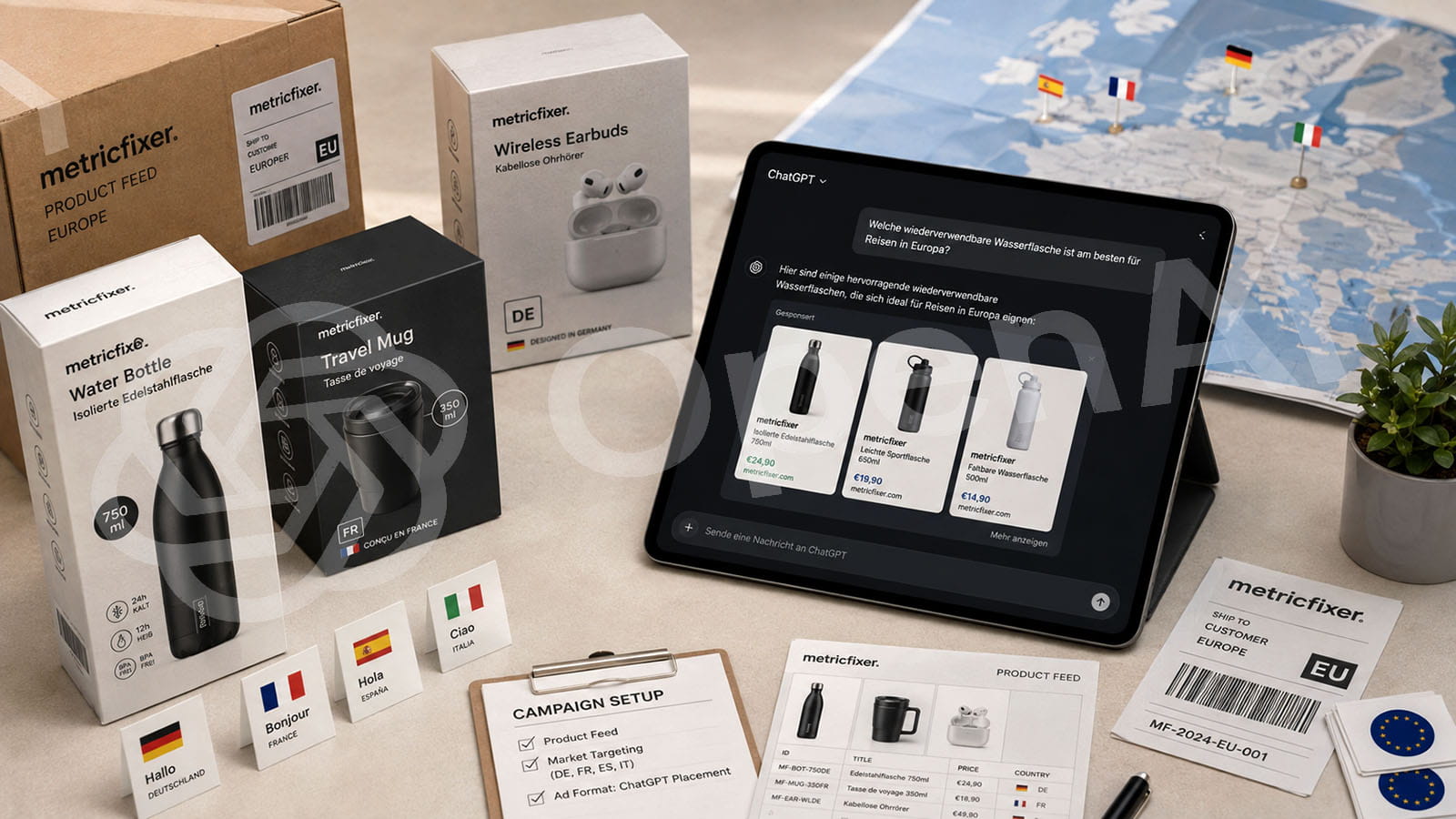
OpenAI Ads is no longer limited to manually entered single-product ads. Retail advertisers can create product-feed campaigns from a catalog. OpenAI currently supports manual CSV or TXT uploads, hosted HTTPS feeds, and SFTP connections. Feed items expire after two weeks, so automated hosted or SFTP updates are the safer production pattern for active catalogs.
Product formats can use structured fields such as product images, titles, ratings, prices, sale prices, and brand. Product filters and an ads_metadata field can be used to organize catalog subsets. OpenAI states that feed-based ads have been among the strongest performers in its early program, but this is a platform-reported observation rather than an independent European benchmark.
The public Advertiser API can manage:
- ad-account metadata;
- campaigns, ad groups, and ads;
- creative files;
- performance insights;
- bulk asynchronous campaign jobs;
- product feeds;
- conversion pixels, server-side keys, and event settings where enabled;
- Custom Audiences in supported non-EEA markets.
API keys are scoped to one ad account. OpenAI currently documents limits of 600 requests per endpoint per minute, 1,200 requests overall per minute, and a separate bulk-job creation limit. Several capabilities, including some conversion and brand operations, may require account enablement by an OpenAI representative.
For agencies, each advertiser should have its own account. OpenAI's account setup guide says the advertiser country, currency, and time zone cannot currently be changed after creation. Those settings should represent the entity being advertised and billed, not simply the agency employee who opened the account.
Measurement and attribution
Ads Manager currently reports impressions, clicks, spend, CTR, average CPC, average CPM, and conversions. order_created events can also support sales and ROAS columns. Reporting can be viewed at campaign, ad-group, and ad levels, exported to CSV, and segmented by country and device. OpenAI advises allowing 24–48 hours for attributed conversions to appear.
OpenAI Pixel and Conversions API
The browser Pixel captures website events and can store OpenAI's click reference, oppref, in a first-party cookie. The Conversions API sends events server-side. OpenAI recommends using both for more resilient measurement and using the same event ID when the same conversion is sent through both paths so that it can be deduplicated.
Preserve oppref through redirects, domain changes, checkout flows, and server-side event pipelines. It is automatically appended to eligible landing-page URLs and is distinct from UTM parameters:
- UTMs classify traffic in GA4, analytics tools, CRM systems, and warehouses.
opprefhelps OpenAI connect a conversion event to an eligible ad click.
Do not replace, rename, or strip oppref when adding your own query parameters.
Set Pixel consent before initialization in Europe
The OpenAI Pixel initializes measurement consent to true by default unless the implementation explicitly sets it to false or the Pixel finds a stored denial. When consent is false, measurement pings are not sent. Events blocked before consent is granted are not replayed later.
Where prior consent is required, set the default before Pixel initialization and update it only after the user grants the relevant measurement permission:
oaiq("consent", false);

oaiq("init", {
  pixelId: "<YOUR-PIXEL-ID>"
});

// Call only after the user grants measurement consent.
oaiq("consent", true);
This code illustrates the OpenAI consent interface, not a complete CMP implementation or legal determination. The required default, consent category, regional behavior, disclosure, and server-side controls depend on the advertiser's setup and applicable law. Automatic advanced matching or hashed first-party identifiers should not be enabled merely because the values are hashed; OpenAI's terms still require appropriate notices, rights, permissions, consents, and legal bases.
View-through conversions are separate
Eligible accounts may receive one-day view-through conversion reporting. If both an eligible impression and click could receive credit for the same conversion, the click takes precedence. OpenAI reports view-through conversions separately from the main Conversions column, which remains click-through only. View-through conversions do not currently affect CPA, post-click conversion rate, bidding, billing, or conversion optimization.
This separation is useful because it reduces the temptation to add click-through and view-through totals together and then compare that inflated number directly with GA4 last-click or session-based reporting.
Third-party measurement integrations
OpenAI currently documents mobile measurement integrations with AppsFlyer and Adjust. It also publishes setup guidance for selected web, ecommerce, offline, and data-platform partners, including Fospha, Hightouch, LiveRamp, Triple Whale, and WorkMagic. Capabilities differ by partner, so advertisers should verify whether the integration provides event forwarding, attribution, reporting, optimization inputs, or only a reporting connection.
Dynamic URL parameters are now officially documented
When metricfixer published its OpenAI Ads dynamic parameters and UTM guide on 25 July 2026, four ID templates were visible in at least some Ads Manager accounts before public documentation clearly supported them. OpenAI's current Measure Results article now officially documents the same four macros:
{campaign_id}{ad_group_id}{ad_id}{ad_account_id}
Ads Manager can append custom query parameters at campaign, ad-group, or ad level. OpenAI documents this precedence order from most specific to least specific: Ad URL → Ad → Ad Group → Campaign. A value already set on the ad URL is not overwritten by a broader-level setting.
A compact GA4-oriented pattern remains:
utm_source=chatgpt&utm_medium=paid_ai&utm_campaign=fr-summer-trial&utm_id={campaign_id}&utm_content={ad_id}&utm_source_platform=openai_adsKeep readable marketing taxonomy static and use dynamic object IDs as technical join keys. The value paid_ai is a metricfixer convention, not a reserved OpenAI or GA4 medium, so it may require a custom channel group. Do not force {ad_group_id} into utm_term unless the organization's UTM policy deliberately treats that field as broader than paid-search keywords; OpenAI ad groups represent themes, needs, and context-hint clusters rather than search terms.
Why Ads Manager clicks will not equal GA4 sessions
OpenAI explicitly notes that ad clicks and third-party analytics sessions can differ because analytics depends on the landing page loading, redirects, consent, browser blocking, UTM preservation, attribution windows, and time-zone settings. European consent behavior can widen the gap: a click can be valid in Ads Manager even when analytics or Pixel measurement does not initialize.
For reliable reconciliation:
- compare the same date range and time zone;
- export campaign and ad IDs from Ads Manager;
- preserve UTMs and
opprefacross every redirect; - test accepted consent and denied consent separately;
- confirm the conversion event attached to the campaign exactly matches the event sent;
- allow 24–48 hours before declaring attributed conversions missing;
- keep click-through and one-day view-through reporting separate.
Policy, verification, and European eligibility
Account and campaign approval are material constraints, not administrative details. OpenAI reviews the advertiser, creative, image, landing page, and placement context. The early program focuses mainly on consumer categories such as household and lifestyle goods, local services, travel and experiences, and digital products or education.
Regulated or sensitive categories remain restricted or prohibited. OpenAI's current policies prohibit political advertising and generally restrict areas such as financial services, health services, legal services, alcohol, tobacco, gambling, adult content, drugs, deceptive offers, and other high-risk products. Some approved US advertisers may receive case-by-case access in selected financial or health categories, but OpenAI says financial and health services outside the US are generally prohibited. European businesses in these sectors should not assume that geo availability makes their vertical eligible.
Advertiser verification uses business information and a Persona verification flow. Verification and account review are separate, and campaigns cannot deliver until onboarding, account information, billing, payment, review, and required status checks are complete.
Agencies and resellers should also review the current Advertising Terms and Ad Tools terms. Authority to act for the advertiser, first-party data rights, consent, legal basis, account separation, and responsibility for client data cannot be treated as an informal media-buying detail. OpenAI's Ad Tools DPA generally describes the parties as independent controllers outside any specifically defined Restricted Processing.
A practical Europe launch playbook
- Confirm the access path. Determine whether the advertiser is entering through OpenAI Ads Solutions, an approved agency or technology partner, or self-service. Do not assume that seeing a country in the picker means a new local account can be opened.
- Create the account under the correct advertiser entity. Verify country, currency, time zone, legal business name, website, billing address, and account owner before submission because key account fields are not self-service editable later.
- Check category eligibility before producing a campaign. Review the latest OpenAI ad policies and the landing page, not only the ad text.
- Start with a small number of priority countries. Choose markets where product availability, language, price, shipping, sales coverage, and landing-page experience are ready.
- Separate countries in the initial test. Country-level campaigns produce cleaner budget control and reporting than one 31-country campaign.
- Build ad groups around customer needs. Write specific context hints that describe real problems, situations, constraints, and use cases rather than keyword lists.
- Localize the complete path. Align ad title, copy, image, landing page, currency, offer, policy information, and conversion flow.
- Begin with CPC unless measurement is already proven. Validate traffic quality and conversion plumbing before creating a separate oCPC campaign.
- Implement Pixel and CAPI deliberately. Use a shared event ID for deduplication, preserve
oppref, and configure consent before Pixel initialization where required. - Add static taxonomy and dynamic IDs. Use readable UTMs plus the officially documented campaign and ad macros. Test a real click to confirm that macros resolve and all parameters survive redirects.
- Segment results by country and device. Watch impressions, clicks, CTR, spend, CPC, conversions, and post-click quality. Do not compare markets only on CTR.
- Keep VTA separate. Treat one-day view-through conversions as supplemental reporting, not as an addition to click-through conversions for CPA calculations.
- Document beta assumptions. Record which settings were confirmed in the live account, which came from public documentation, and which remain experimental.
What remains unknown or account-dependent
OpenAI has moved unusually quickly from a US test to a multi-market advertising platform, and the documentation is changing accordingly. The following questions should remain explicit in any media plan:
- Exact European self-service dates: OpenAI says access will follow, but the current country table still marks the 31 markets as Coming Soon.
- Account-by-account feature parity: conversion bidding, conversion APIs, brand operations, view-through reporting, and partner features may require enablement.
- Subnational European geo coverage: the Help Center says cities, regions, and postal codes may be available, but no stable country-by-country matrix is published.
- Advertiser-controlled language targeting: no public campaign language setting is currently documented.
- European billing details: local currencies, minimum daily budgets, invoicing options, and payment behavior should be checked in the live account or partner agreement.
- Inventory depth: OpenAI does not publish country-level impression forecasts, audience estimates, or mature reach benchmarks.
- Performance benchmarks: there is no official cross-industry CPC, CTR, conversion-rate, CPA, or ROAS benchmark.
- Long-term personalization rules: OpenAI says personalized ads are not initially available in the EEA and Switzerland, but it does not provide a future activation date.
- UI/API parity: some controls may appear first in Ads Manager and later in API documentation, or vice versa.
- Product stability: Ads Manager and several advertising capabilities remain beta services and may change during rollout.
Final assessment
The European rollout is broader than the nine countries that attracted attention in the press release. OpenAI has defined a coherent 31-market footprint that corresponds to the EEA plus Switzerland, while the UK sits in the earlier international wave. The more important conclusion, however, is that market launch, location targeting, advertiser access, and self-service are different states.
OpenAI Ads is already a credible campaign platform rather than a simple sponsored-link experiment. It has semantic context hints, a relevance-weighted auction, multiple bidding objectives, product feeds, country and platform targeting, a public Advertiser API, dynamic URL macros, Pixel/CAPI measurement, one-day view-through reporting, and partner integrations. At the same time, it lacks the mature forecasting, language controls, public benchmarks, stable regional documentation, and universal feature parity advertisers expect from established networks.
For Europe, the winning early strategy is unlikely to be “upload the CRM list and target all 31 countries.” Custom Audiences and personalized ads are unavailable across the rollout footprint. The practical advantage will come from selecting the right markets, describing genuine conversational use cases, localizing the ad-to-landing-page path, using disciplined country-level budgets, and building measurement that survives consent choices, redirects, and attribution differences.
Methodology and sources
This article was prepared from OpenAI's official launch announcements, Help Center, Ads developer documentation, policies, account-setup materials, measurement documentation, and live Ads Manager observations supplied to metricfixer. The 31-country list was compared with official European Union and European Free Trade Association country definitions. Statements described as observations or inferences are separated from features explicitly confirmed in OpenAI documentation. Product status was checked on 26 August 2026; beta interfaces and availability can change after publication.
- OpenAI: ChatGPT Ads expands across Europe
- OpenAI German announcement with the 24 August launch date
- OpenAI Ads Manager Availability
- OpenAI: Testing ads in ChatGPT and rollout timeline
- OpenAI: Ads in ChatGPT consumer FAQ
- OpenAI: Ads in ChatGPT — the basics
- OpenAI: Create Campaigns for ChatGPT Ads
- OpenAI: Create Ad Groups and context hints
- OpenAI: Create Ads for ChatGPT Ads
- OpenAI Ads developer documentation: Campaign Targeting
- OpenAI Ads Advertiser API overview and changelog
- OpenAI Ads developer documentation: Custom Audiences
- OpenAI Ads developer documentation: Conversion-Optimized Campaigns
- OpenAI: Create Campaigns from Product Feeds
- OpenAI: Measure Results in Ads Manager
- OpenAI: Conversion Measurement
- OpenAI Ads developer documentation: Measurement Pixel
- OpenAI: Mobile Measurement Partner integrations
- OpenAI: Measurement Partner integrations
- OpenAI: Ads Manager Beta Account Setup
- OpenAI: ChatGPT Ads advertiser FAQ
- OpenAI Ad Policies
- OpenAI Advertising Terms
- OpenAI Ad Tools Data Processing Addendum
- European Union: EU countries
- European Free Trade Association: EEA EFTA States
This article is for advertising, analytics, and operational information only and is not legal advice. OpenAI Ads Manager Beta, geographic availability, targeting, policies, prices, minimum budgets, measurement, and interface controls may change without notice. metricfixer is not affiliated with OpenAI. Advertisers should recheck the live documentation, their own account, applicable terms, consent requirements, and market eligibility before committing budget or customer data.