
Published Sep 15, 2026
Google Ads Experiments in 2026: New Budget, AI Max, and Performance Planner Tools
Google Ads is rolling out new Search testing tools for budgets and ROI targets, stronger AI Max experiments with brand and location guardrails, and one-click Performance Planner implementation. Here is how to use them without turning short or low-volume tests into false certainty.
Category: Online advertising · By metricfixer Expert Team
Google Ads is making experimentation easier at the same time that Search automation is becoming harder to evaluate with simple before-and-after comparisons. In August and September 2026, Google introduced or announced three changes that matter for performance teams: a new way to A/B test different budgets and ROI targets across multiple Search campaigns, AI Max experiments that can preserve important brand and location guardrails, and a one-click way to apply Performance Planner suggestions directly to live campaigns. The tools reduce setup work, but they do not remove the need for a sound hypothesis, enough conversion volume, a stable measurement setup, and a test window long enough to capture learning and conversion delay.
Practical default: use an experiment when you need evidence about causality, use Performance Planner when you need a forecast, and use a geo or holdout design when the real question is incrementality. Do not turn a one-click recommendation into a live campaign change merely because the interface makes it easy. For bidding and budget tests, define the business KPI first, keep the measurement model stable, split traffic fairly, and allow enough time for Smart Bidding and delayed conversions to settle.
Executive summary
Google's 20 August 2026 product announcement grouped three changes around the same idea: advertisers should be able to plan a scale-up, test it more credibly, and then implement it with less manual work. The direction is useful, but the three tools answer different questions.
| Feature | What is new | Best question to ask | Main caveat |
|---|---|---|---|
| Multi-campaign budget and ROI-target A/B tests | Google announced a single A/B test that can compare different budgets and ROI targets across multiple Search campaigns. Rollout began in September 2026. | What happens if we scale a group of Search campaigns under a different budget-and-efficiency policy? | If budget and target both change, the result measures the combined scaling policy. It does not isolate which setting caused the change. |
| AI Max experiments with guardrails | AI Max can be tested inside the existing Search campaign, and newer experiment flows support important controls such as brand settings; Google has also announced support for location controls. | Does AI Max add useful reach and conversion value when our brand and geographic rules remain in place? | Top-line CPA or ROAS is not enough. Search terms, landing pages, brand traffic, geographic matching, and conversion quality also need review. |
| Performance Planner one-click implementation | Suggested budget and bid changes can now be reviewed and applied directly to live campaigns. | What allocation does Google's current forecast model expect to perform better? | A forecast is not an A/B test. Applying the plan directly removes the clean counterfactual unless a separate experiment is designed. |
The most important change is therefore not a new button. It is that Google is reducing the operational distance between forecast, experiment, and implementation. Advertisers need to preserve the analytical distance between those concepts themselves.
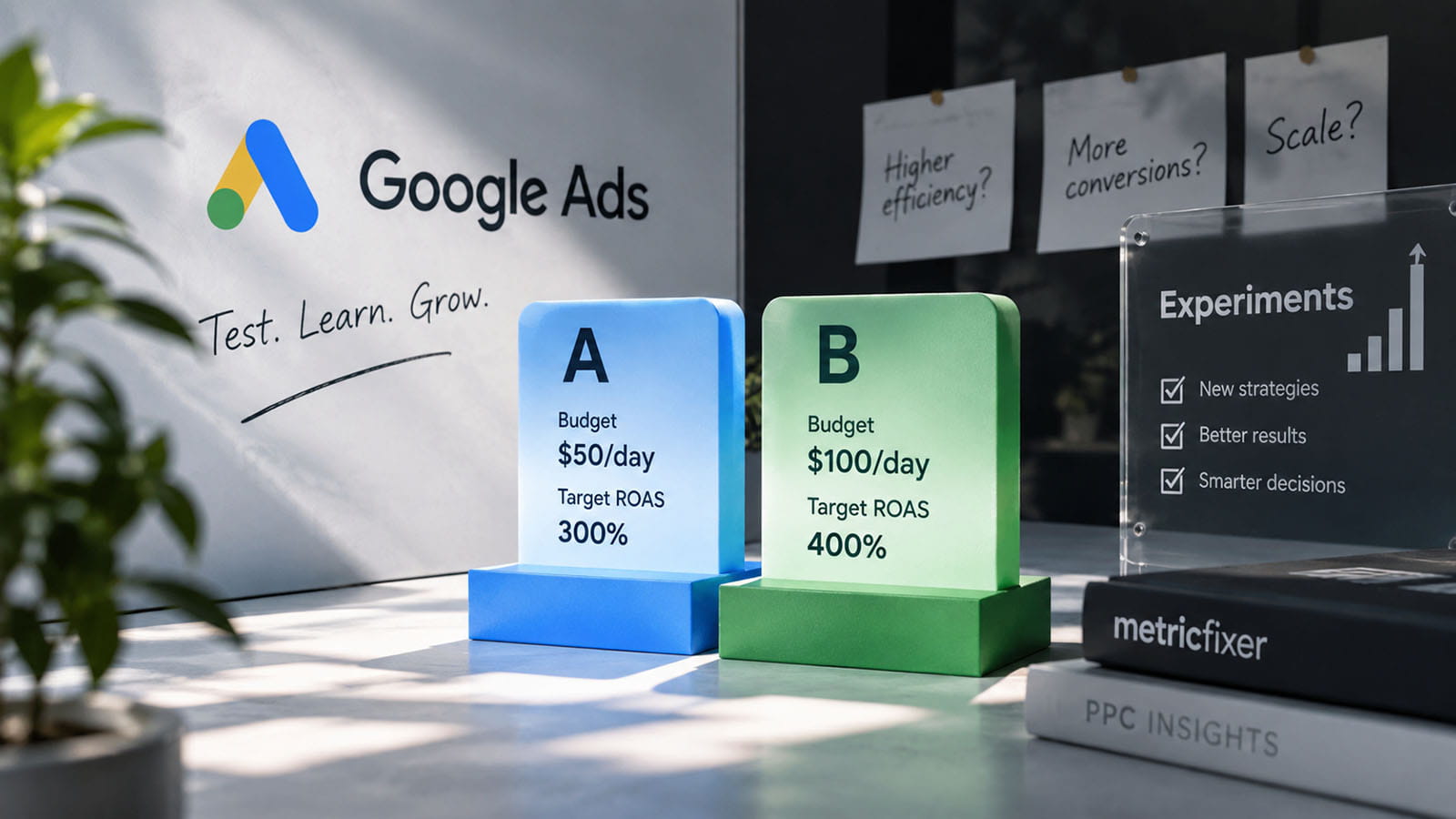
1. A/B testing different budgets and ROI targets across multiple Search campaigns
Google says it is rolling out a new experiment type in September 2026 that lets advertisers test different budgets and ROI targets across multiple Search campaigns in one A/B test. The announcement specifically frames the feature as a way to measure what happens when campaigns are scaled up. Google uses the broader term ROI targets in the launch announcement rather than publishing a complete list of supported bidding strategies, so account-specific Target ROAS/CPA availability should be treated as rollout-dependent until the Help documentation is more explicit.
This is a useful extension because budget decisions rarely happen in isolation. A performance team may have five non-brand Search campaigns pursuing the same commercial objective. The real decision is not necessarily whether Campaign A should receive another $100 per day. It may be whether the entire acquisition portfolio can absorb 25% more spend if the efficiency target is loosened slightly.
Until now, teams often approximated that question with one of three imperfect approaches: change live budgets and compare the next period with the previous one; run separate campaign-level experiments and try to combine the results afterwards; or use a forecast and assume the realized outcome will follow the model. A multi-campaign A/B design can be closer to the business decision because it tests the scaling policy across a group of campaigns at the same time.
Treat the scaling policy as the experimental variable
Google's general experiment guidance says to test one variable at a time. A budget-and-target experiment appears to challenge that rule because both the spending cap and the ROI constraint may change. The clean way to interpret it is to define the tested variable as a single policy.
| Element | Control | Treatment |
|---|---|---|
| Campaign group | Same eligible Search campaigns | Same eligible Search campaigns |
| Budget policy | Current daily budgets | +25% total available budget |
| Efficiency policy | Current supported ROI/efficiency target | Predefined looser target that the business can still accept; for example, a different Target ROAS or Target CPA where that bidding strategy is supported by the experiment |
| Primary business metric | Incremental conversion value, qualified conversions, gross profit, or another commercial outcome | |
| Guardrails | Spend, CPA/ROAS, conversion volume, lead quality, brand share, and any margin or capacity limits | |
The conclusion from this test would be: “this scaling policy produced X more value at Y incremental cost.” It would not be: “the budget increase caused X and the target adjustment caused Y.” If the business needs to isolate those mechanisms, run separate experiments.
Measure marginal economics, not only average ROAS or CPA
A scaling experiment is valuable precisely because average efficiency can hide what happens to the next dollar of spend. Suppose a control arm spends $40,000 at a 500% ROAS and the treatment spends $50,000 at a 460% ROAS. The treatment's average ROAS is worse, but that does not automatically make scaling unprofitable. The relevant calculation is the extra conversion value generated by the extra $10,000, adjusted for margin, refunds, lead quality, or other downstream economics.
For lead generation, the same principle applies to CPA. A campaign can report a stable platform CPA while the proportion of sales-qualified leads changes. If offline or CRM outcomes matter, feed those outcomes back into Google Ads where practical and keep the conversion definition stable for the full test. The metricfixer guide to Google Ads click identifiers and CRM conversion feedback covers the measurement layer in more detail.
What is still unclear during the September rollout
As of 15 September 2026, Google's public announcement clearly confirms the multi-campaign budget and ROI-target test and says it is rolling out during September. The standard Google Ads Help pages document custom experiments, bidding tests, AI Max experiments, and other experiment types, but the full eligibility and reporting rules for this specific new multi-campaign scaling workflow are not yet documented as comprehensively as the announcement itself.
That means account availability, supported combinations of bid strategies, campaign grouping rules, and some UI details may still vary during rollout. Do not build an operating procedure around a screenshot from another account. Confirm the available controls in the account that will actually run the test.
The timing also matters because Google changed target-based bidding behavior on 17 August 2026 for many budget-limited campaigns. If a campaign still has a stale Target CPA or Target ROAS after that change, fix the business target before using it as the baseline for a scaling experiment. See Google Ads Target-Based Bid Strategy Changes: What Advertisers Should Do Before August 2026 for the separate bidding update.
2. AI Max experiments can keep brand and location guardrails
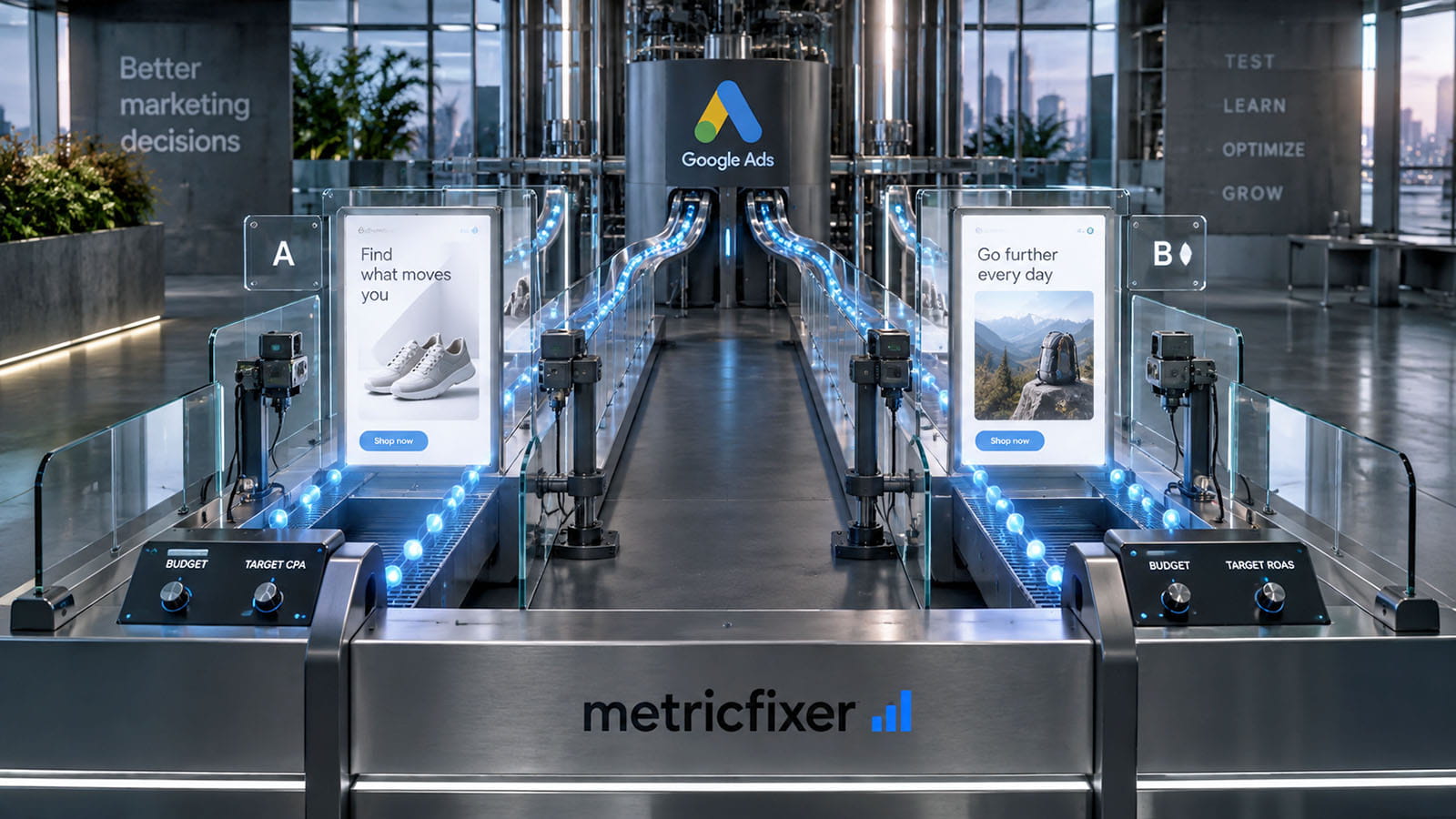
AI Max is not a separate campaign type. It is an optimization layer for Search campaigns that can expand search-term matching and optimize assets. Google now provides a dedicated AI Max experiment that runs inside the existing campaign rather than creating a separate copied campaign.
According to Google's Experiments documentation, the one-click AI Max test splits the current campaign 50/50. Google's AI Max experiment guide says this single-campaign approach can reduce setup and synchronization errors and shorten ramp-up because control and treatment remain inside one campaign.
Brand controls can be held constant across the two arms
This is more important than it sounds. If the treatment arm receives more brand traffic than the control, an apparent improvement can reflect traffic mix rather than better matching or creative optimization. The current AI Max experiment flow lets advertisers configure brand inclusions and exclusions. When brand settings are added during experiment setup, Google says they apply to both the control and treatment arms for the duration of the experiment.
That makes the comparison cleaner: AI Max changes, while the major brand rule remains the same. If the experiment ends without being applied, Google documents how the campaign returns to its pre-experiment brand-control state.
Location controls are useful, but verify the exact experiment behavior
Google's August announcement also says AI Max experiments can now run with specific location controls enabled. Separately, Google's AI Max documentation describes locations of interest as an ad-group-level control for reaching users based on geographic intent, including keywordless matches.
At the time of this review, the AI Max experiment Help page documents brand controls in more detail than the experiment-specific handling of every location control. Treat the announcement as confirmation of the capability, but verify the exact setting inheritance and reporting in your account before launch. For local or regulated campaigns, compare both campaign-level geographic targeting and AI Max's ad-group-level location-of-interest settings; they are not the same control.
Do not judge AI Max only by CPA or ROAS
AI Max changes the queries, assets, and potentially landing pages that participate in Search delivery. A credible experiment therefore needs both an outcome metric and a quality audit.
| Area | What to compare | Why it matters |
|---|---|---|
| Primary outcome | Conversions, conversion value, qualified leads, profit-adjusted ROAS, or the predeclared KPI | Determines whether the treatment created business value. |
| Search terms | Incremental queries, query themes, brand/non-brand mix, irrelevant query rate | AI Max is partly a matching expansion. The source of extra volume matters. |
| Landing pages | URLs selected by AI Max, conversion rate, content quality, compliance | Final URL expansion can change the post-click experience. |
| Creative | Generated or customized assets, message consistency, policy-sensitive language | A conversion gain is not useful if the creative creates brand or compliance risk. |
| Geography | Targeted and matched locations, locations of interest, local conversion quality | A geographic shift can make top-line performance look better or worse for reasons unrelated to the intended test. |
| Downstream quality | Revenue, margin, qualified-lead rate, cancellation/refund rate | Automation can find additional conversions that are not equally valuable to the business. |
Google also warns that AI Max is not effective when a campaign is limited by budget. If the campaign cannot afford additional eligible traffic, an AI Max experiment may answer the wrong question: it may show how the system reallocates a fixed constraint rather than whether the additional reach is valuable.
Current setup limitations matter
The dedicated AI Max experiment flow currently excludes several configurations. Google's Help page lists Search campaigns using the Display Network, Portfolio Bidding Strategies, Shared Budgets, Bidding exploration, an existing active experiment, or certain pre-existing text-customization settings among the limitations. Legacy campaign features can also block eligibility.
If the campaign is not eligible, a custom experiment may still be appropriate in some cases, but it creates separate control and treatment campaigns and therefore has a different learning and synchronization profile. Do not switch test methods only to “make the feature work” without documenting that methodological change.
3. Performance Planner suggestions can now be applied directly to campaigns
Performance Planner already modeled how changes in spend, bids, and targets could affect campaign performance. The new implementation step removes much of the manual transfer from plan to campaign. Google's current Performance Planner documentation now includes an Apply suggested changes action that lets advertisers review the proposed changes, deselect individual campaigns, and update live campaigns. Google says the action can then be monitored and undone through Bulk actions.
The planning model is refreshed daily and uses recent auction simulations, including roughly the previous 7–10 days plus seasonality and other factors. This makes it useful for scenario planning, but also explains why it should not be treated as experimental proof.
Recommended workflow: verify conversion tracking and business targets → use Performance Planner to explore budget and target scenarios → convert the chosen scenario into a predeclared hypothesis → use a Google Ads experiment when causal evidence is needed → run through learning and conversion delay → evaluate the primary KPI and guardrails → apply the tested change only after the result is decision-useful.
A forecast is not an experiment
Performance Planner estimates what may happen under different settings using Google's model of recent auctions. An A/B experiment observes two conditions during the same time period. Those are different forms of evidence.
| Method | Question | Counterfactual | Typical use |
|---|---|---|---|
| Performance Planner | What does Google's current model forecast if settings change? | Modeled | Budget planning, scenario exploration, allocation. |
| Google Ads A/B experiment | Did treatment outperform control under concurrent auction conditions? | Experimental control arm | Bidding, AI Max, match type, landing page, creative, or campaign-setting changes. |
| Geo or holdout incrementality experiment | What business outcome would not have happened without the media or extra spend? | Suppressed or differently treated population/region | Channel incrementality, diminishing returns, media-mix decisions. |
Direct application from Performance Planner is reasonable when the team is making a low-risk operational adjustment and does not need a causal estimate. It is less suitable when the change is large, high-stakes inside the organization, difficult to reverse operationally, or expected to become a benchmark for future budget allocation. In those cases, use the forecast to choose the test—not to replace it.
There is another practical constraint: Google lists campaigns that are already part of an experiment as ineligible for Performance Planner. Build the plan before the experiment starts, export or document the baseline assumptions, and then keep the test stable.
How to design a Google Ads experiment that can answer a business question
The interface can generate an experiment in minutes. Getting a result worth acting on takes longer. Google's own experiment guidance consistently emphasizes a clear hypothesis, a stable comparison, enough volume, and sufficient duration.
1. Write the hypothesis before changing the campaign
A useful hypothesis contains the change, the expected mechanism, the primary outcome, and the business boundary. “AI Max will improve performance” is too vague. A stronger version is: “Enabling AI Max while holding brand exclusions and location rules constant will increase qualified conversion value by at least 10% without reducing profit-adjusted ROAS below 350%.”
Predefining the decision rule reduces the temptation to search dozens of metrics after the test and declare whichever one improved to be the winner.
2. Pick one primary KPI and a small set of guardrails
Google lets experiment reports emphasize selected success metrics. Use the metric that corresponds to the business question. For a Target ROAS test, conversion value and ROAS are usually more relevant than CTR. For lead generation, a platform conversion may be insufficient if sales quality varies materially.
Guardrails should catch expensive side effects. Common examples are total spend, qualified-lead rate, margin, branded-query share, impression share on strategically protected terms, refund rate, and geographic mix. Guardrails are not extra opportunities to find a winner; they are conditions that can make an otherwise positive test unacceptable.
3. Freeze the measurement model
Do not change primary conversion actions, attribution inputs, CRM qualification rules, value rules, or tag implementation halfway through a bidding experiment. Google's value-based bidding guidance specifically warns that comparing different conversion actions between arms does not create a meaningful bidding test because Smart Bidding trains on the conversions available to it.
If measurement is broken, fix measurement first. A cleaner experiment on bad data simply produces a cleaner estimate of the wrong outcome.
4. Choose campaigns with enough volume
Low-volume tests are not automatically invalid, but they need more time and may never produce a useful interval around the effect. Google's Smart Bidding test guidance suggests aiming for campaigns and experiment splits that would provide at least 30 conversions in the previous 30 days. Google's newer Campaign Guidance also exposes Experiment Power for supported Search and Performance Max experiment types and recommends improving power through higher-volume campaigns, longer duration, or a more balanced split.
Use those signals as planning inputs, not universal thresholds. A test with 29 conversions does not become scientifically worthless, and a test with 31 does not become automatically reliable. The question is whether the available data can distinguish an effect large enough to matter to the business.
5. Prefer a balanced split unless there is a strong reason not to
For custom Search experiments, Google recommends a 50/50 traffic and budget split because it generally provides the strongest comparison for a fixed amount of traffic. The setup also offers cookie-based and search-based splitting.
- Cookie-based split: the same user remains in the same arm. This is usually preferable when repeated exposure, landing-page experience, or creative consistency matters.
- Search-based split: each search can be randomized independently, so the same user may see both versions. Google notes that this can reach statistical significance faster, but it is less suitable when cross-exposure can affect behavior.
A 50/50 eligibility split does not guarantee equal spend, impressions, or conversions. Auctions, Ad Rank, bid strategy behavior, and budget constraints can make the arms spend differently. Investigate material imbalance, but do not “correct” ordinary auction variation by repeatedly editing the test.
6. Do not run a seven-day Smart Bidding test and call it conclusive
Short tests are one of the most common ways to manufacture certainty from noise. Google's general experiment documentation recommends allowing roughly 4–6 weeks when results are not yet clear. Its more conservative Smart Bidding guidance gives an explicit timeline: allow about two weeks or three conversion cycles for ramp-up, whichever is longer, exclude that period from evaluation, then run the experiment uninterrupted for at least another 30 days.
The correct duration depends on conversion volume and conversion lag. A high-volume ecommerce campaign with same-day purchases can stabilize faster than a B2B campaign where qualified opportunities appear weeks after the click. If the organization cannot wait long enough to observe the KPI it claims to optimize, choose an earlier validated proxy or accept that the test cannot answer the downstream question.
7. Account for conversion delay before reading the result
Google Ads reports many conversion metrics against the ad interaction date. Recent days can therefore look artificially inefficient because some conversions have not arrived yet. Google's bidding-test guidance recommends excluding recent days where less than 90% of conversions are expected to have been reported.
This is especially important in a budget-scaling test. The treatment arm may spend more immediately while the extra conversions arrive later. Reading the result too early can systematically punish the arm that was designed to generate more future volume.
8. Avoid reactive changes during the experiment
Do not add a new landing page, replace half the ads, change conversion goals, restructure ad groups, and update geo targeting because one arm had a bad Tuesday. Google's experiment guidance warns that changes to base or treatment campaigns can make results harder to interpret. Experiment sync can keep some changes aligned, but it does not turn a moving target into a clean test.
If a change is necessary for safety, compliance, a broken URL, or a material business error, make it and document it. Then decide whether the experiment can still answer the original hypothesis or needs to be restarted.
9. Separate statistical significance from business significance
Google Ads reports confidence intervals and indicates when a difference is statistically significant. This helps distinguish an observed effect from ordinary variation, but it does not decide whether the effect is valuable.
A statistically clear 1% improvement may be operationally irrelevant for a small account. A noisy 12% improvement may be commercially important but still too uncertain to roll out. Read the interval, not just the label, and compare the plausible range of outcomes with the cost and reversibility of the decision.
When a Google Ads experiment is a bad idea or answers the wrong question
Experiments are not automatically better than judgment. They are useful when the test has enough exposure, the treatment can be isolated, and the answer will change a decision. In several common situations, delaying the experiment or using a different method is more rational.
| Situation | Why the result is weak | Better approach |
|---|---|---|
| A one-week bidding or budget test | Learning, weekday mix, conversion lag, and random auction variation can dominate the result. | Plan for multiple conversion cycles and enough post-ramp-up observation time. |
| Testing during a short promotion or major seasonal event without a matching design | The campaign is learning while demand, pricing, stock, and competition are changing unusually fast. | Use a test designed for the event or wait for a more stable window; document seasonality explicitly. |
| Changing bidding, creative, landing pages, conversion goals, and targeting together | The bundle may produce a result, but it does not identify the mechanism. | Test one causal idea at a time, or deliberately define the whole bundle as one operating policy. |
| Low-volume campaign with a tiny treatment split | The test has little power and may remain inconclusive regardless of interface labels. | Use a larger campaign, a 50/50 split, longer duration, or aggregate compatible campaigns where the experiment type supports it. |
| Broken or changing conversion tracking | Smart Bidding and experiment reporting are optimizing against a moving measurement target. | Repair measurement, validate conversion quality, then establish a stable baseline. |
| AI Max test on a severely budget-limited campaign | The treatment may not have room to exploit additional matching opportunities. | Resolve the budget question first or design a scaling experiment that explicitly includes budget. |
| Using campaign A/B testing to prove whether Google Ads as a channel is incremental | Both arms are still exposed to Google Ads, so the test compares configurations rather than advertising versus no advertising. | Use geo holdouts, suppression, Conversion Lift where eligible, or an independent incrementality platform. |
| Applying a Performance Planner suggestion and calling the before/after difference a test | There is no concurrent control, and market conditions may have changed. | Treat the change as implementation monitoring, or create a proper experiment first. |
Third-party tools: useful when the experiment problem is larger than Google Ads
Google Ads should usually remain the source of truth for its native traffic split, auction delivery, and experiment state. Third-party platforms become useful when teams need cross-account management, specialized creative testing, website experimentation, or channel-level incrementality.
| Tool | Useful for | What it does not replace |
|---|---|---|
| Optmyzr Campaign Experiments | Monitoring Google Ads experiments across multiple accounts, comparing performance, reviewing statistical confidence, and taking actions such as applying or ending an experiment. | The underlying Google Ads traffic split and campaign experiment mechanics. It is primarily an experiment-management and analysis layer. |
| Adalysis | Automated ad testing within individual ad groups and multi-ad-group creative comparisons. | Budget, Smart Bidding, AI Max, or channel-incrementality experiments. |
| VWO and Optimizely | Landing-page and on-site experience tests after the ad click, with visitor-level traffic allocation and website conversion metrics. | Google auction experiments. If Google Ads and the website both randomize users independently, design the interaction carefully so one experiment does not contaminate the other. |
| Haus and Measured | Geo-based and holdout incrementality studies, including questions about channel effectiveness, spend scaling, and diminishing returns across publishers. | Granular keyword, asset, and Search-campaign diagnostics inside Google Ads. |
These are examples, not a ranking. Tool choice should follow the causal question. An agency trying to manage 40 concurrent Google Ads experiments has a different problem from a retailer asking whether another $500,000 of Search spend creates incremental revenue beyond what attribution already credits to Search.
Google itself also documents geo experiment designs such as holdback, go-dark, and heavy-up studies. Those methods are useful when the business question is incrementality rather than configuration performance.
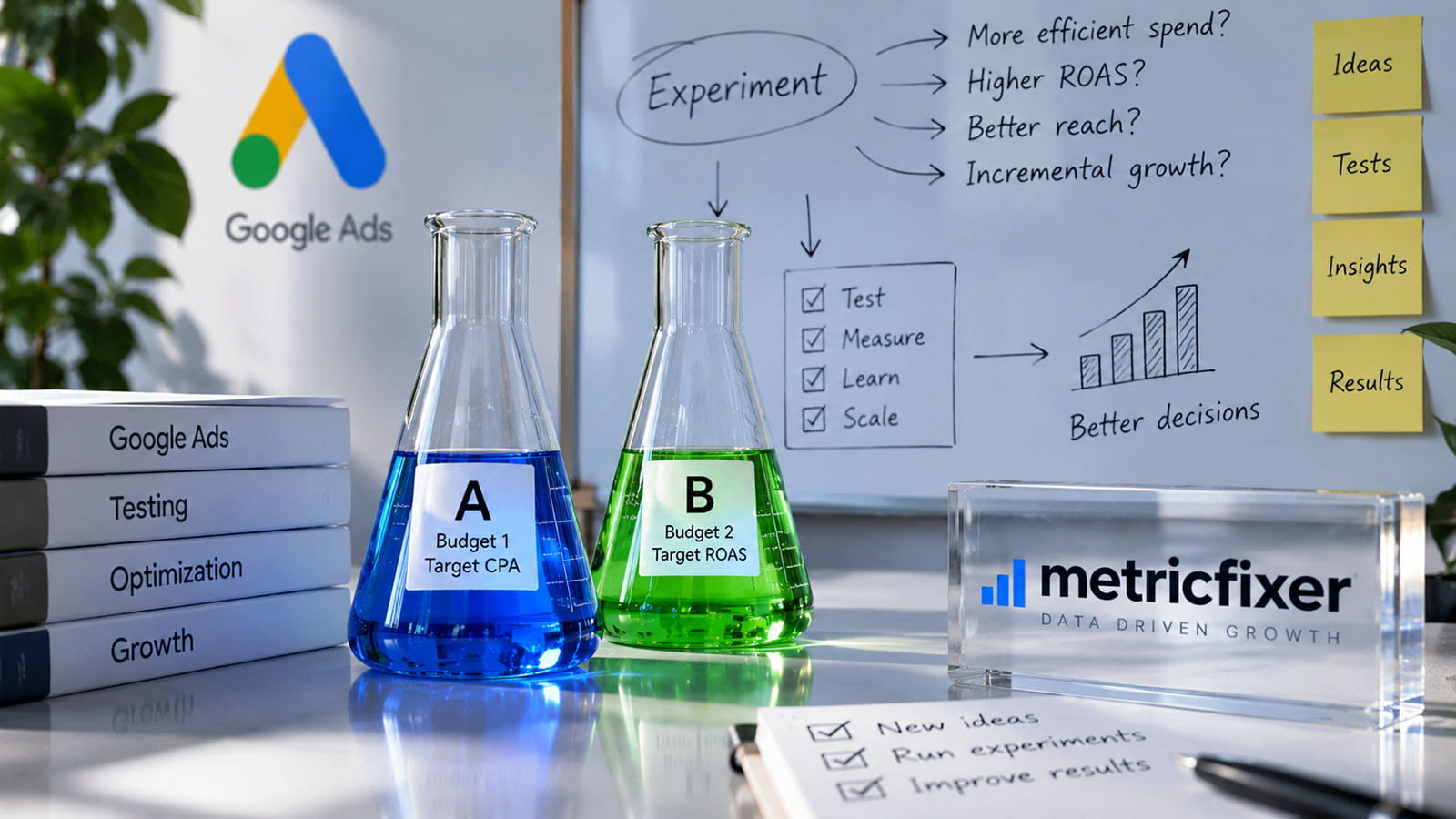
Which testing method should you use?
| Business question | Recommended starting method |
|---|---|
| Does AI Max improve this existing Search campaign while brand controls stay fixed? | AI Max one-click experiment. |
| Can we scale several Search campaigns by increasing budget and changing Target ROAS/CPA? | New multi-campaign budget and ROI-target A/B test where available. |
| How might next month's budget allocation perform? | Performance Planner forecast. |
| Should we apply a high-impact Planner recommendation? | Use the forecast to define the hypothesis, then run an experiment if causal evidence is needed. |
| Which responsive-search-ad message works better? | Google ad variations, or a specialized creative-testing layer such as Adalysis or Optmyzr. |
| Which landing page converts better after the same ad click? | Website A/B testing through VWO, Optimizely, or a comparable experimentation platform; keep campaign conditions stable. |
| Did Google Ads generate sales that would not otherwise have happened? | Geo/holdout incrementality test, Conversion Lift where available, or a specialist incrementality platform. |
| Did a copied campaign recover because duplication itself helped? | Controlled campaign experiment where feasible rather than an uncontrolled before/after duplicate. See the metricfixer review of Google Ads campaign duplication as a recovery experiment. |
Pre-launch checklist
- Write the hypothesis: state the exact policy or feature being tested and why it should change the business outcome.
- Choose the primary KPI before launch: use conversions, value, qualified outcomes, profit, or another metric tied to the decision.
- Define guardrails: spend, CPA/ROAS, lead quality, brand traffic, geography, margin, inventory, or capacity limits.
- Verify tracking: primary conversion actions, values, offline imports, consent, landing pages, and CRM definitions must be stable.
- Choose enough volume: prefer campaigns with meaningful recent conversions and use Google's Experiment Power or other power planning where available.
- Use a balanced split: 50/50 is the normal starting point unless exposure risk justifies another allocation.
- Select the right split method: use cookie-based allocation when consistent user experience matters; understand the trade-off before using search-based randomization.
- Plan the duration: include learning, multiple conversion cycles, and enough post-ramp-up observation time.
- Freeze unrelated changes: do not redesign the campaign while trying to attribute the result to one hypothesis.
- Document exceptions: policy fixes, broken URLs, stock changes, outages, and major pricing events can invalidate or qualify the result.
- Read the interval, not only the winner label: statistical significance and commercial significance are different.
- Keep an experiment log: record dates, settings, targets, primary metrics, guardrails, incidents, result, and the final decision.
The bottom line
Google Ads is making it easier to move from a plan to a test and from a test to implementation. The new multi-campaign Search experiment is the most interesting change for budget scaling because it brings a portfolio-level business decision closer to a concurrent A/B design. AI Max experiments are becoming more credible for advertisers that cannot abandon brand and geographic controls just to test automation. Performance Planner's one-click implementation removes busywork, but it also makes it easier to confuse a forecast with evidence.
The practical rule is simple: use the newest interface features to reduce setup friction, not analytical discipline. A short, low-volume experiment on unstable conversion data is still a weak test. A one-click Planner change is still a forecast-driven intervention. And an in-platform A/B test still does not prove that the channel itself is incremental. Choose the method that matches the decision, give it enough time and data, and preserve a clean control wherever the business needs causal evidence.
Methodology and sources
This article was reviewed on 15 September 2026. Feature behavior and rollout status were checked primarily against current Google Ads Help documentation and Google's Ads & Commerce product announcement from 20 August 2026. Google documentation was prioritized for experiment setup, AI Max behavior, Performance Planner, traffic splitting, Smart Bidding test duration, confidence reporting, and geo experimentation.
The multi-campaign budget and ROI-target A/B test is described by Google as rolling out in September 2026. At the review date, Google's announcement is more explicit about the feature than the public Help documentation is about all of its eligibility and UI details. The article therefore treats account-specific availability and undocumented setup details as rollout-dependent rather than assuming universal access. Google has also announced that AI Max experiments support brand and location controls; the current Help page documents brand-control behavior in the experiment flow more specifically than it documents every location-control interaction.
Third-party services are included only to describe relevant experimentation use cases. Vendor documentation was used for feature descriptions; no independent benchmark of Optmyzr, Adalysis, VWO, Optimizely, Haus, or Measured was performed. No live Google Ads account was modified and no production experiment was run for this publication.
- Google Ads & Commerce: Make AI Max work for your business with new testing and planning tools
- Google Ads Help: About AI Max experiments
- Google Ads Help: How AI Max for Search campaigns works
- Google Ads Help: About Performance Planner
- Google Ads Help: Test with confidence with the Experiments page
- Google Ads Help: Set up a custom experiment
- Google Ads Help: Test your bid strategy
- Google Ads Help: Monitor your experiments
- Google Ads Help: Build better experiments with Campaign Guidance
- Google Ads Help: Apply or dismiss recommendations
- Google Ads Help: Implement campaigns for geo experiments
- Optmyzr Help: Campaign Experiments
- Adalysis Help: Ad testing overview
- VWO Help: Create an A/B test
- Optimizely Support: Landing page experiment walkthrough
- Haus: Incrementality Experiments
- Measured: Incrementality Testing
This article is for advertising, analytics, and experimentation guidance and does not guarantee campaign performance. Google Ads features, eligibility rules, interfaces, forecasts, and rollout timing can change and may differ by account. Third-party tools are mentioned as examples of different testing approaches; metricfixer is not affiliated with Google or the other vendors listed and does not endorse a product merely by including it. Validate conversion tracking, commercial assumptions, privacy requirements, and account-specific settings before applying material bidding, budget, targeting, or automation changes to live campaigns.