
Published Sep 5, 2026
Google Ads Campaign Degradation: When Duplicating a Campaign Can Help
A Google Ads campaign can lose traffic and stop spending after months of meeting its targets. We examine Google's explanations, advertiser reports, and how to decide whether to repair the original or test a duplicate.
Category: Online advertising · By metricfixer Expert Team
A Google Ads campaign can meet its targets for months, then lose traffic, leave its budget unspent, and become less efficient at the same time. Advertisers sometimes recover performance by launching a copy. Is this evidence that campaigns wear out, a genuine Smart Bidding reset, or a recovery that would have happened anyway? The answer matters before you replace a campaign that once worked.
Practical takeaway: duplication is a reasonable recovery experiment for a persistently underperforming campaign after measurement, targeting, and commercial causes have been investigated. It is not scheduled maintenance, a substitute for repairing conversion data, or a guaranteed way to restore the original CPA or ROAS. Judge the result by useful conversions and business value, not by whether the copy starts spending.
Executive summary
There is a real distinction between the observed problem and the explanation attached to it. Advertisers report campaigns that become difficult to revive, and some report successful duplication. That deserves investigation. It does not establish that Google gives campaigns an expiry date or systematically rewards new campaign IDs.
Google's copy-and-paste documentation explicitly says that historical performance and bid strategy learning do not transfer to a copy. However, its explanation of bidding algorithms describes learning beyond an individual strategy. A new campaign is therefore a new campaign-level starting point, not an account-wide memory wipe.
The most useful working explanation is a combination of changing auction economics, changing or damaged conversion signals, restrictive targets, and potentially different learning paths after a restart. The first three have direct support in Google's documentation. The last remains a plausible explanation for some cases, not a publicly verified diagnosis of a Google algorithm defect.
The practical sequence is diagnose, repair, test constraints, and only then consider a controlled restart. When a restart works, keep the business improvement. Do not automatically turn one recovery into a rule to clone every campaign regularly.

What advertisers mean by campaign degradation
Here, degradation means a sustained combination of declining impressions or clicks, spending below the available budget, and worsening cost per acquisition or return on ad spend. It is more specific than a disappointing day, a seasonal slowdown, or reduced volume bought at a deliberately stricter efficiency target.
Target CPA is the desired average cost of a conversion. Target ROAS is the desired conversion value relative to advertising cost; it is not automatically a measure of profit. Google's Target CPA and Target ROAS descriptions make these optimization objectives, not guarantees. The available budget does not oblige a target-based strategy to spend all of it.
Underspending and missing the target are not contradictory. Bids are based on predictions, while reports contain realized results. The system can become more selective, buy fewer opportunities, and still overestimate the conversion rate or value of the traffic it purchases. Recent reporting can also look worse before delayed conversions arrive.
A useful diagnosis separates three questions: Did delivery decline? Did business outcomes decline? Did measurement change? A restart should not be the first response when only the third question has a clear answer.
What a campaign copy resets, and what it does not
Two opposite claims are too simple: that a copy keeps all the old learning, and that it makes Google forget everything about the advertiser.
| Layer | What changes | What not to assume |
|---|---|---|
| Campaign history | The copy is a new campaign; the original's reporting history is not transferred. | The old campaign's historical results have not been erased from the account. |
| Bid strategy learning | Google says campaign copying does not carry over bid strategy learning. | Every model or signal available to Google has been reset. |
| Broader conversion evidence | A new campaign can still benefit from evidence beyond its own new history. | Creating new conversion actions is necessary or desirable. |
| Business and measurement | Nothing inherently improves the offer, website, stock, tracking, or lead quality. | A new ID repairs the environment in which the old campaign failed. |
| Shared bidding arrangements | The effect depends on whether the campaign uses an existing shared strategy or a separate one. | A new campaign attached to the same portfolio constitutes an isolated new bidder. |
The first two rows follow Google's copying guidance. For the third, Google says conversion data from previous campaigns can accelerate initial learning. For the last, portfolio strategies optimize across multiple campaigns. Record the strategy relationship when testing; a campaign-level change and a strategy-level change are different interventions. Portfolio strategies are not available for Performance Max.
In its learning documentation, Google describes adaptive historical weighting: recent evidence can matter more, with adjustments for conversion delay. That is not a universal rule that everything older than 30 days becomes irrelevant. Nor does leaving the visible Learning status mean learning has stopped.
The important distinction: restarting may change how a campaign develops from its new starting point, but it does not isolate it from the advertiser's wider data, the same customers, or the same auction conditions.
What community cases actually show
The reports below are first-hand descriptions in public PPC discussions, not independently audited experiments. They are useful because they include successful recoveries, failed attempts, and cases where additional volume was not an improvement.
| Reported case | What the advertiser reported | What the evidence supports |
|---|---|---|
| A Target CPA campaign recovered, then deteriorated again | A UK web agency advertiser described duplicating a stalled campaign. Their posted figures show CPA of about $248 in January 2026, followed by about $206 in March and $205 in April for the copy. By August, the copy's CPA was about $314. | A rebound followed by renewed decline is consistent with the pattern advertisers describe. However, spend and calendar periods differed, targets were not fully documented, and there was no control group. This is not proof of an age-related defect or a lasting cure. |
| Duplication after previously stable lead generation declined | A practitioner said that, on several occasions, copying a previously successful campaign and moving budget to it over several weeks worked after spontaneous recovery did not occur. | This is a direct report of successful duplication, but without a quantified comparison. The discussion concerned Maximize Conversions without a target, so it is supporting evidence for the broader restart practice, not a controlled tCPA or tROAS result. |
| Reported Google representative advice and a repaired launch | An advertiser attributed a restart-after-14-days recommendation to a senior Google representative. They also described a campaign that began converting after rebuilding, following an initially broken tracking setup and an unsuccessful waiting period after repair. | The thread supports that such advice is reported in practice. It does not establish an official 14-day policy. A repaired launch followed by rebuilding is also not the same test as copying a mature campaign without other changes. |
| Established Target CPA campaigns did not recover after relaunch | An advertiser managing an account spending more than $1 million annually described falling impressions and conversions, rising CPCs, and declining spend. Relaunches, bidding changes, and data exclusions reportedly did not solve it. | Restarting is not reliably effective even with substantial historical conversion volume. The wider account decline also leaves explanations beyond an individual campaign open. |
| More leads, worse customers | A tCPA advertiser said a duplicate containing selected top-performing keywords doubled lead volume when run alongside the original, but lead quality deteriorated enough that the new campaign was stopped. | Restored volume is not restored performance. This was also a changed keyword selection with overlapping delivery, not an identical-copy experiment. |
A separate Performance Max discussion after conversion-tracking problems is equally instructive. The advertiser described persistent poor results and other campaigns recovering, but was asking whether to duplicate. The thread did not provide a completed restart outcome. A proposed remedy should not be counted as a successful case.
The evidence supports testing, not a success-rate claim. These accounts make it unreasonable to dismiss every recovery as imaginary. They do not tell us how often an unchanged copy beats a repaired original, how long the advantage lasts, or which hidden mechanism caused it.
Why performance can decline, and why a copy might appear to fix it
1. The old target no longer fits the available traffic
This is the first explanation to test because it does not require a malfunction. Competition, conversion rate, product demand, and order value can change while the number in the campaign's target field stays the same. Google identifies bidding targets and external market conditions among the causes of Search performance fluctuations.
For a simplified illustration, $3 clicks with a 5% conversion rate produce a $60 CPA. At the same click price and a 3% conversion rate, CPA becomes $100. A $60 target has not become wrong because the campaign is old; it has become harder to achieve because the economics changed. This arithmetic is an illustration, not Google's bidding formula.
A copy may temporarily find a better mix of opportunities. It cannot make the underlying economics irrelevant. If those economics remain unfavorable, the copy can eventually slow down too.
2. The bidder is reacting to damaged or changed conversion signals
A removed tag, delayed offline imports, duplicated purchases, or incorrect values can make a previously sound campaign optimize on misleading evidence. Google's data-exclusion guidance explicitly recognizes that conversion-data problems can affect Smart Bidding.
Another possibility is not missing data but the wrong objective: more form submissions that rarely become customers, or revenue values that no longer reflect the products being sold. Relaunching into the same faulty feedback system does not fix that objective.
Our interpretation is that some apparent restart successes may really be repair plus restart. The distinction matters operationally: repair the inputs first, and record the repair separately so the new campaign does not receive all the credit.
3. A low-volume feedback loop may slow recovery
A plausible working model is: weaker observed performance leads to more cautious bidding under a restrictive target; reduced delivery produces fewer new conversions; the campaign then has less fresh evidence of improvement. A new campaign might develop a different early traffic mix and escape that particular pattern.
This is a hypothesis, not a disclosed Google failure mode. Google's systems also use broader evidence and account for delayed conversions, so the simple story that fewer clicks mean the algorithm learns nothing is incorrect. We cannot establish from public reports whether a particular recovery came from a different learning path, an undisclosed serving issue, or ordinary changes in auctions.
The hypothesis is most worth investigating when one campaign remains unusually weak while comparable activity, measurement, and business demand look healthy. It is much less convincing when the entire business has lost demand or the tracking failure is still present.
4. The copy is not actually buying the same business
Identical-looking settings do not prove identical delivered traffic. A recovery may be concentrated in brand searches, returning customers, a different product group, or lower-quality leads. Likewise, a manual rebuild may silently change conversion goals, exclusions, locations, assets, or product selection.
Use this as a testable alternative explanation: compare like-for-like segments before celebrating. A new campaign that acquires conversions previously credited to another campaign has not necessarily created additional customers.
5. The restart happens near the bottom of a fluctuation
Teams usually restart after an unusually bad stretch, not at a randomly selected time. Some campaigns would improve afterwards without intervention. A promotion, payday, seasonal recovery, or competitor withdrawal can also coincide with the new launch.
This is why a before-and-after chart is useful operational evidence but weak causal evidence. Comparing a copy's best week with the original's worst week exaggerates the case for restarting. Repeating the result across carefully recorded tests is much more persuasive.
A recent change worth checking: Google's August 17, 2026 bidding update
Google's target-based bidding update is particularly relevant to campaigns that previously performed better than their targets. Google says that, from August 17, 2026, affected budget-limited campaigns optimize more consistently toward their specified targets, including after budget adjustments. It also warns of traffic distribution changes in multichannel campaigns such as Performance Max and Demand Gen.
A campaign set to a $100 tCPA but historically achieving $70 may therefore move closer to the entered target. That is different from missing a $70 target. Review the actual business limit rather than assuming the old overperformance was promised indefinitely.
This update is a documented reason to investigate a recent change, not an explanation for every historical degradation case. It specifically concerns the affected target-based, budget-limited behavior. Do not use it as a blanket explanation for an already underspending campaign, and do not assume duplication bypasses the update.
The diagnostic checklist before duplication
Start with a dated incident record. Export the stable period, the decline, and Change history. Compare matched weekdays and allow the conversion lag to mature. Separate campaign settings from website releases, CRM changes, consent changes, and commercial events.
| Check | What to inspect | What it changes about the decision |
|---|---|---|
| Measurement and business truth | Completed orders or accepted leads versus recorded conversions; duplicate events; values and currency; offline-import delays; the actual conversion goals used for bidding. | A measurement fault needs repair. A new campaign would otherwise receive the same misleading inputs. |
| Timing and targets | Mature CPA/ROAS versus the average target over that period; target changes; the normal delay from interaction to a reported conversion. | Recent incomplete data or comparison with today's target can create a false diagnosis. |
| Eligibility and delivery | Ad and product approval, billing, verification, campaign dates, schedules, location restrictions, exclusions, and destination availability. | Resolve a concrete serving restriction instead of attempting to work around it with a copy. |
| Auction and traffic mix | Search demand, CPC, search terms, Auction insights, impression-share losses where available, networks, products, brand/non-brand, and new/existing customers. | A decline in market opportunity or a change in traffic composition requires a different response from an unexplained local collapse. |
| The customer journey | Landing-page changes, mobile forms, checkout, payment failures, price, shipping, inventory, response times, and sales qualification. | A working ad cannot compensate for an offer or purchase path that became less competitive. |
| Shared controls | Portfolio strategy membership where supported, shared budgets, bid limits, ad-group targets, automated rules, scripts, and automatically applied changes. | The constraint may sit outside the campaign settings being copied. |
Google's low-traffic troubleshooting guidance provides a useful starting point for delivery checks. Its average target CPA explanation also matters: compare achieved CPA with the traffic-weighted target the strategy actually optimized toward, not simply the target visible today.
For measurement failures after frontend releases, see metricfixer's guide to reliable GTM tracking for nested and dynamic elements. A click on a submit button is not proof of a successfully submitted lead. For customer-journey diagnosis, keep the counting rules consistent when building GA4 funnels across users, sessions, and events.

What to try on the original campaign first
Repair data, and use exclusions only for the right problem
When conversion reporting was genuinely incorrect, consider a properly scoped data exclusion after identifying the affected period. Exclusions apply to the clicks associated with affected conversions, so the window must account for conversion delay. They change what Smart Bidding uses, not the historical conversion reports.
Do not exclude an ordinary bad sales week just to make the model forget disappointing results. Google cautions against frequent or prolonged exclusions, and they do not guarantee immediate stabilization. They are a data-quality tool, not a generic reset button.
Test whether the target is the constraint
Google's target-adjustment guidance gives the direction clearly: a higher tCPA or lower tROAS can permit more spending. Choose the test level from recent mature results, simulations where available, and the business's acceptable economics. There is no universally safe percentage change.
Google also states that changing a target does not reset what Smart Bidding has learned about the account. That makes a target test different from a campaign restart.
Hold other variables steady and assess the result after one or two conversion cycles, rather than judging the next few hours. Large target changes can substantially change spend. If additional conversions remain uneconomic, the conclusion is not to keep relaxing the target until the budget disappears.
Removing a target can be a separate, risk-capped test, but it changes the objective. So does moving to Maximize Clicks: buying more clicks is not evidence that conversion optimization has recovered. Do not combine several bidding changes with duplication and then attribute the outcome solely to the new campaign ID.
Escalate a persistent local anomaly
When the checks leave a genuine mystery, give support specific evidence: campaign and strategy IDs, the onset date, settings before and after, approval status, mature performance, and a comparison with unaffected campaigns. Ask whether a serving or configuration problem has been identified and why a rebuild is recommended.
A representative's suggested workaround can be worth testing without becoming a universal rule. Ask what success should look like, what should remain unchanged, and how to roll back. That is more useful than an unexplained instruction to start again after a fixed number of days.
When a controlled duplicate is reasonable
Consider a restart when the original has a meaningful record of useful results, the decline persists beyond normal reporting delay, and there is no unresolved measurement, eligibility, or commercial problem that already explains it. The case is stronger when the weakness is localized and reasonable changes to the original have failed.
- Measurement is trustworthy: the same confirmed business outcome will be used before and after the restart.
- The target is commercially and operationally credible: it is not merely a historical number the current offer can no longer support.
- The test can produce evidence: the available budget and conversion volume support more than a handful of ambiguous observations.
- The downside is bounded: the team has an agreed spend limit, stop conditions, a comparison plan, and a rollback owner.
Do not clone solely because the campaign is old, has a Learning label, or suffered several weak days. Do not use duplication to bypass policy restrictions. Avoid it when the proposed test budget is so small that neither campaign will generate enough information, or when losing the original's remaining delivery would put the business at unacceptable risk.
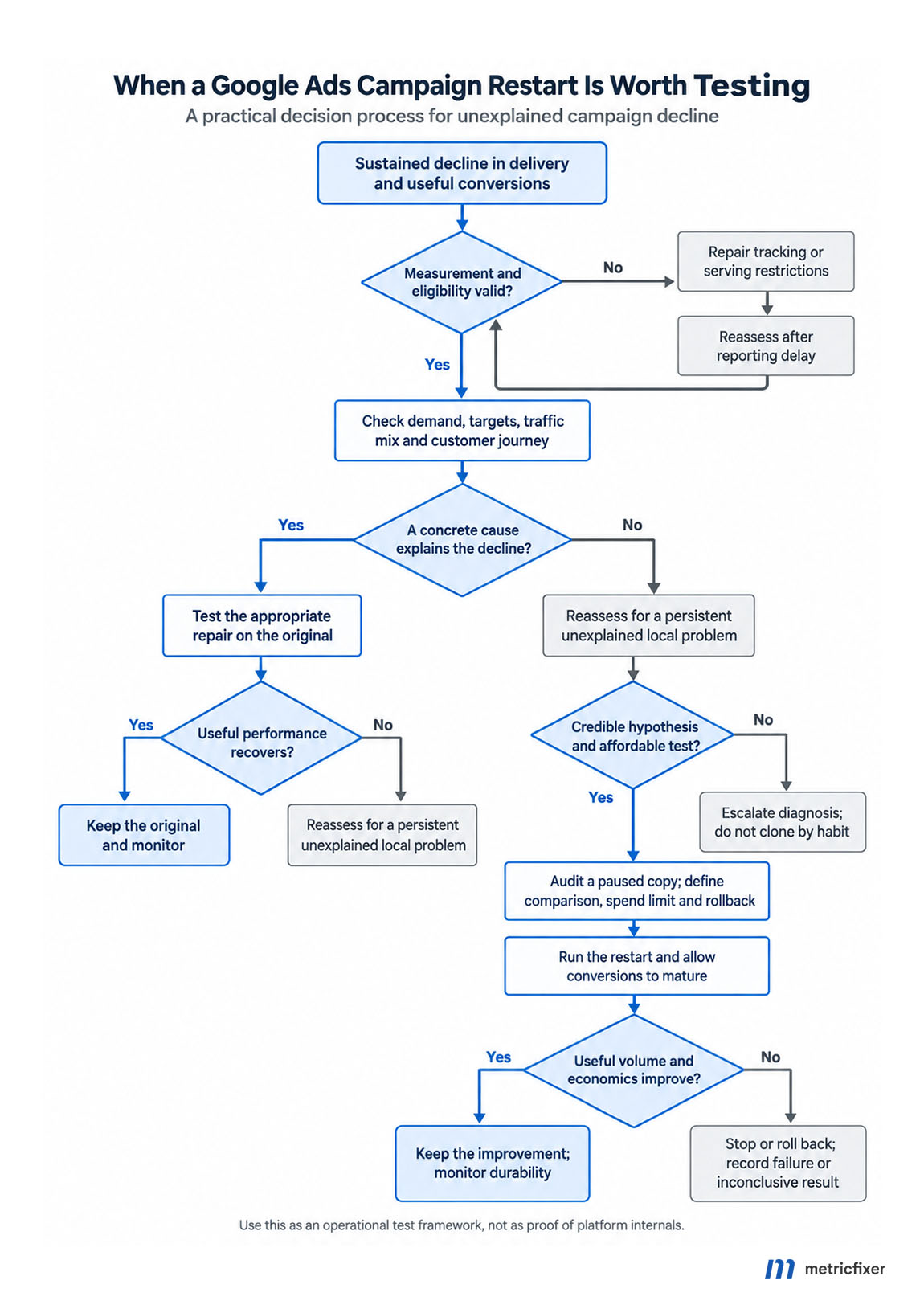
Decision workflow: confirm a sustained decline → validate measurement and eligibility → inspect demand, targets, and traffic mix → test the appropriate repair → if an unexplained local problem remains, run a risk-capped restart → keep it only when mature business results justify the change.
How to run the restart without fooling yourself
1. Write a hypothesis and an economic stopping rule
For example: With the same valid purchase signal, offer, target, and product scope, a new campaign will restore profitable order volume that the original has failed to recover.
Before launch, set the maximum test spend, the acceptable qualified CPA or revenue/profit threshold, the observation window, and the conditions for immediate suspension. Those conditions should include broken tracking, unintended targeting, and unacceptable spend. A safety stop is not a statistical conclusion, but it is still necessary.
Remember that an average daily budget is not a hard daily cap. Under Google's spending-limit rules, most campaigns can spend up to twice their average daily budget on a particular day, subject to the applicable monthly limit. Set budgets with that exposure in mind.
Preserve baseline exports and label all changes. A useful test log records the original ID, copy ID, strategy relationship, launch time, actual spend, mature conversions, and every difference between the two configurations.
2. Choose a comparison that answers the actual question
For supported changes to bidding or settings, Google Ads experiments are preferable to two uncontrolled campaigns. They provide an organized way to compare a treatment with the original. Test one variable at a time.
However, a bid-strategy experiment is not automatically a test of a clean campaign restart. Confirm what the experiment changes and what it shares. Do not assume every campaign type, particularly Performance Max, provides a native identical-copy experiment that isolates campaign history.
A sequential replacement may be the practical option: pause the old campaign when the verified copy is ready to serve, then assess the restart against comparable mature periods. This can inform an operational decision, but seasonality and auction changes remain alternative explanations. Larger advertisers can strengthen the comparison with carefully designed non-overlapping markets or staggered tests; those designs need their own comparability checks.
3. Create the copy paused, and audit it before launch
Use the option to pause new campaigns after pasting. Verify bidding, conversion goals, budgets, locations, schedules, networks, keywords, negatives, assets, landing pages, tracking settings, and any shared relationships. Do not create new conversion actions merely to make the copy look fresh.
Performance Max needs a specific check: Google's copying guidance says listing groups are not copied, and feeds cannot simply be copied and pasted. Verify the Merchant Center/feed connection and rebuild the intended product selection before launch. A different product scope is a different test.
Keep the original paused rather than removed, with its configuration documented. Google's campaign status guidance distinguishes temporary pausing from permanent removal. Retaining a rollback option is valuable even when the old campaign is underperforming.
4. Avoid treating overlapping twins as a clean A/B test
For Search, the warning is not that identical keywords automatically bid against each other and double CPC. Google says eligible keywords targeting the same domain do not compete with one another in the auction; its prioritization rules select which ad group or asset group is used.
The practical problem is interpretation. Two overlapping campaigns can divide or redirect existing opportunities, making one look better while the combined business stays unchanged. Keep the total spend envelope controlled and evaluate the combined result. Do not assume an ordinary parallel launch delivers randomized, comparable traffic.
5. Allow learning and conversion reporting to mature
Set the observation window from conversion frequency and the time required for customers to convert and for those results to reach Google Ads. A lead that takes two weeks to qualify cannot validate a restart after three days.
Google's formal bid-strategy testing guidance recommends a ramp-up of two weeks or three conversion cycles, whichever is longer, followed by at least 30 days of uninterrupted evaluation, excluding recent days with substantial unreported conversions. That is guidance for that testing workflow, not a mandatory waiting period for every recovery attempt.
The general lesson is to distinguish ramp-up, mature evaluation, and financial safety. Keep ramp-up costs in the overall business accounting even when excluding that period from a stabilized-performance comparison. Low-volume campaigns may remain inconclusive; a short run with a few conversions does not resolve the question.
6. Compare business recovery, not a prettier campaign row
Assess useful conversion volume, qualified CPA, conversion value, and, where available, contribution after advertising costs. Check the overall account and the relevant business segment as well as the copy. Separate brand from non-brand, new from existing customers, and material product or geographic shifts.
For lead generation, compare accepted or sales-qualified leads and downstream sales, not only forms. For ecommerce, reconcile real orders, revenue, refunds, and margin consistently. A restart that spends the full budget while missing the business's efficiency limit is not automatically an improvement over an underspending original.
The following example is illustrative, not a measured case study. Assume equal-length, mature periods, an unchanged offer and attribution basis, and a business limit of $300 per qualified lead.
| Metric | Original | Copy A: more activity | Copy B: useful recovery |
|---|---|---|---|
| Advertising spend | $2,000 | $4,000 | $3,000 |
| Form submissions | 20 | 50 | 30 |
| Qualified leads | 8 | 8 | 12 |
| Cost per form | $100 | $80 | $100 |
| Cost per qualified lead | $250 | $500 | $250 |
Copy A looks better in a form-submission report but exceeds the business's qualified-lead limit. Copy B adds qualified volume at the original qualified CPA. Even Copy B still needs a credible comparison before its improvement can be attributed specifically to duplication.

What repeated degradation after a restart tells you
If each copy works briefly and then weakens, do not immediately conclude that regular cloning is the solution. Check whether the same restrictive target, unreliable feedback, narrow pool of profitable demand, or changing customer mix reappears each time.
Maintain a restart register that includes failures and inconclusive attempts, not just memorable wins. Record time to useful recovery, total test cost, qualified volume, and how long the improvement lasted. Otherwise, the organization can build a confident playbook around selected anecdotes.
Bottom line: the reports justify keeping duplication in the recovery toolkit. They do not justify treating it as a cure for campaign age. The best reason to launch a copy is a persistent, investigated problem and a testable hypothesis. The best reason to keep it is sustained improvement in the business outcomes the advertising is supposed to produce.
Methodology and sources
This review was checked on September 5, 2026. It combines Google's documentation on copying campaigns, Smart Bidding learning, target-based strategies, conversion-data exclusions, troubleshooting, portfolio bidding, experiments, and auction prioritization with first-hand reports in public r/PPC discussions. Sources are linked beside the claims and cases they support.
The starting point was the practitioner-reported pattern of established campaigns declining and sometimes recovering after duplication. Public cases were selected for their relevance and for whether they described an actual outcome, an unsuccessful attempt, or only proposed advice. They are a qualitative sample, not a representative survey. Anonymous account data, support conversations, and claimed configuration equivalence could not be independently verified.
No controlled account experiment was conducted for this article, and no restart success rate is claimed. Officially documented behavior is distinguished from advertiser reports and from the explanatory hypotheses developed here. The diagnostic sequence and restart protocol are metricfixer's editorial recommendations, not a Google-endorsed reset procedure. Numerical illustrations are explicitly labeled and are not benchmarks.
This article is for educational and operational information and does not guarantee advertising performance. Campaign changes can increase spend, reduce conversion volume, or disrupt existing results. Evaluate recommendations against your measurement quality, conversion cycle, campaign configuration, and business economics. metricfixer is not affiliated with Google. Google Ads features, documentation, and bidding behavior may change after publication; community reports describe individual experiences, not platform guarantees.