
Published Oct 31, 2026
Cookiebot Price Increase: New USD Rates and What to Check
Cookiebot is raising Premium prices for USD-billed customers. We examine the new rates, a customer notice with a different effective date, existing plan restrictions, and the checks to make before renewing or switching consent platforms.
Category: Consent Management · By metricfixer AI Studio
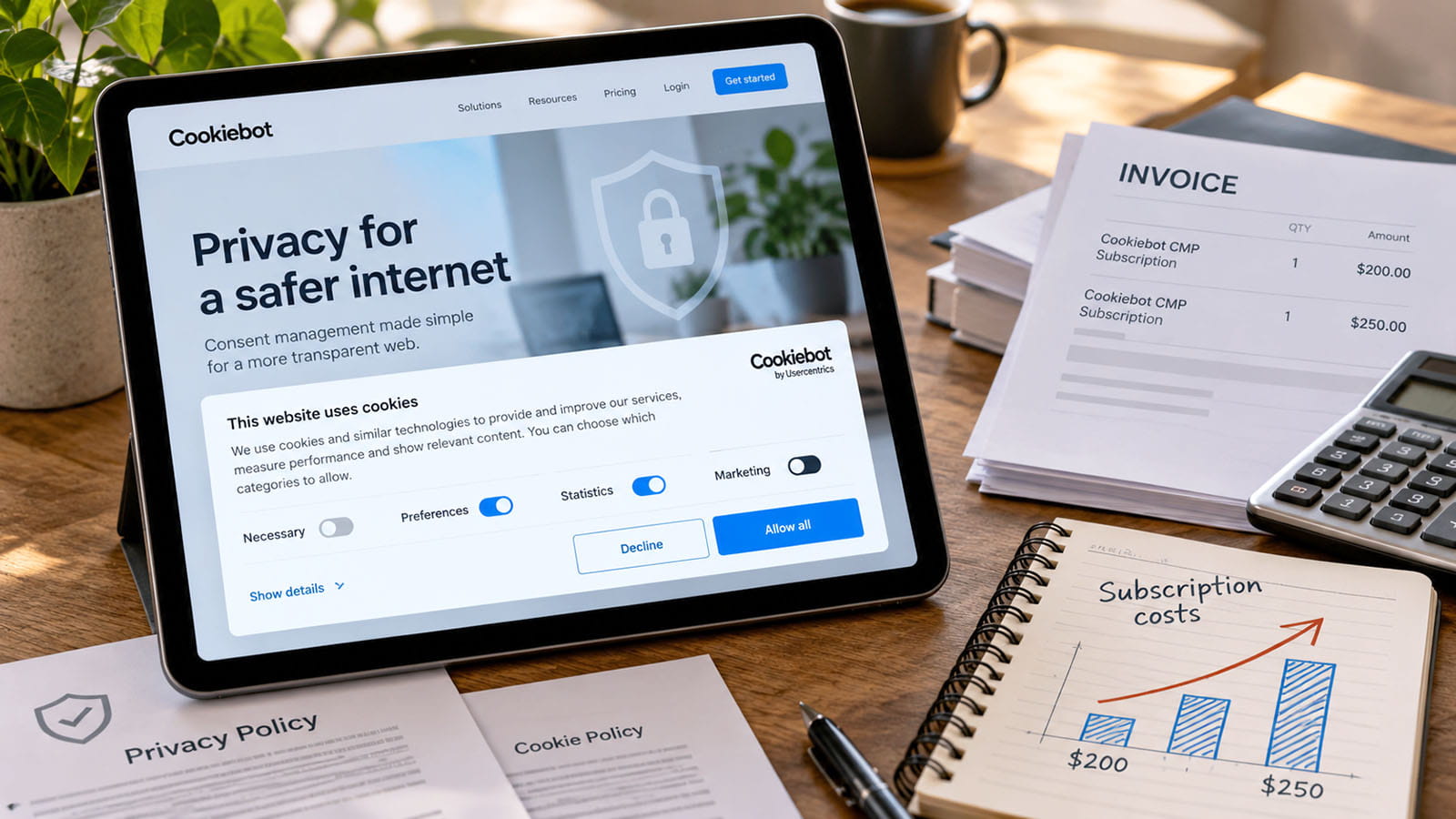
A Cookiebot customer notice announces an increase from $200 to $250 per month. For website owners, the important question is not only how much more the consent management platform will cost, but which rate and billing date actually apply to their account. The notice reviewed for this article shows why the public price list is only the starting point.
Practical starting point: compare your notification, latest invoice and account-level quote before changing anything. Review the price per domain, existing plan restrictions and the cost of any proposed migration. A more expensive subscription does not, by itself, require a new banner or a different consent setup.
Contents
What is changing and who is affected
Cookiebot describes a 25% Premium list-price increase for USD-billed customers, regardless of country, in its official pricing announcement. This announcement does not establish an equivalent increase in EUR or PLN.
For an international business, the practical distinction is between the currency on the supplier invoice and the country where the website operates. Check the invoice rather than assuming that a European business necessarily has euro billing. Equally, the absence of another currency from this announcement is not a promise that its prices will never change.
The customer email reviewed here says the subscription will continue without changes to its domains, banners or settings. That makes the immediate task a commercial review, not an emergency implementation project. Keep a functioning consent setup in place while establishing the correct cost.
New USD prices and the Medium-plan exception
The announcement lists the following per-domain USD prices, excluding VAT. Page-count labels below follow that announcement; eligibility restrictions still apply.
| Plan | Subpages | Previous monthly | New monthly | New annual |
|---|---|---|---|---|
| Lite | ≤ 50 | $8 | $10 | $120 |
| Small | ≤ 350 | $16 | $20 | $240 |
| Medium | ≤ 3,500 | $34 | $43 | $516 |
| Large | ≤ 7,000 | $56 | $70 | $840 |
| Extra Large | > 7,000 | $96 | $120 | $1,440 |
Medium needs a separate calculation. Moving from $34 to $43 is an increase of $9, or approximately 26.47%. A literal 25% increase would produce $42.50. Budget with the published dollar amount rather than multiplying every existing line item by 1.25.
The annual figures shown are exactly twelve times the new monthly figures. This table therefore does not demonstrate an annual-payment discount. Nor does it establish your negotiated price, tax treatment or total account bill.
There is also a boundary-wording inconsistency: the general pricing FAQ uses different cutoffs at some exact page-count thresholds. For a domain sitting precisely on a boundary, request confirmation of its assigned tier rather than treating this summary as an entitlement.
Why the billing date needs an account-level check
The public FAQ applies the new prices to invoices issued from 30 November 2026, UTC. Annual subscribers move at their next yearly invoice; an annual invoice already issued is unaffected. Upcoming account prices have been displayed since 29 October.
Invoice dates and service periods are not interchangeable. Cookiebot’s invoice guidance explains that monthly subscriptions are billed in arrears. A later invoice can therefore relate to an earlier service period. Ask which period the first increased invoice will cover, not just when the payment will leave your account.
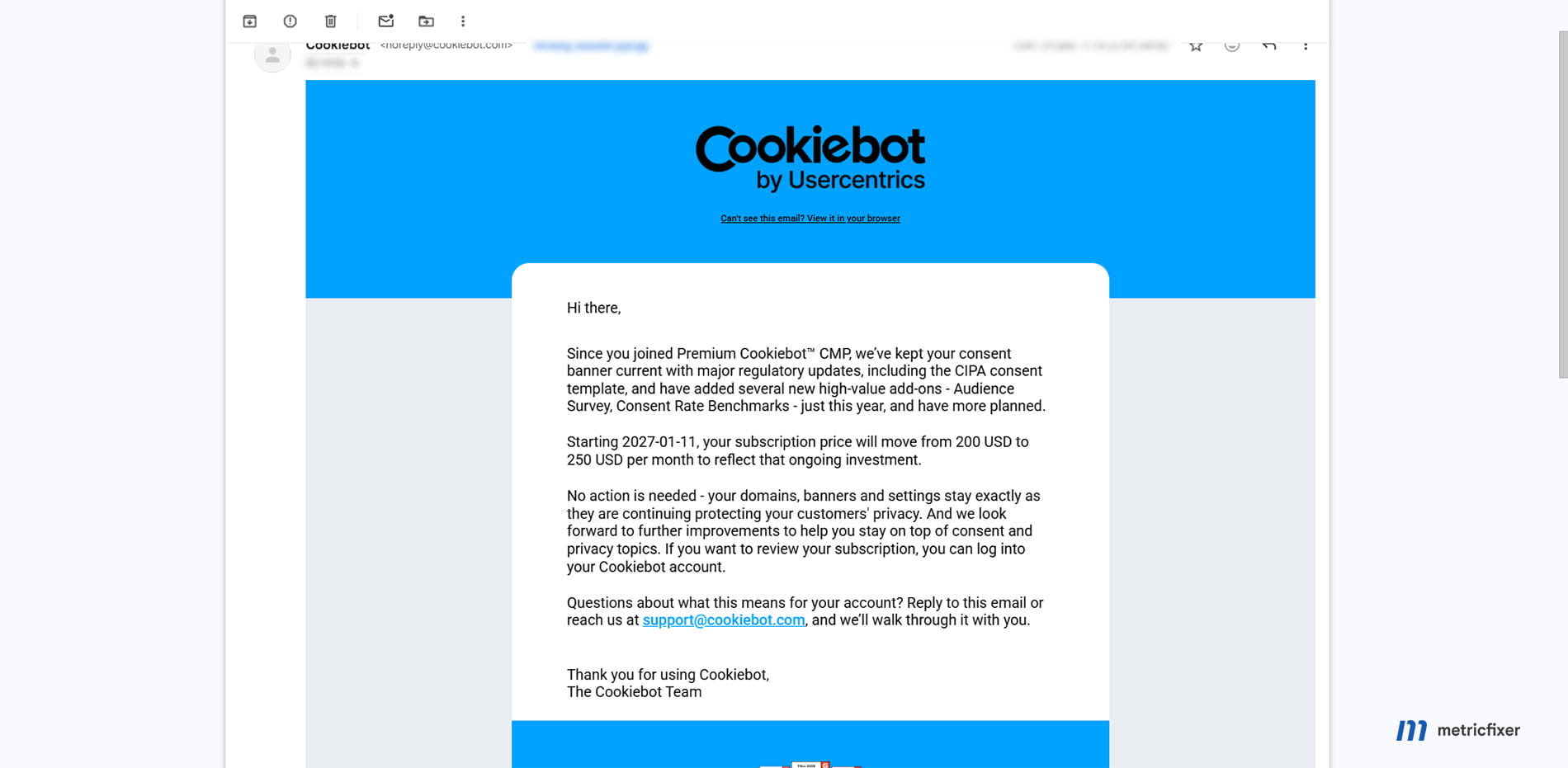
The reviewed customer notice gives a different date: 11 January 2027. It quotes a change from $200 to $250 per month. The screenshot does not show the billing interval, renewal schedule, contractual arrangement or reason for that date. A monthly-equivalent price alone does not prove how often the account is invoiced.
These two sources should not be silently reconciled. The email is evidence of what that customer was told; it does not establish a January rollout for everyone. The public FAQ does not explain the account-specific date either. Obtain written confirmation before using either date in a client commitment or a cash-flow forecast.
Please confirm the first invoice that will use our new price, the service period it covers, and the total before tax. Our notification specifies 11 January 2027. Does that date apply to our account, and how does it relate to the public invoice timetable?
What the $200-to-$250 notice means for budgeting
For the account in the supplied notice, the arithmetic is straightforward: $50 more per month, a 25% increase, and $600 more over twelve months at the new rate. Annualized spending moves from $2,400 to $3,000 if the quoted monthly amount and subscription scope remain constant.
That is an annualized comparison, not a verified calendar-year invoice forecast. The screenshot does not explain whether the quoted amounts include tax, discounts, several domains or other account-specific adjustments. Do not reverse-engineer the customer’s tier mix from the $200 total.
The same distinction matters when comparing alternatives. If switching would cost $600 in implementation and testing, it would take twelve months merely to offset a $50 monthly saving. This is an illustrative break-even calculation, not a migration quote; include ongoing administration and any change in supplier fees before deciding.
What Cookiebot is offering in return
The email attributes the higher price to continued development, regulatory-related banner updates and new add-ons. It names the CIPA consent template, Audience Survey and Consent Rate Benchmarks. Those are the supplier’s reasons for the increase, not evidence that every customer receives the same business value.
| Feature | Documented purpose | Practical question |
|---|---|---|
| CIPA/VPPA template | Cookiebot’s configuration guide describes a consent-first approach to relevant tracking tools. | Does this configuration address your assessed tracking risks? A template is not a legal opinion or a guarantee against claims. |
| Audience Survey | An optional widget collects visitors’ self-reported discovery channels, according to the setup guide. | Will your team use these responses alongside analytics? They describe reported discovery, not verified user-level conversion attribution. |
| Consent Rate Benchmark | The product page describes comparisons with aggregated peer consent rates. Insufficient data can mean no benchmark is shown. | Is the comparison relevant to your audience and setup? A higher opt-in rate is not, on its own, proof of better compliance. |
There is an important pricing qualification. The add-ons overview describes inclusion during the launch period. For the visitor-attribution add-on, Terms of Service clause 2.3.4 also reserves the possibility of future pricing with 30 days’ notice. Do not turn launch-period inclusion into a promise of permanent free access.
A useful review separates the value of the core consent service from the value of optional tools. A business that needs dependable regional banners and consent records may make a different decision from one actively using the new research features. Neither should assume that disabling an optional feature will automatically reduce the base subscription.
Existing plan rules can change the real cost
Small and Lite are not universal low-cost options
A separate Premium Small policy, effective from 18 August 2025, reserves that tier for accounts with at least four domains. Accounts with one to three domains that would otherwise fall into Small are placed in Medium. Qualifying single-domain Premium Lite subscriptions are an exception.
This is an existing eligibility rule, not a new rule introduced by the USD increase. Cookiebot counts domains and subdomains across the account’s domain groups; dividing the same portfolio into more groups does not create separate eligibility tests.
For example, two 200-page domains should not automatically be budgeted at two Small subscriptions. Assuming the published rule applies and no special agreement changes the result, two Medium subscriptions at the new list rate would total $86 per month, not $40. The difference is tier eligibility, not an extra price rise.
The Lite guidance likewise restricts that plan to a single domain and directs existing Premium customers to support for downgrade eligibility. Do not assume that every small site in a multi-domain account can receive a separate Lite price.
Review the actual domain and page inventory
Cookiebot’s pricing FAQ treats production subdomains as separate subscriptions and warns that adding both a bare domain and its www version can produce duplicate billing. Its terms restrict internal domain aliases to non-production environments, with reduced functionality. An alias is therefore not a general substitute for a paid live domain.
Use the scanner’s URL list to investigate the page count. Menu items or the number of pages shown in a CMS are not a reliable substitute. Cookiebot explains that publicly accessible old content and dynamic HTML pages can be discovered too.
Correct genuine inventory errors, but request a revised account quote before deleting domains or reorganizing the portfolio. Removing a domain can affect Small eligibility. Reducing page counts may also require a support-assisted tier review; it should not be treated as a guaranteed automatic discount.
What to check before the next invoice
Build a small reconciliation file that another person could understand without access to your inbox. Cookiebot documents invoice access separately for Admin and Manager. Use the instructions matching your interface.
- Save the baseline. Keep the notice and latest invoice. Record the billing currency, invoice date, service period and whether figures are before or after tax.
- Reconcile the domain list. Record each live domain or subdomain, its assigned tier and page count. Flag duplicates, retired properties and any eligibility dependency on the total number of domains.
- Separate the price components. Check the subscription, discounts, additional scan services and other adjustments individually. Use actual quoted amounts, not a blanket percentage applied to the invoice total.
- Resolve timing in writing. Confirm the first increased invoice, its covered period and the treatment of an existing annual subscription. Attach conflicting notices rather than describing them from memory.
- Document the decision. Record the revised cost, responsible owner and next review date. If staying, update the budget; if switching, approve and test the replacement before ending the current service.
Questions about changing billing currency, available discounts or cancellation treatment should go to support. Do not assume that selecting another currency is permitted for an existing account, preserves its commercial terms or produces a saving after taxes and conversion costs.
Review workflow: save the notice and invoice → reconcile domains and tiers → confirm the exact price and date → compare ongoing cost with migration cost → retain the tested setup or complete a verified replacement.

What agencies and resellers should confirm
The price-change FAQ promises direct Partner-team contact, not specific new commission terms.
Cookiebot’s reseller onboarding documentation distinguishes wholesale arrangements from retail customers billed directly by Usercentrics. It also assigns first-line support responsibilities to resellers. The operational impact therefore depends on who pays the supplier, who invoices the client and who maintains the implementation.
For an agency absorbing the subscription inside a fixed service fee, a higher supplier cost can reduce the amount left to cover support and maintenance. For a client billed directly, the immediate priority may instead be explaining the notice and checking that the client does not cancel a working CMP unexpectedly.
Before changing client prices, confirm the applicable discount or commission, effective date, annual renewals and any customer-specific arrangement. Review your own client contract separately: a supplier increase is not, by itself, authorization to change a fixed client fee.
Keep subscription costs and agency services distinct in the explanation. Configuration, monitoring, incident investigation and migration work should not be presented as though they are all included in the vendor’s list-price adjustment.
Staying or switching without breaking consent
A price increase is a reasonable trigger to compare options. It is not enough, on its own, to identify the best replacement. Compare the total cost of running the required setup: subscription, implementation, regional configuration, record handling, testing and ongoing maintenance.
Set a practical acceptance test before evaluating another CMP. It should cover the visitor regions you serve, the choice controls you need, how consent changes reach tags, and how the team will maintain the system. Use metricfixer’s guides to Cookiebot and Google Consent Mode for European websites and global regional consent architecture to inventory the setup rather than comparing banners only by appearance.
For Google tags, check the initial values and subsequent updates for ad_storage, analytics_storage, ad_user_data and ad_personalization. Google’s Tag Assistant troubleshooting guide covers defaults, updates and tag behavior. As an acceptance test, include a fresh visit, refusal, acceptance, a partial choice where offered, withdrawal and a return visit. Inspect actual requests as well as the visible banner.
Do not delete the old account as the first migration step. Cookiebot’s cancellation instructions warn that account deletion removes stored content, consent logs and scan reports. They also state that simply removing the website script does not cancel billing.
The termination terms say cancellation stops the relevant service immediately and the current billing period remains payable. Preserve the records you lawfully need, test the replacement and coordinate the script change with cancellation. Do not leave conflicting consent integrations running in production or a gap in the required controls.
The sensible outcome may still be to stay. A tested configuration, known maintenance process and avoided migration work have practical value. The alternative may also be worthwhile. Make that choice from a confirmed account quote and a tested replacement plan, not from the headline percentage alone.
Methodology and sources
Reviewed on 31 October 2026. This article compares Cookiebot’s public USD pricing announcement, updated on 29 October, with the customer email screenshot supplied for review. Supporting sources are the official pricing and eligibility pages, invoice instructions, scanner documentation, add-on materials, reseller guidance and Terms of Service linked at the relevant points above. Google’s official documentation supports the consent-testing guidance.
The screenshot is evidence of the message shown, not independent verification of the customer’s contract or future invoice. We did not access the account, inspect the original email headers, receive a support explanation for its date, or test the new add-ons. The reason for the difference between the public timetable and that notice remains unresolved.
Percentage changes, annualized costs and the break-even example are metricfixer calculations. They assume the stated amounts remain constant and do not add tax, discounts or undisclosed fees. The domain examples and review workflow are editorial guidance, not Cookiebot quotes or observed customer outcomes. Related metricfixer articles provide implementation context; they are not evidence of the new prices.
This article provides general commercial, technical and operational information, not legal or tax advice. Pricing, eligibility, feature availability and contractual terms can change. Confirm the amount and effective date for your account with Cookiebot or your authorized billing partner. Consent requirements depend on the website, data flows and applicable law; purchasing a CMP or adopting a template does not by itself establish compliance.