
Published Jul 10, 2026
Why Healthcare Booking Platforms Still Break Advertising Optimization
Medical centers increasingly want to optimize advertising by real bookings, attended visits and appointment value. This review explains why booking widgets need GTM, identifier capture, CRM feedback and post-visit conversion return to support CPA and ROAS optimization.
Category: Analytics & Conversion Tracking · By Mikalai Sasau
Recently, more and more medical centers have been asking us to build advertising optimization around real booked appointments. Some clinics want to go one step further: they want to pass the value of the patient visit back to advertising platforms and optimize campaigns by ROAS, not just by clicks or form submissions.
That is a reasonable request. A clinic does not buy advertising because it wants more website visitors. It buys advertising because it wants the right patients to book, arrive and pay for treatment. The problem is that many online booking platforms are not technically ready for this. In several projects, we found that reliable tracking was blocked at the most basic level: the clinic could not install analytics inside the booking widget or booking page, could not add Google Tag Manager, and could not use a proper event model for the booking flow.
This article explains why that matters, what a modern booking analytics setup should look like, and how several healthcare booking platforms compare when judged specifically by their readiness for GA4, GTM, Meta Pixel, server-side tracking and smart bidding.
Why booking analytics is now a growth issue for clinics
For a medical center, the booking page is not just an administrative tool. It is the place where advertising money either becomes measurable demand or disappears into a black box.
Modern ad platforms use automated bidding. In simple terms, Google Ads and other systems try to learn which clicks are likely to produce valuable outcomes. But they can only learn from the data they receive. When the booking system sends a clean appointment event, the ad platform has a real signal. When the booking system sends the value of the appointment or the fact that the patient actually attended, the signal becomes even stronger.
Without that feedback, the ad system may optimize toward the wrong things: cheap clicks, pageviews, button clicks, or incomplete leads. That is especially dangerous in healthcare, where one campaign may bring many casual visitors and another may bring fewer but more valuable patients.
There is also a privacy side. Clinics cannot simply send every detail about a patient or medical service to advertising platforms. A good measurement architecture should separate useful business signals from sensitive health information. The goal is not to send diagnosis data to ad platforms. The goal is to tell the advertising system, in a controlled and privacy-conscious way, which campaigns generated real business outcomes.
The ideal booking tracking model in plain English
The ideal setup starts inside the booking experience itself — either the widget embedded on the clinic website or the hosted booking page generated by the booking vendor. If tracking exists only on the landing page before the widget opens, the most important part of the journey is still missing.
In this model, the vendor allows the clinic to initialize a client-side GTM container inside the widget or hosted booking page. That container loads the clinic’s approved analytics and advertising tags, such as GA4, Google Ads, Meta Pixel and other measurement tools, depending on consent and local legal requirements. These tags read or assign browser and click identifiers such as client_id, gclid, gbraid, wbraid, fbclid, _fbp, _fbc, utm_source, utm_medium, utm_campaign and session data.
Ideal flow: booking widget or hosted booking page → client-side GTM and analytics tags → browser and campaign identifiers → booking event to analytics plus full booking payload to CRM → confirmed patient visit → post-visit purchase or qualified conversion with value sent back to analytics and advertising platforms → optimization by CPA and ROAS.
- The booking surface becomes measurable. The widget or hosted booking page loads client-side
GTMand sends structured events for key actions, not just a final pageview or a generic button click. - Analytics tags assign identifiers in the browser.
GA4,Google Ads,Meta Pixeland other tools create or read identifiers that later help connect a booking and a completed visit back to the original ad click or website session. - The completed booking creates two useful data paths. First, a safe event such as
book_appointment,leadorconversionis sent to analytics platforms and pixels. Second, the full booking payload is passed into the clinic’sCRMor practice management system. - The
CRMstores the business context. It keeps operational details such as patient contact data, selected service, doctor, location, date and time, booking value, booking ID, consent status and the same source identifiers collected in the browser. Sensitive medical details should not be sent to advertising platforms. - The clinic confirms the real outcome. After the appointment date, the
CRMrecords whether the patient attended, cancelled, paid, was qualified, and what value or revenue should be associated with the visit. This stage separates real business results from empty bookings and low-quality leads. - A post-visit
purchaseor qualified conversion is sent back. TheCRM, server-side tagging endpoint or integration returns the final conversion toGA4,Google Ads,Meta Adsand other measurement systems. It includes the original identifiers, such asclient_id,gclid,fbclid,_fbp,_fbc, plus booking ID, conversion value and currency. Depending on the stack, this can be handled throughMeasurement Protocol,Google Ads Offline Conversions,Enhanced Conversions for leads,Meta Conversions APIorserver-side GTM.
The key idea is simple: the booking event is only the first step. The strongest optimization signal appears later, when the clinic confirms that the patient actually attended and sends a safe value-based conversion back to measurement systems.
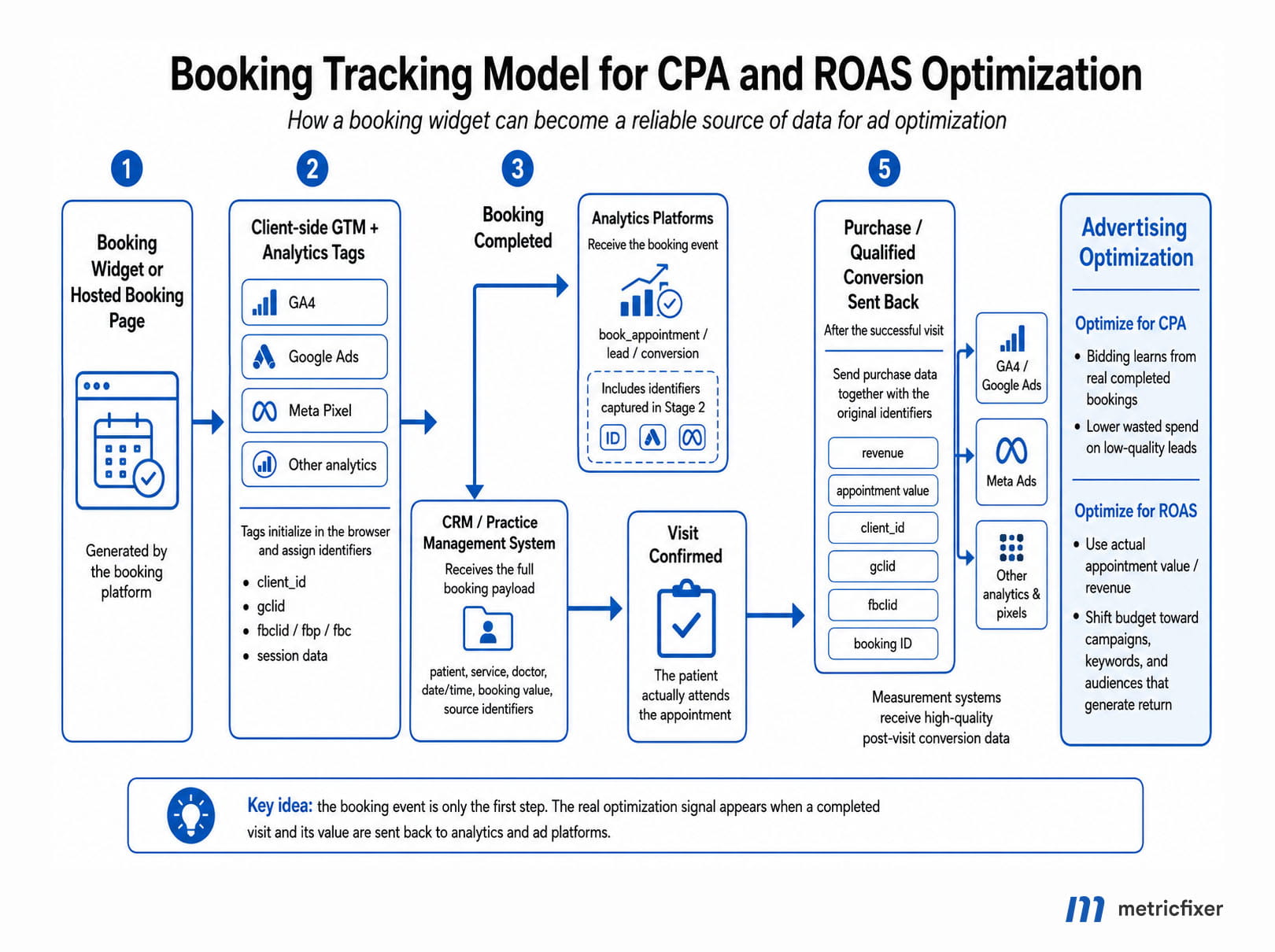
This model supports two advertising goals. For CPA optimization, bidding systems learn from real completed bookings or attended visits instead of weak leads. For ROAS optimization, the clinic can pass appointment value or revenue-like value back to advertising platforms and shift budget toward campaigns, keywords and audiences that generate return.
This is the difference between optimizing campaigns by “somebody opened the booking form” and optimizing campaigns by “this ad generated an attended appointment with measurable value.” The first model may support basic conversion counting. The second model can support better lead quality, lower wasted spend and, where appointment value is reliable, value-based bidding.
The important privacy rule is simple: advertising platforms do not need the medical story. They need a controlled conversion signal: event type, timestamp, source identifiers, value, currency and a deduplication key. Sensitive health details should stay in the clinic’s protected systems, not in advertising tags.
Technical setup of this kind is one of metricfixer’s specializations. We help clinics design the event model, connect the booking page, browser identifiers and CRM, configure client-side GTM, server-side GTM and API-based conversion return, and make sure advertising systems learn from real appointments instead of weak proxy actions.
Four levels of booking analytics maturity
To compare platforms fairly, we use four practical levels. These levels do not describe whether a platform is good or bad as clinic software. They describe how useful the platform is for advertising measurement and optimization.
| Level | What it means | What it means for the clinic |
|---|---|---|
| Zero level | The public documentation does not show a practical way to connect the booking widget or hosted booking page to standard marketing analytics tools. | The clinic can manage bookings, but advertising optimization is weak. Marketers may have to track only landing-page clicks or rebuild attribution outside the booking system. |
| Minimal level | The platform offers a basic connection for tools such as GA4 or Meta Pixel, usually with predefined events and limited customization. |
This may be enough for small budgets, but it usually does not give a full booking funnel or enough flexibility for serious optimization. |
| Normal level | The platform supports Google Tag Manager, booking events, triggers, parameters or a dataLayer-style structure. |
Marketers can build a real measurement plan: booking started, service selected, location selected, booking completed, conversion value and other useful events. |
| Mega level | The platform is designed for the full feedback loop: client-side GTM or equivalent tag initialization in the booking flow, browser identifiers captured before booking, the booking payload saved in the CRM, and a post-visit purchase or qualified conversion with value returned to analytics and ad platforms. |
The clinic can move from simple lead counting toward optimization by real completed appointments, attended visits, conversion cost and, where reliable, ROAS. |
How we reviewed the platforms
This review focuses only on public documentation: vendor help centers, product pages and developer-style materials available during the review. We looked specifically at whether a clinic can instrument the vendor’s booking widget or hosted booking flow for GA4, Google Tag Manager, Meta Pixel and smart-bidding-oriented measurement.
There are two important limitations. First, some vendors may offer private enterprise options that are not documented publicly. Second, product documentation changes. Before making a purchasing decision, clinics should ask vendors direct questions about tracking, not just about calendars, reminders and payments.
The market map: healthcare booking platforms by analytics maturity
| Platform | Level | What the documentation suggests | Practical takeaway for clinics |
|---|---|---|---|
| ClinicCards | Zero level | The platform documents online booking, an API and internal source-style reporting, but we did not find public guidance for adding GA4, GTM or Meta Pixel to the booking widget itself. |
Useful operationally, but weak as a direct advertising measurement surface. A clinic may need custom workarounds outside the booking widget. |
| Docplanner / ZnanyLekarz widgets | Zero level | The platform supports website widgets and internal statistics, but public materials reviewed did not show a clear GA4, GTM or Meta Pixel implementation path for the widget layer. |
Strong for marketplace and appointment operations, but limited for clinics that want full control over paid-media measurement on their own website. |
| SimplePractice | Zero level | SimplePractice supports an appointment request widget and internal reports, but its documentation states that third-party tracking pixels are not used within the platform or client-facing websites. | This may be a deliberate privacy and security posture, but it makes the booking/request layer difficult to use as a performance marketing endpoint. |
| NexHealth | Zero level for direct tag connectivity, with strong attribution workarounds | NexHealth documents campaign attribution, UTM handling, ROI analytics and large exports for analysis, but we did not find a public self-serve path that turns the booking widget into a GA4, GTM or Meta-ready tagging surface. |
Interesting for downstream reporting and export-based analysis, but not the same as an open booking widget with full tag control. |
| Acuity Scheduling | Minimal level | Acuity offers integrations with Google Analytics and Meta Pixel and allows custom conversion tracking code to fire when an appointment or qualifying purchase completes. | A practical option for simple tracking. However, it is still closer to final-conversion tracking than to a full GTM-controlled booking funnel. |
| Cliniko | Normal level | Cliniko supports Google Tag Manager, GA4, Meta Pixel through GTM and booking-completion variables in the dataLayer. It also documents limitations for embedded flows. |
Good enough for a serious analytics setup, especially if marketers plan carefully around referral-source loss and embedded-widget limitations. |
| splose | Normal level | splose documents GTM setup for online bookings, including custom triggers for booking steps and guidance for GA4 and Google Ads. It also warns that ordinary thank-you-page tracking does not work for its single-page booking flow. |
A strong sign of measurement maturity. The documentation recognizes how modern booking widgets actually behave. |
| Pabau | Normal level | Pabau documents analytics settings for Online Bookings, including Google Analytics, Google Tag Manager and Meta Pixel. It also has broader reporting around bookings, leads and conversion-style views. |
A commercially mature option for clinics that need both booking operations and marketing reporting. |
| Practice by Numbers | Normal level | Practice by Numbers has one of the strongest open setups in this sample: GTM onboarding, automatic booking events in the dataLayer, GA4 funnel tracking, Google Ads conversion tracking, optional Facebook Pixel, UTM parameters and CSV export. |
Probably the most marketer-friendly open GTM implementation in this review. |
| Jane | Mega level for Google-focused smart bidding | Jane documents a managed Google Tag Manager integration described as server-side, supports Google Ads offline-style conversion actions, sends booking data automatically to GA4 and claims a fuller conversion picture than cookie-only tracking. |
The strongest native direction for Google smart bidding in this review. The caveat: it is not an open tag-management playground and is not positioned as a traditional Meta Pixel setup. |
What the comparison tells us
The pattern is clear: healthcare booking software is becoming more analytics-aware, but the market is uneven.
Some platforms still treat the booking system as a closed operational environment. That can be acceptable when a clinic relies mainly on referrals, marketplace demand or manual reception work. But it becomes a problem when the clinic is spending meaningful money on search ads, social ads or performance campaigns.
The normal level is currently the practical sweet spot for most clinics. Platforms such as Cliniko, splose, Pabau and Practice by Numbers give marketers enough control to build a real funnel: booking opened, patient details entered, service selected, location selected, appointment booked and, where appropriate, value captured.
The mega level is where the market should move next. At that level, a booking system does not stop at “appointment booked.” It should connect the widget or hosted booking page, client-side GTM, analytics identifiers, the CRM booking record, attendance status and post-visit value into one feedback loop.
The key signal is not only that a booking happened. The key signal is that the patient attended, the appointment has a measurable value, and a qualified purchase or value-based conversion can be sent back with the same identifiers. That is what allows advertising systems to optimize both for conversion cost and for return. Jane is the clearest public example of this direction in the reviewed sample, especially for clinics that are heavily invested in the Google ecosystem.
Questions clinics should ask before choosing a booking platform
Before signing a contract with a booking vendor, a clinic should ask several very direct questions. These questions are not only for marketers. They protect the clinic from buying software that later blocks advertising optimization.
- Can we initialize our own client-side
Google Tag Managercontainer inside the booking widget or hosted booking page, not only on the landing page? - Does the booking widget send structured events to the
dataLayer? - Can we track booking steps, not only the final appointment?
- Does tracking work if the booking flow is embedded in an iframe or hosted on another domain?
- Can the system store
UTMparameters,client_id,gclid,gbraid,wbraid,fbclid,_fbpand_fbcwith the booking? - Can the full booking payload, including booking ID and source identifiers, be passed to the clinic’s CRM or practice management system?
- Can we export booking status, attendance status, payment status and appointment value?
- Can an attended visit or qualified
purchasebe sent back toGoogle Ads,GA4, Meta and other systems with the original identifiers? - Can the setup deduplicate browser-side booking events and server-side post-visit conversions so that the same booking is not counted twice?
- Can this be done without sending sensitive medical details to advertising platforms?
If a vendor cannot answer these questions clearly, the clinic should assume that advanced advertising optimization will require custom workarounds or may not be possible at all.
What metricfixer can do in this situation
When the platform is analytics-ready, metricfixer can help design and implement the full measurement chain: client-side GTM in the booking widget or hosted booking page, GA4 and advertising events, identifier preservation, booking-payload transfer to the CRM, attendance and payment status mapping, post-visit purchase or qualified-conversion return, conversion values, deduplication, consent-aware tracking and server-side delivery to advertising platforms.
When the platform is not ready, the work is different but still important. We can audit the booking journey, check what data is available before and after the booking, capture marketing identifiers before the user leaves the clinic website, use CRM or API data where possible, and design a realistic workaround for qualified lead or attended-visit return.
Sometimes the conclusion is uncomfortable but useful: the clinic’s current booking platform may be good for operations and bad for advertising. Knowing that before scaling ad spend can save a significant budget.
Conclusion: booking software is now part of the ad system
For clinics, the booking platform used to be mainly an operational choice. Does it show available slots? Does it send reminders? Does it reduce calls to reception?
Those questions still matter. But in 2026, they are not enough. A booking platform also decides whether advertising systems can learn from real patient outcomes. If the platform blocks analytics, the clinic may be forced to optimize campaigns using weak signals. If the platform supports modern measurement, the clinic can connect the full chain: browser identifiers, booked appointment, CRM record, attended visit, post-visit purchase event and appointment value.
The next generation of healthcare booking platforms will not only schedule patients. It will help clinics understand which marketing investments bring the right patients — and give advertising systems the signals they need to optimize for both conversion cost and return on ad spend.
Need to check whether your booking platform can support real appointment-based optimization? metricfixer can audit your booking flow, analytics setup and CRM feedback options before you scale paid campaigns around incomplete data.
Methodology and sources
This article is based on a review of publicly available vendor documentation for healthcare and appointment-booking platforms in Europe and North America. The review focused on documented support for GA4, Google Tag Manager, Meta Pixel, server-side GTM, offline conversion return, qualified lead feedback and built-in booking analytics. Capabilities may change over time, and private enterprise configurations may differ from public documentation.
This article is a technical and marketing overview, not legal advice. Healthcare tracking must be designed with privacy, consent and data minimization in mind. metricfixer is not affiliated with the third-party platforms mentioned in this review. Product capabilities and public documentation may change after publication.