
Published Jul 31, 2026
How to Reliably Track Purchases When Customers Do Not Return from an External Payment Gateway
A practical reference architecture for ecommerce and booking services that must record purchases even when customers never return from a hosted payment page. Covers signed webhooks, backend order events, GA4 Measurement Protocol, server-side GTM, deduplication, refunds, and campaign attribution.
Category: Analytics & Conversion Tracking · By Mikalai Sasau
A browser-side purchase event can disappear even after money has been collected when checkout sends the customer to Stripe, PayPal, Adyen, a bank page, or another hosted payment gateway. This guide presents a reference architecture for ecommerce and booking services that confirms the payment on the backend, preserves attribution before the redirect, and sends one reliable purchase to GA4 and advertising platforms even when the customer never returns.
Practical default: make a verified backend transition to a paid and commercially accepted order the only canonical source of purchase. Use the thank-you page for customer experience and status display, not as proof of payment. Receive signed provider webhooks into a durable inbox, create the purchase through an idempotent order-state transition, place the event in a transactional outbox, and deliver it asynchronously to GA4, server-side GTM, Google Ads, the CRM, and the warehouse.
Executive summary
A thank-you page proves only that a browser reached a URL. It does not prove that the gateway captured money, that a delayed payment method eventually succeeded, that a booking was confirmed, or that the page remained open long enough for JavaScript to load. Customers close tabs, return through a different browser, move between a banking app and the merchant site, lose connectivity, or complete a payment method whose final result arrives minutes or days later. Ad blockers, consent choices, JavaScript errors, and repeated page loads create additional undercounting or duplication.
The robust design is server-led. The payment provider sends a signed webhook to the merchant backend. The backend verifies the signature, durably stores the notification, acknowledges it quickly, and processes the business change asynchronously. Stripe explicitly documents retries, duplicate deliveries, non-guaranteed ordering, signature verification, and asynchronous processing. Adyen recommends verifying, storing, acknowledging, and only then applying business logic; it also warns that duplicates are possible. PayPal retries failed webhook deliveries repeatedly over several days. These are not edge cases to work around. They are the normal delivery model for payment notifications.
A webhook alone is still not the architecture. The webhook is a transport message from the provider; the merchant’s order and payment records remain the business source of truth. A single order may have several payment attempts, an authorization may be captured later, a payment may succeed before inventory is confirmed, and a booking may require both a successful charge and a confirmed reservation. The backend should convert provider-specific statuses into a controlled internal state machine and emit order.paid or booking.confirmed_and_paid only when the business definition of a purchase is satisfied.
Reliable delivery then requires idempotency at several layers. Store each provider event once, apply each paid-state transition once, create one outbox event for the business purchase, and track delivery separately for every destination. Use the same stable transaction_id or order identifier in downstream platforms, but do not treat platform-side deduplication as a substitute for internal controls. Google Analytics documents purchase deduplication by transaction_id for web streams, while Google Ads and the Data Manager API have their own transaction-based rules. Those protections are useful final safeguards, not an end-to-end exactly-once guarantee.
Attribution must be preserved before the customer leaves the site. Store the internal order ID, GA4 client_id and session_id when available, authenticated user_id, advertising identifiers such as gclid, gbraid, and wbraid, UTM parameters, landing URL and referrer, consent state, currency, value, and item data. A server event cannot reconstruct identifiers that were never captured. For a detailed treatment of Google Ads identifiers, see the metricfixer guide to GCLID, GBRAID, WBRAID, CRM tracking, and GA4 Measurement Protocol.
GA4 Measurement Protocol can send the confirmed purchase from a trusted backend and join it to tagged browser activity through client_id, with session_id helping to associate it with a specific session. However, Google describes Measurement Protocol as a supplement to browser or app tagging, not a complete replacement. Time matters: a session-specific join should be sent within 24 hours of session start, events intended to work with client-side data should reach GA4 within 48 hours, and backdated timestamps are limited to 72 hours. Long-delay bank transfers and bookings therefore need a CRM or warehouse attribution ledger even when GA4 is also used.
Server-side GTM is optional. It can centralize validation, transformation, consent-aware routing, secrets, and delivery to several marketing destinations. It should not be the payment source of truth and should not replace webhook verification, order-state logic, or the outbox. The safest chain is payment provider → commerce backend → durable order event → optional server container → analytics and advertising destinations.
Why thank-you-page tracking fails
The conventional implementation looks simple: the payment gateway redirects the customer to /thank-you, the page loads Google Tag Manager or the Google tag, and a browser event sends the order value. This is useful when it works, but it places a financial event behind several conditions that the merchant does not control.
| Failure mode | What happens operationally | Measurement consequence |
|---|---|---|
| Customer closes the gateway or banking app | The provider can complete the payment without a successful return navigation. | The business receives money, but the browser never sends purchase. |
| Delayed payment method | The customer finishes checkout while the payment is still pending; final success arrives later through a provider notification. | A return-page event is either too early or absent. |
| Redirect or network failure | The payment succeeds, but DNS, TLS, mobile connectivity, browser process termination, or a redirect-chain error prevents the confirmation page from loading. | Paid order without browser measurement. |
| JavaScript, tag, or consent interruption | The page loads, but the tag is blocked, delayed, misconfigured, denied by consent, or interrupted before the request is transmitted. | The confirmation page exists in server logs while GA4 and Ads see no purchase. |
| Reload, back/forward navigation, or shared URL | The same confirmation page is loaded more than once. | Duplicate purchases unless the implementation and destination deduplicate them correctly. |
| Manipulated success URL | A user or bot opens a predictable URL or changes query parameters without a completed payment. | A false purchase can be recorded if the page trusts URL parameters. |
| Payment and booking finish at different times | Payment may succeed before inventory, ticketing, or reservation confirmation. | A page-level purchase can report revenue for a booking that is later rejected and refunded. |
This is the same general measurement boundary described in the metricfixer review of Google Ads clicks versus GA4 users, sessions, and views: each browser and server stage is a separate observation. A successful payment is even farther from the initial browser click than a page view, so it needs its own authoritative server record.
The return page is still valuable. It can display the receipt, poll the backend while a payment is pending, offer support, and record a non-financial diagnostic event such as payment_returned. It simply should not decide whether money was collected.
What each component is—and is not—for
| Component | What it can prove | Main strengths | Main limitation | Recommended role |
|---|---|---|---|---|
| Thank-you page | The browser reached a merchant-controlled page. | Immediate UX, receipt display, browser diagnostics, optional fallback signal. | Depends on return navigation, JavaScript, consent, and page execution; can reload. | Status and UX only. Do not use as the canonical payment confirmation. |
| Payment-provider webhook | The provider sent a signed notification about a payment object or state change. | Works without browser return, supports delayed results, retries after failures. | Can be duplicated, delayed, retried, or delivered out of order; event semantics vary by provider. | Secure notification input to the backend. |
| Backend order/payment state | The merchant’s business conditions for a paid and accepted order have been met. | Can combine payment, inventory, booking, fraud, and fulfillment rules. | Requires a deliberate state model and reliable persistence. | Canonical source of purchase. |
| Transactional outbox | A committed business change has a durable event waiting for delivery. | Prevents the dual-write gap between database state and external analytics calls; supports retries. | Adds a worker, delivery state, and operational monitoring. | Canonical delivery queue for downstream destinations. |
| GA4 Measurement Protocol | A trusted server sent an analytics event to a GA4 data stream. | Direct server-to-server collection, event timestamps, ecommerce payloads, browser/server correlation. | Not a payment verifier; success responses do not fully validate data; attribution joins are time-sensitive. | One analytics destination after the backend confirms the purchase. |
| Server-side GTM | A server container received and routed event data according to its configuration. | Centralized transformations, privacy controls, secrets, multi-destination routing, governance. | Extra infrastructure and another failure point; no payment-state authority. | Optional routing and control layer after the outbox. |
Reference architecture
Reliable purchase workflow: landing and checkout → backend creates an order and stores attribution context → customer is redirected to the external gateway → provider sends a signed webhook whether or not the customer returns → webhook is verified and durably stored → a worker resolves the latest payment state and updates the order → the same database transaction creates one outbox event → destination workers send the purchase to GA4, server-side GTM, Google Ads, CRM, and warehouse → reconciliation compares provider settlements and refunds with internal records and repairs missing deliveries.
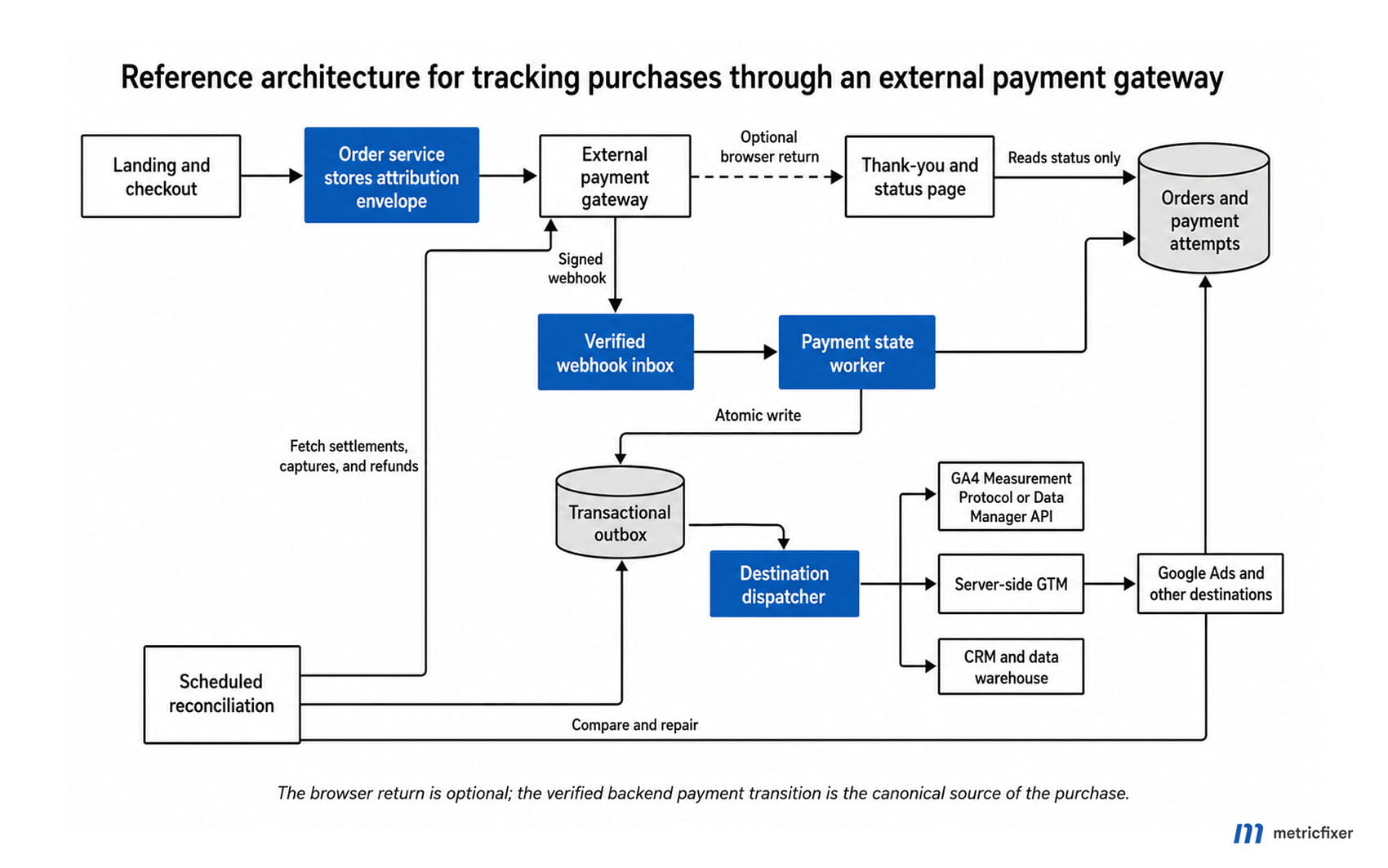
The nine components
- Order service. Creates the order or checkout record before the redirect. Prices, currency, discounts, tax, inventory, and customer entitlements are calculated on the server, not accepted from browser parameters.
- Measurement context. Stores identifiers and campaign data while the customer is still on the merchant domain.
- Payment attempt. Represents one interaction with the gateway. One order can have several attempts; this is why a provider payment ID should not automatically become the analytics transaction ID.
- Provider metadata. Carries an opaque internal
order_idorcheckout_idso the webhook can be mapped back to the merchant record. Avoid putting unnecessary personal data into metadata. - Webhook inbox. Stores verified notifications with a unique provider event key before acknowledging them.
- Payment state worker. Normalizes provider-specific events, optionally retrieves the current payment object from the provider API, and applies the merchant’s state-transition rules.
- Transactional outbox. Writes the business event in the same transaction as the paid order state, eliminating a fragile database-plus-API dual write.
- Destination delivery workers. Send independently to GA4, server-side GTM, Google Ads, CRM, email, fulfillment, or the warehouse and record each result.
- Reconciliation job. Compares gateway reports or APIs with internal orders and event deliveries to catch extended outages, configuration mistakes, orphan payments, missing webhooks, and refund discrepancies.
The architectural goal is not literal end-to-end “exactly once” delivery. Payment providers and message systems normally use retries and at-least-once delivery. The achievable goal is effectively once: every layer may safely repeat work, but the final business state and reported purchase remain correct.
Define the purchase state before writing tracking code
The event name purchase is simple; the business condition behind it is not. The correct trigger depends on the merchant’s payment configuration and what the company treats as an accepted sale.
| Scenario | Do not trigger on | Recommended purchase condition |
|---|---|---|
| Card payment with immediate capture | Gateway page opened, payment submitted, or browser redirected. | Provider confirms successful capture or paid status and the order is accepted. |
| Authorization followed by manual capture | Authorization alone, unless the business explicitly reports authorized value as its conversion. | Capture succeeds and the order is commercially accepted. |
| Delayed bank transfer or asynchronous method | Checkout completion while payment remains pending. | Final provider success notification or verified paid status. |
| Hotel, ticket, appointment, or rental booking | Payment alone when inventory or reservation confirmation can still fail. | Required payment or deposit succeeds and the reservation reaches the business-defined confirmed state. |
| Subscription | Subscription object creation without a successful charge. | Each successfully paid invoice or recognized recurring revenue event uses its own transaction identifier. |
| Marketplace or split settlement | Every internal transfer or payout as a separate customer purchase. | The customer-facing order or merchant-defined revenue unit, with payment attempts and payouts reconciled separately. |
| Installments | Reusing one transaction ID for several intentionally separate revenue events. | Either one purchase for the contracted order value or one unique event per installment, according to the reporting policy documented in advance. |
A practical internal state model might include created, payment_pending, authorized, paid_unconfirmed, confirmed_and_paid, partially_refunded, refunded, cancelled, and disputed. Provider events update this model; they do not bypass it.
For booking services, consider two independent facts: payment status and reservation status. A captured payment with failed inventory allocation is not the same commercial outcome as a confirmed booking. The domain event can require both conditions:
purchase_ready = payment_state in {captured, paid}
                 AND order_state in {accepted, confirmed}
                 AND purchase_event_created = false
Do not trust success=true, an amount, a currency, or an order ID copied from the return URL. The backend should look up the order and verify the provider state using signed notifications and, when necessary, a provider API request.
Capture attribution before the redirect
Once the browser leaves the merchant site, the original analytics context may be unavailable. The order record therefore needs a measurement envelope created before the external redirect. This envelope is correlation data, not the financial source of truth.
| Field | Why store it | Important caveat |
|---|---|---|
order_id or checkout_id |
Stable merchant key used across payment, analytics, refunds, and reconciliation. | Generate on the server. It must not contain personal data. |
payment_attempt_id and provider object IDs |
Reconcile several gateway attempts with one order. | Keep separate from the business transaction ID unless the data model guarantees one attempt per sale. |
GA4 client_id |
Links the server event to the browser or device instance used on the site. | It is pseudonymous browser identity, not a verified person; it may be unavailable under consent or storage restrictions. |
GA4 session_id and session start |
Helps associate the server purchase with the relevant GA4 session and its context. | Time-sensitive; do not invent a new value on the backend. |
Internal user_id |
Supports cross-device continuity for authenticated users. | Use a non-PII internal identifier, never an email address or phone number. |
gclid, gbraid, wbraid and other click IDs |
Supports CRM joins and server/offline conversion return to advertising platforms. | Preserve byte-for-byte; do not lowercase, decode, truncate, or put them in a public receipt URL. |
utm_source, utm_medium, utm_campaign, utm_content, utm_term |
Provides an internal campaign ledger and fallback analysis outside platform attribution. | Store the raw values and a separately normalized reporting version if needed. |
| Landing URL, referrer, first-touch and checkout-touch timestamps | Supports warehouse attribution, debugging, and reconciliation when platform joins fail. | Minimize retention and avoid storing unnecessary sensitive URL content. |
| Consent snapshot | Allows destination workers to enforce the state that applied when identifiers were collected and the order was created. | Server-side delivery is not a consent bypass. Keep policy and jurisdiction logic explicit. |
| Currency, value, tax, shipping, discounts, and item lines | Creates a consistent ecommerce payload without depending on the return page. | Use backend-calculated amounts and immutable order snapshots, not client-provided numbers. |
created_at, paid_at, confirmed_at, refunded_at |
Preserves the real business timeline and correct event timestamp. | Do not substitute worker execution time when a provider notification is delayed. |
Retrieving GA4 identifiers in the browser
Google’s tag API supports the get command for GA4 client_id and session_id. A site can request these values before creating the hosted checkout session, then send them to its own backend. The checkout must continue when a value is unavailable; analytics identifiers should never become a payment dependency.
const getGoogleTagValue = (fieldName, timeoutMs = 800) =>
  new Promise((resolve) => {
    if (typeof window.gtag !== "function") {
      resolve(null);
      return;
    }

    let settled = false;
    const finish = (value) => {
      if (settled) return;
      settled = true;
      resolve(value ?? null);
    };

    const timeoutId = window.setTimeout(() => finish(null), timeoutMs);

    window.gtag("get", "G-XXXXXXXXXX", fieldName, (value) => {
      window.clearTimeout(timeoutId);
      finish(value);
    });
  });

async function createHostedCheckout() {
  const [clientId, sessionId] = await Promise.all([
    getGoogleTagValue("client_id"),
    getGoogleTagValue("session_id")
  ]);

  const response = await fetch("/api/checkout-sessions", {
    method: "POST",
    headers: { "Content-Type": "application/json" },
    body: JSON.stringify({
      client_id: clientId,
      session_id: sessionId
    })
  });

  if (!response.ok) {
    throw new Error("Unable to create checkout session");
  }

  const { checkout_url: checkoutUrl } = await response.json();
  window.location.assign(checkoutUrl);
}
The backend should merge those identifiers with its own first-party session, order, campaign, and consent records. Browser-supplied fields may be useful for correlation, but they must not control price, currency, order ownership, entitlements, or payment status.
In GTM implementations, equivalent values can be collected through supported variables and sent with the checkout-creation request. For consent architecture, see GA4 Consent Changes and Server-Side GTM. The important rule is unchanged: capture permitted identifiers before the redirect and preserve the associated consent state through every downstream hop.
Build the webhook endpoint as a secure inbox
A production webhook endpoint should do as little synchronous work as possible, but it must do the critical work before returning success. The correct sequence is:
- Receive the request over HTTPS and retain the raw body.
- Identify the correct provider account, environment, and signing secret.
- Verify the signature and timestamp using the provider’s official library where possible.
- Extract the provider event ID, event type, object ID, provider-created timestamp, and merchant account context.
- Insert the verified event into a durable inbox with a uniqueness constraint.
- Return
200or202after the durable write succeeds. - Process business logic asynchronously.
Returning 2xx before durable storage can lose the payment if the process crashes immediately afterward. Returning 2xx only after inventory, email, analytics, and CRM calls complete creates timeouts and unnecessary provider retries. The safe boundary is: verify, persist, acknowledge, then process.
Treat the inbox as security-sensitive data. Encrypt payloads at rest where appropriate, restrict access, redact webhook bodies and signature headers from routine logs, apply a defined retention period, and reject stale signed requests according to the provider’s replay-protection guidance. Never store a signing secret in the payload or expose raw notifications in a customer-facing order page.
POST /webhooks/{provider}

1. Read the untouched request body.
2. Verify signature, timestamp, environment, and merchant account.
3. Derive provider_event_key and payload checksum.
4. INSERT into webhook_inbox with a unique key.
5. If already stored, return 200 without repeating business work.
6. If storage succeeds, enqueue or expose the row to a worker.
7. Return 200 or 202.
8. Process payment state outside the request.
Why duplicate and out-of-order handling is mandatory
Stripe’s webhook documentation states that live-mode deliveries are retried for up to three days with exponential backoff, that event order is not guaranteed, and that endpoints can receive the same event more than once. Stripe recommends logging processed event IDs, sometimes combining the object ID with event type for semantic duplicates, and using an asynchronous queue.
Adyen’s handling guidance recommends verifying the notification, storing it in a database or queue, acknowledging it before business logic, and checking timestamps or sequence information. Adyen also notes that duplicates can share eventCode and pspReference.
PayPal’s webhook guide requires a successful HTTPS response and documents repeated delivery attempts over three days when the listener does not return a successful status. These provider policies are why a one-request/one-purchase assumption is unsafe.
Do not make event order a hidden dependency
A worker can receive a later state before an earlier state, or receive an old retry after the order is already settled. Use one or more of these patterns:
- Retrieve the current payment object from the provider API when the webhook payload is insufficient or may be stale.
- Maintain explicit allowed state transitions instead of overwriting the order with whichever event arrived last.
- Store provider-created timestamps and sequence numbers, but do not assume timestamp alone resolves every reversal or adjustment.
- Make terminal and compensating states explicit: paid, refund succeeded, refund failed, refund reversed, dispute opened, dispute won, dispute lost.
- Keep the raw notification ledger separate from the current-state projection so the full history remains auditable.
Create the purchase in a backend transaction
The most dangerous reliability gap appears after the webhook has been accepted. Suppose the application updates the order to paid and then calls GA4. If the process crashes between those operations, the order is paid but the event is lost. Reversing the order of operations is no better: GA4 can receive the purchase, the database update can fail, and a retry can send it again.
The transactional outbox pattern solves this dual-write problem. The same database transaction that changes the business state also inserts an immutable event row. A separate dispatcher reads committed outbox rows and sends them to external systems. AWS and Microsoft architecture guidance describe this pattern as a way to make state change plus event publication durable and replayable.
The following constraints use PostgreSQL-style syntax to show the invariants. Adapt the implementation to the selected database. When one parent order intentionally produces several reportable revenue events—such as recurring invoices or separate installments—the unique aggregate must be the invoice or installment, not the parent order.
CREATE UNIQUE INDEX ux_webhook_provider_event
ON webhook_inbox(provider, provider_account_id, provider_event_id);

CREATE UNIQUE INDEX ux_business_purchase_event
ON event_outbox(event_type, aggregate_id)
WHERE event_type = 'order.paid.v1';

CREATE UNIQUE INDEX ux_destination_delivery
ON event_delivery(destination, outbox_event_id);
A simplified worker transaction looks like this:
BEGIN

Lock the inbox row and related order.
If the inbox row is already processed, COMMIT and stop.
Resolve the internal order from trusted provider metadata.
Retrieve the latest provider object when needed.
Validate amount, currency, merchant account, and payment status.
Apply the allowed payment and order state transition.

If the purchase condition becomes true for the first time:
  update the order with paid_at and the immutable financial snapshot;
  insert one order.paid.v1 row into event_outbox;

Mark the inbox row processed.

COMMIT
The outbox payload should contain the stable business event ID, schema version, internal order ID, transaction_id, event timestamp, currency, value, item lines, attribution envelope reference, consent snapshot reference, and reason for the state transition. Keep destination-specific formatting out of the core order transaction; transform it later in each destination worker.
Direct GA4, server-side GTM, or Data Manager API?
Once the purchase exists in the outbox, there are several valid delivery designs. They solve different operational problems.
| Route | Advantages | Trade-offs | Best fit |
|---|---|---|---|
| Backend → GA4 Measurement Protocol | Fewest components, explicit payload, direct control over timestamp and ecommerce fields. | One destination per request; private API secret; production collection can return success even for malformed event data; custom retry and observability are required. | Teams that need a focused GA4 server event and can maintain a small integration. |
| Backend → server-side GTM → destinations | Centralized routing, transformations, field allowlists, consent enforcement, secrets, and tag governance. | Additional infrastructure, cost, container governance, latency, and another delivery hop. | Organizations already operating a server container for several destinations. |
| Backend → Google Data Manager API | Google’s current unified event model, OAuth-based access, diagnostics, optional encryption, and support for multiple Google destinations in one request. | Newer integration model, fast-fail batches, destination configuration, and feature-availability details that must be checked for the property and use case. | New Google-centric server integrations or planned migrations from Measurement Protocol and legacy Ads uploads. |
| Backend → internal event bus → dedicated adapters | Strong separation, independent retries, multiple vendors, reusable business events. | Highest engineering and operational complexity. | High-volume commerce, marketplaces, booking platforms, and multi-brand stacks. |
As of 30 July 2026, Google publishes an official upgrade path from GA4 Measurement Protocol to the Data Manager API. Google highlights a unified data model, encryption support, multi-destination requests, no Measurement Protocol API secret, and a different error model. Measurement Protocol remains relevant and is covered below because it is widely deployed and directly fits the purchase use case, but a new implementation should evaluate the Data Manager API before treating Measurement Protocol as the automatic long-term choice.
Sending the purchase with GA4 Measurement Protocol
Google describes Measurement Protocol as a way to augment automatic collection from the Google tag, GTM, or Firebase. For a web stream, the request uses the GA4 measurement_id, a private api_secret, and a body containing the browser’s client_id. The API secret must remain on a trusted server.
A production event should use the time when the business purchase actually occurred, not the time when a retrying worker happened to run. It should include the same stable transaction ID used by the order, the backend-calculated value and currency, and the item snapshot associated with the sale.
{
  "client_id": "1234567890.1785501000",
  "user_id": "customer_42",
  "timestamp_micros": 1785504600000000,
  "events": [
    {
      "name": "purchase",
      "params": {
        "transaction_id": "ORD-2026-104582",
        "currency": "EUR",
        "value": 249.00,
        "tax": 39.80,
        "shipping": 0,
        "session_id": 1785501000,
        "items": [
          {
            "item_id": "ROOM-DELUXE-2026-08-14",
            "item_name": "Deluxe room night",
            "price": 200.00,
            "quantity": 1
          },
          {
            "item_id": "BREAKFAST-PACKAGE-2026-08-14",
            "item_name": "Breakfast package",
            "price": 49.00,
            "quantity": 1
          }
        ]
      }
    }
  ]
}
For a standard web-stream request, the collection endpoint is:
POST https://www.google-analytics.com/mp/collect?measurement_id=G-XXXXXXXXXX&api_secret=SERVER_SIDE_SECRETGoogle also documents region1.google-analytics.com as an EU collection endpoint. Endpoint choice does not remove the need to review consent, data-processing, data-minimization, and destination settings.
The join and timing rules that matter
client_idis the primary web correlation key. It should match the value generated by the site’s GA4 tag.session_idhelps with a specific session. Google says a Measurement Protocol event should be sent within 24 hours of session start when it needs the geographic and device context of that session rather than the latest context for the client.- Client/server joins are time-sensitive. Google says events intended to be processed with client-side events should be received within 48 hours of the original client event; later events may not work as expected for conversion attribution.
- Backdating is limited. Events can be backdated up to 72 hours. With relaxed validation, an older timestamp can be clamped to 72 hours ago; strict validation rejects it.
- Advertising identifiers can be joined through tagged activity. Google says
GBRAIDandWBRAIDcollected online can be joined with Measurement Protocol events throughclient_idorapp_instance_id. - Privacy settings are not independent. Google says server events use the linked online interaction to functionally adopt relevant user privacy settings. The merchant should still enforce its own stored consent and policy rules before delivery.
These windows create an important limitation for delayed bank transfers, deferred captures, and bookings confirmed several days later. Send the true business event and preserve its true timestamp; do not falsify timing to force a GA4 join. Use the CRM or warehouse attribution ledger as the durable source for long-lag revenue and use advertising-platform offline conversion mechanisms where their rules and consent permit.
A successful HTTP response is not enough
Google warns that the standard Measurement Protocol endpoint does not return normal HTTP errors for every malformed or incomplete event. Validate development payloads against the Measurement Protocol validation server at /debug/mp/collect, use ENFORCE_RECOMMENDATIONS during testing, and remember that validation events do not appear in reports. The validation endpoint also does not prove that the production API secret is correct.
Production monitoring should therefore track more than 2xx responses:
- outbox event age and retry count;
- destination request ID or response metadata;
- GA4 DebugView and Realtime tests in controlled environments;
- BigQuery or reporting checks for expected transaction IDs;
- paid orders without a GA4 delivery record;
- GA4 purchases whose transaction IDs do not exist in the order system;
- events that missed the 24-hour, 48-hour, or 72-hour timing thresholds.
Where server-side GTM belongs
Google describes server-side tagging as a way to process measurement in a server container while improving performance, privacy control, and data quality. In this architecture, the server container can receive an internal purchase event, validate its schema, remove fields that a destination does not need, preserve consent signals, and fan the event out to GA4, Google Ads, Floodlight, or other supported destinations.
It should sit after the business event, not in front of it:
Recommended:
Payment provider → merchant webhook service → order state + outbox → server-side GTM → destinations

Not recommended:
Payment provider → server-side GTM → tags decide whether the order is paid
Reasons to keep payment logic outside the server container include:
- provider signature verification often requires the exact raw body and provider-specific libraries;
- orders, payments, inventory, and bookings need transactional database state;
- duplicate and out-of-order payment messages require a business state machine;
- refunds and disputes need an auditable financial lifecycle;
- tag-container changes should not be able to mark an order paid or grant an entitlement.
When the backend sends directly to a server container, protect the internal endpoint with authentication, network controls, request signing, schema validation, rate limits, and replay protection. Record the business event ID in server-container logs and propagate it to destination delivery logs. A first-party tagging domain can help browser collection, but it does not solve missing server identifiers or replace consent. The related metricfixer consent review explains why the server container must preserve the browser’s consent state rather than invent a new one.
Deduplication needs four independent layers
A single transaction_id is necessary, but reliable purchase tracking needs more than one deduplication key.
| Layer | Suggested key | What it prevents |
|---|---|---|
| Webhook transport | provider + provider_account_id + provider_event_id |
Processing the same delivered notification twice. |
| Provider semantic event | Provider-specific combination such as object ID + event type or pspReference + eventCode |
Two distinct notification objects describing the same provider-level transition. |
| Business state | order_id + purchase_milestone |
Creating two purchase domain events for one accepted sale. |
| Outbox delivery | destination + outbox_event_id |
Repeating a destination delivery after a worker restart or timeout. |
| Analytics/ads destination | Stable transaction_id or order_id |
Final duplicate counting when the destination supports transaction-based deduplication. |
Rules for the transaction ID
- Generate it on the merchant backend and keep it stable across the original purchase, refund, CRM record, warehouse fact, and advertising adjustment.
- Do not use an empty string. Google warns that empty transaction IDs can cause unrelated purchases to be treated as duplicates.
- Do not include email, phone, card data, names, or other personal information.
- Do not reuse one ID for different customers or different commercial sales.
- Do not automatically use a payment attempt ID when an order can have retries or multiple attempts.
- For recurring invoices or intentionally separate installments, create a unique transaction ID for each revenue event.
Google Analytics documents transaction_id deduplication for purchase events collected through web streams, not app streams. It also states that the first instance of a transaction is retained in relevant multi-source Data Manager API scenarios. This is another reason not to build a casual “browser event plus server event just in case” design.
Should both the thank-you page and server send purchase?
The safest default is one canonical sender per destination: the server. A hybrid browser-plus-server path can be designed when a destination explicitly supports cross-source deduplication and both paths use the exact same transaction ID, event definition, currency, value, and data stream. Even then, first-event-wins behavior can preserve a thinner browser payload and ignore the richer server version.
If a browser event must remain during migration:
- Use the same server-issued
transaction_id. - Never let the page construct value or item data from query parameters.
- Document which path is expected to arrive first.
- Confirm that both events use the same web stream and destination semantics.
- Test reloading, duplicate webhooks, worker retries, and cross-device return.
- Remove the fallback after server delivery has been observed and reconciled.
Refunds, cancellations, retries, and reversals
A reliable architecture treats payment as a lifecycle, not a single boolean. The original purchase remains an immutable historical fact; later financial changes are separate events and adjustments.
| Business outcome | Backend action | GA4 action | Advertising action |
|---|---|---|---|
| Payment failed or customer cancelled before capture | Close or expire the attempt; keep the order unpaid. | No purchase. |
No conversion. |
| Payment captured and order/booking accepted | Create the purchase domain event once. | Send purchase. |
Send or import the conversion with the stable order ID. |
| Refund requested but not completed | Record refund_pending. |
Do not send refund yet. |
Do not retract or restate yet. |
| Partial refund succeeded | Record refunded amount and item quantities; update net financial state. | Send refund with the original transaction_id, refunded value, and affected items. |
Restate the conversion value where supported and appropriate. |
| Full refund or post-purchase cancellation succeeded | Mark fully refunded while retaining the original purchase record. | Send full refund. |
Retract the conversion where supported and appropriate. |
| Refund failed | Return to the prior financial state and alert operations. | No refund event if the refund was not completed. | No adjustment. |
| Refund reversed after a completed refund | Record a compensating financial event and reconcile manually or through the warehouse model. | GA4 has no standard documented refund_reversed ecommerce event; avoid inventing a second purchase with the same ID. |
Apply a supported restatement or other correction only after validating platform rules. |
| Chargeback or dispute | Track dispute state separately from ordinary merchant-initiated refunds. | Map to refund only if that matches the company’s reporting policy; retain the detailed truth in the warehouse. |
Use the documented adjustment method if the business wants bidding and reported value corrected. |
GA4 refund payload
Google recommends sending a refund event with the original transaction_id. For item-level refund reporting, include the refunded items and quantities. Send only after the provider or financial system confirms the refund succeeded.
{
  "client_id": "1234567890.1785501000",
  "timestamp_micros": 1786109400000000,
  "events": [
    {
      "name": "refund",
      "params": {
        "transaction_id": "ORD-2026-104582",
        "currency": "EUR",
        "value": 49.00,
        "items": [
          {
            "item_id": "BREAKFAST-PACKAGE-2026-08-14",
            "item_name": "Breakfast package",
            "price": 49.00,
            "quantity": 1
          }
        ]
      }
    }
  ]
}
For Google Ads conversions, Google documents later conversion adjustments and recommends identifying the conversion by order_id because it is more durable than a click-ID-plus-time pair. A full cancellation or refund can be handled as a retraction, while a retained or partially refunded value can be handled as a restatement when the conversion action and integration support it. Do not assume that a GA4 refund automatically performs the required Ads-side correction.
Every adjustment must also be idempotent
Providers retry refund and dispute notifications just as they retry payment notifications. Use a unique internal adjustment event such as refund.succeeded.v1 with its own event ID, while retaining the original order transaction ID as the link to the purchase. Track cumulative refunded value so two partial-refund notifications cannot subtract the same amount twice.
A useful financial model stores immutable rows for captures, refunds, reversals, fees, and disputes, then derives current net value. Overwriting one order.refunded_amount field without the underlying ledger makes reconciliation and replay much harder.
Linking the server purchase to the original user and campaign
Server-side confirmation fixes loss at the payment boundary. It does not automatically solve identity and attribution. The linkage depends on what the merchant captured before redirect and how much time elapsed.
For GA4
- Send the original web
client_id, not a newly generated server ID. - Send the original
session_idwhen available and relevant. - Send a stable internal
user_idonly for an authenticated user and only under the site’s documented User-ID policy. - Use the original event time in
timestamp_micros. - Keep the browser tag active for normal page and session collection because Measurement Protocol is designed to augment it.
- Expect weaker or missing session attribution when the payment completes outside Google’s join windows.
If a server purchase appears as Direct, (not set), or Unassigned, diagnose the first missing link rather than editing channel rules. The metricfixer GA4 source-loss decision tree covers that workflow in detail.
For Google Ads
Preserve gclid, gbraid, and wbraid in the checkout and CRM records where available. Current Google ingestion options include offline conversion events, enhanced conversions for leads in applicable use cases, multi-source conversion flows, and the Data Manager API. The correct identifier and upload route depend on campaign type, privacy environment, conversion action, timing, and Google’s current product rules.
Where permitted, hashed first-party identifiers can supplement click identifiers for supported Google Ads workflows. Hashing does not remove consent, notice, data-quality, or policy obligations. Do not put raw email or phone data into GA4 event parameters, transaction IDs, URLs, or provider metadata.
For the CRM and warehouse
Keep a separate first-party attribution ledger that does not depend on GA4’s session reconstruction. Useful records include:
- first observed and last observed campaign parameters;
- raw click identifiers and capture timestamps;
- landing and checkout session keys;
- authenticated user and account keys;
- order, payment attempt, and provider object IDs;
- consent state and jurisdiction logic;
- paid, confirmed, refunded, and disputed timestamps;
- gross, refunded, and net value.
This ledger is the reliable place to analyze a transfer paid five days later, a booking confirmed after manual review, or a cross-device customer whose browser ID changed. GA4 and Ads remain valuable reporting and optimization destinations, but neither should be the merchant’s financial reconciliation system.
What the thank-you page should do
Removing the page as the source of truth does not mean removing it from the customer journey. A good return page should:
- use an authenticated session or signed, short-lived token to identify the order;
- query the merchant backend for status rather than trusting gateway query parameters;
- display processing when the payment is not final;
- poll or refresh safely for asynchronous methods;
- show a receipt only after the backend confirms the applicable state;
- allow reloads without changing order state or sending another canonical purchase;
- record a separate diagnostic event such as
payment_returnedorreceipt_viewedwhen useful; - provide support instructions for pending or failed outcomes.
The page can compare its displayed status with the backend event-delivery status in internal diagnostics, but analytics availability should never block the receipt or fulfillment.
Reconciliation is the final reliability layer
Webhook retries are strong, but they do not cover every long-running failure: a secret can be rotated incorrectly, an endpoint can be deleted, an account can be connected to the wrong environment, a code deployment can ignore a new event version, or a provider can exhaust its retry period. Scheduled reconciliation compares merchant records with provider truth and destination delivery logs.
Recommended checks
- captured or paid provider transactions with no paid internal order;
- paid internal orders with no purchase outbox event;
- purchase outbox events with no successful GA4 or Ads delivery;
- internal paid orders with amount or currency different from the provider record;
- stale
payment_pendingorders beyond the method’s normal window; - provider refunds with no internal refund event;
- refund events exceeding the captured value or item quantity;
- orphan provider payments whose metadata does not map to an order;
- duplicate purchases per business transaction ID;
- increasing share of purchases without usable attribution identifiers;
- events arriving too late for GA4 session or attribution joins.
Operational metrics worth alerting on
| Metric | What a change can mean |
|---|---|
| Webhook signature failures | Wrong secret, environment mismatch, body mutation, malicious traffic, or provider configuration change. |
| Webhook inbox age | Worker outage, database contention, queue backlog, or malformed event blocking processing. |
| Provider retry rate | Slow acknowledgement, endpoint errors, capacity issue, or failed durable writes. |
| Duplicate notification rate | Normal retry behavior at a stable level; a spike can indicate acknowledgement or network problems. |
| Paid orders without outbox events | Broken transaction logic or legacy code path bypassing the canonical state transition. |
| Outbox delivery age by destination | API outage, credentials, quota, tag-container error, or payload validation failure. |
| Unmatched transaction IDs | Identifier formatting drift, wrong stream/action, duplicate systems, or manual orders outside the pipeline. |
| Gross-to-net revenue difference | Refund, cancellation, chargeback, or adjustment flows are not reaching reporting destinations. |
Test the failure modes, not only the happy path
A staging test that completes one card payment and lands on the thank-you page proves very little. The release plan should include controlled versions of these cases:
- [ ] Complete payment and close the browser before the return redirect.
- [ ] Complete payment in a mobile banking app and do not reopen the merchant tab.
- [ ] Use a delayed payment method that changes from pending to paid later.
- [ ] Deliver the same webhook event several times.
- [ ] Deliver valid events out of chronological order.
- [ ] Return
500from the endpoint and confirm provider retry behavior. - [ ] Persist the webhook, crash the worker, and confirm safe replay.
- [ ] Mark the order paid, crash before destination delivery, and confirm the outbox recovers it.
- [ ] Cause a destination timeout after it may have accepted the request and confirm destination deduplication.
- [ ] Reload and share the thank-you URL without creating another purchase.
- [ ] Attempt to open the success URL without payment.
- [ ] Make two failed payment attempts followed by one success for the same order.
- [ ] Process a partial refund, full refund, failed refund, and refund reversal.
- [ ] Test a payment success followed by booking or inventory failure.
- [ ] Test no GA4
client_id, nosession_id, consent denied, and authenticated cross-device purchase. - [ ] Test an event delayed beyond 24, 48, and 72 hours.
- [ ] Compare provider settlement totals with internal gross and net revenue.
Implementation checklist
- [ ] The order is created on the backend before redirect.
- [ ] The provider receives only a trusted opaque order or checkout reference.
- [ ] Price, currency, discounts, tax, shipping, and items come from backend records.
- [ ] GA4, Ads, campaign, user, and consent context is stored before redirect when available and permitted.
- [ ] Webhook signature verification uses the untouched raw body.
- [ ] The endpoint writes to a durable inbox before returning
2xx. - [ ] Provider event IDs and semantic duplicate keys are unique.
- [ ] The worker tolerates retries and out-of-order delivery.
- [ ] Provider-specific statuses map to a documented internal state machine.
- [ ] The business definition of purchase is documented for capture, booking confirmation, subscriptions, and installments.
- [ ] The paid-state update and outbox insert are one atomic transaction.
- [ ] Each destination has its own delivery status, retry policy, and dead-letter process.
- [ ] One stable non-PII
transaction_idis used across purchase, refund, CRM, warehouse, and Ads adjustment. - [ ] The thank-you page reads backend status and cannot mark an order paid.
- [ ] GA4 payloads are validated against the debug endpoint before production.
- [ ] GA4 timing limits and long-delay attribution limitations are documented.
- [ ] Server-side GTM is treated as a router, not the payment system.
- [ ] Full and partial refunds are sent only after confirmed success.
- [ ] Reconciliation compares provider, order, outbox, and destination ledgers.
- [ ] Alerts cover signature failures, inbox age, undelivered events, value mismatches, and unmatched transactions.
Limitations and design choices
No universal provider event name means “final purchase” for every merchant. Stripe, Adyen, PayPal, bank-transfer providers, booking engines, and marketplace processors expose different objects and statuses, and merchant settings can change the meaning of authorization, capture, checkout completion, and settlement. Build and test a provider-specific mapping against the exact account configuration.
GA4 is not an accounting ledger. Measurement Protocol has timing, validation, identity, and reporting limitations; GA4’s standard ecommerce model does not represent every refund reversal, dispute, split settlement, exchange, credit note, or revenue-recognition policy. Preserve the full financial truth in the commerce database and warehouse, then send the subset each analytics or advertising destination supports.
Attribution cannot be recovered from nothing. When consent prevents identifier storage, the tag did not run, the customer changed device, or a payment completed outside the supported join window, the server event may remain partially attributed or unmatched. Do not generate fake client_id, session_id, click IDs, timestamps, or consent states to make reports look complete.
Finally, server-side measurement improves reliability but does not make every event lawful or policy-compliant. Data collection, consent, user notice, retention, hashing, regional restrictions, and platform terms still apply to the identifiers and destinations used.
Methodology and sources
This article is based primarily on current official documentation from Stripe, Adyen, PayPal, Google Analytics, Google Tag Platform, Google Ads, Google Data Manager API, AWS Prescriptive Guidance, and Microsoft Azure Architecture Center. The research compared provider delivery guarantees, webhook security and retry behavior, payment-state semantics, GA4 server-event requirements, transaction deduplication, refund handling, server-side tagging, advertising conversion adjustments, and reliable event-publication patterns. The architecture recommendations synthesize those platform rules into one merchant-controlled order and payment workflow.
- Stripe: Receive events in a webhook endpoint
- Stripe Checkout fulfillment guidance
- Adyen webhooks overview
- Adyen: Handle webhook events
- Adyen refund lifecycle
- PayPal: Integrate webhooks
- PayPal webhook event names
- Google Analytics Measurement Protocol overview
- Google Analytics: Send Measurement Protocol events
- Google Analytics: Validate Measurement Protocol events
- Google Analytics ecommerce measurement
- Google Analytics: Minimize duplicate key events with transaction IDs
- Google Analytics: Set up ecommerce events and refunds
- Google tag API reference for
client_idandsession_id - Google Tag Manager server-side documentation
- Google Data Manager API: Upgrade from Measurement Protocol
- Google Data Manager API: Send events and handle multi-source data
- Google Ads offline conversions with Data Manager API
- Google Ads API: Import conversion adjustments
- AWS Prescriptive Guidance: Transactional outbox pattern
- Microsoft Azure Architecture Center: Transactional outbox
This article is for technical and operational information only. It is not accounting, tax, legal, payment-security, or regulatory advice. metricfixer is not affiliated with Stripe, Adyen, PayPal, Google, AWS, Microsoft, or other third-party platforms mentioned in the article. Payment event names, webhook retry behavior, API availability, attribution rules, consent requirements, deduplication behavior, and reporting features may change after publication. Validate the final design against the merchant’s payment-provider configuration, financial policy, privacy requirements, and current official documentation before production deployment.