
Published Sep 1, 2026
Google Tests Channel Prioritization in Performance Max: What the New PMax Channels Alpha Means
Google is alpha-testing a new Channels setting in Performance Max that lets selected advertisers tell Smart Bidding to value some channels more or less. It is not a fixed budget split, has no public general-availability date, and should be tested carefully because channel-level CPA can hide cross-channel assists.
Category: Online advertising · By Mikalai Sasau
Google is alpha-testing a new Channels setting for Performance Max that gives selected advertisers a way to tell Smart Bidding that conversions from some Google channels matter more or less to their business. The control is a significant change for PMax, but it is not a fixed channel budget split and it is not yet a generally available feature.
Practical status as of August 31, 2026: the feature has been spotted in a limited number of accounts and is labelled ALPHA. Public screenshots show a Lower — Auto — Higher control that changes the CPA tolerance applied to a channel. Google has not published a beta date, a general-availability date, or a commitment that the feature will roll out to every advertiser. If the setting is not present, early testers recommend asking a Google account representative about alpha access.
Executive summary
Performance Max has spent most of its life following a simple product philosophy: advertisers define business goals, budgets, conversion values, creative inputs and audience signals, while Google decides where to serve across Search, YouTube, Display, Discover, Gmail, Maps and related inventory. Google added much better channel reporting in 2025 and exposed channel-level PMax reporting through the Google Ads API in 2026, but direct control over the channel mix remained deliberately limited.
The new Channels alpha is the clearest sign yet that this boundary may be moving. Reports published on August 25 and 26, followed by additional coverage on August 31, show a campaign-level setting that lets an advertiser reduce or increase the priority of a channel. A positive adjustment is described as relaxing the CPA the system is willing to accept for that channel; a negative adjustment tightens it. In practical terms, this gives Smart Bidding more or less permission to pursue conversions in that environment.
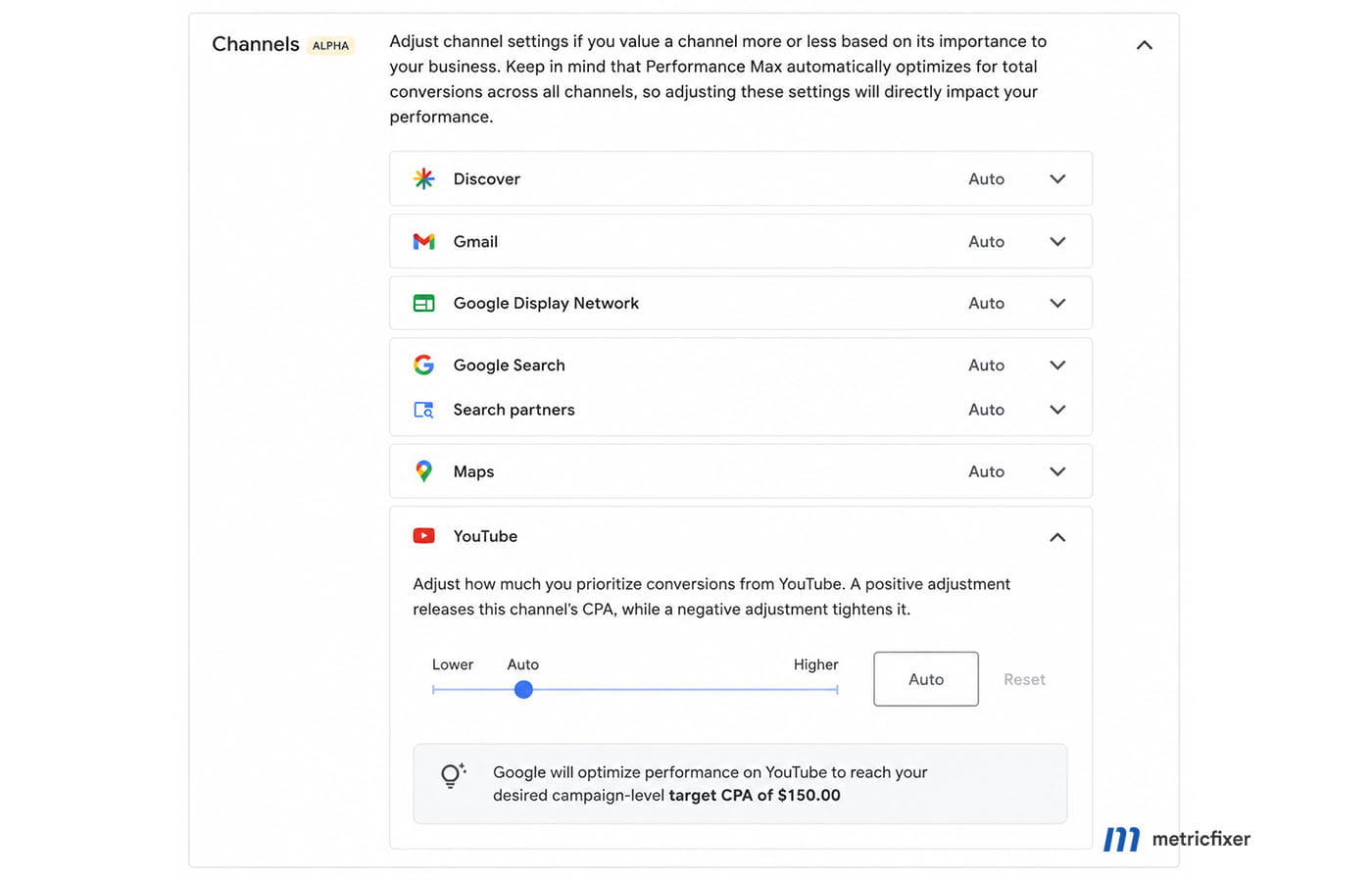
That distinction matters. The control does not appear to reserve 30% of spend for YouTube, force 50% into Search, or create a separate channel budget. It is better understood as a channel-specific preference applied inside campaign-level Smart Bidding. PMax still optimizes the campaign as a whole, and the final channel mix is still determined auction by auction.
The most important limitation is availability. There is currently no official Google Ads blog post or Help Center article announcing the Channels alpha, and Google has not published a date for a beta or global release. The public evidence supports only a limited alpha rollout. A LinkedIn post from early tester Heidi Sturrock says the feature is rolling out and recommends contacting a Google representative for access, but that should be read as alpha allowlisting rather than a promise of universal rollout.
| Question | What is known as of August 31, 2026 |
|---|---|
| Status | Alpha; limited-account experiment, not a standard PMax control. |
| Where it appears | Inside an individual Performance Max campaign under Campaign settings, in a new Channels section on eligible accounts. |
| Control | Reported as a Lower — Auto — Higher priority slider. |
| Mechanism | Higher priority relaxes the channel-specific CPA tolerance; lower priority tightens it. This influences Smart Bidding rather than assigning a fixed budget. |
| Channels reported | Search, Search partners, Discover, YouTube, Maps, Gmail and Display. Some alpha screenshots group Search with Search partners and Gmail with Display, so the final taxonomy is not settled. |
| Full exclusions | A separate Partners (Alpha) test can opt out of Search partners and the Google Display Network. It is not the same control. |
| General rollout date | Not announced. Google has not said when — or whether — every advertiser will receive it. |
| Public API support for priority | No documented public channel-priority field has been announced. The Ads API supports channel-level PMax reporting, which is a different capability. |
What changed in Performance Max?
The change is easier to understand in the context of how PMax controls have evolved. In April 2025, Google announced channel performance reporting for Performance Max. The report made Search, YouTube, Discover, Gmail, Display, Search partners and Maps visible as separate performance dimensions and was followed by further reporting improvements later in 2025.
In January 2026, Google extended that transparency to developers. Google Ads API v23 added channel-level reporting for PMax, replacing the older tendency to return a generic mixed-network view with explicit channel breakdowns.
Visibility, however, was not the same as control. The current Google Ads Help documentation for the PMax channel performance report still says advertisers cannot directly control budget allocation by channel. Google instead recommends influencing delivery through assets, audience signals, conversion tracking, Search themes and suitability or placement exclusions.
The new alpha adds a missing middle layer. Rather than simply observing where PMax spends, or trying to influence the mix indirectly, selected advertisers can now express a business preference at channel level.
How the alpha changes the workflow: channel performance report → identify a channel whose business value may be under- or over-represented → open the campaign’s Channels setting → choose Lower, Auto or Higher → Google changes the channel-specific CPA tolerance inside Smart Bidding → PMax continues optimizing total campaign conversions across all eligible channels.
Where is the new Channels setting in Google Ads?
In accounts where the alpha is enabled, the control has been reported inside an individual Performance Max campaign’s settings. The practical path is:
- Open Campaigns in Google Ads.
- Select the relevant Performance Max campaign.
- Open Campaign settings.
- Look for a section labelled Channels with an ALPHA badge.
- Expand a channel to review or change its priority from Auto toward Lower or Higher.
The exact navigation may still vary between alpha accounts because Google is testing the interface. One independent account report describes the new block directly in PMax campaign settings, while other screenshots present the channel cards as a dedicated settings area. That variation is normal for an alpha and is one reason not to document the UI as final.
Do not confuse this setting with the existing Channel performance report. The report is a generally available analytics view under Campaigns → Insights and reports → Channel performance; the alpha control is a campaign setting that changes optimization behavior. The two features are complementary, but they are not the same screen.

How channel prioritization appears to work
The safest interpretation of the alpha is channel-specific CPA tolerance, not a conventional manual bid adjustment. Public screenshots and reports describe a positive adjustment as relaxing the CPA the system is willing to accept for that channel, while a negative adjustment tightens it.
| Setting | Likely bidding effect | Practical meaning | What it does not guarantee |
|---|---|---|---|
| Higher | Relaxes the channel-specific CPA tolerance. | Google can pursue more conversions on that channel even if they are somewhat more expensive relative to the campaign target. | No fixed spend share, impression share or conversion volume. |
| Auto | Uses standard PMax optimization. | Google decides the channel mix using campaign goals, targets, signals and auction-time predictions. | No promise that every channel will spend. |
| Lower | Tightens the channel-specific CPA tolerance. | The channel must clear a stricter efficiency threshold, so PMax may become less willing to buy traffic there. | The channel is not necessarily disabled. |
This is why describing the feature simply as a “channel bid adjustment” can be misleading. Traditional bid adjustments often imply a transparent percentage applied to a base bid. PMax is built on auction-time Smart Bidding, and the alpha appears to alter the economic threshold used by that system rather than expose a manual channel bid.
The screenshots published so far are explicitly CPA-oriented, including examples that reference a campaign-level Target CPA. Public evidence is not yet sufficient to say exactly how the control behaves under Target ROAS, Maximize conversion value without a target, or every other eligible PMax bidding configuration. Google may support more combinations internally, but that has not been documented publicly.
Which channels are included?
Secondary reports list the same seven channel categories that Google exposes in PMax channel reporting:
- Google Search
- Search partners
- Discover
- YouTube
- Maps
- Gmail
- Google Display Network
There is, however, an alpha-stage inconsistency worth documenting. One account-level report from Spilno Agency shows Google Search + Search partners grouped together and Gmail + Google Display Network grouped together, while Search Engine Land and other coverage describe the channels individually. This may reflect different experiment variants, an evolving UI, or a difference between how the setting is displayed and how the channel taxonomy is reported.
For publication purposes, the safest conclusion is: the alpha targets the same broad PMax inventory families already visible in channel reporting, but Google has not finalized the public control model.
How this differs from the earlier Partners (Alpha) control
The Channels alpha is not Google’s first 2026 experiment with PMax inventory control. By mid-2026, some advertisers were already seeing a separate Partners (Alpha) setting that allows Search partners and the Google Display Network to be turned on or off.
| Control | What it changes | Type of control | Scope |
|---|---|---|---|
| Channels (Alpha) | How strongly PMax prioritizes conversions from a channel. | Graduated steering: Lower / Auto / Higher. | Reported across the main PMax channel families. |
| Partners (Alpha) | Whether PMax can use Search partners or the Google Display Network. | Binary inclusion/exclusion. | Search partners and GDN only. |
| Existing suitability and placement exclusions | Where ads should not appear for brand-safety or placement reasons. | Exclusion controls. | Specific inventory, placements, content categories and supported account/campaign settings. |
Search Engine Land reported in July that the Partners test was also limited to a small number of advertisers and that Google had not said when — or whether — it would roll out broadly. The same caution should be applied to Channels. Alpha status is not simply “a beta with fewer users”; an alpha experiment can change materially or never become a standard product.
When will channel prioritization be available to everyone?
There is no public date. As of August 31, 2026, Google has not announced a beta launch, general availability, a geographic rollout schedule, an account eligibility rule, or a deadline by which all PMax campaigns will receive the setting.
The strongest availability signal comes from Heidi Sturrock’s early-access post, which says the feature is rolling out and advises advertisers to contact their representative if they do not see it. That is useful operational advice, but it should not be interpreted as a standard rollout notice. In product terms, the feature is still visibly labelled ALPHA.
Google Ads’ own LinkedIn account replied publicly in the discussion around the feature, which is a useful sign that the test is real. But the company has not yet published the kind of Help Center or Ads & Commerce announcement that would establish final eligibility, behavior or timing.
For advertisers without a Google representative, there is currently no documented self-service switch or application form that guarantees access.

Why this test matters now
The timing is notable because Google has just changed the behavior of target-based bidding for budget-limited campaigns. Starting August 17, 2026, Google began rolling out changes designed to make campaigns using Target CPA or Target ROAS optimize more consistently toward the target entered by the advertiser. Google explicitly warns that multi-channel campaigns such as Performance Max and Demand Gen may see changes in traffic distribution across channels as a result.
That bidding update is documented in Google Ads Help and is separate from the Channels alpha. Google has not said the two releases are technically connected. Still, they point in the same product direction: targets are becoming more explicit and predictable, while advertisers are being given more visibility — and potentially more steering — over how a multi-channel campaign interprets those targets.
For a detailed explanation of the August bidding change, see metricfixer’s Google Ads Target-Based Bid Strategy Changes: What Advertisers Should Do Before August 2026. For a broader comparison of where Performance Max fits relative to Search, Display and Demand Gen, see Google Ads Formats Compared: Search, Display, Performance Max and Demand Gen.
The biggest risk: channel CPA is not channel value
The alpha will be tempting because the PMax channel report finally makes it easy to see cost, conversions and CPA by channel. The dangerous shortcut is to read that table as a ranking and immediately push down the most expensive channel.
Google’s own Performance Max FAQ explains why that can be wrong. PMax optimizes for marginal ROI, and average CPA or ROAS for an individual channel does not necessarily show its incremental value. A channel with a weaker average CPA can still contain auctions with strong marginal returns, or it can introduce users who later convert through another channel.
A common example is YouTube → Search. A customer may first discover a product through a video impression or engaged view, search for the brand later, and convert through Search. If an advertiser sees a high YouTube CPA and moves the YouTube priority sharply lower, the campaign may lose some of the demand that was feeding later Search conversions.
The new control therefore makes measurement quality more important, not less. Before using it aggressively, advertisers should check whether their conversion model captures offline outcomes, imported lead quality, conversion values, engaged-view conversions and other signals that reflect the real customer journey.
How we would test the Channels alpha
The safest way to use the feature is as a controlled steering experiment, not as a reaction to one week of channel-level CPA.
- [ ] Start with a stable baseline. Review at least several weeks of channel distribution, campaign CPA/ROAS, conversion volume and conversion lag before changing priority.
- [ ] Verify measurement first. Check primary conversion actions, conversion values, enhanced conversions, offline conversion imports and lead-quality feedback where relevant.
- [ ] Understand the channel’s role. Separate direct response from assist value. In particular, do not evaluate YouTube, Discover or Display only through last-touch intuition.
- [ ] Change one meaningful variable at a time. If several channels are moved simultaneously, it becomes difficult to know which change caused the new mix.
- [ ] Use small directional changes first. A modest move away from Auto is easier to diagnose than immediately pushing multiple channels to the extremes.
- [ ] Watch the whole campaign. Track total conversions, conversion value, CPA/ROAS, spend, channel distribution and volume — not just the edited channel.
- [ ] Watch business-quality metrics. For lead generation, compare qualified leads, opportunities and closed revenue. For ecommerce, compare gross margin or contribution value if available, not only platform revenue.
- [ ] Allow for learning and conversion delay. Google’s current PMax guidance recommends giving significant changes roughly one to two weeks to stabilize, and its August bidding guidance recommends evaluating over one to two conversion cycles.
- [ ] Record the original setting. Alpha behavior can change. Keep a change log with date, previous priority, new priority, campaign target and observed channel mix.
- [ ] Be prepared to return to Auto. If total campaign economics worsen even though the preferred channel receives more traffic, the steering decision is not working.
What is confirmed, and what is still unknown?
| Confirmed or strongly evidenced | Still unknown / not publicly documented |
|---|---|
| The feature exists in selected accounts and is labelled ALPHA. | When it will enter beta or general availability. |
| It appears in PMax campaign settings as a Channels control. | Whether every advertiser, market and vertical will ultimately receive it. |
| The UI uses a Lower — Auto — Higher priority concept. | The exact mathematical adjustment behind each slider position. |
| Public screenshots describe positive priority as relaxing CPA tolerance and negative priority as tightening it. | Full behavior under Target ROAS and target-free value bidding. |
| The control does not appear to assign a fixed budget percentage to a channel. | Whether Google will expose channel-priority controls through Ads Editor, Search Ads 360 or the Google Ads API. |
| PMax continues to optimize total campaign conversions across channels. | Whether Search partners and Search, or Gmail and Display, will remain grouped in some versions of the final UI. |
| Google already provides channel-level PMax reporting in the UI and API. | Whether Google will publish experiments, incrementality reporting or forecasting specifically for priority changes. |
What this says about the direction of Performance Max
For years, the central trade-off in Performance Max was reach and automation in exchange for less deterministic control. The product changes of 2025–2026 suggest Google is trying to reduce that tension without turning PMax into seven manually managed campaigns.
The sequence is increasingly clear:
- Channel visibility: channel performance reporting made the cross-channel mix observable.
- Developer visibility: the Ads API exposed channel breakdowns for reporting and analysis.
- Selective exclusions: the Partners alpha began testing binary network control for Search partners and GDN.
- Channel steering: the Channels alpha now tests whether advertisers can express relative business preference without taking channel allocation away from Smart Bidding entirely.
If the experiment survives alpha, this could become one of the most meaningful PMax controls since campaign-level negative keywords and improved channel reporting. It would let advertisers translate business knowledge that Google cannot always infer — for example, that Maps leads have unusually high store value, that YouTube creates profitable branded demand, or that a particular inventory family produces poor offline lead quality — into a direct optimization signal.
But the control also transfers more responsibility back to the advertiser. If the measurement model cannot see assisted demand or final revenue quality, channel steering can make a campaign look more efficient while reducing its true incremental value.

Bottom line
The new PMax Channels setting is real, but it should be described precisely: an early alpha that lets selected advertisers influence channel priority by changing the CPA tolerance Smart Bidding applies to a channel. It is not a fixed channel budget allocator, not a full manual placement system, and not yet a generally available Google Ads feature.
As of August 31, 2026, the setting appears inside eligible Performance Max campaign settings, uses a Lower/Auto/Higher model, and has been reported across Search, Search partners, Discover, YouTube, Maps, Gmail and Display inventory. Google has not announced when it will be available to everyone, and no public documentation guarantees that it will reach general availability at all.
For advertisers who receive access, the best first use is not “move money out of the channel with the worst CPA.” It is to combine channel reporting with business-quality data, understand cross-channel assists, make a small deliberate change, and judge the outcome at the total-campaign level.
Methodology and sources
This article was prepared from Google’s current Performance Max and Smart Bidding documentation, official Google Ads product and developer announcements, and multiple independent reports showing the August 2026 alpha interface. Because the Channels control has not yet been formally documented by Google, statements about the new setting are separated from established PMax behavior. Where early reports disagree — especially on whether some channel families are grouped — the article treats the interface as unfinished rather than choosing one alpha variant as final.
- Google Ads Help: About the channel performance report for Performance Max
- Google Ads Help: Answering your top questions about Performance Max
- Google Ads Help: About Performance Max campaigns
- Google Ads Help: Changes to target-based bid strategies
- Google Ads & Commerce: Channel performance reporting coming to Performance Max
- Google Ads Developer Blog: Channel-level reporting for Performance Max
- Search Engine Land: Google tests channel prioritization controls for Performance Max
- Search Engine Roundtable: Google Ads Channel Settings Prioritization Slider (Alpha Test)
- Heidi Sturrock: early account view of the PMax channel-prioritization setting
- Spilno Agency: account-level review of Performance Max Channel Controls (Alpha)
- Search Engine Land: Performance Max Partners (Alpha) network controls
- PPC News Feed: August 31 coverage of Performance Max channel prioritization
This article is for advertising, analytics, and operational information only. metricfixer is not affiliated with Google or the third-party publishers cited above. The PMax Channels feature discussed here is an alpha experiment and may change, be limited to selected accounts, or be withdrawn without notice. Interface labels, supported channels, bidding behavior, eligibility and rollout plans may change after publication. Before making material bidding changes, validate conversion tracking and evaluate the effect on total campaign and business outcomes rather than channel-level CPA alone.