
Published Jul 19, 2026
Search Ads 360 vs Google Ads Search: Auctions, Bidding, Costs, and Best Fit
A practical comparison of Search Ads 360 and native Google Ads Search, covering auctions, bidding, measurement, fees, CPA and ROAS potential, entry threshold, and advertiser fit.
Category: Online advertising · By Mikalai Sasau
This guide compares Search Ads 360, sometimes referred to as Google Search Ads 360, with running Search campaigns directly in Google Ads. It explains whether the auction changes, how bidding and budget optimization differ, when Search Ads 360 can improve CPA or ROAS, what the extra platform cost means, and which option is the better fit for different advertisers.
Practical default: if most of your paid-search activity is in Google Ads, your conversion setup is straightforward, and one team can manage the account without major workflow problems, start with native Google Ads. Evaluate Search Ads 360 when you need to manage several search engines, many accounts or markets, shared Floodlight measurement, enterprise budget pacing, or portfolio optimization around more complex business goals.
Executive summary
Search Ads 360 is not a second search network and it does not run a separate Google auction. It is an enterprise campaign-management, measurement, reporting, and optimization layer that connects to advertising-platform accounts. A Google Ads Search campaign managed through Search Ads 360 still enters the normal Google Ads auction. The same Google Ads rules determine eligibility, Ad Rank, placement, and actual CPC.
The most important difference is therefore not “where the ad appears,” but how the advertiser manages data, goals, budgets, and portfolios before the bid reaches the auction. Native Google Ads already includes strong Smart Bidding, portfolio strategies, cross-account bidding through a manager account, cross-account conversion tracking, shared budgets, experiments, automated rules, scripts, and offline-conversion imports. For a Google-only advertiser, this is often enough.
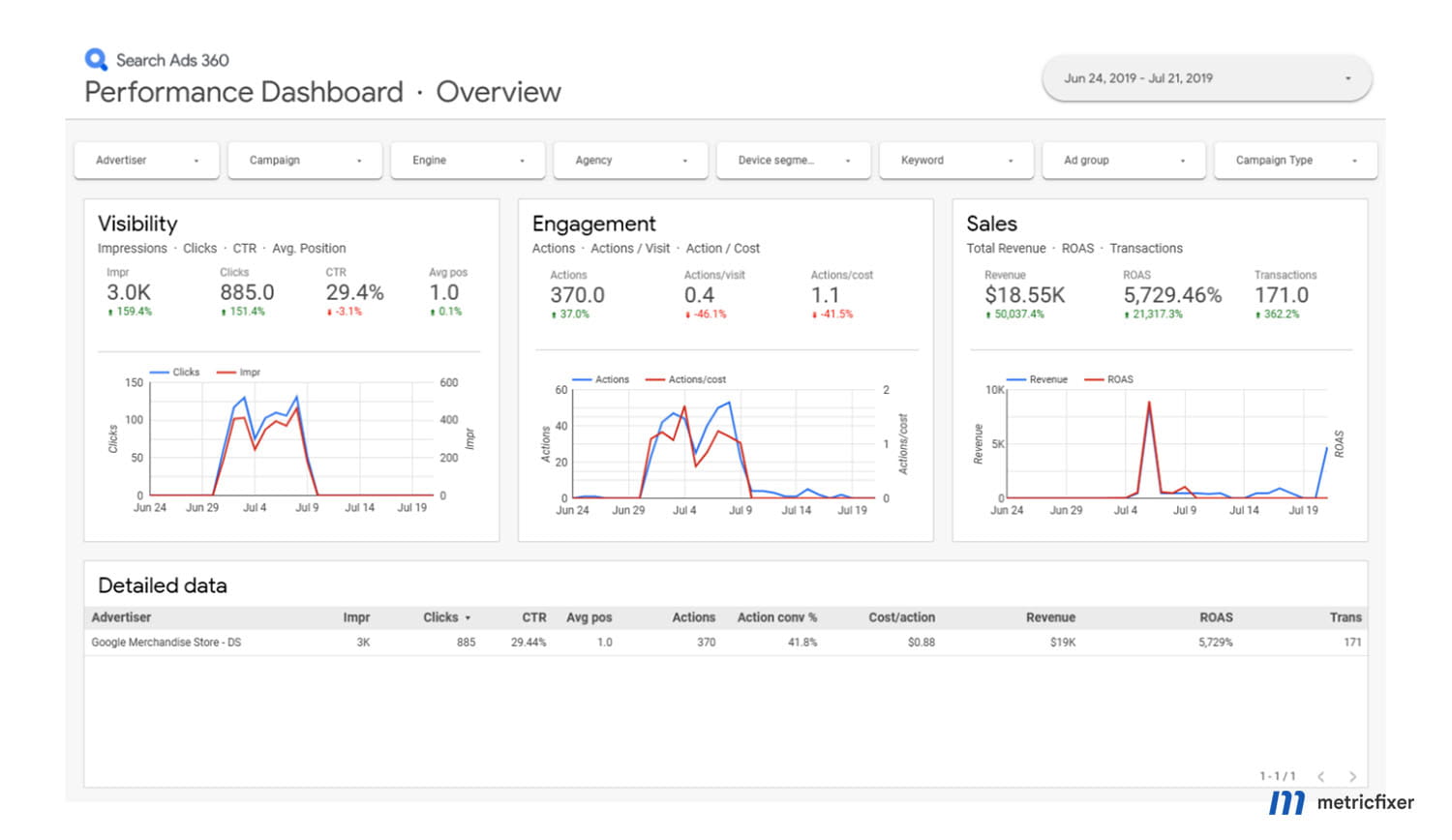
Search Ads 360 adds value when the problem is broader. It can manage and report on supported features across Google Ads, Microsoft Advertising, Yahoo! JAPAN Ads, and Baidu, while also supporting limited workflows for other platforms and engine-track reporting. It adds Search Ads 360 portfolio strategies, cross-engine optimization, budget plans and budget bid strategies, Floodlight measurement shared with Campaign Manager 360 and Display & Video 360, custom conversion variables, large-scale templates, and enterprise reporting.
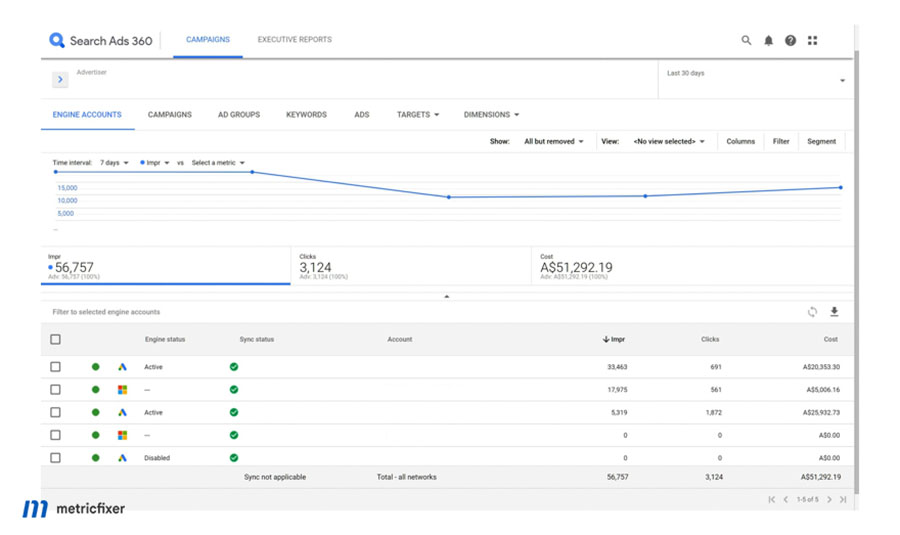
There is no universal CPA or ROAS winner. Search Ads 360 does not receive cheaper Google traffic and does not get a ranking preference. It can produce a lower blended CPA or higher blended ROAS when its broader data, portfolio structure, budget allocation, or operational controls lead to better decisions. It can also produce the same media performance as Google Ads while delivering a worse fully loaded result after the Search Ads 360 fee, implementation work, and additional management complexity are included.
The strongest default recommendation is:
- Choose Google Ads for a Google-only or mostly Google-only program with standard conversion tracking, a manageable account structure, and no clear enterprise workflow problem.
- Evaluate Search Ads 360 for multi-engine paid search, many brands or markets, complex revenue or profit signals, shared Google Marketing Platform measurement, strict monthly or quarterly budget pacing, and agency-scale operations.
- Do not decide from product positioning alone. Run a controlled test and compare fully loaded CPA, fully loaded ROAS, conversion quality, incremental volume, budget pacing, and the hours saved by the team.
What exactly is being compared?
Google Ads Search campaigns
Google Ads is the advertising platform that creates and serves campaigns across Google properties and partner inventory. For a Search campaign, ads can appear on Google Search and, depending on campaign settings, on Google search partner sites. Google Ads owns the auction, evaluates ad eligibility and quality, calculates Ad Rank, sets or accepts bids, records media cost, and charges the advertiser for eligible interactions.
Native Google Ads is not limited to one small account. A Google Ads manager account can organize multiple child accounts. Google Ads also supports cross-account bid strategies, cross-account conversion tracking, manager-level reporting, automated rules, and scripts. This matters because “many Google Ads accounts” by itself is no longer enough to prove that Search Ads 360 is necessary.
Search Ads 360
Search Ads 360 is part of Google Marketing Platform and is designed for enterprise search-campaign management. It connects a Search Ads 360 client account to an external advertising-platform account. Search Ads 360 can then synchronize supported campaigns, apply settings, collect performance data, report conversions, and manage supported bidding and budget workflows.
According to Google’s current supported-platform overview, Search Ads 360 can manage and report on a limited set of features in Google Ads, Microsoft Advertising, Baidu, Facebook, Yahoo! JAPAN Ads, and engine-track accounts. For the core paid-search use case, the most relevant managed engines are Google Ads, Microsoft Advertising, Yahoo! JAPAN Ads, and Baidu. Support is not identical across engines, and not every native platform feature is available in Search Ads 360.
Search Ads 360 also has a more formal account and measurement structure. Manager accounts contain sub-manager and client accounts, and each Search Ads 360 sub-manager has a one-to-one relationship with a Campaign Manager 360 advertiser so that Search Ads 360 can use the relevant Floodlight configuration.
How the delivery flow works: the advertiser or agency configures a campaign, goal, portfolio, or budget plan in Search Ads 360 → Search Ads 360 passes supported settings to the connected Google Ads or other engine account → the advertising engine decides whether the ad is eligible and runs its own auction → the user clicks the ad → the engine records media cost → Google Ads conversion tracking, GA4, or Floodlight records the result → conversion data returns to the bidding and reporting systems.
The practical consequence is simple: Search Ads 360 can influence inputs and portfolio-level decisions, but the connected advertising engine still serves the ad and runs the auction.
Does Search Ads 360 use a different auction?
No. A Google Ads Search campaign does not enter a special Search Ads 360 auction. Google Ads runs an auction when a person searches, and it can run separate auctions for different ad locations on the results page. Google calculates Ad Rank using factors that include the bid, ad and landing-page quality, Ad Rank thresholds, auction competitiveness, the context of the search, and the expected impact of assets and other formats.
Managing the campaign through Search Ads 360 does not create a Quality Score bonus, a lower Ad Rank threshold, a priority lane, or a special CPC discount. If two otherwise identical Google Ads campaigns use the same targeting, ads, landing pages, budgets, conversion goals, and effective bids, the one connected to Search Ads 360 does not win merely because Search Ads 360 is present.
What Search Ads 360 auction-time bidding actually means
The phrase “Search Ads 360 auction-time bidding” can cause confusion. Google’s documentation explains that auction-time bidding is a Google Ads Smart Bidding capability. When a compatible Search Ads 360 strategy uses Google Ads auction-time bidding, the two systems divide the work:
- Search Ads 360 analyzes the broader portfolio and sets high-level goals, such as campaign targets, portfolio ROI targets, or budget objectives.
- Google Ads uses real-time query and user-context signals to set an individual bid at the moment of each Google Ads auction.
- Search Ads 360 reads the resulting performance and can continue adjusting higher-level targets to pursue the portfolio objective.
Compatible Search Ads 360 strategies currently include Target CPA and Target ROAS, plus budget bid strategies using Maximize conversions or Maximize conversion value. Conversion-data sharing must be enabled, and the conversion actions used for optimization must be configured as biddable goals.
If Google Ads auction-time bidding is not used, a Search Ads 360 strategy may use intraday bidding. Google states that intraday bidding can update bids every six hours, while auction-time bidding sets the bid during each auction. This is a meaningful technical difference, but it still does not create a separate auction: it changes how frequently and where the bid is calculated.
Cross-engine optimization does not merge auctions
Search Ads 360 can place campaigns from several supported engines into one portfolio. That does not combine Google, Microsoft, Yahoo, and Baidu into one marketplace. Each engine still runs its own auction, has its own available demand and users, applies its own eligibility and ranking logic, and charges media cost under its own account.
The value of Search Ads 360 is that it can pursue a shared business objective across those separate auctions. A combined strategy may use Google Ads auction-time bidding for Google campaigns, Microsoft Advertising auction-time bidding for eligible Microsoft campaigns, and intraday bidding for other supported campaigns. Search Ads 360 can then adjust targets or allocation so that the portfolio as a whole moves toward the desired CPA, ROAS, conversion volume, or spend.
| Question | Answer |
|---|---|
| Does Search Ads 360 unlock extra Google Search inventory? | No. Google Search and search-partner inventory are controlled by the Google Ads campaign and its network settings. |
| Does Search Ads 360 lower the Google Ads auction price? | No automatic discount or auction preference is documented. CPC still follows Google Ads auction mechanics. |
| Can Search Ads 360 change the bid used in Google? | Yes, through supported strategy settings. With auction-time bidding, Google Ads calculates the final per-auction bid using Google Ads signals and the goals shared from Search Ads 360. |
| Can Search Ads 360 optimize across Google and Microsoft? | Yes, at the portfolio and goal level, while each engine continues to run a separate auction. |
| Can a connected Google Ads account still be managed natively? | Yes. The underlying Google Ads account remains active, and Google Ads accounts are continuously synchronized with Search Ads 360. Clear governance is needed so teams do not make conflicting changes. |
Bidding and optimization options
Optimization available directly in Google Ads
Google Ads already provides a broad optimization toolkit for Search campaigns. Its Smart Bidding strategies use Google AI to optimize for conversions or conversion value in each auction. The core conversion-focused options are:
- Maximize conversions for the highest conversion volume available within the budget.
- Target CPA for conversion volume around an average acquisition-cost target.
- Maximize conversion value for the highest reported conversion value available within the budget.
- Target ROAS for conversion value around a return-on-ad-spend target.
Google Ads also offers Maximize clicks, Target impression share, and Manual CPC where supported. During Google’s 2026 interface transition, the labels shown for Target CPA and Target ROAS may differ between accounts, but the underlying conversion and conversion-value goals remain the important distinction.
These strategies can be applied to one campaign, to several campaigns in an account through a portfolio strategy, or to campaigns across several Google Ads customer IDs through a manager-level cross-account strategy. Google Ads also provides shared budgets that can reallocate unused budget between campaigns in the same account.
For measurement, Google Ads can use native conversion actions, imported GA4 key events, website and app conversions, phone conversions, store-related conversions where eligible, and offline conversions. Google currently recommends enhanced conversions for leads as the upgraded route for many lead-generation advertisers that need to return qualified leads, opportunities, or closed sales to Google Ads.
Operationally, Google Ads also supports:
- manager-account reporting and permissions;
- automated rules and scheduled changes;
- Google Ads scripts across multiple child accounts;
- bulk changes through Google Ads Editor and uploads;
- campaign experiments and bid-strategy reports;
- data exclusions and seasonality adjustments for eligible automated bidding;
- conversion value rules and business-goal settings.
For an advertiser that only buys Google media, this is a strong baseline. Search Ads 360 should be compared with this full native toolkit—not with a single manually managed Google Ads campaign.
Optimization added by Search Ads 360
Search Ads 360 offers two broad bidding routes. First, it can display and manage Google Ads-owned bid strategies. In that case, Google Ads remains fully responsible for optimization, and the strategy does not use Search Ads 360 portfolio features. Second, the advertiser can use Search Ads 360-owned portfolio and budget strategies.
The main Search Ads 360 optimization layers are:
Portfolio bidding across a wider scope
Search Ads 360 portfolio strategies can group campaigns around a common business goal. The platform can optimize the portfolio as a whole, which means individual campaigns do not necessarily reach the same CPA or ROAS. One campaign may run above the portfolio target while another runs below it, provided the combined result moves toward the overall goal.
Current Search Ads 360 portfolio options include Target CPA, Target ROAS, Maximize conversions, Maximize conversion value, Maximize clicks, Target impression share, and budget bid strategies. Google has also added Multiple Target CPA and Multiple Target ROAS. These can preserve different targets for sub-portfolios—such as brand and generic search—while optimizing the wider portfolio toward a shared objective.
Cross-engine bidding
A Search Ads 360 portfolio can include supported campaigns from different search engines. This is one of the clearest differences from Google Ads manager-account bidding, which can optimize across Google Ads customer IDs but not across Microsoft, Yahoo, or Baidu accounts.
Cross-engine optimization is most useful when the advertiser cares about a blended outcome—for example, total qualified leads at a target CPA across Google and Microsoft—rather than forcing every engine to hit the same daily spend or stand-alone efficiency.
Budget plans, pacing, and budget bid strategies
Search Ads 360 can organize campaigns into campaign groups and performance plans for a defined period such as a month or quarter. A budget bid strategy can adjust individual campaign budgets, bids, and supported bid adjustments to pursue a target spend and performance objective.
This is more than a dashboard showing whether the account is overspending. It is designed to manage pacing and allocation across a portfolio over a planned period. It is especially relevant to advertisers with fixed monthly, quarterly, regional, or brand budgets where underspend is almost as problematic as overspend.
Floodlight and richer business inputs
Floodlight is the shared conversion system for Google Marketing Platform. It provides a common measurement layer across Campaign Manager 360, Display & Video 360, and Search Ads 360. This can help a large advertiser use a more consistent conversion definition and reduce channel-by-channel duplication in reporting.
Custom Floodlight variables can pass details such as shipping cost, product category, customer value, new-customer status, or other conversion attributes. Search Ads 360 can use custom metrics, dimensions, and value adjustments to move optimization closer to commercial value rather than relying only on a basic lead count or gross transaction revenue.
Templates and enterprise workflow automation
Search Ads 360 templates can use a feed and formulas to generate or update campaigns, ad groups, ads, and other supported entities across several advertising platforms. This is useful for large product catalogs, travel inventory, locations, marketplaces, frequently changing offers, and agencies that need repeatable structures across clients or markets.
The platform also adds bulk actions across accounts and engines, scheduled edits, custom dimensions, centralized reports, APIs, recommendations, and ownership controls. These features may not directly lower a bid, but they can reduce stale ads, missed launches, budget errors, inconsistent naming, and slow response times—operational problems that can eventually affect performance.
Important optimization caveats
- More controls do not automatically mean better performance. A poorly designed Search Ads 360 portfolio can pool campaigns with different margins, conversion delays, or business goals and make optimization less useful.
- Data volume still matters. Google states that Search Ads 360 predictive bidding needs sufficient clicks and conversions. Low-volume portfolios do not become statistically strong merely because they are placed in an enterprise platform.
- Offline data must arrive reliably. A strategy that depends on qualified-lead or revenue uploads can stop learning correctly when those uploads are delayed or incomplete.
- Manual overrides are limited under auction-time bidding. Auction-time bids and many adjustments cannot be manually overwritten, even if an interface accepts a value that the bidding system later ignores.
- Feature support is not identical across engines. Search Ads 360 manages a limited set of platform features, and some campaign types have partial Floodlight or bidding support. New native features may require work in the original engine interface.
- Synchronization adds another failure mode. External-platform changes, unsupported settings, tracking-template changes, and sync errors can produce reporting or configuration differences that do not exist in a Google Ads-only workflow.
Conversion measurement and attribution
The quality of the conversion signal usually matters more than the name of the interface used to manage the campaign. Both products can perform poorly when the advertiser optimizes to form submissions that include spam, values every lead equally, ignores cancellations and returns, or uploads offline revenue too late.
When Google Ads measurement is enough
For a Google-only advertiser, native Google Ads conversion tracking can be sufficient. A manager account can share conversion actions across child accounts, and Google Ads can optimize to primary conversion goals, imported GA4 events, enhanced conversions, and offline lead or sales outcomes. A business does not need Search Ads 360 merely to send a closed-sale value back to Google Ads.
Google Ads is often the simpler option when:
- all important media is bought in Google Ads;
- the advertiser already has reliable first-party conversion and revenue data;
- cross-channel deduplication is handled elsewhere or is not a material problem;
- the same commercial goal can be expressed with native conversion values and account-level settings.
When Floodlight and Search Ads 360 matter
Floodlight becomes more valuable when search is part of a larger Google Marketing Platform setup. The same conversion framework can be used across paid search, display, video, and Campaign Manager reporting. For an advertiser already using Campaign Manager 360 and Display & Video 360, this can reduce inconsistent tags, attribution definitions, and duplicated conversions between teams.
Search Ads 360 can report Floodlight, Google Analytics, GA4, and Google Ads conversion actions. Custom Floodlight variables can add business context that is difficult to preserve in a basic conversion count. Examples include:
- gross margin instead of gross revenue;
- new customer versus returning customer;
- approved loan value rather than submitted application count;
- qualified opportunity stage rather than raw lead count;
- shipping, returns, or product-category information;
- store, region, franchise, or business-unit attributes.
However, Floodlight is not automatically “more accurate.” It is a different measurement architecture. The advertiser still needs correct tagging, consent handling, transaction IDs, offline-data governance, attribution settings, and a clear definition of which conversion is primary.
Why CPA and ROAS can look different even when performance is unchanged
Before comparing platforms, align the reporting definitions. Search Ads 360 reports conversions by click date by default, while conversion-time columns can be added. Other interfaces may use different default date alignment, attribution windows, time zones, currencies, conversion sets, or modeled-conversion treatments.
A credible comparison should use the same:
- conversion actions and primary-goal settings;
- conversion window and attribution model;
- click-date or conversion-date basis;
- currency and tax treatment;
- revenue, margin, cancellation, and return logic;
- brand and non-brand segmentation;
- media-cost and platform-fee treatment.
Google Ads Search vs Search Ads 360: side-by-side comparison
| Dimension | Google Ads Search | Search Ads 360 |
|---|---|---|
| Product role | Advertising platform, inventory access, auction, media billing, native campaign management. | Enterprise management, measurement, reporting, bidding, and planning layer connected to external advertising-platform accounts. |
| Google auction | Google Ads runs it. | The connected Google Ads campaign enters the same Google Ads auction. |
| Google inventory | Google Search and optional search partners, depending on campaign settings. | No additional Google inventory merely from using Search Ads 360. |
| Supported engines | Google Ads only. | Supported workflows across Google Ads, Microsoft Advertising, Yahoo! JAPAN Ads, Baidu, and limited additional reporting or platform features. |
| Auction-time bidding | Native Google Ads Smart Bidding sets bids for each eligible auction. | Can combine Search Ads 360 portfolio goals with Google Ads or Microsoft auction-time execution for supported campaigns. |
| Portfolio scope | Campaign, account, and Google Ads manager-account portfolios. | Search Ads 360 portfolios can span supported engines and broader enterprise structures. |
| Budget management | Campaign budgets, shared budgets within an account, portfolio bidding, forecasts, and native recommendations. | Performance plans, campaign groups, pacing, and budget bid strategies that can adjust campaign budgets and bids over a plan period. |
| Conversion system | Google Ads conversions, GA4 imports, enhanced conversions, offline imports, and cross-account conversion tracking. | Floodlight, Google Ads conversions, GA4 and other supported sources, with shared Google Marketing Platform measurement and custom variables. |
| Automation | Editor, uploads, scripts, API, rules, experiments, and manager-account workflows. | Cross-engine bulk actions, templates, scheduled edits, enterprise reporting, custom dimensions, APIs, and portfolio experiments. |
| Feature freshness | Native Google Ads features generally appear here first and have full native support. | Support depends on Search Ads 360 integration and may be partial for some campaign types or engine features. |
| Platform cost | No separate Search Ads 360 platform fee; media and any chosen agency or third-party costs remain. | Negotiated contract; fee calculated as a percentage of eligible media spend, with a possible minimum service fee. |
| Setup complexity | Low to moderate, depending on account and measurement design. | Higher: contract, account hierarchy, linked platform accounts, Campaign Manager 360 advertiser relationship, Floodlight and governance. |
| Best fit | Small to large Google-focused advertisers whose needs are covered by native Google Ads and manager-account tools. | Large advertisers and agencies with multi-engine, multi-market, complex measurement, budget-governance, or Google Marketing Platform requirements. |
Which option can achieve a lower CPA or higher ROAS?
Neither product has an inherent performance advantage in the Google auction. Search Ads 360 can improve the decisions surrounding the auction, but it cannot buy the same Google impression at a secret enterprise price.
The correct answer depends on what is being held equal:
- the same Google Ads media budget;
- the same total budget including platform fees;
- the same conversion definition and attribution model;
- the same target CPA or ROAS;
- the same conversion volume and commercial quality;
- the same campaign mix, including brand and non-brand traffic.
Situations where Search Ads 360 can produce a better result
- Cross-engine budget allocation: the platform can pursue a blended target across Google, Microsoft, Yahoo, or Baidu instead of optimizing each engine in isolation.
- Better commercial data: Floodlight and custom variables can let bidding optimize toward profit, qualified revenue, new customers, or offline outcomes rather than a shallow conversion.
- Large portfolio learning: campaigns with the same business goal can be managed as one portfolio, potentially giving the strategy more useful aggregated performance history.
- Different sub-portfolio targets: Multiple Target CPA or Multiple Target ROAS can preserve different economics for brand, generic, product, market, or margin groups while optimizing the wider portfolio.
- Budget pacing: a budget bid strategy can reduce expensive underspend, late-month overspend, and manual reallocation across many campaigns.
- Operational speed and consistency: templates, bulk workflows, and common reporting can reduce mistakes and shorten the time needed to respond to inventory, price, promotion, or market changes.
- Cross-channel measurement: an advertiser already using Campaign Manager 360 and Display & Video 360 can work from a more consistent conversion layer.
Situations where native Google Ads can produce a better result
- Single-engine simplicity: if the program is Google-only, Google Ads already has direct access to auction-time signals, manager-level portfolios, shared conversions, and strong automation.
- No incremental data advantage: if Search Ads 360 receives the same conversion data and uses the same Google Ads auction-time execution, the extra management layer may not improve bidding.
- Platform-fee pressure: identical media performance produces a worse fully loaded CPA and ROAS after the Search Ads 360 fee is added.
- Low conversion volume: neither platform can manufacture reliable learning from too few meaningful conversions, but Search Ads 360 adds cost and setup effort.
- Limited team capacity: a complex platform that is poorly configured or rarely monitored can perform worse than a simpler native account managed well.
- Need for immediate native feature access: some new or specialized Google Ads features may be available sooner or more completely in Google Ads.
Equal-budget math: media budget vs all-in budget
Search Ads 360 fees are contract-specific. Let f represent the contractual Search Ads 360 fee as a share of eligible media spend. The following logic excludes taxes, partner fees, implementation, and internal labor so the comparison stays simple.
Case 1: equal media budget
If both setups spend the same amount inside Google Ads, the Search Ads 360 setup has a higher total cost because the platform fee is added on top.
Fully loaded CPA = (media spend + Search Ads 360 fee + incremental management cost) / conversions
Fully loaded ROAS = revenue / (media spend + Search Ads 360 fee + incremental management cost)
If campaign revenue and conversions do not change, fully loaded CPA becomes worse and fully loaded ROAS becomes lower under Search Ads 360.
Case 2: equal total budget
If the advertiser has one fixed total budget that must include the Search Ads 360 fee, less money remains for media:
Available media spend = total budget / (1 + f)
For a purely illustrative example, assume a total budget of $100,000 and a hypothetical fee rate of 3%. This is not a Google list price.
- Available media spend would be approximately $97,087.
- The Search Ads 360 fee would be approximately $2,913.
- To generate the same number of conversions, media CPA would need to improve by about 2.9% before implementation or management costs.
- To generate the same revenue, media ROAS would need to improve by about 3% before other costs.
The real break-even requirement is therefore:
Incremental gross profit + operational savings > platform fee + implementation cost + incremental operating cost
This is why a small change in dashboard ROAS is not enough. The advertiser should calculate profit after fees, returns, discounts, cost of goods, agency costs, and the value of staff time saved.
Likely outcome by scenario
| Scenario | Likely starting choice | Reason |
|---|---|---|
| One Google Ads account, one market, standard ecommerce revenue | Google Ads | Native Target ROAS or Maximize conversion value usually covers the core need without an enterprise fee. |
| Several Google Ads accounts under one business, same conversion goal | Google Ads manager account first | Cross-account Smart Bidding and conversion tracking may solve the problem without Search Ads 360. |
| Google and Microsoft campaigns managed to one blended lead target | Evaluate Search Ads 360 | Cross-engine portfolio optimization and unified reporting can add value. |
| Global brand with many markets, currencies, agencies, and fixed quarterly budgets | Evaluate Search Ads 360 | Planning, pacing, governance, hierarchy, and repeatable workflows may justify the platform. |
| Advertiser already using Campaign Manager 360 and Display & Video 360 | Evaluate Search Ads 360 | Shared Floodlight measurement and Google Marketing Platform integration become more valuable. |
| Low-volume B2B account with a few qualified opportunities per month | Google Ads plus better offline measurement | The main limitation is signal volume and quality, not the lack of an enterprise interface. |
| Large catalog with rapidly changing products, locations, or offers | Evaluate Search Ads 360 | Templates and bulk automation may create significant operational and performance value. |
| Strict all-in budget with no demonstrated Search Ads 360 uplift | Google Ads | The platform fee reduces media capacity unless better performance or operational savings offset it. |
Cost and entry threshold
Google Ads entry threshold
Google Ads lets the advertiser choose the average daily campaign budget, and Google states that the amount is entirely up to the advertiser. There is no separate Search Ads 360 enterprise-platform contract required to run a native Search campaign.
The practical threshold is not zero, however. A campaign still needs enough budget to enter relevant auctions, collect meaningful clicks, and generate enough valuable conversions for evaluation. A daily budget that is far below the target CPA can make learning slow and results unstable. The appropriate level depends on search demand, CPC, conversion rate, sales cycle, and the value of the outcome.
Search Ads 360 entry threshold
Search Ads 360 has no universal public list price or one published minimum media-spend threshold that applies to every advertiser. Google’s current billing documentation says that the business negotiates and signs a contract, that the Search Ads 360 fee is calculated as a percentage of eligible media spend, and that some contracts include a monthly or annual Minimum Service Fee.
Access is positioned as an enterprise sale through Google or a Google Marketing Platform Sales Partner. Commercial terms, support, minimums, and implementation arrangements can therefore vary by advertiser, country, partner, and contract.
The account structure also requires more setup. Each Search Ads 360 sub-manager is linked to a Campaign Manager 360 advertiser for Floodlight configuration. The advertiser then links client accounts for Google Ads or other supported engines, configures measurement and permissions, and establishes ownership and synchronization rules.
The five real thresholds to evaluate
| Threshold | What to ask | Why it matters |
|---|---|---|
| Commercial threshold | What are the contractual percentage, minimum service fee, partner fee, and support terms? | The platform must create more incremental profit or savings than its fully loaded cost. |
| Data threshold | Are there enough clicks, conversions, and conversion value across a coherent portfolio? | Automated bidding needs meaningful history; a larger interface does not solve sparse data. |
| Complexity threshold | Are several engines, accounts, markets, brands, currencies, or teams creating real management friction? | Search Ads 360 is strongest when complexity has a measurable cost. |
| Measurement threshold | Is shared Floodlight measurement, cross-channel reporting, or custom conversion data necessary? | Better business signals can justify the platform even when media spend alone does not. |
| Operating threshold | Can the team implement, govern, test, and maintain Search Ads 360 correctly? | Enterprise tools create value only when the organization can use them consistently. |
A useful economic screening rule is:
- Do not buy Search Ads 360 only because spend is “large.”
- Do not reject it only because one account is small.
- Buy it when the expected annual value of better allocation, measurement, control, and saved labor clearly exceeds the annual platform and implementation cost.
Which advertisers are the best fit?
Google Ads is usually the better fit for
- small and mid-sized businesses advertising mainly on Google;
- local service businesses with one or a few markets;
- startups that need a fast setup and flexible spend;
- ecommerce advertisers whose main goal is already represented by reliable Google Ads revenue values;
- B2B advertisers that can return qualified leads or sales through enhanced conversions for leads;
- in-house teams that can manage their account structure with a Google Ads manager account, Editor, scripts, rules, and native reporting;
- advertisers that need full access to new Google Ads features as soon as they are released;
- businesses for which an additional platform fee would consume a material share of the optimization opportunity.
Search Ads 360 is usually the better fit for
- large advertisers operating across Google, Microsoft, Yahoo! JAPAN, or Baidu;
- global brands with many countries, languages, business units, and account owners;
- agencies managing many enterprise advertisers and requiring repeatable workflows and permissions;
- retail, travel, marketplace, automotive, or local-inventory advertisers with large and frequently changing feeds;
- advertisers with fixed monthly or quarterly budgets that require active pacing and reallocation;
- businesses that optimize to margin, approved revenue, lifetime value, new customers, store outcomes, or other advanced conversion variables;
- organizations already using Campaign Manager 360, Display & Video 360, and Floodlight;
- teams that need a consistent reporting and bidding layer across separate search engines.
The hybrid reality
Using Search Ads 360 does not eliminate the underlying Google Ads account. Teams may still need Google Ads for unsupported settings, newly released features, diagnostics, policy work, asset management, or campaign experiments. Search Ads 360 should therefore be treated as an additional control layer, not as a complete replacement for native platform knowledge.
A mature operating model usually defines:
- which settings are owned in Search Ads 360;
- which settings may be changed directly in Google Ads or another engine;
- who owns conversion goals and Floodlight;
- who approves bid-strategy and budget changes;
- how sync errors and reporting discrepancies are investigated;
- which platform is the source of truth for each KPI.
How to test Search Ads 360 without guessing
The only reliable way to answer the CPA or ROAS question for a specific advertiser is a controlled evaluation. Google supports portfolio experiments in Search Ads 360 and campaign experiments in connected platforms. Google’s own guidance also recommends allowing a new Search Ads 360 portfolio strategy to run for two to three conversion-delay cycles before assessing performance.
- Define one commercial KPI. Use qualified CPA, contribution margin, profit-adjusted ROAS, new-customer value, or another outcome that reflects the business—not only the easiest conversion to count.
- Align the measurement. Confirm the same attribution model, conversion window, date basis, values, currencies, and primary-goal settings in both test arms.
- Choose comparable campaigns. Keep brand and non-brand separated, avoid mixing very different margins or sales cycles, and control for geography and seasonality.
- Hold the budget rule constant. Decide whether the test uses equal media spend or equal fully loaded spend. Do not switch between the two after results appear.
- Use an experiment where possible. A traffic split is more credible than a simple before-and-after comparison.
- Allow learning and conversion delay. Do not judge the first few days, especially when offline revenue arrives slowly.
- Measure scale as well as efficiency. A lower CPA with sharply lower qualified volume may not be a better business result.
- Include all costs. Add Search Ads 360 fees, partner fees, implementation, extra tagging, reporting work, and ongoing platform administration.
- Count operational value. Include hours saved, fewer launch errors, better budget compliance, and faster multi-market changes—but document the assumptions.
- Set a decision threshold in advance. Specify the minimum profit uplift, CPA reduction, ROAS increase, or labor saving required to adopt the platform.
Decision workflow: confirm that native Google Ads manager-account tools do not already solve the problem → obtain the real Search Ads 360 contract and minimum-fee terms → estimate implementation and operating cost → identify the specific additional value expected from cross-engine bidding, Floodlight, budget pacing, or templates → run a controlled test on a coherent portfolio → compare fully loaded economics and operational savings → scale only if the measured benefit exceeds the total cost.
Decision checklist
Stay with or start in Google Ads when:
- [ ] Almost all paid-search spend is in Google Ads.
- [ ] Native Smart Bidding and manager-account portfolios cover the required optimization scope.
- [ ] Google Ads or GA4 conversion data accurately represents the business outcome.
- [ ] Shared budgets, rules, scripts, Editor, and reporting solve the operational problem.
- [ ] The team wants the lowest setup complexity and fastest access to native features.
- [ ] The expected efficiency uplift is unlikely to cover the Search Ads 360 fee and migration cost.
Shortlist Search Ads 360 when:
- [ ] Google and at least one other supported search engine need one operating and reporting layer.
- [ ] Many accounts, markets, brands, or agencies create measurable workflow and governance costs.
- [ ] Campaigns should be optimized to one blended portfolio outcome across engines.
- [ ] Monthly or quarterly budget pacing requires frequent reallocation across campaigns.
- [ ] Floodlight and Google Marketing Platform integrations are strategically important.
- [ ] Conversion quality depends on custom variables, offline outcomes, profit, or customer value.
- [ ] Feed-driven templates can materially reduce manual work and launch errors.
- [ ] A controlled test shows better fully loaded economics after all fees and labor are included.
Bottom line
Google Ads Search and Search Ads 360 should not be compared as two competing search networks. Google Ads is the advertising platform and auction; Search Ads 360 is an enterprise layer that can manage and optimize campaigns across Google Ads and other supported engines.
For a well-run Google-only advertiser, Search Ads 360 may not lower CPA or raise ROAS at all. Native Google Ads already has auction-time Smart Bidding, cross-account portfolios, conversion sharing, shared budgets, experiments, and substantial automation. In that situation, the simpler and less expensive system can be the better commercial choice.
Search Ads 360 becomes compelling when complexity is real and measurable: several engines, many markets, large portfolios, shared Floodlight measurement, difficult budget pacing, advanced conversion values, or feed-driven operations. Its advantage is not a privileged auction. Its advantage is the possibility of making better portfolio decisions with broader data and stronger enterprise controls.
The final decision should be based on fully loaded profit, not platform prestige. Calculate the contract cost, implement one clean measurement framework, test a representative portfolio, wait through the learning and conversion-delay period, and adopt Search Ads 360 only when the measured value exceeds the fee and operating burden.
Open questions and limitations
This review focuses on Search campaign management and does not attempt to compare every feature of Performance Max, Shopping, Demand Gen, video, app, hotel, or display campaigns. Search Ads 360 supports several of those campaign types, but Floodlight, bidding, and editing support can be partial and should be checked for the exact setup.
Search Ads 360 pricing is contractual. Google publishes the billing model—a percentage of eligible media spend and a possible minimum service fee—but not one universal rate or minimum for every advertiser. Any business case should therefore use the actual quote and partner terms, not an assumed market percentage.
Performance depends on auction competition, targeting, creative quality, landing pages, conversion measurement, consent signals, conversion delay, product economics, and account structure. No platform can guarantee a lower CPA or higher ROAS, and vendor case studies should not replace an advertiser-specific controlled test.
This article reflects official product documentation available on 18 July 2026. Interfaces, supported engines, bidding labels, campaign-type support, fees, and feature availability may change after publication.
Methodology and sources
This article is based primarily on current official Google Ads, Search Ads 360, and Google Marketing Platform documentation. The review compares auction ownership, bidding execution, portfolio scope, conversion systems, budget controls, account structure, billing, and testing methods. It intentionally avoids treating promotional case studies as universal performance evidence.
- Google Marketing Platform: Search Ads 360 overview
- Google Marketing Platform: Search Ads 360 benefits
- Search Ads 360 supported advertising platforms
- Search Ads 360 supported campaign types
- How Search Ads 360 bid and budget bid strategies work
- Search Ads 360 strategies with Google Ads auction-time bidding
- Google Ads bid strategy functionality in Search Ads 360
- Search Ads 360 budget bid strategies
- Search Ads 360 Multiple Target CPA bidding
- Search Ads 360 Multiple Target ROAS bidding
- Search Ads 360 Floodlight overview
- Custom Floodlight metrics and dimensions
- Search Ads 360 templates
- Search Ads 360 fees and payment methods
- Search Ads 360 and Campaign Manager 360 advertiser relationship
- Search Ads 360 portfolio experiments
- How the Google Ads auction works
- Google Ads Ad Rank
- Google Ads Smart Bidding
- Google Ads cross-account bid strategies
- Google Ads cross-account conversion tracking
- Google Ads shared budgets
- Google Ads offline conversions and enhanced conversions for leads
- Google Search Network and search partners
- Managing spend in Google Ads
- Google Marketing Platform enterprise sales contact
This article is for advertising, analytics, and operational information only. It does not guarantee campaign performance or provide financial, legal, or privacy advice. metricfixer is not affiliated with Google, Microsoft, Yahoo, Baidu, or the other platforms mentioned. Product features, support, auction behavior, measurement rules, fees, and contractual terms may change after publication. Advertisers should verify current documentation and use their actual commercial terms and controlled test results before making a platform decision.