AI is useful when it adds a capability to a defined task. A possible project might help staff find approved support information, sort incoming enquiries, or prepare a document for human review. We examine the process first, including steps that need ordinary business rules or a person’s judgment. These examples illustrate possible scopes; your design covers the process agreed for your company.
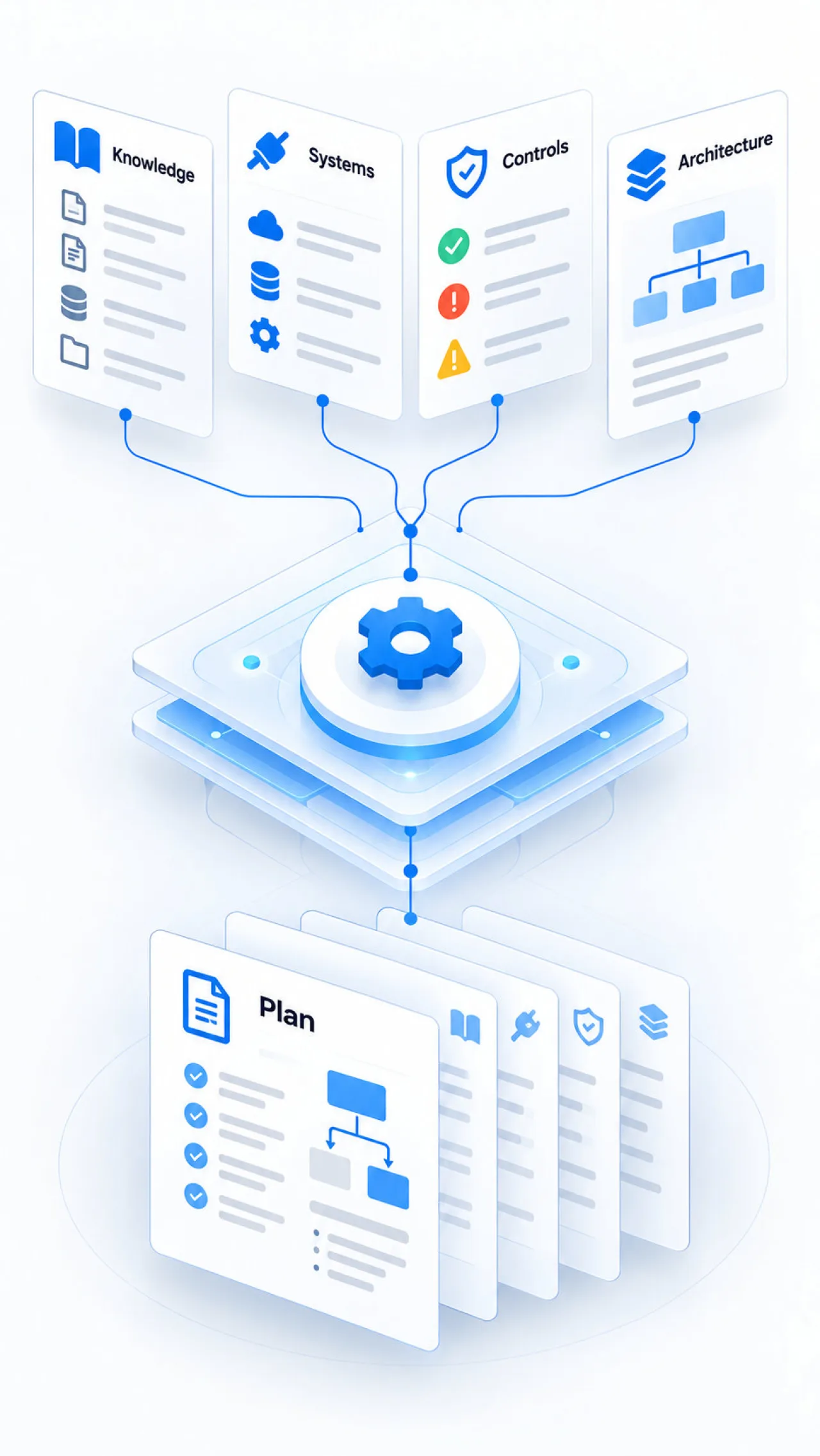
The design connects the business objective to users, inputs, outputs and named systems. It identifies approved knowledge sources, how they are kept current, data and access boundaries, and the information each connection needs. Approved documentation, internal rules and recorded company experience can supply that knowledge layer. It also explains when AI may suggest or draft something, when a person approves it, and how exceptions reach the right owner. The design identifies authoritative-source owners and refresh responsibility, and defines what happens when knowledge is missing, stale or contradictory. It specifies application permissions separately from prompts, including allowed low-risk automatic steps and approvals for consequential actions.
You receive model-selection reasoning that weighs capability against implementation effort and usage cost, integration contracts, infrastructure options, risks and dependencies, usage and operating-cost assumptions, delivery stages and acceptance measures. We explain the advantages, disadvantages and ongoing costs of feasible options; you make the informed choice. The documents and diagram sources are editable, with a readable copy for review. Formats, design depth and revision arrangements are agreed for the project.
Free preliminary scoping helps define the engagement. Paid design develops the actual plan. An optional proof of concept, implementation, deployment and operation are separate agreed stages. We assess a suitable existing client design before recommending more design work. Buying this service is not a compulsory extra for every voice-agent or workflow implementation, and design already included in an accepted implementation is not charged twice.
Completion means that the agreed design has been delivered and reviewed, with settled decisions, assumptions and remaining dependencies visible. We address gaps against the accepted design scope; new requirements are considered separately. A reviewed plan does not mean an agent is working, runtime evaluations have passed or production is ready. Use rights and third-party licensing are agreed in writing. We correct nonconformities in our agreed work and faults we introduce as part of meeting the accepted result. These are not automatically paid additions or the unforeseeable-work exception. New requirements, later source updates, provider changes and third-party faults are assessed separately.
The design documents how knowledge retrieval and context differ from training, and maps relevant data classes and providers rather than assuming one retention rule. Retrieval from approved sources and use as context are distinct from model training or fine-tuning, which require separate authorization. We limit data sharing to the agreed purpose, roles and necessary information. Access, retention, deletion and export are agreed separately for provider processing records, stored application state, transcripts, call logs, raw audio, backups, files and indexes, and third-party or telephony records. We name the parties responsible for applicable AI, recording and transcription notices and required authorization; neither zero retention nor immediate deletion of every copy is assumed.
We agree the paid design scope and any separate stages before work. If billable hours are agreed, we agree the scope and billable hours before paid work. The charge for that scope uses those agreed hours. Actual staff time is recorded internally to improve future estimates; more or less actual time does not automatically change your charge. Our underestimation or correction of our own faults does not become paid extra work. If genuinely additional work could not have been foreseen and arises through no fault of metricfixer, we explain it immediately and jointly agree the next step before undertaking additional paid work. The proposal separates initial work and agreed paid stages from continuing model, voice and backend-tool usage, telephony, number rental, hosting, logs, storage, indexes and operating support where applicable. We agree what is included, the provider account owner and bill payer, any expressly agreed allowances, forecast assumptions, usage visibility, spending authority and what happens when a usage budget is reached. Metered provider consumption is separate from actual staff time. The same accepted design, integration or release is counted once across services. Experimental AI-assisted delivery is a separate option, not automatic enrollment: human fallback for the same unchanged accepted experimental project keeps its agreed price and quality and is not resold as workflow implementation or web support.