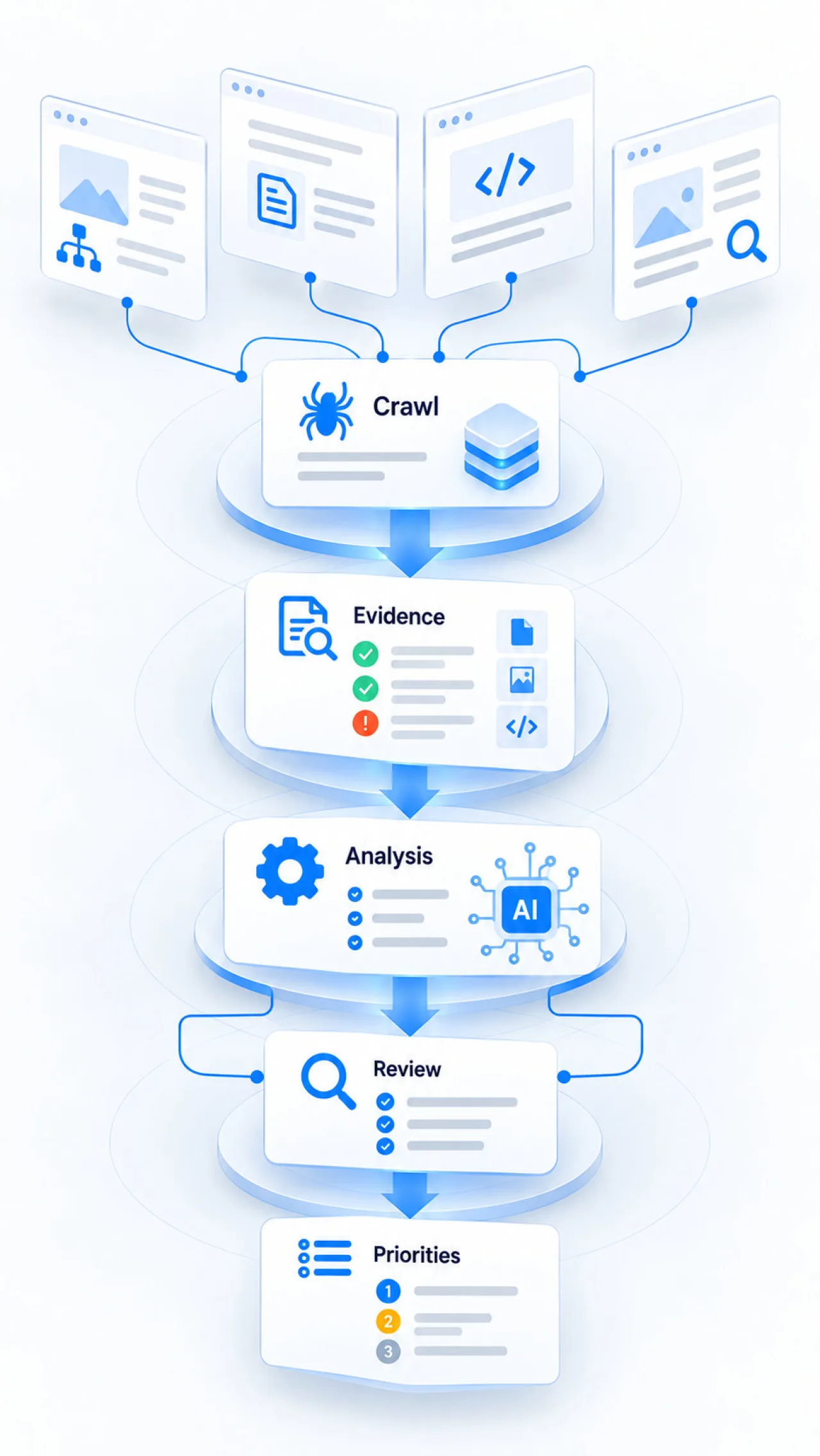
A page can respond successfully and still have problems that affect discovery or interpretation. The useful question is where the path breaks: a response, a crawl rule, a rendering dependency, a conflicting canonical signal or another technical condition. We investigate the agreed areas and show the evidence behind each finding so your team can judge the next action.
The workflow gives particular attention to search crawlers and AI search access where relevant. Search retrieval, model training and user-triggered agents can have different controls. We identify the purpose of the named crawler and distinguish declared permissions from observed behaviour. An ordinary fetch or a request claiming a crawler name does not prove that the genuine crawler visited. Access permission also does not guarantee that an AI service will cite your site.
Available Search Console information, authorised logs, public responses and browser observations answer different questions. The report identifies sources, dates and coverage, separates observations from hypotheses and labels estimated visibility. Laboratory performance checks are distinguished from field datasets, including page versus origin coverage. Missing private evidence stays visible as a limitation.
You receive the agreed research and a reviewed report, rather than an unchecked automated score. Recommendations describe what to change and how to verify it; implementation is included only if separately agreed. Useful existing evidence can inform the investigation. We correct nonconformities in our agreed report, while new requirements and later source changes are assessed separately.