
Published Oct 9, 2026
Google Vacation Rentals Leaves EEA Search: Why It Happened and What Owners Should Do
Google has withdrawn its vacation rentals unit from Search for users in the EEA, not removed rental websites from Google. We explain the DMA dispute, the uncertain return prospects and the practical response for property owners and rental businesses.
Category: SEO & Web Marketing · By Mikalai Sasau
Google began removing its dedicated vacation rentals unit from Search results for users in the European Economic Area in September 2026. That is a meaningful distribution change, but it is not the disappearance of rental websites from Google. This review explains the regulatory background, the prospects of a replacement, and how property owners and rental businesses should protect their visibility without chasing the wrong fixes.
Practical starting point: keep a healthy existing feed connected, establish how many bookings actually came through the affected Search unit, and separate that loss from ordinary organic traffic. Do not rebuild your website, change domains or buy a schema plugin on the promise that it will restore a feature Google has withdrawn.
Contents
Executive summary
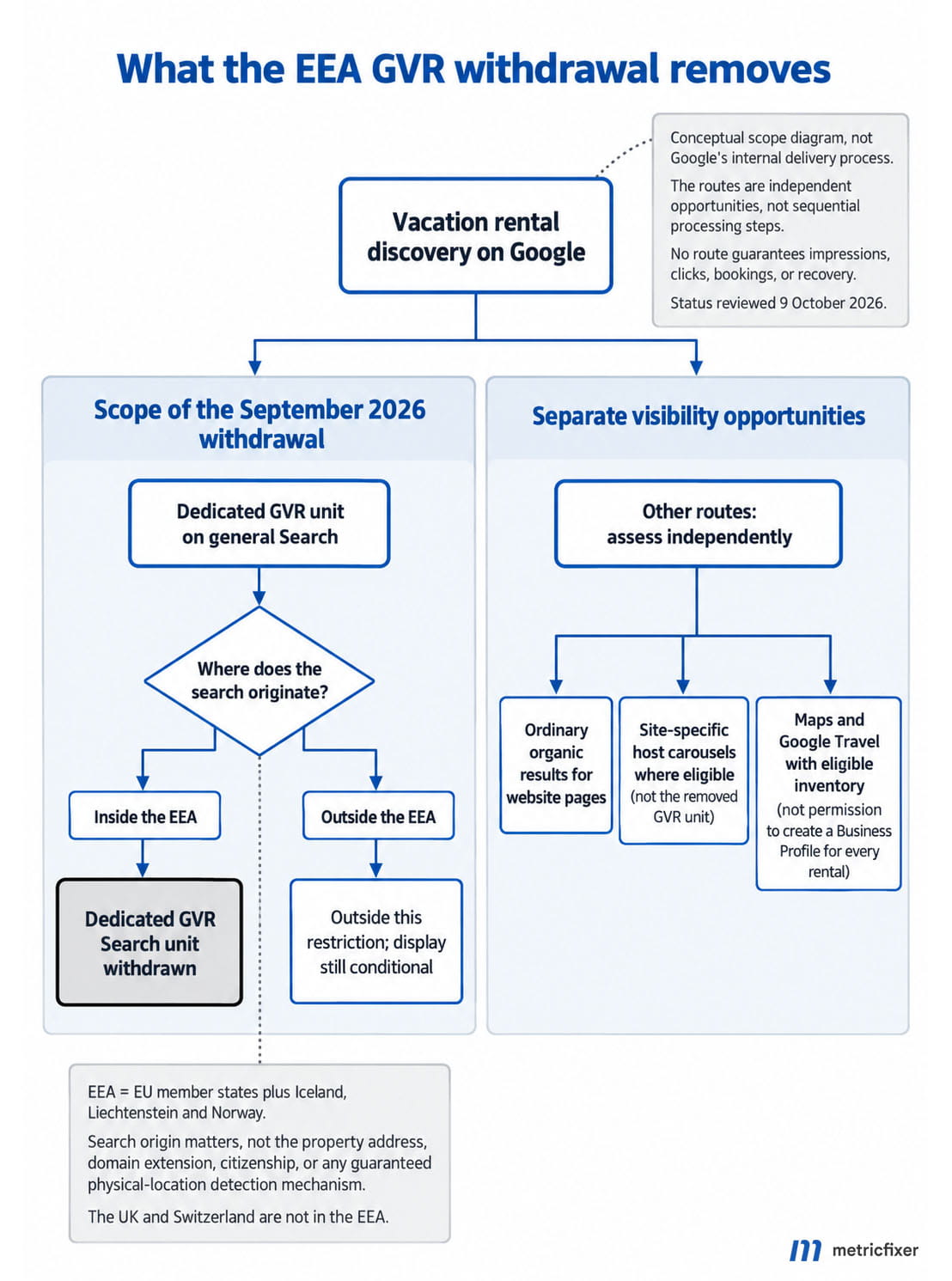
The September announcement concerns one Google-owned vacation rental discovery unit on the general Search results page. It does not mean that holiday apartments have been banned, that rental websites have been deindexed, or that the entire Google Vacation Rentals ecosystem has closed. The relevant abbreviation is GVR.
Google linked the withdrawal to its work on the EU Digital Markets Act, or DMA. Its partner notice, reported by PhocusWire on 8 September 2026, expressed hope for a future vacation rentals experience, not a commitment to restore the old one. As of 9 October 2026, the public sources reviewed for this article provide no confirmed return date.
For an operator, the right response is proportionate: identify the exposed audience and booking volume, preserve working distribution, and strengthen the pages and customer relationships you control. A business that barely used GVR should not assume that a September traffic decline was caused by this change. A business that relied on it should not wait for an unannounced relaunch before adjusting its plan.

What Google removed, and who is affected
NextPax's account of the partner notification says the rollout could begin as early as 8 September 2026. This is the appropriate starting point for analysis, not evidence that every query and device changed simultaneously at midnight.
The geographic boundary is the European Economic Area: the EU member states plus Iceland, Liechtenstein and Norway. The United Kingdom and Switzerland are not in that group. Crucially, Hospitable's updated operational notice clarifies that the restriction follows where the guest searches from, not where the property is located.
For example, a search from Berlin for a Florida villa falls on the affected side of the boundary. A search from London for an Algarve apartment does not fall within this particular EEA restriction. These are illustrations of the rule, not a promise that a specific listing will appear outside the EEA.
| Surface or asset | What the change means |
|---|---|
| Dedicated GVR unit in general Search | Withdrawn for searches originating in the EEA. |
| Ordinary links to rental websites | Not removed by this announcement. Their crawling, indexing and ranking remain separate questions. |
| GVR feeds and connected inventory | Not automatically disconnected because the EEA Search unit has gone. |
| Maps and Google's travel/hotels surfaces | Partner notices identify these as continuing routes for eligible vacation rental content. |
| Search outside the EEA | Outside the scope of this withdrawal, including searches for properties inside the EEA. |
Continuing availability is not the same as guaranteed reach. A functioning listing in Google Travel does not prove that the former Search exposure has been replaced. Equally, a missing Search unit does not by itself prove a feed rejection. Keep those two investigations separate.
Why Google made this change
The dispute is about Google's treatment of competing services
The DMA's self-preferencing rule addresses a gatekeeper giving its own services more favourable treatment than comparable third-party services. In plain language, the dispute is not simply whether an individual apartment can link to its own booking website. It is whether Google's search page gives Google's own comparison experience advantages that competing comparison and discovery services do not receive. The EU's summary of the DMA explains the wider framework.
On 23 July 2026, the European Commission announced a EUR 460 million fine concerning Google's self-preferencing in Search. A separate EUR 430 million fine concerned Google Play. The combined EUR 890 million headline should therefore not be described as a fine for vacation rentals.
The Commission's full decision announcement required Google to remedy the infringements within 60 days and described continuing scrutiny of changes. That was a compliance deadline, not a timetable for bringing vacation rentals back.
There is an important distinction between the legal obligation and the product response. The public announcement demands fair, non-discriminatory treatment; it does not specifically instruct Google to delete the vacation rentals unit. Google chose withdrawal as part of its response while saying that it could not display the current format. Calling this either an EU ban on direct bookings or an unrelated Google technical outage misses that distinction.
Why hotels received a different treatment
Google's current documentation describes an aggregator unit for eligible comparison services and a separate supplier unit for direct providers. Hotel and flight queries are explicitly included. Vacation rentals are not explicitly listed as their own supported query category in those two guides.
According to NextPax's 11 September explanation, a redesigned hotel solution was available, while a corresponding vacation rental solution was not. The partner also reported that Google was gathering information about the hotel format before deciding whether it could be extended. That is a useful account of the operational gap, but not a published engineering roadmap or a regulatory guarantee that every new format has been accepted.
The practical inference is that a redesigned rental experience is possible. The unsupported leap is to assume it is already scheduled. The sources do not establish that a feed error, an owner's licensing status or a website's structured data caused this region-wide withdrawal.
Why the industry's reactions differ
Google argues that the changes harm direct suppliers and make the search experience less useful. HomeToGo co-founder Patrick Andrae, meanwhile, welcomed the development as progress towards fairer competition. These positions reflect different interests: the owner seeking direct bookings and the comparison service seeking equal access to Google's results are not measuring the same thing.
Both effects could exist at once: stronger competitive access for intermediaries and the loss of a useful direct-booking route for some properties. Neither establishes the eventual booking impact. Nor do the public sources prove a theory that Google removed the unit specifically to force owners into advertising. Commercial incentives are worth examining, but they are not a substitute for evidence of the decision's actual motive.
Will the vacation rentals unit return?
Google has expressed an intention to explore a future experience. That is weaker than promising to restore the old product. Hospitable's live support notice still reports no timeline. We found no public confirmation of a scheduled relaunch by the article's research cut-off, 9 October 2026.
| Scenario | How to treat it | Operational response |
|---|---|---|
| The unit remains absent | A prudent assumption for the next planning cycle, not a prediction of permanent closure. | Do not include unannounced GVR recovery in committed booking targets. |
| A redesigned experience appears | Plausible, but conditional on Google's product work and compliance position. | Retain accurate inventory and be ready to assess new eligibility and reporting requirements. |
| The old unit returns unchanged | Not supported by a public commitment reviewed here. | Do not postpone necessary acquisition work on this assumption. |
Our assessment: planning for continued absence is sensible; maintaining the ability to participate in a replacement is also sensible. These are compatible decisions. A low-maintenance, functioning feed can preserve options without making a relaunch the centre of the business plan.
The strongest signals would be a dated Google partner announcement, documentation explicitly describing a new rental experience, and repeatable observations across relevant countries and devices. One screenshot of a property card is insufficient: it could show a different carousel, a non-EEA result or a limited experiment. A general DMA development is also not, by itself, confirmation that this particular unit has returned.
What changes for visibility and bookings
The immediate issue is the loss of a placement, not an automatic loss of all demand. A guest may find the same property through its website, a booking platform, another Google surface or a different channel. The business consequences depend on which of those paths, if any, replaces the lost one.
| Business | Likely question to investigate | First priority |
|---|---|---|
| Owner without a GVR connection | Was there any direct exposure to the removed unit at all? | Check ordinary search performance before attributing a decline to GVR. |
| Direct-booking operator using GVR | How much traffic came from EEA Search rather than other surfaces? | Reconcile partner clicks with completed bookings and acquisition costs. |
| Multi-property manager | Which destinations, properties and source markets were most exposed? | Prioritise affected inventory rather than changing the entire portfolio. |
| Marketplace or comparison website | Does the changed results page create measurable new visibility? | Track actual queries and eligible formats; do not assume an automatic gain. |
It is reasonable to expect a modest absolute effect for an operator that received very few bookings from GVR. It is not reasonable to turn that observation into an unsupported statement about every European market. We found no representative public dataset establishing GVR's booking share across most European countries. Your historical channel mix is a better starting point than a sweeping industry claim.
The same caution applies to alarming percentages. In a December 2024 report on its hotel-results test, Google said hotel traffic fell by more than 10%. That was Google's own test, involving hotels and an earlier change. It is not a measured loss from the September 2026 vacation rentals withdrawal and should not be inserted into a rental-site forecast.
A quieter but important risk is channel substitution. Occupancy may stay stable while more guests book through commission-charging intermediaries. Conversely, an operator might recover some demand through ordinary organic results. Track both booking volume and the amount retained after acquisition costs, rather than treating stable occupancy as proof of no impact.
What still works: organic results, carousels and Maps
Ordinary organic results remain a separate opportunity
A rental website still needs to satisfy Google's technical requirements for Search: Google must be able to access the page, receive a successful response and find indexable content. Meeting those requirements does not guarantee indexing or ranking, but the GVR announcement does not replace them with a prohibition on rental pages.
Do not assume that removal of a visual unit automatically pushes your website upwards or increases clicks. The surrounding layout and competing results matter. Check your actual destination and property queries. A site can have a sound organic strategy and still have lost a useful additional placement.
Site-specific vacation rental carousels are not the removed GVR unit
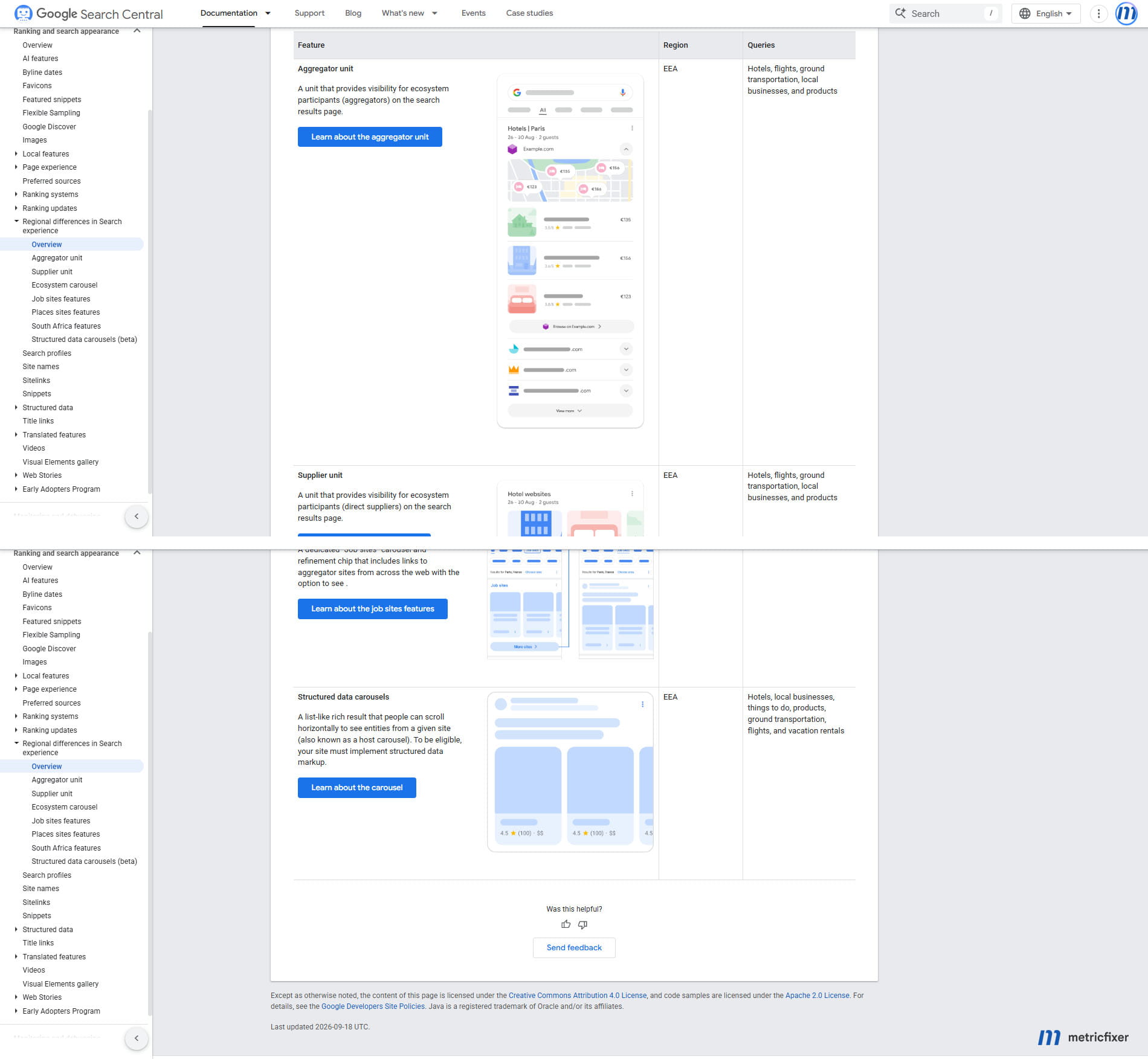
This is an important exception to the broad headline. Google's regional Search feature documentation, updated on 18 September 2026, still lists vacation rentals for structured-data host carousels in the EEA. These display entities from a particular website. They are not the same thing as the withdrawn Google-owned vacation rentals unit.
For a suitable multi-property site, Google's carousel beta guide describes ItemList markup combined with a supported type such as VacationRental. The model requires a summary or category page containing at least three entities, linked to separate detail pages on the same website. An all-in-one page with anchor links to sections is not the documented model.
Follow the guide's participation route, markup requirements and validation steps. Markup belongs on the summary page; the guide does not require corresponding carousel markup on every detail page. Eligibility is not a promise of display. This is a feature worth assessing when the site's real structure fits, not a guaranteed replacement channel and not a reason to invent duplicate properties.
Keep useful feeds and accurate property markup
Google's separate vacation rental structured-data integration guide is aimed at participants connected to its integration process, including a Google Technical Account Manager and Hotel Center. Installing a plugin is not equivalent to acceptance into that programme.
The vacation rental onboarding documentation also separates property information, pricing and availability, and landing-page integration. Preserve that data chain where it still serves your business. Fix genuine mismatches, stale availability or broken booking links, but do not repeatedly resubmit healthy inventory hoping to reverse a regional product decision. Never relabel an apartment as a hotel merely to pursue a different display format.
Maps visibility does not make every rental eligible for a Business Profile
Google's Business Profile eligibility rules identify rental properties, including vacation homes, as ineligible for standalone profiles. Genuine sales or leasing offices can be eligible, subject to the normal business requirements. Feed-powered property visibility and eligibility to create a Business Profile are different things.
For an eligible management office or agency, maintain an accurate profile, genuine customer information and appropriate local pages. Our guide to improving Google Maps visibility is relevant to that eligible business, not permission to create a profile for every apartment.
How to measure your actual exposure
Start with the source, not a traffic graph
Ask your connectivity provider what its GVR report actually measures. Does it combine Search, Maps and Google Travel? Can it identify user country, property, device and destination URL? Google's Hotel Center performance documentation describes dimensions including user country and property. That does not mean every provider dashboard exposes a reliable Search-versus-Maps split.
Where the surface cannot be isolated, label the number as broader GVR exposure, not bookings proven to originate from the removed unit. Preserve historical exports and existing campaign identifiers. A missing identifier cannot be recreated with certainty after the event.
Next, compare Search Console by country, page, device and query group. Google's performance-dimension guidance defines country in relation to the search location and explains the available breakdowns. Use a relevant search-appearance filter only when your property actually has it. Search Console is not a complete GVR booking ledger.
In website analytics, do not use a broad label such as google / organic as proof that a session came from GVR. Match the identifiers you really collected with entry pages, booking records and partner reports. Be particularly careful not to confuse the first page of a visit with every page viewed afterwards; our GA4 landing-page and page-path guide explains that distinction.
Compare like with like
Annotate the rollout from early September, then compare weekday-matched periods and, where useful, the equivalent booking period a year earlier. Separate booking date from stay date: a reservation made in August for an October stay says little about a discovery feature removed in September.
Use comparable non-EEA audiences as a reference, not a perfect experimental control. Differences in school holidays, demand, inventory, rates, length-of-stay rules and marketing can all change the result. Also review site releases, tracking changes and wider search visibility. A before-and-after chart alone cannot isolate the cause.
Practical measurement workflow: establish the historical source definition → segment by search-origin country and available surface evidence → match to bookings → account for cancellations and channel costs → compare equivalent periods → record what remains uncertain.
Estimate exposure without pretending it is a forecast
Consider a deliberately simplified example, not market data. An operator has 1,000 completed bookings in a comparable period. Forty were attributed to GVR; reliable historical records identify 30 as coming through the affected EEA Search unit. The identifiable exposure is 3% of bookings, not all Google traffic and not an automatic 3% future loss.
Suppose 10 of those prospective bookings are recovered through another direct route, 12 through a paid intermediary and eight are not recovered. The consequences are eight fewer bookings plus the acquisition-cost difference on the rerouted business. These invented figures illustrate the accounting question; they do not estimate recovery rates.
For real decisions, compare retained revenue after cancellations, commissions, media spending and relevant booking costs. Where reliable attribution is missing, present a range with its assumptions rather than a precise-looking causal claim.
The practical SEO response for rental websites
Make property pages useful before adding more pages
Prioritise real information that helps someone choose: sleeping arrangements, dated photographs, accessibility details, parking restrictions, check-in arrangements, total pricing where available and clear cancellation conditions. Check that the booking journey works on mobile and that a date change does not silently switch the guest to a different property.
This is consistent with Google's people-first content guidance, but it is not a guaranteed ranking formula. The goal is to answer questions that generic listing copy leaves unresolved and convert the visitors you do earn. More traffic is less valuable when the guest cannot establish what they are booking.
Build destination pages around genuine inventory
For a portfolio, organise discoverable categories around useful differences: location, property type and amenities that guests actually need. A page for family apartments near a specific beach should contain matching inventory and practical local information, not the same introduction repeated across dozens of place names.
Link category pages to stable property URLs. Keep important information accessible to crawlers, review accidental noindex directives and canonical mistakes, and avoid a site where the only route to inventory is an interactive search form. When a property is unavailable for a selected week, distinguish that temporary booking state from a genuinely removed listing.
Serve worthwhile source markets instead of changing your address
The withdrawal is not solved by moving a European property website onto a US domain. Work on the audiences you can serve: accurate translations, suitable currencies, booking support and destination information. Google's international-site guidance explains the role of distinct regional or language versions.
Use hreflang where appropriate and maintain coherent canonical signals. The choice between country domains and subdirectories is a separate architecture decision, covered in our international SEO domain strategy guide. It should not become an expensive reaction to a user-location-based feature restriction.
Replace dependence, not just clicks
Test alternative acquisition routes with a defined budget and a completed-booking target. Strengthen repeat-guest communication where you have the necessary permissions, referral relationships and relevant destination partnerships. Judge paid activity by what it adds, not merely by whether it reports conversions that might have happened anyway.
For a single property, this may mean improving one excellent booking page and maintaining a manageable channel mix. For a larger manager, it may justify destination-level experiments, carousel eligibility work and deeper reporting. Not every owner needs a major technical project, and not every missing free click should be replaced with a more expensive paid one.
A 30-day action plan
Days 1–7: establish the facts. Confirm the property's actual GVR connection, preserve historical reports and identify affected source markets. Check that existing feeds and booking links remain healthy. Record whether a missing Search placement is regional or a separate listing problem.
Days 8–14: fix the highest-value gaps. Review the property and destination pages that previously received relevant visits. Resolve technical access problems and booking friction before producing more content. Evaluate the separate host-carousel opportunity only where the website genuinely fits its requirements.
Days 15–30: test and review. Run a small number of measurable acquisition experiments, compare booking quality and costs, and revise the next planning cycle without assuming an unannounced GVR return.
- Scope: the team distinguishes EEA-origin searches from properties located in Europe.
- Evidence: broader GVR traffic is not presented as an exact measure of the withdrawn unit.
- Distribution: functioning feeds are retained where they still have operational value.
- Eligibility: carousel work, hotel classification and Business Profiles follow their actual rules.
- Performance: bookings, cancellations and acquisition costs are reviewed together.
- Planning: any future relaunch is treated as an opportunity, not committed revenue.
The central lesson is not that Google has become irrelevant to holiday rentals. It is that an extra discovery feature is not an owned acquisition channel. Preserve useful integrations, invest in the website and relationships you control, and let measured exposure determine the scale of your response.

Methodology and sources
This article was researched on 9 October 2026. The review separates the September product announcement from the July regulatory decision, and both from older tests of hotel search formats. Google's reported partner statement and public connectivity-provider notices establish the rollout and operational scope. European Commission materials establish the formal enforcement context. Google Search Central, Hotel Center and Business Profile documentation establish feature and eligibility boundaries.
The Google Search documentation update log and current feature guides were also reviewed for subsequent changes. A live documentation page is evidence of published requirements, not proof that a particular property appears in a particular search result.
No private Google correspondence, customer analytics or controlled multi-country Search experiment was available for this review. The article does not claim a measured Europe-wide traffic loss, a representative GVR market share or a confirmed relaunch schedule. Forecast scenarios, the response plan and the numerical example are editorial analysis; the example is explicitly hypothetical. Source links accompany the relevant claims so that policy, partner interpretation and practical recommendations remain distinguishable.
This article provides general SEO and operational information and is not legal advice. Google's product availability, eligibility rules and reporting can change after publication. metricfixer does not control Google's services and cannot guarantee indexing, rich-result display, traffic, bookings or the return of a withdrawn feature.