Third-Party Iframe Conversion Tracking

Establish whether a third-party iframe exposes a reliable completed-action signal before promising implementation.

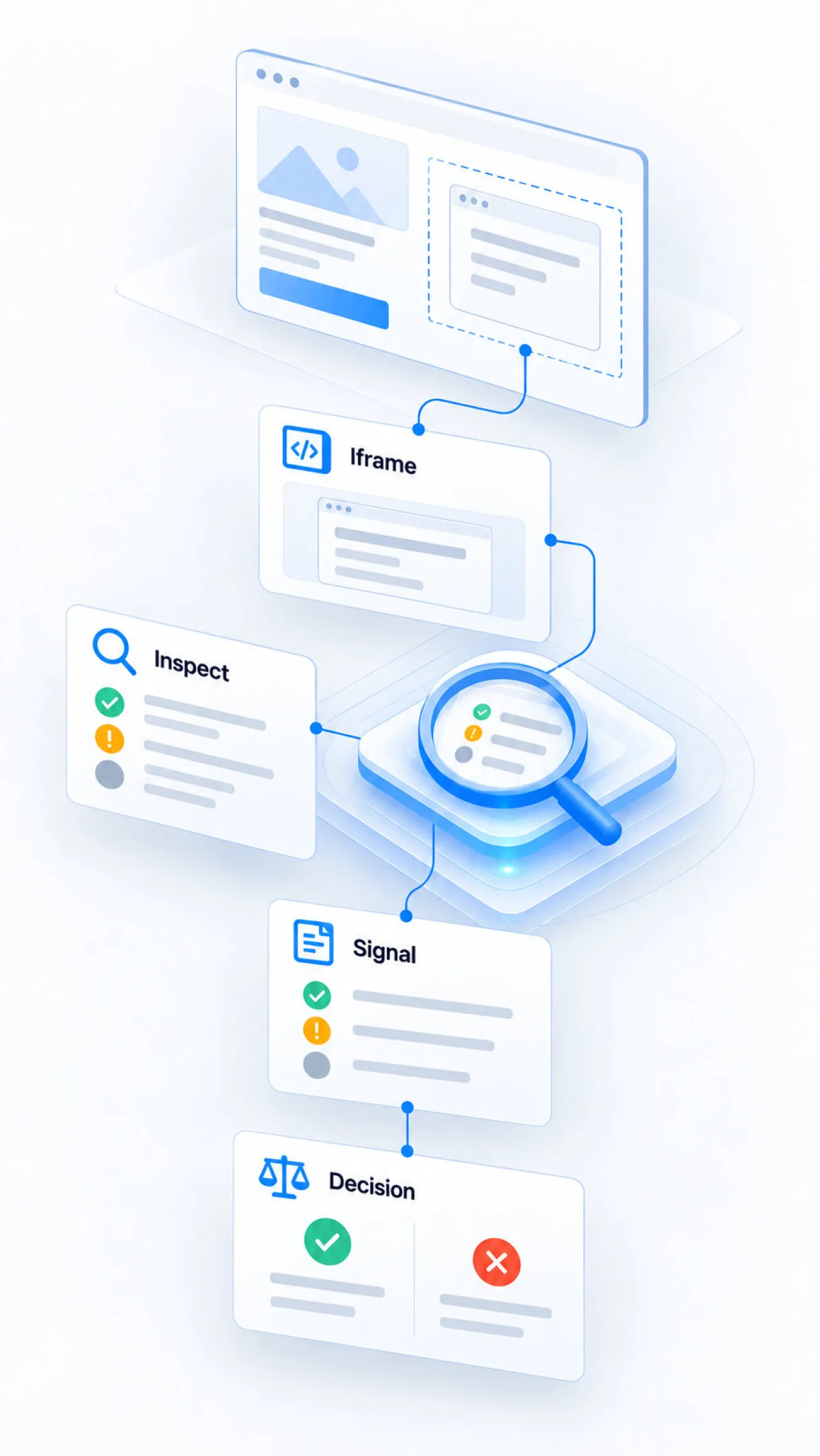
We start with feasibility. A supported callback, postMessage, API or webhook, top-level success redirect, provider event or genuine same-origin access may support tracking; click, focus, blur and load do not prove a conversion.

  • An initial assessment of the available reliable success signal
  • A scoped implementation path where the provider exposes supported evidence
  • Documented infeasibility, provider requirements or alternatives when a reliable path does not exist

What happens inside the third-party iframe?

Describe the iframe or provider, the completed action to measure, available callbacks, API, postMessage or redirects, your access level and known limitations. We agree access and scope later; do not send passwords, private keys, API secrets or customer personal data.

You can upload multiple files.

Business hours: Monday–Saturday, 09:00–22:00 (Europe/Warsaw).

Send your request anytime — we’ll reply by email.

Start with evidence, not a proxy interaction

  • Assess the provider architecture

    Identify what the iframe, provider or surrounding page can actually disclose about success.

  • Find a reliable signal

    Use a supported callback, postMessage, API, webhook, redirect or genuine same-origin access where available.

  • Accept a valid infeasibility outcome

    If no trustworthy signal exists, document the limitation and feasible alternatives instead of pretending a conversion is measurable.

How iframe feasibility is handled

  1. Review available evidence

    We assess the provider, completed action, access and any supported success channels.

  2. Agree the feasibility or implementation scope

    Where uncertainty needs deeper work, a separately agreed paid feasibility stage may be proposed before implementation.

  3. Validate the supported outcome

    If a reliable path exists, we validate the actual supported completed-action signal and its correlation.

A reliable success signal is the prerequisite

A third-party iframe can make reliable conversion tracking technically impossible when the provider exposes no trustworthy success signal. Possible supported paths include postMessage, a provider callback, API or webhook, a top-level success redirect, a provider-supported event or genuine same-origin access.

Iframe click, focus, blur, load and generic interaction are not proof of a successful conversion. If basic evidence already shows the required signal does not exist, implementation is not sold as if success were expected.

Where substantial investigation is necessary, a separately agreed paid feasibility stage may be offered before payment. It can validly finish with evidence of technical infeasibility, provider requirements, feasible alternatives or an implementation plan. It does not need to result in working tracking when the provider architecture cannot support it.

<redacted>

Find out whether the completion can be measured reliably

Describe the provider, completed action and available success signals so we can assess the technical path.

Describe the iframe

Jul 25, 2026 • Analytics & Conversion Tracking

Track Conversions Inside a Third-Party iframe

How to Track Conversions Inside a Third-Party iframe Without Code Access

A practical comparison of every realistic way to measure a form, booking, checkout, or multi-step conversion inside a third-party iframe—from same-origin DOM access and provider callbacks to postMessage, webhooks, API polling, and the hard limits of Google Tag Manager.