Custom Google Tag Manager Implementation

Turn a non-standard GTM requirement into a discovery-led, bounded custom implementation.

We begin with a free preliminary review. If substantial technical discovery is needed, it is separately scoped before an estimate, a bounded custom build, validation and handoff. Named website-side support can fit only when explicitly agreed.

  • A free preliminary review of the non-standard requirement
  • A separately scoped technical discovery and estimate where needed
  • A bounded custom implementation, validation and handoff after agreement

What non-standard GTM problem are you solving?

Describe the business or measurement problem, current GTM or dataLayer, systems involved, required outcome, technical constraints and known website-side dependencies. We agree access and scope later; do not send passwords, private keys, API secrets or customer personal data.

You can upload multiple files.

Business hours: Monday–Saturday, 09:00–22:00 (Europe/Warsaw).

Send your request anytime — we’ll reply by email.

A bounded route for non-standard GTM work

  • Start with a preliminary review

    Clarify the business need, available systems and whether the work fits an existing GTM service.

  • Discover before estimating complex work

    Use separately scoped technical discovery when the architecture cannot be responsibly estimated from the initial request.

  • Build only the agreed solution

    Implement, validate and hand over the bounded custom scope after it has been estimated and agreed.

From an unusual requirement to a controlled build

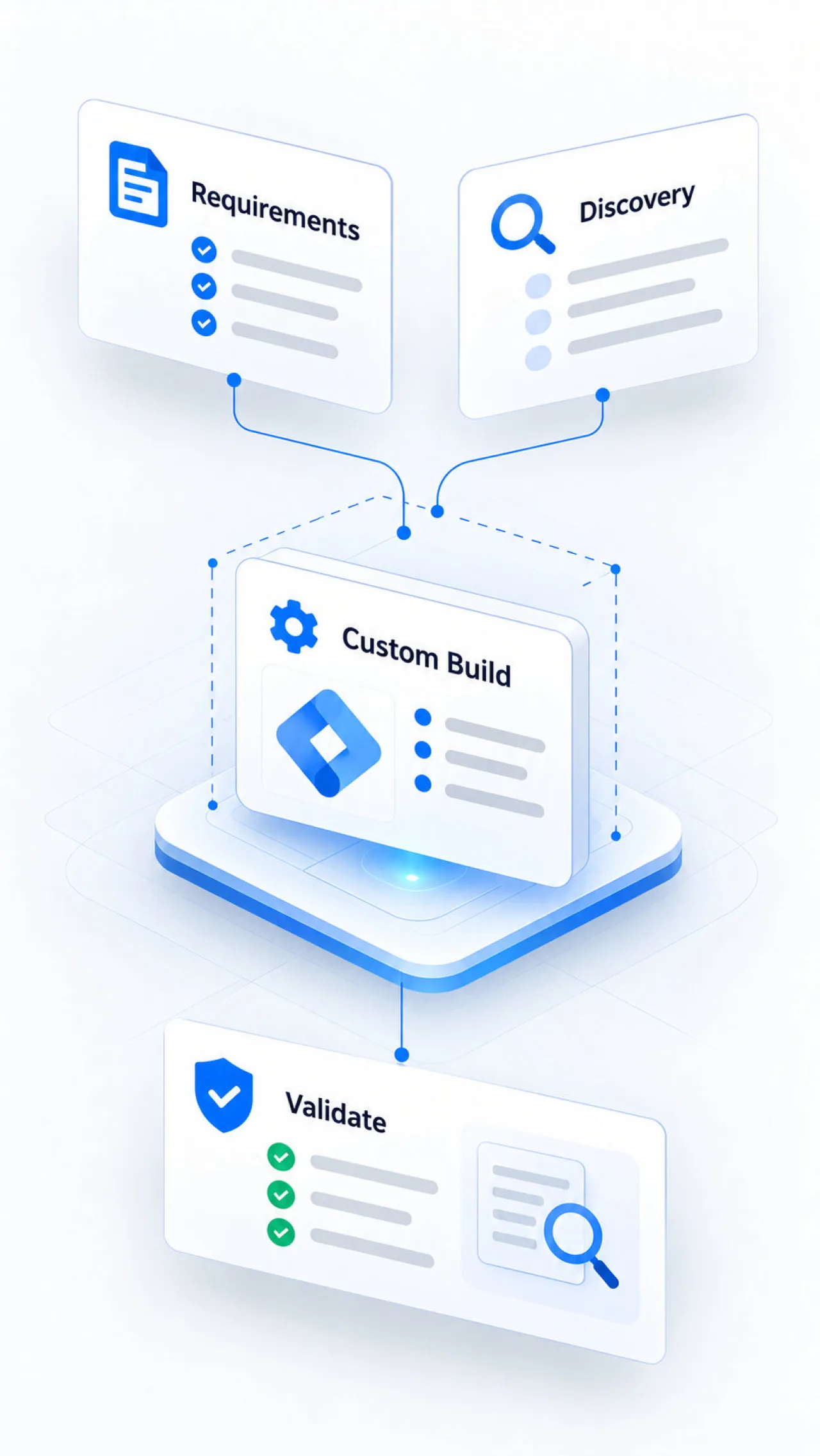
  1. Review the request

    We provide a free preliminary review to understand the problem, dependencies and probable path.

  2. Scope discovery and estimate

    Where needed, separately agree substantial technical discovery, then define the bounded implementation and estimate.

  3. Implement, validate and hand over

    After agreement, we deliver the custom GTM work within the named scope and document the result.

Custom does not mean unlimited website or application development

This service covers non-standard GTM requirements that do not fit the more specific GTM services. Possible cases include custom dataLayer logic, bespoke JavaScript, unusual state or trigger logic, custom templates, uncommon vendor integration, complex frontend signal orchestration and technical measurement logic requiring bespoke implementation. These are examples, not automatic inclusions.

The commercial path is free preliminary review, then separately scoped substantial technical discovery if needed, estimate, bounded custom implementation, validation and handoff. The preliminary review is not a free full architecture, proof of concept or unlimited investigation.

Named website-side support may be included where explicitly agreed. Arbitrary website development, application development and product development are not automatically included merely because GTM depends on them. The settled historical URL continues to redirect to the Google Tag Manager category; it is not the canonical replacement for this service and is not carried into this content.

Custom Google Tag Manager Implementation

Describe the non-standard measurement requirement

Share the outcome, systems and constraints so we can decide whether a preliminary review or scoped discovery is the right next step.

Describe the custom need

Aug 16, 2026 • Analytics & Conversion Tracking

SPA Analytics: Page Views, Timers & Cleanup

SPA Analytics Architecture: Page Views, Events, Timers, and State Cleanup

A practical reference architecture for SPA analytics that treats every virtual page as a lifecycle: commit the route, close the previous scope, send one page_view, attach events to a stable context, and clean up timers, requests, ads, widgets, and user state.

Aug 25, 2026 • Analytics & Conversion Tracking

Reliable GTM Click Tracking for Nested and Dynamic Elements

Reliable GTM Click Tracking for Nested and Dynamic Elements

Nested spans, icons, SVG paths, and dynamic components can make GTM capture the wrong element. Learn how CSS selectors, closest(), event delegation, data attributes, Shadow DOM handling, and dataLayer events keep tracking stable after frontend releases.