
Linux Server Administration
Keep recurring server responsibilities clear, controlled and documented.
After acceptance of the required initial maintenance and reboot-validation handoff, we agree the recurring tasks, workload, coverage and change authority for your named server. A specialist controls administration and reviews AI-assisted evidence organization and documentation where useful.
- An agreed recurring task list and workload for a named Linux server and software stack.
- Authorized administration work within defined support and escalation boundaries.
- Work records, agreed reporting and a clear list of required follow-up actions.
What recurring server help do you need?
Describe the server and stack, who administers it now, the status of initial Linux Server Maintenance and Upgrade with Reboot Validation, recurring needs, known risks, backup and monitoring arrangements, and desired support coverage. We review the initial request and estimate scope at no charge; this is preliminary scoping, not administration or an active subscription. Secure access is arranged after scoping. Do not send private keys, root passwords, tokens, unredacted logs, environment files, customer databases or sensitive inventories.
Business hours: Monday–Saturday, 09:00–22:00 (Europe/Warsaw).
Send your request anytime — we’ll reply by email.
We use your email only to manage your request and provide service-related communication. We do not use it for marketing, promotional, or advertising messages.
Recurring work with named responsibilities
Start from an accepted baseline.
Use the required initial maintenance handoff to establish the agreed stack, known risks and recovery dependencies.
Define tasks and change authority.
Name the recurring work, workload, support coverage and actions that need individual approval.
Keep work and follow-up visible.
Record performed tasks, observations, interventions and escalations through the agreed reporting process.
From initial maintenance to a recurring agreement
Complete the required initial maintenance.
Review its validation record and resolve required onboarding checks before ordinary administration begins.
Agree responsibilities and the start.
Confirm tasks, workload, cadence, coverage, authorized contacts and escalation, then start the separately agreed engagement.
Perform, review and report.
Carry out authorized recurring work, document evidence and raise work or risks outside the agreed boundary.
A recurring agreement for an agreed server software stack
Linux Server Administration begins after acceptance of the required initial Linux Server Maintenance and Upgrade with Reboot Validation. Linux Server Security Audit and Hardening does not replace that prerequisite, and purchasing maintenance does not automatically activate a subscription. We agree the administration start, responsibilities and recurring commercial conditions separately in writing before administration begins.
We use the initial-maintenance handoff to confirm the accepted stack and configuration, known risks, recovery dependencies, authorized contacts, change permissions and required validation. An unresolved mandatory check, including a required reboot, blocks ordinary onboarding. If you already have a documented initial-maintenance service, we can consider reusing it only with explicit approval of its freshness and the unchanged baseline. Suitable accepted evidence avoids unnecessary duplicate work; there is no universal validity period, automatic waiver or exemption for existing or provider-managed customers. We document the accepted baseline and separately agreed start.
Before estimating recurring work, we assess the versions, architecture, repositories, control-panel compatibility, provider restrictions and support subscriptions for your named server and agreed stack. A technology name alone does not establish support for its installed version or combination. An unsupported component does not regain vendor support through hardening. If a major upgrade or migration is needed for safe administration, we explain the dependency and estimate that work separately; a replacement vendor or stack requires your approval.
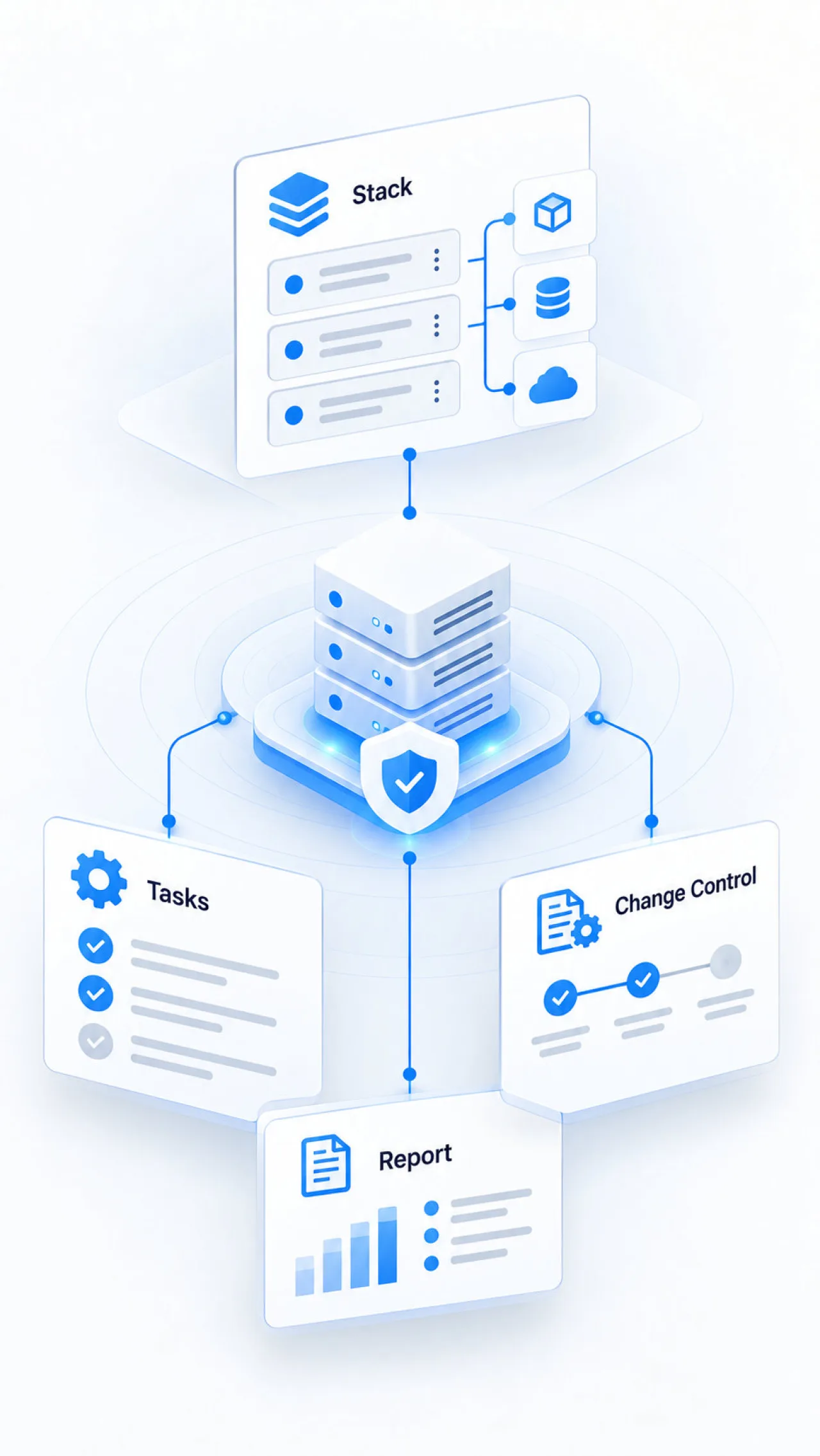
Your agreement defines the recurring tasks and workload, review and reporting cadence, support hours and channel, alert ownership, routine change authority, individual approvals and escalation. Responsibilities may include service-health and resource review, supported routine updates, agreed access or configuration changes, backup and scheduled-job checks, relevant logs or alerts, and maintenance planning. Only the tasks and maintenance workload expressly included in the agreement are covered. Routine actions follow the agreed authority; disruptive or material changes need the appropriate approval, window and recovery readiness.
Observation and intervention are separate responsibilities. Monitoring software can generate alerts without providing continuous specialist attention or response. We agree who receives alerts, when they are reviewed and how any intervention is authorized. The ticket form's availability does not guarantee server uptime, emergency response or restoration time. Emergency or after-hours coverage, incident recovery, unlimited maintenance cycles, major upgrades, migrations, application redevelopment and cluster work are not automatically included.
You receive work records and reports at the agreed cadence, showing performed tasks, relevant checks, risks, outstanding actions and escalation. Before we estimate the work, we agree the named checks and completion criteria for the covered tasks and interventions, together with responsibilities and next steps for pending checks or work that remains incomplete. Backup-job results are reviewed separately from timer configuration; a website response or limited sample does not establish the health of every application workflow. A specialist controls decisions and authorized changes and reviews any AI-assisted analysis or documentation.
Hosting, licenses, monitoring tools, extended support, backup storage and provider fees are separate unless expressly included. The same agreed work is not charged twice when administration is combined with another service; combining services does not automatically create a bundle or discount. Any billing, renewal, minimum term, cancellation and applicable warranty conditions are agreed in writing before administration starts, alongside the recurring scope and support arrangements.
Define the recurring help your server needs.
Share the initial-maintenance status and responsibilities you want covered so we can agree an administration boundary.