
Linux Server Security Audit and Hardening
Reduce avoidable server exposure with agreed corrections and clear evidence.
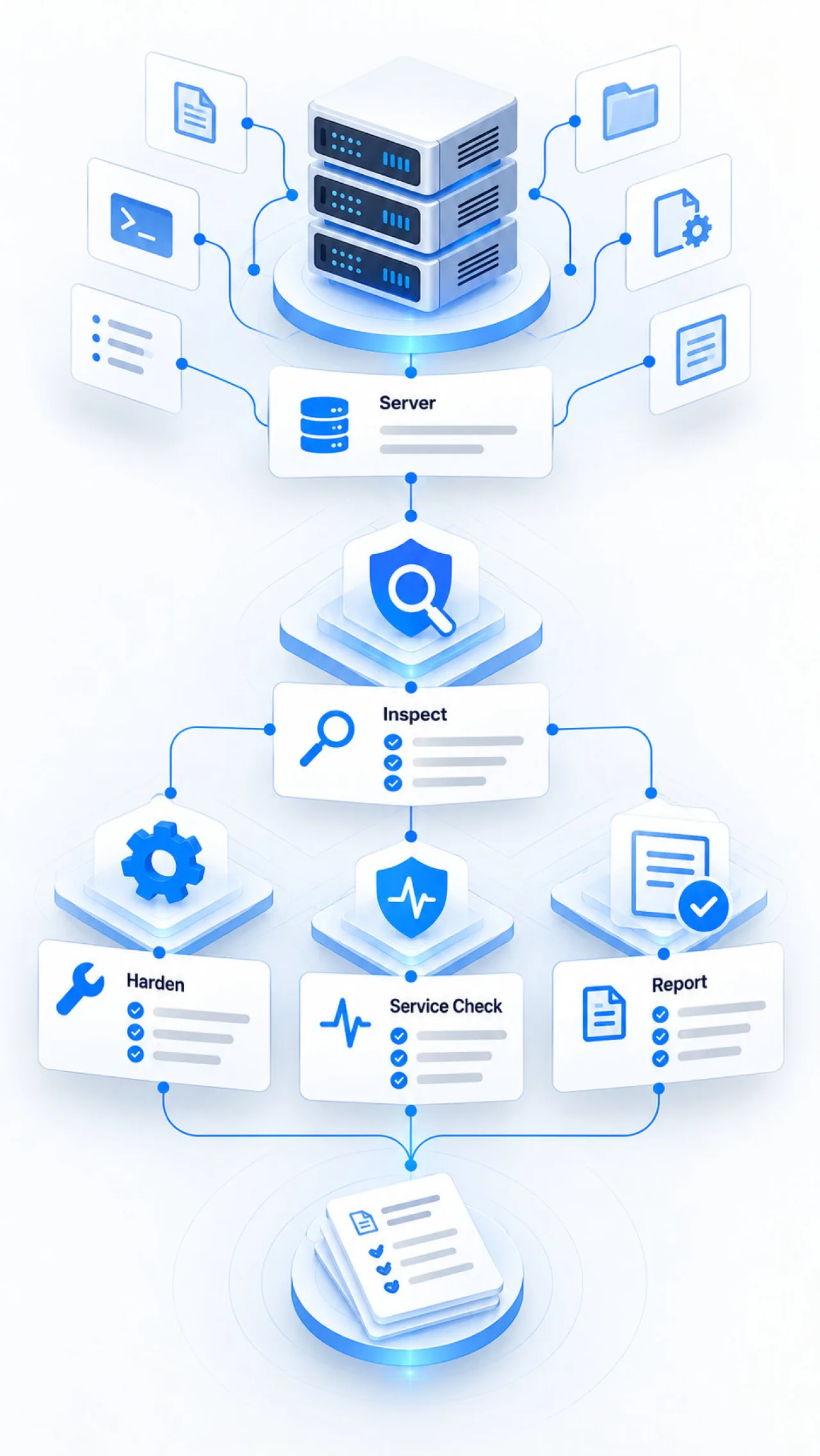
A specialist reviews your server's role, access and configuration, using AI assistance to organize permitted evidence and draft recommendations. The specialist controls the hardening plan, authorized changes, service checks and final report.
- A scoped security review of your existing server and agreed server software stack.
- Agreed hardening corrections with checks of affected services.
- A reviewed PDF report covering evidence, changes and remaining risks in the same ticket.
What security concern should we investigate?
Tell us the server's business role, Linux distribution and version if known, hosting provider or control panel, critical services, security concern, backup arrangements and permitted change window. We review the initial request and estimate scope at no charge; this is preliminary scoping, not the completed audit or hardening service. Secure access is arranged after scoping. Do not send private keys, root passwords, tokens, unredacted logs, environment files, customer databases or sensitive inventories.
Business hours: Monday–Saturday, 09:00–22:00 (Europe/Warsaw).
Send your request anytime — we’ll reply by email.
We use your email only to manage your request and provide service-related communication. We do not use it for marketing, promotional, or advertising messages.
Security work shaped around your server's role
Understand access and exposure.
Review the agreed administrative access, installed services, patch status and network exposure in their operational context.
Apply agreed corrections.
Improve confirmed settings and safely address unnecessary exposure within the approved hardening scope.
Check the result and explain risks.
Validate affected services and provide evidence, limits and prioritized follow-up actions.
From security concern to checked hardening
Agree the review and safety boundaries.
Define the server, stack, investigation depth, critical services, recovery readiness and authorized change window.
Review and implement agreed fixes.
A specialist interprets findings, confirms dependencies and applies the corrections you authorize.
Validate and hand over.
Check affected access and services, then deliver the reviewed report, changes and remaining risks in your ticket.
A review that includes agreed hardening
We review one named existing server and implement the agreed hardening corrections for its server software stack. Before we provide an estimate, we agree the review areas, depth and affected-service checks, and assess your software versions, architecture, update sources, control-panel compatibility, provider restrictions and support subscriptions. Technology names describe possible coverage, not support for every version or combination. The review can cover patch status, users and privileges, SSH, exposed services, firewall and brute-force protection, web/TLS settings, existing security modules, logging, backup arrangements and applicable Docker or systemd exposure.
A specialist interprets the evidence, develops the hardening plan, confirms authorization and controls changes and validation. AI may help organize permitted evidence, compare configuration patterns and draft documentation. We consider dependencies and business use before disabling a service; an unfamiliar service is not automatically unnecessary.
Before disruptive changes, we agree an authorized window, the recovery route and responsible contacts. We review backup freshness, completion evidence, coverage of relevant data and configuration, and restoration access. A configured backup is not proof of a completed backup, adequate coverage or tested recovery; a provider snapshot is not automatically application-consistent. Creating a backup or snapshot and testing a full restore require an explicit scope and estimate. We also agree stop and rollback criteria and the implications for newer writes. If recovery readiness is inadequate, risky changes pause until the dependency is resolved. This review does not guarantee recovery, zero data loss or a fixed recovery time.
You receive the agreed corrections, checks of affected access and services, and a specialist-reviewed PDF in the same ticket, with supporting files where useful. The PDF documents implementation, inspected coverage and remaining risks. We agree the named before/after checks and completion criteria before providing an estimate. The record distinguishes completed work from partial results, checks that could not be performed and issues requiring further work, with reasons, responsible contacts and next steps. A running backup timer does not prove a successful job, an HTTP 200 response does not establish full application health, and sampled checks do not cover every business workflow. We do not promise removal of every vulnerability or prevention of future compromise.
Agreed hardening is included. Substantial updates, rebuilding, major OS migration, architecture redesign or work beyond the agreed corrections require a separate estimate and approval before the scope expands. Hardening cannot restore vendor support to an unsupported component. If safe work depends on a larger upgrade or migration, we explain that dependency and scope it separately; any replacement vendor or stack requires your approval. Hosting, licenses, extended security support, backup storage and provider charges are separate unless expressly included. If hardening is combined with another service, the same agreed work is not charged twice; combining services does not automatically create a bundle or discount.
Penetration testing, source-code security audits, certification, malware eradication and existing-incident response are outside this service. If evidence suggests compromise, we pause ordinary hardening and explain the need for a separately authorized incident scope. The ticket form does not guarantee emergency handling. Ongoing administration is a separate engagement, and Linux Server Administration requires accepted initial Linux Server Maintenance and Upgrade with Reboot Validation.
Describe the server and the concern.
Share the role, critical services and change constraints so we can scope a review with agreed hardening.