
Linux Server Maintenance and Upgrade with Reboot Validation
Update the agreed server stack and verify critical services recover.
A specialist reviews health and recovery readiness, agrees a compatible maintenance route and controls updates and necessary interruptions. AI may assist permitted evidence analysis and documentation; the specialist handles related troubleshooting and validates the named services after required authorized restarts or reboot.
- A maintenance plan for the existing server and agreed server software stack, with recovery and interruption prerequisites.
- Supported updates and related compatibility or startup troubleshooting within the agreed boundary.
- Critical-service validation, actual restart/reboot status and a maintenance handoff with remaining actions.
What maintenance does your Linux server need?
Describe the OS and stack, intended maintenance, known failures, uptime constraints, backup and recovery status, provider console availability and permitted reboot window. We review the initial request and estimate scope at no charge; this is preliminary scoping, not completed maintenance or validation. Secure access is arranged after scoping. Do not send private keys, root passwords, tokens, unredacted logs, environment files, customer databases or sensitive inventories.
Business hours: Monday–Saturday, 09:00–22:00 (Europe/Warsaw).
Send your request anytime — we’ll reply by email.
We use your email only to manage your request and provide service-related communication. We do not use it for marketing, promotional, or advertising messages.
A controlled cycle with recovery checks
Establish a safe maintenance route.
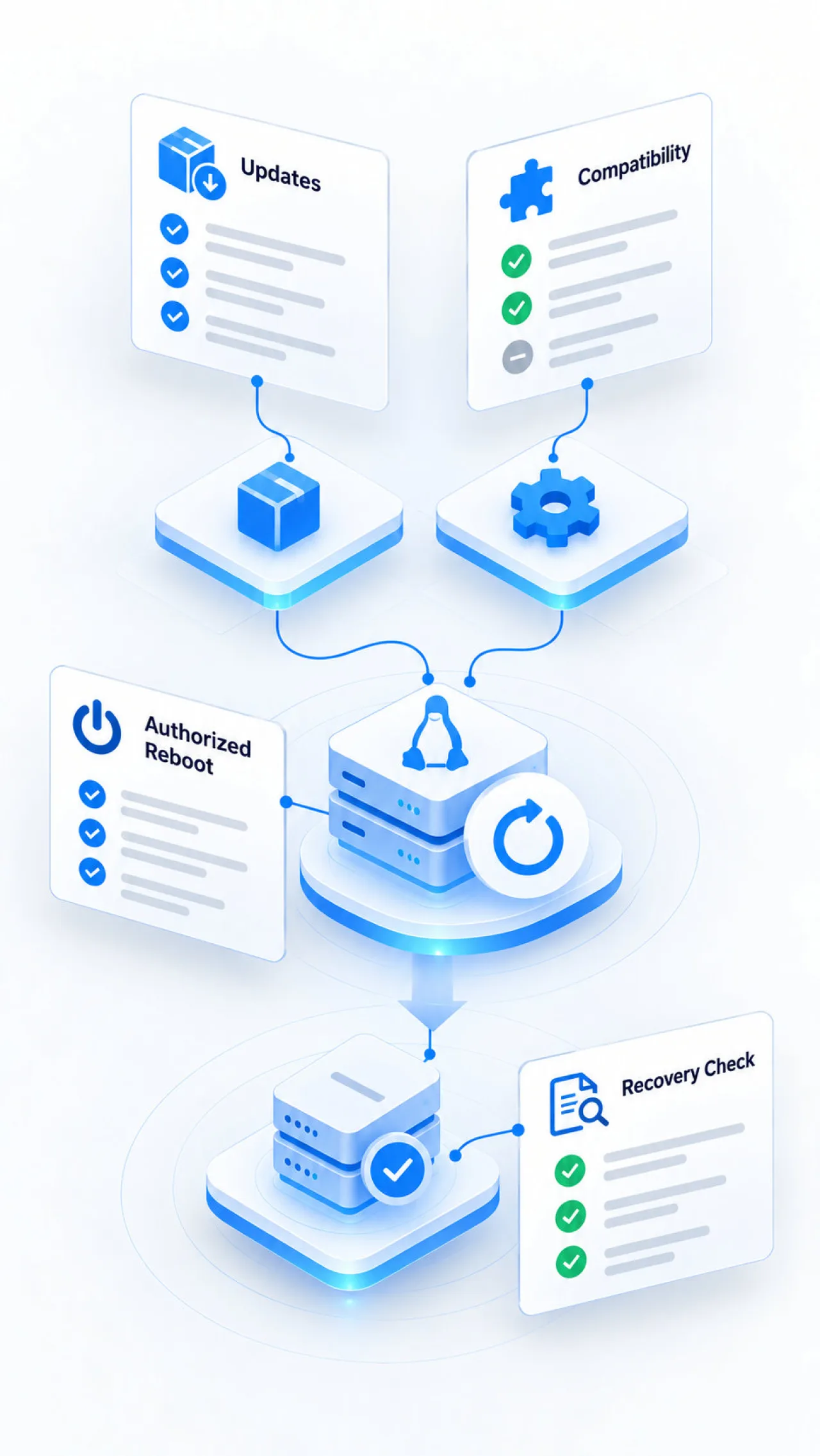
Review health, package state, compatibility, backup coverage and the available recovery route before changes.
Maintain the named stack.
Apply supported updates and address their related configuration, compatibility and startup issues within the agreed scope.
Verify critical-service recovery.
Check named access, services and application scenarios after authorized interruptions, recording any pending validation.
From readiness to maintenance handoff
Review readiness and agree the plan.
Confirm the server, stack, known failures, recovery access, critical checks and maintenance window.
Update and handle related issues.
Perform the supported maintenance and compatibility work, with controlled restarts or reboot where required and authorized.
Validate and document the outcome.
Check the named services and application scenarios, record actual reboot status and hand over results, limits and follow-up.
Maintenance within an agreed compatibility boundary
We maintain one named existing server and its agreed server software stack through a supported update route. Before we provide an estimate, we review health and package state, software versions, architecture, repositories, control-panel compatibility, provider restrictions, support subscriptions and critical dependencies. We agree the maintenance plan and named before/after checks. Depending on that plan, the work can cover supported OS packages and kernel, web/PHP runtime, databases, installed mail or FTP services, panel components, Docker runtime, security tools and firewall. An installed component or technology name alone does not establish inclusion or support.
We preserve relevant configuration and address compatibility and startup problems caused by the agreed updates. This related troubleshooting is included within the agreed route; consequences of the agreed work are not automatically paid extras. A package manager's ability to execute a transition does not establish compatibility, and panel-managed components need an appropriate supported route. Substantial runtime or database transitions beyond that boundary, custom dependency or schema work, application redevelopment and unrelated pre-existing failures require separate planning and estimation. If unexpected material work arises, we pause the scope expansion, explain options and obtain approval before expanding the work or cost.
Recovery readiness is a condition for risky changes. We review backup freshness and completion evidence, coverage of relevant data and configuration, restoration access, the recovery route and responsible contacts. A configured backup, completed backup, relevant coverage and tested restoration provide different evidence; none guarantees recoverability. Provider snapshots are not automatically application-consistent. Backup or snapshot creation and a full restore test are included only when explicitly scoped and estimated. We agree the interruption window, stop and rollback criteria, and implications for newer writes. If recovery readiness is inadequate, risky work pauses until the dependency is resolved. We do not promise zero data loss, guaranteed recovery or a fixed recovery time.
A reload, service restart and OS reboot are different actions. We perform a reboot when technically required and authorized, after establishing appropriate recovery or console access and relevant boot or unlock dependencies. When a reboot is not required, your record explains why and identifies the checks actually performed, without claiming a tested reboot. An unnecessary reboot does not automatically make the maintenance prerequisite unsuccessful. If a required reboot is postponed or unavailable, the result remains partial, with pending validation, a responsible contact and a later expressly authorized window; it is not full acceptance. When we perform the reboot and the required named recovery checks pass, you receive the actual reboot and validation evidence. If boot succeeds but a required application or service check fails, further work remains and the result is not fully accepted.
Validation follows the agreed checklist for your stack: administrative access, package and configuration state, relevant kernel or reboot status, named services and dependencies, database availability, container restart behavior, websites/HTTPS and any named mail, DNS, firewall, VPN, backup-job or application smoke checks. Before estimating the work, we agree completion criteria and responsibility for outstanding checks. A running timer does not prove a successful backup, HTTP 200 does not establish full application health, and a limited sample does not cover every workflow. We identify unavailable or unauthorized checks and failed required checks, explain what remains incomplete and agree responsible contacts and next steps.
Major distribution upgrades, server or provider moves, arbitrary application source, dependency or schema changes, cluster/Kubernetes upgrades, existing-incident recovery and hardware/provider-side work are outside this maintenance cycle. The narrow exception is a named supported product's standard updater performing its normal migration within the expressly agreed supported route. Maintenance cannot restore vendor support to an unsupported component. If safe work requires a major upgrade or migration, we explain the blocker and scope that work separately; a replacement vendor or stack requires your approval.
You receive a maintenance summary, change and validation record, actual restart/reboot status, remaining risks and a handoff with responsibilities and follow-up actions. The result distinguishes completed work, partial completion, pending validation and work still required. Ongoing Linux Server Administration requires acceptance of the initial-maintenance handoff and a separate agreement; no subscription or post-completion round-the-clock monitoring starts automatically.
Hosting, licenses, extended support, backup storage and provider fees are separate unless expressly included. If maintenance is combined with hardening or administration, the same agreed work is not charged twice; combining services does not automatically create a bundle or discount.
Plan your server's next maintenance window.
Share the stack, recovery arrangements and interruption constraints so we can agree a controlled cycle and meaningful checks.