Meta Ads Management

Manage Meta campaigns around one clear objective and usable business data.

We manage one Meta Ads account for one coherent product or business scope and one agreed primary KPI. Campaign strategy, testing and optimization use sufficiently representative signals from the relevant customer journeys.

  • An agreed management plan and primary objective
  • Ongoing campaign review and adjustments within scope
  • Reporting that explains results, measurement gaps and next decisions

Tell us what Meta Ads should improve

Describe what you promote, target audience, primary KPI, current account state, important lead or purchase journeys and current measurement. We will discuss permissions later; do not send credentials or secrets here.

You can upload multiple files.

Business hours: Monday–Saturday, 09:00–22:00 (Europe/Warsaw).

Send your request anytime — we’ll reply by email.

A coherent scope with a useful signal

  • One strategic direction

    One account may promote several offerings when they share a coherent strategy and audience model. Planned segments, tests and creative variants can fit that direction; a common KPI alone does not combine unrelated businesses.

  • One primary objective

    We agree the KPI and use reliable available evidence. Lead quality, purchases or revenue require suitable underlying data and any downstream feedback included in scope.

  • Representative measurement

    Data readiness is judged against the actual relevant leads, purchases or purchase value, as appropriate to the objective—not a platform score or rigid pass/fail percentage.

How management begins

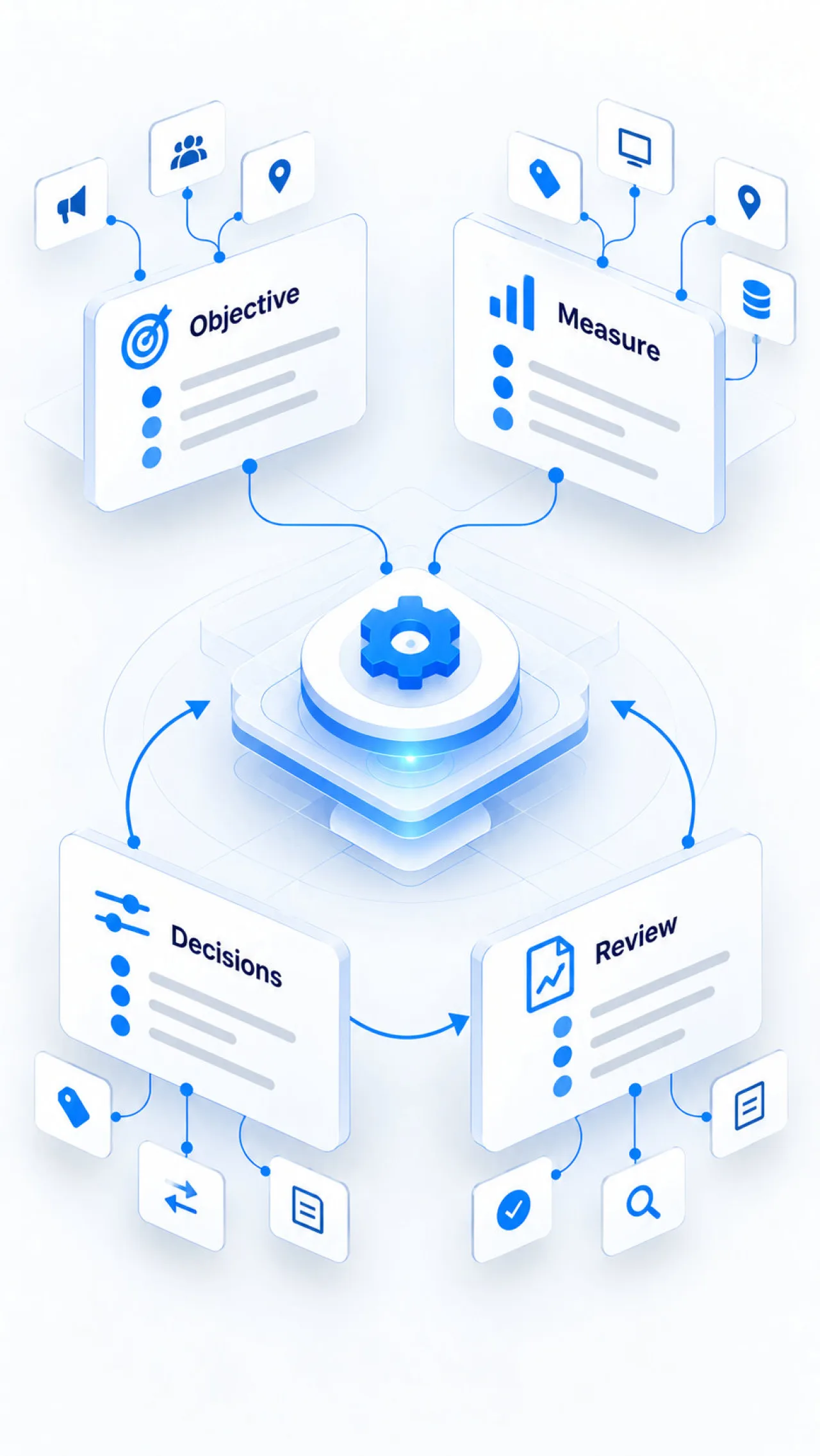
  1. Review the goal and journeys

    We examine the account, coherent offer, audience, KPI and ways customers become leads or buyers.

  2. Agree scope and readiness

    We define strategy, client-material adaptations, measurement gaps, workload and price before paid work.

  3. Manage and refine

    We review evidence, adjust agreed campaigns and report limits and next decisions.

Measurement and work boundaries

For lead-generation optimization, we generally look for measurement that represents roughly 80% or more of the actual relevant leads across the customer journeys that matter. For ecommerce purchase-volume or CPA optimization, we generally look for measurement that represents roughly 80% or more of the actual relevant purchases. For ecommerce ROAS optimization, we generally look for measurement that represents roughly 80% or more of the actual relevant purchase revenue or value used for the agreed objective. These are practical data-readiness guidelines, not automatic contractual pass/fail thresholds. The acceptable level depends on the business model, journey, data quality and strategy; a different objective needs a goal-specific test.

Directly observed and legitimate platform-modeled conversions may contribute when appropriate, without adding overlapping browser/server, modeled/observed or duplicate lead/purchase events twice. An invisible phone, messaging, native-form or purchase path may require further measurement before normal optimization responsibility is accepted. The guideline is not tracking accuracy, Event Match Quality, Meta-attributed share, consent rate, lead qualification, sales rate or a performance guarantee.

Adaptation of client-provided copy, images, existing video or documents is included within the agreed campaign scope. We agree the strategic direction, adaptation workload, scope and price before paid work. Original design, new photography/video/UGC, creator sourcing or licensing, landing pages, long-form content and unlimited variants or recurring replacements are separate by default. If selected, native Instant Form and ad-side messaging campaign configuration can be included; inbox staffing, conversations, sales operations, chatbot and CRM/offline integration are not automatic. Organic publishing, community management, account recovery and unrelated website work are outside the default management scope.

Meta Ads Management

Plan management around real outcomes

Tell us the objective, audience and where leads or purchases actually happen.

Describe your campaigns

Sep 2, 2026 • Online advertising

Meta Ads Learning Phase for Low-Volume Campaigns

Meta Ads Learning Phase for Low-Volume and Limited-Time Campaigns

Meta's learning phase is often reduced to a rule that every ad set needs 50 conversions in seven days. This guide explains why that benchmark is not a mandatory purchase quota, campaign duration, or universal minimum budget, and shows how to structure ticket, high-ticket, seasonal, and other low-volume campaigns around signal quality and real business economics.

Nov 2, 2026 • Online advertising

Why Meta Gives Some Creatives Almost No Impressions

Meta Ads Creative Testing: Why Some Ads Get Almost No Impressions

When a Meta ad receives almost no impressions, that is not proof the creative failed. This guide explains GenRecs, Andromeda and the difference between delivery optimization and deliberate testing, with a practical framework for planning distinct concepts, funding useful comparisons and avoiding unsupported conclusions.