
Published Oct 12, 2026
EU Consent for U.S.-Focused Websites: Cookiebot, Consent Mode, and Google Ads Audiences
A U.S.-focused website can avoid a global GDPR banner, but it still needs a defensible path for visitors in the EEA, UK, and Switzerland: regional consent or complete suppression of the relevant Google services.
Category: Consent Management · By metricfixer AI Studio
A website can sell almost entirely in the United States and still fall within Google’s EU User Consent Policy whenever a visitor located in the European Economic Area, the United Kingdom, or Switzerland reaches the site and Google advertising or measurement services are loaded. This guide explains how a U.S.-focused business with a small share of European traffic can use Cookiebot, Google Consent Mode, and regional tag controls without forcing one European-style banner on every visitor worldwide.
Practical default: show a properly configured consent interface to visitors in the EEA, the UK, and Switzerland; set the relevant Google consent states before any advertising or analytics processing starts; let the visitor’s choice update those states; and leave the main U.S. experience under a separate U.S. privacy configuration. A business that does not want a CMP for European visitors needs to prevent the relevant Google services from loading for those visitors—not merely exclude Europe from campaign targeting.
Executive summary
For Google’s policy, the decisive factor is the location of the end user. The advertiser’s place of incorporation, billing country, headquarters, and principal sales market do not create an exemption. Google states that its EU User Consent Policy applies to end users located in the EEA, the UK, and Switzerland, and it separately confirms that a website outside Europe is still in scope when it uses Google products that incorporate the policy.
A 2% share of European traffic is therefore not the same as zero exposure. Google does not publish a de minimis traffic threshold in this policy. The obligation applies to the covered users who actually receive the relevant Google services. A small share does, however, make a regional implementation commercially sensible: the site can run a consent layer only where it is needed instead of interrupting the other 98% of visitors with an identical banner.
The cleanest implementation for a U.S.-focused site is normally one of these:
- Regional CMP, recommended: Cookiebot displays a GDPR-style consent experience to the EEA, UK, and Swiss traffic and sends the visitor’s choice through Google Consent Mode. U.S. visitors receive a separate U.S. configuration, preference mechanism, or no popup where the business’s actual U.S. obligations do not require one.
- One geo-targeted Cookiebot configuration: a single domain group displays the European consent banner only in explicitly selected countries. This is simpler than maintaining several legal configurations and is often enough for a predominantly U.S. business.
- No CMP for covered traffic: the site or CDN does not load the relevant Google advertising and measurement services for visitors in the EEA, UK, and Switzerland. Those visitors cannot enter Google Ads remarketing audiences through that visit, and the site gives up the affected measurement and activation capabilities for that traffic.
What is not a defensible substitute is simply removing European countries from Google Ads location targeting. A person in Germany, Norway, the UK, or Switzerland can still arrive through organic search, a referral, a forwarded link, direct navigation, or a VPN. If Google tags load on that visit, campaign targeting has not removed the service from the website.

Which geography controls the rule?
Consent discussions often mix together four different questions: where the business is incorporated, where ads are targeted, where the website is available, and where the visitor is located. Google’s own policy separates them.
| Factor | Does it determine the scope of Google’s EU User Consent Policy? | Practical meaning |
|---|---|---|
| Advertiser incorporation or headquarters | No, not by itself | A Canadian or U.S. company can still be in scope for covered visitors. |
| Google Ads billing country | No, not by itself | A North American billing profile does not change where the end user is located. |
| Campaign location targeting | No | Excluding Europe from campaigns does not prevent European users from opening the site. |
| End-user location | Yes | The policy applies to users in the EEA, the UK, and Switzerland. |
| Whether covered Google services load for that user | Yes | If those services are removed for covered visitors, Google says the policy does not apply to that service interaction. |
| Percentage of European traffic | No published minimum | Low traffic may reduce operational impact, but it is not an exemption stated in the policy. |
The EEA consists of the EU member states plus Iceland, Liechtenstein, and Norway. The UK and Switzerland sit outside the EEA but are named separately in Google’s policy. Google currently says that advertisers are expected to send verified consent signals for EEA traffic; it does not currently state the same verified-signal expectation for UK or Swiss advertiser traffic. That technical enforcement distinction should not be mistaken for a statement that the broader policy or local consent obligations disappear in the UK or Switzerland.
Google’s public checklist also expects advertisers to display the mechanism across the relevant covered countries, disclose Google and other data recipients, obtain an affirmative choice, retain consent records, make withdrawal possible, and avoid setting cookies before consent where consent is required. Google says it conducts periodic audits and may suspend audience functionality, ad personalization, remarketing, or conversion measurement when a partner does not resolve a policy issue.
What “removing Google services” means in practice
The wording in Google’s policy help page is easy to misread as an account setting. It is not a Google Ads interface control. It describes a website or application architecture in which the relevant Google services are not made available to covered users.
For a website focused on GA4 and Google Ads, a true removal path normally means that the covered visitor does not receive the applicable implementation components, for example:
- the Google Tag Manager container, where that container is the delivery path for Google advertising and measurement tags;
- the Google tag or
gtag.jsimplementation; - GA4 collection requests;
- Google Ads conversion and remarketing tags;
- Conversion Linker behavior and advertising-cookie creation;
- other Google products incorporated into the policy, if the site uses them and they are part of the same covered interaction.
This is normally implemented in the server template, edge worker, reverse proxy, or CDN. The user’s country is resolved before the HTML is returned, and the template omits the relevant scripts for the blocked region. A client-side rule that waits for Google Tag Manager to load and then decides not to fire another tag is weaker because the Google delivery layer has already loaded.
No-CMP removal flow: request reaches the server or CDN → visitor country is resolved → EEA, UK, or Swiss request receives HTML without the relevant Google advertising and measurement scripts → no Google consent-dependent audience or advertising data is generated from that visit → U.S. request receives the normal U.S. tag stack.
Advanced Consent Mode is different. In advanced mode, Google tags can load while the default states are denied and can send cookieless pings. That can preserve modeling, but it is not the same thing as removing Google services. Google’s newer data-transmission controls can further restrict or prevent advertising data when ad_storage is denied, yet those controls still need to be assessed separately from analytics and diagnostic transmission. A business relying on the policy’s “services removed” sentence should use a hard technical suppression path rather than describe an advanced, denied-state implementation as removal.
Recommended architecture for a U.S.-focused website with limited European traffic
The most practical design is a jurisdiction-aware router rather than one global popup. The router does not need fifty bespoke legal experiences. It needs a small number of well-defined paths based on the website’s real audience, data uses, and applicable rules.
| Visitor segment | Recommended website behavior | Google audience consequence |
|---|---|---|
| United States core market | Apply the business’s U.S. privacy configuration. Honor applicable state opt-outs and browser-level signals where required. Do not apply an EEA opt-in banner automatically just because the site uses Google Ads. | Eligible U.S. users can enter GA4 and Google Ads audiences when the relevant product settings and privacy choices allow it. |
| EEA | Display a prior-choice CMP experience; initialize ad_storage, analytics_storage, ad_user_data, and ad_personalization appropriately before tags process data; update them from the user’s choice. |
Only users with the necessary affirmative advertising consent can be used for Google Ads personalization and remarketing. |
| United Kingdom | Use a UK-appropriate prior-consent configuration. Operationally, many businesses place it in the same Cookiebot routing group as the EEA. | Do not equate Google’s current lack of a verified-signal expectation with permission to ignore consent or local storage rules. |
| Switzerland | Use a Swiss-reviewed configuration. A combined EEA/UK/Swiss route is often simpler, although local legal treatment is not identical. | Keep personalization and audience use aligned with the visitor’s choice and the business’s legal assessment. |
| Other occasional countries | Use a documented fallback and monitor traffic. Add a dedicated regional configuration when actual exposure, data use, or local rules justify it. | Do not assume that a global “granted” fallback is appropriate merely because the market is not part of the EEA. |
This approach is consistent with the broader metricfixer guide to website consent signals around the world. That global article is a comparison matrix, not an instruction to create a separate Cookiebot domain group for every listed jurisdiction before the business has users, operations, or regulated processing there.
The important correction is that advertising plans are not the only trigger. A company does not need to build a Brazil, Japan, Australia, or South Africa module merely because those regions appear in a reference table. But “we do not advertise there” is not, by itself, proof that no duties can arise. Actual visitors, sales, data collection, legal thresholds, targeting practices, and the applicable platform terms still matter. For Google’s EU policy specifically, even non-advertising visits from the EEA, UK, or Switzerland matter if the incorporated Google services load.
Cookiebot implementation options
Cookiebot is well suited to this type of regional architecture because it can geo-target the banner, maintain consent records, scan the site, and send Consent Mode values to Google. The appropriate Cookiebot design depends on whether the business needs one European experience or several materially different regional experiences.
Option 1: multiple domain groups for separate legal experiences
This is the most flexible and the closest to the metricfixer setup shown in the project screenshot. A practical structure could be:
- Primary / U.S. domain group: contains the actual website domain, scanning configuration, consent records, cookie classifications, and the default U.S. experience.
- EEA, UK, and Switzerland domain group: contains the stricter consent design, category behavior, languages, and Google Consent Mode mapping for covered visitors.
- U.S. opt-out states domain group, where needed: contains the state-specific notice, opt-out, Global Privacy Control, and sale/share behavior required by the business’s U.S. privacy program.
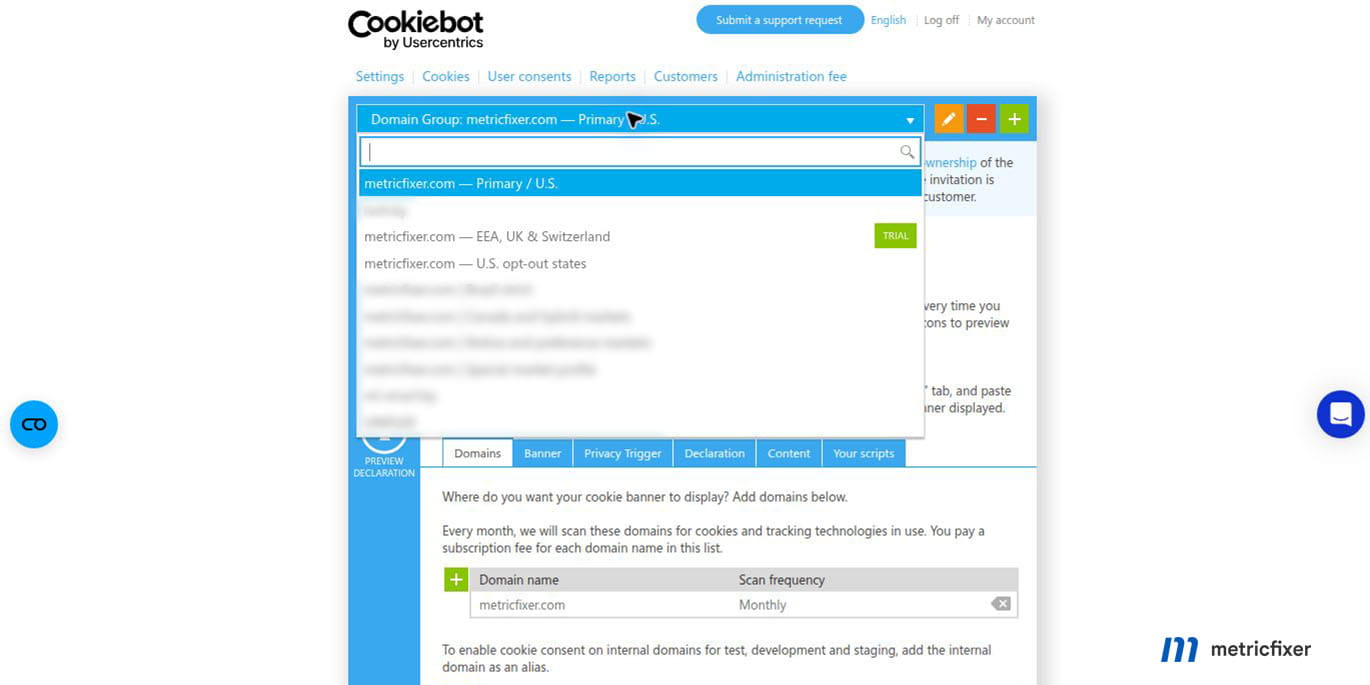
Cookiebot’s current multi-legislation instructions make an important implementation point: only the primary domain group should contain the domain. The alternative groups are configuration records and should not repeat the domain, otherwise the same site can be scanned and billed more than once. The groups can still be named clearly in the account dropdown, such as “metricfixer.com — EEA, UK & Switzerland,” without adding the domain to the alternative group’s domain field.
Cookiebot maps an alternative group to a region through data-georegions. The same regional mapping should be used for the banner script and the Cookie Declaration script so that the user-facing declaration matches the banner configuration.
<script
  id="Cookiebot"
  src="https://consent.cookiebot.com/uc.js"
  data-cbid="PRIMARY-DOMAIN-GROUP-ID"
  data-blockingmode="auto"
  data-georegions="{'region':'EEA-UK-CH-COUNTRY-CODES','cbid':'EUROPEAN-DOMAIN-GROUP-ID'}"
  type="text/javascript">
</script>
The placeholder EEA-UK-CH-COUNTRY-CODES should be replaced with the current ISO country-code list used by the implementation. Do not assume that a preset labeled “EU” covers every territory named by Google. Depending on the Cookiebot interface and version, an EU preset may list EU member states but not automatically include Iceland, Liechtenstein, Norway, the UK, or Switzerland. Verify the live list and explicitly include every intended territory.
Option 2: one Cookiebot group with regional banner display
A simpler business may not need separate U.S. and European banner designs. Cookiebot can display one banner only to selected countries or regions while leaving other visitors’ site experience unchanged. This is often the best balance for a U.S.-focused ecommerce site with 1–3% European traffic:
- Use one primary Cookiebot domain group.
- Configure the consent banner and Google Consent Mode integration.
- Display the banner only in the explicitly selected EEA countries, the UK, and Switzerland.
- Leave the U.S. experience outside that distribution rule, subject to the business’s separate U.S. privacy requirements.
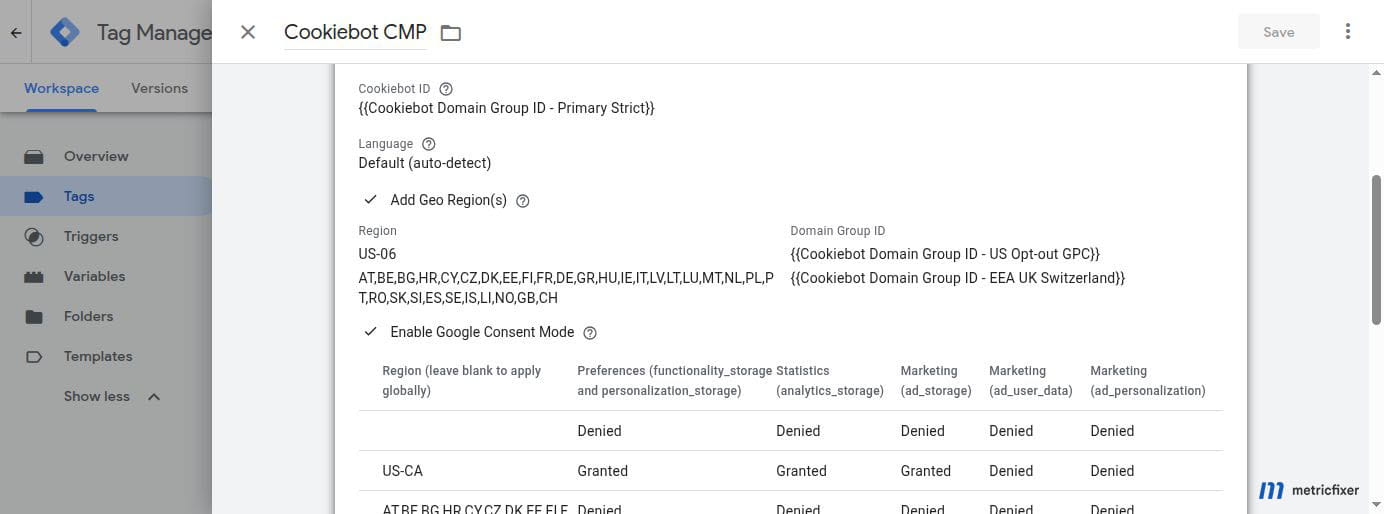
This version has less maintenance overhead and fewer opportunities for a wrong domain-group ID. Its limitation is that every covered visitor receives the same consent text and behavior. It becomes less attractive when the business needs separate UK wording, a Swiss notice-and-choice treatment, U.S. opt-out logic, multiple languages, or materially different category defaults.
Option 3: one global banner
A global banner is technically simple and can be appropriate for a genuinely international business that wants one conservative standard. It is usually inefficient for a business that sells only in the United States and receives a small amount of foreign traffic. It introduces consent friction for users whose applicable rules may be based on notice and opt-out rather than prior opt-in, and it can unnecessarily suppress measurement if the defaults are denied worldwide.
A global banner is therefore a governance choice, not an automatic “safest” choice. A poorly routed global implementation can also be less safe operationally: a single mistaken default or a missing update can stop audience growth in the United States, where the business expected normal collection.
Option 4: no CMP, with hard regional suppression of Google services
This route can be reasonable when the business has no commercial interest in measuring or remarketing to European visitors and is prepared to give up the affected data. The server or CDN should suppress the relevant Google stack for the EEA, UK, and Switzerland before the page is rendered.
The main drawbacks are:
- no GA4 client-side behavior data from the suppressed implementation for those visits;
- no Google Ads remarketing membership from those visits;
- no client-side Google Ads conversion measurement from those visits;
- additional engineering and testing around geolocation, caching, VPNs, bots, and unknown locations;
- a need to document the geolocation provider and fallback behavior;
- a need to review other third-party tags separately, because removing Google does not control Meta, Microsoft, call tracking, chat tools, or embedded media.
A permanent denied default without a banner can be used as a technical fail-safe, but it is not the same as collecting consent. In advanced mode, cookieless requests may still be transmitted. If the business’s position is that covered users should not receive Google services at all, hard suppression is clearer than loading Google and leaving consent denied forever.
Basic vs Advanced Consent Mode for this scenario
Cookiebot collects and records the user’s decision. Consent Mode communicates that decision to Google. They solve different parts of the same workflow; Consent Mode is not a standalone banner.
| Mode | Before the visitor chooses | After rejection | Best fit |
|---|---|---|---|
| Basic Consent Mode | Google tags are blocked until the required consent is granted. | The blocked tags remain inactive for the denied purposes. | Businesses that prioritize no pre-consent transmission and accept less modeling coverage. |
| Advanced Consent Mode | Google tags can load with denied defaults and send limited cookieless pings. | Tags continue in consent-aware limited behavior; no advertising cookies should be written for denied storage. | Businesses that want conversion and behavioral modeling, subject to their legal and policy assessment. |
| Hard service removal | The relevant Google scripts are not delivered to covered visitors. | Nothing changes because the service was not loaded. | Businesses choosing no CMP and no Google measurement or activation for covered traffic. |
For most U.S.-focused advertisers that still want useful European measurement, the practical choice is Cookiebot plus Advanced Consent Mode, with denied regional defaults and a clear visitor choice. For a stricter no-pre-consent design, Basic Consent Mode or Google’s “do not transmit advertising data” control can be used, but the implementation must be tested because advertising, analytics, and diagnostics have separate transmission controls.
Beginning in August 2026, Google says it is beginning to launch IP-based ads measurement and personalization solutions in the EEA, UK, and Switzerland and reminds customers to provide appropriate transparency. That makes it particularly unsafe to assume that “no advertising cookie” automatically means “no consent or disclosure question.” The CMP text, Consent Mode state, and Google tag data-transmission choices should be reviewed as one system.
How consent affects GA4 and Google Ads audiences
A regional CMP does not require the advertiser to shut down all audiences. It should separate eligible and ineligible users at the visit level.
ad_personalization='denied'prevents the data from being used for personalized advertising and remarketing.ad_user_data='denied'disables use of personal data for online advertising use cases and can limit conversion export keyed to advertising click identifiers.- Google states that both
ad_user_dataandad_personalizationneed to be granted for personalized advertising. ad_storage='denied'prevents advertising-cookie storage and stops Google Signals accumulation for that traffic.analytics_storage='denied'changes how Analytics storage and behavioral measurement operate, depending on whether the site uses Basic or Advanced Consent Mode and the selected transmission controls.
When the routing is correct, U.S. visitors are not removed from audiences merely because 2% of traffic is European. European users who reject the relevant purposes should not be activated for remarketing; consenting European users can be eligible when the rest of the GA4–Google Ads configuration is correct. The separate step-by-step guide, How to Link GA4 to Google Ads and Configure Audiences and Consent, covers the product screens that control this flow.
Common implementation mistakes
- Do not use campaign geo exclusions as a consent control. They control ad delivery, not organic, direct, referral, or shared-link visits.
- Do not set denied consent worldwide unless that is intentional. A global denied default with no regional grant path can stop U.S. audience growth and conversion optimization.
- Do not mark all website data as consented at the Google Ads account level to “fix” diagnostics. Account defaults are fallbacks; they do not replace a real visitor choice and should not contradict the website signal.
- Do not assume the word “EU” covers the full Google policy geography. Verify the EEA, UK, and Swiss country list used in Cookiebot and in any Google tag override.
- Do not add the same website domain to every Cookiebot alternative group. Keep the real domain in the primary group and use alternative groups as regional configurations.
- Do not treat Restricted Data Processing as a GDPR control. It is a separate Google Ads mechanism for specified U.S. state-law use cases and can restrict audience functionality.
- Do not rely only on a green GA4 consent status. Low EEA traffic can produce no warning even when the implementation has not been fully exercised.
Validation plan before publication
Regional consent setups fail most often at the edges: the default arrives after the Google tag, a country is missing from a preset, a cached HTML response crosses regions, or the CMP updates one consent type but not the others. Test the implementation as a sequence, not as a screenshot review.
- Test at least five locations: United States, an EU member state such as Germany, an EEA non-EU state such as Norway, the United Kingdom, and Switzerland.
- Inspect the page before interaction: confirm which scripts load, which cookies exist, and the default values for
ad_storage,analytics_storage,ad_user_data, andad_personalization. - Reject optional purposes: confirm that the values remain denied and no disallowed advertising cookies appear.
- Accept the relevant categories: confirm that Cookiebot sends an update and Google tags move to the granted state only after the choice.
- Withdraw consent: confirm that the preference control is visible and the new state is respected on later pages.
- Test unknown geography: define what happens when the geolocation lookup fails. A silent global grant is usually a poor fallback.
- Review Cookiebot records and scans: verify that the visible text, categories, third parties, and current scripts match the live site.
- Use Google Tag Assistant: verify the on-page default and update commands rather than relying only on delayed GA4 or Google Ads diagnostics.
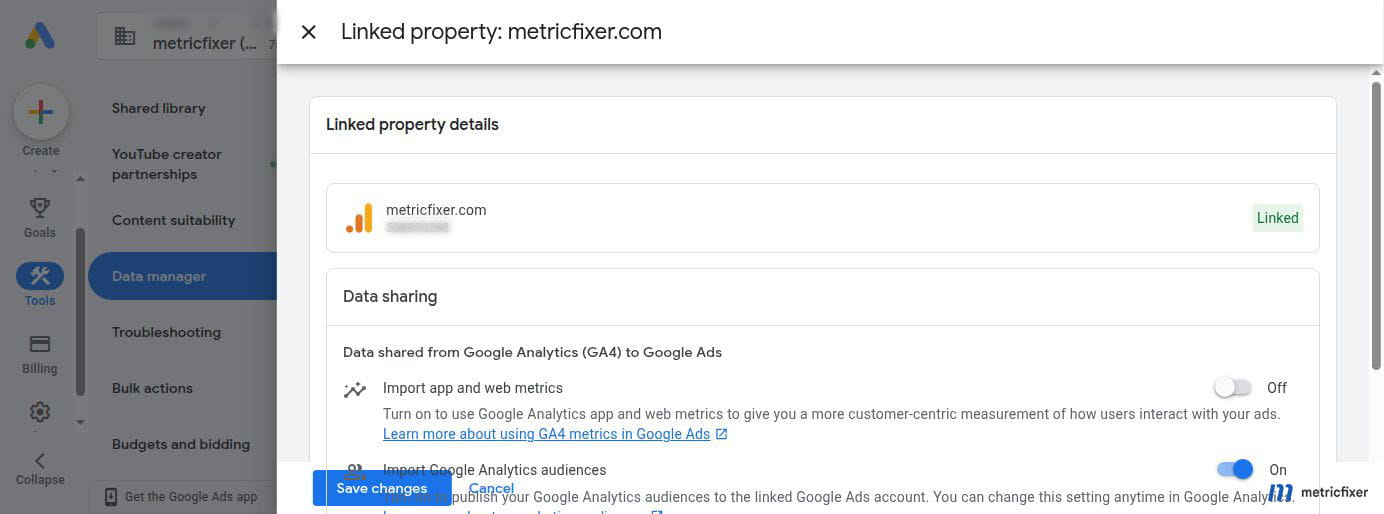
Google Analytics consent notifications can take 48–72 hours to update, and Google Ads consent status can take 48 hours or, in some cases, up to two weeks. A delayed status is not a reason to change a working implementation. Tag Assistant and direct network/cookie inspection should be the first diagnostic layer. The metricfixer article Consent Mode v2 Is Configured—but Google Still Says It Is Not explains how to separate a real implementation failure from delayed or low-volume product diagnostics.
Decision table
| Business situation | Recommended path | What happens to European Google Ads audiences? |
|---|---|---|
| Small EEA/UK/Swiss traffic, but the business wants measurement and possible remarketing | Geo-targeted Cookiebot plus Consent Mode; usually one European configuration is enough. | Consenting users can be eligible; rejected users are excluded from personalized advertising use. |
| Different European and U.S. privacy experiences are required | Cookiebot multiple-domain-group architecture with one primary domain group and regional alternatives. | Eligibility follows the regional configuration and user choice. |
| No commercial value from covered traffic and no desire to operate a CMP | Suppress relevant Google services at the server/CDN/template layer for EEA, UK, and Swiss visitors. | No members or conversions are generated from the suppressed Google implementation. |
| Europe excluded only in Google Ads campaign settings | Insufficient. Add a CMP or hard service suppression. | European organic/direct visitors can still reach the tag stack, creating policy exposure. |
| One worldwide denied default was added after a warning | Replace it with intentional regional routing and a tested update path. | Otherwise U.S. audience growth and measurement can be unintentionally reduced. |
Implementation checklist
- [ ] Inventory every Google tag and other third-party tag that loads before user interaction.
- [ ] Decide between regional CMP, global CMP, and hard regional suppression.
- [ ] Explicitly cover the EEA, the UK, and Switzerland; verify the country list in the live Cookiebot interface.
- [ ] Place the Consent Mode default before the Google tag or GTM container can process data.
- [ ] Confirm that Cookiebot sends an update for all four relevant Google consent parameters.
- [ ] Keep the real domain only in the primary Cookiebot domain group when using multiple configurations.
- [ ] Use the same regional mapping for the Cookiebot banner and Cookie Declaration.
- [ ] Define the behavior for unknown or failed geolocation.
- [ ] Test U.S., EU, non-EU EEA, UK, and Swiss visits separately.
- [ ] Keep consent records and a visible withdrawal or preference-control path.
- [ ] Recheck Google Ads and GA4 audience settings using the linked implementation guide.
- [ ] Review the setup after Google, Cookiebot, or regional privacy requirements change.
Methodology and sources
This article was prepared from a review of Google’s EU User Consent Policy and policy help page, Google Consent Mode and data-transmission documentation, Google Analytics consent diagnostics, current Google Analytics advertising-control changes, Cookiebot’s Google Consent Mode, geo-targeting, and multiple-legislation documentation, and the current metricfixer consent-management materials. The review was completed on 6 August 2026. Product labels and interfaces can change after publication.
- Google EU User Consent Policy
- Google: Help with the EU User Consent Policy
- Google Ads Consent Mode reference
- Google Ads: Set up Consent Mode
- Google Ads data-transmission controls
- Google Analytics: Verify and update consent settings
- Google Analytics data-control changes for 2026
- Cookiebot: Implementing Google Consent Mode
- Cookiebot: Displaying a banner only in selected regions
- Cookiebot: Supporting multiple legislations on one website
- Cookiebot: About Google Consent Mode
This article provides technical and operational information and is not legal advice. The correct privacy configuration depends on the website’s users, data uses, contracts, applicable laws, and current platform terms. metricfixer is an official Cookiebot reseller, but Cookiebot configuration does not by itself guarantee legal compliance. metricfixer is not affiliated with Google. Google and Cookiebot policies, interfaces, enforcement practices, and technical behavior may change after publication.