
Published Aug 29, 2026
How ChatGPT Ads Targeting Works After the August 2026 Privacy Update
OpenAI's August 2026 privacy rollout makes the ChatGPT Ads model much clearer: non-personalized ads are still contextually targeted, personalization requires user choice, and advertisers do not receive chat-level data. This guide explains the new targeting layers, placements, auction mechanics, audience tools, and campaign strategy.
Category: Online advertising · By metricfixer Expert Team
OpenAI's August 2026 privacy rollout makes the ChatGPT Ads targeting model much clearer. Ads can be highly contextual even when they are not personalized, personalization adds a separate user-controlled layer, and advertisers still do not receive ChatGPT conversations or personal chat histories. This guide explains what advertisers can actually control, how OpenAI selects and ranks ads, where placements appear, and how to build campaigns around conversational intent rather than keyword lists.
Practical default: treat ChatGPT Ads as a contextual-intent platform first and a personalized audience platform second. Build campaigns that can perform from the meaning of the current conversation alone. Use personalization, first-party audiences, and conversion optimization as additional layers where they are available, rather than making them the foundation of the media plan.

What changed in the August 2026 rollout
On August 29, 2026, OpenAI began emailing ChatGPT users about an updated privacy framework for advertising. The message is important for advertisers because it clarifies a distinction that was easy to miss in earlier announcements: non-personalized ChatGPT ads are still contextually targeted. A user who does not opt in to personalized advertising can still receive an ad selected using the current conversation and limited contextual information.
That interpretation is now explicit in OpenAI's updated Europe Privacy Policy. OpenAI says the generic ads experience may use the context of the current ChatGPT chat, general location, time of day, and device type. By contrast, personalized ads can additionally use broader ChatGPT signals after the user provides consent, including past chats, ad interactions, and information provided by advertisers.
This privacy change arrives at the same time as the advertising product itself is becoming substantially more complete. OpenAI has expanded beyond simple CPM buying to CPC and conversion-optimized campaigns, added product feeds, first-party Custom Audiences in supported markets, the OpenAI Pixel and Conversions API, and a relevance-weighted auction. Its August 18 Europe expansion announcement says tens of thousands of marketers have now advertised on ChatGPT.
For Europe, one operational distinction still matters. Consumer ad inventory and advertiser self-service access are not the same rollout. As of August 29, OpenAI's Ads Manager Availability page lists the 31 new European countries as Coming Soon for self-service, while advertisers in those markets can already begin through the OpenAI Ads Solutions team, agency partners, or technology partners.
| August 2026 clarification | What it means for advertisers |
|---|---|
| Generic ads can still use the current conversation and limited context. | Contextual relevance remains the primary targeting opportunity even without personalized ads. |
| Personalized ads require a separate user choice where available. | Do not build forecasts on the assumption that every ad-supported user will be personalized. |
| Personalized ads are not initially available in the EEA or Switzerland. | European campaigns should be designed to work on contextual intent alone. |
| Advertisers do not receive chats, chat history, memories, or personal ChatGPT details. | Optimization must rely on campaign structure, aggregate reporting, conversion measurement, and first-party data that the advertiser legitimately supplies. |
| ChatGPT Ads now supports CPM, CPC, and oCPC, plus product feeds and conversion measurement. | The platform is moving from an experimental placement toward a performance advertising system. |
This article deliberately does not repeat the market-by-market rollout already covered in our OpenAI Ads Europe geo-targeting guide, or the click-tracking syntax covered in our OpenAI Ads dynamic parameters and UTM tracking guide. The focus here is the newer targeting, privacy, placement, auction, and audience architecture.
"Non-personalized" does not mean "untargeted"
The most important practical conclusion from the privacy update is that there are now two different relevance layers.
Generic or non-personalized ads can be selected from the context of the current chat thread plus limited contextual signals such as general location, language, time of day, and device type. OpenAI's consumer ads FAQ also says that when personalization is turned off, the system can continue to use the current conversation, but not other chat threads, ads history, or topics to inform the ads shown.
Personalized ads, where available and enabled by the user, can add selected signals from the user's broader ChatGPT experience. OpenAI lists past chats and memory, interactions with ads, and the current chat including personalized model responses among the signals that may contribute to ad relevance.
For a PPC team, this is a major difference from a traditional interpretation of "non-personalized." A generic ChatGPT ad can still appear at a very specific decision moment because the system understands the semantic intent of the conversation taking place now.
Consider an illustrative user request such as: "I need a lightweight carry-on for a two-week trip to Japan, under EUR 150, and it has to fit stricter European cabin limits." An advertiser does not receive that sentence. But the ads system can use the current conversational intent when deciding whether a luggage ad is relevant. The targeting advantage comes from meaning and constraints, not from exposing the prompt to the advertiser.
Simplified ChatGPT Ads selection flow: ad-supported user and eligible conversation → sensitive-context and brand-safety filtering → advertiser geography, platform, audience, budget, and campaign eligibility → semantic relevance from the current conversation, context hints, creative, and landing page → optional broader personalization signals where enabled → expected outcome prediction and relevance-weighted auction → sponsored placement below the ChatGPT response.
This workflow is a practical synthesis of OpenAI's published selection, privacy, campaign, auction, and ad-policy documentation. OpenAI does not publish the exact weighting of these signals, so advertisers should treat the sequence as an operating model rather than a disclosed ranking formula.
What advertisers control - and what stays inside ChatGPT
One of the easiest mistakes is to read the privacy policy's list of available signals and assume those signals become targeting fields inside Ads Manager. They do not. OpenAI separates advertiser controls from internal relevance signals.
| Layer | Examples | Advertiser visibility or control |
|---|---|---|
| Campaign controls | Objective, budget, dates, country and supported subnational locations, iOS/Android/Web platforms, included or excluded Custom Audiences where supported. | Directly configured by the advertiser. |
| Ad-group relevance inputs | Context hints, product/use-case grouping, bid or Bid Cap. | Directly configured by the advertiser. |
| Creative relevance inputs | Headline, description, image, destination and landing-page content. | Directly supplied by the advertiser; OpenAI says these are used in selection and delivery. |
| Current conversation signals | Meaning, intent, constraints and overall context of the current chat. | Used inside ChatGPT; raw conversations are not shared with advertisers. |
| Broader personalization signals | Past chats, memory, ad interactions and other eligible ChatGPT signals when personalization is enabled. | User-controlled and kept within ChatGPT; not exposed as raw targeting data to advertisers. |
| Safety and suitability | Whether the conversation is sensitive, regulated, controversial, unsafe, or otherwise inappropriate for ad adjacency. | Controlled by OpenAI policy and delivery systems, not by advertiser targeting. |
| Performance signals | Expected click or conversion outcomes, including predicted conversion likelihood for oCPC. | Used by the delivery system; advertisers see resulting performance metrics rather than the full model inputs. |
This separation has an important planning consequence: there is no reason to write media plans as if ChatGPT exposes a keyword list of user prompts. OpenAI explicitly describes advertiser-supplied context hints as guidance, not exact-match keywords, and says they do not guarantee delivery in specific conversations.
Where ChatGPT ads actually appear
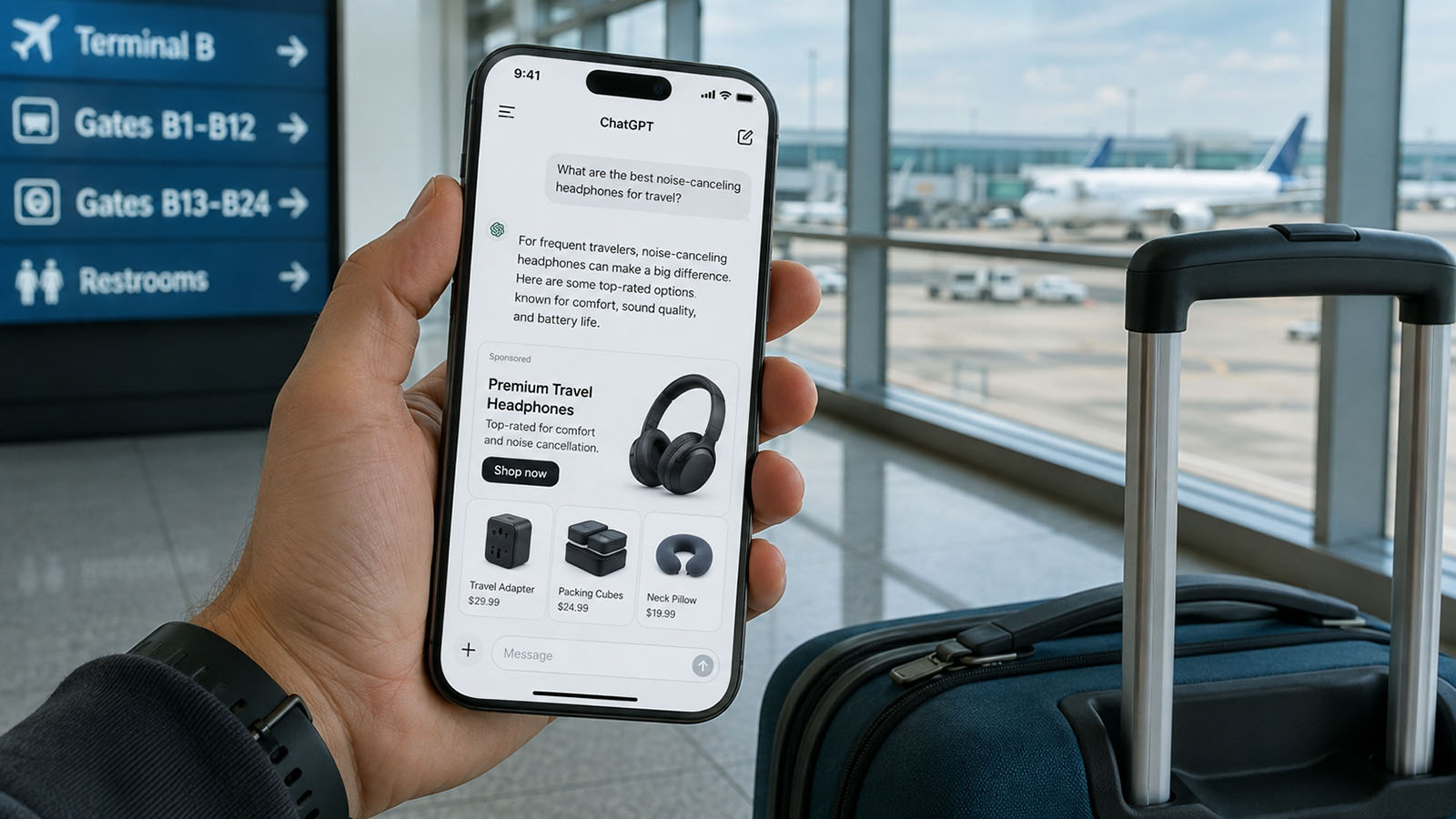
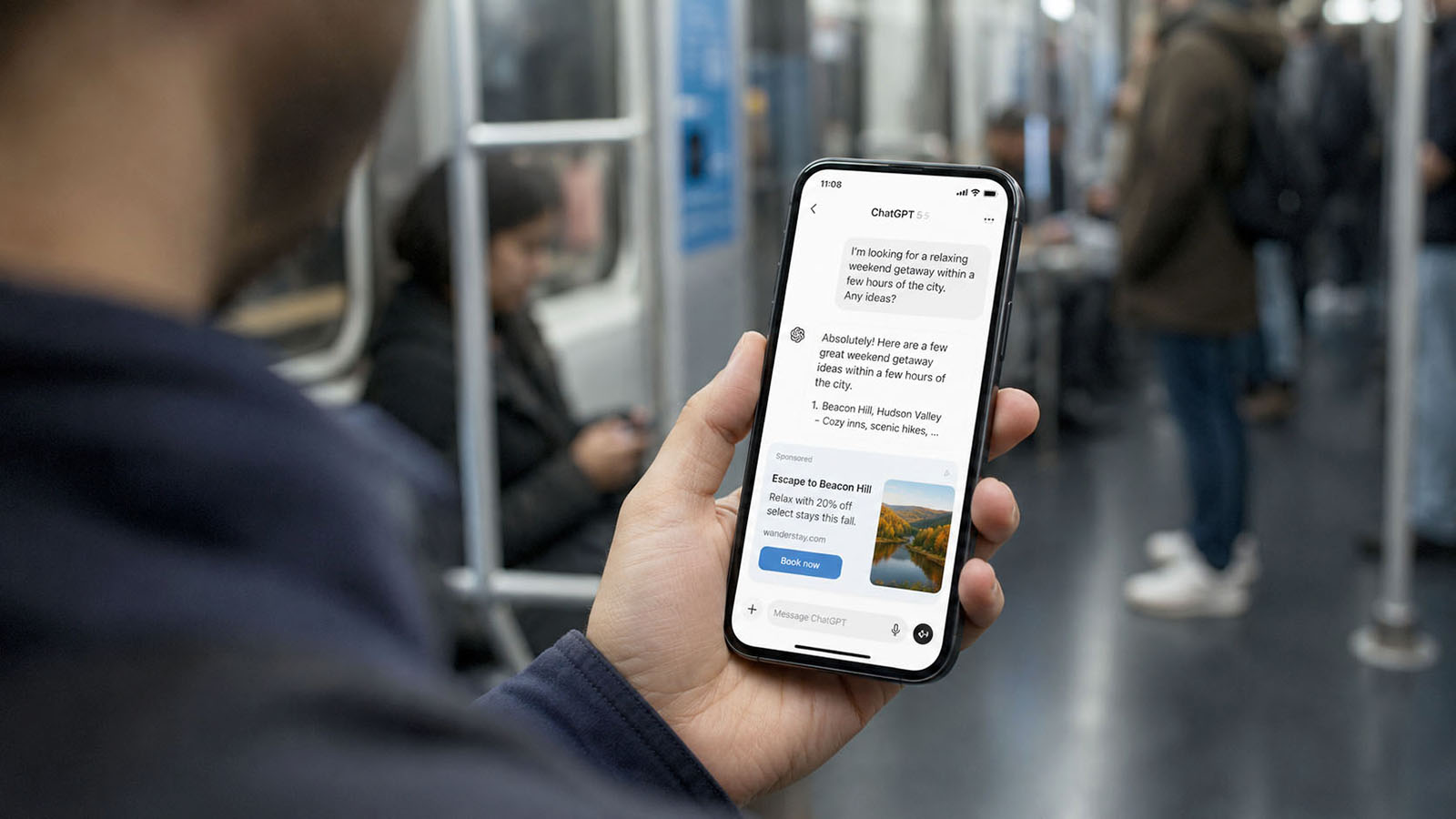
The current standard placement is straightforward: according to OpenAI's Ads in ChatGPT: The Basics, ads appear below ChatGPT responses and are visually separated and labeled as sponsored. A standard unit can include the advertiser name, logo/favicon, headline, description, landing page, and image.
The consumer FAQ adds an important detail: during the test, users may see one or more ad units below a response. A unit can contain one or more items from a single advertiser or items from multiple advertisers. For longer conversations, OpenAI says it also considers overall context and user experience.
This means "a ChatGPT ad" should not be modeled as a single fixed search-ad slot. There is already a range of display patterns inside the same post-response placement:
- Single advertiser creative: a conventional sponsored card with title, copy, image and landing page.
- Multi-item units: one advertiser may surface several relevant products or items.
- Multi-advertiser units: more than one advertiser may appear in the sponsored area.
- Product-feed formats: retail ads can include product images, titles, ratings/stars, prices, sale prices and brand information.
OpenAI says product-feed campaigns have been among the strongest-performing ads in its program to date. That is a platform-reported result rather than an independent benchmark, but it is still a useful signal: structured catalog data fits naturally with comparison-heavy conversations where users are narrowing options by price, features, size, availability or other constraints.
The addressable inventory is smaller than the ChatGPT user base
Advertisers should not use total ChatGPT usage figures as a proxy for paid reach. The current consumer rules exclude several meaningful portions of usage:
- Ads may appear on Free and Go plans; Plus, Pro, Business, Enterprise and Edu accounts are ad-free.
- Accounts identified as belonging to users under 18 do not receive ads.
- Temporary Chats do not show ads.
- During the current test, ads do not appear in the ChatGPT Atlas browser.
- OpenAI also offers a free no-ads option in some regions with lower usage limits and fewer tools, which can further reduce ad-supported inventory.
This is especially important for B2B planning. ChatGPT may have deep adoption inside companies, but Business and Enterprise subscriptions are not ad inventory. A B2B advertiser can still reach professionals who use Free or Go accounts, but enterprise product adoption should not be treated as enterprise ad reach.
Campaign setup currently supports platform targeting for iOS App, Android App and Web, with Web including both desktop and mobile web. OpenAI says more detailed platform reporting is planned; current Insights group devices more broadly into Mobile and Desktop.
How the auction works when there is no exact-match keyword
ChatGPT Ads is not an auction where a keyword alone determines eligibility. OpenAI says the ads system evaluates expected relevance and outcomes using the current conversation, landing page, title, copy, advertiser-provided context hints and targeting selections, plus broader ChatGPT signals when personalization is enabled.
Among eligible ads, OpenAI uses a relevance-weighted second-price auction. In practical terms, the highest bid is not automatically the winner. Relevance is part of the ranking decision, so increasing a bid cannot fully compensate for a weak match between the user's intent, the context hint, the creative and the destination.
The platform now exposes three major buying objectives:
| Objective | Billing | System goal | Practical use |
|---|---|---|---|
| CPM / Reach | Per 1,000 impressions | Maximize visibility and exposure. | Useful for reach tests, launches and upper-funnel coverage where a conversion signal is not yet mature. |
| CPC / Clicks | Per valid click | Find users more likely to engage and click. | A sensible baseline for new accounts because it produces traffic and lets the advertiser validate intent, landing pages and analytics. |
| oCPC / Conversions | Per valid click | Find clicks more likely to produce a selected downstream conversion. | Best after Pixel and/or Conversions API tracking is reliable and the selected event has enough volume. |
OpenAI's current advertiser guidance recommends starting CPC advertisers around a USD 3-5 maximum CPC bid, while emphasizing that Ads Manager may provide bid-strength guidance. This should be treated as platform guidance, not as a universal benchmark for every country or vertical.
For oCPC campaigns, the mechanics are more unusual. The advertiser sets a conversion-oriented Bid Cap at the ad-group level. OpenAI uses predicted conversion likelihood to derive a per-click auction bid, but the advertiser is still billed for valid clicks. The Bid Cap is therefore neither a promised CPA nor a price paid per conversion.
That makes clean conversion measurement strategically important. If the Pixel or Conversions API is incomplete, duplicated, delayed or mapped to a weak event, the problem is no longer just reporting accuracy: it can directly affect the signals used for campaign optimization.
Context hints and landing pages are part of targeting
OpenAI's ad-group guidance says context hints should explain what the product offers, who it helps, or when it is useful. It explicitly recommends descriptive natural-language phrases rather than broad terms.
This is a different optimization habit from building a search campaign around lists of exact and phrase-match queries. A useful ChatGPT ad group is closer to a well-defined job-to-be-done.
| Weak setup | Stronger ChatGPT-style setup | Better landing destination |
|---|---|---|
| "project management software" | "project management software for small agencies coordinating client approvals, deadlines and recurring deliverables" | An agency workflow or client-approval product page rather than a generic homepage. |
| "running shoes" | "cushioned everyday running shoes for beginners training for their first 5K" | A filtered beginner/everyday running collection. |
| "online course" | "self-paced analytics training for marketers who need practical GA4 reporting skills" | The specific course syllabus or enrollment page. |
| "city hotel" | "central hotel for a three-night business trip with late arrival and easy rail access" | A property or collection page that proves those constraints. |
These are illustrative examples, not OpenAI-provided targeting categories. The principle comes directly from the platform documentation: context hints help the system understand relevant conversations, needs and user journeys, but they are not exact-match controls.
The landing page matters more than on many mature ad platforms because OpenAI explicitly lists it among ad-selection signals. Its creative guidance recommends sending users to the most relevant product, collection or content page rather than defaulting to the homepage. It also requires destinations to remain accessible to OpenAI's ad/search user agents.
For performance teams, the practical rule is simple: the context hint, ad promise and landing page should describe the same task at roughly the same level of specificity. If the ad group is about a narrow use case but the destination is a broad corporate homepage, both matching quality and post-click conversion can suffer.
What changes when a user opts in to personalized ads
OpenAI's updated Europe Privacy Policy creates a clear legal and product distinction between generic advertising and personalized advertising. For Free and Go users, OpenAI says it relies on user consent when it asks to personalize ads. Where personalization is on, the system may use past chats, ad interactions, information from advertisers, and the current chat to make ads more relevant.
The consumer FAQ adds several useful operational details:
- Turning personalization off does not turn ads off; current-chat contextual selection can continue.
- Past chats and memory can contribute only when the relevant personalization controls are enabled.
- Hiding, reporting, viewing or clicking an ad does not itself become a ChatGPT memory.
- If a user deliberately shares an ad into a chat through Ask ChatGPT, that resulting conversation can later be referenced if the user's chat-history settings allow it.
- If a user clears ads data, OpenAI says it stops using that data for ads and removes it from servers within up to 30 days.
For advertisers, the key point is what does not change: OpenAI says advertisers never receive the user's chats, chat history, memories, name, email, precise location, IP address or sensitive ChatGPT information. Early advertiser-facing reporting is aggregate and non-identifying.
Therefore personalization should be viewed as an internal relevance upgrade, not as access to a new set of user dossiers in Ads Manager. The advertiser may benefit from better matching, but does not get the underlying conversation history that produced that match.
Personalized ads and Custom Audiences are two different systems
This distinction is now essential.
ChatGPT ad personalization is controlled by the user and changes which internal OpenAI signals can inform relevance. It can include broader ChatGPT context such as past chats, memory and ad interactions where available.
Custom Audiences are advertiser-provided first-party lists used for campaign inclusion, exclusion or bid adjustments. They are an advertiser-side media tool, not a view into ChatGPT's own user profile.
OpenAI's current Custom Audiences documentation adds several practical rules:
- Custom Audiences are not supported for campaigns targeting the EEA or Switzerland, where personalized ads are not yet available.
- Advertisers should upload only first-party audience data they have the right to use and should not upload broker-sourced data.
- For inclusion targeting and Custom Audience bid adjustments, OpenAI publishes 25,000 matched users as the planning threshold. Uploading 25,000 identifiers does not guarantee 25,000 matches.
- Exclusion can be used with small or even empty ready audiences; the same matched-size minimum does not apply.
- The API supports Custom Audience bid multipliers from 0.1x to 10x.
- Matched-user counts are privacy-preserving ranges rather than exact individual-level membership reports.
This makes first-party audiences useful for familiar performance patterns such as suppressing existing customers, separating prospects from customers, or increasing bids for valuable known segments. But those tactics should be treated as a separate test layer on top of contextual relevance.
It is also important not to assume that Europe's future opt-in personalization automatically means Custom Audiences will immediately become available there. The consumer personalization system and advertiser audience product are related conceptually, but OpenAI documents them separately and can roll them out on different timelines.
Brand safety is also an inventory filter
OpenAI's Ad Policies do more than regulate creative. They also determine where ads are eligible to appear.
OpenAI says ads should not be placed near sensitive or brand-unsafe conversations. The published examples include personal or mental health contexts, politics, self-harm, weapons, illegal activity, fraud, harmful or controversial material and other categories where ad adjacency could undermine user trust.
This matters when estimating delivery. A company can be permitted to advertise in a regulated category and still be ineligible to appear in the conversations that look most commercially relevant on paper. OpenAI explicitly notes, for example, that some approved health or financial advertisers may advertise while ads still cannot appear near sensitive personal-health conversations.
For agencies, the practical implication is to separate two questions:
- Is the advertiser/category allowed?
- Is the conversation context eligible for ad placement?
A narrow campaign can underdeliver because of contextual suitability even when bids and budgets are competitive. That is another reason not to model ChatGPT Ads as a conventional keyword inventory where every commercial query is auctionable.
How to optimize without conversation-level reporting
OpenAI's user-facing privacy position and advertiser-facing measurement product point in the same direction: advertisers should expect performance data without access to raw conversations.
The current Ads Manager Beta documentation lists impressions, clicks, spend, CTR, average CPC, average CPM and conversions. OpenAI also supports conversion tracking through the Pixel and Conversions API. The public advertiser documentation does not describe a traditional search-term report containing raw ChatGPT prompts, and OpenAI explicitly says conversations are not shared with advertisers.
That changes the optimization workflow. Instead of mining a query report, teams need to create the diagnostic structure themselves:
- Separate ad groups by distinct user job, product category or use case.
- Write context hints narrowly enough that each ad group represents one coherent need.
- Use multiple genuinely different creatives per offering so the system can cover different decision angles.
- Send each theme to a correspondingly specific landing page.
- Keep campaign naming and URL tracking consistent enough to reconstruct performance in analytics and CRM systems.
- Use Pixel and/or Conversions API events for platform optimization, but independently reconcile those events against the site's analytics and backend outcomes.
For click-level attribution, continue to use stable URL parameters and campaign identifiers. Our separate OpenAI Ads UTM and dynamic-parameter guide covers the platform's destination tracking patterns in detail. The key point for this article is that URL tracking becomes even more valuable when there is no advertiser-visible conversation transcript to explain why an impression occurred.
First-party data does not remove privacy responsibility
OpenAI has also formalized the advertiser-side data layer. The Ad Tools Data Processing Addendum, effective August 19, says that except for defined Restricted Processing, OpenAI and the advertiser generally act as independent data controllers for personal data processed through covered Ad Tools. The accompanying Ad Tools Terms, published August 24, place responsibility on advertisers to have the necessary rights, notices, consents, permissions and legal bases for audience data and other advertising materials they provide.
For PPC teams, the practical reading is not complicated: the fact that OpenAI protects ChatGPT conversation privacy does not make an advertiser's own CRM uploads or conversion data automatically compliant. Audience and conversion workflows still need normal first-party-data governance, and OpenAI prohibits sensitive/prohibited data in these tools.
A practical campaign architecture for the contextual-first era
The most robust setup depends on which targeting layers are actually available in the market.
| Market/setup | Recommended targeting foundation | Buying approach | Primary measurement |
|---|---|---|---|
| EEA / Switzerland today | Current-conversation intent, geography, platform, focused context hints, creative and landing-page relevance. Do not assume personalized ads or Custom Audiences. | Start with CPC where practical; use CPM for reach use cases. Move to oCPC only after conversion tracking and volume are credible. | Ads Manager aggregate metrics + Pixel/CAPI + analytics/CRM + structured URL tracking. |
| Market with personalized ads, no CRM audience | Same contextual foundation, with OpenAI able to add user-enabled broader ChatGPT signals internally. | Compare CPC versus oCPC after establishing a clean baseline. | Measure contextual campaign structure rather than trying to infer individual user history. |
| Market with eligible Custom Audiences | Contextual intent plus first-party audience inclusion/exclusion or bid multipliers where scale thresholds allow. | Run audience tests separately from context-hint tests so the effect of each layer remains interpretable. | Platform conversion reporting plus first-party customer/CRM reconciliation. |
| Retail with a broad catalog | Product feed structure, product metadata, contextual intent and catalog filters. | Use feed-based campaigns where inventory and catalog quality justify them; evaluate CPC/oCPC based on conversion maturity. | Product-level or category-level commerce outcomes, margin-aware backend reporting where possible. |
Recommended build sequence
- Define the user's task, not the keyword list. Start from the decisions people make: compare, choose, troubleshoot, plan, buy, learn, replace, book or evaluate.
- Create one ad group per coherent need. If two use cases need different landing pages or different promises, they should usually be separate ad groups.
- Write descriptive context hints. Include the product, the user type and the situation in natural language.
- Build creative coverage. OpenAI recommends multiple distinct title/copy variations rather than near-duplicates.
- Deep-link aggressively. Send the user to the page that best resolves the stated need, not automatically to the homepage.
- Establish a CPC baseline. Validate click quality, landing-page behavior, conversion tracking and URL attribution before asking the system to optimize deeper outcomes.
- Add oCPC only when the conversion event is dependable. OpenAI currently supports one selected standard conversion event per oCPC campaign, and the event cannot be changed after campaign creation.
- Add first-party audience tactics only where supported. Keep suppression, inclusion and bid-multiplier experiments separate from semantic targeting tests.
- Evaluate by market mode. Do not compare an EEA contextual-only campaign directly with a market where user-enabled personalization and Custom Audiences are available without noting the structural difference.
Which advertisers are best positioned now?
Retail and ecommerce
Retail is currently one of the clearest fits. Product conversations naturally contain attributes that structured feeds can answer: size, price, color, compatibility, reviews, delivery, features and alternatives. OpenAI's own early performance statement about feed ads supports testing this category, although advertisers should validate the claim against their own incrementality and margin data rather than treating it as a benchmark.
SaaS, software and digital products
These advertisers can benefit from rich problem descriptions that are difficult to capture with short search queries. A user can explain a workflow, team size, integration requirement and budget in one conversation. The challenge is to translate that richness into focused context hints and landing pages rather than trying to advertise a broad software category to every related discussion.
Travel, local services and planning-heavy purchases
ChatGPT is frequently used for planning. The generic ad experience can use current-chat context and general location, while advertisers separately control geographic targeting. This combination can be useful when the commercial need depends on destination, timing, constraints or a local service area. Advertisers should still keep location targeting explicit rather than assuming the conversational location signal substitutes for campaign geo controls.
B2B
B2B can work well when the buyer is researching on a Free or Go account, especially for software, training, professional tools and smaller-business services. But the inventory caveat is important: Business and Enterprise accounts are ad-free. The platform may therefore be excellent for reaching an individual professional researching a problem without being a direct paid-media route into managed enterprise ChatGPT seats.
Regulated and sensitive categories
These require a narrower forecast. OpenAI's ad policies can restrict both who is permitted to advertise and which conversations are eligible for ad adjacency. Even approved advertisers should expect sensitive-context exclusions to remove some of the seemingly highest-intent conversations from the auction.
The new Ad Tools Terms reveal where the platform may go next
The August 24 Ad Tools Terms contain two sections that are strategically important, but they need careful wording because the terms are broader than the features currently documented as generally available.
AI Creative Tools
The terms say OpenAI may make available AI-powered Creative Tools that can generate, modify, optimize, localize, translate, select, assemble or otherwise adapt ad creative. The terms even contemplate dynamically tailoring generated creative to the context of a user's interaction with OpenAI.
That is potentially a major evolution: ChatGPT Ads could eventually move from contextual selection of prebuilt ads toward contextual adaptation of creative. But this should not be described as a standard live feature today. OpenAI's current self-service creative documentation describes a Suggested ad drafts feature that uses existing website metadata to prefill an image, title and description, and explicitly says that it does not generate new copy or imagery with AI.
Sponsored Agents
The same Ad Tools Terms include a section for Sponsored Agents, covering situations where OpenAI creates, configures or makes an advertiser-sponsored agent available. This suggests a future path toward richer conversational commercial experiences in which the paid interaction can extend beyond a static card.
Again, the terms are legal groundwork, not proof that Sponsored Agents are broadly available in Ads Manager. The standard public placement documented today remains a sponsored unit below a ChatGPT response. Advertisers should watch this area, but should not build current forecasts around a format that OpenAI has not yet documented as normal self-service inventory.
There is already an intermediate interaction layer. The consumer FAQ documents Ask ChatGPT, which lets the user deliberately share an ad with ChatGPT and ask questions about it. It also notes that if a user chooses to message an advertiser through an ad, the advertiser sees only the messages the user directly sends. These features show the direction of travel without changing the core privacy rule that the advertiser does not receive the surrounding ChatGPT conversation.
Advertiser checklist for the next rollout phase
- [ ] Separate contextual targeting from personalization in your strategy. Your campaign should make sense even if only the current conversation is used.
- [ ] Do not treat context hints as keywords. Write them as natural-language descriptions of needs, users and situations.
- [ ] Align context hint, creative and landing page. OpenAI uses all of them as relevance signals.
- [ ] Forecast from actual ad-supported inventory, not total ChatGPT adoption. Paid business plans, minors, Temporary Chats and some other experiences are excluded.
- [ ] For Europe, distinguish inventory rollout from self-service rollout. As of August 29, the 31 new European markets remain Coming Soon for direct self-service.
- [ ] Do not assume personalized ads in the EEA or Switzerland yet. OpenAI explicitly says they are not initially available there.
- [ ] Do not confuse personalized ads with Custom Audiences. They are separate systems with separate availability rules.
- [ ] Use first-party audience data only where you have the required rights and where OpenAI supports the feature. Broker-sourced audience data is not allowed under the Custom Audiences guidance.
- [ ] Validate conversion tracking before oCPC. Optimization depends on the quality of the conversion signal.
- [ ] Keep independent analytics and CRM reconciliation. Platform optimization and business truth should not rely on a single measurement system.
- [ ] For retail, test product feeds as a distinct campaign architecture. Feed quality and metadata become part of ad relevance and scale.
- [ ] Account for brand-safety exclusions in delivery forecasts. Not every commercially relevant conversation is eligible for an ad.
- [ ] Monitor AI Creative Tools and Sponsored Agents, but label them correctly. The August terms establish a framework; current public Ads Manager documentation does not yet make them standard inventory.
Open questions and limitations
OpenAI is still describing ChatGPT Ads as a test or beta in several help materials, and important parts of the system can change quickly. As of August 29, 2026, several questions remain open:
- OpenAI has not published the exact weighting of current-chat relevance, creative, landing page, personalization signals, predicted outcomes and bid in the ranking system.
- The public advertiser documentation does not provide a search-term-style report of raw conversation prompts, which is consistent with OpenAI's statement that chats are not shared with advertisers.
- Personalized ads are not initially available in the EEA or Switzerland, and OpenAI has not published a firm date for enabling them.
- Custom Audiences remain unavailable for EEA/Swiss-targeted campaigns under the current developer documentation.
- The 31-country European self-service rollout is still marked Coming Soon, even though advertisers can access campaigns through OpenAI or partners.
- The Ad Tools Terms cover AI Creative Tools and Sponsored Agents, but the current public documentation does not establish them as broadly available standard campaign formats.
- OpenAI reports strong early product-feed performance, but it has not published an independent benchmark dataset that would let advertisers compare feed ads reliably with other channels.
The safest planning assumption is therefore to treat the current contextual placement and current Ads Manager controls as the production baseline, and treat broader personalization, richer creative automation and agent-based commercial experiences as incremental capabilities only when they are explicitly enabled for the advertiser's market and account.
Methodology and sources
This article was prepared from OpenAI's user email distributed on August 29, 2026 and a review of current official OpenAI consumer privacy, ChatGPT Ads, Ads Manager, developer, advertising-policy and advertiser-contract documentation available on August 29, 2026. The analysis distinguishes documented current capabilities from features that appear only as future-capable or optional language in the Ad Tools Terms. Existing metricfixer publications on European geo-targeting and OpenAI Ads URL tracking were used to avoid repeating topics already covered in the series.
- OpenAI Help Center: Ads in ChatGPT
- OpenAI Europe Privacy Policy, updated August 24, 2026
- OpenAI: ChatGPT Ads expands across Europe
- OpenAI Help Center: Ads Manager Availability
- OpenAI Help Center: Ads in ChatGPT - The Basics
- OpenAI Help Center: Create Campaigns for ChatGPT Ads
- OpenAI Help Center: Create Ad Groups for ChatGPT Ads
- OpenAI Help Center: Create Ads for ChatGPT Ads
- OpenAI Help Center: Conversion-optimized Campaigns
- OpenAI Developers: Custom Audiences
- OpenAI Help Center: Create Campaigns from Product Feeds
- OpenAI Ad Policies
- OpenAI Ad Tools Terms, published August 24, 2026
- OpenAI Ad Tools Data Processing Addendum, effective August 19, 2026
- OpenAI: New ways to buy ChatGPT ads
This article is for advertising, analytics and operational information only and is not legal advice. ChatGPT Ads remains a rapidly evolving advertising product, and availability, privacy controls, targeting options, auction mechanics, policies, formats and measurement capabilities may change after publication. metricfixer is not affiliated with OpenAI. Advertisers should verify current OpenAI documentation, account availability and applicable privacy requirements before launching or materially changing campaigns.