Full Server-Side Tracking Setup

Build one agreed server-side tracking architecture with named sources, domains, endpoints, clients and destinations.

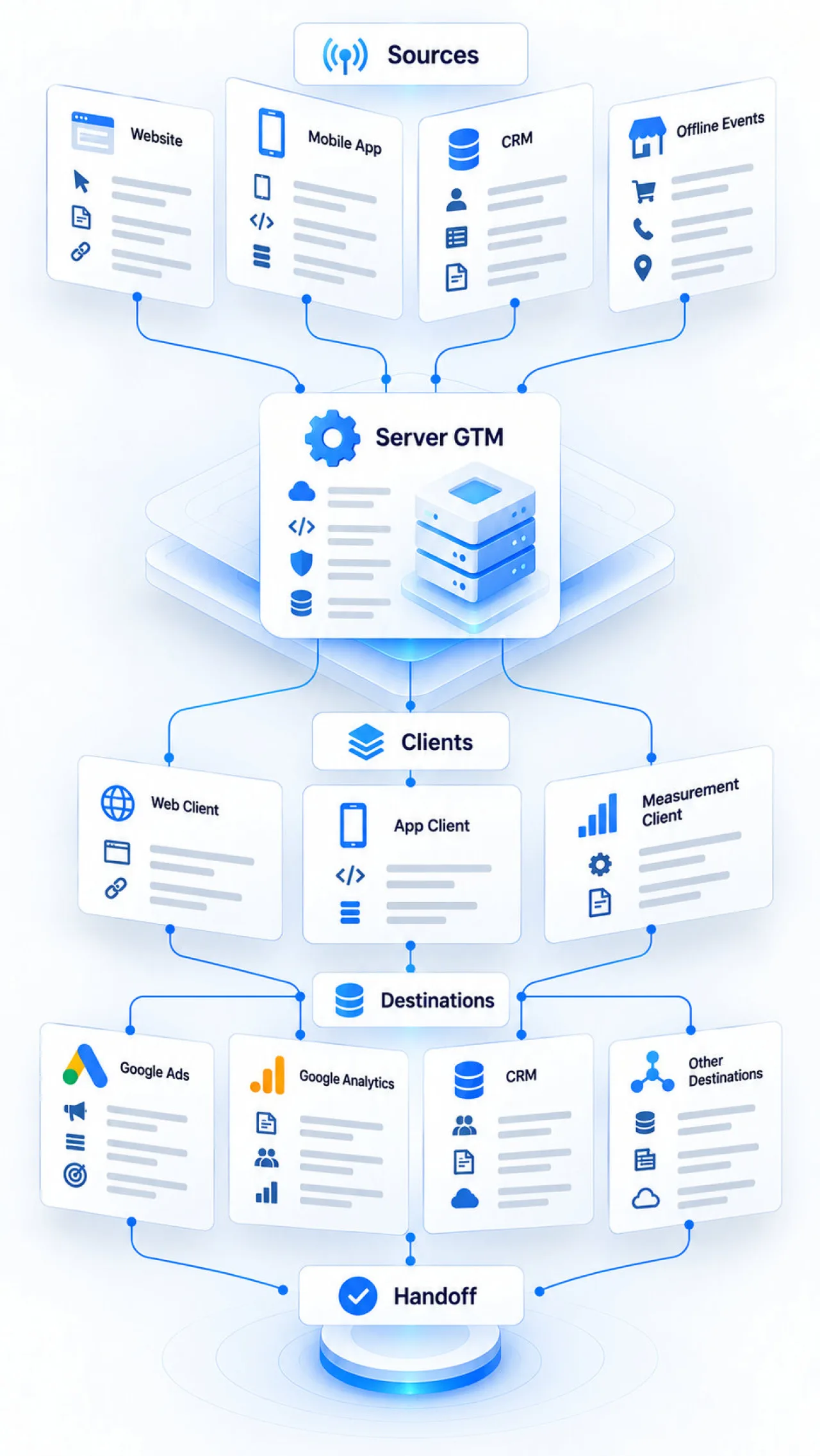
We scope a broader server-side GTM architecture around named inputs and destinations, then configure agreed routing, clients, tags, consent propagation and validation. The architecture does not recreate events that never existed or include unlimited integrations.

  • One agreed server-side architecture with named inputs, domains and destinations
  • Scoped server GTM, routing, client and destination configuration
  • Validation, operational handoff and documented third-party boundaries

What server-side architecture do you need?

Share the current web GTM, domains, event sources, destinations, server-container or hosting state, consent or CMP state, and any backend or CRM sources. We agree access and scope later; do not send passwords, private keys, API secrets or customer personal data.

You can upload multiple files.

Business hours: Monday–Saturday, 09:00–22:00 (Europe/Warsaw).

Send your request anytime — we’ll reply by email.

A server-side design with named boundaries

  • Name the architecture

    Agree the sources, domains, endpoints, clients and destinations before configuration.

  • Configure the scoped path

    Set up the agreed server container, routing, clients, tags and useful transformations.

  • Validate and hand over operations

    Check agreed routing, overlap and consent behavior, then document operating boundaries.

How server-side tracking is scoped

  1. Map named inputs and outputs

    Review the current web setup, domains, sources, destinations, hosting and consent context.

  2. Agree the architecture

    Define the one agreed server-side design and identify routine connection work and separate dependencies.

  3. Implement, validate and hand over

    Configure the agreed components, validate observable paths and document operational limits.

Broader server-side GTM architecture, not unlimited coverage

This service covers one agreed server-side architecture with named sources, domains, endpoints, clients and destinations. Depending on the agreed design, it can include a server GTM container, hosting connection, tagging or server domain, routine DNS or routing connection, web-to-server routing, suitable clients, agreed destination tags, GA4, Google Ads, useful transformations, consent propagation behavior, overlap checks, validation and operational handoff.

There is no fixed universal destination or domain quota, and there are no unlimited integrations. Substantial website or app work, custom clients or backend systems, independent CRM or offline feeds, extra substantial destinations or domains, major CMP repair, complex security or isolation work, and ongoing operations are separately estimated.

Server-side GTM cannot recreate an event that never existed. It does not bypass consent or privacy boundaries, turn denied users into observable users, or promise future platform processing, attribution or complete tracking. Provider subscriptions, hosting fees, overages and ongoing operation or maintenance are separate unless a quote expressly says otherwise.

Full Server-Side Tracking Setup

Describe the named architecture you need

Share the web setup, sources, domains and destinations so we can define a bounded server-side design.

Describe server-side needs

Aug 4, 2026 • Analytics & Conversion Tracking

Server-Side GTM: Real Gains vs Marketing Myths

Server-Side GTM Benchmarked: What It Really Improves—and What It Does Not

Server-side GTM can reduce browser work, improve first-party data controls, and make some identifiers more durable—but it cannot recover events the server never receives or make tracking invisible. This controlled benchmark separates measurable gains from common sales claims.

Sep 6, 2026 • Analytics & Conversion Tracking

Server-Side GTM for Multiple Domains

Can One Server-Side GTM Container Serve Multiple Domains?

One server-side GTM container can serve several domains, but sharing a server does not merge identities or isolate client data. Learn how to route events, preserve consent, separate GA4 data, and allocate costs.