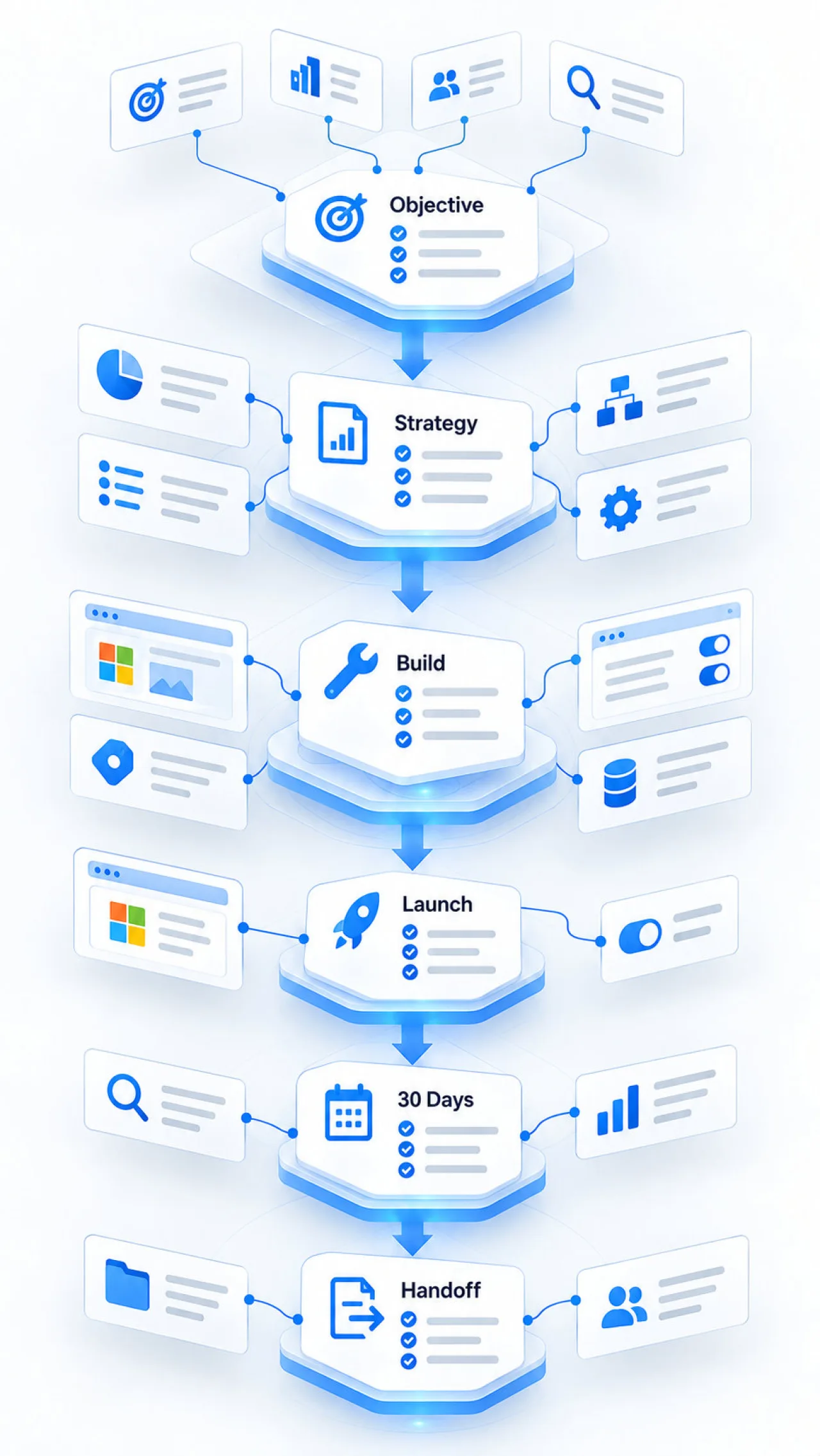
The starting scope covers one main service, a closely related group of services, or one product group or related product categories that can share a coherent promotion strategy and one primary KPI. The exact boundaries are confirmed during the initial review.
A single launch may require several campaigns, audiences, ads, keywords, assets, or hypotheses. Their number follows the agreed strategy and workload rather than a package quota. The service does not create an unlimited campaign-building allowance.
Before paid work begins, we review tracking readiness. Reasonable tracking setup or corrections that are necessary for the agreed launch and are included in the approved scope remain part of that launch scope. We do not later reclassify reasonably identifiable launch-essential tracking as an extra merely because the launch depends on it.
Substantial standalone measurement work — for example complex call tracking, CRM/offline conversion integration, iframe tracking, server-side or Conversions API work, complex messaging/widget paths, or broader analytics implementation — is identified during scoping and separately estimated when appropriate. If a material dependency could not reasonably have been identified before paid work, we pause and agree any additional scope before proceeding.
The included management period is 30 calendar days. It begins at the actual launch milestone stated in the approved scope. For staged launches, the milestone that starts the 30-day period must be agreed before paid work begins. The period covers management of the agreed launch scope and ends with a status/handoff summary.
There is no automatic paid subscription after Full Setup. Continued management is separately agreed through Microsoft Advertising Management. Merchant/feed projects, landing-page development, unrelated website work, and materially different business directions are separately scoped unless explicitly included in the approved project scope.
Advertising results are not guaranteed. The offer, market, budget, measurement quality, landing pages, competition, sales process, platform behavior, and implementation decisions can affect performance.