
Published Oct 19, 2026
Google Ads Government Documents Policy: What Changed on October 5, 2026
Google Ads has tightened the evidence required from authorized government-document providers. This review explains the October 2026 changes, the implications for visa, legal and education services, and how to align a website, business model and review request without confusing transparency with eligibility.
Category: Online advertising · By Mikalai Sasau
Google Ads' October 2026 update makes government authorization a more demanding business requirement for advertisers selling access to official documents and services. For visa agencies, immigration advisers, document intermediaries and private credential issuers, the practical question is not simply whether the website looks trustworthy. It is whether the actual service, the provider's authority, the advertised domain and the campaign geography fit an available advertising route.
Start here: identify exactly what the customer buys and who has the authority to deliver it. Then establish whether the offer falls within a restricted category, whether certification or an exclusion is available, and what the actual Google Ads notice says. A privacy policy, a professional licence or a disclaimer cannot answer all three questions. This review reflects the documentation checked on 17 October 2026.
Contents
Executive summary
The change is real, but the headline should not be "Google has banned immigration lawyers and document assistance." Google's October 2026 announcement concerns eligibility as a government-authorized provider. Its enforcement date was 5 October 2026; the announcement was published on 4 August 2026.
The most useful distinction is between being legally entitled to operate a business and meeting Google's requirements to advertise a particular government-document service. Those are different tests. A legitimate agency may encounter a certification problem without having committed fraud. Conversely, a well-designed website cannot make an unsupported claim of official authority acceptable.
There is also an important boundary around scope. The Government documents and services policy targets direct acquisition or access in specified categories. It does not identify all legal advice, all educational consulting or all privately issued certificates as one prohibited market.
For an advertiser, the sensible order is therefore: classify the real offer, verify the available eligibility route, correct the customer journey, and only then request the appropriate review. Treat the absence of a clear route as a business constraint, not a copywriting challenge.
What changed on October 5, 2026
The updated authorized-provider criteria connect three things:
- Public authority: an accessible official government page must link to the advertised domain and identify its authorization for the particular service, from the government entity responsible for that service.
- Domain scope: the domain must promote only the documents or services covered by the government's authorization or authorizations.
- Geographic scope: advertising must match the authorized territory. The geographic condition has an exception for inherently transnational categories, including electronic travel visas, border-entry documents and US Trusted Traveler programs.
A commercial contract, a business or trade licence, a business-register entry, or a government-hosted article is not sufficient authorization evidence. Google's examples of potentially acceptable evidence instead include properly constituted government partner directories and regulatory portals. Other advertising policies continue to apply, and certification can be denied or revoked.
The transnational exception concerns geography, not permission to provide the service. A company should not treat international customers as a substitute for an authorization file.
Our operational reading is that a mixed-service website needs a portfolio review, not just a new landing page. Create a row for every marketed service and identify the authorization that covers it. Where a row has no supporting authority, resolve that gap before presenting the domain as fully covered. Do not assume an approval obtained before October remains sufficient for a changed offer.
Which services are in scope?
Begin with the current policy's category list rather than the advertiser's industry label. The following is a working classification aid, not a Google eligibility decision. Its first column distinguishes explicit coverage from situations requiring an individual assessment.
| Offer | Policy starting point | What to establish |
|---|---|---|
| Visa or travel-authorization applications | Electronic travel visas and authorizations are listed; the examples include tourist and student visas. | Whether the business is facilitating the application, not merely discussing travel requirements. |
| Passports, identity documents and certain government records | Several relevant categories are explicitly listed. | The exact document and transaction, rather than a broad label such as "relocation support." |
| Driving-licence applications or changes | Driver licence is a listed category. | Whether the product is an official credential, a private translation or another service. Assess international driving-permit offers individually. |
| Legal consultation, general information or translation | Potentially outside this particular restriction when the service does not facilitate direct acquisition. | The deliverable, purchase flow and follow-up service, not just the word "consultation." |
| Diploma recognition or nostrification assistance | Not separately named as a blanket category. | The actual recognition process and any bundled visa, identity-document or other listed service. |
| Private membership cards or course certificates | Not automatically government documents. | Who issues them, what they prove and whether marketing suggests public rights or official equivalence. |
Consult the live category and exclusion list for the exact product and market. Exclusions are specific: a driving-school exception is not an exception for selling driving credentials. A regional exception for one document category does not open every government-related service in that country.
A useful internal question is: after paying us, does the customer receive independent advice or another private deliverable, or have they bought a route to obtaining a listed official document? Neither receiving money nor submitting a form is, by itself, a complete classification test. Review the entire commercial arrangement.
Impact by sector
Immigration and legal services
A legal practice may sell several materially different services: an initial assessment, representation in a dispute, preparation of a visa application, or assistance obtaining an identity document. Do not place all of them in the same advertising bucket. Separate the deliverables in the service catalogue and ask which ones actually involve a listed category.
Professional regulation matters, but its meaning needs to be precise. The UK government's immigration-adviser guidance explains that advisers can help with forms and representation while not making immigration decisions. This is a useful model for website language: identify the adviser's role and the authority that decides the case. UK arrangements are an example, not a licensing standard for other countries.
A genuine professional directory may support an authorization submission where it satisfies Google's particular requirements. It is not automatically sufficient merely because a professional's name appears there. Likewise, a client's permission to act on their behalf does not, on its own, establish that the government has authorized the advertised domain.
For mixed practices, the commercial consequence may be a narrower Google Ads offer. An independent consultation can have its own value, but it should not be advertised as a cosmetic first step in an undisclosed document-acquisition sale. The engagement letter, sales call and subsequent fulfilment should tell the same story as the ad.
Travel and visa agencies
Travel businesses should distinguish the holiday product from the immigration transaction. A hotel booking with a general visa-information page is not the same offer as a paid visa application service. Selling a package that includes document assistance requires an assessment of that component; calling the package a tour does not settle its classification.
Explain what the customer is purchasing: an appointment with an adviser, administrative preparation, submission support, or another clearly defined service. Identify which organization makes the admission or visa decision. Do not promise an outcome that your business cannot control.
Separate your own turnaround commitment from the authority's processing time. For example, a commitment to review a complete file within two working days is different from a promise that a visa will be issued within two days. Only publish the former when your operation can actually meet it.
For international campaigns, record the issuing country, the provider's authorized territory and the location of the intended audience separately. These are three different fields. A transnational product still needs a defensible provider and certification route.
Education and qualification recognition
Nostrification means a formal process for recognizing a foreign qualification in the relevant national system. Its procedures vary. For example, Poland's NAWA guidance on nostrification assigns the procedure to universities meeting specified criteria. An intermediary's document preparation is not the university's recognition decision.
An education consultant should describe that distinction plainly: "We help you prepare the material for assessment" is a different proposition from "We issue the recognized equivalent of your diploma." State who evaluates the qualification, who receives each fee and which outcomes remain outside the consultant's control.
Do not present October's update as a confirmed blanket ban on recognition support, sworn translation or apostille assistance. These require classification against the actual listed services and the complete offer. A study-abroad bundle can also contain a separately restricted visa service, even when the main business is educational consulting.
The distinction between intermediary and authority is not unique to advertising. Poland's Ministry of Foreign Affairs apostille page says the ministry does not cooperate with intermediaries. Participation in an official administrative process should therefore not be described as an official partnership without appropriate evidence.
Associations and private credentials
An association's card might confirm membership; a training certificate might record completion of its course. Neither should be presented as a state-issued identity document or professional entitlement unless the applicable authority genuinely gives it that effect. Nonprofit status does not answer that question.
Publish a straightforward explanation of the issuer, admission or assessment criteria, permitted uses and limitations. A searchable entry in the association's own database can confirm that the association created a record. It does not independently prove government recognition or compulsory acceptance by another organization.
International driving-document offers deserve particular care. An official permit, a translation of an existing licence and a private membership booklet are not interchangeable products. Their legal status must be checked for the relevant jurisdictions. A multilingual cover, a federation logo or an "international" name does not resolve that status.
This also creates a separate policy boundary: Google's dishonest-behavior policy prohibits false documents such as fake passports and diplomas. That is not a reason to call every private certificate fake. It is a reason to document exactly what a credential represents and never sell a private record as a substitute for a public qualification.
What the case study can and cannot prove
The supplied dialogue describes a private driving-document business, claims of official standing and association accreditation, related websites, and questions about using two advertising accounts. It is a useful diagnostic case, but it is not an authenticated Google enforcement record. The export does not contain the original policy notices and certification decisions needed to establish the cause of a restriction.
We therefore use the case anonymously to illustrate questions an advertiser should answer. We do not identify it as a confirmed October-policy suspension, or conclude that the business is fraudulent.
| Reported feature | What it may support | What remains unproven |
|---|---|---|
| A company or association is registered | The existence of the organization. | Its authority to provide the advertised official document. |
| Private federation accreditation | A relationship with that federation, subject to verification. | Government delegation for the specific service and domain. |
| A partnership or physical presence at a public-service location | The activities actually described by the arrangement. | Authority to issue a document rather than provide advice or premises-based services. |
| Broad acceptance claims, but restrictive contract terms | A need to reconcile the customer's expectations with the contract. | Universal recognition, or the particular policy reason Google applied. |
| Two advertising accounts or missing public ads | A reason to inspect account ownership, history and search filters. | A suspension, its severity, or an attempt to evade enforcement. |
Timing is not causation. A restriction reported after 5 October may involve the new eligibility requirements, an older policy, a verification issue, destination problems, or several findings together. Obtain the dated notice, the affected account and ad identifiers, the policy label, the advertised URL and the review history before choosing a remedy.
Public ad research is supplementary evidence. Not finding an advertiser in a library does not establish why an account is not serving. Finding an ad does not establish that another business can use the same certification route. Our guide to competitor ad research and regional evidence explains how to keep those observations within their limits.
Why moderation problems persist
Advertisers reported government-document restrictions before this update. In a January 2025 Help Community thread, a poster described unsuccessful attempts to resolve restrictions using business-licensing evidence. A December 2023 immigration-software discussion described a provider struggling to reconcile the legality of filing assistance with Google's certification restriction.
These are first-person reports, not verified findings or a representative sample. They do not measure rejection rates or prove the result of an appeal. They do show why October should not be treated as the starting date of every problem in this market.
The recurring operational mistake is to solve the wrong problem. Advertiser verification establishes facts about an advertiser; a category review addresses a restricted offer. A private-business disclaimer clarifies identity; it does not grant authority. A clean privacy page addresses data practices; it does not change the document being sold.
| Finding | Question to resolve | Suitable response |
|---|---|---|
| Government-document eligibility or classification | Is this offer in scope, and which route applies? | Certification, a documented exclusion, or a correction of a genuine classification error. |
| Misleading identity, qualifications or affiliation | Does the whole customer journey accurately represent the provider? | Correct unsupported claims and supply evidence for claims retained. |
| Destination or verification problem | Can Google review the working destination, and do business details match? | Fix access or identity discrepancies through the relevant process. |
| Account suspension | Which policy was cited, and what broader conduct must be addressed? | Follow the suspension appeal route, not just an individual ad appeal. |
The distinction affects enforcement expectations. The government-documents policy provides for at least seven days' warning before account suspension under that policy. This is not a guarantee that disapproved ads will continue serving. Separately, unacceptable business practices and circumventing systems are treated as egregious violations and can lead to suspension without prior warning. A category rejection alone does not prove either finding.
There is no published universal list of "safe words" for this sector. Google's ad-review guidance describes review of the ad's components and destination. Do not assume that changing a headline while leaving the commercial offer unchanged resolves the issue.
Build an authorization evidence file
Before commissioning a redesign, ask the business owner to assemble a service-level evidence register. The following is an editorial audit structure, not an additional Google form or a promise of acceptance.
| Field | What to record |
|---|---|
| Customer deliverable | What is supplied, by whom, and which decisions remain with another authority. |
| Responsible public body | The entity responsible for the document or service, not simply any government organization. |
| Provider identity | The authorized legal entity, trading name and relationship to the advertiser and payment recipient. |
| Public evidence | The government page, its statement of scope, and the link to the exact advertised domain. |
| Limits | Service, territorial, time and subcontracting limits that affect the offer. |
| Advertising record | Relevant customer ID, domains, certification or exclusion decision, and subsequent changes. |
| Owner and review date | Who maintains the file and checks it when a service, domain or authorization changes. |
Google's application form asks nongovernment providers for the advertised domains and public government evidence. Work with the relevant authority to correct a missing or outdated official listing. A self-published certificate page is not a substitute for the required external evidence.
Keep commercial agreements and professional licences in the file, but label what they actually establish. A contract permitting an office to provide consultations should not be summarized as permission to issue credentials. A registered parent company should not be treated as automatic authorization for every subsidiary, reseller or marketing domain.
There is a useful policy distinction here: supporting documents can help explain a genuine relationship when responding to an affiliation concern, but that does not make every such document sufficient for government-document certification. Submit evidence against the particular requirement, not a large undifferentiated bundle.
Ask for clarification where the service is unusual or the authority's public wording is incomplete. Record the answer and its scope. Do not invent a broader delegation in your application to fill a gap that the authority itself has not resolved.

Prepare the website and customer journey
Explain the service before the form
On each relevant service page, a prospective customer should understand who they are dealing with, what they receive, who makes the official decision, what they pay and what happens if the outcome is unsuccessful. Put those answers before payment or document upload, not only in a footer.
Google's guidance for private providers calls for clear identity and affiliation disclosures. Where a service is available directly from the government for less or free, it also requires disclosure and a link to the official route. An authorized private provider should explain its real limited authorization rather than falsely deny it or imply that it is itself the government.
This illustrative copy is suitable only for a genuinely independent consultation service with no government affiliation. Adapt it to the actual engagement; it is not a certification template.
Independent application-readiness consultation

You are purchasing an assessment of your situation and a written checklist
from our private advisory business. We are not a government office and
are not affiliated with the authority that decides applications.

This service does not include submitting an application or issuing a
visa, permit or identity document. We do not guarantee an official outcome.

Our consultation fee is shown before booking. Any later service requires
a separate, clearly described engagement. Official application information
and the direct application route are linked below.
Do not use this copy for a package that actually includes filing a listed application. The exclusion question depends on the real service, not the disclaimer. Equally, do not remove a genuine professional qualification merely to make the page sound less regulated: explain its scope accurately.
Make claims and fees consistent
Review words such as official, accredited, approved, recognized and guaranteed wherever they appear. For each claim, record who grants the status, for what purpose, in which territory and subject to which limitations. Google's misleading-representation policy addresses inaccurate identity, qualifications and affiliation. It also specifically warns against promoting legal services as an affiliate without making clear that the advertiser is not the provider.
A headline promising acceptance everywhere cannot be repaired by a contract saying acceptance is not guaranteed. Resolve the substantive contradiction. Review translations, downloadable brochures, testimonials reused as marketing claims, images of credentials, structured data, booking confirmations and sales scripts as part of the same exercise. This is a consistency audit, not a claim about the weight Google's systems assign to each item.
Under Google's dishonest-pricing policy, costs and payment obligations must be clear. A useful presentation separates the private service fee, any actual authority fee, courier or other mandatory charges, taxes and the total payable. Name the recipient of an authority fee. Do not describe a private registration or database charge as a government duty.
Also explain refund conditions and the difference between payment for completed professional work and payment contingent on an outcome. Do not imply that a refund policy makes a visa or recognition result guaranteed.
Review related domains and technical access
Trace the journey from ad to landing page, intake, document upload, payment and support. Where another entity or domain takes over, explain its role before the handoff. A disclosed payment-provider checkout is not the same thing as an ad URL silently redirecting to another merchant.
Google's destination requirements separately address mismatched destinations, cross-domain redirects from an ad's final URL, inaccessible pages and crawler errors. Check that security rules are not returning 403 or 5xx responses to AdsBot. Important explanations should remain readable without logging in or submitting personal documents.
Do not show Google a sanitized service while users receive another. Nor should an old transactional offer remain available through an alternative language, hidden checkout or sales agent after the website claims it has been retired.
For legitimate multi-domain booking and payment journeys, our GA4 cross-domain tracking guide covers measurement continuity. Tracking continuity is a separate task: it does not validate the seller, the authorization or the advertising destination.
Choose a business model that fits the rules
The strongest response to an eligibility gap may involve changing what the business sells or how it distributes the service. The following are strategic options to assess, not guaranteed ways to obtain approval.
| Model | What must be real | What does not solve the problem |
|---|---|---|
| Authorized service provider | The actual provider, service portfolio and advertised domain are supported by the necessary authority. | Buying a logo licence, obtaining a generic partnership letter or assuming old approval covers new services. |
| Independent advice, education or translation | The advertised output is genuinely independent of facilitating a restricted acquisition, with clear limits and truthful fulfilment. | Renaming an unchanged application package as consulting. |
| A properly disclosed provider relationship | The roles, permissions and advertising route of each participant are established and reviewed. | Borrowing a partner's certification or sending every lead to an undisclosed restricted seller. |
| No Google Ads promotion of the affected offer | The business accepts the channel constraint while considering lawful alternatives and their own rules. | Rotating accounts, domains or agencies to keep the same ineligible offer running. |
A genuine separation of services can improve clarity, but it is not an enforcement loophole. Before restructuring domains or entities, assess the entire business relationship, disclose it accurately and establish what fresh review is needed. Moving the same offer behind a new address does not resolve an existing suspension.
For a mixed legal or travel business, calculate the revenue contribution of each service rather than treating all leads as equivalent. Consider what happens to acquisition costs when only some services remain eligible, and whether an independently valuable advisory product has enough demand and margin to stand on its own.
Prepare for interrupted lead flow without inventing a forecast. Review commitments to customers, staffing, prepaid marketing and refund exposure. The evidence reviewed for this article does not support a universal prediction for rejection rates, cost per lead or the size of the affected market.
Align campaigns with the approved scope
Once the business and website are aligned, audit the campaign inventory against the service register. Include ads, sitelinks, other assets, destination URLs, automated content and geographic settings. A correct landing page does not help when a sitelink promotes an unsupported credential.
Pay particular attention to automation. Google's Performance Max final URL guidance explains that URL expansion can send traffic to other relevant pages on the domain. A page feed is not a strict destination allowlist while expansion is enabled. Review expansion and generated text settings, and inspect any other campaigns that dynamically choose pages or messages.
During remediation, a tightly controlled campaign with explicitly reviewed destinations can make the evidence easier to maintain. That is an operational recommendation, not a Google requirement or a certification workaround. URL exclusions do not cure a domain-wide authorization problem.
For territorially limited offers, review the difference between location presence and location interest. Google's advanced location settings include both concepts, and the default can include interest. Use settings appropriate to the authorization rather than assuming that a country name in the campaign is sufficient. Location targeting is not proof of a person's legal residence or perfect physical-location detection.
A certification also should not be confused with government branding. The policy describes a Not a government website disclosure for relevant Search advertising by nongovernment providers. Seeing that disclosure does not, by itself, mean an ad has violated the policy.
Finally, distinguish ordinary account administration from evasion. Where more than one account exists, document its purpose and the relevant approvals. Do not use an alternative account to continue an offer after suspension or to spread uncertified activity. Google's circumventing-systems policy expressly addresses such conduct.
Protect customer data and review audiences
Document businesses often ask for more sensitive information than an ordinary lead form needs. Separate first contact from secure case intake. An initial consultation request rarely needs a passport scan, a complete immigration history and a signature.
Google's data collection and use policy requires appropriate security and disclosure and addresses the handling of identification information. HTTPS is necessary for relevant sensitive collection, but it is not a complete governance plan. Define access permissions, recipients, storage, retention and deletion, and explain the role of external case-management or fulfilment providers.
As a technical precaution, keep document numbers, scans, signatures and detailed case narratives out of analytics events, URL parameters, the dataLayer and session recordings. Prefer neutral measurement such as consultation_booked rather than encoding a person's immigration circumstances in an event label. Review Google customer-data rules separately before enabling enhanced conversions or uploading client lists.
Audience eligibility is another independent issue. Google's personalized-advertising policy for marginalized groups identifies immigrant services, including refugee legal services, as sensitive. It restricts advertiser-curated targeting such as Customer Match and your own data segments for this category. Consent does not override those platform restrictions.
Assess the actual service and audience use; do not automatically classify every holiday enquiry as a refugee-related service. Equally, do not build remarketing lists that reveal such circumstances merely because the underlying consultation ad is eligible. Contextual advertising and personalized targeting require separate checks.
For European websites, the consent and Google tag setup needs its own review. A compliant consent interface cannot compensate for an ineligible service, and certification cannot compensate for unsafe document collection.
Certification, exclusions and appeals
Choose the route that matches the facts. The government-documents application separates government providers, authorized nongovernment providers, applicable regional or business exclusions, and advertisers whose offers were incorrectly classified.
For an out-of-scope request, explain the real deliverable and why it does not promote the restricted acquisition. The form includes an ongoing warranty that the advertiser's ads will not promote the outlined government-document services. Google also re-reviews the ads and domain. Do not make that declaration while continuing contradictory advertising or presenting an inconsistent destination.
Agencies should submit the individual advertiser's customer ID, not the manager account ID. Keep the domain and business information consistent with the evidence. General advertiser verification remains distinct from the service-specific review.
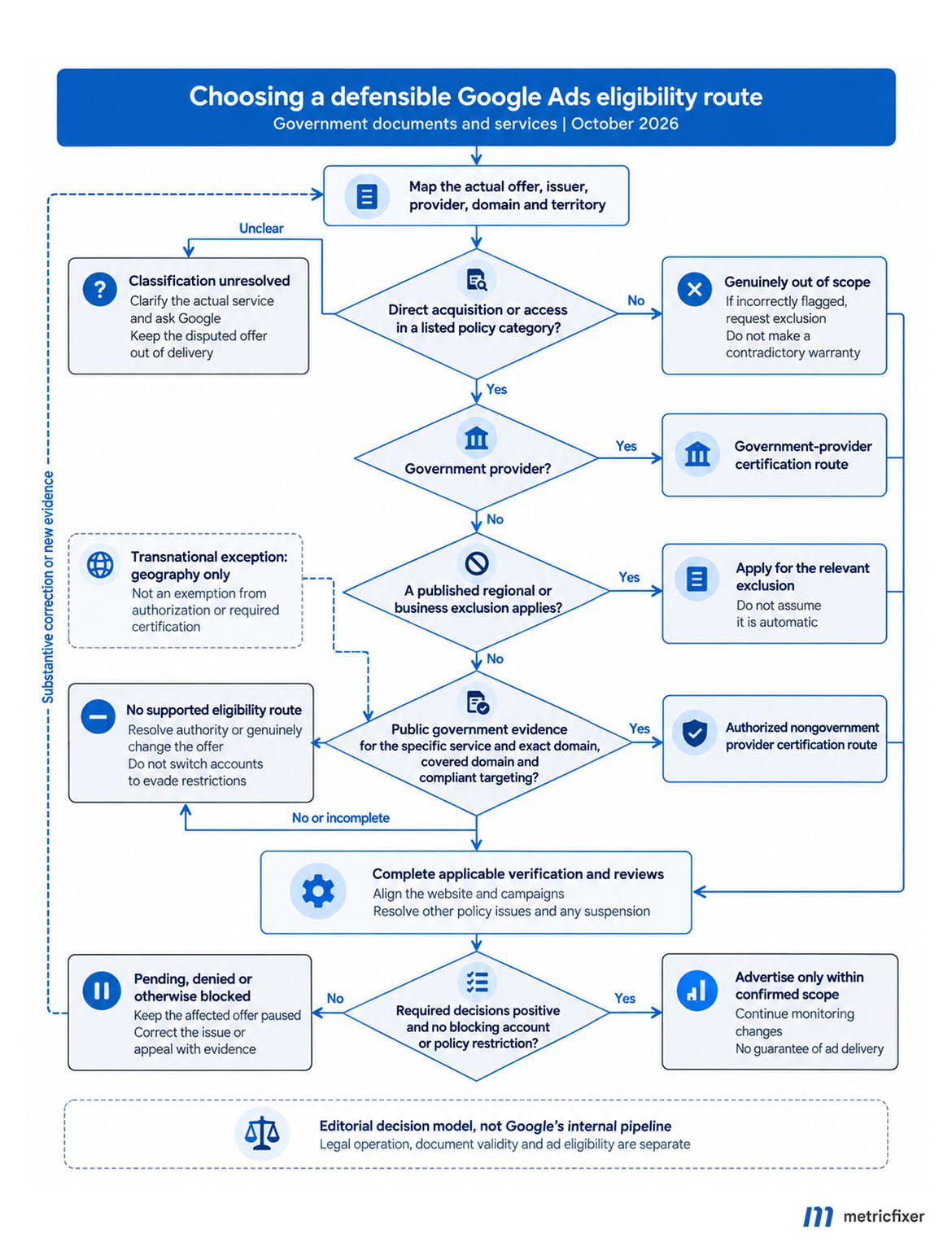
Text workflow: map the actual offer and destination → check the listed categories → resolve uncertain classification, or select a supported certification or exclusion route → correct the website and campaign scope → obtain the required review and resolve any separate account restrictions → advertise only within the confirmed scope. Where evidence is missing or review is unsuccessful, keep the affected offer out of delivery while resolving the problem.
Prepare one coherent review package
Build a concise submission around the exact decision being challenged. Include the policy notice and date, affected customer ID and destinations, a factual business description, the appropriate authorization or exclusion evidence, and a dated explanation of substantive corrections. Distinguish changes already deployed from proposed work.
Use original, verifiable records. Do not manufacture official-looking evidence, alter a licence's scope or temporarily change the business solely for review. Avoid unnecessary customer documents; authorization should normally be demonstrated through business and public-authority records, not a client's passport.
Keep the procedures separate. Certification does not itself lift an account suspension. An ad appeal does not automatically grant category permission. Google's account-suspension guidance is the relevant starting point when the account, rather than just an ad, is suspended.
Appeal without creating more noise
For an ad-level decision, Google's appeal guidance distinguishes disputing an incorrect finding from reporting compliance changes. Select the reason that matches the evidence. The current guidance limits each ad to three appeals before support escalation and says to wait at least 24 hours between appeals for the same ads or campaigns. Avoid duplicate requests while a review is pending.
There is a separate date-sensitive limitation: since 21 July 2026, decisions older than six months cannot be appealed through the in-account route; the guidance points advertisers to support. This is not a reason to open a replacement account.
Plan for review uncertainty. The certification form and policy help page describe different processing stages, and their indicative timings should not be presented as a guaranteed launch date. Keep the original request, its reference and Google's response together rather than repeatedly submitting the same material.
After a successful review, verify which account, domains, services and territories it actually covers. Check the other policy statuses before interpreting the result as permission to resume every campaign. Approval of one issue does not resolve an unrelated one.
Practical readiness checklist
The following is a suggested operational sequence for the next month, not a Google grace period. Enforcement of the October update has already started. Business owners, legal advisers, website teams and advertising managers should work from the same service register.
| Workstream | Completion checks | Evidence to retain |
|---|---|---|
| 1. Establish the facts | Record exact policy notices; inventory accounts and domains; classify each service; identify the actual issuer and provider; separate verified facts from hypotheses. | A dated incident record and service-by-service scope matrix. |
| 2. Resolve the business and website gaps | Verify authorization; reconcile claims and terms; identify seller and partners; disclose fees and direct official routes where required; secure document intake; check every language and checkout. | Public authority references, corrected pages, revised fulfilment documents and a change log. |
| 3. Align and submit | Review geography, assets, automated destinations and sensitive audiences; choose the correct application or appeal; remove contradictory statements from the submission. | A consistent evidence package linked to the relevant advertiser account. |
| 4. Monitor and maintain | Record the outcome and its limits; keep unresolved offers paused; recheck new services and partners; monitor business results without sending case details to ad platforms. | An approval register, change-review ownership and a business continuity plan. |
Before requesting review, the owner should be able to answer four questions without qualification: What do we sell? Who authorizes or decides it? Why does this advertising route apply? Does every step of the customer journey agree? Where an answer remains uncertain, make that uncertainty explicit rather than conceal it in the application.
For management reporting, track the share of services with a documented eligibility position, outstanding evidence gaps, unresolved policy decisions and qualified enquiries for the offers that can actually be promoted. Keep these separate from impressions or ad approval counts. They are internal readiness measures, not Google scoring factors.
metricfixer can help turn this review into a practical website, campaign and measurement audit: reconcile claims with the real offer, inspect destinations and data flows, and organize the evidence needed for the appropriate review. Legal authority must be established with the relevant professionals and institutions; only Google can decide advertising eligibility and reinstatement.

Methodology and sources
This review was prepared on 17 October 2026. The policy analysis uses Google's English-language announcement, current government-document policy and application form, alongside the official guidance on representation, pricing, destinations, circumvention, sensitive targeting, data collection and appeals linked in the relevant sections. English is the enforcement language identified in Google's policy documentation.
The supplied dialogue was treated as a private case narrative and a source of diagnostic questions, not proof of a policy finding. Selected publicly accessible case pages were checked for the existence of the claims discussed. That check does not authenticate the provider's authority or establish Google's reason for restricting an account. The public article anonymizes the case and does not reproduce customer identifiers, private documents or the original export.
The two Help Community discussions are historical first-person reports predating October's update. Indexed excerpts were used where the direct page did not expose the discussion text. They are included to illustrate reported moderation difficulties, not to establish Google's position or the success of a remedy. UK government, NAWA and Polish ministry materials provide jurisdiction-specific examples of the difference between an adviser or intermediary and the institution responsible for an official outcome.
The classification table, evidence register, website recommendations and workflow are editorial synthesis. We did not access the advertiser's Google Ads account, submit an application, test an appeal or measure a representative sample of affected businesses. The reviewed evidence cannot establish a post-update rejection rate, a universal classification for every recognition or private-credential service, or a guaranteed route to approval. Recheck the linked official materials before acting on a new service, jurisdiction or account decision.
This article is for advertising, technical and operational information only and is not legal advice. metricfixer is not affiliated with Google or the public authorities mentioned. Advertising eligibility, professional licensing and the legal validity or recognition of a document are separate matters. Requirements depend on the service, jurisdiction and account circumstances and may change after publication. Website changes, disclosures, certification requests and appeals do not guarantee approval, reinstatement, delivery or an official document outcome.