
Published Oct 27, 2026
Performance Max Channel Prioritization: When the New Controls Help
Google's new channel controls give advertisers more influence over partner and Display spending, but they do not replace sound measurement or strategy. We review the rollout, practitioner reactions, and when a cautious intervention is justified.
Category: Online advertising · By metricfixer Expert Team
Google Ads is adding channel prioritization and budget allocation controls, giving advertisers more influence over where campaign spending goes. For Performance Max, that is useful progress, but not a reason to replace automatic allocation with a preferred channel mix. This review explains what the October 2026 controls actually change, how they differ from the earlier Channels alpha, what practitioners are saying, and when metricfixer recommends intervening.
Practical starting point: keep a working campaign's allocation unchanged unless there is a measurable business problem or a clearly defined strategic requirement. First check conversion quality, the effective settings, and a sufficiently mature reporting period. Then test the smallest relevant change. A channel receiving little spend is not automatically a problem, and a channel receiving most of the budget is not automatically the best use of the next advertising dollar.
Contents
Executive summary
The useful question is not whether advertisers should welcome more control. They should. It is whether a particular control can solve the problem in front of them.
For example, limiting exposure to a persistently low-quality partner network is a different task from trying to make a campaign more visible on Maps. The new Performance Max settings shown in metricfixer's screenshots distinguish Google channels, Search partners, and the Google Display Network. They do not offer a separate Maps priority selector.
Our recommendation is therefore selective: investigate a persistent mismatch between spending and business value; use an appropriate campaign structure for a separate visibility objective; and do not expect a budget setting to repair weak demand, an uncompetitive offer, or unreliable measurement.
Evidence checked: October 25, 2026. The screenshots and account-management observations discussed below are practical examples, not a controlled study establishing that automatic allocation or manual intervention always performs better.

From the September alpha to the October rollout
On September 1, metricfixer published its review of the Performance Max Channels alpha. That article covered an experimental Lower / Auto / Higher interface intended to influence channel-specific bidding tolerance. It should not be read as documentation for the interface now appearing in ordinary campaign settings.
Google announced the new priority and allocation controls on October 14, 2026, covering Search, Shopping, Performance Max, and Demand Gen. Its Help Center dates the start of progressive availability to October 15. A rollout across supported campaign types is not confirmation that every account already has every capability.
There is also a substantive product distinction. In Search Engine Journal's first-hand report from Google's product briefing, Google confirmed that the more advanced PMax alpha would continue alongside the new controls. This is not simply the September experiment becoming universally available under a different name.
| Feature | What the evidence describes | How to use it |
|---|---|---|
| Channel performance report | A reporting view showing delivery and attributed outcomes. | Investigate what happened; do not confuse visibility with control. |
| October priority and allocation controls | Funding preferences and optional limits for supported channel groups. | Address a specific spending constraint. |
| Earlier Channels alpha | A separate limited test involving more granular channel preferences. | Follow the actual alpha interface and its terms; do not assume access. |
The distinction matters when sharing advice. A screenshot of an alpha slider is not evidence that another advertiser can now promote Discover individually. Likewise, a menu that has appeared throughout one agency's accounts is not an account-by-account rollout census.
What the new controls change in Performance Max
The supplied settings screenshot shows three rows: Google channels, Search partners, and Google Display Network. All three display High priority. It also shows a choice between inheriting account settings and customizing the campaign. The campaign-specific option is selected in the captured panel, but an open settings panel alone does not prove that a change was saved.
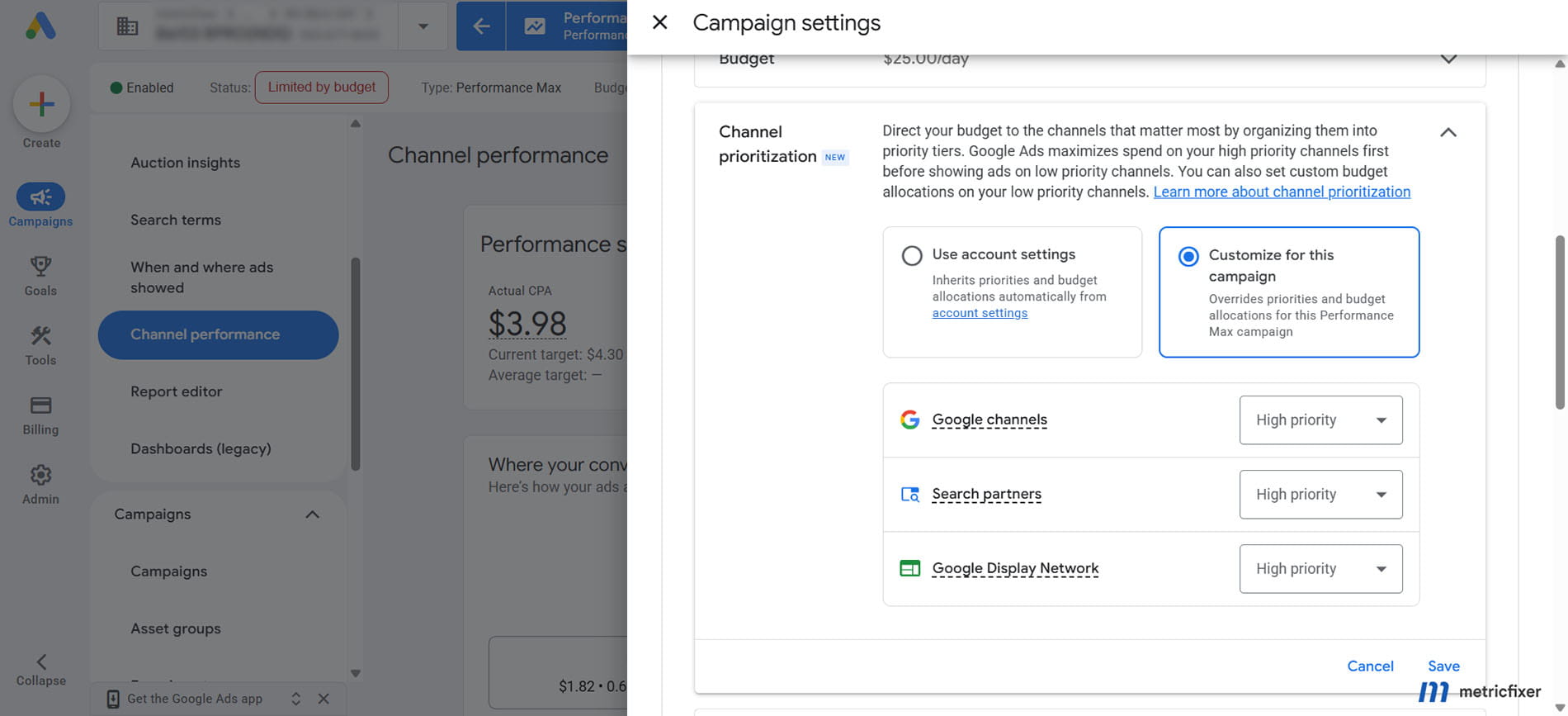
Google's launch explanation describes funding higher-priority inventory before lower-priority inventory, respecting the target when Target CPA or Target ROAS is used. Inside PMax, Search, YouTube, Maps, Gmail, and Discover belong to the same Google channels group.
That grouping is the central limitation: you cannot use this control to put Maps above Search or Discover above YouTube. Nor does selecting a group establish a minimum amount of visibility on any surface inside it. A reporting breakdown can be more detailed than the available controls.
Priority is not a reserved budget
A priority tells the system which eligible group should receive funding first. An allocation limits a lower-priority group's spending; it does not reserve that amount for the group. Google describes nonzero limits as best-effort, not guaranteed financial ceilings.
Under the documented allocation rules, percentages use the average daily budget, not actual spend; allowances reset daily without carryover. A Low priority allocation of 0% stops spending on that channel.
Consider an illustrative €200 average daily budget with a 10% allocation. The reference amount is €20. If the campaign actually spends €100, €20 represents 20% of that day's spend, not 10%. Conversely, the setting does not promise that the channel will receive €20. This is why the percentage in settings and a channel's percentage of reported cost need not match.
The bidding strategy and budget constraint still matter
Google's launch post says priority alone generally has little effect on Target CPA or Target ROAS campaigns that are not budget-limited; allocation limits can still matter. The control is not an independent instruction to purchase more impressions regardless of the campaign's economic target.
For Maximize Conversions or Maximize Conversion Value without a target, the bid-strategy table describes higher-priority inventory spending first, with remaining budget moving to lower-priority inventory when necessary.
Before diagnosing a control as ineffective, establish what is actually constraining delivery. A campaign unable to find additional acceptable opportunities is a different case from a campaign with more acceptable opportunities than its budget can fund.
Check what the default actually means
Google's product team told Search Engine Journal that channels initially default to High priority. That is not an equal spending split.
When an account manager calls a campaign's state Campaign Default or automatic allocation, record the actual setting behind that shorthand. The supplied interface explicitly distinguishes account inheritance from campaign customization. An inherited configuration can contain someone's deliberate preferences; it is not evidence of an untouched baseline.
For a meaningful comparison, save the effective channel settings as well as the name of the selected option. Otherwise, a future account-level change could alter the supposed control condition without the analyst realizing it.
Reading the metricfixer example without overclaiming
Metricfixer's specialists report that, in most cases they observe in their client work, default automated allocation already concentrates spending in channels that appear appropriate for the campaign's performance objective. That is a qualitative account-management observation, not a published success rate or proof that manual controls add no value.
The supplied ecommerce report illustrates a strongly concentrated allocation. For September 25 to October 24, 2026, its displayed channel costs are:
| Channel | Displayed cost | Displayed share of cost |
|---|---|---|
| Google Search | €2.77K | 97.0% |
| Google Display Network | €75.57 | 2.7% |
| YouTube | €5.86 | 0.2% |
| Discover | €2.31 | 0.1% |
| Search partners | €0.31 | 0.0% |
| Gmail | €0.28 | 0.0% |
| Maps | €0.00 | 0.0% |
These are the rounded values visible across the screenshots. A displayed 0.0% does not necessarily mean zero expenditure, as the Search partners and Gmail rows demonstrate. We do not reconstruct an exact total cost from the abbreviated Search figure.
The report contradicts the assumption that a multichannel campaign must spread spending widely or evenly. It does not establish that Search generated the highest profit, that the allocation was optimal, or that a different allocation would perform worse. The screenshots do not contain a controlled alternative, complete channel-level purchase economics, or a settings history.
The 983.46 Results are not 983.46 purchases
The same report displays 983.46 total Results, consisting of 757.03 Add to cart, 159.43 Begin checkout, and 67.00 Purchase results. Purchase carries an Optimizing for badge.
Google's Results Reporting documentation explains that Results includes primary actions across standard account goals, including goals a particular campaign is not optimizing toward. It is not synonymous with All conversions, and secondary actions are not automatically included.
Therefore, do not divide spending by the headline Results total and call the answer purchase CPA. Do not add cart and checkout values to purchase value and call the sum sales revenue. Equally, the appearance of cart and checkout results does not by itself prove the campaign is bidding toward those goals.
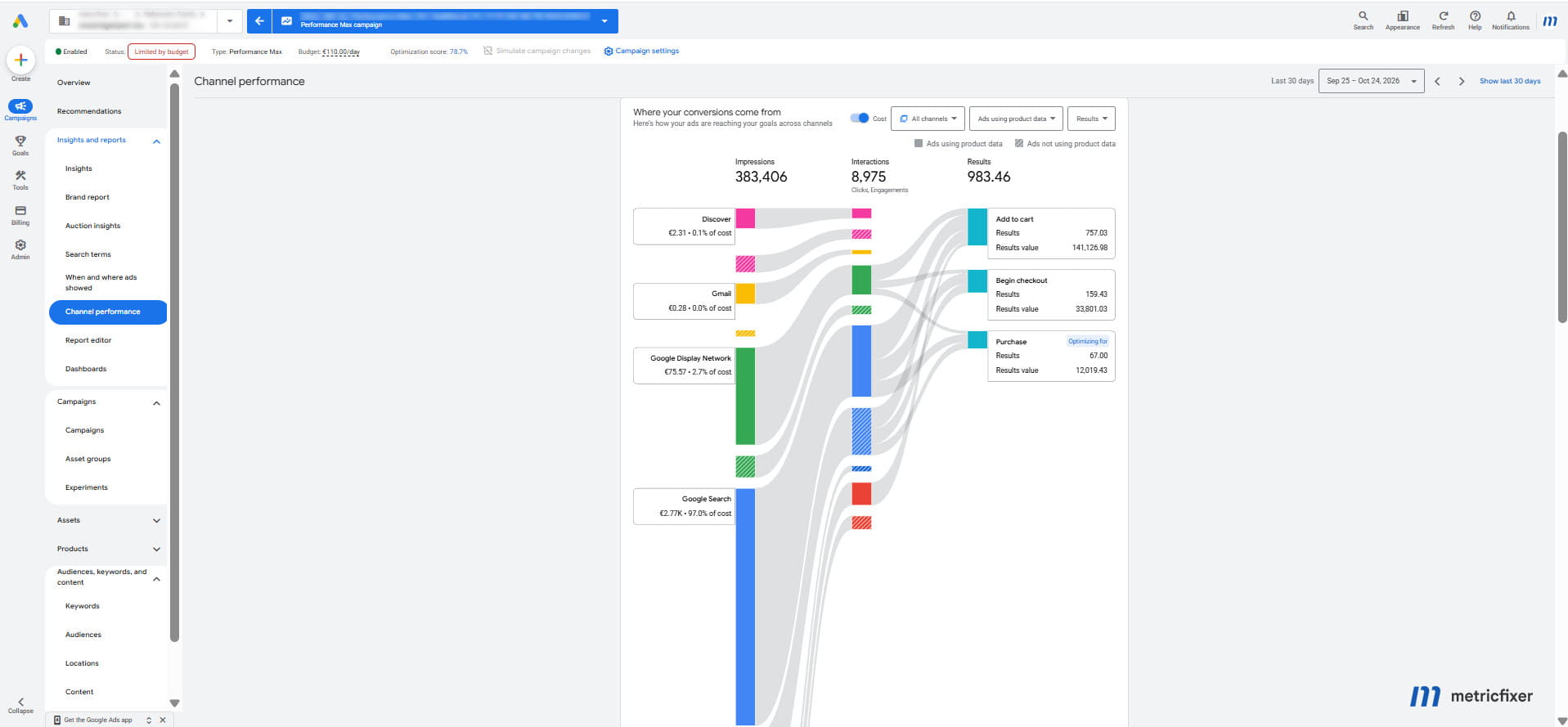
For evaluation, use the channel report's Conversions view for the goals being optimized, inspect the relevant conversion actions, and review the product-data segmentation separately. In the supplied screenshots, solid and hatched blocks distinguish ads using and not using product data; they are not priority tiers.
The Google Search row is a channel category, not proof that all of its spending went to conventional text ads. Product-data segmentation helps distinguish eligible Shopping-related formats from ads not using product data. Do not assume that a large Search share establishes the campaign's brand versus non-brand mix.
The chart's connecting bands are also not an individual customer's journey through successive channels. They present aggregated delivery and attributed outcomes. A visually persuasive diagram cannot answer a causal question by itself.
Why a weak channel-level ROAS is not enough
A channel's historical average answers a different question from the return available on the next increment of spending. Google's channel-report troubleshooting guidance explicitly distinguishes these and explains why a channel with a lower average return may still receive budget.
Imagine that a campaign has already captured most of its inexpensive Search opportunities. The remaining Search opportunities may be much more expensive. A second channel can then offer the better next opportunity even while its historical average looks worse. This is an illustration of the decision, not a measurement of the account shown above.
That does not make every allocation defensible. It means the test should ask whether restricting a channel improves the campaign's total business outcome, not merely whether the remaining channel's dashboard looks cleaner.
Attribution complicates the comparison further. Google notes that last-click measurement can understate earlier interactions and that delayed conversions can make recent channel performance look artificially weak. Neither explanation should become an excuse to ignore persistent poor lead quality or disappointing sales. An attributed conversion is evidence to inspect, not an automatic demonstration of additional business caused by the ad.
Also check the target itself. Google's August 17, 2026 target-based bidding update changed behavior for affected budget-limited campaigns and can change multichannel traffic distribution. A campaign moving toward a loose target is not necessarily failing to follow its instructions. Our review of the target-based bidding changes explains why the entered target deserves its own audit.
What other practitioners are saying
The public discussion is more useful than a simple argument between trusting automation and taking back control. The sources below offer different reasons to value the feature, but do not establish a universal performance uplift.
| Source | Published assessment | Practical implication |
|---|---|---|
| Brooke Osmundson, Search Engine Journal, October 14 | Sees particular value in bounded tests of additional inventory, while cautioning against restricting campaigns already meeting their targets. | The strongest use case may be a controlled expansion, not an automatic reduction in channel access. |
| WebFX, October 23 | PPC analyst Kayla J. describes spam and low-quality leads as a real concern, but recommends more restraint in PMax than blanket exclusions. The article proposes gradual tests assessed against qualified leads and CRM revenue. | There are legitimate reasons to intervene when platform conversions fail to represent business quality. Their proposed testing cadence is agency advice, not a Google requirement. |
| Upp.ai, October 23 | Emphasizes the difference between controlling partner/Display exposure and reallocating between Google's own surfaces. It also argues that additional settings do not create profitability without a coherent strategy. | Establish what job a channel should perform before deciding whether to constrain it. |
| Thomas Walker, Atlas MKT, October 16 | Welcomes greater control but recommends measurement checks, campaign-specific decisions, and changing one campaign at a time rather than reacting to the launch itself. | Configuration should follow a diagnosis rather than become a substitute for one. |
Metricfixer agrees with the emphasis on business outcomes, but does not adopt a universal cap, a fixed reduction schedule, or the idea that every partner or Display exposure is waste. These publications are practitioner interpretations and proposed workflows. They should not be presented as independently replicated experiments showing that the new controls improve every account.
When metricfixer considers intervention justified
A persistent mismatch between spend and business value
Intervention becomes reasonable when a channel repeatedly absorbs meaningful spending without producing acceptable purchases, qualified leads, or another agreed outcome, after measurement and delivery issues have been investigated.
Metricfixer typically considers a 15–60-day diagnostic window, depending on the product, sales cycle, volume, and reporting delay. This is a working range, not an automatic waiting period, statistical threshold, or claim that 60 days of results already exist for the newly released settings.
Google's Smart Bidding evaluation guidance recommends examining at least two complete conversion cycles and accounting for conversion lag. A long B2B sales cycle may require more than 60 days; a short-cycle, high-volume campaign may reveal a problem sooner. Two purchases spread across a month remain weak evidence despite the elapsed time.
Look for a pattern that survives reasonable checks: comparable trading periods, the same business outcome, adequate volume, and no obvious tracking outage or offer change. Then ask whether the suspected issue maps to an independently controllable group. An expensive YouTube pattern cannot be isolated with a PMax setting that groups YouTube with Search.
A separate visibility objective
A business may legitimately want presence on Maps or Discover even when that campaign is not intended to maximize immediate purchases. The objective is valid. The mistake is assuming the new PMax priority menu can implement it precisely.
Write down what visibility means: eligible local reach, exposure to a particular audience, visits to locations, or a measurable awareness outcome. Agree on the acceptable cost and the performance trade-off before selecting the campaign and settings.
For more granular surface selection, Google's separate Demand Gen channel controls operate at ad-group level and list Discover and Maps among the selectable surfaces. Eligibility still depends on the ad type, audience, and other settings. For Maps, the documentation specifies an enabled non-affiliated location asset. Selection is not a guarantee of impressions or a replacement for those prerequisites.
This is a different feature from the new priority tiers. Where a campaign must have an independently controlled budget and a different success criterion, our recommendation is to consider a separately budgeted campaign designed for that purpose rather than distort the interpretation of a sales campaign. See our comparison of Google Ads campaign formats for the broader trade-offs.
A bounded test of inventory previously excluded
The new controls can also justify testing more inventory rather than less. An advertiser who previously rejected a network because the exposure felt too open-ended may now have a workable test hypothesis.
Set the experimental allowance from an acceptable business risk, not a percentage copied from another account. Calculate its monetary reference amount, inspect actual delivery, and predefine when the test stops. A best-effort allocation is not sufficient protection where exceeding a strict financial ceiling would be unacceptable.
Most importantly, specify what would change your mind. A test that can only confirm an existing dislike of a channel is not a useful test.
When not to wait for a long observation period
Our 15–60-day diagnostic range is not a reason to continue clearly harmful exposure. Confirmed unsuitable placements, an active measurement failure, or demonstrably unacceptable traffic can require immediate containment using the relevant exclusions or other controls. Address the immediate problem, record the intervention, and reassess once the data is trustworthy.
What channel controls will not fix
A channel setting cannot make an unwanted product desirable, remove a pricing disadvantage, restore unavailable stock, or make an untrustworthy checkout convincing. It cannot ensure that a sales team follows up on leads or that a campaign's claimed value reflects actual margin.
Likewise, asking automation to maximize a convenient but commercially weak action can produce an apparently successful campaign that disappoints the business. Before trying to redirect delivery, agree on which outcome deserves to guide spending and how its quality will be verified.
There are therefore three different diagnoses to keep separate:
- Measurement problem: the campaign's signals do not reliably represent the intended outcome.
- Allocation problem: trustworthy evidence suggests that a spending constraint could improve results.
- Strategy or offer problem: the campaign is pursuing the wrong market, proposition, or commercial objective.
Only the second diagnosis directly points toward this feature. The others may need tracking repair, different conversion goals, creative work, a better offer, or a different marketing plan. Smart Bidding can optimize media decisions within its inputs and constraints; it is not a mechanism for guaranteeing product-market fit.
That is why metricfixer recommends neither uncritical trust in automation nor manual intervention as a default display of expertise. Leaving a sound allocation alone can be a deliberate professional decision.
A practical testing workflow
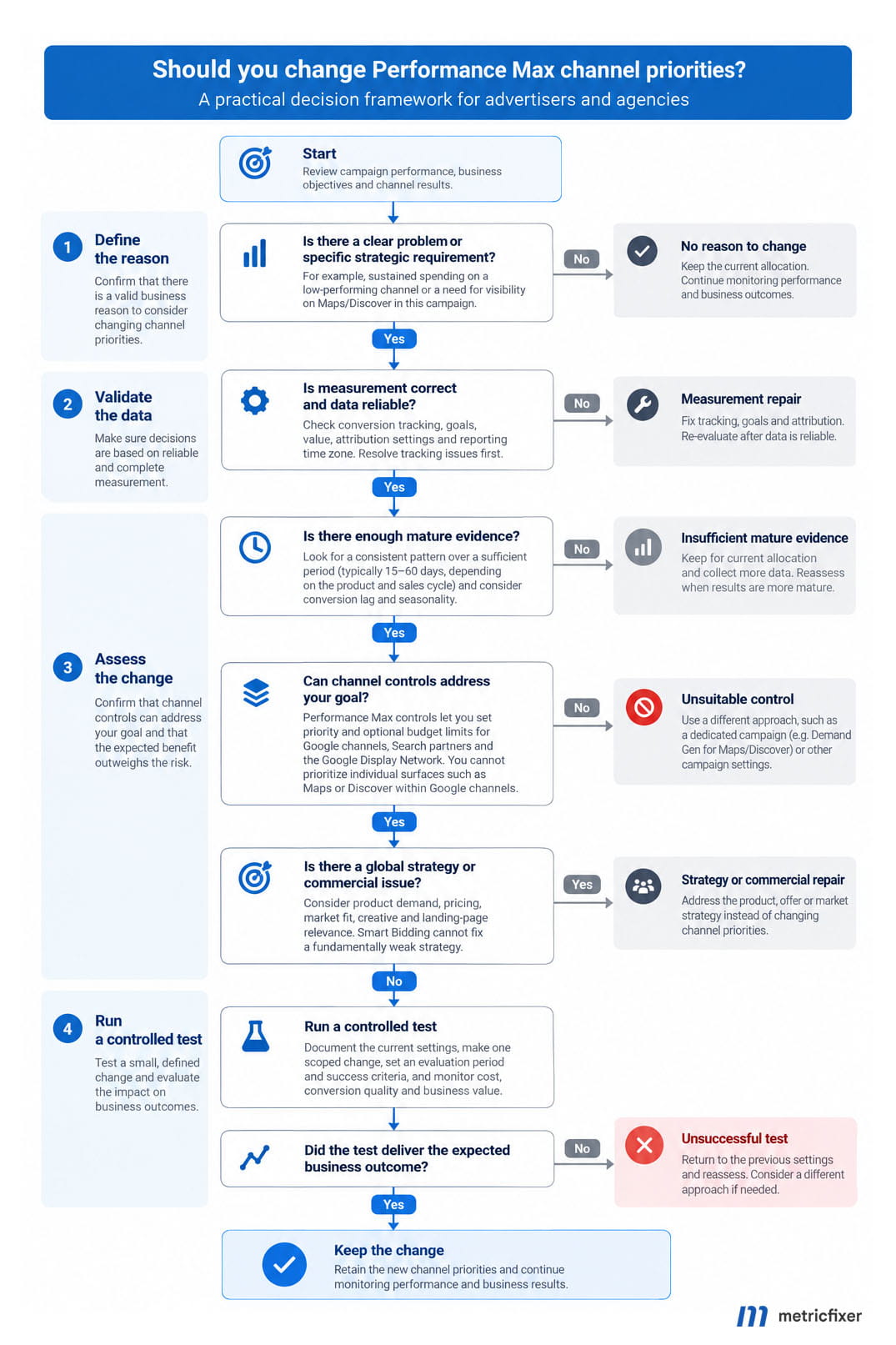
The following is metricfixer's proposed decision process, not a Google eligibility model or a promise that a particular experiment type supports these settings.
Workflow: establish the business objective → verify measurement and effective settings → identify a persistent problem or explicit strategic requirement → confirm the control can address it → record a baseline and risk limits → make one scoped change → evaluate mature business outcomes → retain, reverse, or classify the result as inconclusive.
Before changing settings
- Record the problem, the expected business benefit, and the evidence that would disprove the hypothesis.
- Save the date range, conversion actions, values, bid strategy, targets, budget, effective priorities, and any inherited settings.
- Export channel costs and the relevant outcome metrics; reconcile important sales or leads with the business system.
- Identify promotions, stock changes, tracking incidents, and other changes that could make the periods incomparable.
- Agree on an evaluation date, acceptable downside, stop conditions, and the exact previous settings to restore.
During the test
Start with the narrowest sensible scope. Avoid changing an account-wide default to investigate a single campaign. Do not simultaneously replace creative, change the main conversion goal, raise the budget, and introduce a channel restriction unless the immediate business situation demands it; otherwise, the result will be difficult to interpret.
Separate an operational check from a performance judgment. First verify that the intended setting remains in place and that delivery behaves plausibly. Then wait for enough relevant outcomes to mature. A changed channel mix is evidence that something changed, not evidence that the change helped.
Where an experiment is available, verify what it actually varies. Google's current experiment caveat says custom experiments treat channels on the same priority tier and exclude multi-campaign shared budgets. Do not assume this provides a clean High-versus-Low priority test.
A staged before-and-after comparison can still support an operational decision, but label it correctly. Seasonality, changes in demand, and other concurrent factors remain alternative explanations. Do not duplicate overlapping campaigns and describe the resulting comparison as automatically randomized or causal.
Deciding what to keep
| Observed outcome | Recommended interpretation |
|---|---|
| Better business value at acceptable volume | Retain provisionally and continue monitoring. Record the scope and conditions rather than generalizing to every campaign. |
| A cleaner channel mix, but fewer worthwhile sales or qualified leads | Reverse or revise the constraint. The mix itself was not the objective. |
| Little or no delivery change | Check whether the constraint was relevant or binding before concluding that channel preferences do not matter. |
| Too little mature data or conflicting signals | Call the result inconclusive. Extend only within the agreed risk allowance, or stop without claiming a winner. |
For ecommerce, useful outcomes may include validated purchase value, contribution after advertising, returns, and new-customer economics. For lead generation, they may include accepted leads, qualified opportunities, and closed business. Choose the measures appropriate to the business before the test, not after seeing which dashboard improved.
Implementation limits and the February 2027 Search migration
Several implementation limits deserve checking: Demand Gen has priorities but no allocation percentages; PMax campaigns with total budgets are excluded; supported shared-budget setups require one campaign type. Configure priorities in the client account, not at manager-account level.
Tooling guidance is not fully synchronized. The Help Center still lists API and Editor support as forthcoming, whereas Search Engine Journal's first-hand briefing reported API support at launch. Verify the actual API version, fields, and account behavior before planning bulk changes; do not infer write support from the existence of channel reporting.
The February 2027 change is separate from deciding whether a PMax campaign needs intervention. Google's Display Expansion documentation says Search campaigns using that feature will transition to the new model. To preserve the existing configuration, Google specifies Display at Low priority with a 50% daily allocation.
Google also says Display will stop serving on Search campaigns using Target Impression Share. Treat this as an additional configuration check for affected Search campaigns, not a reason to change a PMax bid strategy.
That is a migration instruction for affected Search campaigns, not a recommendation to allocate half of every PMax budget to Display. Nor does preserving a configuration promise identical future costs or results. Audit the affected Search campaigns separately rather than applying a migration recipe across unrelated campaign types.
Bottom line
Google's new controls are useful because they make some spending preferences explicit and testable. Their value is not that every advertiser should now operate Performance Max manually.
Metricfixer's position remains pragmatic: when default allocation is producing acceptable business results, there may be nothing to fix. When there is a sustained, investigated mismatch, use the relevant control carefully. When the objective is genuinely different, choose a campaign approach capable of serving it. And when the underlying problem is the product, market, offer, or measurement, solve that problem rather than rearranging channel labels.

Methodology and sources
This review was checked on October 25, 2026. Product mechanics were assessed against Google's launch announcement, feature-specific Help Center guidance, and documentation on channel reporting, Results Reporting, Smart Bidding evaluation, Demand Gen channel selection, target-based bidding, and Display Expansion. Sources are linked beside the statements they support rather than repeated in a technical reference list.
The earlier metricfixer article supplies historical context, not evidence that its alpha interface is now generally available. Search Engine Journal's first-hand product briefing helps distinguish the parallel tests and identifies a tooling discrepancy. Practitioner commentary was selected from publicly accessible, self-published professional assessments; it is treated as opinion or proposed practice, not independent proof of effectiveness. Where a commentator's broader wording exceeds Google's documented controls, the documented scope governs this article.
Metricfixer's contribution consists of the account-management observations supplied for this review and six screenshots: five views of one ecommerce report and one settings view from another account. No raw campaign export, complete configuration history, randomized comparison, or defined client cohort was supplied. We therefore report visible values without claiming a measured performance uplift, an optimal allocation, or a population-wide success rate.
The ecommerce reporting period begins before the announced October rollout and ends after it. Without a change history, that timing cannot establish an effect of the new controls. The 15–60-day diagnostic range and the testing workflow are metricfixer recommendations, not Google requirements. Numerical examples outside the screenshot table are illustrative.
This article provides technical and operational information, not a guarantee of advertising performance. metricfixer is not affiliated with Google or the independent publishers cited. Feature availability, interfaces, documentation, and supported campaign configurations may change. Review your own account settings, measurement quality, commercial objectives, and spending risk before making changes. Client screenshots should be published only with appropriate permission and identifying information removed.