
Published Nov 13, 2026
AI Content on YouTube: Disclosure, Monetization and Channel Risk
YouTube does not treat every use of AI the same way. Learn when videos need a disclosure, what makes a channel monetizable, how original Shorts are treated, and how to respond to labels, rights claims and policy decisions.
Category: SEO & Web Marketing · By metricfixer AI Studio
An AI voice, a generated scene and an automated channel are not the same publishing decision. This guide explains when YouTube content needs an AI disclosure, what makes a channel eligible for monetization, how Shorts distribution differs, and what to do when a label, claim or policy decision appears.
Practical starting point: review the finished video, not just the tools used to make it. Check whether it misrepresents reality, whether you have the necessary permissions, and what original value it gives viewers. Treat disclosure, recommendations, channel monetization and individual video earnings as separate checks. Research reviewed: November 12, 2026.
Contents
Executive summary
YouTube does not impose a blanket ban on AI-assisted videos or their monetization. In its official clarification of the July 2025 monetization update, TeamYouTube explicitly said that channels using AI can remain eligible. The change clarified the treatment of repetitive or mass-produced material; it was not a new prohibition on a production tool.
That does not make every generated video acceptable. A useful way to review a proposed upload is to separate five questions:
| Question | What it actually tests |
|---|---|
| Can it stay on YouTube? | Compliance with Community Guidelines and other applicable rules, including impersonation and spam. |
| Does it need an AI disclosure? | Whether realistic generated or meaningfully altered material needs to be identified to viewers. |
| Will it be recommended? | Discovery and audience response, including the specific originality update for Shorts. |
| Can the channel participate in YPP? | Channel-level eligibility for the YouTube Partner Program, including originality and content quality. |
| Can this video earn advertising revenue? | Video-level ad suitability and rights restrictions, not simply whether the channel is monetized. |
These are separate parts of YouTube's Community Guidelines, disclosure guidance, recommendation guidance and advertiser-friendly rules. Passing one check does not establish the outcome of the others.
Older tutorials also miss important developments. YouTube announced more visible labels and expanded automatic detection on May 27, 2026. Its July 16, 2026 Creator Insider explanation discussed more specific monetization categories. An October update concerns original content in the Shorts feed. This article uses those developments alongside the live policy pages, rather than treating the July 2025 announcement as the whole story.
Map AI use before deciding what to disclose
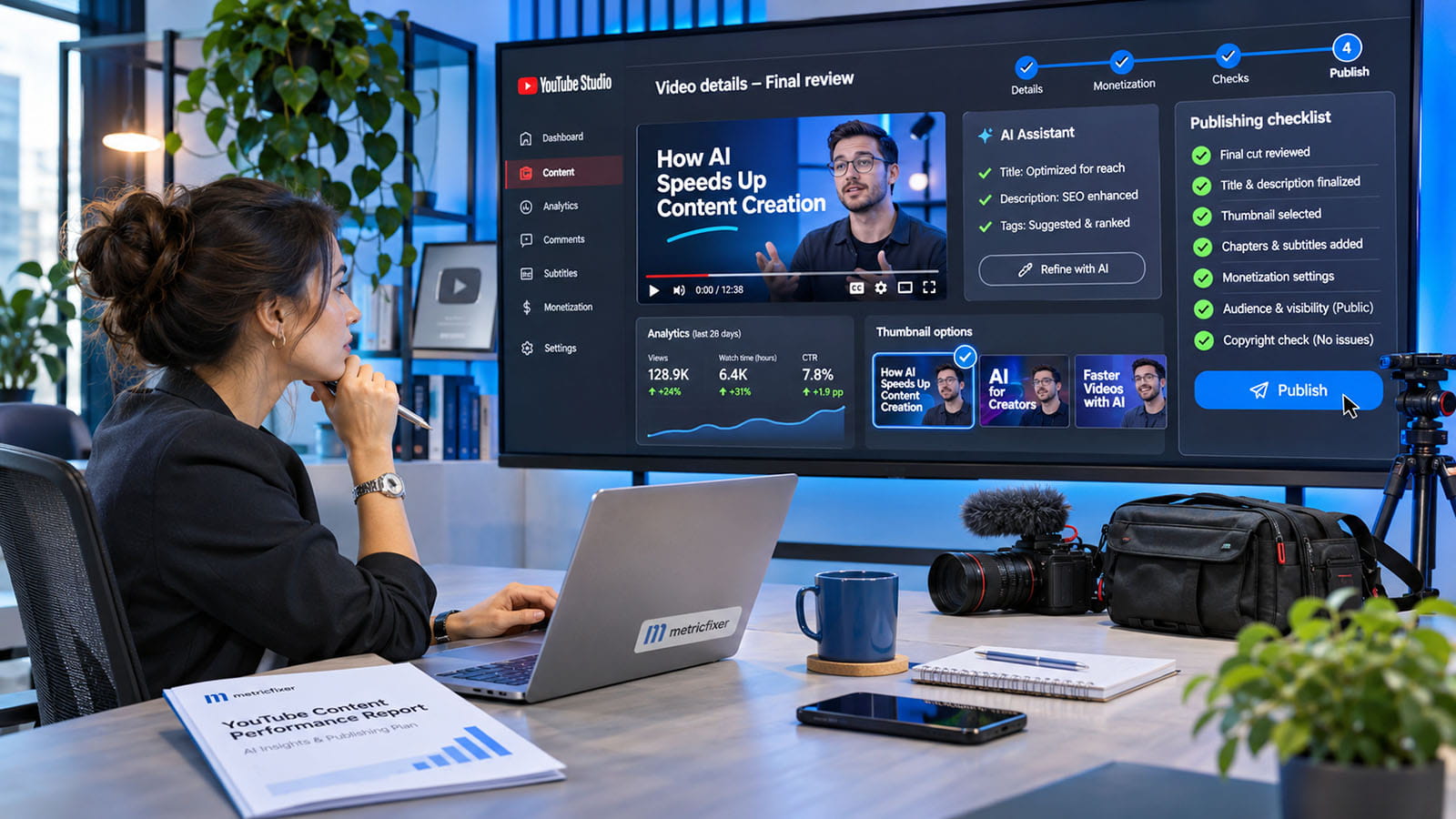
The useful distinction is between production assistance and synthetic material that viewers could mistake for reality. YouTube's original disclosure explanation separates realistic synthetic people, places and events from ordinary editing, obvious fantasy and behind-the-scenes help. The current Help Center supplies additional examples.
The following matrix applies that distinction to common workflows. The last column contains our editorial checks, not a promise of approval or earnings.
| Production scenario | Disclosure position | What to check before publishing |
|---|---|---|
| AI-assisted outline, script, title or captions | Not required for that assistance alone. | Verify facts, quotations and the final meaning of captions. |
| Color correction, sharpening or audio repair | Not required for minor, non-misleading edits. | Check whether the edit changes evidence, not merely its presentation. |
| Clearly fantastical animation | Not required for the unrealistic visuals alone. | Review music, narration and claims separately. |
| Cloning your own voice for narration or dubbing | Listed as an example not requiring disclosure. | This exception does not cover every other element in the video. |
| Realistic synthetic narration or another person's cloned voice | Assess as realistic synthetic audio; do not assume all text-to-speech is exempt. | Check whose identity is implied and whether permission is needed. |
| A photorealistic virtual presenter | Disclose when the generated person appears real. | Do not invent qualifications, personal experience or endorsements. |
| Generated footage of a real location or event | Disclose realistic scenes that did not happen or meaningful alterations. | Identify reconstructions where viewers could otherwise treat them as evidence. |
| AI-assisted thumbnail design | Production assistance alone does not require disclosure. | A misleading thumbnail remains a separate problem. |
| Generated music as the main attraction | The current guidance explicitly requires disclosure. | Check music-specific delivery requirements and permissions. |
The exceptions for your own cloned voice, thumbnail assistance and minor editing come from the current disclosure examples. They are narrow exceptions, not a general exemption for an entire AI-assisted production.
For a borderline voice or presenter, ask what a reasonable viewer would believe they are hearing or seeing. Our recommendation is to disclose realistic synthetic presentation rather than rely on an assumed exemption for a particular voice provider. Do not select an inaccurate answer simply because a creator tutorial says that a tool is undetectable.
Permission is a different question. YouTube's impersonation policy covers deceptive uses of AI likenesses and voices, including false suggestions that somebody owns, authorizes or endorses the content. An AI label does not authorize that deception.
How labels work in Studio and for viewers
Make the disclosure in Studio
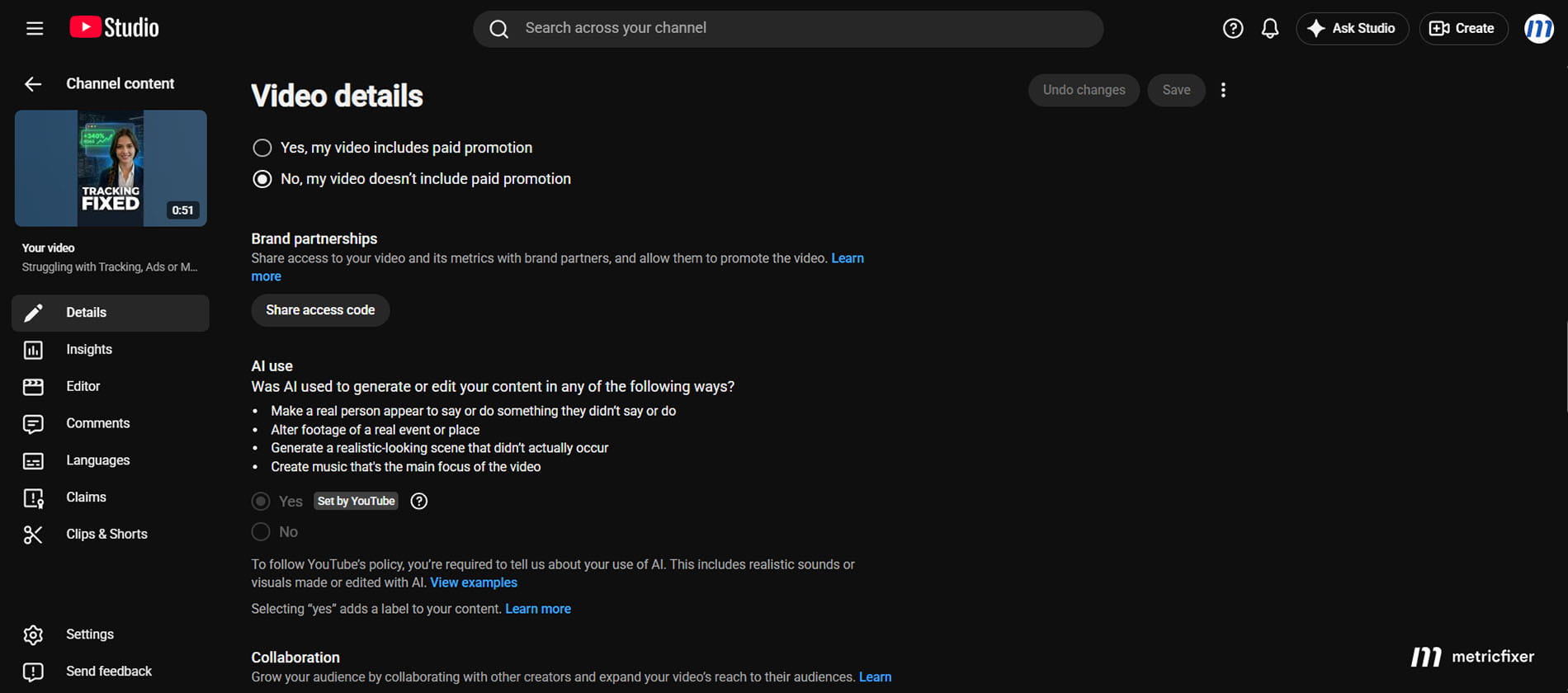
The current upload instructions identify Attributes → AI use. Select Yes when the finished content meets the disclosure requirements and continue through the upload settings. Older guides may call the control Altered content; do not assume an old screenshot matches today's interface.
For an existing upload, open its details from the Content list and review the same disclosure setting. Record the decision and who approved it. A note in the description can add context, but should not replace the required Studio declaration.
Check the viewer-facing label
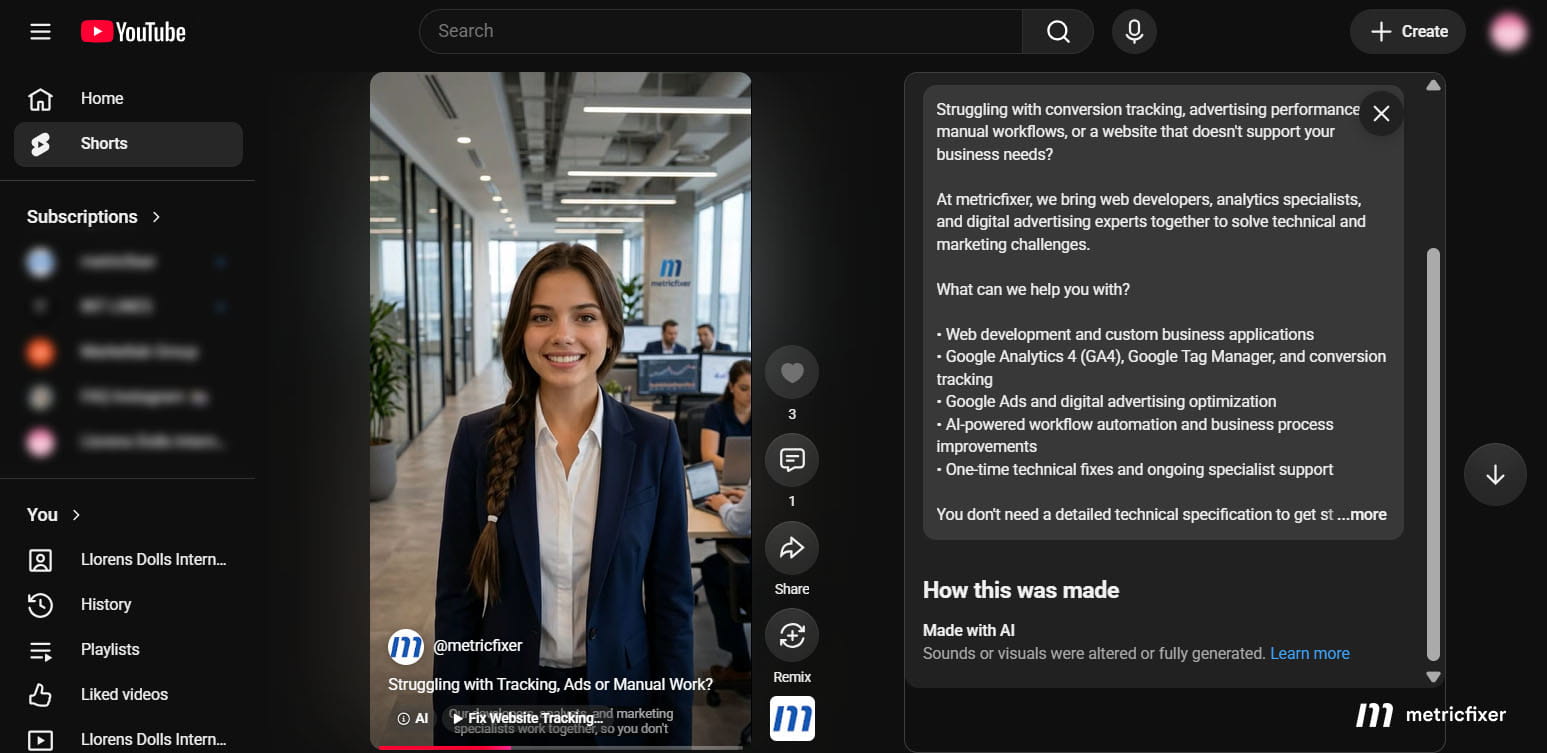
YouTube's May 27, 2026 announcement moved photorealistic AI disclosures below the player for long-form videos and onto the video as an overlay for Shorts. Other disclosure information can remain in the expanded description. The live guidance also distinguishes music and photorealistic content from other audio or animation. Check the actual published presentation rather than promising one label location on every device.
Automatic detection does not remove the creator's responsibility. YouTube can use its own signals, its creation tools and provenance information. Its content-origin guidance explains that secure C2PA Content Credentials version 2.1 or higher can carry forward a declaration that an entire video was AI-generated. A provenance label describes how something was made; it is not a verification of its factual accuracy or permissions.
Correct an inaccurate label without hiding an accurate one
In its May announcement and August 3 follow-up, TeamYouTube describes finding automatically applied labels through Content-list notices and changing the AI-use answer when detection was wrong. Some labels cannot be removed this way: those associated with YouTube's own AI tools, qualifying AI provenance metadata, or manual Trust and Safety review.
Open the notice, identify its basis, and correct the survey only when that correction is truthful. Where the control is unavailable, use the available support route rather than stripping metadata or repeatedly uploading the same file. Keep the source file and a record of the disputed label.
Repeated failure to make required disclosures can lead to labeling, removal or YPP suspension under the disclosure policy. That is different from receiving an accurate informational label.
What makes an AI-assisted channel monetizable
Start with the work viewers receive. A production can involve substantial manual effort and still feel interchangeable with dozens of other uploads. Conversely, using AI to illustrate a carefully researched explanation does not automatically eliminate its original contribution.
The live channel monetization policy identifies several distinct problems:
- Generic or repetitive content: interchangeable templates with little meaningful variation.
- Reused content: republishing existing material without substantial commentary, modification or viewer value. Permission alone does not resolve this monetization issue.
- Unsatisfying or off-putting content: manipulative, incoherent or shock-led production without meaningful substance.
- AI personas on sensitive topics: synthetic personas presented as human experts giving health, legal, financial or political advice. The policy says channels uploading this content cannot monetize.
These are channel-level concerns, not simply labels attached to individual files. Reviewers can examine the channel's theme, important uploads and metadata. The July 2026 Creator Insider explanation also distinguishes Community Guidelines enforcement from the higher requirements for participation in YPP.
Evaluate the contribution, not the tool count
Consider two hypothetical videos about the same software feature. One reads another publisher's article over stock images. The other reproduces the feature in a test environment, explains a failed attempt, compares results and supplies a clear conclusion. Both might use a synthetic narrator. Their editorial contribution is very different.
For our own review, we would ask the producer to identify the contribution in one sentence: We tested these configurations and found this difference, or We created this original story and visual sequence. Then we would check that the finished video actually delivers it. An outline saying "unique content" is not evidence.
TeamYouTube's 2025 clarification specifically distinguishes meaningful additions to reused material from channels whose narrated stories or slideshows differ only superficially. Our practical response is not to abandon every recurring format, but to review whether each episode has a distinct purpose and result.
Be especially careful with synthetic authority
A virtual host describing a fictional world and an invented "doctor" giving treatment advice are not equivalent scenarios. The sensitive-topic category in the monetization rules needs its own review. Do not budget on the assumption that an "AI-generated" caption makes a synthetic expert eligible.
Our recommendation for a professional channel is to keep expertise traceable: identify the real responsible contributor, document the research and avoid giving a fictional presenter invented credentials. For borderline sensitive-topic formats, seek clarification before scaling production, rather than treating the absence of an immediate restriction as approval.
Keep ad suitability and children's content separate
A channel can qualify for YPP while a particular video receives limited or no ad earnings. The advertiser-friendly guidelines assess the whole presentation, including the thumbnail, title and description. Graphic, shocking or otherwise unsuitable material does not become advertiser-friendly because it was generated.
Children's content also has additional quality principles. Confusing narratives, misleading educational claims and inappropriate uses of familiar characters can affect recommendations and monetization. An exemption from AI disclosure for obvious animation is not an exemption from those standards.
Long videos, Shorts, dubbing and music are not interchangeable
The overall content obligations are not confined to long-form video. However, format-specific revenue and rights rules still matter. The Shorts monetization policy excludes ineligible engaged views, including non-original reuploads and compilations without original additions. A large view count is therefore not proof that every view can generate revenue.
Rights can also affect playback differently. YouTube's copyright-claims guidance states that Shorts longer than one minute with an active Content ID claim are blocked, regardless of the claimant's policy. Do not assume that music acceptable in another upload is suitable for the edited Short.
Dubbing deserves a separate quality check. YouTube's automatic dubbing guidance describes translated tracks, an auto-dubbed indication and possible translation or pronunciation errors. Creators can use manual review before publication. Listen to names, numbers, qualifications and safety-related wording in the target language; a fluent voice does not prove an accurate translation.
Uploading a separately prepared language track is another workflow. Multi-language audio allows additional tracks on a single video or Short. It should not be confused with YouTube generating the dub. Review any synthetic voice and the meaning of the translated material on their own merits.
Music now has an additional transparency layer. On October 14, 2026, YouTube Music announced player labels for tracks created primarily with generative AI, with expansion to the main YouTube app. Music partners also have specific delivery declarations. A cartoon music video should therefore not be assessed only by whether its visuals look realistic.
Does an AI label reduce reach?
YouTube says the label alone does not reduce recommendations or monetization eligibility. That position appears in its 2026 labeling announcement. Its recommendation documentation also says AI-made videos can be recommended as broadly as other videos. It describes audience signals such as viewing history, feedback and satisfaction, not a public formula assigning every AI video a fixed penalty.
This is a statement about platform treatment, not a promise of equal performance. Viewers may respond differently to different presentations. A less convincing voice, repetitive story or misleading promise could change their behavior. That is a plausible explanation to investigate, not proof of a hidden AI penalty.
The October Shorts update is specifically about originality
On October 1, 2026, TeamYouTube announced a recommendation update prioritizing original Shorts. Channels mainly aggregating or reuploading other creators' videos without significant additions are likely to receive less Shorts-feed distribution. The post calls for genuine commentary, storytelling or a distinct perspective rather than superficial technical edits.
That announcement is not a blanket prohibition on AI-generated Shorts, and its stated scope should not be silently extended to every recommendation surface. It also does not turn a distribution change into a copyright strike or YPP suspension.
The broader direction is consistent with the January 21, 2026 CEO letter, which described reducing low-quality AI material through systems addressing spam, clickbait and repetition while also developing AI creation tools. A strategic letter still does not disclose an algorithm's weights.
For a practical investigation, compare similar uploads by format, topic, audience and time since publication. Separate Shorts-feed traffic from other discovery sources. Record any actual notices, changes in packaging and changes in production quality. Do not run a "test" by withholding a required disclosure, and do not infer causation from one upload before and one after a label.
What channel-removal headlines actually prove
The widely shared story about CuentosFacianantes and Imperio de Jesus is useful because the evidence developed over time. ARY News reported their disappearance on February 3, 2026, drawing on Kapwing's channel research. A missing channel page by itself does not establish who removed it or why.
The Verge's report, updated February 2, added a YouTube spokesperson's explanation: 11 flagged channels were removed for spam-related violations, one was suspended from YPP, and others were renamed, made private or deleted by their owners. These were different outcomes, not one universal AI ban.
The relevant distinction remains practical. The current spam policy addresses automated or synthetic mass production that floods the platform with minimally changed content, alongside scraping, deceptive promotion and other abuse. Disclosure is not a free pass. At the same time, the policy distinguishes that behavior from simply experimenting with tools or making a few variations.
When reviewing another enforcement story, ask for the dated notice, the specific rule and the scope of the action. Separate a removed video, lost monetization, a renamed account and termination. Treat subscriber counts as scale, not proof of compliance, and estimated earnings as estimates rather than verified payouts.
These historical reports do not provide a complete enforcement file for each named channel or establish its status today. Nor do they justify assigning the same reason to every unavailable AI-related account.
A publishing workflow for creators and brands
A useful review process should leave a short record that another editor can understand. Our suggested production record contains the video's purpose, sources, generated elements, permissions, disclosure decision, responsible reviewer and final published URL. Keep it with the script and project files, not only in a message thread.
- Define the viewer's benefit. State the question answered or the experience offered. Identify the original research, demonstration, analysis or creative work before production begins.
- Map every generated component. Include narration, faces, footage, images, music, translations and thumbnails. Review the final edit: one realistic synthetic segment can change the disclosure decision.
- Verify claims and permissions. Check factual statements against their sources and document rights to inputs, music, voices and likenesses. Review the generator's applicable terms rather than assuming a subscription settles every right.
- Review the series, not only the episode. Compare neighboring uploads. Look for repeated plots, interchangeable scripts, unsupported expert claims and automated publishing mistakes.
- Complete the separate declarations. Make the AI-use decision, identify any paid promotion, set the appropriate audience designation and complete ad-suitability self-certification where applicable.
- Inspect the finished upload. Review available checks, captions, language tracks, metadata, label placement and playback before the planned release. Preserve the approved version.
- Check again after publication. Monitor notices and substantive viewer corrections. Record changes and assign somebody to act on rights, labeling or translation problems.
YouTube warns that upload checks are not final: later claims and other developments can affect a video. A clean initial check should therefore be recorded as a result at that time, not as permanent clearance.
Separate sponsorship from AI disclosure
A sponsored AI-assisted video may need both disclosures. YouTube's paid-promotion guidance requires notification of applicable placements, endorsements and sponsorships, while creators and brands remain responsible for local disclosure obligations. An AI label explains production; a commercial disclosure explains the relationship behind the message.
Buying distribution through Google Ads is outside this article. However, organically uploaded branded content is not outside all advertising rules: YouTube's paid-promotion guidance itself refers to applicable Google Ads policies. The distinction is between reviewing the sponsored video and planning a paid-media campaign.
Likewise, a disclosed synthetic face or voice can still raise a privacy complaint. YouTube's identity-protection process considers identifiable realistic likenesses and several contextual factors. Disclosure is one factor, not automatic permission to use another person.
Publishing the same video on a website creates an additional delivery decision. See our comparison of YouTube embedding, managed hosting and self-hosting. Keep the website copy, transcript and published video aligned when making corrections.
Respond to the actual decision, not a general fear of AI
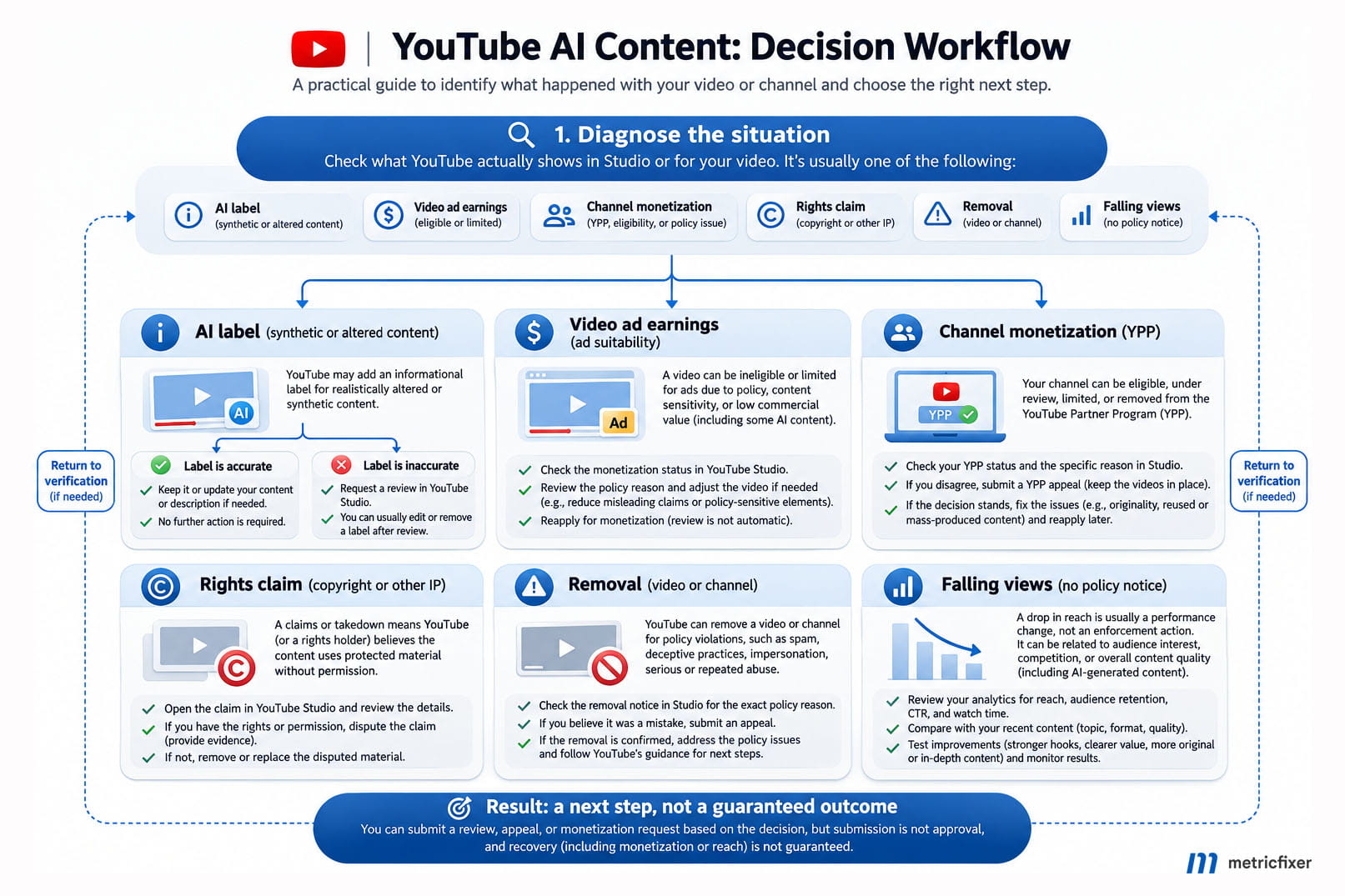
Start in Studio and read the notice. The Content-tab guidance distinguishes informational notices from partial or complete restrictions. It specifically lists detected AI content among informational cases. Save the wording, affected upload, date, available action and deadline before choosing a response.
| What happened | First response | Avoid this mistake |
|---|---|---|
| An AI label appeared | Check whether it is accurate and whether the disclosure is editable. | Treating an informational label as demonetization. |
| One video has limited or no ad earnings | Read the ad-suitability reason and use the available review route. | Assuming the whole channel has been removed from YPP. |
| YPP was rejected or suspended | Read the channel-level reason and decide between appeal and remediation. | Deleting evidence before an appeal. |
| A copyright claim or takedown appeared | Identify which process applies and examine the claimed material and rights. | Treating a Content ID claim as automatically equivalent to a strike. |
| Content or the channel was removed | Read the stated policy and use its appeal process when justified. | Creating another channel to bypass a restriction. |
| Views fell without a policy notice | Investigate traffic, originality and audience response. | Inventing an enforcement reason from the graph alone. |
For video-level advertising decisions, self-certification guidance explains the available human-review process. For rights issues, Content ID claims can track, monetize or block material and are distinct from copyright removals and strikes. Do not submit a rights dispute merely because the file was generated.
Choose appeal or remediation deliberately
YouTube's YPP appeal instructions say not to delete videos before submitting an appeal, because the channel is assessed in its current state. An invited pre-suspension appeal can have a seven-day window; a post-suspension appeal generally has a 21-day window. Follow the actual deadline shown in Studio. A rejected pre-suspension appeal does not create a second appeal opportunity.
By contrast, preparing to reapply after rejection involves reviewing and correcting the channel, including editing or removing violating material where appropriate. Do not combine those two workflows into "delete everything, then appeal."
A useful evidence package should address the cited issue: show the research and production process, explain the contribution across the channel, and provide relevant project files or permissions through the permitted route. A long list of software subscriptions does not explain why the content satisfies the policy.
For a Community Guidelines action, deleting the video does not remove the strike and can prevent an appeal. YouTube's strike guidance also prohibits using another channel to circumvent active restrictions. Keep those procedures separate from a monetization review.
Decision workflow: preserve the notice and evidence → identify whether the issue concerns a label, video earnings, YPP, rights, removal or reach → choose the matching correction, review, appeal or remediation route → verify the recorded result. A submitted request is not a successful outcome.
Audit older videos without destroying appeal evidence
Begin with an inventory, not a deletion campaign. As an editorial priority, review realistic synthetic people and events, sensitive-topic presenters, reused footage, generated music, important language versions and repeated formats. Include high-value library videos even when they are no longer receiving new uploads.
For each video, record a next action: retain, correct disclosure, clarify context, replace a language track, investigate rights, or redesign the format. Assign an owner and save the reason. Where a YPP appeal or other dispute is active, check its evidence requirements before modifying or deleting anything.
Do not exclude translated versions from the audit. YouTube says automatic dubs may also be generated for older uploads. A previously reviewed original does not establish that every later audio version is accurate.
Our suggested cadence is a focused check after a relevant policy or product update, plus a recurring review proportionate to the library's size and risk. The objective is an explainable catalog, not a collection of videos that merely passed one historical upload check.
Methodology and sources
Research reviewed: November 12, 2026. This article prioritizes YouTube Help, official YouTube Blog announcements and posts identified as coming from TeamYouTube employees. It distinguishes current operational guidance from dated announcements, and policy requirements from metricfixer's suggested editorial controls. Source links appear beside the relevant claims rather than in a duplicated reference list.
The supplied CEO letter, monetization page, Shorts discussion and channel-removal report were used as starting points. The Shorts thread was traced to the October 1 official announcement; comments and Product Expert opinions were not treated as platform policy. The enforcement example was checked against the later spokesperson clarification, rather than relying only on the initial disappearance headline.
This is a documentary review, not an experiment on YouTube's recommendation system. We did not access private enforcement files, test YPP acceptance or verify every interface variant in a signed-in account. The examples and workflow are decision aids, not approval guarantees. Screenshot placeholders require real authorized captures; no simulated interface is presented as evidence.
This article provides editorial, technical and operational information, not legal advice or a guarantee of publication, recommendations, monetization or appeal success. Platform rules, interfaces, availability and enforcement can change. Copyright, likeness, consumer-protection and disclosure obligations depend on the material and applicable jurisdiction. metricfixer is not affiliated with YouTube, Google, the creators or the other organizations mentioned.
Expert help with this topic
 AI-Assisted Content Management
Carry out an agreed content plan with AI assistance, human direction, fact checking, editing and controlled publication.
 SEO and Digital Marketing
Choose technical, comprehensive or usability analysis, SEO strategy and coordination, go-to-market research, JSON-LD implementation or managed content work.
 SEO Strategy Implementation Management
 Product Go-to-Market Strategy
Plan product market entry through lawful research, explicit calculations, strategic options and a roadmap with validation checkpoints.